
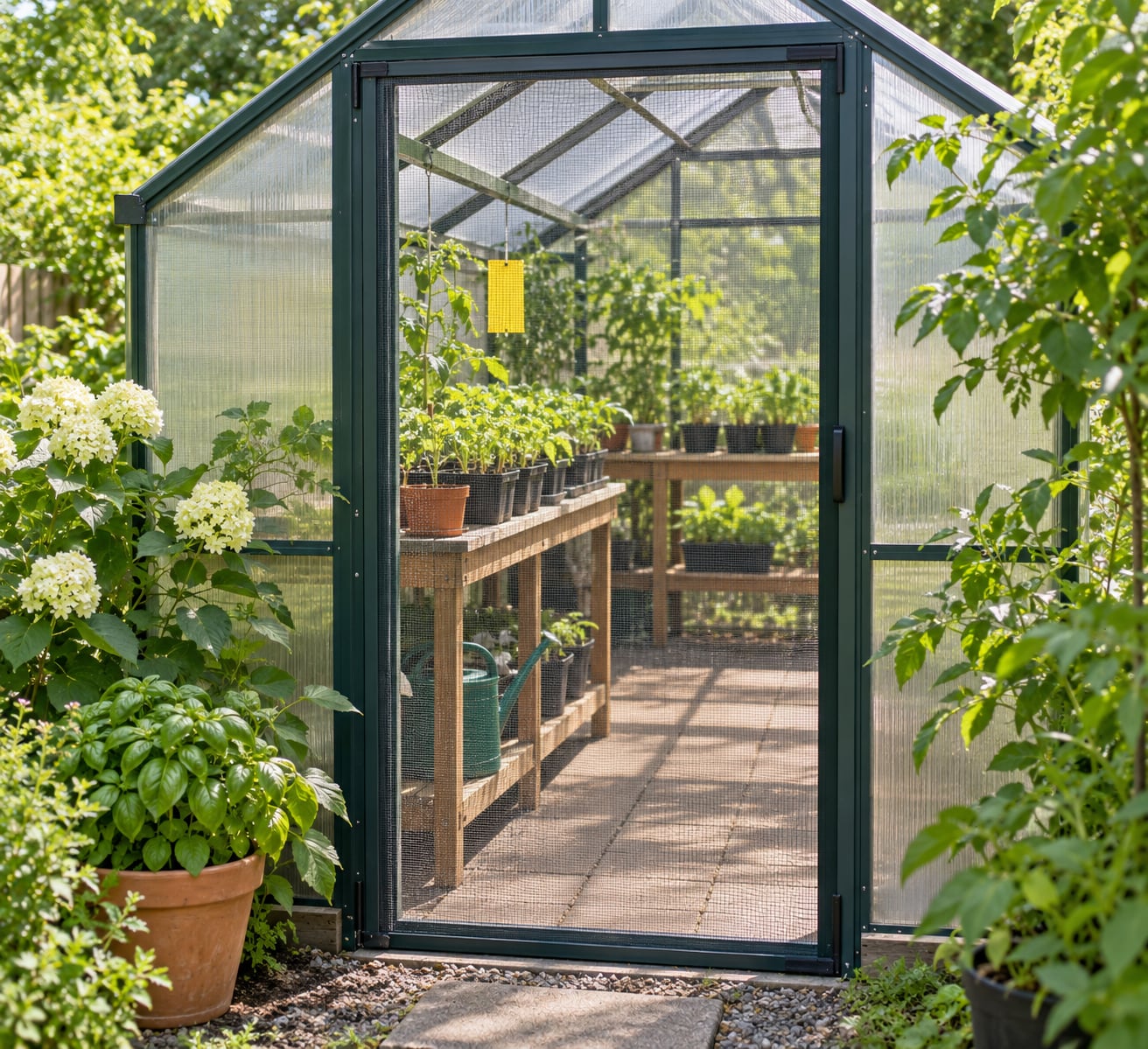
To keep bugs out of a greenhouse you have to close every route in: seal the frame, cover each vent and gap with fine insect screen, hold doors closed, quarantine anything new for a week or two, and clean plant debris off the floor. Add weekly inspections with yellow sticky cards and you catch the handful of hitchhikers that get through before they become an infestation. Most of this is setup work you do once, not a spray schedule you maintain all summer.
The reason a greenhouse needs this level of attention is simple. Inside, it stays warm and humid, there is no wind to knock insects off, and no predator population to eat them. Aphids, whiteflies, spider mites and thrips multiply fast in exactly those conditions, and a single infested plant can take out a whole collection in under a week.
What follows is the system I would build first: the supplies, the six prevention steps in order, and the mistakes that quietly undo all of it.
Table of Contents
- What You Need
- Step-by-Step
- Step 1: Inspect the greenhouse for entry points
- Step 2: Install screens and doors to keep bugs out of a greenhouse
- Step 3: Clean plants, tools, and the greenhouse floor
- Step 4: Monitor plants and greenhouse spaces
- Step 5: Control outbreaks with the least disruptive method
- Step 6: Keep a weekly prevention routine
- Common Mistakes
- Frequently Asked Questions
- What size screen do I need to keep bugs out of a greenhouse?
- Should you open your greenhouse every day?
- How do I stop new plants from bringing pests inside?
- Is Dawn dish soap an insecticidal soap?
- What is the hardest pest to get rid of in a greenhouse?
- How do I get rid of bugs that are already in my greenhouse?
- Conclusion
What You Need

Most of the kit is cheap hardware you buy once. The expensive mistakes are sprays, and a prevention plan means you mostly avoid needing them.
- Fine insect screen. 60-mesh, roughly 0.6mm pore size, for vents and doorways. Go to about 0.145mm if thrips are a problem in your area.
- Door sweeps and weatherstripping. Sweeps for the gap under the door, foam tape for the door frame and for panel seams that flex when the wind moves.
- Silicone sealant and stainless steel staples. For gaps along the base rail, around utility penetrations, and any hole where panels meet the frame.
- Hand lens and a flashlight. A cheap 10x loupe and a penlight find aphids, thrips and whitefly pupae on leaf undersides in seconds.
- Yellow and blue sticky cards. Yellow for flying adults such as whiteflies and fungus gnats, blue for thrips. One card per 100 to 200 square feet, hung at canopy height.
- Pruning shears, a stiff brush and a bucket. Pruning, scrubbing and a soak bath for tools between plants.
- A hose-end nozzle or pump sprayer. For water knockdowns, insecticidal soap, horticultural oil or neem, used only after you have identified the pest.
- Beneficial insects, if you get serious about it. Parasitic wasps for aphids, predatory mites for spider mites, lacewings and lady beetles for soft-bodied pests.
A note on supply sizing: roll screen wider than the vent by a few inches on every side so you can staple a flat, tensioned panel rather than a sagging one. A sagging screen has gaps along the folds, and gaps are what you are paying to close.
Step-by-Step

Run these in order. Each one is cheap on its own, and skipping a step means the ones after it have to work harder than they should.
Step 1: Inspect the greenhouse for entry points
Walk the inside of the structure with a flashlight and look for any path a pest could take. Check the ridge and eave seams, the fasteners holding panels to the frame, the gap under each door, the corners where glazing meets the base rail, the utility penetration for power and water, and any spot where the base rail meets the ground or a concrete foundation.
Daylight is the honest test. Shut the lights off inside on a bright day and look for light coming through joints. Those bright lines are the routes insects use. Also inspect screens for rips, and check that every screen is fastened tightly with no lifting corners.
You will know it worked when the flashlight reveals no light through joints and you can run your hand along any seam without finding a gap wider than a dime. Foam weatherstripping handles moving joints, silicone handles fixed ones, and staples plus tape handle fabric.
Step 2: Install screens and doors to keep bugs out of a greenhouse
Cover every intake with 60-mesh insect screen and staple it flat, then fit a sweep at every door. Vents and ridge vents are the main route in, and an open door during a warm afternoon is an open invitation. If you prop a door or a panel with a brick to get airflow, the screen loses its purpose.
Pore size matters because the mesh has to be smaller than the pest. Here is where the common options land.
| Screen type | Approximate pore size | Pests it blocks | Trade-off |
|---|---|---|---|
| 60-mesh insect netting | 0.6mm | Aphids, whiteflies, most flies, slugs | Good airflow, affordable, the standard choice |
| Thrips screen | 0.145mm (about 145 microns) | Thrips, smallest of the troublemakers | Restricts airflow noticeably and costs more |
| Shade or blackout cloth | 1mm and up | Large flying insects only | Cheap and breathable, but aphids walk straight through |
Airflow is the real cost of fine mesh. Growers get nervous that screens will cook the greenhouse, and that worry is partly earned. The working rule is to give the screen roughly five times the surface area of the free air intake, which is why a screen box built onto the intake end beats a flat panel over the same vent. If a vent is unscreened instead, you have an open highway. Keep an oscillating fan running inside so plants still get air movement across the canopy.
You will know it worked when the door stays shut, the screen has no torn corner, and the fan is running. For a second entry, build a simple airlock: a small screened vestibule or a rack of hooks outside the door so you can leave dirty outerwear there instead of carrying it in.
Step 3: Clean plants, tools, and the greenhouse floor
Sanitation removes the food and shelter pests need once the structure is closed. Sweep the floor weekly, clear fallen leaves and dead plant material out of the beds, pull weeds inside and immediately around the structure, and empty any standing water in saucers or trays. A three-foot band of bare, weed-free ground around the greenhouse cuts down on the weeds that harbor insects and whitefly pupae all season.
Tools move pests between plants. Scrub pruners, wash hands, and wipe the bench between a suspect plant and a healthy one. Run pots and trays through a soapy water scrub before they go back into the greenhouse, and wipe condensed water off glazing where algae and fungus gnats start.
A floor of bare concrete or washed paving removes a hiding place that a dirt floor gives leafminers and slugs. If you have a dirt floor, rake it smooth and let it dry out between waterings.
You will know it worked when a weekly sweep finds almost nothing on the floor and no weeds are growing within a foot of the base rail.
Step 4: Monitor plants and greenhouse spaces
Monitoring early beats treating late, and it is cheap. Hang yellow sticky cards at canopy height, one per 100 to 200 square feet, and check them weekly against a clean card you keep aside so you can see the change. Cards tell you a pest is active and roughly where, even when you cannot identify it by eye yet.
Then do a hand check with a hand lens on leaf undersides and stem joints, where aphids, thrips and whitefly nymphs actually sit. Look at the newest growth first, since soft tissue is what they prefer. Crawl under the benches at night with a flashlight; slugs, cutworms and caterpillars hide there and rarely show up in daylight.
Watch the record, not just the plants. Which crop, which bench, how many, and when. Two weeks of notes tells you which corner of the greenhouse is the source, which is more useful than any spray.
You will know it worked when you find one or two pests before you find clusters, and when a card that was busy last month comes back nearly clean.
Step 5: Control outbreaks with the least disruptive method
Identify the pest before you treat it, because the treatment changes completely. A miticide does nothing for an insect, and a broad spray kills the predators that were helping you. Here is the quick reference for the usual suspects.
| Pest | Damage signs | Where to look | First move |
|---|---|---|---|
| Aphids | Curled yellow leaves, sticky honeydew | New growth, stem tips | Water spray knockdowns, then insecticidal soap |
| Whiteflies | Yellowing, clouds of tiny white adults on disturbance | Leaf undersides, white nymph scales | Yellow sticky cards, horticultural oil on undersides |
| Spider mites | Fine stippling, webbing, bronzed leaves | Undersides, hottest and driest corners | Raise humidity and airflow, then predatory mites or miticide |
| Thrips | Silver streaks, black specks of droppings, distorted flowers | Flower buds and new growth | Blue sticky cards, thrips screen, remove affected flowers |
| Fungus gnats | Small flies around soil, algae on the surface | Overwatered soil, standing water | Let soil dry, sticky cards, beneficial nematodes in soil |
| Mealybugs | White cottony blobs, sticky residue | Stem joints, leaf axils | Dab individually with alcohol, then follow with soap |
| Leafminers | Winding pale trails inside leaves | Leaves, and any soil surface below | Remove mined leaves, eliminate the soil surface they drop to |
Work up this order: physical removal first, then biological control, then a targeted low-toxicity spray. A hose blast knocks aphids off a plant, and in an enclosed greenhouse many never find their way back. Growers on the gardening forums also mix a few drops of dish soap into a quart of water for residue, which is cheaper than buying a bottle.
For anything that spreads, remove the heavily infested plant and bag it rather than leaving it on the bench. For oils and soaps, follow the product label for rate, timing and edible-crop intervals, and spray the undersides where the pests sit. Skip the spray entirely when temperature climbs, since oils and soaps can scorch foliage in heat and direct sun.
If you release beneficials, remember they cannot be stored, so two or three releases through the season usually beat one. Lady beetles and lacewings handle many soft-bodied pests within about a week. Then confirm they are surviving: a card count or a hand lens check will show whether the release stuck or whether something ate it.
You will know it worked when trap counts fall and new growth comes in clean for two consecutive weeks.
Step 6: Keep a weekly prevention routine
A repeatable hour on the same day each week is what keeps a greenhouse pest-free. Copy this list into your notes and tick as you go.
- Check screens for rips and lifting staples; replace any panel with a hole.
- Test the door sweep and confirm doors stayed shut since your last visit.
- Read every sticky card against your clean reference card and note the count.
- Hand-lens check leaf undersides on the worst-performing bench first.
- Inspect any new or returning plant before it joins the main area.
- Sweep the floor, empty saucers and trays, pull weeds inside and out.
- Scrub tools and wipe the bench between benches.
- Run the fan and confirm airflow across the canopy, not just at the ceiling.
- Check relative humidity and vent a damp morning, since above 85 percent invites fungal problems and soft-bodied pests.
- Log what you found and what you did, so next season starts with data instead of guesswork.
Keep daytime temperatures near 65 to 75 degrees Fahrenheit, avoid overcrowding, and space plants so air can move between them. Stressed, crowded plants attract pests and slow down any biological control you release.
In the off-season, an empty greenhouse that can hit freezing kills a large share of overwintering eggs for free. Where winters are mild, leave the structure closed, sealed and empty until spring, and clear it of all plant debris first.
Common Mistakes
Most infestations trace back to one of these. Each has a straightforward fix.
Mesh that is too coarse. 1mm shade cloth stops big flies and nothing else. Aphids are roughly 0.5 to 1mm and slip through coarse openings, and thrips are far smaller. Use 60-mesh at 0.6mm as a floor, and finer still for thrips.
A propped door or an unscreened vent. One open panel undoes every hour of sealing work, and warm afternoons are exactly when people prop the door. Keep the sweep in good shape and build a screen box so you can ventilate without an open gap.
Overcrowding and still air. Plants packed shoulder to shoulder trap humidity and give pests a continuous leaf surface to walk across. Space plants and run air movement so leaves dry between waterings.
Looking only at the top of the plant. Most pests that matter in a greenhouse sit on leaf undersides and stem joints. Two minutes with a hand lens underneath prevents most of what a full spray program would have tried to cure.
Spraying before identifying. Growers on the forums report more burned plants than stubborn pests. A miticide aimed at aphids wastes a day and a dose, and broad-spectrum sprays kill the lacewings and parasitic wasps doing free work.
Skipping entry hygiene. Clothes, hair, tools and pets carry pests in from the yard, and a dog that sleeps in the greenhouse is a mobile distribution system. Go to the greenhouse before the outdoor garden, change outerwear, brush your hair and leave pets outside.
On companion plants: marigolds, basil, chives and mint are pleasant in a greenhouse and pleasant to pollinators, but they are not a barrier. Growers who expect a pot of marigolds to hold off an aphid colony are disappointed, so treat them as a minor addition rather than a control method.
Frequently Asked Questions
What size screen do I need to keep bugs out of a greenhouse?
Use 60-mesh insect netting, about 0.6mm pore size, on every vent, door and opening. That blocks aphids, whiteflies, most flies and slugs. Thrips are much smaller and need roughly 0.145mm mesh, which costs more and cuts airflow, so give it a screen box with about five times the surface area of the free intake. Cover the door with a sweep and keep it latched.
Should you open your greenhouse every day?
Yes, ventilating is healthy, and opening the door is where screening programs fail. The door itself stays shut while you are inside. Instead, ventilate through screened intakes, and build an airlock vestibule if you need frequent access. If you need to prop something open, use a screened port with a removable flap rather than a bare panel.
How do I stop new plants from bringing pests inside?
Quarantine anything new away from your established plants for 7 to 14 days, ideally in a separate room or a screened holding area. Inspect it first with a hand lens, focusing on leaf undersides, stem joints and the soil surface. Keep it out of the main airflow, water it separately, and if you spot pests treat it there before it moves in.
Is Dawn dish soap an insecticidal soap?
It works, and growers use it, but it is not the same product. Insecticidal soap is a specific formulation of potassium salts of fatty acids, refined to a controlled concentration that will not burn leaves. Dish detergent can work as a knockdown for aphids at a few drops per quart, but test a leaf first and never spray in heat or direct sun.
What is the hardest pest to get rid of in a greenhouse?
Most growers will tell you spider mites, and thrips right behind them. Both hide in crevices and on leaf undersides, both reproduce fast in warm dry conditions, and both hide from broad sprays while the mites keep feeding. They also arrive hitchhiking on new plants. Finer screening, higher humidity, airflow and repeated predator releases work better than a single heavy spray.
How do I get rid of bugs that are already in my greenhouse?
Start by removing heavily infested plants and bagging them rather than composting them. Then identify what you have, use yellow cards for whiteflies and fungus gnats and blue cards for thrips, and choose a matching treatment. Water knockdowns and insecticidal soap handle aphids, horticultural oil reaches whitefly nymphs, and predatory mites work on spider mites. Recheck weekly and record counts.
Conclusion
Start at the structure, because that work holds for years. Seal the seams and base rail, fit 60-mesh screen over every vent, add a door sweep, and clear a weed-free band around the greenhouse.
Then set the habits that keep it clean: sweep the floor weekly, quarantine new plants for one to two weeks, hang sticky cards at canopy height, and look at leaf undersides with a hand lens. Treat what you find by identifying it first, and you will rarely need a spray at all.


