
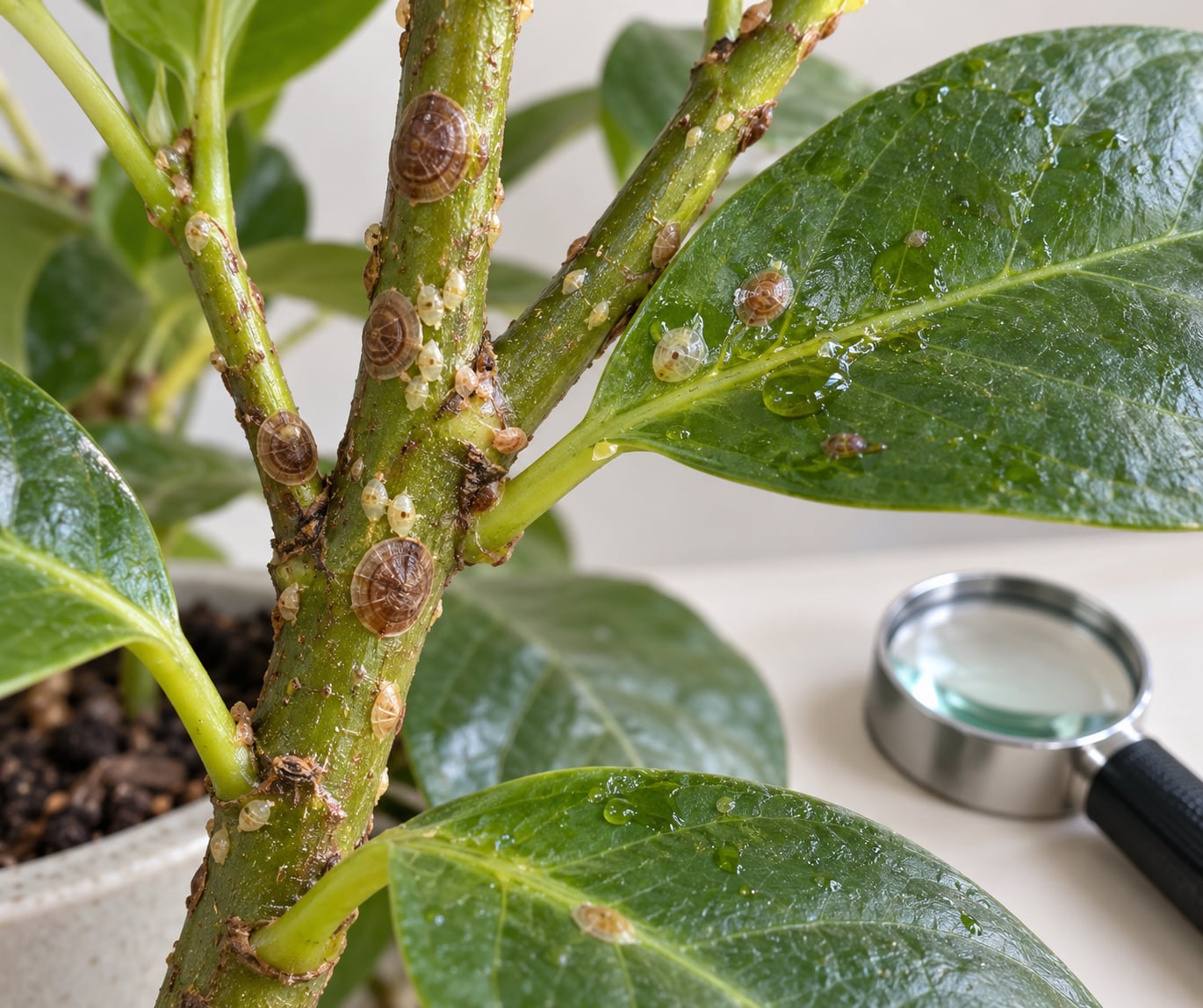
Scale insects on plants identification almost always comes down to one thing: a bump that does not move. These tiny sap-sucking insects hide under a waxy, shell-like cover and attach themselves to stems, leaf undersides, branches, and fruit, so they look like part of the plant until you scrape one and find the body underneath. Most infestations are confirmed in under ten minutes with a hand lens, a white card, and your fingernail.
This guide is written for US homeowners and indoor plant growers. You will find where to look, how armored scale differs from soft scale, what the common look-alikes are, and how to run the scrape and crush tests that tell you for certain whether you are dealing with scale.
Table of Contents
- Scale Insects on Plants Identification: Quick Clues to Check First
- What Do Scale Insects Look Like on Plants?
- Armored Scale vs. Soft Scale: What Is the Difference?
- Where Do Scale Insects Hide on Plants?
- What Bugs Look Like Scale Insects?
- What Damage Do Scale Insects Cause on Plants?
- Which Plants Commonly Get Scale Insects?
- How to Confirm a Scale Insect Infestation
- How to Control Scale Insects on Plants
- When Is a Scale Infestation Serious?
- Frequently Asked Questions
- Conclusion
Scale Insects on Plants Identification: Quick Clues to Check First

Scale insects belong to the superfamily Coccoidea in the order Hemiptera, the same group as aphids and whiteflies. Adults are immobile: they settle once, insert a needle-like mouthpart into plant tissue, and feed on that spot for weeks. The waxy covering they produce is what you actually see, and that is why scale gets overlooked for so long.
Most scale are between 1/16 and 1/8 inch long, somewhere between a pinhead and a match head, though a few soft scales reach a small pea. Use this quick-reference table while you inspect a plant.
| Clue | What scale looks like | What it tells you |
|---|---|---|
| Body shape | Flat, hard, shield-like, or a rounded dome you can see the outline of | Armored scale is flat and rigid; soft scale is rounded and collapsible |
| Color | White, tan, yellow, brown, gray, or a mottled pattern; sometimes nearly translucent | Color narrows the field but does not confirm on its own |
| Mobility | Does not move when tapped; only pinhead-sized pale crawlers shuffle away | Immobile adults mean sap-sucking injury is underway |
| Honeydew | Sticky film on the leaf or surface below, sometimes dotted with black sooty mold | Honeydew means you have a soft scale, not an armored one |
| Plant damage | Yellowing, leaf drop, twig dieback, sticky residue on windows or floors | Damage shows up weeks after the infestation was established |
Scale Insects on Plants Identification Checklist
Run through this list in order when you suspect scale. It takes one focused pass and settles most cases.
- Look in sheltered growth points. Check leaf undersides, midribs, leaf axils, stem joints, and the crotches where branches meet the trunk. Scale rarely sits in open light on the top of a leaf.
- Tap the plant over a white card. Hold a plain white index card or sheet of paper beneath the branch and tap it lightly. Bumps that fall onto the card are much easier to see, and pale moving specks mean crawlers are active.
- Scrape one bump with a fingernail. A soft scale smears and leaves a colored residue on your nail. An armored scale feels hard, and the cover lifts off cleanly like a tiny lid.
- Crush it on paper to check for life. Squeeze the scale onto a tissue. A wet, juicy streak means it is alive. A dry, dusty mark means it is a dead shell still attached to the plant.
- Look for honeydew and sooty mold. Check surfaces below the plant, including windowsills and floors. Sticky film with black speckling is a strong clue, and no armored scale makes it.
- Inspect several areas, not one. A single clean leaf does not mean a clean plant. Check at least five growth points on two different plants before you declare a space scale-free.
- Compare with the look-alikes. Mealybugs carry visible cottony filaments, aphids cluster and move quickly, whitefly nymphs are translucent flat discs, and natural buds or lenticels do not scrape off.
What Do Scale Insects Look Like on Plants?

What scale looks like depends on the family. Armored scale insects (Diaspididae) cover themselves with a thin, waxy layer that hardens into a flat shield, often with a lighter spot in the center where the cover split as the insect grew. The body underneath stays protected, and the whole thing reads as a small tan or brown patch stuck to the leaf or twig. Common examples on houseplants are the brown armored scale, which shows up on ficus and dracaena as flat, slightly raised oval bumps.
Soft scales (Coccidae) look rounder and more three-dimensional. Their body is a dome covered in a soft, olive to brown waxy layer, and it often looks like a small bead of varnished sap stuck to a stem. When you press one, it dents and smears. Brown soft scale (Coccus hesperidum) clusters along stems and leaf veins of citrus, hibiscus, and indoor plants, sometimes so densely that stems look like they have been dipped in caramel.
Egg masses change the look again. Cottony cushion scale (Icerya purchasi) leaves conspicuous white, ridged cottony sacs roughly the size of a match head on twigs, and cottony maple scale (Pulvinaria innumerabilis) produces long white jelly-like egg sacs that stick out from under a brown scale. Mealybugs look similar from a distance, which is why the checklist above includes a check for cottony filaments standing proud of the body.
Newly hatched scale are the hardest to see. These first-instar nymphs, called crawlers, are pale yellow, roughly the size of a period on this page, and they move for a few days before settling permanently. A hand lens or the camera on your phone zoomed in is often the difference between seeing them and guessing.
Armored Scale vs. Soft Scale: What Is the Difference?
The distinction matters because the two types behave differently and honeydew only appears with soft scale. You do not need a microscope to sort them; a fingernail and a paper towel will do it.
| Feature | Armored scale (Diaspididae) | Soft scale (Coccidae) |
|---|---|---|
| Profile | Flat, thin, shell-like, sits nearly flush with the leaf or bark | Rounded dome, visibly three-dimensional |
| Cover behaviour | Hard shield lifts off intact, often with the pale scale body still beneath it | Cover is part of the body, so it crushes and smears |
| Honeydew | None | Copious, sticky, and often covered in black sooty mold |
| Ants | Generally not attracted | Often attended, because ants feed on the honeydew |
| Typical hosts | Euonymus, oleander, cycads, orchids, citrus, magnolia, indoor ficus and palms | Citrus, hibiscus, camellia, indoor plants, maples and many fruit trees |
| Plant risk | Severe when heavy, but no sticky fallout | Faster decline because feeding and sooty mold compound each other |
| Contact sprays | Shield blocks most contact products | Oil and soap work better, especially on crawlers |
One practical note from university extension programs: some species are essentially harmless on a vigorous plant, and treatment choice can change the pest you end up with. Broad-spectrum systemic insecticides, including imidacloprid, have been linked to flare-ups of cottony cushion scale and other species that are less defended by natural enemies. Identifying at least to the soft-versus-armored level is a good reason to look for a local extension resource before spraying anything systemic.
Where Do Scale Insects Hide on Plants?
Where scale hides is predictable, and once you know the list you can check a whole plant in a couple of minutes. Leaf undersides come first, especially along the midrib and the main veins. Leaf axils, where the petiole meets the stem, are a favorite because they stay sheltered and moist.
Next come the junctions: branch crotches, nodes where leaves were shed, and the underside of stems. Bark ridges and the base of petioles matter on woody plants. Fruit is worth checking too, and citrus growers often find scale on the fruit surface and in the calyx end.
Indoors, concentrate on leaf undersides near the soil line, along midribs, and at the joints where several stems meet. Windowsills collect scale from outdoor trees, and the wall or sill below the plant is often sticky before the plant itself shows any damage.
A light infestation stays localized and the plant looks healthy for weeks. Population growth along a stem is the signal that it has moved past that stage, because scale rarely spreads far on its own. It arrives by wind, by insect, or by you, then crawlers walk to new growth.
What Bugs Look Like Scale Insects?
Most misidentifications come down to a bump you cannot move. These are the common impostors and how to separate them during a close inspection.
- Mealybugs. Oval, soft-bodied, and covered in white cottony filaments that stand out from the surface like tiny whiskers. They cluster in leaf axils and stem joints, and they move when disturbed. Scale has no loose filaments.
- Aphids. Soft, pear-shaped, and present in groups along new growth. They move constantly and often have wings. Aphids also cast white skins, which can look like tiny flakes scattered on a leaf.
- Whitefly nymphs. Flat, translucent, pale green or yellow discs sitting flat against the underside of a leaf. They are easy to crush and leave no shell. Their scale-like appearance is the reason they get flagged as scale so often.
- Psyllid lerps. Small, brown or white, hood-shaped shells built by tiny jumping insects, often on eucalyptus and ficus. A lerp is attached at one point and looks like a miniature tent, and beneath it you may find the insect rather than a scale body.
- Spider mite eggs. Round, translucent, and about the size of a grain of salt, usually on the underside of leaves near the midrib. They do not scrape off with a fingernail and they sit in fine webbing.
- Fungal structures and natural plant bumps. Lichen, leaf scars, lenticels, dormant buds, and variegation patterns all mimic scale at a glance. These are part of the plant: they do not lift off, they do not smear, and they do not appear suddenly in a week.
The fastest way to settle it is the scratch test. Scrape the bump. If something comes away with the cover, it is scale.
What Damage Do Scale Insects Cause on Plants?
Damage comes from two directions, and only one of them is obvious. Feeding damage is slow and quiet. A scale insect taps into the vascular tissue and drains sap continuously, so the plant is losing resources long before anything looks wrong. Yellowing leaves, a general loss of vigor, and slow new growth are the first hints.
As feeding continues, leaf drop, twig dieback, and distorted growth show up. On a badly infested plant, branches can die back from the tips, and a plant that declines despite correct watering and light is often carrying a scale problem nobody looked for. Plant death is possible, but it takes a heavy, long-running infestation on a stressed plant.
Honeydew damage is far more dramatic and much easier to trace. Soft scales excrete sticky sugar as they feed, and it lands on leaves, stems, windowsills, floors, and sometimes parked cars nearby. That film is why homeowners sometimes first notice scale from the sticky mess rather than the insects. Black sooty mold fungi then grow on the honeydew, blocking light and making leaves look dirty.
Ants are a related clue. Ants feed on honeydew and will patrol a plant heavily, and in doing so they can defend scale from the parasitic wasps and lady beetles that would otherwise control it. If ants are visiting your plant constantly, look closely underneath them.
Which Plants Commonly Get Scale Insects?
Indoors, the usual hosts are ficus and rubber plants, dracaena, palms, schefflera, monstera, fiddle leaf fig, orchids, cacti and succulents, and most nursery potted plants that came in from a greenhouse. Orchids and succulents get armored scale, while ficus, citrus, hibiscus, and gardenia tend to get soft scale.
Outdoors in the US, oleander, magnolia, euonymus, camellia, citrus and other fruit trees, roses, palms, cycads, and evergreen shrubs are common hosts. Cottony maple scale on a maple or silver maple in the Northeast, magnolia scale on southern magnolias, and oystershell scale on willow and dogwood are all routine encounters.
Some plants simply suit scale better than others, and that is not something you control. What you can control is plant stress. Plants that arrived from a nursery already carrying scale, plants moved outdoors for the summer and brought back in, and plants sitting in dry, hot, cramped conditions tend to attract them. Overfertilizing with lots of soft growth is also associated with heavier infestations, since new growth is tender and scale favors it. I would not call that the cause, but it is a fair explanation for why the same plant gets hit twice in one season.
How to Confirm a Scale Insect Infestation
Confirmation takes five minutes once you know what to do. Isolate the plant first, away from the rest of your collection, so a single decision does not turn into a house-wide problem. Then work through the checklist: sheltered growth points, white card tap, scrape test, crush test, honeydew check.
Use the white card properly. Hold it under the branch, tap the stem with a pencil or your finger, and look at what lands. Adult scales fall cleanly and stay put. Crawlers scatter. A single card tap that produces a dozen specks on white paper is far more convincing than squinting at a dark green stem in a dim room, and it takes almost no effort.
The crush test settles the alive-versus-dead question, which matters more than most people expect. A dead armored scale keeps its shield and looks identical to a live one for months, so many growers treat a plant that is already clean and then wonder why nothing changed. Squeeze the scale onto a paper towel or tissue. A wet, colored streak means it is feeding. A dry, powdery mark means it is an empty shell, and those can be flicked off.
To judge severity, count and spread matter more than size. A handful of bumps on one branch of a large, vigorous plant is light. Scales running along a stem in a line, bumps on multiple branches, new growth that is wilting, and honeydew on the surface below all point to a widespread infestation that needs a full protocol rather than a spot treatment.
How to Control Scale Insects on Plants
Once scale is confirmed, work in this order. Skipping the early steps is why so many people report that treatment worked for a few weeks and then failed.
- Isolate the plant. Move it away from other plants. If it came in recently, keep it separate for two weeks while you inspect it repeatedly.
- Remove what you can reach. Dab individual bumps with a cotton swab soaked in 70% isopropyl alcohol, or slide a fingertip along the stem to crush and dislodge them. Masking tape wrapped around the stem picks up domes and the crawlers around them. Manual removal is genuinely effective on light infestations and it buys you time.
- Wash off the honeydew. Wipe leaves and stems with a damp cloth, and clean the sticky film from windowsills and floors. This does not kill anything, but it removes the sooty mold food source and tells you how heavy the feeding is.
- Prune out infested sections. On outdoor shrubs and trees, cut out heavily colonized branch interiors where you cannot reach with a swab. Bag and discard the material rather than dropping it under the plant.
- Treat crawlers with a labeled product. Horticultural oil and insecticidal soap are the usual choices for indoor plants, applied to leaf undersides, midribs, and stems until it runs off. Oils and soaps work by suffocating the insect, which means the crawler stage is the vulnerable one. Follow the label exactly, test a leaf or two first, and never apply in full sun or when temperatures are high.
- Repeat on a schedule. Expect three to four applications spaced about 7 to 10 days apart to catch successive crawler waves. One spray is rarely enough, and this is the single most common reason people give up on scale.
- Control ants and protect natural enemies. If ants are farming your scale, deal with them, or the scale keeps coming back. Parasitic wasps, lacewings, and lady beetles do real work in outdoor plantings, so avoid broad-spectrum pyrethroids that wipe them out and can trigger spider mite outbreaks.
A few home remedies get asked about constantly, so here is the honest version. Dish soap or Dawn in soapy water is a surfactant, and surfactants help an oil or soap product wet the surface. Plain soapy water alone is weak against a waxy cover, and dish detergent formulas vary, so if you use one, treat it as a wetting aid rather than a treatment. Vinegar on foliage can burn leaves, and it does not reach scale hidden under a shield. Neem oil is a real option for edible plants when used according to its label, though its reputation for clearing scale overnight is not deserved; plenty of growers have used it and still been fighting the same infestation weeks later. For edible crops, always follow the product label for harvest intervals, and never mix oil with sulfur or apply either near a sulfur application.
Timing matters because of the life cycle. Adults are protected and largely unreachable by contact products, while crawlers are exposed and mobile. Systemic products and oils applied at the right stage work far better than repeated spraying of armored adults.
When Is a Scale Infestation Serious?
A scale problem becomes serious when the plant is declining despite correct care and the population keeps growing. Warning signs include spreading bumps along multiple stems, heavy honeydew with sooty mold, repeated leaf drop, branch dieback from the tips, and new growth that comes in small and distorted. Ants constantly working the plant is another sign that you have a scale population big enough to be worth food.
Serious does not automatically mean hopeless. A heavily infested plant can often be saved by cutting back hard, removing the visible scale, and following a repeat-treatment schedule for a month. Many growers on plant forums describe rescuing plants they were about to toss, so do not discard on sight.
Removal is a reasonable call when the plant is declining fast, when scale has reached the main trunk and most of the canopy, or when you cannot realistically inspect and treat it every 7 to 10 days for a month. Bag the plant, including the soil and the tray, rather than composting it. Leaving an infested plant in a pile near healthy stock just relocates the problem.
For anything outdoors and larger than a shrub, contact your local extension office. They can identify the scale species from a sample, which matters because some species are harmless and because the right control differs between armored and soft scales. Getting that answer before you spray usually costs one email.
Frequently Asked Questions
Are scale insects bugs?
Yes. Scale insects are in the order Hemiptera, the same order as aphids, whiteflies, and cicadas, and the superfamily Coccoidea. Adults are motionless sap-suckers with piercing mouthparts, which is why they look like plant parts rather than insects. They are not spiders or mites, and they are not parasites of people or pets.
Can scale insects come back after treatment?
They often do, and it is usually biology rather than failure. Adult armored scales are shielded from most contact sprays, and eggs hatch in overlapping waves, so a second and third crawler generation arrives after your first treatment. That is why repeat applications every 7 to 10 days matter, and why untreated plants nearby keep reseeding the infestation.
What is the white fluffy stuff on my plant?
White cottony or waxy material is usually one of three things: mealybug filaments, which stand out from an oval soft body; an egg sac from a soft scale such as cottony maple or cottony cushion scale; or a psyllid lerp shell. Mealybugs move when touched, scale egg sacs are firmly fixed and sit under a brown dome, and lerps look like tiny hoods.
Do scale insects live indoors?
Yes, and indoor plants are among the most common hosts. Scale usually arrives on a new plant from a nursery, on a plant that spent a summer outdoors, or on clothing and tools. Because crawlers are mobile for a few days after hatching, one infested plant can spread to its neighbors, which is why isolation and a two-week inspection of new purchases matter.
Should I remove a plant with a severe scale infestation?
Not automatically. Plenty of heavily infested plants recover after a hard prune, manual removal of the visible scale, and repeated treatments for a month. Removal makes sense when scale has reached the main trunk and most of the canopy, when the plant is failing fast, or when you cannot inspect it every 7 to 10 days. Bag the plant and its soil rather than composting it.
What is the best treatment for scale insects on plants?
The most reliable approach is a combination: remove accessible scale by hand, then apply a labeled horticultural oil or insecticidal soap to leaf undersides, midribs, and stems, repeating every 7 to 10 days for a month to catch each crawler wave. No single application clears an established infestation. Finish by controlling ants, which otherwise protect scale from its natural enemies.
Conclusion
Start with one move: isolate the plant, then check leaf undersides, stems, branch crotches, and fruit for attached bumps, sticky honeydew, or black sooty mold. That ten-minute routine gives you a confirmed answer and tells you whether scale insects on plants identification has landed you on armored scale, soft scale, or something else entirely.
Take a white card under a branch and tap it, scrape one bump to see whether it smears or its shell lifts off, and crush it on a tissue to see if it is alive or an empty shell. Every control decision after that gets easier, because you now know which type you are dealing with and whether the crawlers are still moving.


