
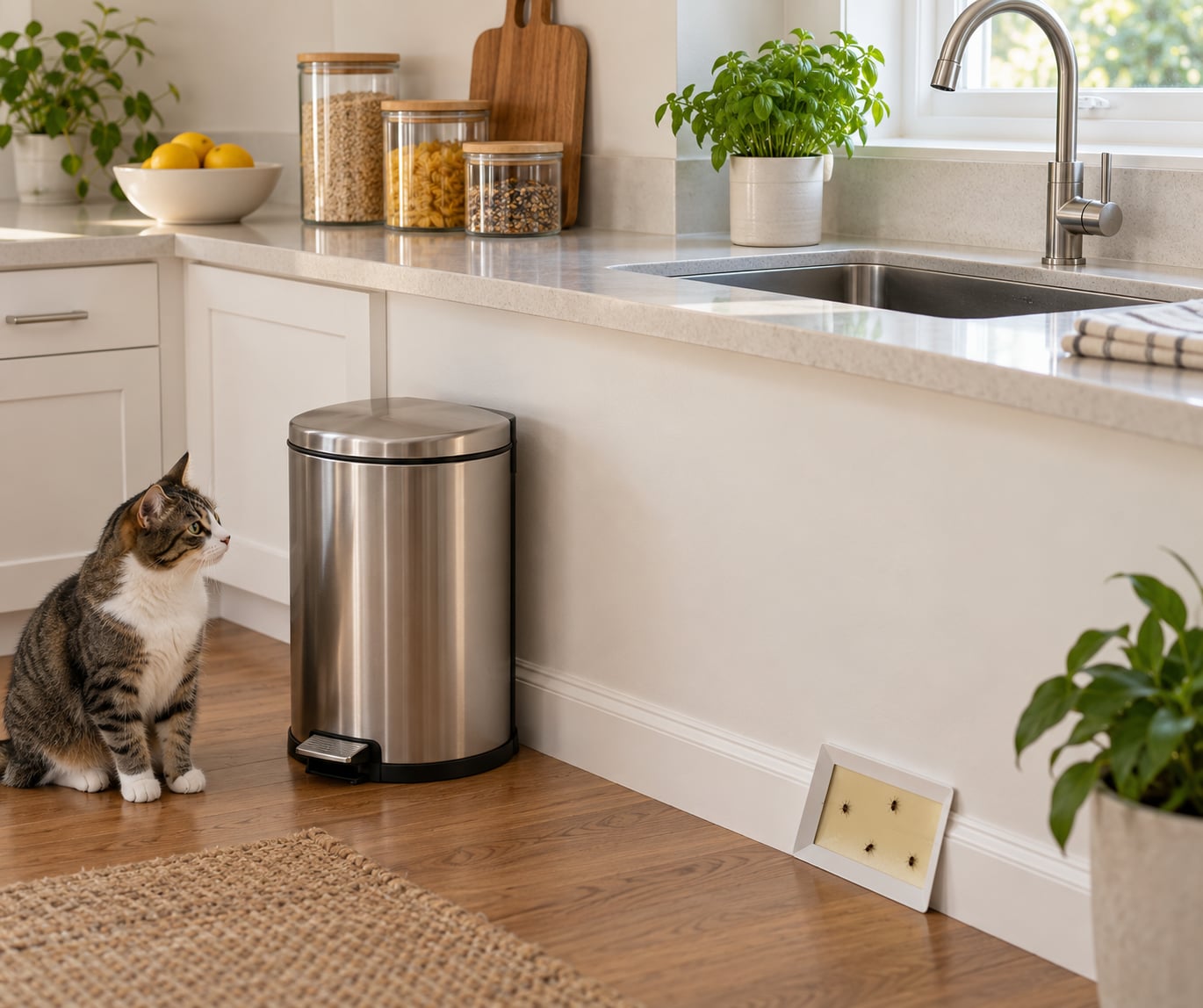
The safest way to get rid of bugs in a house with pets is to identify the pest first, remove the food, water, and shelter it depends on, keep your animals away from anything you treat, and then use a product labeled for that specific pest and for use around pets. Most of the work is preparation and prevention rather than spraying.
A cat sitting next to a cockroach and a mouse in the wall are two different problems, and treating them the same way is how people end up with a sick pet and an infestation that came back. This guide walks through pet safe pest control methods for a home in the order that actually works, starting with identification and ending with sealing entry points.
One thing to clear up first: “natural” does not mean “safe.” Concentrated essential oils such as tea tree, eucalyptus, and peppermint can cause serious respiratory and skin problems in cats and dogs, and indoor foggers leave pesticide residue on bedding, toys, and bowls where animals spend hours.
Table of Contents
- What You Need Before You Treat
- Step-by-Step Pet Safe Pest Control Methods
- Common Mistakes That Put Pets at Risk
- Frequently Asked Questions
- How do I get rid of bugs in my house without harming pets?
- What is the best indoor pest control safe for pets?
- Is diatomaceous earth safe for pets?
- Which pest control products are dangerous for cats?
- How long after pest control treatment is it safe to let pets back in?
- When should I hire a professional pest control company instead of doing it myself?
- Conclusion
What You Need Before You Treat
Gather your supplies before the first sighting gets worse, because most of the items are ordinary household supplies rather than specialty products.
- The correct product for the identified pest. Look for the specific pest on the label, and check that the label permits use in homes with pets and children.
- Gloves, soap, and clean water for your hands and any skin you expose during application.
- Sealed food containers and a bin with a tight-fitting lid so nothing edible is accessible during treatment.
- Ventilation. Open windows and run a fan while you apply anything with a label drying time, then ventilate until the odor clears.
- Identification aids such as a magnifying glass, a sealed container or tape sample, a flashlight, and sticky traps or monitors to confirm where the activity is coming from.
- A way to keep pets out of treated areas — a closed door, a baby gate, a crate in another room, or a laundry hamper with a lid for bait stations.
- A notebook or phone notes for dates, product names, and sighting counts so you can tell whether a treatment worked.
Read the entire label before you open anything, not just the front. The label tells you the pest it controls, where it may be applied, whether pets may re-enter, and how long surfaces stay wet. Follow those directions exactly, and never combine two products unless both labels allow it.
Keep the ASPCA Animal Poison Control line (888-426-4435) and Pet Poison Helpline (855-764-7661) saved in your phone. If your pet licks a treated surface, chews a bait station, or shows drooling, vomiting, tremors, or breathing trouble, call a veterinarian or one of those lines right away rather than waiting to see what happens.
Step-by-Step Pet Safe Pest Control Methods

Step 1: Identify the Pest and Choose a Pet-Safe Treatment
Match the treatment to the pest, because a product that works on one insect can be completely useless against another.
Look at four things: what the insect looks like, where you see it, when it appears, and what you find around it. Ants travel in trails to a food source, so wipe a trail with a damp cloth and follow it back to the entry point. Roaches hide in warm, dark, damp spots and scatter when you flip on a light. Fleas show up as itching, usually near the ankles or the base of a tail, and you may find pepper-like droppings in bedding or on pets. Mosquitoes are only active around dusk and dawn and breed in standing water. Spiders stay in corners, ceilings, and undisturbed boxes. Termites show up as mud tubes on exterior brick or wood, or wings dropped near a window. Bed bugs leave rust-colored spotting on a mattress seam and bite in a line or a cluster of three.
Choose a product labeled for that pest. A flea and tick treatment meant for dogs is not a cat product, and many are dangerous to cats. Keep in mind that not every sighting needs treatment: most spiders indoors are harmless and eat pests, so sealing cracks is a better response than spraying.
Step 2: Remove Food, Water, and Shelter
Cleaning is the part most people skip, and it is often the part that actually ends the problem.
Put food in sealed containers rather than an open bag on the counter, take trash out daily in a bin with a lid, and wipe grease and crumbs off stovetops. Run the dishwasher or wash the sink and dry it fully, because cockroaches need both food and water. Store pet food in a sealed container and wipe the bowl after every meal.
Then take away shelter. Vacuum carpets, rugs, and sofa cushions, and empty the vacuum immediately into a sealed bag. Clear storage bins, move stored items off the floor, and leave a gap so you can see behind appliances. Reduce standing water in plant saucers, buckets, birdbaths, and wading pools. Check and repair window and door screens, and tighten door sweeps.
When the food supply is gone, many small infestations stop growing before you ever apply a product.
Step 3: Protect and Separate Your Pet During Treatment
Move animals out of the room before you treat, and keep them out until the label’s drying and re-entry time has passed. “Dried to the touch” is not the same as “safe,” especially for a small animal that grooms a treated surface.
Move dogs, cats, and puppies or kittens into a closed room or a crate in a separate part of the house. Move birdcages out of the room entirely — birds are extremely sensitive to sprayed products and to fumes, and no bird should share a space with a freshly treated floor. Cover or remove aquariums and remove food and water bowls rather than covering them, because a cover traps residue near the surface.
If you cannot relocate a pet, choose a different method for that area. Crack-and-crevice application into gaps behind appliances, inside wall voids, and along baseboards keeps pets from walking through treated residue. Keep bait stations inside locked cabinets or behind appliances, not in open floor areas where a curious pet can chew them.
Step 4: Apply the Treatment Correctly
Apply only what the label allows, and apply it where pests actually travel rather than across open surfaces.
Bait stations work by letting ants and roaches carry material back to the colony, so place them along trails and near entry points and leave them undisturbed. Insect growth regulators stop juvenile insects from developing into adults and work best applied in cracks, crevices, and under appliances, but they take weeks to show results. Low-toxicity spot treatments such as insecticidal soap or horticultural oil need direct contact with the insect and must be sprayed to the point of runoff on the target, not as a fine mist in the air.
Never spray over an open aquarium, never treat food-preparation surfaces where pets can walk or eat right after, and never use a product labeled only for outdoor use inside your home. Skip foggers and bug bombs indoors with pets; they leave residue in places you cannot easily reach and are poorly effective against hidden pests.
Step 5: Monitor, Reapply Only When Permitted, and Prevent Return
Check whether the treatment worked using the same tools you used to find the problem. Put out sticky monitors along walls and behind appliances and count new catches weekly, and note sightings by date and location.
Success looks like fewer sightings each week rather than zero sightings after one day. If activity continues at the same level after a full label cycle, the usual causes are an entry point you have not sealed, a second nest, or a pest that needs a different product — not a need for more spray. Reapply only on the label schedule, never sooner and never on more surfaces than the label lists.
Seal what you found. Fill cracks wider than a quarter inch, stuff the gaps around plumbing penetrations and vents with steel wool and caulk, fit door sweeps and weatherstripping, and add mesh screens over vents. In the yard, remove standing water, keep vegetation off the foundation, and store pet food and trash in sealed containers so wildlife is not drawn to your house.
Common Mistakes That Put Pets at Risk
Almost every emergency I hear about starts with one of these.
Using a product that was never labeled for pets
Dogs-only flea and tick products containing pyrethroids can be acutely toxic to cats, and some are dangerous to fish and birds as well. Fix: read the species on the label before you buy, and if a product does not name cats or dogs explicitly, ask your veterinarian.
Assuming natural means harmless
Tea tree, eucalyptus, and peppermint oils are toxic to cats and dogs when concentrated, and pets can show respiratory distress and skin irritation after a diluted spray is used in a closed room. Homeowners on pest forums have reported cats sneezing repeatedly after a peppermint spray went up. Fix: skip essential oils around pets entirely, or ask your vet about a product formulated for them.
Spraying without identifying the pest
A general-purpose spray applied across a kitchen accomplishes nothing against a nest in the wall and puts residue where your dog walks. Fix: identify first, treat second.
Mixing insecticides
Mixing a bleach-based cleaner with an ammonia or vinegar-based insect product can create toxic gas, and combining two insect products can cause an overdose through a pet licking a treated surface. Fix: use one product at a time, read labels, and never combine products unless both labels say it is allowed.
Ignoring drying and re-entry times
Letting a pet back into a treated room “when it looks dry” is the most common re-exposure error. Fix: follow the label’s stated drying and re-entry intervals, and keep in mind that a damp mop or a humid day extends wet time.
Using household products as pesticides
Bleach, ammonia, drain cleaner, and turpentine are not insecticides, and a pet that walks through a dried puddle of any of them can get sick. Fix: leave household cleaners out of pest control entirely.
Failing to remove food, water, and entry points
Even a correctly applied product fails if ants keep finding a food source and a new trail leads back inside. Fix: complete Step 2 before you treat, and redo it weekly during an active infestation.
Two habits cover most prevention. Seal entry points every few months, and empty standing water weekly in warm weather. Pet owners on pest forums also report that food-grade diatomaceous earth dusted lightly along a wall base works well, but only when pets stay off the carpet until it has settled, and that cinnamon sticks or a coffee-ground line at an ant entry point is a harmless extra barrier.
Frequently Asked Questions
How do I get rid of bugs in my house without harming pets?
Start by identifying the pest, then remove its food, water, and shelter before applying anything. Move pets out of the room, keep them out until the label’s drying and re-entry time has passed, and treat cracks and entry points rather than spraying open surfaces. Never use a product not labeled for your species of pet, and skip indoor foggers, which leave residue on bedding and bowls.
What is the best indoor pest control safe for pets?
For most indoor pests, the safest effective tools are mechanical and physical ones: sealed food containers, a lidded trash bin, sticky monitors, snap or live-catch traps placed out of reach, and sealing cracks with caulk and steel wool. When a product is needed, choose one labeled for the specific pest and for use around pets, and apply it in cracks and crevices instead of across floors where animals walk.
Is diatomaceous earth safe for pets?
Food-grade diatomaceous earth is low in toxicity, but it is a lung irritant for people and pets alike. Apply only a thin dust along baseboards, under appliances, and in dry cracks, and keep dogs and cats off treated carpet and floors until the dust has fully settled, which can take several hours. Never use pool or garden diatomaceous earth, which is not food grade and can be dangerous if eaten.
Which pest control products are dangerous for cats?
Cats are the most sensitive household pet, mainly because they groom themselves and walk low to the ground where residue settles. Avoid products containing pyrethroids such as permethrin, which are highly toxic to cats even in small amounts. Avoid concentrated essential oils such as tea tree, eucalyptus, and peppermint, and keep cats out of any treated area until the label’s re-entry time has fully passed.
How long after pest control treatment is it safe to let pets back in?
Follow the drying and re-entry times printed on the label rather than how dry the floor looks. Most indoor sprays and spot treatments require several hours of ventilation before pets return, and some products specify a longer window. Keep in mind that humidity, a wet mop, or heavy rain outdoors can extend wet time. If the label is missing or unreadable, wait longer and call your veterinarian for advice.
When should I hire a professional pest control company instead of doing it myself?
Call a licensed pest professional when the pest is structural, such as termites, or when you see evidence you cannot reach, like a nest inside a wall. Bed bugs, severe cockroach infestations, and rodents in the attic or walls also call for professional equipment and follow-up. Choose a company that uses integrated pest management and can explain which products it plans to use and the re-entry interval before any work begins.
Conclusion
The safest first moves in any order are the same: identify the pest, remove the attractants, get the pets out of the way, use only a product labeled for that pest and for your species of pet, and monitor with traps and a written log so you know whether it worked. None of those steps require the strongest product on the shelf, and most infestations shrink considerably once the food and entry points are gone.
If a pet may have ingested or inhaled something, call your veterinarian or the ASPCA Animal Poison Control line at 888-426-4435 without delay. For infestations that persist after a full label cycle, involve a rodent, or touch the structure of the house such as termites or suspected bed bugs, call a licensed pest professional and ask how they keep pets safe during treatment.


