
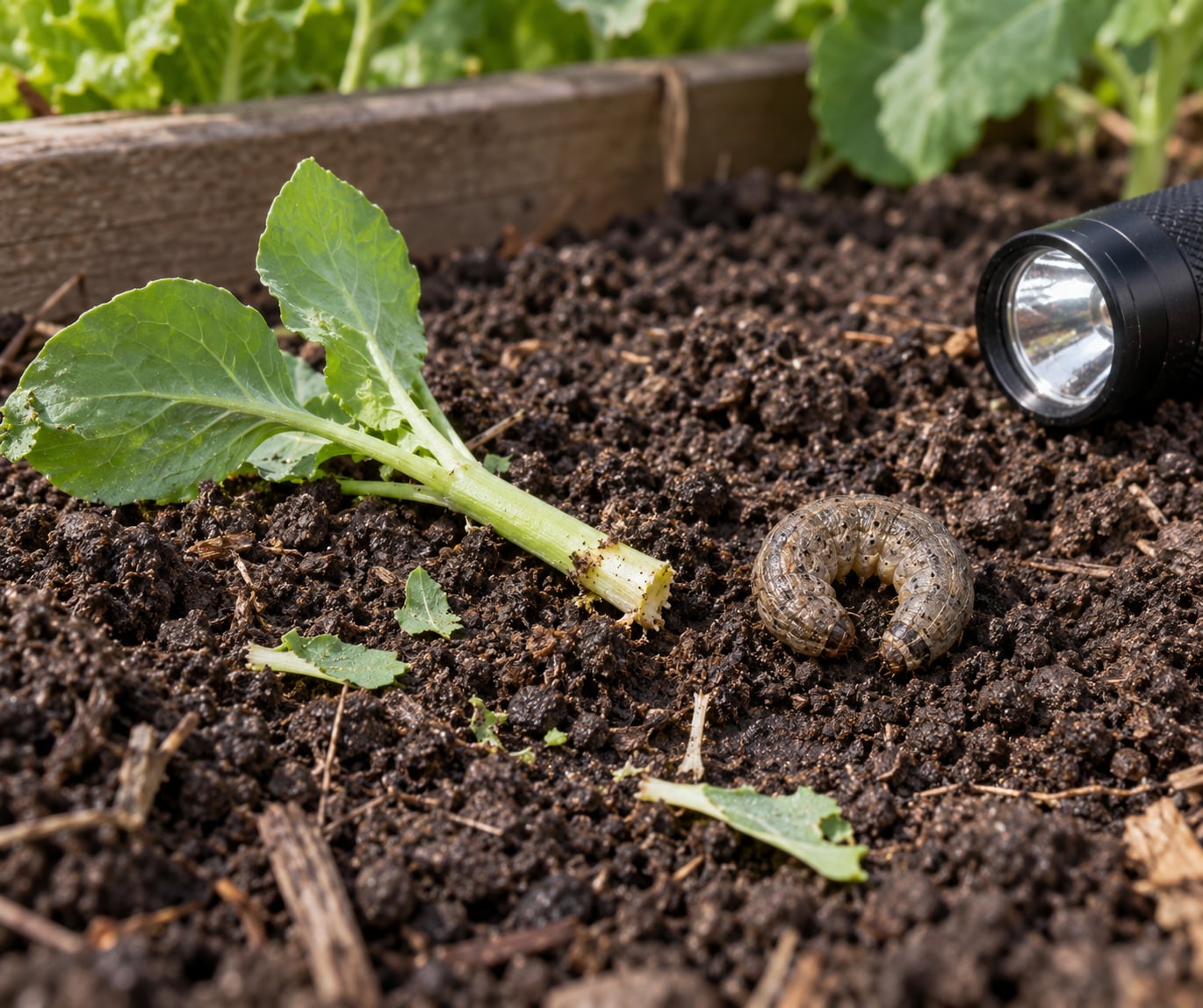
Cutworm damage in a garden identification comes down to one detail: a seedling or transplant stem cut cleanly at or just above the soil surface, with the leafy top lying on the ground beside an upright stub. Cutworms are caterpillars, not worms, and they hide in the soil by day and feed at night. Most gardeners lose a row of brassicas or tomatoes in a single evening and never see the culprit, so the fix is a dusk patrol with a flashlight rather than a spray can.
This guide covers what the damage looks like, how to confirm cutworms are actually the cause, what to do the night you find them, and how to keep it from happening to the next planting.
Table of Contents
- Cutworm Damage in a Garden Identification: Quick Guide
- What Does Cutworm Damage Look Like?
- How to Tell Cutworms Apart From Other Garden Pests
- Where Cutworms Hide and When They Feed
- How to Find a Cutworm in Your Garden
- How to Stop Cutworm Damage
- How to Protect Seedlings After an Attack
- When Cutworm Damage Is Not the Problem
- Frequently Asked Questions
- Conclusion
Cutworm Damage in a Garden Identification: Quick Guide

If you want the short version, work down this list. Cutworm damage in a garden identification is usually confirmed in under five minutes once you know where to look.
- Stems severed flat at the soil line, with the top still green and intact a few inches away.
- Plants that wilt in the sun but look fine again in the morning, then collapse for good.
- Small irregular holes in leaves, or ragged patches where leaves were chewed through.
- Rounded pellets of frass, insect droppings, near the base of damaged plants.
- No slime trail, which is the fastest way to rule out slugs and snails.
- A smooth larva, one to two inches long, curled into a tight C when you disturb it.
- Damage that shows up overnight and gets worse night after night.
| What you see | Likely cause | Check next |
|---|---|---|
| Stem cut flat at soil level, top on the ground | Cutworm | Search within 12 inches at dusk |
| Missing tops, shiny slime trails, holes in fruit | Slug or snail | Look under boards and mulch at night |
| Many tiny round shot holes in leaves | Flea beetle | Shake a leaf over white paper |
| Ragged bites to leaf edges, caterpillar droppings on leaves | Cabbage looper or worm | Check leaf undersides for larvae |
| Whole plants pulled or bitten off, torn foliage | Rabbit or deer | Look for droppings and rub marks |
| Whole seedling wilted, stem still intact | Watering, frost or disease | Dig up and inspect the root |
Cutworm damage in a garden identification: three checks that settle it
Run the stem, the ground and the timing in that order. Pull one damaged plant and look at the cut: a smooth, flat stub means chewing, not wilting. Dig gently around the base within a foot and sift for a smooth larva that curls into a C, and check for frass pellets. If a clean cut, a larva and new damage all appear within a day of each other, you have your answer. Anything less consistent, and you are probably chasing slugs, a watering problem or damping-off instead.
What Does Cutworm Damage Look Like?
The signature injury is a clean cut. A cutworm larva grips the stem near the surface and works through it, which leaves a smooth, flat stub rather than a ragged tear. The severed top usually stays green for a day or two, so it is easy to miss in mulch.
Other patterns show up depending on when the larva feeds:
- Wilt before collapse. Plants hit just below the soil line lose contact with water, droop in midday heat, and often recover overnight if the stem is only partly severed.
- Holes in older leaves. Young larvae chew the leaf surface before they are big enough to cut stems, leaving irregular holes you might mistake for flea beetles.
- Surface vegetables. Lettuce and leafy greens can be found face-down on the soil with the stem nibbled through at the base.
- Tunneling in turf. In lawns, blades are cut at the base and dragged toward small burrows, and the holes may be lined with frass.
Brassicas, lettuce, tomato transplants, peppers, celery, carrots, corn seedlings and most flowers are hit hardest because the stems are tender and the plants have no stored reserves.
How to Tell Cutworms Apart From Other Garden Pests
The confusion almost always comes down to slugs. Cutworms leave no slime trail, and they hide by day, while slugs chew at night too but leave a shiny trail behind them. Flea beetles make neat round shot holes; cutworm holes are ragged and irregular.
| Pest | Damage pattern | Evidence left behind |
|---|---|---|
| Cutworm | Stem cut off cleanly at soil level, missing tops, wilted plants | C-shaped larva, frass pellets, no slime |
| Slug or snail | Ragged holes in leaves and fruit, seedlings chewed at the base | Shiny slime trails, feeding at night, hiding under debris |
| Flea beetle | Numerous tiny round shot holes, speckled seedlings | Small dark beetles that jump when disturbed |
| Cabbage looper | Large ragged holes in brassica leaves | Green looping caterpillars, green droppings on leaves |
| Rabbit or deer | Plants pulled up, stems nibbled, foliage torn | Droppings, rub marks, tracks at the bed edge |
| Cutworm look-alikes | General collapse with no cut stem | Brown or mushy roots, frost damage, dry soil |
If a stem is too thick for a small larva to have cut, you are probably looking at animal damage, wind or hail rather than cutworms.
Where Cutworms Hide and When They Feed
Cutworms are the larval stage of several large brown or gray night-flying moths, including the black cutworm, bronzed cutworm, variegated cutworm and army cutworm. They are not the same as the small green caterpillars on your brassicas, though the damage can look similar at first.
During daylight they sit an inch or two down in the soil, under mulch, inside weed clumps or in garden debris. They come up at dusk, feed, and retreat before the sun is well up. That is why a daytime inspection almost never turns one up.
Three feeding behaviors explain most of the variation you will see:
- Above-ground feeding. Small larvae chew leaf surfaces, leaving irregular holes, before they grow large enough to cut.
- Subterranean cutting. The classic behavior, where the larva severs stems at the soil line, usually on a night with damp soil and mild temperature.
- Climbing and foliage feeding. Larger larvae climb plants and strip foliage, sometimes leaving only a stub.
Damage peaks in spring and early summer when transplants go in and moths are laying eggs on weeds and low plants. A second wave can show up later in areas with a long warm season.
How to Find a Cutworm in Your Garden
Finding one proves the diagnosis and stops the guessing. Gardeners report this as the single most reliable step, and it takes ten minutes with a flashlight.
- Go out at dusk as the light drops, when larvae are moving toward the surface.
- Walk the rows and stand within about a foot of the damaged stems.
- Use a flashlight held at a low angle so you can see the gap between mulch and soil.
- Roll soil clumps, clods and weeds by hand. Larvae curl into a C against the underside of the clod.
- Check the collars of transplants, the bases of stems and the edges of beds where soil is loose.
- Look for frass pellets in the soil or on the surface of the bed.
- Drop larvae into a bucket of soapy water, which kills them before you compost them.
- Walk back once more before dawn, since feeding often continues past midnight.
Gardeners on r/gardening and general home gardening forums describe this flashlight patrol as the tactic that finally ended repeated losses, because killing one larva while a dozen more sit below the soil line explains why damage seemed to come back every night.
How to Stop Cutworm Damage
Most home gardens can be handled without pesticides, and university extension services generally say insecticides are rarely necessary at garden scale. Start with the physical and cultural steps below, and move up only if damage continues.
- Hand-pick at night. The fastest, cheapest control. Search within a foot of damaged plants after dark and drop larvae into soapy water.
- Fit collars on new transplants. Cardboard, aluminum foil, or empty tin cans with both ends removed work. Push 1 to 2 inches into the soil and leave 2 to 3 inches standing above the surface.
- Use floating row covers. Insect netting over brassicas solves recurring losses for many gardeners, since it blocks egg-laying moths and keeps larvae off the plants.
- Clean up weeds and debris. Eggs are laid on low weeds and dead plant material. Removing both after the season reduces next spring’s population.
- Till in fall and again in spring. This buries overwintering larvae and pupae. Leave a strip of bare, cultivated soil 3 to 4 feet wide along bed edges so committed gardeners have nowhere to hide.
- Try Bt kurstaki on edible crops. It works on exposed larvae, so timing matters; apply in the evening and repeat as the label directs.
- Consider spinosad or beneficial nematodes. Both are options when Bt is not working, though results in home gardens are mixed and cost adds up.
- Use a labeled conventional product only as a last step. Follow the label exactly, observe any pre-harvest interval on edible crops, and treat in the evening when larvae are exposed.
On home remedies: coffee grounds do not have a reliable repellent effect, and diatomaceous earth and neem oil are poor choices against a larva that is underground feeding at night. Researchers also flag that evidence for collars is limited, even though many gardeners swear by them.
How to Protect Seedlings After an Attack
Morning after a cut, triage in this order:
- Remove cut tops and debris from the bed so they do not attract scavengers into the spot.
- Check whether the stub is still standing. If the stem was only partly severed, splint it with a thin stake and soft ties.
- Water the root zone evenly. Plants weakened by cutting stress go drought-sensitive within days.
- Replant promptly while the soil is workable, and set collars before the same night arrives.
- Delay replanting the worst-hit spot by a week or two if you suspect a heavy larva population is still there.
Repeat attacks usually mean the diagnosis was right and the defenses were not. Once cutworm damage in a garden identification points at the larvae, collars and a cleared planting strip do more good than another round of spraying. Planting transplants a few inches deeper than the seed packet suggests also gives the stem more buffered length, since cutworms target the soil-line band.
When Cutworm Damage Is Not the Problem
Some losses are not cutworms at all. Consider these causes when the stem is still intact:
- Transplant shock. Plants wilt for days after moving, then recover on their own.
- Watering problems. Dry soil, overwatering or a buried root crown all look like pest damage from a distance.
- Frost or cold snap. Blackened, soft tissue on the top leaves points to weather, not chewing.
- Disease. Damping-off causes seedlings to collapse at the soil line with a darkened, pinched stem, which is easy to confuse with a cut.
- Herbicide drift. Cupped, twisted or strap-like leaves suggest a spray problem rather than feeding.
The deciding test is simple: pull up one wilted plant and look at the stem at the soil line. A clean cut means cutworm, brown mush means disease, and a firm intact stem with dry roots means water.
Frequently Asked Questions
How do I confirm cutworm damage in my garden?
Look for a stem cut cleanly at or just above the soil surface with the leafy top on the ground nearby. Check for frass pellets at the base, confirm there is no slime trail, and search within a foot of the damage at dusk. A smooth larva one to two inches long that curls into a tight C when disturbed confirms it.
What time of year are cutworms most active?
Cutworms cause the most damage in spring and early summer, when transplants go in and night-flying moths lay eggs on weeds and low plants. Eggs hatch within about a week, and larvae feed for several weeks. In warmer regions a second generation can produce damage later in the season, which is why late-summer seedlings sometimes get cut too.
Do cutworm collars actually work?
Many gardeners report good results from cardboard, foil or tin-can collars, especially on transplants. The technique needs the collar pushed 1 to 2 inches into the soil with 2 to 3 inches standing above the surface, otherwise larvae simply crawl under the edge. Extension services note that formal research on collars is limited, so results vary by garden.
Do coffee grounds, neem oil or diatomaceous earth get rid of cutworms?
Not reliably. Coffee grounds have no proven repellent effect, neem oil breaks down quickly and does not reach larvae underground, and diatomaceous earth is a desiccant that only works on direct contact with a soft-bodied insect. Cutworms spend the feeding window below the soil line, so surface treatments miss them. Barriers and hand removal target the problem more directly.
Why do my seedlings keep getting cut down overnight?
Usually because killing the one larva you found does not clear the rest. Cutworms hide in soil clumps, under mulch, in weeds and in debris during the day, and several can be feeding within a foot of the same stem. Add collars, clear weeds and debris, and do a flashlight patrol for several nights in a row instead of relying on a single rescue.
Conclusion
Start tonight, not tomorrow. Walk the beds at dusk with a flashlight, search within a foot of the severed stems, roll over soil clumps, and hand-pick any curled larva you find into soapy water. Then remove weeds and debris, sink collars 1 to 2 inches into the soil around every survivor, and clear the planting strip before the next round goes in. That routine handles most cutworm problems without reaching for a spray. If damage comes back, run the same sequence again: pattern of loss, soil-line check, dusk search. A cutworm damage in a garden identification that stops at guesswork is what sends gardeners spraying at the wrong pest.


