
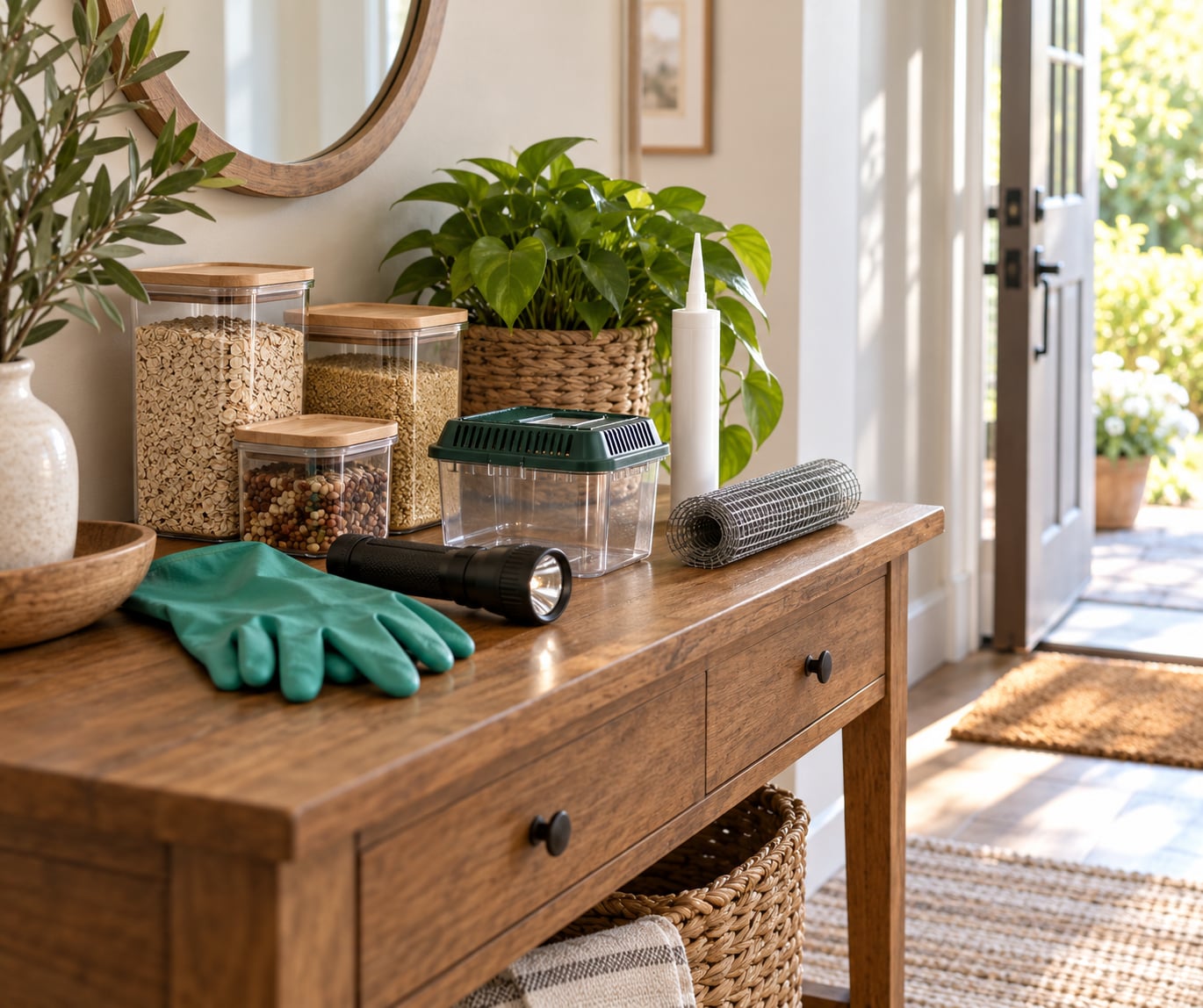
Child-safe pest control around a house comes down to three habits: identify the pest before you treat it, remove the food, water and entry points it depends on, and use the least-risk method that will actually work. Most infestations never need a broad indoor spray. Prevention and targeted enclosed baits handle the large majority of what families run into, and they do it where a toddler cannot reach.
This guide walks through the whole sequence in order, from identification to monitoring, plus what to do in the first minutes after a child touches a product or a treated surface. Most of the work takes an afternoon and basic cleaning supplies. Anything structural, anything involving a dangerous pest, or anything you cannot identify properly belongs with a licensed professional.
Table of Contents
- What You Need
- Step-by-Step: Child-Safe Pest Control Around a House
- 1. Identify the pest and where it is active
- 2. Remove attractants and block access
- 3. Keep children and pets out of the treatment area
- 4. Choose the lowest-risk effective method
- 5. Use traps or products exactly as labeled
- 6. Monitor for signs of improvement or reinfestation
- 7. Escalate recurring or hazardous infestations
- Common Mistakes
- Frequently Asked Questions
- Is it safe to use pest-control sprays in a home with young children?
- What is the safest pest-control method for a house with kids and pets?
- How should I store pest-control products safely around children?
- What should I do if a child touches or ingests a pest-control product?
- Are bug bombs or foggers safe when children are in the home?
- When should I call a pest-control professional instead of treating the house myself?
- Conclusion
What You Need

Gather these before you start, because most child-safety problems come from improvising mid-job. Nothing here is exotic.
- Identification supplies: a flashlight, a small container or envelope to capture a specimen, your phone camera, and a magnifying glass or hand lens if you have one.
- Cleaning supplies: dish soap, a degreaser for counters and stovetops, a vacuum with a hose attachment, and a mop. Most of what draws pests into a home is food residue you cannot see.
- Storage containers: airtight bins for dry goods, pet food and opened packages. Cardboard boxes are not storage for a pantry under pressure from pests.
- Exclusion materials: silicone caulk or sealant, steel wool or copper mesh for gaps, weatherstripping for door sweeps, and window screen repair supplies.
- Safety gear: nitrile or rubber gloves, a mask if you will be dusting, and hand soap and water at the sink before anyone eats or handles a baby.
- Pest control supplies: snap traps or box traps in tamper-resistant housings, gel baits with a keyed station, or an EPA-registered product whose label clearly permits the site you intend to treat. Read the label before you buy, not after.
Step-by-Step: Child-Safe Pest Control Around a House

1. Identify the pest and where it is active
You cannot control what you have not named. Look at the evidence rather than the guess: droppings, gnaw marks, trails, nests, an odor, or damage to food and fabric.
Catch or photograph one specimen if you can do it without chasing it through the house. A photo on your phone beats a dead bug in a cup, and it beats a night of guessing. Note where it was and what time it was active, because most indoor pests are nocturnal and seeing one at noon usually means the population behind it is larger than it looks.
If two different insects are clearly present, treat them as two problems. If you cannot identify it with reasonable confidence, go straight to step 7 rather than buying a broad product for a guess.
2. Remove attractants and block access
Do this before you treat anything. It is the least toxic step in the whole process and it is the one most people skip.
- Move dry goods, pet food and open packages into airtight containers, and wipe the shelf and container rim before putting them back.
- Clean crumbs and spills, take out the trash daily, and pull the bin away from the counter edge.
- Dry the sink and any standing dishes at the end of every night, and fix a faucet that drips overnight.
- Empty and scrub pet water bowls daily.
- Look for water collecting in plant saucers, toys, gutters, buckets and birdbaths, and empty them at least weekly.
- Seal cracks with caulk, patch screens, add door sweeps, and cover vents with fine mesh where the gap is large enough for a mouse.
Two cautions on sealing. Do not close off a gap that traps heat or moisture inside a wall, and do not block a weep hole or drainage path. If you are unsure what a gap vents, leave it and ask.
3. Keep children and pets out of the treatment area
Set this up before you open anything. The order matters more than the speed.
Move children, toys, pet bowls, bedding, food and dishes out of the room. Pull area rugs if you will be applying a floor treatment. Open windows or run a fan if the label calls for ventilation. Post a note on the door so nobody walks back in, and set a phone timer for the label’s stated drying time and re-entry interval rather than guessing.
Do the job while the kids are at school or with a grandparent if you can. A toddler who is not in the room is a much easier safety plan than a toddler who is being distracted.
4. Choose the lowest-risk effective method
Work down this order and stop as soon as the pest is gone. Most homes never get past the first two tiers.
- Sanitation and exclusion: cleaning, sealing, removing food and water. Free, and it fixes more than any product.
- Physical methods: snap traps, box traps placed inside tamper-resistant housings, sticky monitors for monitoring, hand removal for a single indoor nest.
- Enclosed baits: gel baits and bait stations in keyed housings, applied along edges, hinges and under appliances where pests travel but hands cannot.
- Targeted dusts and powders: food-grade diatomaceous earth or boric acid in cracks and wall voids, applied in a thin line rather than a thick layer.
- Liquid or aerosol products: crack-and-crevice spot treatments, and nothing broader, applied only where the label permits.
Two things get skipped too often. First, wall voids: a thin line of powder or gel behind a removable baseboard or inside a wall cavity is genuinely out of reach, which makes it one of the safest places to treat an indoor infestation. Second, prevention of secondary exposure. A poisoned mouse that leaves the bait station may die in a wall or under an appliance where a pet can reach it, so plan where dead pests will end up.
Skip total foggers. Parents online describe them as the most disappointing tool in the category, and they agree with the label: the mist cannot reach inside walls or furniture where pests actually live, while it does settle on toys, bedding and food surfaces the whole family touches.
5. Use traps or products exactly as labeled
The label is the law for a household pesticide. It tells you the permitted sites, the dose, the drying time, the re-entry interval, storage and disposal. Using a product anywhere its label does not allow is off-label use, and it is the single most common way families accidentally create a hazard.
- Read the site list first. Some products are approved for outdoor cracks and crevices only, and using them indoors is not a small technicality.
- Check the signal word. Caution carries the lowest acute risk, Warning signals greater risk, and Danger signals the highest hazard. Higher-risk products have restricted use classifications and are not for a do-it-yourself household job.
- Never mix products, never decant one into a food or drink container, and never transfer bait or powder to a surface that is not on the label.
- Wash your hands and any exposed skin after handling, and wash or replace any toy, bowl, toy box lining or food-contact surface that was in the area before application.
- Store every product in its original container, upright, locked, and out of reach and sight. Keep the label attached.
Watch the clock on re-entry. If the label says children and pets should stay out until surfaces are dry, treat dry as a minimum, not a target.
6. Monitor for signs of improvement or reinfestation
Give the method the interval the label or the biology suggests. Most indoor infestations need one to two weeks before you can fairly judge a treatment, and rodent traps can keep catching new mice for a while even after breeding has stopped.
Success looks like no new droppings, no fresh gnaw marks, no sightings, and sticky monitors that stay clean when you replace them. Put fresh monitors or traps out each time you check, because a trap that caught something last week tells you nothing about today.
Fresh activity after the interval usually means one of four things: the entry point is still open, there is a second harborage nearby, the identification was wrong or incomplete, or the method chosen does not work on this pest. Parents who switched from sprays to enclosed baits and exclusion often report the same pattern, so if activity continues, change one variable at a time rather than adding products on top of products.
7. Escalate recurring or hazardous infestations
Call a licensed pest professional when any of these apply.
- Dangerous pests: stinging insects nesting in the wall, termites with visible damage, rodents in quantity, or a venomous spider you cannot identify.
- Structural damage: chewed wiring, gnawed beams, a hole through siding, or anything involving gas, electrical or structural work. That is a different trade and a different set of codes.
- Repeated indoor infestations, especially in multi-unit housing where pests move in through shared walls or from a neighboring unit.
- Unexplained bites on a child, or any suspected illness following a pest problem.
- A product that cannot be used safely with children or pets in the home, including inside a child’s bedroom or play area.
When you do hire someone, ask which products they plan to use, where those products will be placed, what the re-entry instruction will be in writing, and whether they hold an IPM-focused certification. A company that answers placement questions specifically is usually doing the child-safety work already.
Common Mistakes
Almost every household problem I have seen traces back to one of these.
Spraying first and identifying never. A general aerosol kills what is in front of it and repels nothing at all, so the same pest comes back. Fix: complete steps 1 and 2 before a single product is opened.
Treating near food, dishes, toys or a child’s play surface. Fix: pull everything out of the area first, and use a product whose label lists that exact site. If the label does not list it, that site is off limits.
Reaching for foggers. Fix: use a targeted product or enclosed bait instead. If the pest is living inside the wall, fog cannot get there and children can.
Ignoring entry points. Fix: seal the gaps you found during identification before you spend another dollar on treatment. Exclusion is what makes the treatment last, and parents in DIY forums credit it more often than any product.
Putting traps where a toddler can reach them. Fix: only use traps inside a keyed, tamper-resistant housing, and never rely on a trap’s shape alone to keep a child out.
Using a product off-label. Fix: treat the label as a boundary, not a suggestion. If the label does not permit the location or the pest, choose a different product.
Stopping before you monitor. Fix: set a check date before you apply, and re-check with fresh traps or monitors rather than a leftover empty trap.
Assuming natural means safe. Essential oils repel rather than eliminate, and several are genuinely toxic to cats and young children when concentrated or diffused. Pool-grade diatomaceous earth contains crystalline silica and is not the same thing as food-grade material; only food-grade is appropriate where a child could touch or breathe it. Fix: use natural products as deterrents and repellents inside an IPM plan, never as the sole control for an established infestation.
Waiting too long to call help. Fix: set a personal limit, such as two failed attempts or an interval with no improvement, and treat reaching that limit as the decision point rather than a failure.
Frequently Asked Questions
Is it safe to use pest-control sprays in a home with young children?
Pest-control sprays can be used safely in a home with young children when you follow the label exactly, remove children and pets from the area first, and keep them out until surfaces are fully dry and the stated re-entry interval has passed. Move food, toys, dishes and bedding out before applying. Choose a product approved for that exact site, prefer lower-risk enclosed baits and targeted crack-and-crevice treatments over broad spraying, and store everything locked and out of reach.
What is the safest pest-control method for a house with kids and pets?
The safest method is whichever one lets you avoid chemical exposure entirely: cleaning up food sources, drying standing water, sealing cracks and entry points, and using traps inside tamper-resistant housings. When a pest persists, enclosed gel baits and wall-void treatments put the product behind a physical barrier between your child and the pest. The order to work down is sanitation, exclusion, physical methods, enclosed baits, targeted powders, and only then liquid pesticides used exactly as labeled.
How should I store pest-control products safely around children?
Keep every product in its original labeled container, never in a food, drink or household container. Store it upright in a locked cabinet or a high shelf, out of both reach and sight, away from food, medicines and pet supplies. Keep the label attached so you can read the permitted sites, re-entry time and first-aid instructions later. Do not leave a container open on a counter during a job, and keep it closed as soon as you finish.
What should I do if a child touches or ingests a pest-control product?
Move the child away from the area first, then check the product label for first-aid instructions, because the label is the most specific guide you have. If the product got on skin, remove contaminated clothing and wash skin with soap and water. If a product was swallowed, do not induce vomiting unless the label says to, and call Poison Control at 1-800-222-1222 or your regional poison center immediately. In the United States, emergency help is available through 911. Call for advice even when you are not sure how much was involved.
Are bug bombs or foggers safe when children are in the home?
Whole-house foggers are generally not recommended for homes with children, and most labels restrict their use or warn heavily against indoor use. The mist cannot reach inside walls, cracks or furniture where pests actually live, so it kills little while settling on toys, bedding, dishes and food surfaces children touch. If a label permits indoor use, that still means removing children, pets, food and toys first, following the full re-entry instruction and ventilating afterward. Targeted baits and exclusion work better and expose far less of the household.
When should I call a pest-control professional instead of treating the house myself?
Call a licensed professional for stinging insects nested in walls, termites with visible structural damage, heavy rodent activity, venomous spiders you cannot identify, chewed wiring, and any repeated indoor infestation. It is also the right call when pests arrive from a neighboring unit through shared walls, when a child has unexplained bites, or when no product can be used where the pest is without exposing children or pets. Ask which products they plan to use, where they will place them, and what the written re-entry instruction will be.
Conclusion
Start with the first two steps and nothing else. Identify the pest properly, remove its food, water and shelter, and seal the entry points you can reach. Only after that do you pick a method, and the least-risk effective option is almost always a trap or an enclosed bait rather than a spray, applied strictly according to its label with children and pets kept out until surfaces are dry and the re-entry interval has passed.
Call a licensed professional when the pest is dangerous, the damage is structural, the infestation keeps coming back, or the treatment cannot be done without exposing your child. For questions about identifying what you are seeing, start with the pest identification guides on this site.


