
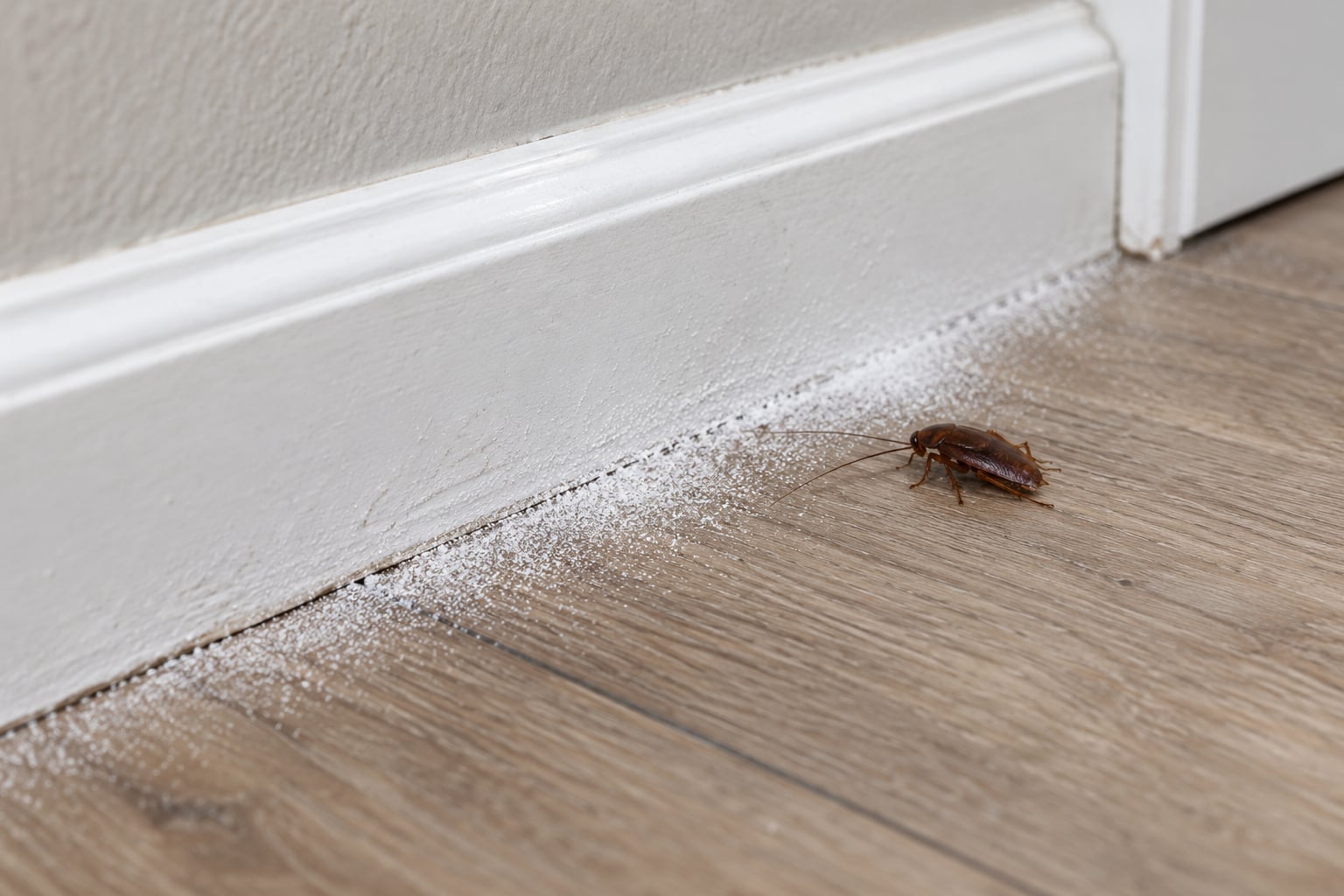
A residual insecticide spray is a pesticide formulated to stay active on a treated surface long after the spray dries, so insects that walk across or rest on it hours or weeks later are still exposed. Most products leave a thin invisible film on hard surfaces, or an absorbed residue inside porous material.
Understanding the mechanism matters because it explains the three things people get wrong most often: that spraying a porous surface can put the chemical somewhere insects never touch, that rain too soon after application can wash the treatment away, and that a residual is a slow suppression tool rather than an instant kill. Here is the full picture, updated for 2026.
Table of Contents
- The Short Version
- What Is a Residual Insecticide Spray?
- How Residual Insecticide Sprays Work on Surfaces
- Which Active Ingredients Are Commonly Used?
- How Long Do Residual Sprays Keep Working?
- What Surfaces Can You Treat?
- How to Apply Residual Insecticide Spray Safely
- What Makes Residual Sprays Stop Working?
- Residual Spray vs. Immediate Knockdown Spray
- When to Choose a Different Pest-Control Approach
- Frequently Asked Questions
- Do residual insecticide sprays kill insects after they dry?
- How long should you stay away after spraying?
- Can residual spray be used where children or pets are present?
- Is a residual insecticide spray better than a regular bug spray?
- Can you use residual spray on furniture or food-contact surfaces?
- What happens if you wash or paint a treated surface?
- Key Takeaways
The Short Version
- A residual leaves a film on hard surfaces and binds into porous surfaces; the second case delivers much less activity at the walking surface.
- The kill happens later and somewhere else than the spray. Residual sprays are poor at killing insects that are already present in numbers.
- Hard, sheltered surfaces such as under-eave voids and wall cracks hold activity far longer than sunlit, painted or porous surfaces exposed to weather.
- The product label is the only reliable source for expected duration, drying time and re-entry, and following it is the law, not a suggestion.
What Is a Residual Insecticide Spray?
A residual insecticide is any product that stays active on a treated surface for a defined period after application. That period can run from a couple of weeks indoors to a season outdoors, depending on the active ingredient, the formulation and where you put it. The word residual just means something is left behind after the spray has dried.
Residual products come in a few recognizable packages. Aerosols and pump sprays are the familiar household format, usually an emulsifiable concentrate or a microencapsulated suspension in a water or solvent carrier. Professional perimeter work uses concentrates diluted on site, applied as a coarse band around the foundation line. Dusts and powders cover dry voids and cracks where liquid will not stay. Gel baits and granular baits are not residuals at all, which is a distinction worth keeping straight.
What separates a residual from an ordinary household aerosol is the intended purpose. Household bug spray is built for knockdown: fine droplets, fast evaporation, and a direct hit that overwhelms an insect within seconds. A residual is built for persistence, which usually means a coarser deposit, a slower-drying carrier and an active ingredient that stays biologically available on the surface for weeks.
How Residual Insecticide Sprays Work on Surfaces

The whole process can be broken into five physical steps, and each one is a place where a treatment can quietly fail.
- Deposition. The spray leaves droplets on the surface. Coverage matters more than volume here, because a walking insect has to cross a treated zone, and gaps in the band become free highways.
- Drying. The water or solvent carrier evaporates. Until it does, the active ingredient is suspended in liquid rather than bound to the surface, and heavy rain during this window can wash it away.
- Film formation or adsorption. On a non-porous surface such as glass, tile, painted metal or sealed wood, the residue organizes into a thin continuous film. On porous material such as raw wood, brick, or mulch, it absorbs into the substrate instead.
- Contact. An insect walking across the treated area picks up residue on its legs and body. This is the step most products are designed around, which is why non-repellent products matter: a repellent residue pushes insects around the treatment instead of onto it.
- Penetration and mode of action. The chemical crosses the cuticle, enters the nervous system and disrupts it. Most modern residual actives are pyrethroids, which hold sodium channels open in nerve cells and cause repeated firing, paralysis and death. This usually takes minutes to hours, not the instant collapse people expect.
One thing to internalize: none of those five steps happen to an insect that is not on the treated surface. A residual does not chase anything, and it does not fog a room. That is the single biggest misunderstanding in DIY pest control.
Why Residual Sprays Last Longer Than Household Sprays
A household knockdown spray leaves almost nothing behind. The droplets land wet, the carrier flashes off, and the insect either died from the direct hit or did not. A residual formulation is engineered around the opposite goal. Microencapsulation wraps the active ingredient in a polymer shell that releases it slowly as insects contact or absorb the capsule, and polymer-bound concentrates hold the chemical on the surface rather than letting it evaporate with the carrier.
Two processes work against that design, and both are mostly out of your control. Hydrolysis breaks some molecules down when they sit in moisture, and photodegradation does the same under ultraviolet light. That is why an exposed vertical surface in direct sun can lose activity in a fraction of the time of the same product applied inside a shaded wall void.
Surface texture matters just as much. Smooth, sealed surfaces give a film a continuous place to sit. Dusty, textured or painted-over surfaces give it a thousand micro-cracks to sit in instead, where the concentration reaching any single insect’s foot is lower. Published field work on residual efficacy has made the substrate point repeatedly: a review of residual efficacy studies found lambda-cyhalothrin produced extended control on indoor wood and cement surfaces, with meaningful differences tied to the surface itself rather than the chemistry alone.
Which Active Ingredients Are Commonly Used?
There is no single best active ingredient. Each group works differently, and the label tells you which one your product contains.
- Pyrethroids (deltamethrin, lambda-cyhalothrin, bifenthrin, permethrin, cyfluthrin) are the backbone of both consumer and professional residual work. They are broad-spectrum, low-volatility, and they break down slowly on dry sheltered surfaces.
- Pyrethrins are botanical-derived and degrade fast in sunlight and air, which makes them useful for immediate knockdown but a poor choice for long residual work.
- Organophosphates (malathion, diazinon, chlorpyrifos) work by a different route, inhibiting an enzyme that clears neurotransmitters. Their residual life is generally shorter and they carry a stronger odor, which some people notice long after the surface feels dry.
- Carbamates (bendiocarb, propoxur) are another older nerve-agent class with a similar mode of action and typically limited persistence.
- Neonicotinoids (imidacloprid, acetamiprid, clothianidin) act on receptors in the insect’s central nervous system and have become common in consumer residual products. They are systemic in plants and are handled differently around pollinators and water.
- Insect growth regulators such as pyriproxyfen affect molting and egg development rather than killing adults on contact. They rarely work alone, and they pair with a residual or bait in a broader program.
Microencapsulated and polymer-bound versions of several of these actives are what give you a long residual interval. That is usually a formulation difference rather than a chemistry difference, which is why two products with the same active ingredient on the label can behave very differently on the same baseboard.
How Long Do Residual Sprays Keep Working?
There is no honest single number. Duration depends on the active ingredient, the concentration, the surface, the exposure and the pest, and the ranges below describe typical consumer and professional residual behavior rather than a guarantee. Consumer-grade pyrethroid sprays applied to dry interior surfaces usually give useful activity for roughly two to eight weeks. Professional perimeter products applied in sheltered conditions often hold for a season or longer.
| Surface and exposure | Typical useful residual life | What cuts it short |
|---|---|---|
| Interior crack-and-crevice, under sink, behind appliance | Several weeks to a few months | Cleaning, grease film, dust |
| Interior wall void, sheltered | Weeks to months | Little; mostly undisturbed |
| Interior baseboard, painted wall | A few weeks | Dust, abrasion, repainting |
| Interior void near moisture (bathroom, laundry) | Days to weeks | Water, humidity, heat |
| Exterior under-eave, soffit, shaded foundation seam | Weeks to months | Windblown dust, temperature swings |
| Exterior band exposed to sun and rain | Weeks | UV degradation, rain wash-off |
| Porous masonry, raw wood, mulch, soil | Days to weeks at the surface | Absorption below the walking line |
Two distinctions get blurred constantly, so keep them apart. Knockdown time is how fast an insect dies after a direct exposure, usually seconds to minutes. Residual duration is how long the surface stays lethal, usually weeks. A product can have excellent knockdown and a poor residual, or the reverse, and a spray that stopped working after nine days may have delivered the full knockdown the label promised.
The other practical point is rainfastness. The label’s rainfast period is the time the treated surface needs before rain. Treating right before a storm is the most common way people wash off a perfectly good application, and it explains a lot of the complaints that arrive a week later.
What Surfaces Can You Treat?
Residual sprays belong on surfaces insects walk, rest or travel along. Good indoor targets include baseboards, the seam where wall meets floor, cracks and gaps around plumbing, the underside and back of appliances, cabinet hinges, and the underside of shelves and drawers. Outdoors, the useful placements are the same logic translated: the foundation seam, under eaves and soffits, porch and deck undersides, entry steps, and the shaded side of the foundation.
Some surfaces work against you. Raw or unfinished wood, unpainted brick, concrete block, and mulch beds all absorb liquid. Applying a residual there can place most of the active ingredient below the surface line, where no insect will ever contact it. If you must treat a porous surface, follow the label rate precisely and expect shorter and less even results, or pair the residual with a bait program that gets the chemical to where the insects are actually feeding.
Never apply a residual to a food-contact surface, a surface that touches food, dishes or toys, or to bedding and soft furnishings unless the label specifically permits it. Keep food covered or moved out of the room, and do not spray where children or pets will be handled until the label’s drying and re-entry times have passed.
How to Apply Residual Insecticide Spray Safely

Read the label first, all of it, including the re-entry interval and the water buffer directions. Everything below assumes you are following a label that permits indoor residential use of that product.
- Move food, toys, dishes and pet items out of the room. Cover or remove anything on surfaces you are about to treat, and take bedding and curtains out if the spray will reach them.
- Get pets and children out and close the room. Plan the sequence so you do not re-enter a treated area mid-job.
- Clear the surfaces first. Wipe dust, grease and food residue off baseboards and counters. Residue sitting on top of a grease film is residue you paid for and did not buy.
- Ventilate. Open windows and run a fan in an adjacent space. Keep airflow moving out of the treated room rather than through it.
- Apply a continuous band, not patches. Start and stop the spray outside the treated area, sweep into the crack, and keep moving at a steady pace along the seam. Gaps are where insects travel.
- Use the label rate. Under-dosing gives a patchy barrier and encourages resistance; soaking past the label is a safety and waste problem.
- Respect the cure window. Keep the area dry and undisturbed until the product has fully dried, then allow the label’s re-entry time before people or pets go back in.
- Wait out the rain period outdoors before any rain, irrigation or hose spray, then check the treated band afterwards.
- Note the date and set a reminder. Reapplication on a calendar beats reapplication on panic, and panic is what leads to over-application.
Wear the protective equipment the label specifies. For most household residual sprays that means chemical-resistant gloves and eye protection, and for outdoor perimeter work a long-sleeved shirt, long pants and closed shoes.
What Makes Residual Sprays Stop Working?
When a residual seems to fail, the cause is usually one of a small number of things, and identifying which one saves you from spraying the same wall a fourth time.
- Absorption into a porous surface. The chemical went into the substrate rather than staying on the walking line. This is the most common DIY failure and it is invisible afterward.
- Rain too soon. The cure window was cut short and the deposit washed off before it bound to the surface.
- Sunlight. Photodegradation shortens the life of exposed vertical surfaces dramatically compared with the same product in a shaded void.
- Cleaning, dust and abrasion. A wiped or repainted baseboard has no residue left. Dust settles into the film and lowers the concentration any insect contacts.
- Behavioral avoidance. Ants in particular will walk around a treated band rather than across it, sometimes for meters. A barrier that is avoided is not protecting anything, and no amount of spraying fixes that.
- Resistance. Repeated under-dosing selects for tolerant strains, especially in populations of German cockroaches. This is why professionals rotate modes of action rather than repeating the same active ingredient.
- Treating the wrong place. The insect is living in a wall void, an appliance cavity or a neighboring unit, and the baseboard was never the route it used.
- Life stages the chemistry cannot reach. Egg cases, oothecae, pupae and larvae sealed inside a capsule or a wall cavity are largely untouched by a surface film. What hatches later can look like complete failure even when the surface treatment worked exactly as designed.
Seeing live insects a day or two after a professional treatment is normal rather than a sign the treatment failed. Disturbed insects leave harborage, and some species are simply more tolerant. Consistently rising numbers over weeks, not a brief bump, are the signal to reassess.
Residual Spray vs. Immediate Knockdown Spray
These two products solve different problems and professionals use them together rather than choosing between them. Technicians commonly describe residual pyrethroids as the backbone of perimeter work, with knockdown products used for fast visible results the same day.
| Consideration | Residual spray | Knockdown spray |
|---|---|---|
| Speed | Hours to days after contact | Seconds to minutes |
| Duration | Weeks to months | Minutes; little residue |
| Where the kill happens | Wherever insects walk later | Where the spray landed |
| Best at | Suppressing a trail or a perimeter | Clearing an insect already in view |
| Main limitation | Eggs, sealed voids, avoided surfaces | Nothing left behind afterward |
| Application | Thin continuous band along cracks and seams | Direct shot at the target |
A residual alone on an active indoor infestation usually disappoints, because the density of insects present is high and many are in hiding places the spray never reached. The same is true in reverse: knocking down every roach you can see with a contact spray, then doing nothing about the harborage, is why people report that roaches come back.
When to Choose a Different Pest-Control Approach
Residual spraying is the wrong tool in several common situations, and choosing it anyway is how a small problem turns into a recurring one.
- Dense active indoor infestation. Hundreds of German cockroaches need baits placed in harborage, an insect growth regulator, sanitation work and follow-up visits, not a surface film.
- Eggs and egg cases. Cockroach ootheca, bed bug eggs and spider egg sacs are physically sealed from a surface treatment. Heat, steam, bait stations and physical removal are the options that reach them.
- Insects living inside the structure. Termites, carpenter ants inside wood and rodents are not surface pests. Carpenter ant and termite treatments are soil treatments or wood treatments applied by licensed operators under structural protocols.
- Ants entering from outdoors. Spraying the interior trail treats the symptom. Sealing the entry point, trimming vegetation away from the foundation and removing the food source address it.
- Recurring problems in multi-unit buildings. A single unit’s residual cannot control a problem that keeps arriving from a neighboring unit or the hallway.
Most people get better results by combining methods instead of escalating one chemical. Seal cracks and entry points, remove water and food sources, drop gel or granular baits where insects actually feed, keep a residual in the cracks and seams they travel, and monitor with sticky traps so you know whether the population is dropping before you decide to spray again. That is integrated pest management, and it is why technicians describe a single spray as never being enough on its own.
If an infestation involves structural pests, a species you cannot identify, or repeated treatments that are not reducing activity, a licensed pest professional is the right call. For anything touching your skin, food or a pet, ask a veterinarian or your local poison control center rather than guessing.
Frequently Asked Questions
Do residual insecticide sprays kill insects after they dry?
Yes, and that is the whole point of the format. Once the carrier evaporates, an active residue stays on the surface and kills or repels any insect that contacts it later, including days afterward. What it cannot do is kill insects that never touch the treated area, or reach eggs and sealed life stages inside a wall or an egg case.
How long should you stay away after spraying?
Follow the re-entry interval printed on the label, which often differs from drying time. Drying means the surface feels dry; re-entry means ventilation and time have cleared the air. Outdoors, most products need several hours of drying before people or pets enter, and a longer window if it is humid or the room is closed up. When in doubt, wait longer rather than shorter.
Can residual spray be used where children or pets are present?
Only if the label permits it, and only by following the label exactly. Move children and pets out before treating, cover or remove food, toys, dishes and bedding, and keep them out until drying and re-entry times have passed. Cats are notably sensitive to some pyrethroid products, so treat any cat household conservatively and check with a veterinarian first.
Is a residual insecticide spray better than a regular bug spray?
They do different jobs. A regular bug spray gives fast knockdown of an insect you can already see and leaves almost nothing behind. A residual lasts weeks and suppresses insects that arrive later, but it acts slowly and cannot handle a large active infestation on its own. Most effective programs use both, plus baits and exclusion work.
Can you use residual spray on furniture or food-contact surfaces?
Only where the label allows it, and never on a surface that touches food, dishes, toys or bedding. Appliance exteriors, cabinet hinges, baseboards, and the undersides of shelves are typical allowed targets. Upholstery, mattresses and bedding are usually outside what a surface residual can reach and often outside what a label permits. When the label is silent, treat the surface as off-limits.
What happens if you wash or paint a treated surface?
The residue is gone. Washing a baseboard, or painting over it, removes the film that was doing the work, so the treated area becomes untreated again. Dust and grease film have a similar effect by reducing the amount an insect picks up. Wipe surfaces before treating, repaint first, and treat only after the new paint or finish has fully cured.
Key Takeaways
Identify the pest first, because the life stage and the behavior decide which product even makes sense. Then choose a product labeled as residual for that pest and for the surface you intend to treat, and apply it as a thin continuous band on hard, sheltered, non-food-contact surfaces along the seams insects actually travel.
Give it time to dry, respect the label’s rain, re-entry and reapplication intervals, and keep in mind that the residue is doing slow work rather than instant work. When the problem is eggs, sealed voids, structural pests or a heavy infestation, add baits, exclusion and sanitation, or call a licensed professional. That combination, not a heavier dose of spray, is what actually holds an infestation down.


