
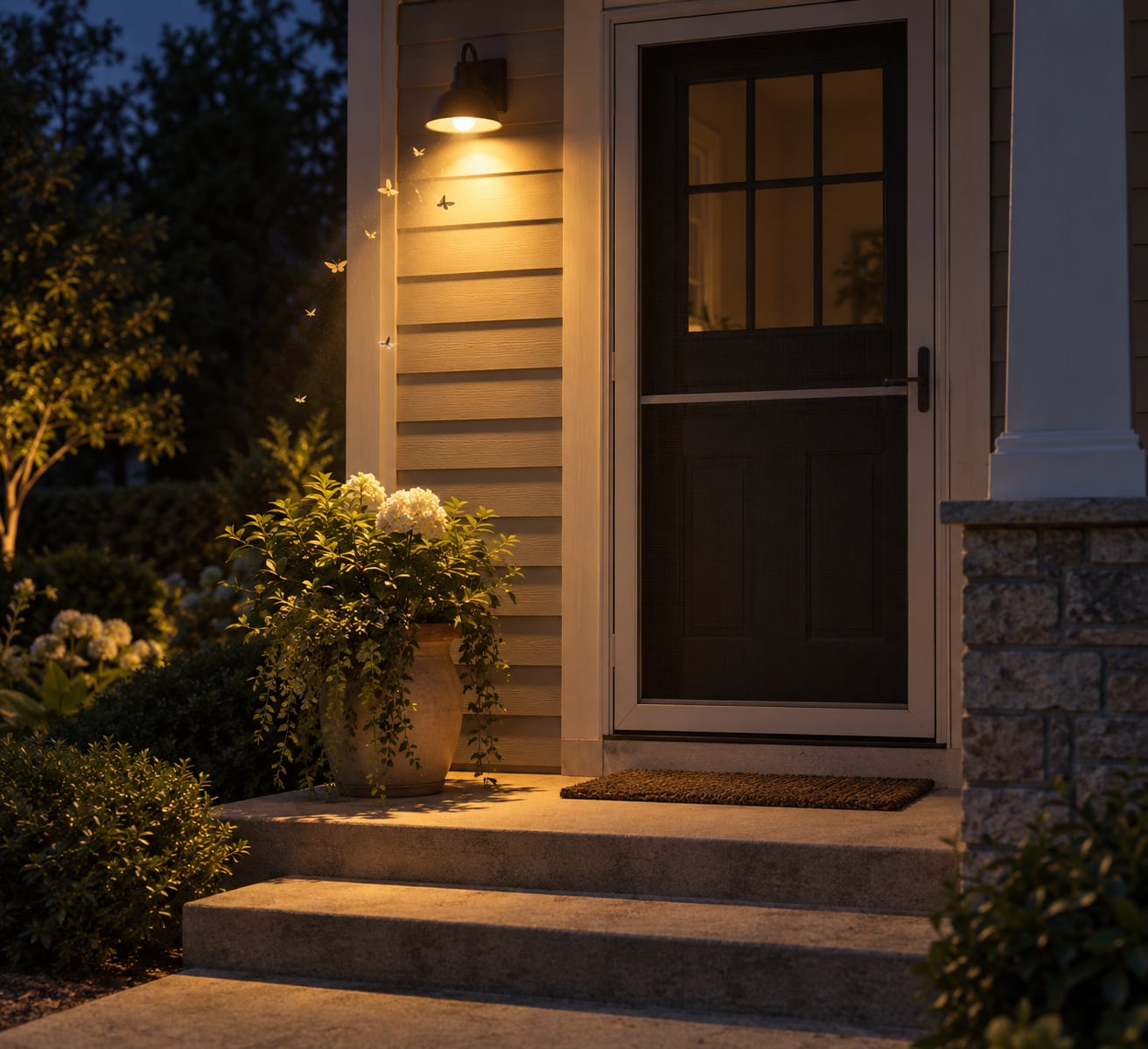
To reduce bugs on a porch light without pesticides, you have to fix two separate problems: the light itself, and the insects already living beside your door. Swap to an amber or warm white LED at 2200K or lower, dial the brightness down, shield the fixture, and run it on a motion sensor or a dimmer instead of all night. Most homeowners see the biggest drop within a week of the bulb swap.
The bulb is the fix that gets attention. It is also not the whole fix, which is why so many people end up still swatting at moths on the ceiling three months later. If you sit next to woods, water or tall grass, expect swarms within minutes of the light coming on, no matter which brand of bulb you install.
Plan on an evening to do the cleanup, then 30 minutes for the bulb and fixture work. None of the steps below involve spraying anything into a light fixture, which is both a poor idea for the insects and a bad idea for the wiring. For electrical work beyond swapping a bulb, call a licensed electrician.
What You Need
You can do this with a short hardware-store list. The expensive item is usually the bulb.
- A stable step ladder. Not a chair, not a railing. Porch fixtures sit above head height and the ladder feet need solid, level ground.
- An outdoor-rated LED bulb in warm white 2200K, amber or red. Match the base type (E26, E27, medium screw, candelabra) and stay at or under the wattage printed on the fixture.
- Gloves, a microfiber cloth, a soft brush and a flashlight. A toothbrush works on the vent slots in a motion-sensor housing.
- Mild dish soap and warm water in a spray bottle. No harsh cleaner, nothing sprayed into an open socket.
- A sealed trash bag or two. You will be scooping out a surprising amount of dead insect matter and old webbing.
- Caulk or exterior sealant, plus stainless mesh. For closing gaps around siding, trim and utility penetrations.
- Optional: a dimmer switch, a smart bulb with a schedule, a fixture baffle or shield, and a porch fan for the seating area.
Do the cleanup in daylight. It is easier, safer, and you can see what you are doing instead of guessing in the dark.
Step-by-Step: How to Reduce Bugs on a Porch Light
Work in this order. The early steps cost almost nothing and remove the conditions that make the later steps necessary.
1. Identify What Is Gathering Around the Light
Look at what is actually on the fixture before you change anything, because different bugs mean different problems. Moths and june bugs lighting up at the glass are a light-attraction problem, and the bulb swap handles it. A steady line of ants or spiders working the mounting screws is a moisture and shelter problem, and no bulb will touch it.

Three patterns tell you most of what you need to know. A tight cloud that forms within minutes of the light switching on means the bulbs are doing most of the recruiting. Insects that keep arriving from one direction, a specific wall or the grass line were probably already in the yard. Bugs ending up inside the house the moment the door opens usually means the fixture sits directly above the entry, and that geometry matters more than the bulb color.
That last one is the most repeated complaint in DIY and home-improvement discussion boards. A light mounted a few inches over the front door creates a landing pad right at the threshold, so anything it attracts walks in with you.
2. Clean the Fixture and Nearby Surfaces
Turn the fixture off at the wall switch, then open the cover and wipe out the accumulated mess. Use a dry cloth first to lift out dead insects and webbing so you are not smearing residue into the finish, then follow with a cloth lightly dampened with soapy water. Let it air-dry fully before you switch the power back on.

Clean the shade, the lens, the underside of the cover and the wall above and below it. Over time a film of residue builds up, and it gets warm enough in sunlight that a bare-bulb fixture actually becomes an attractant on its own. People who clean the fixture report consistently that the swarm comes back within a few weeks if this step is skipped.
While the fixture is open, check whether the bulb has contact with the shade. An LED sitting flush against glass or metal traps its own heat, which shortens bulb life and, on a bare-bulb fixture, can make the housing hot enough to draw insects to the surface rather than the light.
3. Use a Less Attractive Light or Bulb
Insects see short blue and ultraviolet wavelengths far better than we do, and cool white bulbs are full of them. Amber light sits around 590 nanometers, where insect vision drops off sharply, so a bulb in that range is close to invisible to most of the species you are trying to avoid.
How much each color pulls insects, from lowest to highest:
- Amber or bug-repellent LED — lowest attraction. The best choice for a front door or entry fixture.
- Red LED — very low. A good option when you need a little more visibility than amber.
- Warm white 1800K to 2200K — low. The warmest white bulbs on the shelf, and the most common recommendation in DIY forums.
- Warm white 2700K — moderate. A partial improvement over cool white, not a full fix.
- 3000K — moderate to high. Still reads as white to most insects.
- 4100K — high. Neutral white, a poor choice outdoors.
- 5000K to 6500K — highest. Cool daylight white, the worst option near an entry door.
Two variables move together: color temperature and brightness. A 2200K bulb at full output still pulls in insects, just fewer than a 6500K bulb at full output. Dimming does real work, and people on home-automation forums routinely call the dimmer the single most underrated fix in the whole list.
Then cut the hours. A dusk-to-dawn fixture with a photocell leaves the light off until it is genuinely dark. A PIR motion sensor drops it to a minute or two of use a day instead of eight or ten. The catch most people hit: bugs can and do trigger the sensor, which is covered in the FAQ below.
Shielding matters as much as color. A shallow baffle, a hood, or a full-dome fixture with a clear lens between the bulb and the sky pushes the light downward onto the steps instead of broadcasting it over the yard. Swapping to a dome-style fixture is often the single biggest improvement when the current light sits inches above a door.
4. Seal Nearby Entry Points and Remove Attractants
Reducing bugs on a porch light only controls what arrives at the light. Entry points and nearby attractants control what is waiting when you open the door.
Close gaps under exterior trim, around the door frame, where siding meets the foundation, and around pipe and cable penetrations. Any opening wider than a quarter inch is worth a look, and stainless mesh or a dab of exterior caulk is enough for most of them. Check the door sweep and make sure the screen is seated in its track, because a sagging screen does nothing.
Then cut the food and water supply within about 20 feet of the porch. Dump anything holding rainwater, including the saucer under a planter, a clogged gutter, a birdbath you forget about and the low spot where the hose drips. Scrape or power-wash accumulated organic debris out of the siding joints, where a lot of outdoor insects and spiders shelter during the day. Stack firewood away from the wall and keep planters off the ground.
This is the step people skip and it is the one that decides whether a bulb swap actually changes your evenings. A porch light cannot thin out a mosquito population that is breeding in the downspout two feet away.
5. Maintain the Area and Check Results
Give the fixture a real test rather than judging it from the doorway. Sit outside with the light on for 15 minutes and see how many insects actually reach the glass and how many stay out in the yard. Count them on two different evenings, since insect pressure swings a lot night to night.
A good result looks like this: moths and gnats no longer blanketing the lens, a handful of insects rather than a solid layer, and nothing walking inside when the door opens. Not zero. No outdoor light in any yard eliminates insects entirely, and anyone selling you one is overselling it.
Give the setup an annual walk-through at the turn of the season, and a light check once a month in between: wipe the fixture, then look at the caulk lines, the screens and any container collecting water. Keep a fan running if you sit out there, because airflow stops mosquitoes from finding you while the light keeps doing its job at the edge of the yard.
Escalate to a pest professional if you are seeing a large number of insects indoors during the day, structural damage in wood, droppings in an attic or wall void, or a persistent swarm that survives a bulb swap plus a clean fixture plus water removal. That pattern points at a nest inside the structure rather than a light problem. Have a licensed electrician handle the fixture if you are adding a dimmer, a new sensor or a different fixture body.
Common Mistakes
Almost every one of these shows up in the same advice threads, usually repeated by someone who never tried it.
- Spraying insecticide into or around the fixture. It kills the insects already there and leaves them dead in the glass, and it can contaminate a surface you touch. Clean instead, and remove the attractant.
- Installing a bare high-output LED. Bright cool-white bulbs without a shade are the worst combination available. You are adding glare, spill into neighboring windows and an insect beacon at once.
- Leaving gaps unsealed and calling it a lighting problem. A light a few inches above the front door will deliver everything it attracts straight into the hallway unless the door is tight.
- Forgetting containers near the porch. A saucer, a toy, a blocked drain or an empty bucket will out-produce any bulb change you make.
- Letting screens and sweeps slide out of place. A gap you filled two seasons ago is usually the reason bugs are suddenly getting in again.
- Leaving the light on all night. Every extra hour is another hour of recruitment. Sensor control, a dimmer or a low setting after bedtime does more than most hardware changes.
- Expecting a bug zapper to handle mosquitoes. Electric zappers catch a lot of insects and very few mosquitoes, and they take out pollinators along the way. If you want a device, use it as a supplement, not a solution.
Two more worth naming. Skip the scented candles and citronella planters on a porch people actually sit on; the effect is temporary and inconsistent next to a working light. And skip “bug-repellent” spray bulbs that promise a clear field of view; several rely on coatings that fade within weeks, and a warm 2200K bulb with a shield is more dependable and cheaper to replace.
Frequently Asked Questions
What porch light does not attract bugs?
An amber or bug-repellent LED bulb is the best answer for most entry doors, because amber light sits near 590 nanometers where insect vision drops off. If you prefer white light, go no warmer than 2200K and keep the fixture shielded so light points down rather than out. Adding a baffle or dome cover and cutting brightness matters nearly as much as the color.
Will a yellow light bulb keep bugs away?
Yes, substantially. Yellow and amber bulbs suppress the short blue and ultraviolet wavelengths that insects are drawn to, so the light is much less visible to them. The effect is real but partial, and it works far better when combined with lower brightness, a shield over the fixture, and fewer hours of operation. Warm white at 2200K gives most of the benefit for people who find amber too orange.
Can bugs trigger motion sensor lights?
They can, especially larger moths and insects flying close to the lens, and this is the most common complaint about motion sensor porch lights. It is less of a problem in practice than it sounds because the sensor does not usually re-trigger repeatedly for one passing insect, but it does happen. Aim the detection zone away from shrubs, set the sensitivity to its lowest useful level, and pair the sensor with a warm bulb and a dim setting.
What bug is most attracted to light?
Moths are usually first, especially any light-colored outdoor moth. June bugs, crane flies and midges gather around lights as well, and gnats cluster near the glow rather than the glass. Mosquitoes are drawn to the light but also to the carbon dioxide you exhale, which is why a fan keeps them off you while insects still collect around the light overhead.
Do bug zappers work on mosquitoes?
Not well. Mosquitoes hunt mainly by smell, hearing and carbon dioxide, so an electric zapper that attracts by light barely catches them, while it does kill bees, moths and other beneficial insects. Users describe zappers as a waste of money for mosquito control specifically. If you want a device, use it near a seating area and treat it as a supplement to bulb changes, airflow and water removal.
How do I get bugs out of my light fixture?
Turn the fixture off at the switch, take the cover down according to the manual, and lift out dead insects, egg sacs and webbing with a soft brush or cloth. Wipe the lens and housing with warm soapy water, let it dry completely, and bag the debris in a sealed trash bag rather than shaking it out on the porch. Never spray cleaner into an open socket or handle a bulb while the power is on.
Conclusion
Start with three things in one evening. Clean the fixture out, replace the bulb with an amber or 2200K warm white LED behind a shield, and add a motion sensor or dimmer so the light runs a few hours instead of all night. Then spend twenty minutes removing standing water and closing gaps near the door.
If bugs are still coming in, the problem is likely the insects already living there or a fixture sitting directly over your entry, not the light itself. Call a pest professional when you are seeing insects indoors during daylight or signs of a nest inside the structure.


