To check a hotel room for bed bugs, you are looking for evidence, not for a moving bug. Keep your bags in the bathroom, then work the bed in this order with a flashlight: mattress seams and piping, the box spring, the headboard and the gap where it meets the wall, then nearby furniture. You are hunting dark ink-like spots, translucent shed skins, tiny pale eggs and rust-colored smears.
It takes about five minutes, and you do it before you unpack, before you sit down, before anything else. Bed bugs are nocturnal, so by the time you would notice a bite, the population is usually well established. The inspection only works if it happens before your suitcase is on the bed and your clothes are on the chair.
Here is the honest part first: finding a live bug or a reliable sign means something. Finding nothing does not prove the room is clean. Guest inspections are quick and untrained, and the real work of detection belongs to the hotel, not to you. This guide tells you what to look at, how to tell a real sign from a harmless one, and when to stop inspecting and pick up the phone.
What You Need
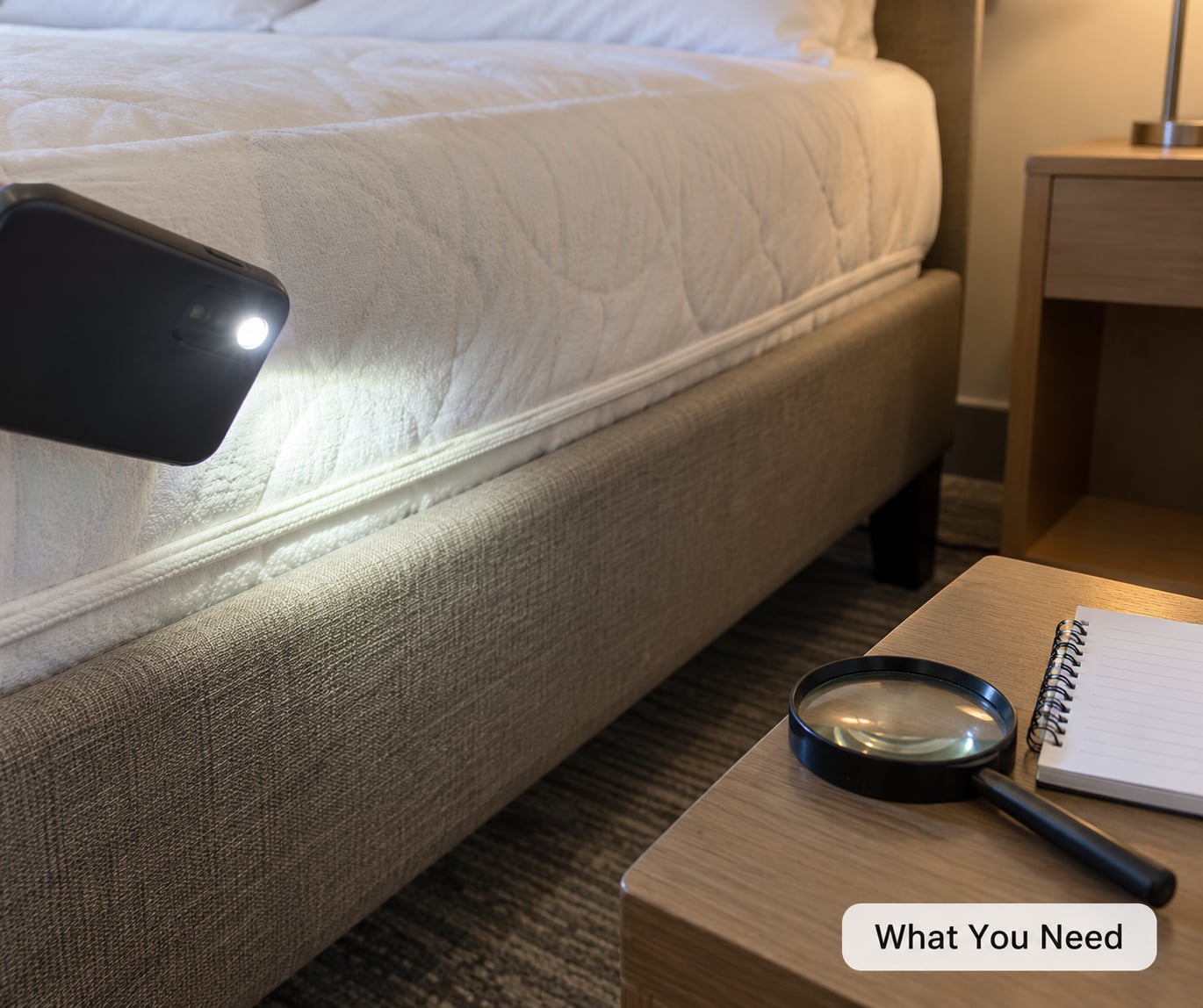
You need almost nothing, which is the point. The gear below is nice to have, and the first two are close to essential.
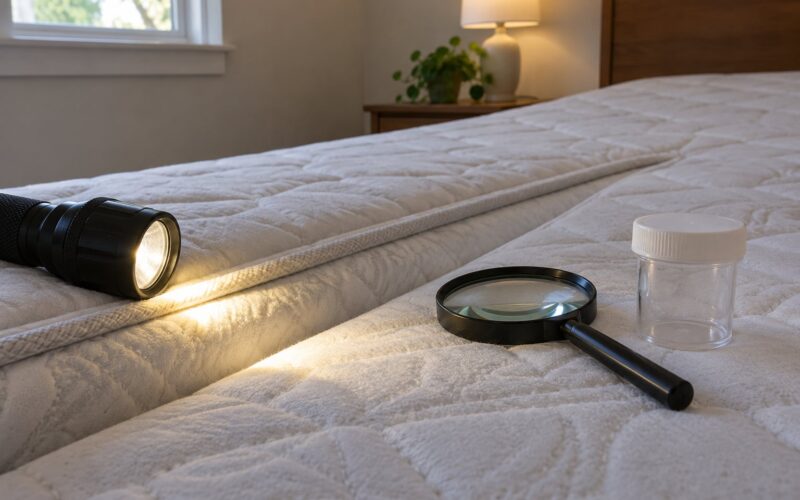
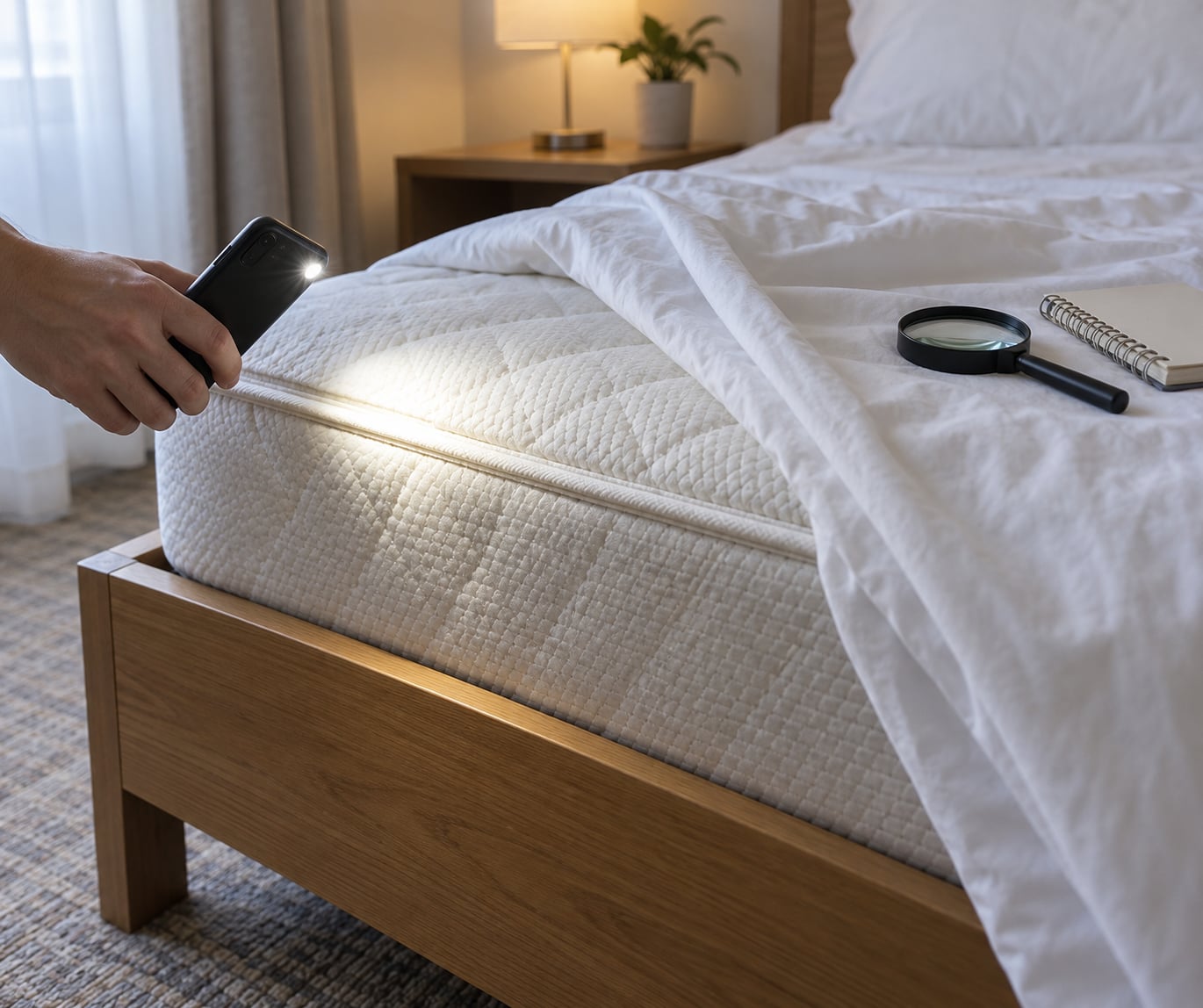
- A phone flashlight. Almost every bed bug sign lives in a shadow. Raking light along a seam turns a flat surface into a whole field of cracks and shadow.
- Your phone camera. The zoom is genuinely useful for eggs and shed skins, and it doubles as your evidence tool if you find something.
- A magnifying glass or loupe. Optional. Useful for confirming a suspected fecal spot, less useful for the rest of the check.
- A note on your phone. Room number, date, time, and what you saw. Write it down before you leave the room, while details are fresh.
A checklist matters more than any tool. Most people who miss an infestation are not under-equipped, they just looked at the headboard, decided the room was clean, and sat down.
Step-by-Step: How to Check a Hotel Room for Bed Bugs

Start With the Room and Bedding
Put your luggage in the bathroom and keep it closed. Not on the bed, not on the chair, not on the floor. A suitcase that sits open on carpeted floor for ten minutes is a better transport than most people realize, because the same carbon dioxide your body and soiled clothing produce is part of what draws bed bugs to a spot in the first place.
Then walk the room once before you touch the bed. Look for the general condition of the room, and for the places where fabric meets structure, because that is where harborage sites form. Check the headboard, the gap behind the headboard if it is removable, the seam where the bed meets the wall, the nightstand, the chair, the curtains and the baseboards.
Then the bedding. Peel back the top sheet and look at the mattress surface first, before you disturb anything. The top third of the mattress near the head is where you are most likely to find something, because that is where a person spends the most stationary hours while the insects feed.
| Sign | What it looks like | Where to find it | How to confirm |
|---|---|---|---|
| Live adult | Flat, reddish-brown, about the size of an apple seed | Seams, tufts, folds, the head end of the bed | It moves. It is the only unambiguous sign. |
| Nymph | Smaller, paler, translucent to light tan | Same seams as adults, often in the head area | Magnifier helps. Pale versions exist, so color alone proves little. |
| Egg | Tiny, pearly white, about the size of a pinhead, laid in clusters in a seam | Bed seams, piping, fabric folds | Look for several together. Single pale specks are usually lint. |
| Cast skin | Translucent, hollow, cricket-like shell left behind after a molt | Seams and the head end of the bed | Crushes into nothing. A shed skin means the population is established, not new. |
| Fecal spot | Dark, ink-like mark roughly the size of a pen tip, often in a line or cluster | Mattress seams, sheet folds, headboard fabric, bed frame | Wet it and press a tissue over it. It smears reddish-orange and does not wipe away like dirt. |
| Blood smear | Rust-colored streak, often on a white sheet near a seam | Lower sheet, mattress edge, pillowcase edge | Position tells the story. A stain at mattress height is not a bed bug stain. |
That smear test is worth knowing because it settles most arguments with yourself. Travelers on r/Bedbugs describe exactly this: a small black speck on the sheet, dampened, pressed with a tissue, crumbling into finer specks and leaving a reddish-orange mark. Dirt does that. Ordinary lint does not.
Inspect the Mattress and Box Spring for Bed Bugs
This is the core of how to check a hotel room for bed bugs, and most people quit after the top of the bed. The mattress itself holds the answer in a small number of specific places, and you can cover all of them in a couple of minutes.
Start with the piping, the raised seam running around the edge of the mattress. Run the flashlight along it at a shallow angle, close in, so the light rakes across the texture. Then work the tufts and buttons if the mattress is tufted, the folds where the ticking tucks in, the handles, and the manufacturer tag area. Pull the tag slightly outward if it does not already stand proud, because it is a seam like any other.
Turn the corner of the sheet back and look at the top third of the mattress near the headboard. Then check the sides and the bottom edge, including the box spring and the bed base underneath, where the staple line runs. Gaps between the mattress and the frame, and the void between the headboard and the wall, are all harborages that a quick glance never reaches.
If you see one live bug, you have your answer. If you see only a cast skin or a single faded fecal spot, that still means an infestation has been living and feeding in the room, probably for weeks. One credible sign is enough. Do not keep digging for a better look, do not try to kill it, and do not move to the next room on your own. Call the front desk.
Check Nearby Furniture and Hidden Seams
The bed is where you are most likely to find signs, but it is not the only harborage site. Bed bugs move outward from the bed as a population grows, and they travel room to room on luggage, housekeeping carts and clothing.
Check the nightstand, inside and out, including the drawer runners and the back edge where it touches the wall. Open each drawer and check the underside, because the underside of a drawer is a protected void that a flashlight rarely reaches on its own.
Check upholstered furniture: the seat cushion seams of the armchair, the crevice between cushion and arm, the underside of the chair. Check the curtains and their folds, the carpet edges along baseboards, the gaps in wall trim and around electrical outlets, and any framed art on the wall, which gives an insect a flat sheltered surface off the floor.
Check the closet, including any spare linens the housekeeping cart left behind. And check the alarm clock, the phone charger, the television remote, and the light switch plate. Bed bugs are nocturnal and hide wherever a person rests motionless for a few hours, which is why bedside objects and seating get inspected.
Look at the luggage rack too, even though the standard advice is to throw your bags up there. A fabric or webbed luggage rack is itself a listed harborage site, so give it the same look you gave the nightstand. If you have a hard-shell suitcase, use that instead, and if you must use a soft bag, seal it in a plastic bag first.
One caution about lookalikes, because this is a common source of false alarms. Bat bugs resemble bed bugs closely and bite the same way, but they live in bats and enter buildings rarely. Carpet beetles are small, hard-bodied and hairy, and their larvae produce the damage, not the adults. Minute pirate bugs are tiny, black-and-white and fast, and they do not feed on blood. If what you found does not match the size, movement and setting, you are probably looking at a different insect.
Look for Evidence Without Spreading the Problem
If you think you found evidence, the next five minutes decide whether this becomes a one-room report or a problem that follows you home.
Do not disturb what you found. Do not swat it, do not brush it off the sheet, do not try to crush it or move it to a cup. Do not sit or lie on the bed, and keep your clothes off the mattress and the upholstered chair. Do not move your belongings to another room, because you would be carrying the problem, not avoiding it.
Take clear photos. Wide shot first so the location is obvious, then close shots of the sign itself and one showing the item in relation to the bed. Note the room number, the date, the time, and the front desk employee’s name.
Then report it to the front desk calmly and specifically, not as a general worry. Say you found what looks like bed bug evidence and where. Hotels deal with this regularly, and a specific report is far easier to act on than a guest who is convinced the room has bugs but cannot say what they saw.
Ask for a room change and be specific about which rooms you do not want. The standard advice from experienced travelers is to avoid the room next door, the room above and the room below, since bed bugs move through walls and along shared baseboards. Ask for a room on a different floor if the hotel has one, re-inspect it using the same routine, and keep your belongings in the new bathroom until you are satisfied.
Finally, remember what a clean result means. A clear room is reassuring, not conclusive, and no guest in five minutes can clear a room. Ask what the hotel does about detection and treatment, and note the answer.
Common Mistakes
Checking only the headboard. It is the most repeated item in every guide, and headboards do hide bed bugs, but so do mattress piping, the box spring staple line and the head end of the mattress. Give each of them a minute.
Treating every dark spot as a bed bug. Dust, lint, a crumb of grit and a rust-colored mark from a previous guest all look like something in bad light. Use the smear test before you decide, and remember that a genuine fecal spot smears reddish-orange and does not lift off the fabric.
Skipping the box spring. The bed base is a protected space with seams, gaps and a staple line, and it is one of the classic places to find cast skins. It is also awkward to reach, which is exactly why it gets skipped.
Moving heavy furniture alone. Shifting a dresser or a bed base on your own risks injury and, if anything is living under there, a very direct transfer to your hands. Look underneath and behind with a flashlight and a phone camera instead. If something needs to be moved, ask staff.
Sitting on the bed before inspecting. This is the mistake that undoes every other precaution. Inspect first, then sit. It costs five minutes and it is the difference between a clean trip and a suitcase full of cast skins.
Believing a spotless room must be a bug-free room. Bed bugs are not attracted to dirt. A heavily cleaned budget property and a five-star suite can host the same infestation, because the insect follows people, not grime. Cleaning standards say nothing about infestation history.
Treating a clean check as a guarantee. The reverse mistake. Field visual inspections, even professional ones, miss a large share of infestations. A clear result lowers your risk, it does not remove it, and hotels that use canine teams or interceptor monitors are doing the detection work your eyes cannot.
Preventing Bed Bugs Before, During, and After Your Stay
A few habits reduce the odds before you arrive. Check the room as described, in the first fifteen minutes, and ask the front desk whether the property runs canine inspections or places bed bug monitors under room legs. Travelers on forums like r/Bedbugs report checking every room as standard practice, and the consensus there is simple: five minutes of checking costs almost nothing, while a missed infestation means a home problem and treatment bills.
During the stay, keep bags sealed and off soft surfaces, check a bag before you unpack it rather than after, and be cautious about picking up used or second-hand furniture, which is a far more common route into a home than a hotel stay is.
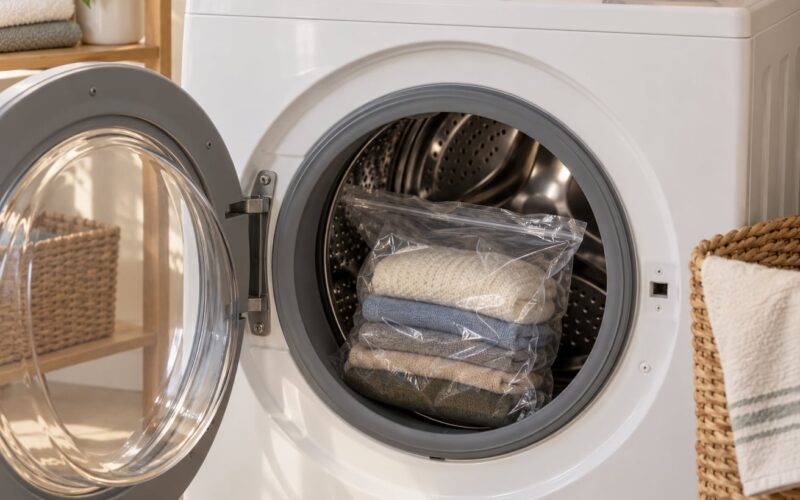
When you get home, run suspect clothing and bedding through a washer and then a dryer on high heat. The dryer is the part that matters: sustained high heat is what kills bed bug eggs, and a wash cycle on its own does not reliably do it. Seal anything you did not wash in plastic bags, keep it sealed for a period, and inspect the bags before opening them indoors.
If you wake up with clustered bites after a stay, watch for signs over the next several days rather than treating everything immediately. A traveler on r/Bedbugs woke with six or seven clustered bumps, found no evidence anywhere in the room, and also found a mosquito in the same room. Mosquito bites cluster like that too, and one serious cause of unnecessary panic is assuming every post-travel bump came from the bed.
Frequently Asked Questions
Can you see bed bugs in a hotel room?
Sometimes, but most of the time you will not see a live one. Adults are reddish-brown, flat and about the size of an apple seed, and they hide in seams during the day. What you are more likely to find is evidence: dark ink-like fecal spots the size of a pen tip, translucent cast skins, tiny pale eggs, or a rust-colored smear on a white sheet. A live bug is the only unambiguous sign, so treat reliable evidence as enough to call the front desk.
Where do bed bugs hide in a hotel room?
Start with the bed, then work outward. The mattress piping, tufts, folds, tags and handles hold the highest concentration, along with the top third of the mattress near the head. Next comes the box spring and its staple line, the headboard and the gap where it meets the wall, and the bed frame joints. Then check nightstand drawers, upholstered chair seams, curtains, baseboards, the luggage rack, the closet spare linens, and bedside objects like the alarm clock and light switch plate.
What does bed bug evidence look like?
Three signs matter most. Fecal spots are dark, ink-like marks about the size of a pen tip, often in a line or cluster, and they do not wipe off like dirt. Cast skins are the translucent shells left behind after a molt, and they crush to nothing. Rust-colored blood smears on a white sheet near a mattress edge usually point to a bed nearby. To confirm a suspect spot, dampen it and press a tissue over it: a genuine fecal mark smears reddish-orange. A single pale speck is usually lint.
What should I do if I think I found a bed bug?
Do not disturb it and do not sit or sleep on the bed. Photograph the sign, then note the room number, date, time and what you saw. Tell the front desk specifically what you found and where, and ask for a room change rather than moving rooms yourself. Avoid the adjacent room, the room above and the room below, since bed bugs travel through walls and along shared baseboards. Keep your belongings in the bathroom until you are in a room you have inspected yourself.
Is checking only the mattress enough to rule out bed bugs?
No. The mattress is where you are most likely to find something, but it is only one harborage site among many, and infestations spread outward to the box spring, headboard, nightstands, chair seams, curtains, baseboards and luggage rack. A clear mattress check also does not rule out an infestation, because field visual inspections miss a large share of them. A quick positive is meaningful; a quick negative is not. Hotels using canine teams or interceptor monitors are doing the detection work your eyes cannot.
Conclusion
If you do one thing, do this: put your bags in the bathroom, then take your flashlight to the bed. Work the mattress seams and piping, the top third near the head, the box spring staple line, the headboard and its gap with the wall, then the nightstand, the chair, the curtains and the luggage rack.
If you find a live bug or a sign that holds up, photograph it, write down the details while you are still in the room, and tell the front desk immediately rather than moving rooms yourself. Early reporting is worth far more than trying to diagnose or deal with an infestation on your own, and the hotel can move you somewhere sensible faster than you can.
And if you find nothing, that is a good result, not a guarantee. A clear room in five minutes lowers your risk. It does not eliminate it.