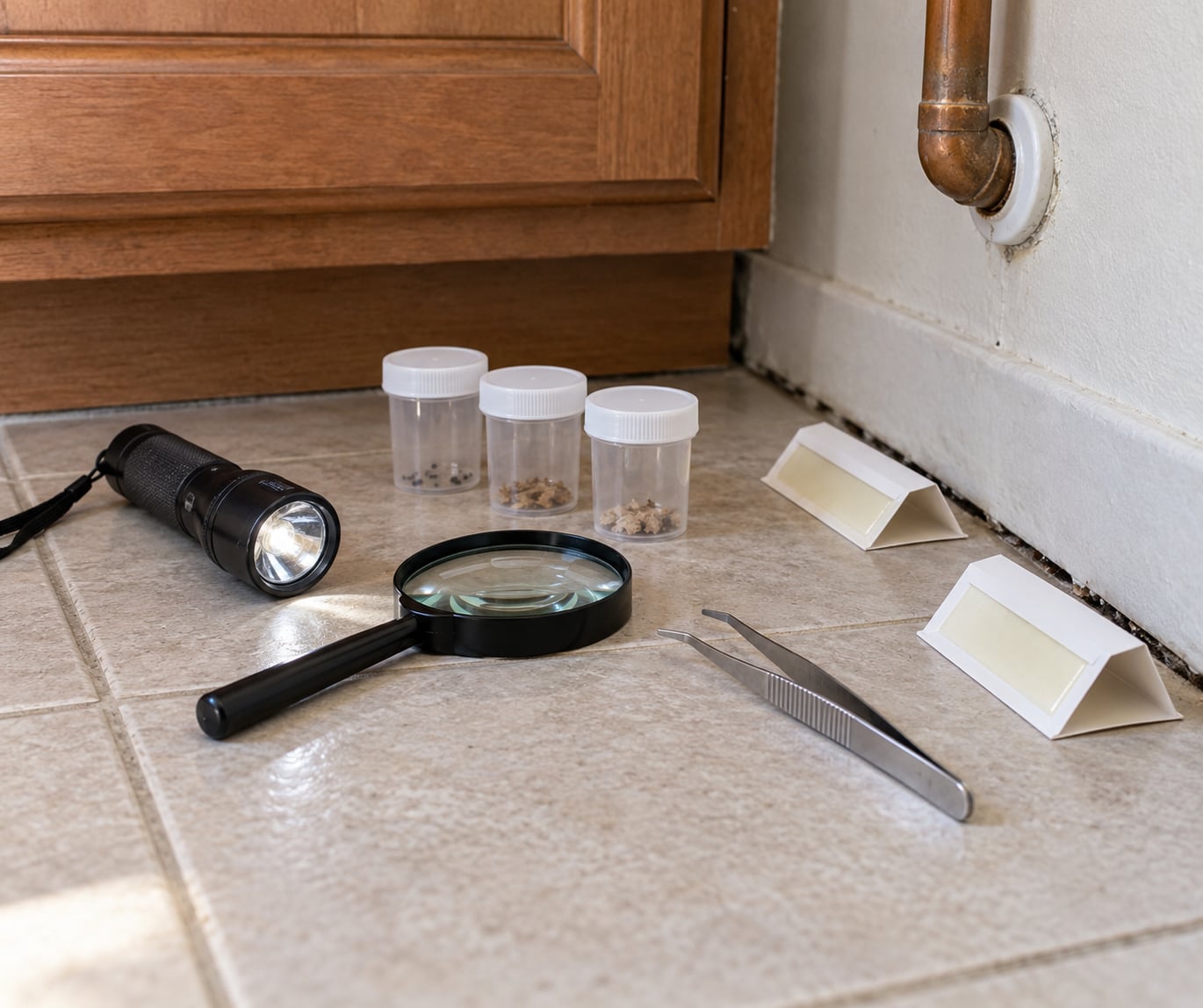
To find where cockroaches are coming from in a kitchen, work backward from the evidence: read the droppings and egg cases, set sticky traps and check them after 48 hours, run a flashlight inspection at night, then seal the gaps that feed them. Most people start at the opposite end, spraying whatever they see, and wonder why the same roach shows up the next night.
Kitchens draw roaches because kitchens have the three things they need at once: water, food residue, and a warm dark place to press against. A kitchen can be spotless and still qualify, as long as one crumb under the toaster rack or a slow sink drain is doing enough work. The inspection below takes about an hour in daylight, plus one late-night pass.
A note on what a nest actually is. Roaches do not build structures like ants. A nest is simply a warm, dark, enclosed harborage near food and water, where one roach feels as safe as a hundred would.
Table of Contents
- What You Need
- Step-by-Step: How to Find Where Cockroaches Are Coming From in a Kitchen
- 1. Look for Droppings, Egg Cases, and Shed Skins
- 2. Check Warm, Dark Places Near Food and Water
- 3. Trace Their Routes Along Edges and Surfaces
- 4. Inspect Plumbing Gaps and Other Entry Points
- 5. Search Adjacent Rooms and Hidden Nesting Areas
- 6. Place Sticky Traps to Confirm Activity
- 7. Decide Whether the Source Is Inside or Nearby
- 8. Seal the Source and Plan the Next Control Step
- Common Mistakes
- Frequently Asked Questions
- Where do cockroaches hide in a kitchen during the day?
- How can I tell if cockroaches are coming from a wall or pipe?
- Is finding one cockroach in my kitchen a serious problem?
- Should I move my refrigerator or stove to look for cockroaches?
- Why do cockroaches keep coming back after I clean the kitchen?
- When should I call a pest control professional for cockroaches?
- What to Do First
What You Need
- A bright flashlight. A headlamp frees both hands, which matters when you are holding a flashlight behind a stove and a phone in the other.
- A magnifying glass or your phone camera. Droppings and shed skins are small and easy to miss at arm’s length.
- Gloves. You will be touching shelf corners, cabinet interiors and under-sink plumbing.
- Paper labels and a pen. Trap positions get meaningless fast. Label each one with the room and location, not a number.
- Tweezers. For lifting an egg case or a dead roach without smearing the evidence around.
- A small mirror. A hand mirror or an old phone lets you look behind toe-kicks and under cabinets without moving anything.
- Sealed containers or bags. If you are a renter and need to show a landlord proof, you will want specimens kept intact and dated.
- Sticky monitoring traps. Optional, but the single most useful item on this list. Even plain commercial glue boards will work.
Skip anything that requires you to dismantle an appliance. Most of this inspection can be done with a flashlight and a mirror.
Step-by-Step: How to Find Where Cockroaches Are Coming From in a Kitchen
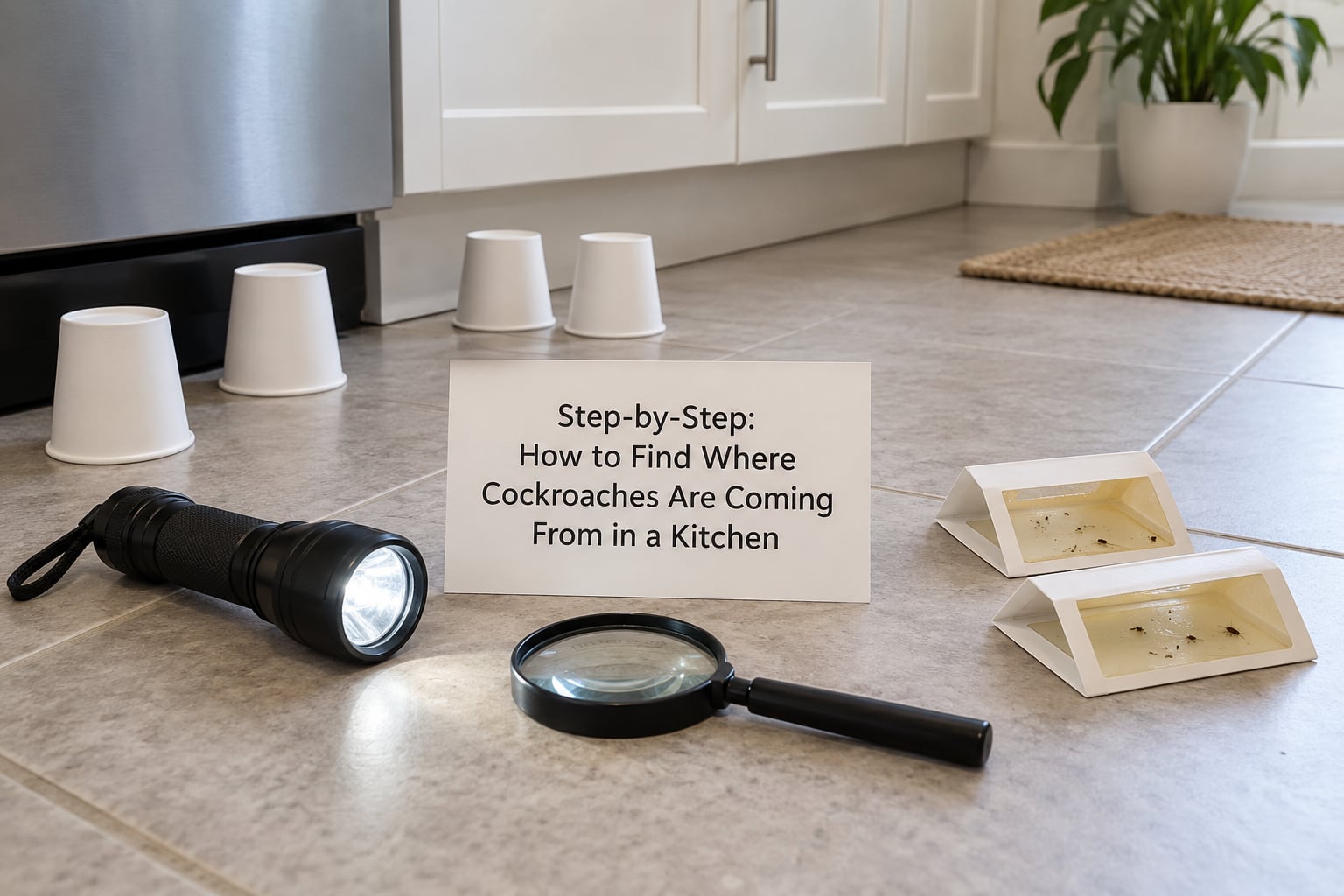
Follow these steps in order. Each one narrows the search, and doing them out of order means hauling a stove out for nothing.
1. Look for Droppings, Egg Cases, and Shed Skins
Droppings are the most reliable evidence you can get without buying anything. German cockroach droppings look like coarse ground coffee or ground pepper, and they show up in clusters, not as scattered single specks. Look on horizontal surfaces first: shelf interiors, drawer bottoms, the lip beneath a sink, the top edge of the refrigerator door gasket, and inside the cabinet above the stove.
Two other finds change what you do next. A brown, purse-shaped egg case, called an ootheca, means the population is reproducing inside your space, not passing through. Translucent shed skins, the molted exoskeletons left behind by growing nymphs, tell you a brood is living there and growing. Both turn a nuisance sighting into an established problem.
The pattern matters more than the count. Dense clusters on the bottom shelf of one cabinet mean that cabinet is the harborage. A thin scattering along the toe-kick says the roaches are traveling through, and the source sits further along the route.
2. Check Warm, Dark Places Near Food and Water
Cockroaches are thigmotactic, meaning they press against surfaces. They follow edges rather than crossing open floor, so the places to look are the places with tight contact: under the sink, inside the toe-kick of the base cabinets, in the cabinet corners, beneath the dishwasher, and behind the refrigerator.
Start under the sink and pull everything out. A slow drain under the sink gives the same room free water, and the cabinet directly above the dishwasher often hides a nest nobody has opened since moving in.
Do not move a refrigerator, stove, or dishwasher by yourself. They are heavy, and the gas line on a gas range or the water line on a dishwasher is not something to learn about on a Tuesday night. Slide out only what you can comfortably control, and use the mirror to look behind anything you cannot move.
3. Trace Their Routes Along Edges and Surfaces
Roaches leave a dark smear along cabinet edges and door frames, and a route that gets used often picks up a line of debris and droppings that follows the same path every time. Anywhere you see that line, follow it until it reaches a gap. That gap is either a hiding place or a way in.
Look along the countertop backsplash seam, the joint where the counter meets the backsplash, the base of the cabinet toe-kick, and the plumbing penetrations where a pipe meets the wall. Kitchen base cabinets often have a cutout at the back for pipes, and that cutout is a highway straight into the cabinet cavity and sometimes the wall behind it.
If you can, watch where a roach runs when you switch the light on. The common advice that roaches flee from light is only half right; much of the scatter comes from the air you displace. Either way, the direction it bolts tells you where its escape route goes, and that is the direction of the source.
4. Inspect Plumbing Gaps and Other Entry Points
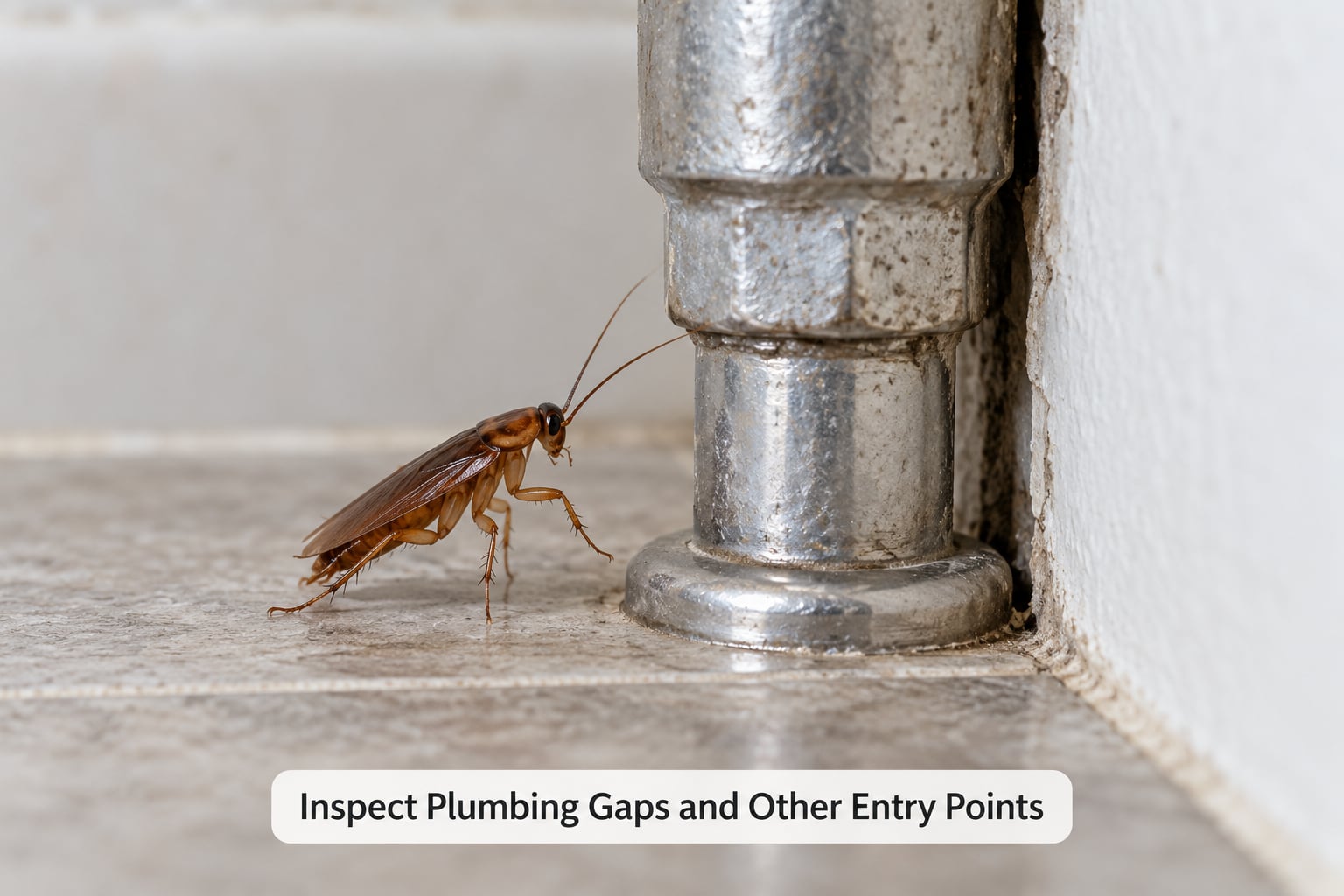
Cockroaches fit through a gap about as wide as a pencil, so a 6 mm opening is all any of them needs. That includes the space around sink and dishwasher drain pipes, the loose fitting where a pipe enters a wall, the gap under an exterior door, the back door threshold, and the hole around a hose bib or dryer vent.
Match the seal to the gap. Kitchen and bathroom penetrations that stay dry can be packed with silicone caulk, and gaps that might stay damp or that you want to reopen later take copper mesh stuffed in with a little expanding foam behind it. Door bottoms get a sweep or weatherstripping. Floor-level gaps around pipes get a rubber drain screen or a stopper, and a plugged sink at the end of the night is one of the cheapest entry blocks you can add.
Keep larger structural cracks, anything near wiring or a junction box, and anything on a gas or water line for a professional. If the gap sits where two apartments share a wall, note the address and location and hand it to your landlord or property manager with photos. That paperwork is the difference between a fix and a shrug.
5. Search Adjacent Rooms and Hidden Nesting Areas
Once the kitchen is clean of evidence, widen the circle. The bathroom, laundry room, basement, garage and utility areas all have the warmth and water that roaches need, and a nest near a laundry tub can feed the kitchen without ever being visible from it.
In apartments, the search has to go past your own door. Shared walls, the pipe chase behind the wall, the utility penetration where services enter, the hallway, the elevator area and the dumpster pad are all connected harborage. If activity shows up in the bathroom and a bedroom but never in the kitchen, think about the wall, the riser, or the apartment above or beside you rather than the cabinet.
Roaches on the kitchen ceiling are a specific clue, not a coincidence. That usually means a wall void, an attic or crawlspace route, or an upper apartment rather than anything at counter height. Dark streaks running down the ceiling from a corner or a light fixture are a good reason to bring in a professional, because a sealed void is not a weekend project.
6. Place Sticky Traps to Confirm Activity
Set traps where the evidence is heaviest, not in the middle of the floor. The useful spots are under the appliances, inside the lower cabinets, at the back corner where the wall meets the cabinet, and where drains and pipes meet the wall. Label each one, and check them after 48 hours before drawing conclusions.
Read the count as a number rather than a yes or no. Zero on every trap over 48 hours, with a clean inspection, suggests the sighting was an intruder and your source may be outside the home. A few across the traps spread out means low-level movement and a source still to be found. Heavily loaded traps, especially several in one cabinet, point at a harborage you can open and inspect directly.
Traps confirm and measure. They do not remove anything, and a trap you stepped on or a dusty board is useless, so replace them and lay fresh ones after you clean and seal.
7. Decide Whether the Source Is Inside or Nearby
What you found tells you which of four situations you are in. A warm, tight harborage with heavy droppings behind an appliance is an indoor source you can reach yourself. Repeated sightings in the same spot with light trap counts, plus fresh droppings appearing between visits, means roaches are entering from an adjacent space or a neighboring apartment. A single large roach near a door, a basement window or a floor drain, with no supporting evidence anywhere inside, reads as an outdoor migrant. Droppings concentrated in a wall void, on the ceiling, or spread through several rooms points to a building-level or plumbing-shaft problem.
Species helps narrow this further. A small tan roach with two dark stripes on its back and nymphs nearby is a German cockroach, which lives indoors year-round and is the hardest to trace because it stays close to harborage. A large reddish-brown roach with a pale figure-eight marking on the pronotum is an American cockroach, which usually enters from a drain, a basement, or an adjacent space. Brown-banded cockroaches show up in warm, dry cabinets, away from water. Outdoor species wander in, usually in warm weather, and rarely establish a colony indoors.
8. Seal the Source and Plan the Next Control Step
Work outward from the hot spot you identified. Remove and bag the clutter, clean the harborage surfaces, and scrub the grease film out of the cabinet corners and under the stove edge, because that film is part of the reason the spot was attractive. Fix the drip or slow drain that gave them free water, then seal the gaps you mapped in step 4.
Once the source is closed, put fresh sticky traps back in the same positions. Empty traps after another 48 hours are your proof the source is actually shut, which is the question tenants rarely get an answer to. If counts stay low but sightings continue, assume an unsealed route you missed and check the wall, the pipe chase and the neighboring space again.
Then decide between bait and professional work. Gel bait stations and boric acid applied to harborage surfaces work when the source is small, reachable and you can keep bait away from children and pets. Aerosol sprayed into an open space works almost as hard against the source as against the one roach you swatted: it disperses the colony into more hiding places and it kills the roaming adults rather than the ones holding down the food source. A heavy infestation, evidence in wall voids, or roaches that keep arriving from next door are the point where integrated pest management stops being a weekend job and starts being a scheduled treatment.
Common Mistakes
Most failed kitchen inspections come down to the same handful of mistakes.
Spraying before you locate the source. You kill one adult and scatter the rest into new hiding places. Correct it by putting the spray away and running the eight steps in order.
Cleaning without removing the food. Wiping a crumb from the shelf while the open grocery bag stays on the counter moves nothing. Put food in sealed containers, take the cardboard boxes out, and use a bin with a foot pedal rather than a loose lid.
Sealing only the one crack you found. If you can fit a pencil in it, so can they, and there is usually more than one route into a kitchen. Seal every penetration in the cabinet backs, the door thresholds and the plumbing lines before you call it done.
Moving a heavy appliance alone. A tipped refrigerator can damage a water line, and a pulled stove can damage a gas line. Pull only what you can control, and use a mirror for the rest.
Setting traps and never reading them. A trap you did not count is just a sticky board. Check at 48 hours, write the number down, and check again after you clean and seal.
Assuming one trapped roach settles it. A single roach with no droppings, no egg case and no shed skins is an intruder. The same roach alongside a nymph or an ootheca means the population lives there now.
Cleaning but not drying. Fix the drip under the sink, the sweating pipe, the damp cabinet corner and the condensation line on the refrigerator. Water is what keeps a harborage worth living in.
For prevention, the routine is short: sealed food, a bin that closes, a dry sink and dry floor, gaps sealed, and sticky traps sitting quietly in the lower cabinets so you notice activity before you see a roach. A few weeks of empty traps is the cheapest monitoring you will ever run.
Frequently Asked Questions
Where do cockroaches hide in a kitchen during the day?
During the day they stay in dark, warm, enclosed spots that press against a surface: under the sink, inside lower cabinet corners, behind and beneath the refrigerator, under the dishwasher, in the toe-kick, inside drawers, and along the seam where a counter meets the backsplash. Kitchen roaches are mostly nocturnal, so daytime sightings near these spots usually mean the population is dense rather than that the hiding place changed.
How can I tell if cockroaches are coming from a wall or pipe?
Look for droppings, shed skins, and egg cases that continue into a gap rather than stopping in open space. A dark smear running up a wall or out of a cabinet’s rear pipe cutout is a strong sign of a route there. Cockroaches on the kitchen ceiling, or streaks descending from a corner or light fixture, usually mean a wall void or the apartment above rather than anything at counter height.
Is finding one cockroach in my kitchen a serious problem?
On its own, usually not. One roach with no droppings, no egg case and no nymphs nearby is often an outdoor migrant or a lone stray from a neighboring space. One roach with shed skins or a brown egg case means reproduction is happening inside your home, and a German cockroach can go from a single female to a serious infestation within months. Record where and when you saw it and set traps to find out which situation you have.
Should I move my refrigerator or stove to look for cockroaches?
Pull out what you can comfortably control, but do not move a refrigerator or stove by yourself. Both can be heavy enough to injure you, and pulling a gas range or a dishwasher can damage a line. Use a mirror and flashlight to look behind them instead, and slide out only lightweight items like a crisper drawer. If you want the full appliance moved, have someone help you and unplug appliances well ahead of the inspection.
Why do cockroaches keep coming back after I clean the kitchen?
Most often the source was never closed. Cleaning removes the droppings and the food film but leaves the harborage, the entry gap and the water source intact, so the roaches that survive simply move down the hallway. Another cause is starving them out rather than baiting them, which pushes the population into new rooms instead of holding it near the source. Clean, dry, seal the route, then keep the traps in place to confirm.
When should I call a pest control professional for cockroaches?
Call a professional when you find egg cases or many nymphs, when activity continues after two weeks of cleaning and sealing, when droppings appear inside a wall void or on the ceiling, or when roaches keep arriving from a neighboring apartment in a multi-unit building. These cases need access you do not have, structural repairs, or bait placed in areas that are off-limits to you. Renters should involve the landlord first, with dated photos and trap counts to document the evidence.
What to Do First
Tonight, put sticky traps under the appliances, in the lower cabinets, and where the drains meet the wall. Tomorrow, pull everything out of the cabinet under the sink and check the cabinet above the dishwasher for droppings, egg cases, and shed skins. That combination tells you more than a week of guessing, and it is the whole method: read the evidence, map the route, close the gap, then count the traps again after 48 hours to confirm the source of cockroaches in your kitchen is actually shut.