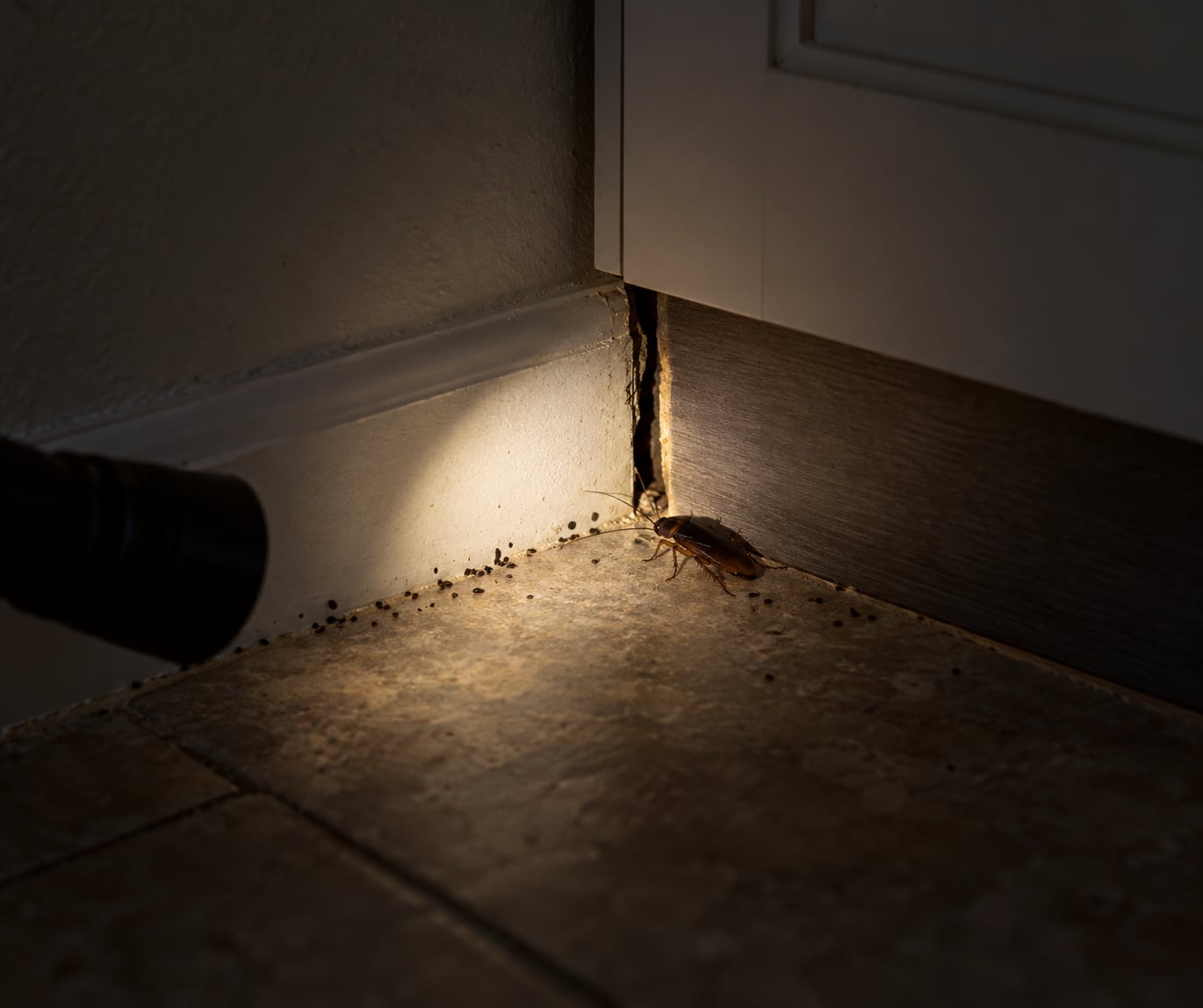
Cockroaches are nocturnal, and that single fact answers why cockroaches come out at night and hide during the day. They rest in dark, tight harbourages by day, then leave to forage once the house is dark, still and unattended, because their circadian clock, dim-light eyes and vibration-sensing hairs all mark staying hidden as safer until the lights go off.
The timing of a sighting is also a diagnostic signal. A roach crossing a dark bathroom floor at 2am is normal foraging. The same species sitting on a sunlit countertop at noon means the shelter nearby is full, or the population has outgrown it.
Below is what drives the night shift, where they spend the daylight hours, how to read the evidence they leave behind, and what to do about it.
Table of Contents
- Why Cockroaches Come Out at Night and Hide During the Day
- What Makes Roaches Active After Dark?
- Where Do Cockroaches Hide During the Day?
- How Can You Tell if Roaches Are Living in Your Home?
- Why Might Roaches Appear During the Day?
- Are You Seeing a German, American, or Oriental Cockroach?
- How to Find and Reduce Nighttime Cockroach Activity
- Common Myths About Daytime and Nighttime Roaches
- Frequently Asked Questions
- What to Do First
Why Cockroaches Come Out at Night and Hide During the Day
Four conditions have to line up before a cockroach leaves harbourage: enough darkness, enough stillness, a reason to move, and a route that is not blocked by you. Remove any one of them and most roaches stay put.
Why Cockroaches Come Out at Night and Hide During the Day
It starts with light. Roaches are photophobic, and their compound eyes are built for dim conditions rather than bright ones. A lit room is not just uncomfortable to them, it is exposed. Add an internal circadian rhythm tuned to darkness and the daytime hiding becomes the default state rather than a choice.
Sensory hardware reinforces it. Two organs called cerci sit at the rear of the abdomen and read air pressure shifts and vibration. A footstep, a slammed door or a chair dragged across a floor registers as a threat long before they can see you. Many of the hairs that cover their legs and antennae work the same way, picking up the small disturbances that tell a hunting bird or a vacuum cleaner is close.
By day they press into crevices, which is what entomologists call thigmotactic behaviour, a preference for contact on both sides of the body. It is why you find them along baseboards, in cabinet corners and behind appliances, squeezed into gaps that look far too small. A flattened adult can work through a gap around 6 mm wide, so hiding places are rarely obvious from the doorway.
That is the difference between night foraging and daytime hiding. By night they leave the harbourage on a route to water and food, usually hugging edges rather than crossing open floor. By day they go back and sit tight. When you see one in daylight, the usual explanation is overcrowding, recent disturbance, unusual heat or dryness, or genuine food scarcity nearby, which means the hiding spots can no longer hold the population.
What Makes Roaches Active After Dark?
Each factor below loosens or tightens their schedule. Light is the strongest lever, but a silent house matters almost as much because of how much vibration they detect.
| Trigger | Typical effect on activity | What it means for you |
|---|---|---|
| Low light or total darkness | Strongest single driver; emergence usually begins soon after lights go off | A dark, unused room is an open highway |
| Stillness and quiet | Makes movement safe; noise and vibration push them back into cracks | Vacuuming or rearranging furniture flushes them out |
| Food and cooking smells | Draws them out toward kitchens, even from wall voids | Overnight leftovers are an open invitation |
| Standing water or high humidity | Bathrooms, under-sink areas and leaking lines stay attractive all night | Fixing the drip removes a nightly reason to come out |
| Warmth | They are ectothermic, so warm spots speed up their metabolism and movement | Near a warm appliance or boiler, expect more movement |
| Dry, hot or cramped conditions | Can push them out of a harbourage in daylight hours | Seasonal heat can change the normal pattern |
| Recent pesticide use | Repels or kills on contact, scattering survivors to new rooms | Spray can move the problem, not end it |
Where Do Cockroaches Hide During the Day?
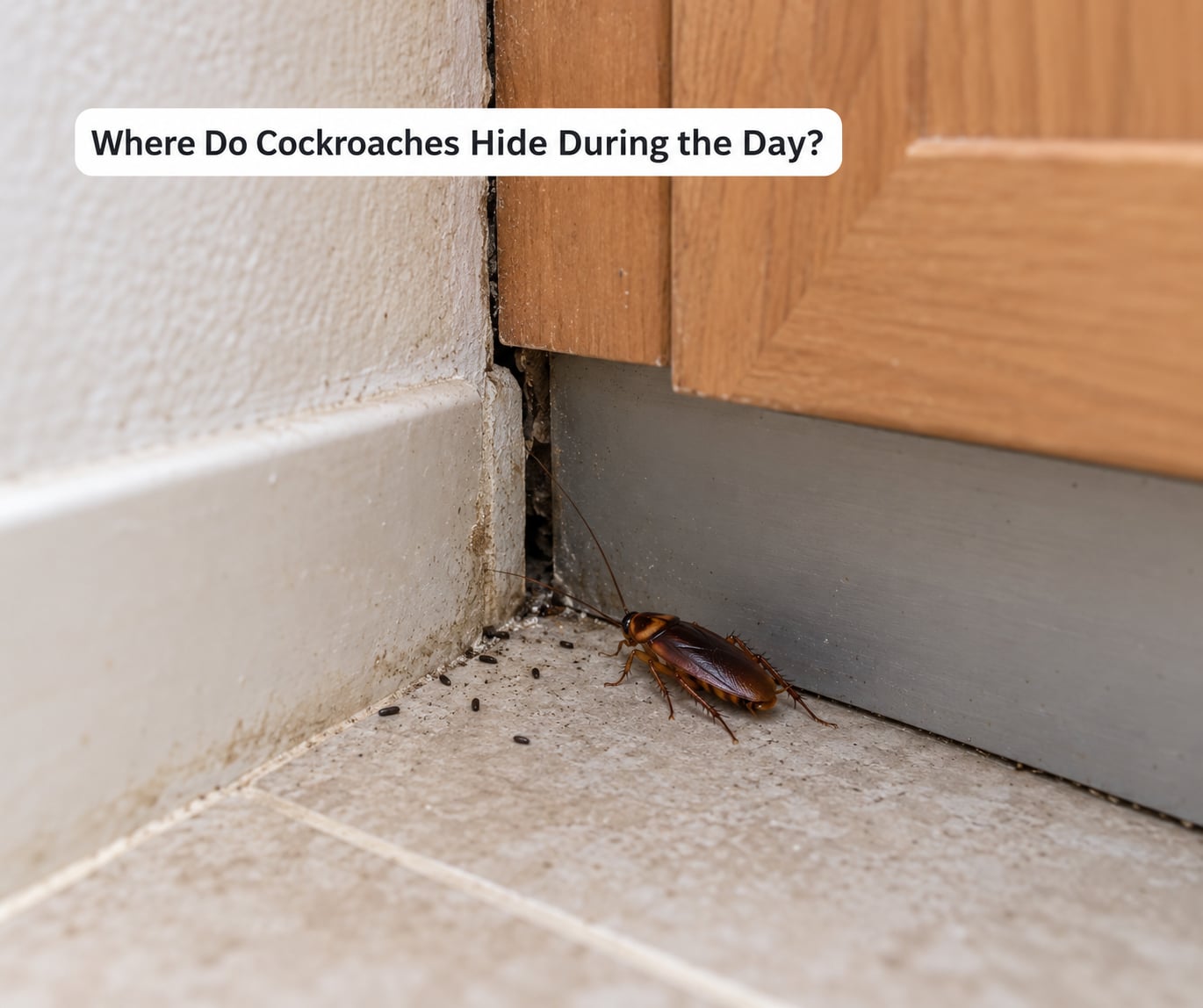
In the kitchen, start behind and under the appliances. The space behind a refrigerator, under the sink cabinet and inside the base of a stove or dishwasher runs warm and dark and stays undisturbed for years.
Then check the edges rather than the middle of a room. Baseboard gaps, the hinge side of doors, the joint where a counter meets a wall, the back corner of a drawer and the gap under a bathtub are all typical. Storage areas count too, since cardboard boxes stacked in a closet give them a sheltered vertical surface to grip.
In a bathroom, the usual harbourages are the vanity cabinet, the area behind the toilet, under the tub, and the plumbing chase where pipes enter the wall. That chase also explains bathroom sightings that seem to come from nowhere, because roaches travel through drain lines and pipe walls rather than across the floor to reach you.
Beyond the obvious rooms, they settle into wall voids, under baseboards along interior walls, in the gap above a dropped ceiling, and inside hollow-core doors. Warm electronics and game consoles attract them for the warmth, which is worth remembering before you blame the neighbour.
Light and movement reveal these spots fast. Flip a switch in a dark kitchen and anything on the wall or counter bolts for the nearest gap. Pulling an appliance forward or shifting stored items in a closet has the same effect, because both change the light and air movement in a space they had settled into.
How Can You Tell if Roaches Are Living in Your Home?
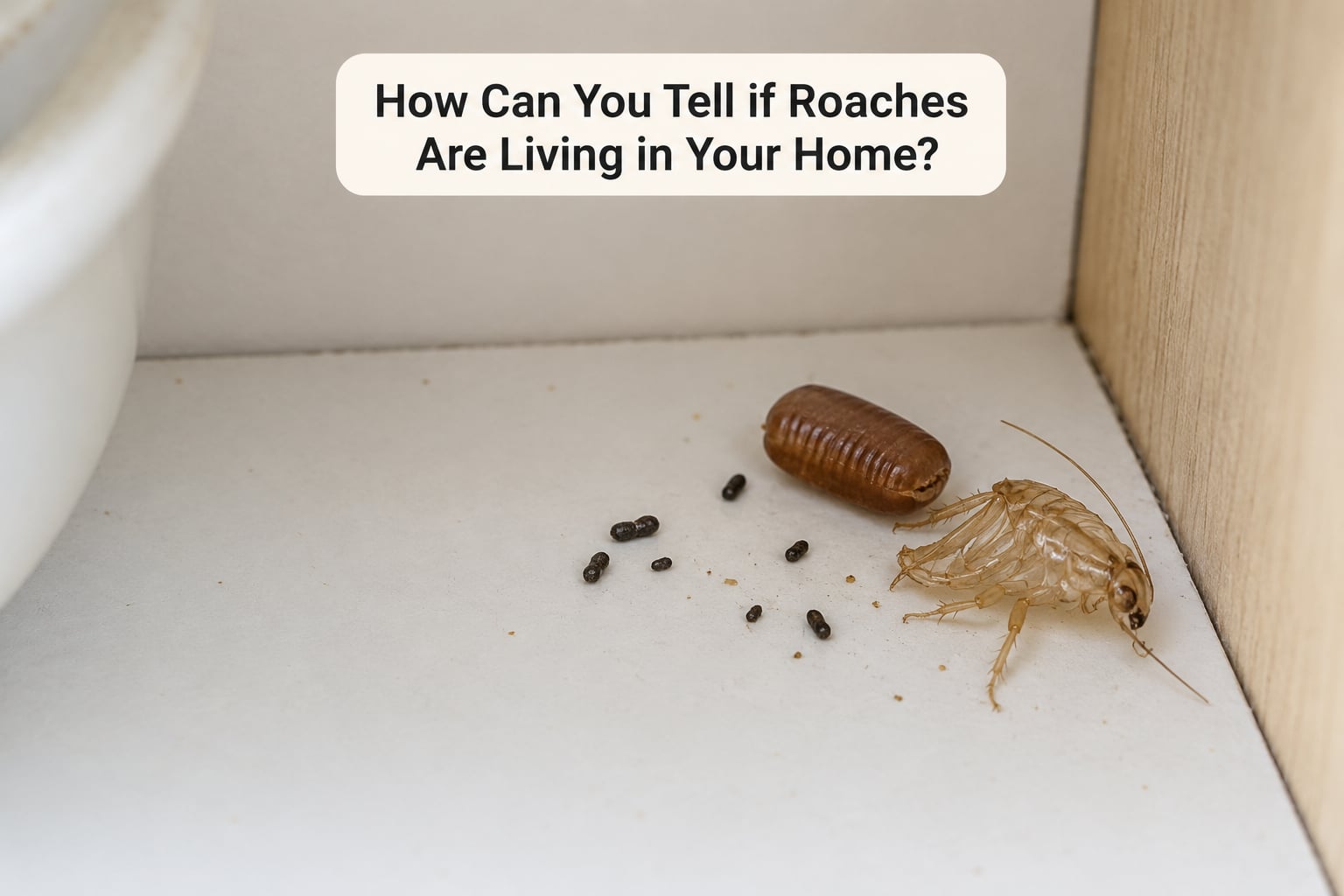
Night sightings get all the attention, but the leftovers tell a clearer story. Look for the evidence rather than the animal.
Droppings resemble black pepper grains or coarse coffee grounds, and they scatter along baseboards, under sink pipes, on shelves and inside cabinet corners. Groups of them near a hinge or an appliance foot mean repeated traffic rather than one visitor.
Egg cases, called ootheca, are brown, capsule-shaped and about the length of a small bean. German cockroach ootheca are carried by the female until they harden, so German infestations often show up as live nymphs instead of abandoned cases.
Shed skins and egg cases near a water source usually signal breeding nearby. So does a persistent musty or oily smell in a small enclosed space, which comes partly from faecal material and partly from the aggregation pheromones in droppings that keep others coming to the same spot.
Look for smear marks, which are dark streaks left where a body moved along a wall or surface. Damaged or chewed food packaging, greasy fingerprints on cupboard handles, and rust-coloured spots on dishware are less obvious but point the same way.
And listen. Kitchen cabinets, closets and wall voids that rustle after lights go off mean activity in daylight hours you never see.
One sighting proves a roach is inside your home. It does not tell you how many are hiding, or whether they bred here or arrived through a shared wall from a neighbouring unit. Only patterned evidence over several nights gives you that.
Why Might Roaches Appear During the Day?
Common causes, roughly in the order they show up in most homes:
- The shelter is full. When harbourage capacity is exceeded, individuals are pushed out during daylight hours. This is the most common explanation and usually means a developed population rather than a stray.
- Recent pesticide application. Sprays kill or repel on contact and scatter survivors into adjacent rooms and wall voids, where the light and air conditions look better for a few days.
- Disturbance. Moving furniture, deep cleaning, a renovation or a water leak destroys their settled spot and flushes them out mid-day.
- Heat or dryness. They are ectothermic. A very hot, dry spell or a furnace running constantly can make harbourage less comfortable than open floor.
- Food scarcity nearby. When accessible food disappears, roaches travel further and take chances in the open, sometimes during the day.
- Pressure from outside. A neighbouring unit in an apartment building, or a heavy outdoor population in warm months, pushes roaches through shared drain lines, pipe chases and entry gaps.
Nymphs are the sighting that most deserves attention. Babies cannot fly or climb well and stay close to the harbourage, so a nymph in a bathroom sink or a bedroom means breeding nearby, not a single intruder.
Are You Seeing a German, American, or Oriental Cockroach?
Colour alone is unreliable, so use size, markings, speed and location together. A German cockroach has two dark stripes running lengthwise along its back and moves quickly when disturbed. An American cockroach is much larger, reddish brown with a pale figure-eight marking behind the head, and runs rather than scurries. An Oriental cockroach is dark, glossy and sluggish, and it often shows up in cool basements and damp ground-floor areas.
| Species | Size and appearance | Nighttime behaviour | Where it usually lives | Clue to look for |
|---|---|---|---|---|
| German cockroach (Blattella germanica) | Small, pale tan, two dark back stripes | Strongly nocturnal, very fast when disturbed | Kitchens, bathrooms, warm indoor harbourage | Nymphs in the sink or on counters; live-carried ootheca |
| American cockroach (Periplaneta americana) | Large, reddish brown, pale marking behind the head | Nocturnal, fast runner, may briefly fly | Basements, utility areas, kitchens, outdoor drains | Sewage drain entry, sightings in laundry or basement |
| Oriental cockroach (Blattella orientalis) | Large, dark black-brown, glossy | Nocturnal but slow and less skittish | Cool damp areas, basements, ground floor | A high population count in a moist hidden space |
| Brown-banded cockroach (Supella longipalpa) | Small to medium, two pale bands across the wings | Nocturnal, prefers warmth and height | Upper floors, shelving, electronics | Activity away from kitchen water sources |
Accurate identification from a photo is genuinely hard, so treat a photo as a starting point rather than a verdict. If you need certainty before choosing a treatment, send a sample or several clear pictures to a pest management professional.
How to Find and Reduce Nighttime Cockroach Activity
The night check is a five-step survey you can finish in about thirty minutes, and it tells you far more than any spray.
- Wait two hours after lights out. Let the house sit dark and still so the usual night traffic has started.
- Walk the kitchen and bathroom with a flashlight. Shine along baseboards, under the sink, around the toilet base and behind appliances. Droppings, smear marks and shed skins are easier to spot than moving roaches.
- Place sticky monitoring traps in protected spots. Under the sink, behind the stove, in the bathroom vanity and inside a low cabinet. Flat against the wall, not in the middle of the floor. Check them after a night and note the count and the location.
- Remove the reasons they come out. Wipe down counters, put food in sealed containers, take rubbish out before bed, scrub grease off stovetops and fix or mop standing water. Each of these removes a reason for the night trip.
- Seal and dry. Fill gaps around pipe entries, baseboards, door hinges and under 6 mm openings with silicone or steel wool, and repair dripping taps and leaky lines.
A night survey run three nights in a row gives you a rough severity read. A single trap with one or two roaches on it, and nothing visible elsewhere, is an early problem you can often solve with sanitation and sealing.
Repeat sightings every night, multiple roaches per trap, nymphs in open areas, activity during daylight, or noise and droppings in more than one room all point to an established population. That is the point where a licensed pest management professional is worth the call, particularly in multi-unit buildings where roaches move through shared pipe walls.
One more warning about reactive spraying. Aerosol sprays kill on contact and repel what survives, so the survivors scatter to a new harbourage instead of dying. Targeted bait stations and dust applied into cracks do the opposite: roaches carry bait back to the aggregation site, where the colony feeds on it. Professionals working this problem generally favour baiting around plumbing and entry points over interior sprays for that reason.
Common Myths About Daytime and Nighttime Roaches
Myth: they come out because the room is dark. Darkness matters, but stillness matters nearly as much. Roaches pick up air currents and vibration through their cerci and leg hairs, so a quiet dark room is far more inviting than a dark one with a running dishwasher.
Myth: seeing one in daylight is harmless. It depends entirely on the context. A single roach scurrying across a dark hallway is normal. Repeated daytime sightings, nymphs in open rooms, or droppings inside cabinets point to a populated harbourage and warrant action.
Myth: leaving the lights on solves it. It slows them down for a while and does nothing else. The roaches still find harbourage, still breed, and the wasted bulbs become your electricity bill.
Myth: all indoor cockroaches behave the same way. Species differ in speed, preferred temperature and moisture, and not every cockroach species is nocturnal. Many forest species are diurnal, active in daylight, living in leaf litter. The indoor pests you meet in American kitchens are a small, heat-loving, night-active group, and their habits should not be generalised to every cockroach on the planet.
Frequently Asked Questions
Does seeing a cockroach during the day mean I have a severe infestation?
Not automatically, but it is worth taking seriously. Daytime sightings usually mean the nearby harbourage is full or disturbed, so the population has grown past what the cracks and cabinets can hold. Check for droppings, nymphs and egg cases to confirm. A single sighting with no other evidence may be a stray through a shared pipe, while repeated sightings plus nymphs in open areas point to a real indoor population.
Are cockroaches more active at night or during the day?
Night, in nearly every indoor case. Roaches are nocturnal and hide during the day because light and disturbance expose them to predators and to you. Their circadian clock, light-sensitive eyes and vibration-sensing cerci all push them out after dark. Seeing them in daylight instead points to crowding, heat, disturbance, food scarcity or pressure from a neighbouring unit rather than a normal schedule change.
Why did turning on the kitchen light make a cockroach run away?
Light and movement both registered as danger. Roaches are light-avoiding, and their cerci detect the change in air currents from a hand or a door as vibration. The combination triggers an instant escape response toward the nearest gap or edge. That rapid scatter is also a useful tip that something is living in the wall or cabinet near where you saw it.
What time of night are cockroaches most active?
Activity typically builds through the first hour or two after lights go off, once the house is quiet and still, and continues until dawn. There is no fixed clock for every home. Warm rooms, cooking smells and standing water pull more of them out earlier, and cooler late-night hours often slow them down. A check about two hours after lights out catches a good sample of normal night traffic.
Should I move appliances or furniture to look for cockroaches?
Moving them works well as a one-off inspection, since pulling an appliance forward changes the light and air movement and flushes roaches out. Stop there. Repeated shifting disturbs settled harbourage and can push roaches into open areas during the day. Inspect once, note what you find, then push everything back into place and seal the gaps around pipes and skirting instead.
What to Do First
Two hours after lights out tonight, walk the kitchen and bathroom with a flashlight and check for pepper-like droppings along baseboards and under the sink. Then set sticky traps in the same spots and compare the counts in the morning.
That single survey usually tells you what the daytime sightings could not: whether this is one stray, a small population, or a full harbourage driving roaches into the open.
Then remove what draws them out. Seal food, take rubbish out before bed, clear standing water and drips, close gaps around pipes and skirting, and keep food in closed containers. Knowing why cockroaches come out at night and hide during the day gives you the map of their range, and cutting off food, water and entry points at the same time is what makes the difference.
Call a licensed pest management professional if you see roaches in daylight, find nymphs, notice activity in several rooms, live in an apartment with a neighbouring problem, or get repeated trap counts after a couple of weeks of clean-up. In multi-unit buildings, baiting and sealing often has to happen across the shared pipe chases, not just inside your own unit.