If you’re asking why mosquito repellent stops working on you, the honest answer usually comes down to a short list: the product expired, you applied too little, it was wiped off by sweat or water, it never matched the conditions you were in, or mosquitoes found you through attraction cues stronger than the protection you applied. None of that means repellent is useless. It means the failure has an addressable cause.
Most of the people who ask this question aren’t using the wrong ingredient. They’re using the right one badly, or they’re expecting protection to outlast what the label promises. Repellents work by confusing the chemical receptors on a mosquito’s antennae, which masks the scent and heat cues it uses to track you. That masking layer thins over time, and the moment it drops below the level that hides you, the mosquitoes come back. 2026 updated guidance still points to the same handful of practical causes.
The rest of this guide walks through how to identify which cause is yours, what to change, and when it’s worth switching products entirely. Follow the directions on whatever product you use, since labels differ by formulation.
Table of Contents
- Why Mosquito Repellent Stops Working on You
- 7 Fixes That Can Improve Repellent Protection
- How to Apply Mosquito Repellent Correctly
- DEET, Picaridin, IR3535, and Other Active Ingredients
- Does Sweat, Water, Sunscreen, or Rain Reduce Protection?
- When to Switch Mosquito Repellents
- Safety and Bite-Prevention Basics
- Frequently Asked Questions
- Why does mosquito repellent seem to stop working after a few hours?
- How often should I reapply mosquito repellent when I am outside?
- Is a higher percentage of DEET always better for preventing bites?
- Can I use mosquito repellent with sunscreen or after swimming?
- Why do I still get mosquito bites after applying repellent?
- What should I do if mosquito repellent causes skin irritation?
- What to Do First
Why Mosquito Repellent Stops Working on You
Four things have to go right for repellent to protect you, and it only takes one of them failing for the product to feel like it stopped working.
The active ingredient has to be there at full strength. DEET, picaridin, IR3535, and oil of lemon eucalyptus all wear down gradually as they evaporate, break apart under UV light, absorb into skin, and get rubbed away by clothing. The layer thins whether or not you notice it happening.
You have to have enough on. Repellents are tested at specific application rates. Under-applying is the single most common reason people report failure, and a quick mist that smells strong at first is often well below anything the label describes.
The film has to survive. Sweat, swimming, towel drying, rain, and friction against clothing all remove or thin repellent faster than the clock does. Heat speeds things up too, which is why a summer afternoon and a cool evening don’t behave the same way.
The repellent has to matter more than your other cues. Mosquitoes home in on carbon dioxide, body heat, and odor compounds produced by skin bacteria. If the ambient attraction is unusually strong that day, a thin layer of repellent may simply not be enough to override it.
There’s also a timing expectation problem. Protection duration on a label is measured under specific test conditions, not in a backyard during a humid afternoon with hard work. Treating the label number as a guarantee is the most common reason people think the product failed.
How to Tell Why Mosquito Repellent Stops Working on You
Run through these questions in order, because they separate the cheap causes from the ones that need a different product.
Is the bottle old? Look for an expiration or a purchase date. Old stock can separate, change color, or lose potency.
Was your skin wet or sweaty when you applied? Repellent applied over damp skin spreads unevenly and dilutes.
Did you use less than the label calls for? People routinely treat “more” as “better” but “more” as dangerous, so they use a fraction of the amount.
Did you only treat one small area? Ankles, the back of the neck, elbows, and the strip of skin above your socks get missed constantly.
Did you expect it to outlast the label? If protection faded at four hours and the label said four hours, the product worked as designed.
Are you being bitten by something that isn’t a mosquito? Deer flies and stable flies hunt almost entirely by sight and largely ignore topical repellent. If the bites are hard, immediate, and bloody rather than itchy welts, you may be fighting the wrong insect.
Does the pattern change day to day? Mosquito activity tracks species, breeding water nearby, time of day, temperature, and wind. A repellent that works in May can feel broken in August in the same yard.
7 Fixes That Can Improve Repellent Protection
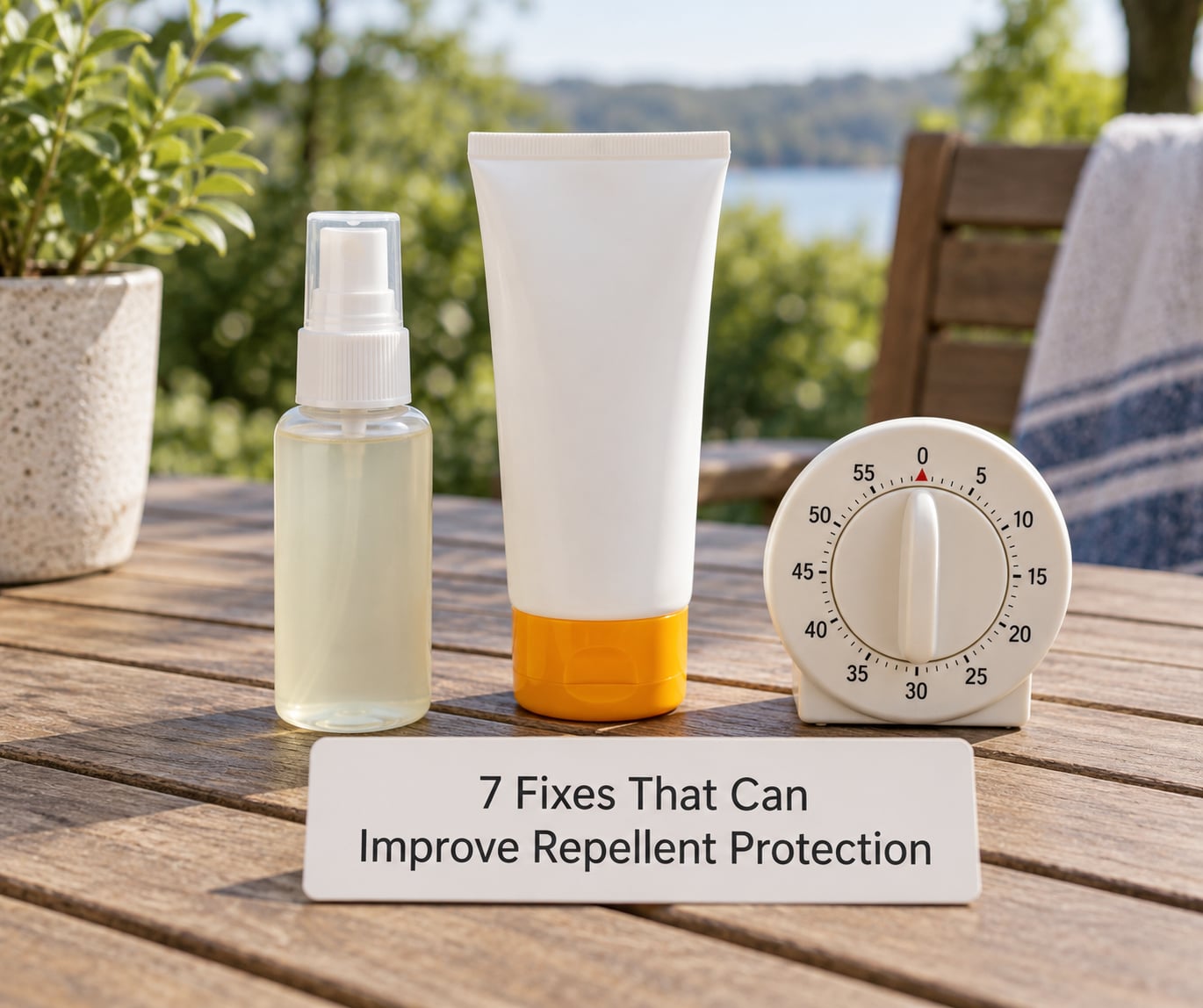
Each of these targets a different reason repellent underperforms. The order roughly follows how often each one turns out to be the culprit.
1. Check that the product is registered and appropriate for the job. In the United States, an EPA-registered label is the only document that tells you what the product was evaluated to do, for which insects, and for how long. Buy the registration number before you buy the price.
2. Use the amount on the label, every time. Pumps exist to make this consistent. A measured pump-and-spread beats a hopeful spray, and it takes about as long.
3. Cover all exposed skin, including the spots you forget. Ankles, wrists, the back of your neck, elbows, knees, and the skin above socks and at your waistband account for most missed bites.
4. Reapply after water, heavy sweating, or towel drying. This is the fix that changes outcomes most for people who work outdoors, swim, or hike. Set a timer rather than trusting your sense of time.
5. Don’t let application order work against you. Apply sunscreen first and let it dry before repellent goes on. Reversed, the repellent can be absorbed or blocked rather than sitting on the surface as its own layer.
6. Keep repellent off gear it can damage, and off surfaces it can be diluted on. Concentrated products soften some plastics, watch bands, sunglass frames, and synthetic fabrics. Applying to a wet surface also dilutes it.
7. Switch the active ingredient or format when bites continue. If you’re doing all of the above correctly and still getting bitten, the problem is probably fit: wrong duration for your outing, wrong ingredient for your skin, or a different insect entirely.
How to Apply Mosquito Repellent Correctly
Most labels give one instruction and it changes how you should read the whole product: apply to exposed skin, not under clothing. Repellent under a shirt can’t evaporate, can’t dry, and often ends up smeared rather than spread.
Sprays go on first, lotion or cream goes on second, and sticky sticks are for spot touch-ups where a wet product would be inconvenient. Aerosols need the skin damp enough to distribute, then time to dry. Wipes suit a face or a quick touch-up and rarely last as long as a lotion.
How to tell an application worked: the skin should look evenly damp or glossy right after, not patchy, and the scent should be noticeable but not overpowering. A strong smell that fades within minutes is usually a sign of too little product, not a strong product.
| Format | Best for | Watch out for |
|---|---|---|
| Aerosol spray | Large body areas, quick application | Easy to under-apply; propellant overshoots and wastes product |
| Lotion or cream | Even, measured coverage on skin | Slower to apply; can feel greasy in heat |
| Pump spray | Consistent dosing you can repeat | Can collect at the nozzle if stored warm |
| Sticky stick | Face, hands, spot touch-ups | Shortest protection; easy to overshoot onto surfaces |
| Wipes | Travel and picnics | Small surface area, brief coverage |
| Permethrin-treated clothing | Long stretches in tick and mosquito country | Fabric only, never on skin; toxic to cats |
DEET, Picaridin, IR3535, and Other Active Ingredients
Repellent does not kill mosquitoes, and that distinction matters when a product seems to have “stopped working.” These ingredients block or disrupt detection rather than killing anything, so there’s no dose at which they become more lethal, only a range where the odor signal stays masked.
Higher concentration is not automatically better protection. What increases is duration, because a heavier active load takes longer to wear off. That’s the trade field workers describe: around 30% DEET is where added concentration mostly extends hours rather than adding coverage, and above that the cost, the smell, and the risk to plastics and fabrics rise faster than the benefit.
| Ingredient | How it works | Duration on the label | Best fit |
|---|---|---|---|
| DEET | Overloads olfactory receptors so the mosquito can’t sort your scent from background | Ranges from a few hours up to full-day claims at high concentrations | General purpose, wide availability, hard research base |
| Picaridin | Masks odor and taste cues on close approach | Several hours on most labels | People who dislike DEET odor or the grease |
| Oil of lemon eucalyptus / PMD | Interferes with sensory receptors before biting | Several hours | A non-DEET option; not for infants under 2 months |
| IR3535 | Imitates a chemical cue that blocks mosquitoes from landing and feeding | Several hours, longer in sustained-release formulas | Sensitive skin and everyday use; can affect some plastics |
| Citronella and other essential oils | Brief masking of odor | Usually well under an hour | Light exposure only; far weaker than registered actives |
One important label detail gets missed constantly: oil of lemon eucalyptus repellent is a specific extract rich in PMD, and it is not the same thing as lemon eucalyptus essential oil you can buy for aromatherapy. Only the registered extract carries an efficacy evaluation.
Does Sweat, Water, Sunscreen, or Rain Reduce Protection?
Water does the most damage of anything in that list. Swimming, a soaking rainstorm, or even standing in surf will remove much of the protective layer, and the drying and rubbing that follows takes the rest.
Sweat works more slowly but steadily. It carries the active ingredient off the skin surface and, in hot weather, raises the rate at which it evaporates and breaks down. People who work in the yard or train outdoors in summer usually need to reapply on a schedule rather than on a feeling.
Sunscreen is mostly an order-of-operations problem. Both products want to sit on the surface of your skin, and layering them carelessly leaves one displaced or diluted. Sunscreen first, repellent second, and give it a moment to dry.
Towel drying gets missed almost universally. The towel removes whatever film survived the water, so the drying step quietly cancels the coverage you paid for.
Rain matters less than people expect if you’re wearing a layer between skin and sky, and it matters a great deal if you aren’t. Wind is worth mentioning too: a strong breeze disperses spatial products such as plug-in or fuel-burning repellers quickly, which is why some of them stop working outdoors in a breeze but not in a still room.
When to Switch Mosquito Repellents
Switching makes sense when the product is right but the situation outgrew it. A picnic and a week of backcountry work don’t ask the same questions of a repellent.
Exposure longer than the label covers. If the protection window ends before you’re indoors, move to a formula labeled for longer coverage rather than topping up a short one all day.
Sensitive skin or irritation. Fragrance-free and gentler formulas usually mean a different active ingredient, not just less scent in the same one.
Children. Products are tested and labeled for age groups, and the under-2-month category is a hard line. Never apply a repellent to a child’s hands, since children put hands in their mouths.
Heavy sweat, water, or work conditions. A wipe or stick format is easier to reapply mid-task than a full lotion application.
When bites continue despite correct use. Add physical protection instead of escalating strength: long sleeves and pants, permethrin-treated clothing where the label allows it, screens, bed nets, and air movement. Permethrin is for fabric only and is dangerously toxic to cats, so keep treated gear away from them.
When the biting insect isn’t a mosquito. Deer flies and stable flies are visual hunters. Repellent, permethrin, and area products will disappoint you; mesh head nets, moving targets, and visual traps work far better.
Safety and Bite-Prevention Basics
The general rule is simple: use the product exactly as the label says, every time. The label is the safety instructions and the efficacy instructions at the same time.
Apply to exposed skin only, avoid the eyes and mouth, keep repellent off broken skin unless the label permits it, and wash it off when you get home. Don’t spray near flames, and don’t let aerosol dry on a patio table where someone might sit.
Wash hands after handling it and after applying it to someone else. Products that melt plastic and damage synthetic fabric deserve a moment of thought before they go in your pocket next to a phone case.
Environmental control still does real work: screens on windows and doors, remove standing water in containers and gutters, and use air movement where you’re sitting outside. Bite prevention is easier when you aren’t relying on one product alone.
For personal safety questions, a reaction, or travel health advice, talk to a pharmacist, your doctor, or your local public-health authority. Repellents used as directed are considered safe for everyday use, including during pregnancy, which is why so many public-health bodies recommend them rather than telling people to avoid outdoor time.
Frequently Asked Questions
Why does mosquito repellent seem to stop working after a few hours?
Because the active ingredient is always being removed. Sweat, water, rubbing against clothing, heat, and UV light all thin the protective layer, and the scent and heat cues mosquitoes use to find you start showing through again. Label durations are measured under test conditions, so a hot afternoon or a long workday will outlast them. Reapply when the label tells you to, and after any water or heavy sweating.
How often should I reapply mosquito repellent when I am outside?
Follow the interval printed on the label, since it varies by product and active ingredient, and reapply sooner after swimming, toweling off, or sweating heavily. In practice that means treating reapplication as a timed step rather than something you notice you need. Setting a phone reminder works well for full days outdoors. If mosquitoes start landing and probing without landing, that is a good sign your layer has thinned.
Is a higher percentage of DEET always better for preventing bites?
No. Higher DEET percentages mostly extend how long the protection lasts rather than how wide it covers. Beyond roughly 30 percent, most of the extra benefit is extra hours, and the downsides rise with it: stronger odor, more residue, and a greater chance of affecting plastics, watch bands, and synthetic fabrics. Many people get more usable protection from a mid-range formula they can reapply comfortably than from the strongest one they use once and dislike.
Can I use mosquito repellent with sunscreen or after swimming?
Use both, in the right order. Apply sunscreen first, let it dry, then put repellent over exposed skin. Applying repellent first can leave it displaced or absorbed into the sunscreen layer. After swimming, reapply according to the repellent label rather than assuming the water only diluted it slightly. Towel drying removes more protection than most people expect, so treat the towel as a reason to reapply.
Why do I still get mosquito bites after applying repellent?
Common reasons are under-application, missing spots like ankles and the back of the neck, applying over damp skin, letting sweat or water remove the layer, and expecting more hours than the label allows. Some of it is not mosquitoes at all. Deer flies and stable flies hunt by sight and mostly ignore topical repellent, which is worth checking if the bites are painful and immediate rather than itchy welts.
What should I do if mosquito repellent causes skin irritation?
Wash it off with soap and water and stop using that product. A rinse-off reaction is different from an allergic one, and if you develop hives, swelling, or breathing difficulty, treat that as urgent medical care rather than a product to test again. For sensitive skin, look for a product labeled for it, often fragrance-free and based on IR3535, and patch-test on a small area before full application. A pharmacist can help you compare options.
What to Do First
Check the expiration date and the label on the bottle in front of you. Then apply the labeled amount to all exposed skin, including ankles, wrists, and the back of the neck, and put a reminder in your phone for the reapply time the label specifies.
If bites still show up after a full day of correct use, change one thing at a time: switch active ingredient, switch format, add treated clothing and physical barriers, or check whether the insect you’re fighting is even a mosquito. That last check solves more cases than people expect.