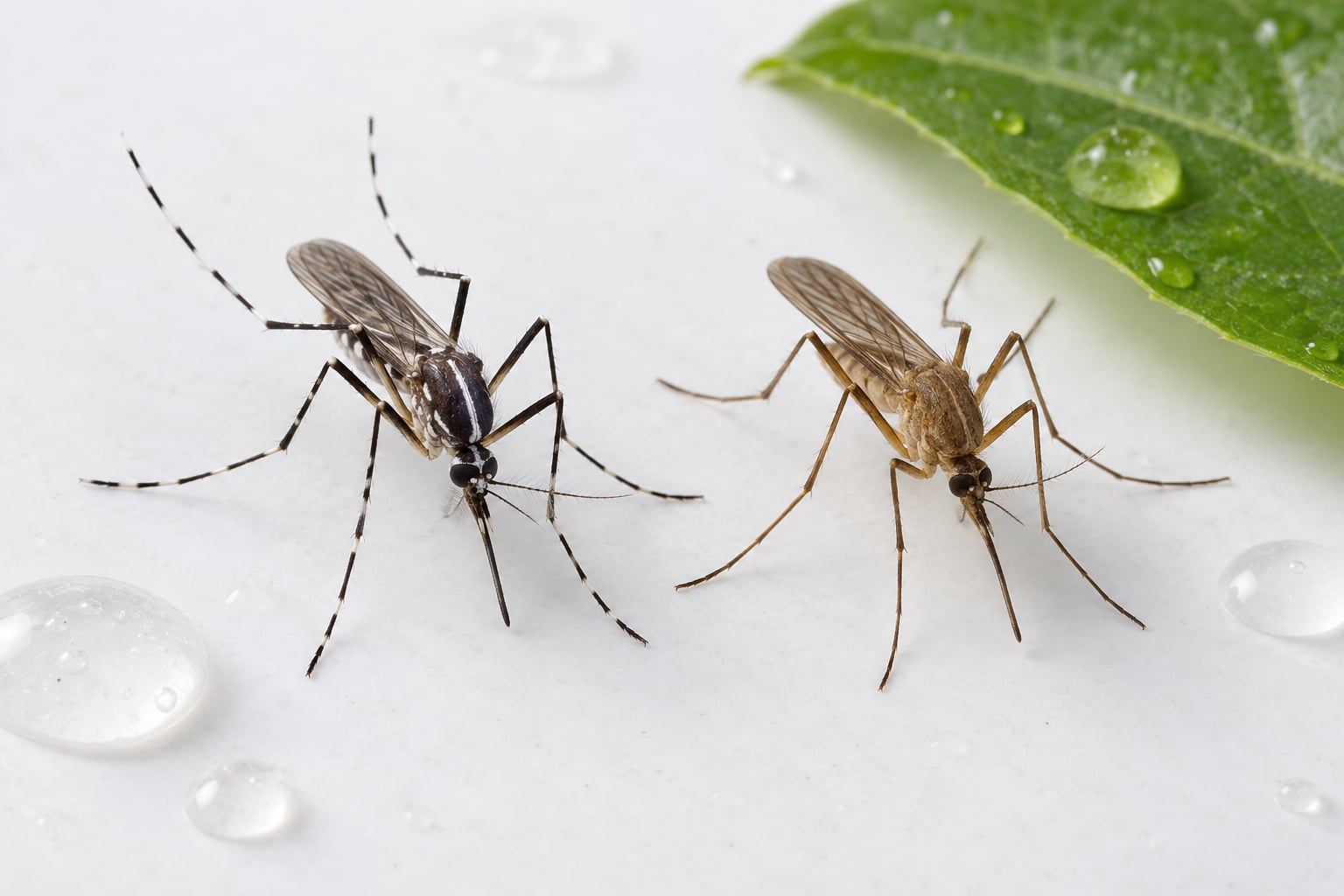
Get the difference in one pass: the Asian tiger mosquito (Aedes albopictus) is a small black-and-white striped insect that bites in daylight and breeds in tiny containers, while the common house mosquito (Culex pipiens in the north, Culex quinquefasciatus in the south) is a plain tan-brown species that feeds from dusk to dawn in larger pools of standing water.
Those two differences do most of the identification work for you. Color tells you which species is on your arm, and the hour it bit tells you the same thing when you never got a clear look at the insect.
It matters because the control targets are opposites. A tiger mosquito population lives in the things you left on the patio, and a house mosquito population lives in the yard water you stopped looking at in September. Draining a bird bath does nothing for one of them and nearly everything for the other.
Table of Contents
- Asian Tiger Mosquito vs Common House Mosquito at a Glance
- How to Tell Asian Tiger Mosquitoes and Common House Mosquitoes Apart
- Behavior and Habitat Differences
- Asian Tiger Mosquito vs Common House Mosquito: Biting and Disease Risk
- Which Mosquito Is More Likely in Your Area?
- Why Accurate Mosquito Identification Matters
- Frequently Asked Questions
- Conclusion: Start With the Markings, Then Reduce Breeding Water
Asian Tiger Mosquito vs Common House Mosquito at a Glance
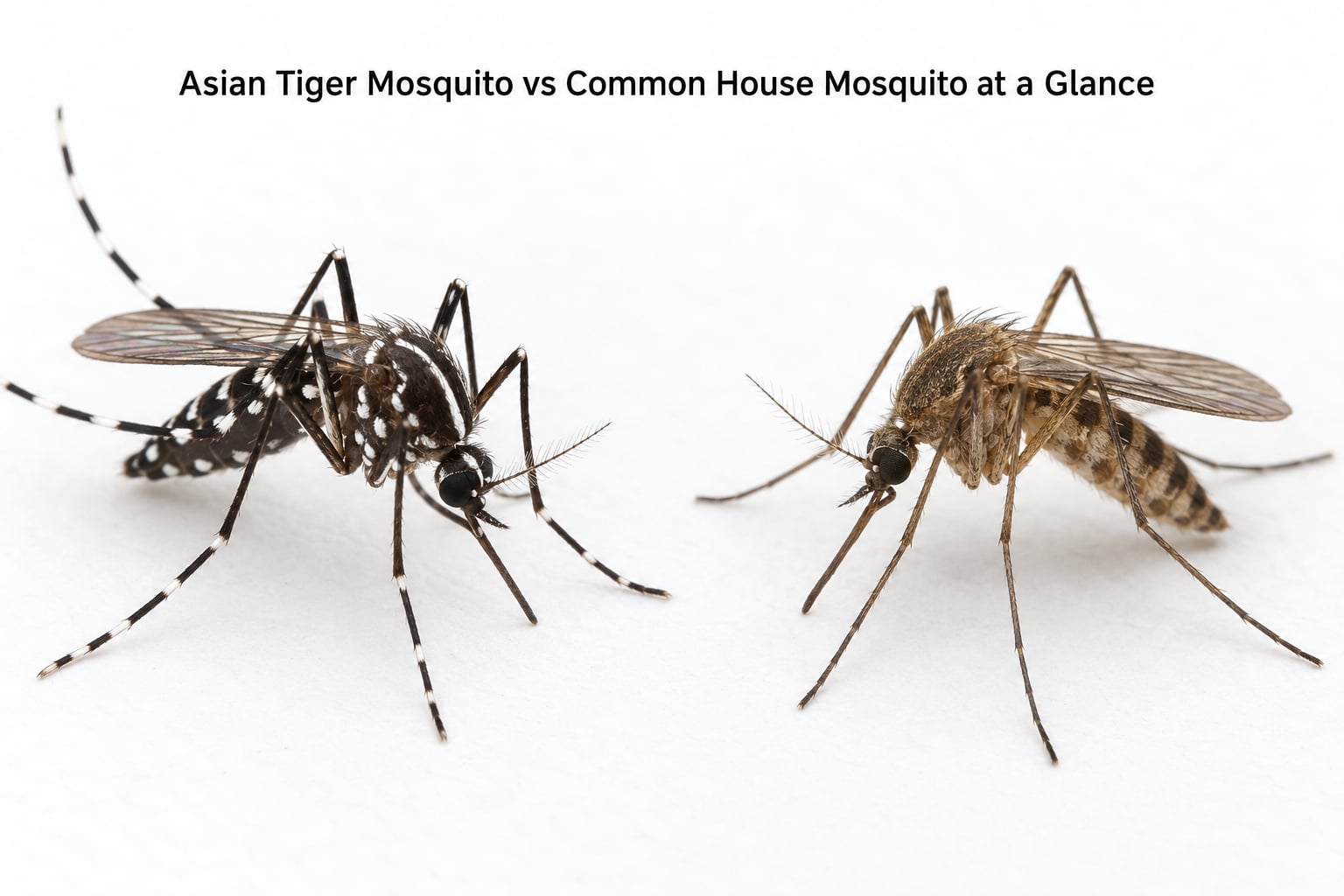
The table below is the whole comparison in one view. Every row is a field mark you can check without any equipment, except the last two rows, which explain why the difference is worth learning.
| Feature | Asian tiger mosquito | Common house mosquito |
|---|---|---|
| Body length | About 5 mm, a small insect | About 4 to 6 mm, slightly larger and bulkier |
| Overall color | Black with bold white and silvery markings | Uniformly tan to dull brown, drab overall |
| Thorax marking | One bright silvery-white stripe running lengthwise down the center of the back | No central stripe; a faint lyre-like pattern on some individuals |
| Legs | Black and white banded, like tiny striped socks | Plain unmarked brown legs |
| Abdomen | Dark with white triangular or teardrop marks | Evenly colored with faint banding at most |
| When it bites | Daytime, from morning through late afternoon, often peaking in the shade of trees and shrubs | Mostly after sunset and before sunrise, with lighter activity in shaded, humid conditions during the day |
| Preferred host | Daytime humans working in the yard or on the patio, often landing low on legs and ankles | Mostly people after dark, frequently targeting legs below the knee |
| Egg laying | Lays single dark eggs on damp container walls just above the waterline, not on the water | Lays eggs in floating rafts directly on the water surface |
| Breeding site | Small artificial containers: tires, buckets, planters, birdbaths, rain barrels, blocked gutters | Larger standing or slow-moving water: storm drains, catch basins, clogged gutters, ponded lawn water, tire piles at recycling yards |
| Overwintering | Eggs survive drying and winter inside containers, then hatch when refilled by spring rain | Adults overwinter in sheltered places such as sheds and culverts in many climates, and some larvae overwinter in water |
| Disease carried in the US | Dengue, chikungunya, Zika where those viruses circulate locally | West Nile virus, St. Louis encephalitis, Eastern equine encephalitis |
The Asian tiger mosquito wins the identification contest outright. Its markings are high-contrast and hard to confuse with anything else, which is why most people who ask this question can tell the two apart at a glance once they know what to look for.
How to Tell Asian Tiger Mosquitoes and Common House Mosquitoes Apart
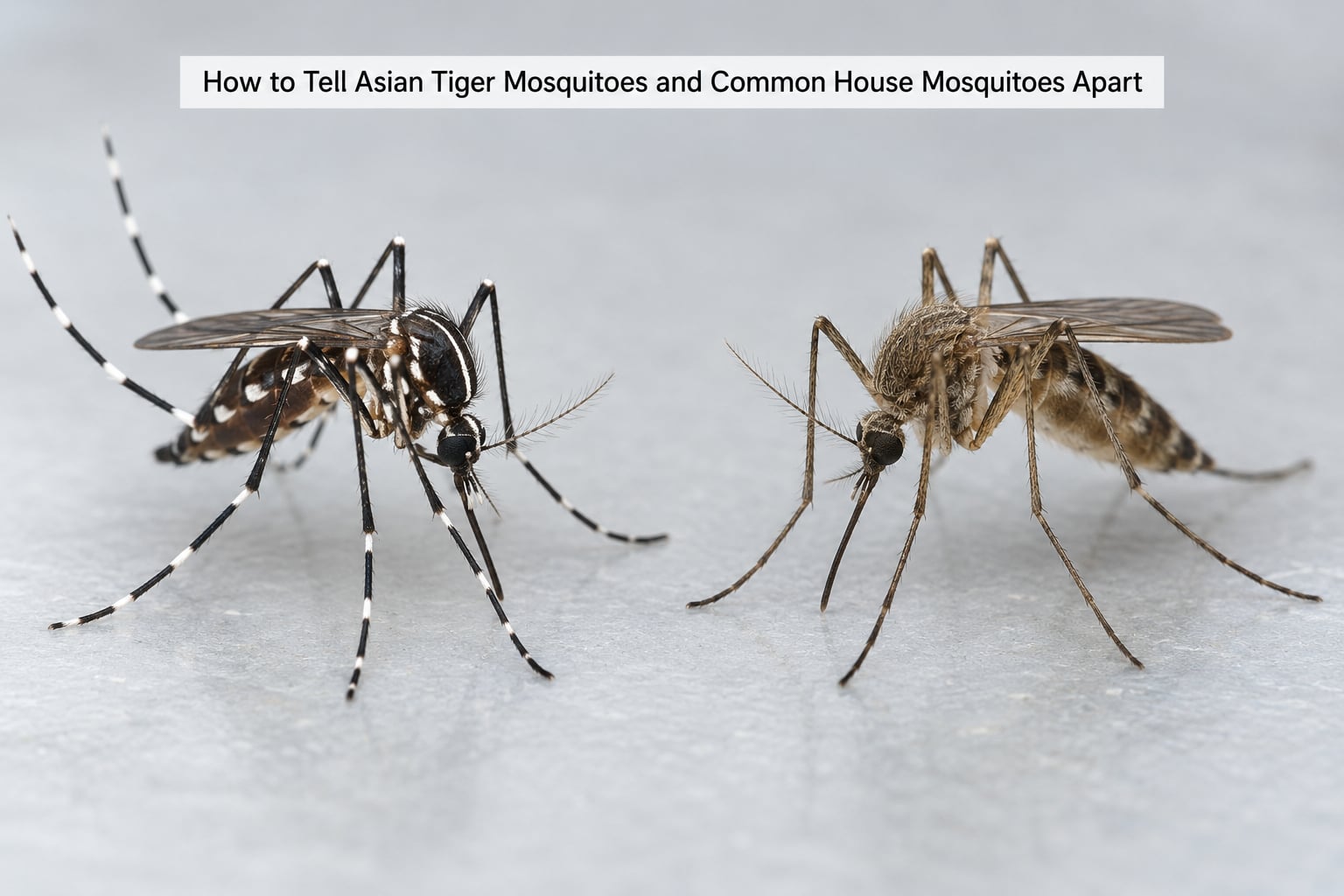
Start with the back of the insect, not the size of the bite. Size is the least useful cue here, because both species sit in the same few millimeters and both look larger than they are in the moment right after they land.
Field marks of the Asian tiger mosquito (Aedes albopictus)
- A single white stripe down the middle of the thorax. This dorsal stripe is the cleanest single mark and the one to check first.
- Banded legs. The legs are striped black and white, and they look almost decorative against the dark body.
- High-contrast coloring overall. White marks on a black body, with pale triangular or teardrop shapes on the abdomen.
- Small size, about 5 mm. Smaller than most people expect, which is why people describe seeing something bigger.
- Aggressive daytime flight. It approaches quickly and directly, and it does not circle first the way a night biter often does.
The banding is the reason people consistently overestimate this species. A dark mosquito with bright white banding reads as heavier and bolder than a plain tan one of the same size, so a 5 mm tiger mosquito gets described as a big black-and-white insect that was impossible to miss.
Field marks of the common house mosquito (Culex spp.)
- Uniformly tan, brown, or olive-brown. No bright white anywhere on the body.
- Unmarked legs. Plain legs with no banding, which is the fastest way to rule a suspect in or out.
- No central back stripe. The thorax is plain or faintly marked, never the bold white line of the tiger mosquito.
- Longer, more level posture while resting, with the body held roughly parallel to the surface rather than angled.
One note on the name, because it causes more confusion than anything else on this topic. House mosquitoes are not one species. Culex pipiens, the northern house mosquito, is the dominant species across the northern United States and Canada, while Culex quinquefasciatus, the southern house mosquito, is the common one in the south. In practice the two are hard to separate by eye, they behave almost the same, and the control steps are the same, so for backyard purposes they are one category.
Two limitations are worth stating plainly. A mosquito that has been squashed, brushed against a window, or partly eaten by a spider often loses the leg banding and back stripe, which are exactly the marks you need. And a phone photo taken in bad light at arm’s length is not reliable evidence. When the visual cues fail, fall back on the behavioral cue below, or skip identification entirely and focus on removing the breeding water.
Time-of-day shortcut: Asian tiger mosquito vs common house mosquito
If you did not see the insect clearly, the clock is a surprisingly reliable second opinion. Bites landing on your legs while you are gardening, doing yard work, or sitting on a shaded patio in the middle of the afternoon point toward the Asian tiger mosquito. Bites that show up after a walk or a deck evening and cluster on your lower legs point toward the house mosquito group.
This is the shortcut most searchers actually need. Catching the insect to identify it is hard, because the Asian tiger mosquito is fast and skittish, and by the time you notice a bite the mosquito is long gone. Forum threads about being surprised by bites in broad daylight keep coming back to exactly this point: most people assume mosquitoes only come out at night, and a daylight bite is what makes them look twice.
Behavior and Habitat Differences
Habitat is where the two species part ways, and this is the difference that decides what you do about them. The Asian tiger mosquito is a container breeder: it lives in water held in small human-made objects, and it needs almost no space to complete its life cycle. The house mosquito group breeds in larger, often disturbed or slightly polluted water in the ground around your property.
A container breeder is simply a mosquito that prefers water held in things rather than in natural ponds. Buckets, planters with no drainage hole, tarps that hold a puddle, blocked gutters, and rain barrels all qualify. A tire holds a surprising volume of water and offers shaded sides, which is why tire piles at recycling yards and yard-waste sites reliably produce tiger mosquitoes.
That container strategy comes with a survival trick worth knowing. The female Aedes albopictus lays single dark eggs on the damp inner wall of a container just above the waterline, rather than dropping eggs into the water. Those eggs tolerate drying out and can sit through winter inside a bucket, an empty pot, or a stacked tire. When spring rain refills the container, the eggs hatch. Draining a bucket once a week works, because emptying it kills the larvae before they mature; leaving the bucket in place all winter works against you, because you have left next spring’s generation sitting on the wall.
House mosquitoes use the opposite approach. Culex females lay egg rafts that float on the water surface, and the larvae hang at the surface breathing through a siphon where they filter organic material. The water tends to be bigger and less clear: catch basins at storm drains, clogged downspouts, low spots in a lawn that hold water for days, and blocked culverts. Because larvae at the surface also drink floating particles, heavily organic water such as nutrient-rich runoff from a lawn or a manure pile tends to produce heavier Culex populations.
There is also a competition story here that explains a lot about suburban backyards. Where container habitat becomes dominated by Aedes albopictus, Culex larvae often lose out in the same containers. The tiger mosquito is more tolerant of the small, variable, polluted containers people create, so it frequently arrives first and takes the spot. That displacement is well documented in urban and suburban settings, and it is why a container that used to produce evening bites may gradually shift to producing daytime bites.
Asian Tiger Mosquito vs Common House Mosquito: Biting and Disease Risk
Neither species should be treated as harmless, but they carry different risks in different places, and the everyday version of that risk is low for both in the continental United States. Here is the honest framing rather than the alarming one.
The Asian tiger mosquito is the vector of record for dengue, chikungunya, and Zika. The important qualifier is where those viruses circulate. In the continental US, transmission of these viruses by local mosquitoes has been rare and tied to travel-associated cases. In tropical areas of the Americas, where the same species is common, the same mosquito is a genuine everyday concern, which is why travel guidance for the Caribbean, Central America, and parts of South America takes it seriously.
The common house mosquito group carries a different and, for US residents, more immediate set of viruses. Culex pipiens and Culex quinquefasciatus are the primary vectors of West Nile virus in the United States, and they also transmit St. Louis encephalitis. Eastern equine encephalitis is linked to other mosquito groups, mostly Culex species in some regions as well as Aedes and Culex variants depending on location, and it is rare but severe. West Nile is the one most US homeowners will actually encounter, and the practical response to any Culex population is the same as for any mosquito population: reduce standing water and protect yourself from bites.
Now the part that gets repeated a lot online and is worth correcting directly. There is a folk theory that tiger mosquito bites feel different, look different, or are worse than other bites. The science does not support that. How strongly a person reacts to a bite depends mainly on their own immune response and their history of exposure, not on the species that delivered it. Two people can get bitten by the same mosquito and one will get a large welt while the other gets a small dot. That is why the bite mark cannot identify the mosquito, and it is why the time of day remains the more useful clue.
What should actually prompt a call to a doctor rather than a trip to the internet: trouble breathing, swelling of the face or throat, widespread hives, or dizziness right after a bite suggest a severe allergic reaction and need emergency care. A bite that becomes hot, increasingly red, painful, and streaked days later suggests a bacterial skin infection and needs medical attention. If you develop fever, rash, joint pain, or headache after travel to an area where dengue, chikungunya, or Zika circulate, mention the travel history to any clinician you see, because the mosquito that bit you is a detail they will want.
Which Mosquito Is More Likely in Your Area?
Asian tiger mosquitoes have expanded from a limited non-US range, first recorded in the US in the mid-1980s, into most of the southern and eastern United States and into a growing number of additional states, and they are now established across a large share of the country. House mosquitoes of the genus Culex occur widely nationwide, with Culex pipiens favoring the north and Culex quinquefasciatus the south.
Two caveats about range maps. Neither species is confined to the map’s shaded area in any individual season; a single hot, wet summer moves the practical range further than the published line suggests. And tiger mosquitoes travel inside cars and in shipping, so new establishment sites show up ahead of the slow spread researchers would predict. If you see one where the map says it should not be yet, that is not a misidentification by you.
A local answer beats a national map in almost every case. State health departments and university extension offices run mosquito surveillance programs that publish species lists, trap counts, and West Nile test results for your county or region. That tells you what is actually flying near you this season, which is the information that matters for whether you need to act.
Why Accurate Mosquito Identification Matters
Identification changes the target, and the target changes the work. Container source reduction is the answer for tiger mosquitoes, and it is mostly free: empty birdbaths at least weekly, scrub and flip buckets and planters, discard tires rather than stacking them, keep rain barrels and gutters screened and sealed, and change pet water bowls every few days. Where containers cannot be removed, a Bti larvicide or an insect growth regulator briquette treats the water directly. Bti is a bacteria-derived product that kills larvae once they ingest it, and it works only on immature stages, so timing matters.
House mosquitoes need a different list because their water is bigger and mostly in the ground. Clear catch basins and storm drains, clear leaf litter and debris from low spots, keep gutters and downspouts flowing, and address any lawn area that holds water for more than a day after rain. Because Culex overwinters as adults in sheltered structures in many climates, cleaning shaded corners, sheds, and under decks in late fall has value that a container-only routine does not.
Personal protection applies the same way to both. Use an EPA-registered insect repellent with DEET, picaridin, IR3535, or oil of lemon eucalyptus on exposed skin, follow the label, and remember that sunscreen goes on before repellent. Screens on windows and doors keep mosquitoes out of a house entirely, which is the real answer to the common question of why people are seeing them indoors. Neither mosquito is a strong indoor flier, so entry almost always means open doors and windows, or a porch light attracting a crowd of them to the threshold.
Two good reasons to contact someone beyond your own yard. If mosquito activity around your property jumps well beyond what you have seen in previous years, your local health department or extension office may already be tracking it, and a report from you adds to their trap data. And if you can capture an intact specimen, a hand lens or a phone photo in good light is enough for many extension offices to confirm the species, which resolves the question far better than guessing from a welt.
Species identification is worth doing, and it is not a substitute for the basics. If you cannot tell the two apart with confidence, the correct move is the same: remove standing water, use repellent, keep windows screened, and treat any bite reaction that looks unusual or does not resolve as a question for a clinician.
Frequently Asked Questions
Which mosquito has black-and-white stripes?
The Asian tiger mosquito (Aedes albopictus) is the striped one. It has a bright silvery-white stripe running lengthwise down the center of its thorax, banded black-and-white legs, and white markings on an otherwise dark body. Common house mosquitoes (Culex pipiens and Culex quinquefasciatus) are uniformly tan or brown with plain, unmarked legs and no central back stripe.
Are Asian tiger mosquitoes more dangerous than common house mosquitoes?
It depends on where you live. Asian tiger mosquitoes transmit dengue, chikungunya, and Zika where those viruses circulate, which is mostly in tropical regions rather than typical US backyards. Common house mosquitoes are the primary vector of West Nile virus in the United States, plus St. Louis encephalitis. Neither species should be ignored, and the practical precautions are identical for both.
What time of day do Asian tiger mosquitoes and common house mosquitoes bite?
Asian tiger mosquitoes bite during the day, from morning through late afternoon, and they are aggressive about it while you are working in the yard. Common house mosquitoes feed mainly from dusk to dawn. That difference is the most useful identification shortcut when you never got a clear look at the insect, especially when daylight bites land on your lower legs.
Can I identify a mosquito by its size alone?
No. Asian tiger mosquitoes run about 5 mm and common house mosquitoes about 4 to 6 mm, so the ranges overlap almost completely, and both look bigger than they are while they are feeding. Size also varies with blood feeding, and damaged specimens lose their markings. Check the white back stripe and leg banding instead, or fall back on the time of day the bite happened.
What should I do if I find many mosquitoes around my home?
Start by removing the water rather than spraying the air. For Asian tiger mosquitoes, empty small containers weekly, scrub them, and discard tires. For house mosquitoes, clear storm drains, gutters, and low spots that hold water. Add EPA-registered repellent, screens, and fans on porches, and contact your local health department or extension office if activity is far above what you have seen before.
Conclusion: Start With the Markings, Then Reduce Breeding Water
The Asian tiger mosquito is the easy one. Conspicuous black-and-white banding, a white stripe down the back, and a habit of biting in broad daylight mark it clearly. The common house mosquito is plainer and harder to pin down, feeding mainly from dusk to dawn out of larger standing water around the yard. When the visual cues fail, the hour of the bite is your second opinion.
Then act on the habitat, not on the species name. Empty and scrub small containers weekly, discard tires, keep rain barrels and gutters clear, drain low spots, use an EPA-registered repellent, and keep windows screened. If activity is far above last year, or a bite leaves a hot, painful, spreading welt or fever and rash after travel, contact your health department and a clinician. Comparing the two species helps most when it changes what you do about the water sitting behind your house.