Termites swarm in spring because three conditions arrive together: soil and air temperatures climb high enough to fly, humidity and rainfall are high, and daylight hours keep growing. That combination tells a mature underground colony it is time to release its winged reproductives.
Those winged termites are called alates, and a swarm is simply the flight those alates make. They leave the nest, pair up, shed their wings, and look for damp wood touching soil where they can start a new colony. It is a normal life stage, not a sign the colony is dying off.
It is also the moment most homeowners find out termites exist in their house at all, which is why a few things are worth getting straight: what a swarm looks like, where it comes from, and what it does and does not tell you.
Table of Contents
- Why Do Termites Swarm in the Spring?
- What Conditions Trigger a Termite Swarm?
- What Does a Termite Swarm Look Like?
- Termite Swarmers vs Flying Ants: How to Tell Them Apart
- Where Do Termites Swarm From?
- Does a Termite Swarm Mean My House Has a Serious Infestation?
- What Should You Do If You See a Termite Swarm?
- How Can You Prevent Termites in Your Home?
- Frequently Asked Questions
- Conclusion
Why Do Termites Swarm in the Spring?
A colony only makes alates once it is mature enough to spare them. That maturity check and the weather have to agree, and in most of the US spring is when they agree.
From the colony’s side the sequence is simple. Workers sense warm, damp soil and rising humidity, the colony has enough mature individuals to send out reproductives, and winged alates are produced. They push out through small exit openings, sometimes called kick-out holes, and take flight.
That is why termites swarm in the spring more than any other season: it is when moisture is in the soil and the air is warm enough to keep a flight going. Late winter rains and early spring warming usually set the window. The parent colony stays put and keeps feeding, which is worth remembering.
What Conditions Trigger a Termite Swarm?
Temperature and moisture do most of the work, and humidity and daylight act as the signal that flips the switch. Regional timing shifts with climate and species.
- Temperature. Most subterranean flights happen once daytime temperatures hold in the low 70s Fahrenheit or higher and nights stay mild enough to avoid chilling the swarmers.
- Rainfall and humidity. Swarms cluster on warm, humid days, often the same day as a decent rain or within a day or two of one. Homeowners on r/Termites describe this pattern constantly, and the wet soil is the point: a new colony needs moisture and contact with soil to survive.
- Daylight. Increasing daylight acts as a seasonal signal, and it is the reason flights cluster in spring and early summer rather than spread evenly through warm months.
- Colony maturity. Weather only releases alates a colony has already produced. A young colony will not fly no matter how good the day is.
- Species. Eastern subterranean termites typically fly from late winter into early spring. Drywood termites usually fly later, often in late summer or early fall after fall rains. Dampwood termites fly in spring and summer, and Formosan subterranean termites can fly during daylight hours in spring and early summer.
None of that is a precise calendar. In the Gulf Coast and Florida the window opens earlier than in the Northeast, and a warm wet spell in February can pull a flight forward in the South.
What Does a Termite Swarm Look Like?
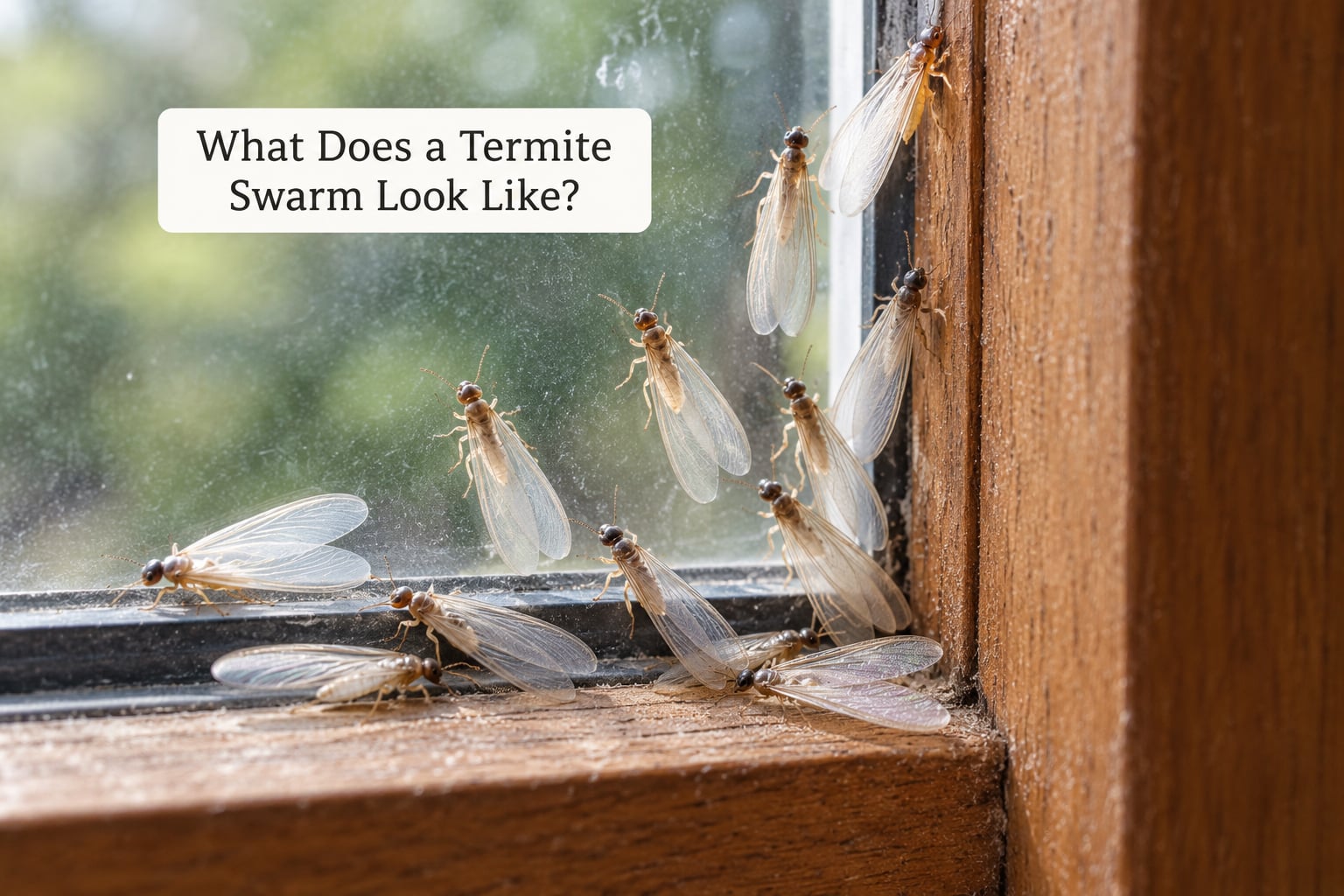
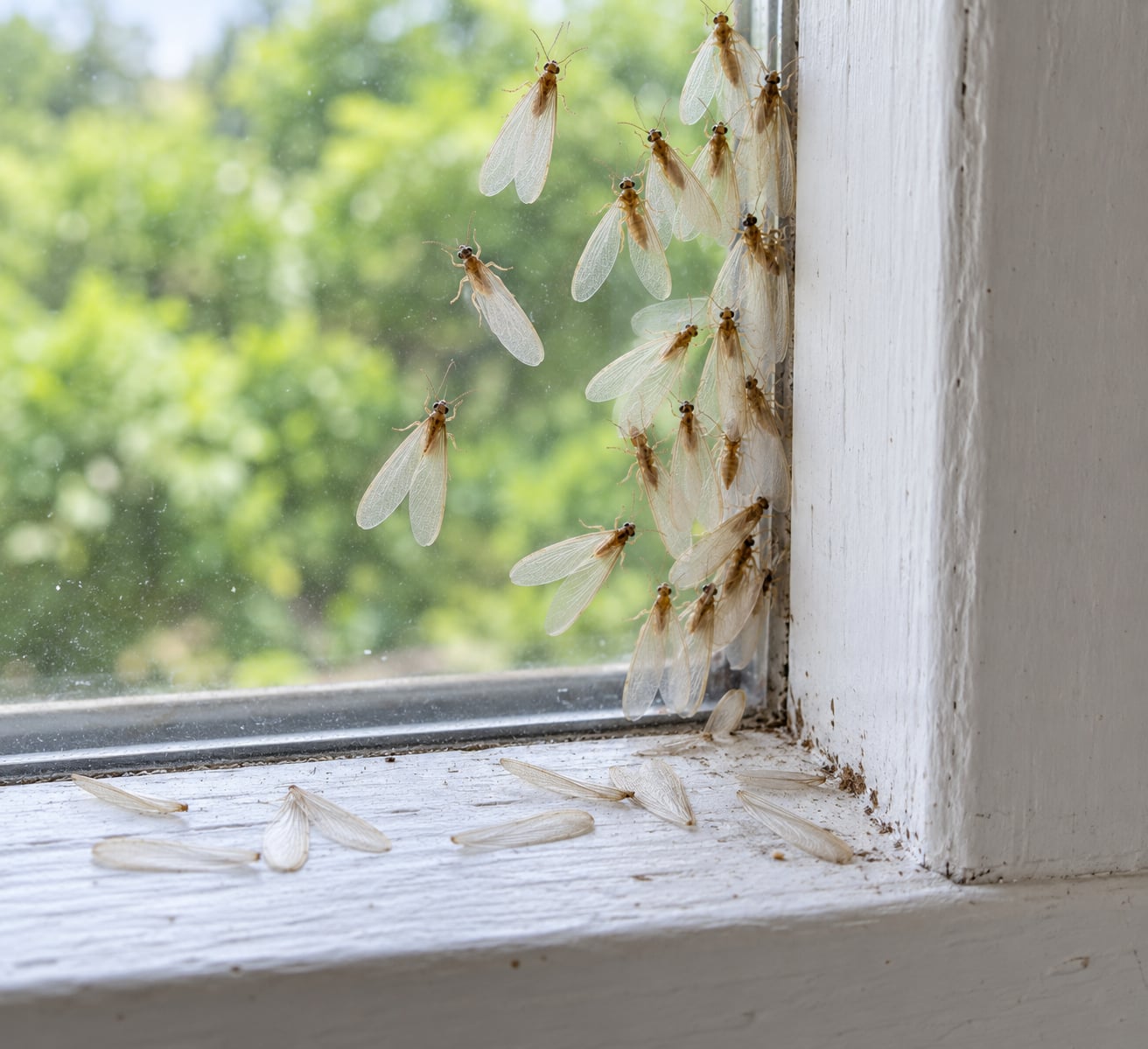
Swarmers are pale, soft-bodied and about the size of a small ant, with two pairs of wings that are all the same length. They look lighter than you expect, almost whitish against dark window trim.
The traits worth checking:
- Wings of equal length. Termite wings extend past the end of the body and match each other in length. Ant wings are usually shorter and clearly different lengths.
- Straight, bead-like antennae. Ant antennae bend at the elbow. Termites have a smooth, beaded look with no elbow.
- A thick waist. The termite body is roughly even in width front to back. Ants have a pinched waist.
- Shed wings on sills and counters. Uniform-size wings in a neat line are often the strongest sign once the swarm itself is gone.
- Flight near light. Swarmers gather at windows, sliding glass doors and porch light fixtures, fluttering in short, awkward bursts rather than steady flight.
Pale wings and a straight antenna are enough for a confident call in most cases. If you want certainty, the next section is the one that actually settles it.
Termite Swarmers vs Flying Ants: How to Tell Them Apart
Ant reproductives fly too, and this is the single most confused comparison in pest identification. Here is the side-by-side version:
| Feature | Termite swarmer | Flying ant |
|---|---|---|
| Wing length | All four wings equal, extending past the body | Front pair longer than the back pair |
| Antennae | Straight, bead-like, no elbow | Bent, elbowed |
| Waist | Thick and even, body looks uniform | Pinched between thorax and abdomen |
| Body texture | Softer, paler | Harder, darker |
| Flight pattern | Short, darting, drops down quickly | Slower, steadier flight |
| Flight origin | Soil, near wood or the foundation | Nest in soil, wall voids or wood |
| Wings after landing | Shed in neat piles on sills and floors | Also shed, usually scattered |
| Risk level | Get it inspected, especially indoors | Annoying, usually not a structure threat |
Size helps too, but not much. Drywood termites and ants overlap closely, so if the specimen is in a sealed container, a local extension office or an entomologist can settle it in a day.
Where Do Termites Swarm From?
The source tells you a lot about the risk. Outdoor swarms usually come from a colony in the soil near the house or a neighboring property; indoor swarms usually come from a colony already feeding inside the structure.
Common outdoor spots
- Kick-out holes in bare soil, patio, driveway or a crawlspace slab near the foundation
- Under mulch beds, along landscape edging or beneath stone or gravel
- Next to stacked firewood, a deck, fence, outbuilding or shed
- Tree stumps, buried wood and untreated timbers in the yard
- A neighbor’s yard or street tree, which is why swarmers show up on a property that never had damage
Common indoor spots
- Window and sliding-door frames, especially in a bathroom or laundry area
- Around light fixtures, porch lights and skylights
- Near bookcases, cabinets or baseboards in a damp room
- Small holes punched in drywall or flooring near a wall that runs to the slab
Look at a uniform pile of dead, intact wingless termites on an interior floor. That often means alates emerged indoors and could not get back to soil, which is a stronger warning than any outdoor swarm.
Does a Termite Swarm Mean My House Has a Serious Infestation?
Sometimes, but not always, and a swarm on its own does not tell you how much damage exists. An outdoor flight from a neighbor’s tree and an indoor flight from your own wall can look similar and mean very different things.
The useful rule: an outdoor swarm tells you reproductives are active nearby. An indoor swarm tells you a colony is inside the structure or directly connected to it. Indoor is the one worth acting on quickly.
Also keep the timeline in perspective. A colony that can produce alates has already been established for years, feeding quietly behind baseboards or under a deck. Seeing swarmers in 2026 does not mean the infestation started in 2026. Visible damage often lags behind the feeding by one to three years, so the practical move is an inspection rather than a guess.
A swarm is also not a dying colony. The parent colony stays in place and continues working, which is why treatment has to reach the colony, not just the flying insects.
What Should You Do If You See a Termite Swarm?
Work through these in order. None of them requires a purchase decision today, and steps one to three cost nothing.
- Capture one sample without crushing it. Put a swarmer in a small sealed container or a zip bag. Wings are diagnostic, and a specimen beats a photo when identification matters.
- Photograph the wings and any pile of shed wings. Take a close shot of the wings on the sill and note where you found them: window, door, light fixture, or floor.
- Keep kids and pets out of the area. Swarmers are not aggressive and do not sting or bite, but there is no reason to let a pet chase them across the floor.
- Look for the exit point, not the swarm. Check the frame or trim near where they appeared for a pencil-lead-sized hole. Do not seal it, and do not spray it, before a professional sees it.
- Do not fog, vacuum or spray the swarmers. Over-the-surface sprays kill a few visible insects and can repel alates away from treated soil into other parts of the structure, which makes the problem harder to scope.
- Schedule an inspection. Ask for a wood-destroying insect inspection, ask to have a sample identified in writing, and ask what the inspection covers and what a treatment quote would include.
Homeowners on r/Termites almost always end up at step six. That is the right instinct once you have indoor swarmers or signs of damage.
Expect swarmers to keep appearing for a week or two after treatment. That is normal and does not mean the treatment failed.
How Can You Prevent Termites in Your Home?
Subterranean termites need three things: moisture, wood, and a path between soil and wood. Break any one of them and most of the pressure comes off.
- Grade the soil away from the foundation. Keep soil about 6 inches below the siding line and slope it outward, not toward the house.
- Keep wood off the ground. Store firewood on a raised rack at least 10 feet from the foundation, and trim shrubs so branches do not touch siding.
- Hold mulch to a 2-3 inch depth and pull it back several inches from the foundation. Mulch is the easiest food and moisture source you can hand them.
- Fix water before spring. Repair dripping outdoor faucets, clear gutters, and deal with condensation in crawlspaces and attics. A dry foundation does more than any repellent.
- Seal entry points. Gaps around plumbing, wiring and HVAC penetrations, plus utility line openings, are the usual underground highway into the house.
- Ventilate enclosed areas. Crawlspace vents and basement dehumidification reduce the damp soil conditions colonies need.
- Get a wood-destroying insect inspection before peak season. Most inspection reports are valid for a limited period, and a house that failed before may be re-treated under a warranty.
- Choose treatment with the infestation, not the swarm. Options run from a liquid barrier to baiting systems to localized treatment of a damaged area. A qualified operator should tell you which one fits and why.
On repellents, be skeptical. No smell reliably keeps termites away, and citronella, garlic or essential oils are not substitutes for moisture control. They are not going to protect the wood.
Frequently Asked Questions
Should I worry about swarming termites?
It depends where you found them. Outdoor swarmers usually come from a colony in nearby soil, a stump, or a neighbor’s property and are not an emergency. Swarmers inside a room, dead termites on an interior floor, or a pile of shed wings on a windowsill are a real warning of a colony connected to the structure. Get a wood-destroying insect inspection rather than treating based on a guess.
Should I worry if I see flying termites?
Worth taking seriously, because a colony large enough to swarm has been feeding for years. That does not mean the house is about to collapse, but it does mean the damage is probably already there, hidden behind trim or under a floor. Photograph the wings, save a specimen, and book an inspection before you decide anything about treatment.
What kills termite swarms?
Swarmers die quickly on their own; most never make it to soil to found a new colony. What matters is killing or suppressing the colony that produced them, which is what soil treatment, a liquid barrier or a baiting system is designed to do. Spraying the flying insects does nothing for the colony and can push future flights away from treated areas.
What smell do termites hate the most?
None that you can rely on. There is no proven smell, oil or plant repellent that keeps termites out of a structure, and most of the products sold for this purpose do not prevent an infestation. What actually works is removing what attracts them: damp soil against wood, mulch against siding, stacked firewood near the foundation, and unsealed utility entry points.
What is a termite’s worst enemy?
Dry conditions and lack of contact between soil and wood. Subterranean termites need moisture and a continuous path from the ground into cellulose, so a dry foundation, a raised wood line and soil graded away from the house take away the resource they depend on. That is why prevention is built around drainage and wood-to-soil contact rather than chemicals.
What are the key differences between flying ants and drywood termites?
Equal-length wings, straight bead-like antennae and a thick even waist point to termites; a pinched waist, elbowed antennae and two different wing lengths point to ants. Drywood termites are usually larger and paler than a small ant, with wings that extend well past the body. The reliable method is to preserve a sample in a sealed container and have it identified.
Conclusion
Termites swarm in the spring because warm soil, wet weather and longer days tell mature colonies it is time to send out winged reproductives. The flight itself is normal, and the parent colony survives it.
What matters is where you found them. Outside the house, usually from a neighbor’s yard or a stump, it is a good reason to schedule an inspection. Inside the house, it is a reason to move quickly. Save a specimen in a sealed container, photograph the wings and the spot they came from, leave the exit hole alone, and have a licensed pest professional look at the structure before you spend money on treatment.