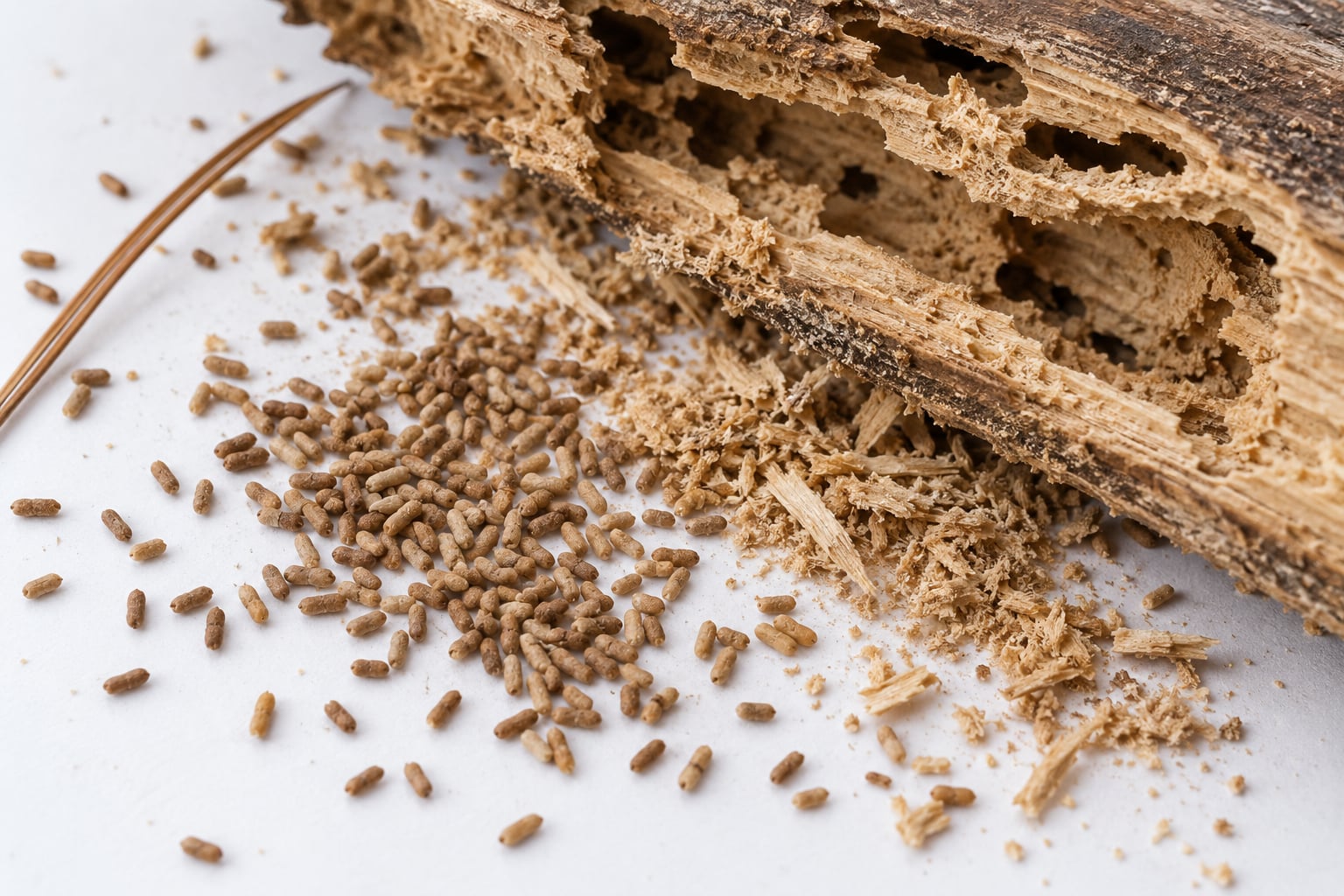
Termite droppings, also called frass, are small pellet-like waste pellets that termites expel as they tunnel through wood. They are usually tan, brown, or dark brown, roughly the size of a grain of rice or a pinhead, and they collect on the surface directly below or beside the wood where the colony is working. The part that matters most: pellets on their own never confirm termites, and most subterranean damage happens inside wood where you cannot see it at all.
This guide is written for termite droppings identification in a home, so you can make a reasonable call on what you found, rule out the common look-alikes, and decide whether an inspection is worth the trip. It takes about ten minutes for a first pass.
Table of Contents
- Termite Droppings Identification in a Home: What to Look For
- What Do Termite Droppings Look Like?
- Where Do You Find Termite Droppings Inside a Home?
- How to Tell Termite Droppings Apart from Other Debris
- What Other Signs Suggest a Termite Problem?
- What to Do After You Find Possible Termite Droppings
- How to Prevent Future Termite Problems
- Frequently Asked Questions
- Conclusion: Start With the Location and Nearby Damage
Termite Droppings Identification in a Home: What to Look For
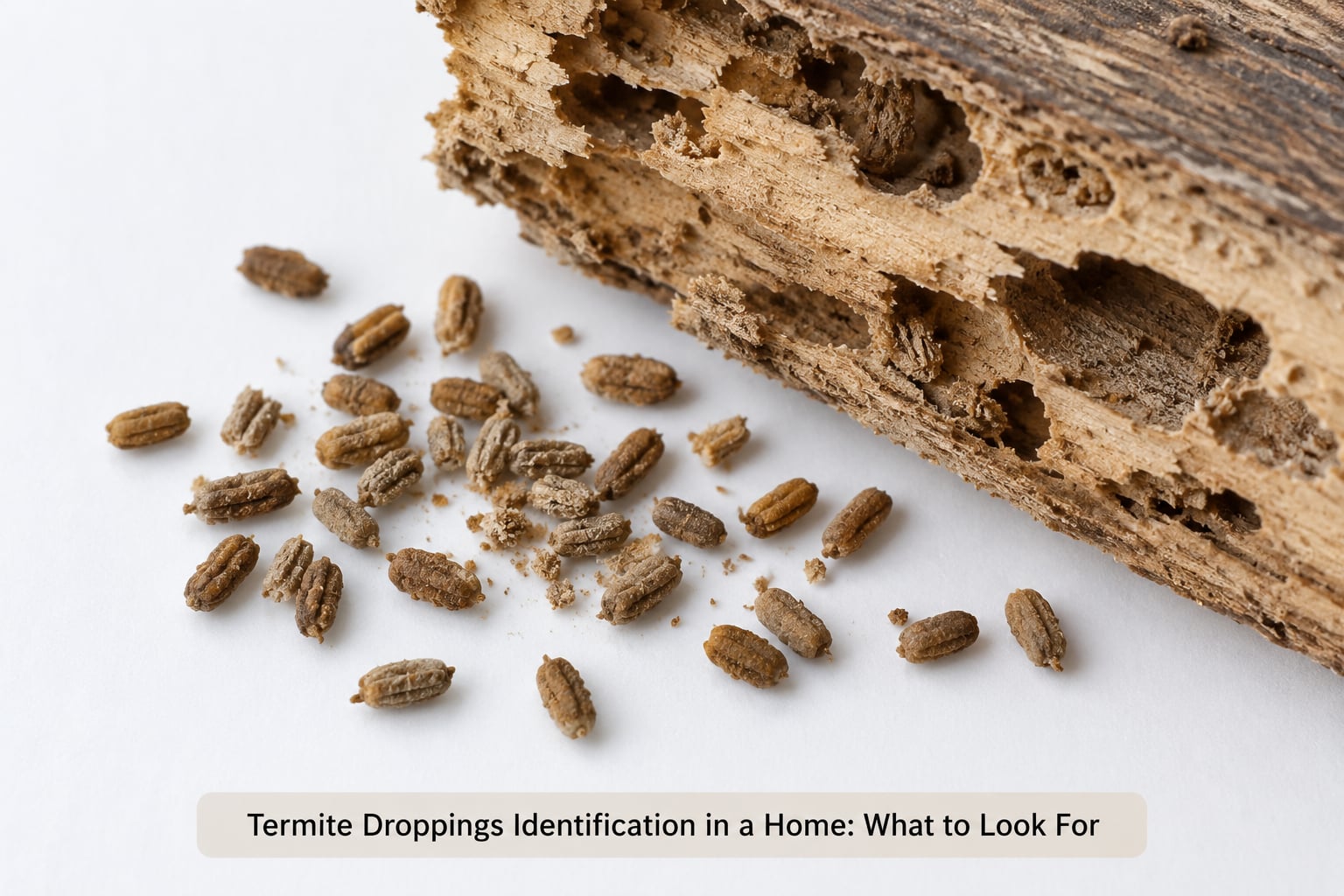
Start with five traits instead of one. Size, shape, color, texture, and location together give you a much better read than any single feature, because ant debris, sawdust, and lint each match one or two of them.
- Size: roughly a pinhead to a grain of rice, about 1/16 to 3/32 inch long. Bigger pieces are usually something other than termite frass.
- Shape: elongated and cylindrical with squared or blunt ends. Some have faint lengthwise ridges or striations.
- Color: light tan at first, then light brown, dark brown, and nearly black as they age and dry.
- Texture: dry, crumbly, and gritty to the touch. It breaks down into powder rather than bending.
- Location: a scatter or small pile on a shelf, sill, countertop, or floor below wood, usually with damaged wood or a small hole above it.
Two rules keep you out of trouble. If there is no wood, no damaged trim, and no tiny hole anywhere above the pile, be skeptical. And if you find pellets next to soft, damp, mud-tube-covered soil, that is a different situation from dry pellets next to a window casing.
What Do Termite Droppings Look Like?
Here is the detail you need to make an initial identification. Read several of them together, because older and newer pellets in the same spot can look different.
Size and shape
Drywood termite frass is longer and more uniform than most household debris. Pellets are usually about 1/16 to 3/32 inch long, narrow, and roughly the width of a matchstick or a sharpened pencil lead. Under magnification the ends often look squared off, which is a giveaway, because ant debris and dust tend to be more angular or irregular.
Surface and texture
Break one between your fingers. Termite frass is dry and crumbly, with a gritty, sand-like feel, and it smears into powder rather than forming a wad. Sawdust from a drill bit or a nail gun comes from the same wood but keeps a curled shaving shape. Coffee grounds are dark and crumbly too, which is exactly why so many people second-guess themselves.
Color and freshness
New frass is lighter, sometimes almost golden tan. Over days it darkens to brown and then near black as it dries. A scatter that is part tan and part dark usually means the colony is still active and is still ejecting. If everything in the pile is uniformly dark and nothing new appears over a week or two, it may be old evidence rather than an ongoing problem.
Quantity and pattern
A light dusting on one shelf is common and often harmless. A dense accumulation on several surfaces below the same structural member is a stronger signal. Drywood termites work from the inside and push pellets outward, so the fall pattern tends to be a narrow line or cone beneath the affected wood rather than a wide even spread.
Where Do You Find Termite Droppings Inside a Home?
Work outward from wood-to-soil and wood-to-non-wood contact points, because those are where colonies gain access. In practice that means a ten-minute walk of a specific route.
Kitchen and bathroom cabinets
Sink base cabinets, dishwashers, and plumbing penetrations are prime territory. Termites follow damp plumbing lines, and you may find pellets on the cabinet floor, on the wall behind an appliance, or inside a kick plate.
Window sills, door frames, and baseboards
These are the classic spots homeowners report. Paint that is blistering or peeling on an exterior trim board, a swollen window sill, or a door frame that suddenly sticks are all worth a look right above the sill or threshold.
Bookcases, shelving, and finished wood
Finished hardwood floors, wooden picture frames, and antique furniture can house drywood termites, which do not need soil contact. Pellets here often show up on a bookshelf or the floor below with no visible mud at all.
Garage, attic, and crawl space
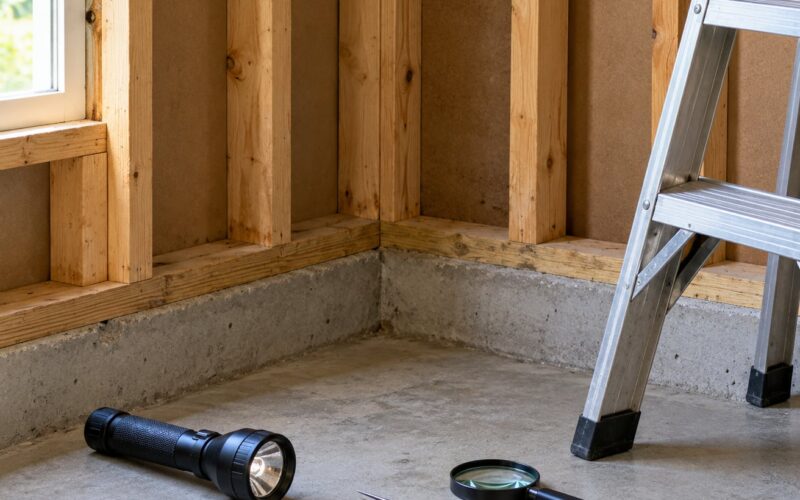
Stacked firewood, garage doors with wood trim, attic eaves, and crawl space joists are all common. In the garage, check around a converted or removed door and along any wood that was in contact with the ground at some point.
A termite droppings identification in a home routine that takes ten minutes
Walk the baseboards, then the window and door openings, then under sinks and appliances. Look up before you look down: pellets on a couch cushion or inside a light fixture are explained by something above them, often a ceiling or wall cavity. Measure the spread of the scatter, since a tight pile means the source is close and a wide fan means it is higher up. Then check the ceiling and the wall above for pin-sized holes, and look for mud tubes on foundation walls, piers, or porch posts.
One warning before you keep reading. Finding pellets tells you termites were working in the area. It does not tell you where the colony is, how many there are, or how much structural damage exists. People assume a small pile means a small problem, and that assumption is expensive.
How to Tell Termite Droppings Apart from Other Debris
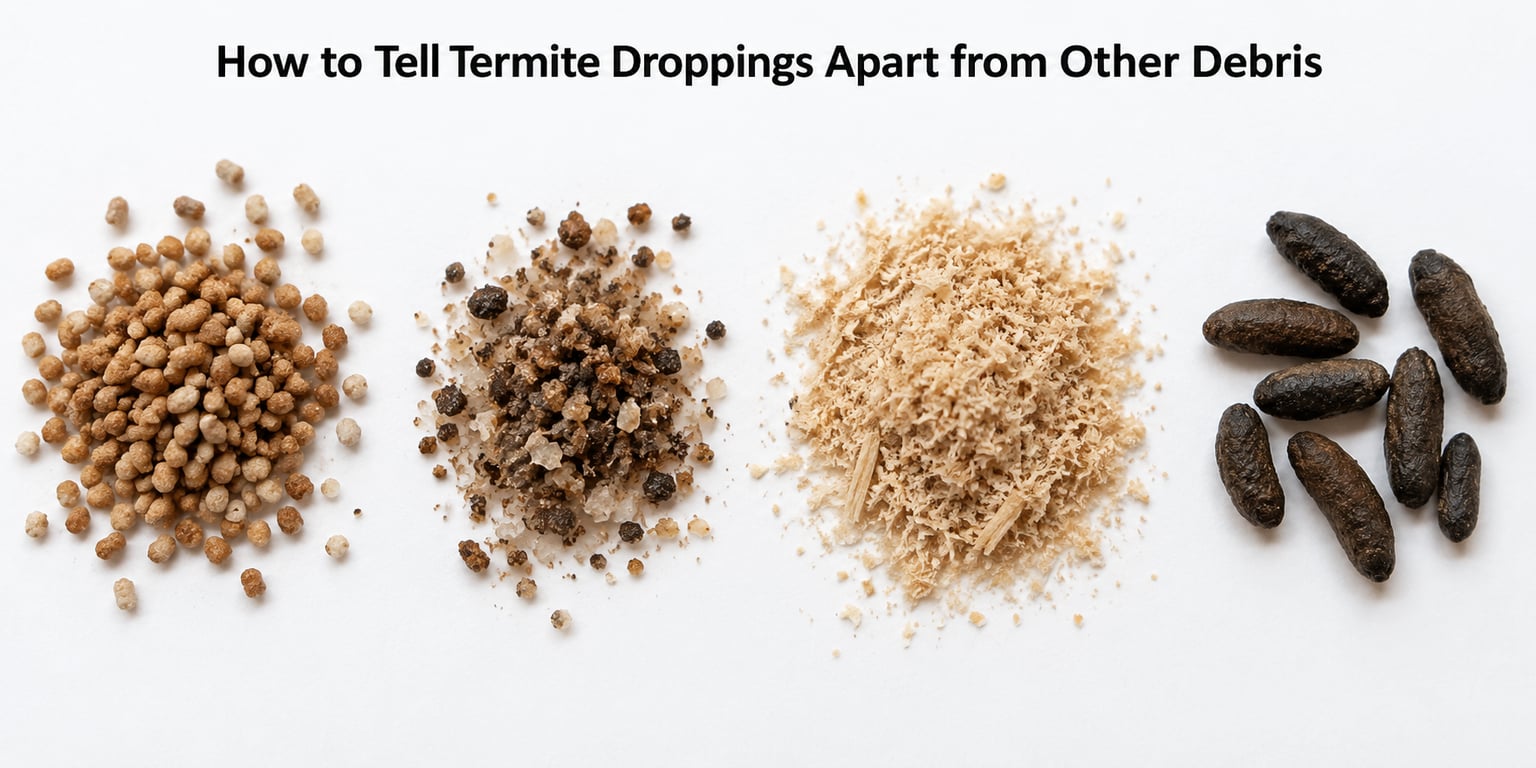
Ant frass is the most common mix-up by far. Both are wood waste, both collect below the source, and from a distance they look nearly identical. The table below is the fastest way to sort them out.
| Debris | Size and shape | Color | Texture | Where it shows up |
|---|---|---|---|---|
| Termite frass | 1/16 to 3/32 inch, elongated, squared ends | Tan to near black | Gritty, dry, crumbly to powder | Below damaged wood, sills, shelves, kick-out holes |
| Ant frass | Similar size, often finer and more irregular | Tan to dark brown | Fine, powdery, sometimes sticky with moisture | Near ant trails, entry gaps, kitchen and bathroom debris |
| Sawdust or wood shavings | Curl-shaped or splintered, not pellet shaped | Fresh pale wood | Fibrous, springy | Near recent drilling, sanding, or nail gun work |
| Rodent droppings | Rice shaped, 1/8 to 1/4 inch, blunt ends | Dark brown to black | Firm, sometimes glossy or fresh and soft | Attics, garages, along walls and beams, droppings in piles |
| Spider egg cases | Round or silken, not elongated | White, cream, or translucent | Silky or papery | Corners, ceilings, window frames, high sheltered spots |
| Lint, dust, or food crumbs | Irregular, no consistent shape | Any, including white and gray | Fibrous or powdery, no grain structure | Anywhere, usually with normal household dust |
Two tie-breakers help more than anything else on the page. First, ants are usually visible or their trail is nearby; termites inside the wood are not. Second, ant frass often forms a line along a travel route, while termite frass forms a pile directly under a damaged member or a hole.
What Other Signs Suggest a Termite Problem?
Pellets move you from maybe to probably. These are the corroborating signs that move you further.
- Mud tubes or mud shelters on foundation walls, piers, porch posts, or along plumbing lines. Subterranean termites build these covered runways between soil and wood.
- Kick-out holes in wood, roughly pin-sized, with frass scattered directly beneath. Drywood termites eject pellets through these to keep the inside of the gallery clean.
- Hollow or papery sounding wood. Tap a suspicious board. Solid wood knocks dull, hollow wood knocks flat and hollow.
- Blistering or buckling wood flooring, often in lines where boards meet, where the subfloor beneath has been eaten unevenly.
- Doors and windows that swell, bind, or stick in wet weather and loosen in dry weather, as the moisture the colony brings in dries out.
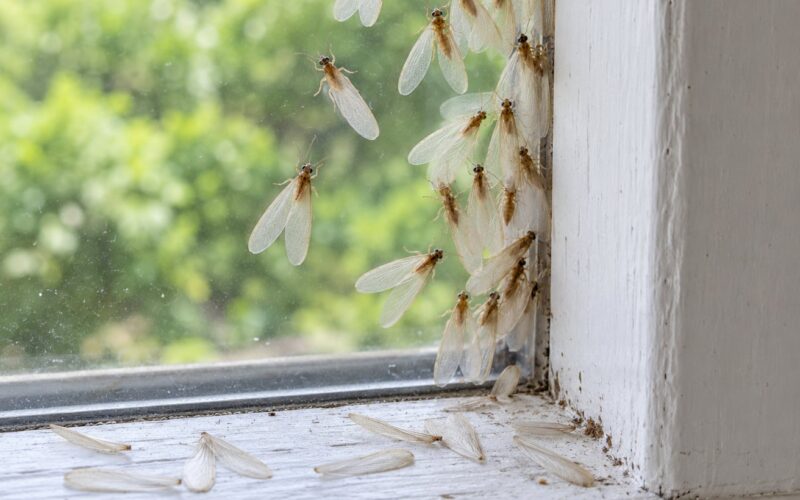
- Discarded wings near windows, light fixtures, or patio doors. Swarmers shed two long wings after flight, and you may find dozens at once.
- Peeling paint or wallpaper on exterior trim near a wood-to-soil contact point, which is often shrunken wood under the paint rather than dampness alone.
- A musty odor in the area, caused by moisture and fungal growth in damaged wood.
Professional inspection is more reliable than any amount of debris collecting, because a technician can probe wood, open concealed areas, and identify the species. Multiple independent signs together make a strong case. One odd pile on a shelf does not.
What to Do After You Find Possible Termite Droppings
Follow this order. It protects the evidence and gives you the best shot at a small problem rather than a large one.
- Do not clean it up first. Wait until you have decided whether to get an inspection. Vacuuming or sweeping removes the pellets and leaves no way to confirm anything.
- Photograph it with scale. Put a coin or ruler in the frame. Photos with a scale reference are what people trust, and it costs you nothing.
- Note the exact location in writing. Which room, which surface, what is directly above it, and the date you first noticed it.
- Look for the hole. Check the wood above the pile for a small round opening and for fresh, lighter wood around it.
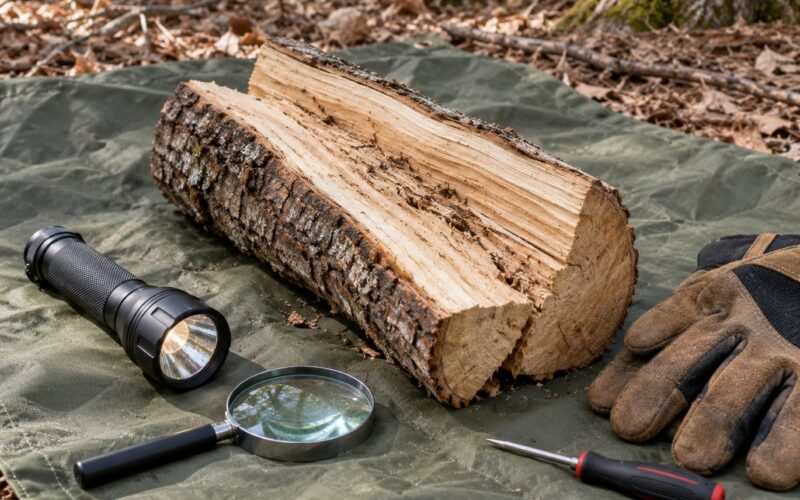
- Probe gently. A thin screwdriver or a nail pushed into soft, hollowed wood is a strong clue. Hard, solid wood is a relief.
- Inspect the neighboring rooms on the same wall or floor, especially kitchens, bathrooms, and garages.
- Reduce moisture nearby and keep the area dry, but do not spray anything into the wood.
- Book an inspection if several signs line up, if new droppings keep appearing, or if you are selling the house.
Avoid three common mistakes. Do not seal kick-out holes or caulk over suspicious openings, because you trap the colony and cut off the exit it uses to signal that a treatment worked. Do not spray household insecticides into a void or crawl space, since they kill scouts without reaching the colony. Do not delay an inspection you already know you need.
Call a professional when you have any of these: more than one location with frass, hollow-sounding wood, mud tubes, or droppings on multiple floors. Also call before you close a purchase or a refinance, because most termite warranties require documentation from a licensed inspector and a report obtained by the seller.
How to Prevent Future Termite Problems
None of this eliminates risk, but it removes the conditions that colonies actually depend on.
- Break wood-to-soil contact. Keep firewood, stacked lumber, and stored wood off the ground and at least a couple of inches away from the foundation.
- Cut moisture sources. Repair plumbing leaks, keep the crawl space and attic ventilated, grade soil away from the foundation, and use a dehumidifier in persistently damp basements.
- Seal gaps. Close openings around utility penetrations, pipes, vents, and where siding or trim meets the foundation.
- Keep vegetation off the structure. Trim shrubs and mulch away from the foundation so damp soil does not sit against wood.
- Store firewood off-site if you can, or at least well away from the house and off the ground.
- Inspect after renovations. New decks, fences, and additions often bring wood in contact with soil, and fresh mulch can attract swarming termites.
- Schedule periodic inspections in higher-risk areas, especially where the house sits in wooded terrain, near known termite activity, or has a history of treatment.
One habit pays off more than the rest. After remodeling or after heavy rain and soil saturation, walk the baseboards and sills once. New droppings in the fall that were not there in the spring mean something changed, and catching that early is the whole game.
Frequently Asked Questions
Are termite droppings inside a home dangerous?
Termite droppings are not dangerous to people or pets. They are simply partially digested wood waste, and the main risk is minor dust irritation if you sweep a large amount of dry material in an enclosed room. Wear a mask and dampen the debris with water before cleaning it. Nobody gets sick from handling frass, and it does not carry disease like rodent droppings can.
Where should I look first if I think I found termite droppings?
Start at wood-to-soil and wood-to-non-wood contact points: under kitchen and bathroom sinks, along baseboards, on window sills and door thresholds, behind appliances, and inside garage door trim. Then look straight up from the pile. Pellets on a shelf or inside a light fixture usually mean something in the ceiling or wall above them, so check for pin-sized holes overhead before you search the room.
Can termite droppings be confused with ant droppings?
Yes, constantly. Ant frass and termite frass are both wood waste of similar size and color, which is why this is the most common identification mistake. Ant frass is usually finer and more irregular, often found along a visible trail, while termite frass is more uniform, cylindrical, and piled directly below damaged wood or a kick-out hole. If ants are visible nearby, you are almost certainly looking at ant debris.
Do termite droppings mean I have a severe infestation?
Not necessarily. Droppings show that termites have been feeding nearby, not how many there are or how far the damage extends. A drywood colony can be small and contained for years, while a subterranean problem can do significant structural damage without producing much visible frass at all. The severity comes from the condition of the wood, the species involved, and the location, so get an inspection rather than guessing from the size of the pile.
Should I remove termite droppings I find in my home?
Wait until you have decided whether to get a professional inspection. Cleaning the pellets removes the easiest evidence to photograph and compare, and some treatments are verified by watching whether fresh droppings stop appearing. Once you are past that point, remove them by dampening with water and wiping or vacuuming, wearing a dust mask for larger piles. Leave the wood itself alone until it has been assessed.
Conclusion: Start With the Location and Nearby Damage
Make one decision before you do anything else. Look at where the material actually is, then check whether damaged wood, a kick-out hole, or mud tubes sit above or beside it. Pellets with no wood above them and no damaged trim in sight are usually ant debris, lint, or sawdust. Pellets directly below compromised wood with hollow sound, swelling trim, or new ones appearing each week are the case for calling a pest professional now.
Your first action is simple and takes under a minute: take one photo of the pile with a coin beside it for scale, and write down the room and date. That single record is worth more than anything you could clean up today.