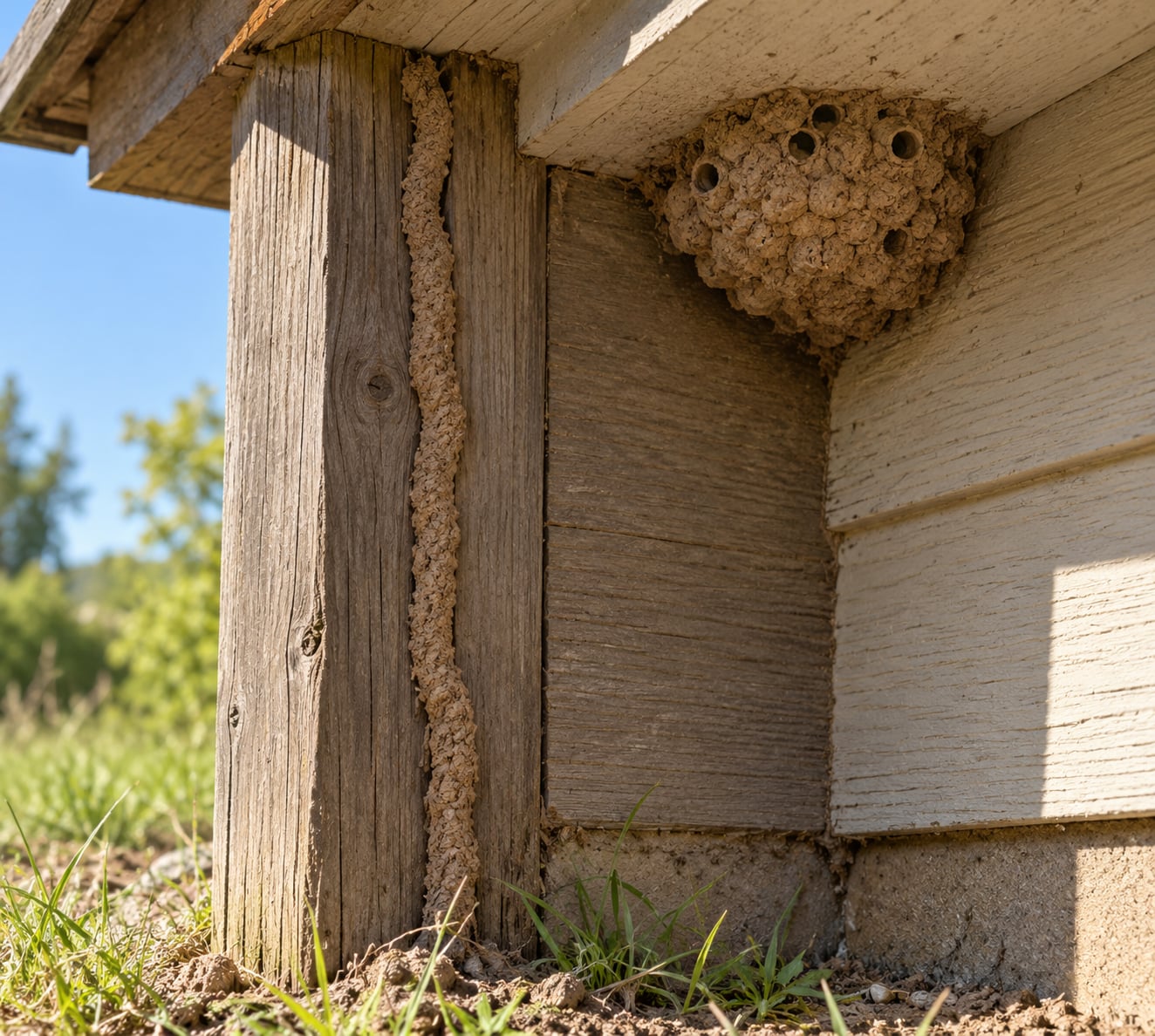
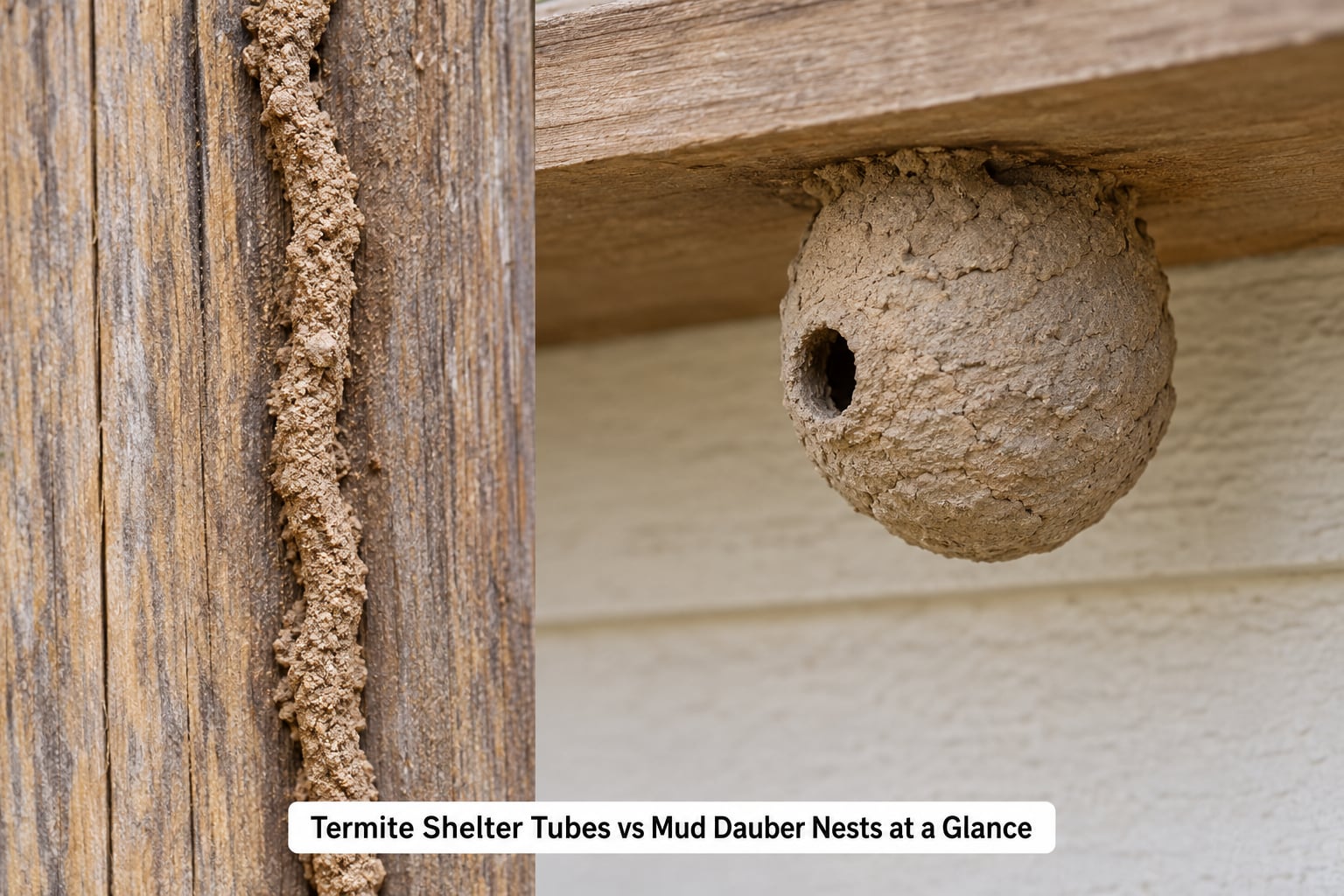
Both structures are made of mud, and both show up on houses every spring, but they come from insects that have almost nothing in common. Termite shelter tubes are thin, flat runways built by a colony feeding on cellulose, usually running up from the soil onto a foundation. Mud dauber nests are short, thick, self-supporting structures plastered by a single solitary wasp onto a protected overhead or vertical surface, and each sealed cell holds a paralyzed spider and one egg.
Getting this right matters because the two responses are opposites. Treat a mud dauber nest as termites and you spend money on a wall with no problem. Break off a termite shelter tube yourself and an active colony stays inside the wood, feeding undisturbed.
Table of Contents
- Termite Shelter Tubes vs Mud Dauber Nests at a Glance
- What Is a Termite Shelter Tube?
- What Is a Mud Dauber Nest?
- Termite Shelter Tubes vs Mud Dauber Nests: How to Tell Them Apart
- Where Each Structure Is Usually Found
- Which One Is More Damaging?
- Termite Shelter Tubes vs Mud Dauber Nests: What Action to Take
- Which Should You Choose?
- Frequently Asked Questions
- Conclusion: Start With the Location and Shape
Termite Shelter Tubes vs Mud Dauber Nests at a Glance
| What to check | Termite shelter tube | Mud dauber nest |
|---|---|---|
| Who builds it | A colony of subterranean termites, a social insect in the order Blattodea | One female solitary wasp, family Sphecidae or Crabronidae |
| Thickness | Thin and flat, usually pencil-width | Thick and rounded, chunky in the hand |
| Shape | A continuous open-ended tube, often with angular bends | Short tubes, an organ-pipe row, or a plastered cluster of cells |
| Attachment | Always glued flat against wood, siding, stucco or concrete | Self-supporting, projecting away from the surface |
| Location | Near ground level, running from soil to foundation or siding | Overhead and sheltered: eaves, porch roofs, garage ceilings, rafters, vents |
| Colour | Brown to grey-brown, weathered and crumbling when old | Yellow-brown to grey, sometimes banded, often with a smoother finish |
| What’s inside | Nothing stored. Termites pass through in both directions | Sealed brood cells holding paralyzed spiders, or an empty cell wall and an emergence hole |
| Does it mean a problem? | Yes, it can indicate an active infestation nearby | No. Cosmetic at worst |
| Injury risk | None. Termites do not bite people | Low but real. Solitary wasps rarely sting unless handled |
| Correct action | Leave it and book a termite inspection | Leave it, or scrape it off dry when you are ready |
One row settles most cases on its own. If the structure is not touching the surface it sits on and is hanging under something, you are looking at a wasp nest, not a termite tube.
What Is a Termite Shelter Tube?
A termite shelter tube, also called a mud tube or mud lead, is a covered passageway termites build between their underground colony and a wooden food source. The tube is made of soil particles carried up from the ground and bound together with saliva and fecal material, and it is assembled from short sections rather than one continuous pour.
The tube exists for humidity and protection. Termites are soft-bodied and lose moisture quickly in dry air, so the covered runways let workers travel to a beam, deck, or window casing while staying damp and shielded from predators.
Termites are social. A mature eastern subterranean colony can hold anywhere from tens of thousands to around a million individuals across castes, including workers, soldiers, and reproductives. That is why the work looks coordinated: a tube usually appears as a continuous line rather than a single lump.
If you find a tube near your foundation, treat it as a warning sign rather than a diagnosis. Termites also build galleries inside damaged wood, so the visible tube may be the smallest part of what is happening.
What Is a Mud Dauber Nest?
A mud dauber nest is a brood structure built by a solitary hunting wasp, sometimes called a mud wasp or dirt dauber. There is no colony. The female works alone, mixing mud with saliva and letting it dry into a shell with individual chambers.
Each chamber is provisioned before it is sealed. The female paralyzes a spider or several smaller insects, carries or drags them into the cell, lays one egg on the bundle, and seals the chamber with a thin mud cap. When the larva hatches it eats the stored prey, pupates, and chews an emergence hole out through the wall.
Construction varies by species. Organ pipe mud daubers, the shiny black wasps most people mean, build rows of separate tubes that look like a stack of organ pipes. Blue mud daubers build irregular plastered clusters, and yellow mud daubers make closed mud cells under overhangs. Appearance and species range differ by region, so a dauber nest in a different part of the country may look unfamiliar.
Termite Shelter Tubes vs Mud Dauber Nests: How to Tell Them Apart
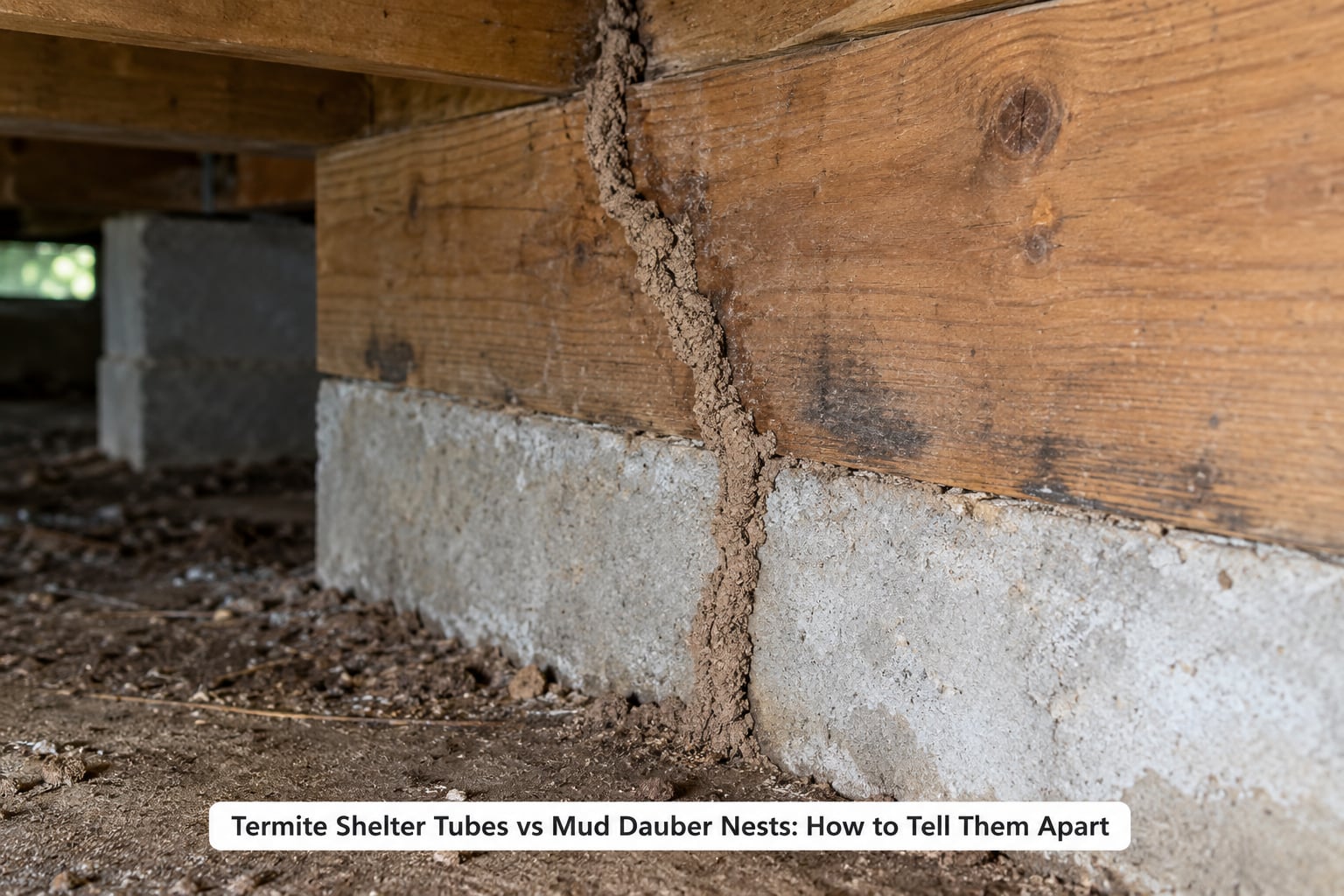
Five questions settle almost every case, and you can answer them from the ground with a phone photo.
- Where is it? Within a foot or two of the soil line and touching the building, think termites. Under an eave, on a porch ceiling, a garage ceiling, a rafter, or inside a vent, think mud dauber.
- Is it flat against the surface or standing off it? Termite tubes are plastered flat. Dauber nests hang out into open air and hold their own weight.
- How thick is it? A termite tube is roughly pencil-width and feels flimsy. A dauber tube is chunky, usually at least half an inch across.
- Are there holes? Round holes in the side or end of a mud dauber nest are emergence holes made by wasps that already moved on. A termite tube is an open-ended run, not a chambered structure.
- What is inside? Break open a dauber cell and you may find a brown, motionless spider and a white grub, or nothing but a clean hollow. A termite tube is empty by design. Termites pass through, they do not store food in it.
That fifth check is the one homeowners describe most often. A DIY segment scraping a nest open on camera shows the spider cache, and it is immediately clear which insect made the structure.
Other insects that build mud tubes
If the structure is not on your building, or the location makes no sense, other insects use mud as well.
- Termites build shelter tubes and underground galleries, always against a substrate and almost always near ground level.
- Mud daubers build above-ground organ-pipe rows or plastered clusters on protected surfaces.
- Other solitary wasps, including potter wasps, cell the ground in small clusters near water or bare soil.
- Field crickets and mole crickets push short burrow plugs and muddy tunnels through damp lawn soil. These are in the ground, not on walls.
- Mud splashed by chimney swifts and similar birds can look like a smear of nest material rather than a built structure.
Use the season as a second check
Eastern subterranean termites typically swarm from February to April, which is when winged reproductives leave the colony, drop, and shed wings near windows and doors. Shelter tubes often appear at the same time. Mud daubers, by contrast, build through the warm part of the year, and nests are common on structures well outside any termite swarm window. Finding the mud structure in July leans wasp; finding it alongside shed wings on a windowsill in March leans termite.
Where Each Structure Is Usually Found
Termite shelter tubes follow the ground. They run from the soil line up onto a foundation, along the edge of a crawlspace wall, over a downspout, or across a concrete stem wall where the colony is feeding on buried wood. You will also see them bridging across exposed concrete or foundation cracks, which is what the mud tube bridges are for.
They turn up in damp, unfinished places: garage interiors, porch columns, uninsulated additions, and anywhere with a moisture source near the wood.
Mud dauber nests go where mud daubers can work in shade and stay sheltered. Common spots include under eaves, under porch and carport roofs, on garage and carport ceilings, in rafters and under soffits, on stucco walls beneath a window drip line, and on outdoor light fixtures, AC housings, meter cabinets, and vent openings.
The overlap cases are worth knowing. A nest built inside an AC unit housing or a gas meter cabinet is still a wasp nest, and so is one built on the underside of a vehicle’s fitting. Forum threads about daubers nesting in aircraft-style pitot tubes and exhaust pipes are not far-fetched, since those fittings are simply protected cavities.
Which One Is More Damaging?
The termite tube wins on damage, by a wide margin. Termites eat cellulose, so a colony working on a sill, joist, or deck can compromise wood while you watch a mud tube quietly lengthen on the outside. Shelter tubes can also show up as secondary signs: buckling floorboards, swollen baseboards, hollow-sounding wood when tapped, dark blistered paint on drywall, or piles of shed wings inside a window.
A mud dauber nest causes no structural damage. It does not eat the wall. The only real costs are cosmetic, a stain on stucco or paint that needs patching, and the sting risk if you handle an active nest.
Sting risk deserves a clear statement because both insects are frequently feared for the wrong reason. Mud daubers are solitary and not colony-defensive. They are not territorial about the nest the way a yellowjacket or honey bee is, and stings usually happen when a wasp is trapped or handled. A few people do react badly to any wasp sting, so treat an active nest with the same respect you would give any stinging insect.
That sting risk is also a reason many homeowners simply leave daubers alone. They are useful spider predators, and homeowners in areas with black widows around garages and sheds often consider that a fair trade for a mud nest under the eave.
Termite Shelter Tubes vs Mud Dauber Nests: What Action to Take
If it is a termite shelter tube, leave it in place and get it inspected. Do not break it off, and do not seal it. Removing the tube destroys the visible evidence and can cut off a foraging route without affecting the colony at all, because termites simply build around the damage. An independent termite inspector can tell you whether you have an active colony, what extent the damage runs, and what treatment would involve. The February to April swarm window is the easiest time to confirm activity, since swarmers are hard to miss, but tubes should be reported outside that period too.
If it is a mud dauber nest, you have options and no urgency beyond avoiding stings.
- Check activity first. Watch the nest for a few days at a distance. Wasp traffic in and out means it is in use. Old emergence holes with no open cells and no wasps mean it is finished and safe.
- Remove it dry, late in the day. Scrape it off with a putty knife or a paint scraper. Do not hose it down. Water softens the mud, turns it to slurry, and drives it into the stucco or siding instead of coming away.
- Work at dusk. Wasps are less active and less likely to fly at you while you are on a ladder.
- Keep it away from your face and wear long sleeves, gloves, and eye protection.
- Patch the surface afterward. Fill the marks with a stucco patch or exterior spackle matched to the surface, then prime and paint to seal it.
Removing a nest does not prevent a rebuild, because the female is usually still around and the same sheltered surface still works. Blocking access to the attachment point, painting over the surface so there is no bare mud edge, or having a residual surface treatment applied to that spot usually breaks the cycle. Homeowners who have scraped the same eave two or three years running learn this the hard way.
Which Should You Choose?
If you have a mud structure on your building, start by matching what you saw against the table above, then pick the branch.
Choose the inspection branch when the structure is flat against the building, near ground level, pencil-thin, and hollow along its length. That combination points to termites, and the cost of a wrong guess here is the highest of the three outcomes. Choose the leave-it branch when the nest is overhead, chunky, self-supporting, and away from the foundation. One wasp nest on an eave is a normal seasonal event with no structural consequence.
If the location and thickness genuinely do not resolve it, take a photo with something for scale next to the structure and get an identification from your local extension service or a pest professional before you spend anything. Reddit identification threads show why: in one thread in r/pestcontrol a posted structure called a termite tube was corrected in the comments as a mud dauber nest, and in a thread on r/Termites a garage-corner structure was identified as a solitary mud dauber nest that could be knocked down safely. Professionals misidentify these too, which is normal and fixable.
Frequently Asked Questions
Can mud dauber nests look like termite shelter tubes?
They can confuse people, especially an organ pipe mud dauber row with several tubes side by side, which looks like a cluster of termite tubes at a glance. Location and attachment settle it. Termite tubes are thin, flat against the surface, and sit near the soil line. Mud dauber nests are thicker, stand off the surface, and sit under eaves or ceilings. Break one open and a paralyzed spider or an emergence hole settles the question.
Are termite shelter tubes dangerous to touch?
No. Subterranean termites do not bite or sting people, so touching a shelter tube carries no direct risk to you. The danger is to the structure, not to your skin. Breaking a tube can sever a foraging route, and the colony will simply build around the break. Leave the tube intact and let an inspector assess it. Wear gloves for hygiene, not for protection.
Does one mud dauber nest mean there is a large infestation?
It does not mean any infestation at all. Mud daubers are solitary wasps, so each nest belongs to a single female rather than to a colony. Several nests on one wall usually means several females found the same sheltered surface useful, not that the number is escalating. The only related concern is spider numbers nearby, since the daubers exist because they found hunting worth staying for.
Should I remove a mud dauber nest?
Either choice is reasonable. Leaving it costs nothing structural and keeps a useful spider predator on site, but the nests do not prevent a rebuild and can leave stains on stucco or paint. To remove one, work in the evening and scrape it off dry with a putty knife. Avoid spraying it or hitting it with water, which can provoke defensive stinging and drive moisture into the wall surface.
What does an empty termite shelter tube mean?
It means workers are still using that route, because a termite tube is a working passageway rather than a food store. If the colony has died or moved on, the tube will look weathered, dry, and crumbling, often with sections flaking away. A crumbling tube on its own does not prove an active infestation, but a firm, recently patched tube on sound-looking wood does deserve an inspection.
How can I identify an insect nest I cannot see clearly?
Take a photo with a coin or ruler for scale, and shoot it from below with the light behind you. Note three things: the height above the ground, whether the structure is flat against the surface or standing off it, and whether any wasps are entering or leaving. Send all three to your local extension office or a pest control professional. A close photo with scale resolves almost every case in a single exchange.
Conclusion: Start With the Location and Shape
Look at the structure again and check two things first: how high off the ground it sits, and whether it lies flat against the building or stands off it. Flat, thin, and low means a termite shelter tube, so leave it untouched and book an inspection. Chunky, self-supporting, and overhead means a mud dauber nest, which you can leave for the spider control or scrape off dry with a putty knife whenever you like. If neither description fits, send a photo with a coin for scale to your extension office or a pest professional and let them call it.