The difference comes down to one behavior: termites eat the wood, carpenter ants excavate it to nest. That single fact changes what you find on the surface, what the debris looks like, where on the house the damage shows up, and how fast it spreads. Sorting out termite vs carpenter ant damage differences before you call anyone is the difference between paying for a barrier treatment and paying for a moisture correction that was never the problem.
Neither pest announces itself. A termite colony can hollow out a floor joist while the surface still looks like new lumber, which is why people describe it as damage that happens out of sight. Carpenter ants are noisier and more obvious, but the pile of debris they leave is easily mistaken for a construction leftover or a paint flake.
Here is what each pest actually leaves behind, and how to use that evidence to decide what happens next.
Table of Contents
- Termite vs Carpenter Ant Damage Differences at a Glance
- How the Damage Looks on Wood
- Termite Damage Signs
- Carpenter Ant Damage Signs
- Where Each Pest Is Most Likely
- How Professionals Tell Them Apart
- Which Should You Choose?
- Frequently Asked Questions
- Can you tell termites and carpenter ants apart by the damage alone?
- Do carpenter ants destroy the structural wood of a house?
- Which is more damaging, termites or carpenter ants?
- Should I repair wood damage before treating termites or carpenter ants?
- Are termite mud tubes and carpenter ant frass easy to distinguish?
- Do DIY treatments work for termite or carpenter ant damage?
- What to Do First
Termite vs Carpenter Ant Damage Differences at a Glance
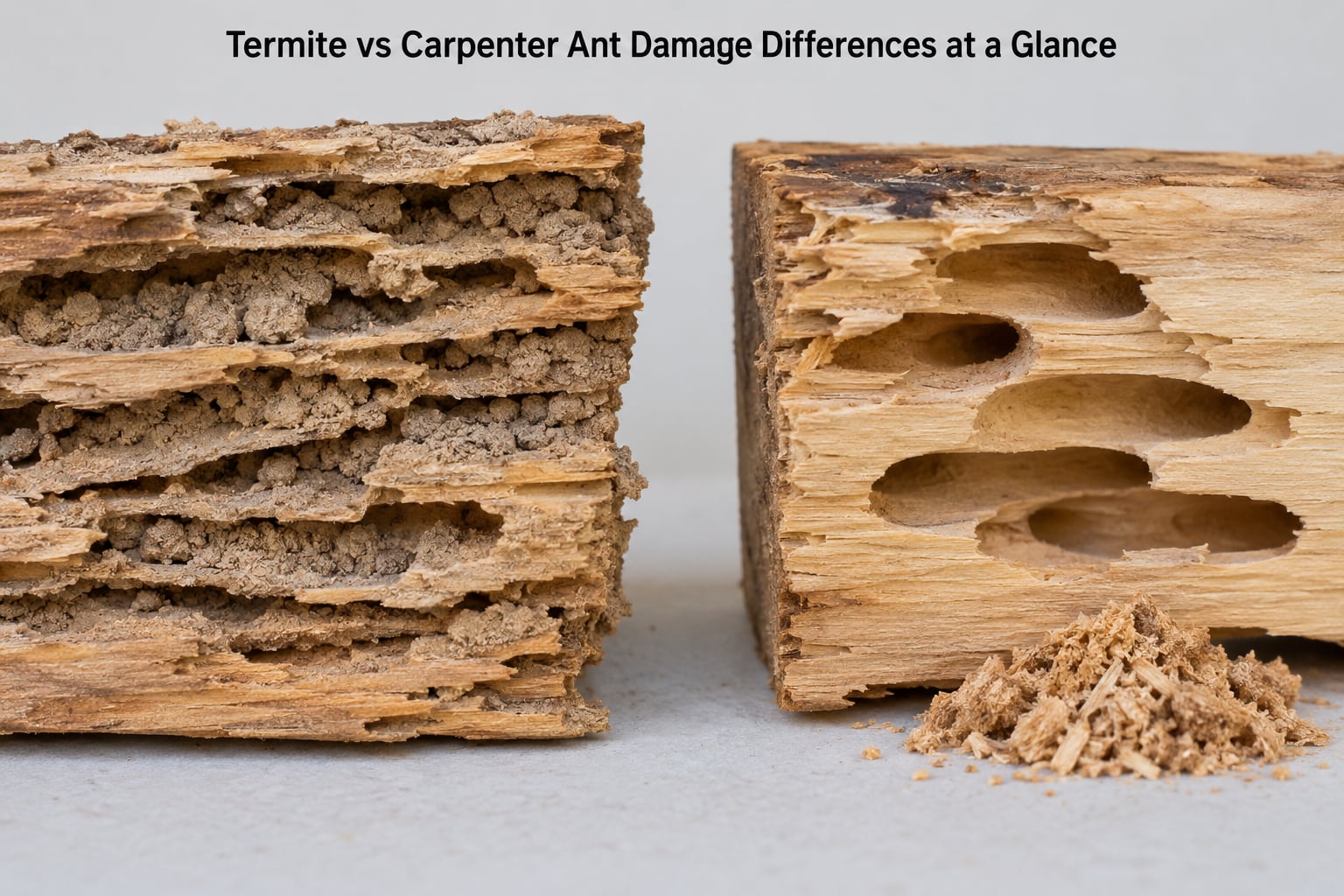
This table is the fastest read. Every row below is a difference a homeowner can actually check, not an insect fact you would need a magnifier for.
| Point of difference | Termite damage | Carpenter ant damage |
|---|---|---|
| Damage pattern | Rough, ragged galleries arranged in layers or a honeycomb pattern, often slicked with mud | Smooth-walled tunnels and chambers cut cleanly through the grain, like chiselled work |
| Debris left behind | No sawdust piles; instead mud tubes, and for drywood species, tiny six-sided pellets and a fine dust that falls out of kick-out holes | Fibrous, sawdust-like frass in piles below kick-out holes, mixed with insect parts and sometimes darker wood fragments |
| Wood preference | Any cellulose, so framing, trim, flooring, books and even paper-backed items in damp areas | Damp or softened wood, usually where water or decay has already weakened the material |
| Moisture relationship | Subterranean termites need wood-to-soil contact to keep moist; they travel up through damp crawl space or fill soil | Moisture is the starting point, not the requirement; carpenter ant galleries often begin at a leak, a damp sill, or a wet spot behind trim |
| Activity pattern | Mostly hidden. Winged swarmers appear in spring or after rain, and damaged wood may be hollow when tapped | Foragers travel at night, so you may see a line of ants running to a wood source and hear rustling inside the wall |
| Odor | Faint musty smell sometimes noticed in heavy infestations, more often in crawl spaces | Moist, musty smell from damp wood; the ants themselves are not usually odorous |
| Structural risk | Higher. A colony feeding from the inside can weaken load-bearing members before the surface shows anything | Lower and more localized, but significant where the wood was already softened by water |
| Inspection priority | Book a termite inspection promptly; a mud tube reaching the soil line is a strong reason to move now | Find the nest and the moisture source first; ant control without fixing the water usually fails |
How the Damage Looks on Wood
Termite vs Carpenter Ant Damage Differences in Wood
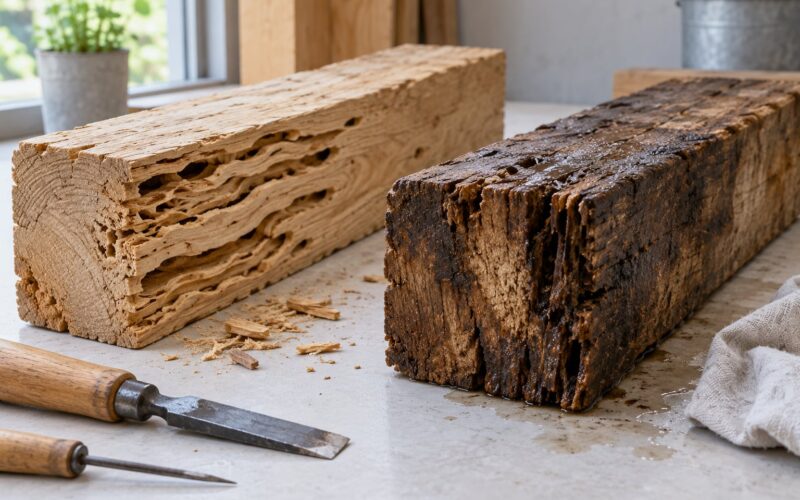
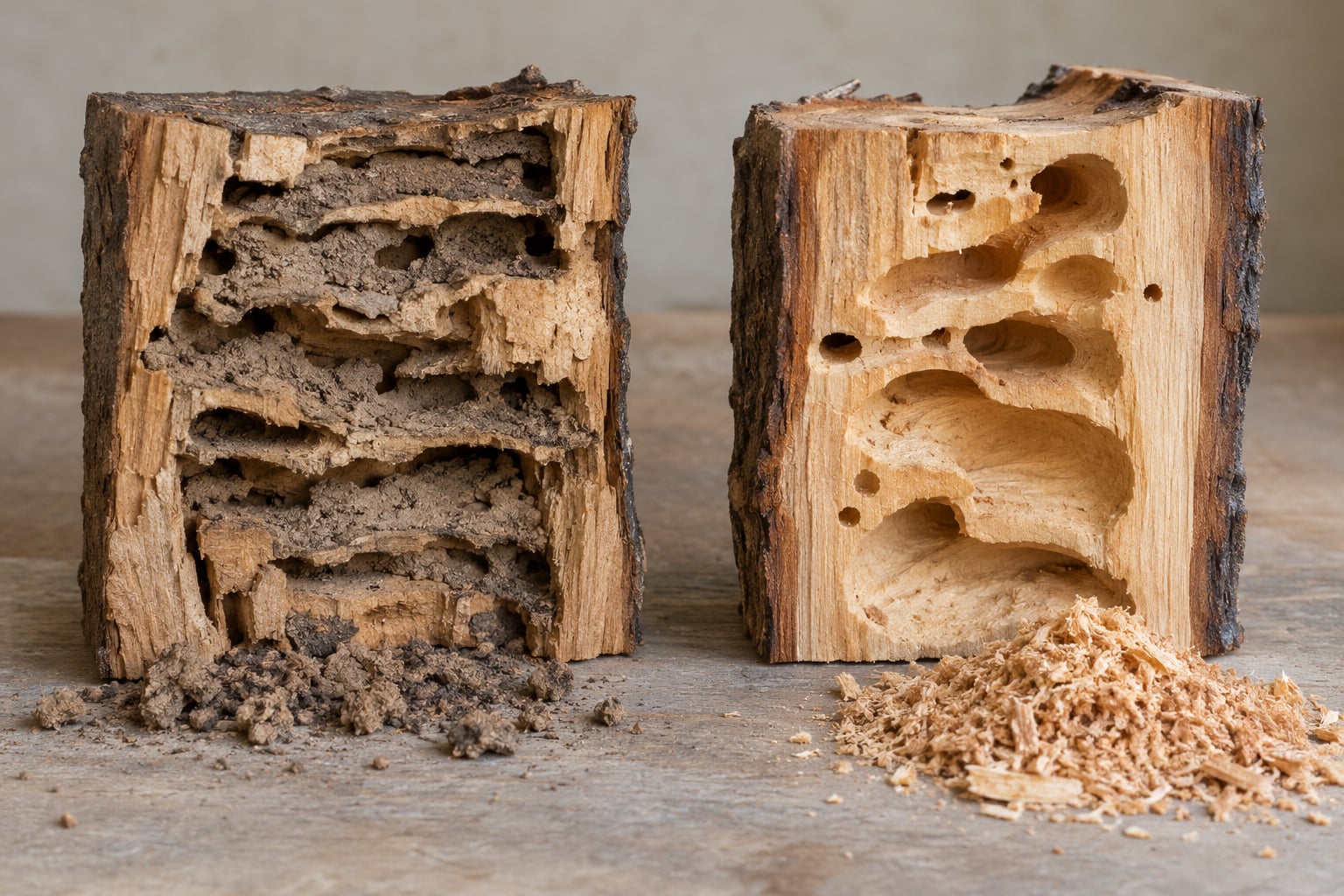
Break open a suspect board and the difference shows in the interior. Termite galleries are irregular, with walls that look chewed and lined with a thin layer of soil or mud the workers carried up from below. The damaged area often reads as stacked layers or a honeycomb, and the outer shell of wood can stay intact while the middle is gone.
Carpenter ant galleries are the opposite character. The ants hollow out chambers with smoother, more defined walls, and they push the removed material out through a small opening, which is where the pile of frass ends up. They cut across the grain rather than following soft, damp layers, so a piece of framing can look excavated while still holding together.
Appearance alone is not proof. Old carpenter ant galleries, rodent-chewed wood, and galleries from insects that have since died can look almost identical, and a photo of a rafter cannot tell you how far the damage extends. Treat what you see as a strong clue, then get it confirmed before you spend money on a repair or a treatment plan.
One more difference worth knowing: termites consume the wood and leave little behind at the site, while carpenter ants remove wood but keep none of it. That is why you find a sawdust pile under one and not the other. If someone handed you a bag of debris from inside the wall, the material itself is often the most useful evidence you have.
Termite Damage Signs
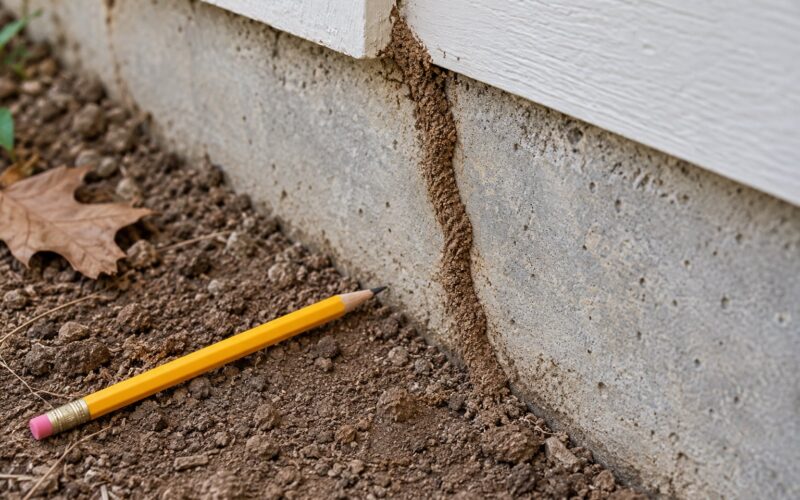
Look for the trail first. Mud tubes, sometimes called shelter tubes, are the classic sign of subterranean termites. They are narrow lines of soil, roughly pencil-width, built along foundation walls, along cracks in concrete, across crawl space joists or over blocked vents, and they tell you the termites have a route between soil and wood.
Beyond the tubes, winged insects are strong evidence. After a colony matures it sends out swarmers, and both the flying adults and the shed skins they leave behind can be found near windows, light fixtures, or in a crawl space. Workers themselves are pale, soft-bodied, and straight-waisted, which is unusual enough that people rarely believe them at first glance.
Wood evidence includes a hollow or dull sound when you tap a surface, buckling or tiny holes in drywall, paint that bubbles or peels where moisture is moving behind it, and baseboards or floorboards that feel soft under a knife test. Drywood termites leave a different signature: stacks of tiny, uniform, six-sided pellets outside small kick-out holes, often on windowsills, in attics, or near books and stored paper.
Be honest about the limits. In cold or dry regions, subterranean activity can slow or stop, and a house in a heavy Formosan termite pocket can look quiet while the colony is still large. Absence of signs is not proof of absence.
Carpenter Ant Damage Signs
The most obvious clue is debris. Carpenter ant frass is fibrous and sawdust-like, sometimes mixed with insect parts, and it collects in small piles directly below a kick-out hole in the wood or in a void behind trim. People regularly mistake this pile for old construction dust or sanding residue, which is why a homeowner can tidy it away twice and have it back the next week.
The second clue is the ant itself. Carpenter ants are large, dark brown to black, sometimes with a reddish tint on the head and thorax, and they have a pinched waist, elbowed antennae, and a narrow waist you can see without magnification. Wings, when present, are clear and longer than the body, unlike termite swarmers whose wings extend well past the abdomen.
Where they nest explains most of the damage. Carpenter ants need a damp starting point, so galleries frequently begin at a leaking window, a wet sill plate, a plumbing drip, or a spot where trim sat against wet masonry. Once inside, they excavate a parent nest in sound wood and satellite colonies in softer, damper material nearby, then take on damp, decaying wood.
That last point settles the most common misconception. Carpenter ants do not eat wood for food. They cut and discard it to build chambers, so a large carpenter ant infestation is often a signal that a water problem is already softening the structure, and fixing the wood without fixing the water just invites them back.
Where Each Pest Is Most Likely
Termites follow the ground. Subterranean species need a continuous moisture path from soil to wood, so look first at the crawl space, the bottom of basement walls, the sill plate, deck posts sitting on concrete, and any wood that touches soil or a concrete block. Drywood species ignore that rule entirely and are more likely in attics, near window trim, or around stored furniture and books.
Carpenter ants follow the water. Their damage shows up near window casings, door jambs, bathroom or kitchen trim, fascia behind a downspout, roof edges, and any framing that has been wet and then dried slowly. A deck with a hidden water trap or a set of steps that hold moisture after rain is exactly the kind of place where a colony starts.
Both can be in the same house at the same time, and that confuses people more than anything else on this list. Carpenter ants prey on termites, so finding ants does not prove the termites are gone, and it certainly does not prove they were never there. The honest answer is that the two pests can overlap in the same structure, which is another reason to identify the insect instead of assuming.
How Professionals Tell Them Apart
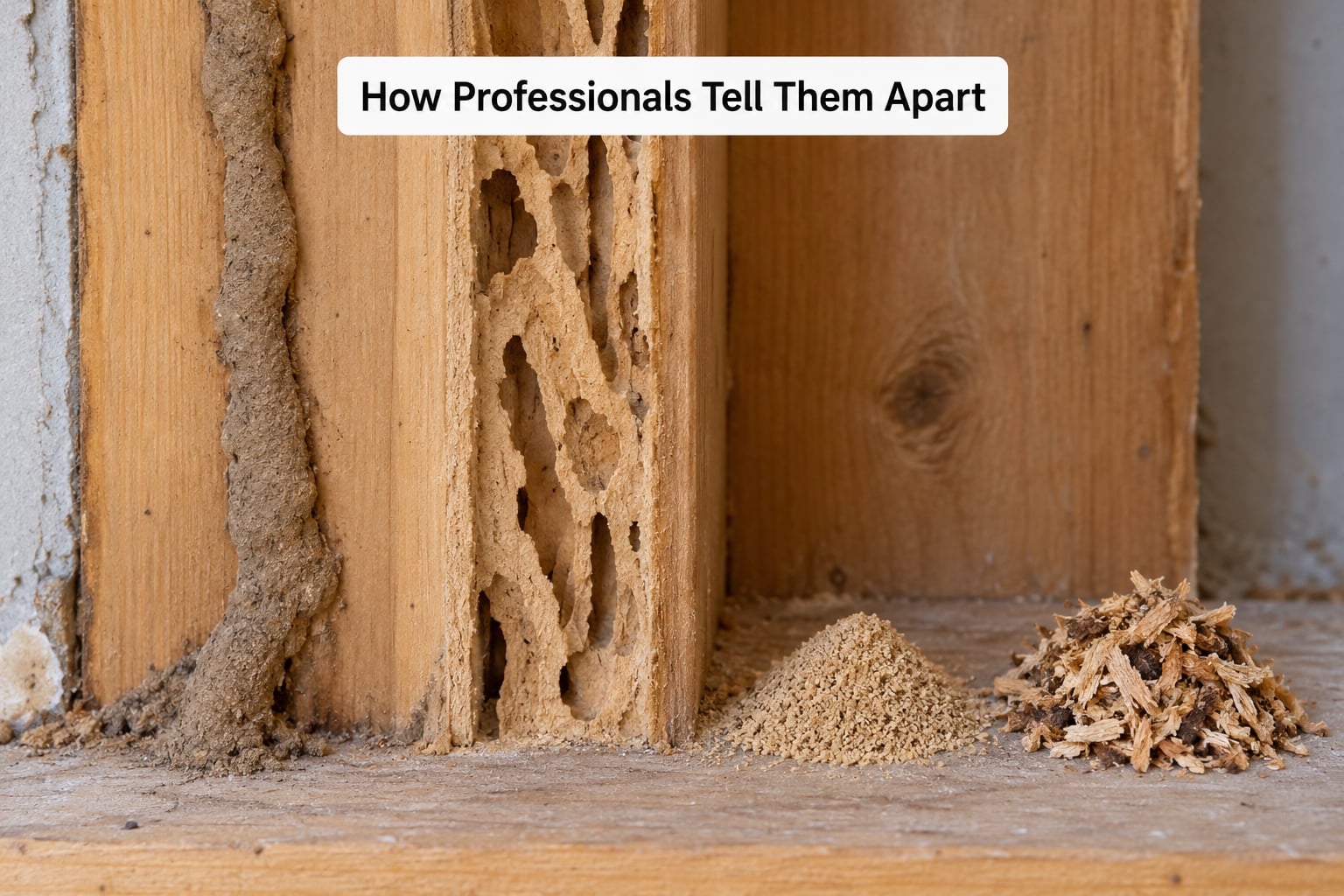
An inspection starts with evidence collection, not spraying. The inspector looks at what is on the ground first, then the location, then the insect. Debris shape narrows the field quickly: six-sided pellets or a mud tube leading back to soil points one way, fibrous frass at a damp spot points the other, and paint dust or dried rot points somewhere else entirely.
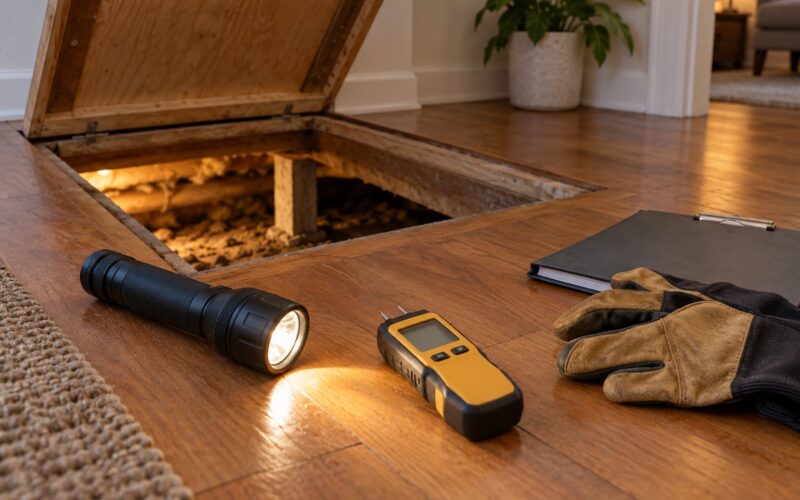
From there the inspector checks structure and contact points. Is there a path from soil to wood? Does the damaged member touch a water source? What does the wood sound like when tapped, and does a thermal camera or moisture meter show dampness behind the suspect area? A thermal camera on a cold morning will show heat loss through hollowed wood in places that look perfectly fine, which is how out-of-sight damage gets found.
Sometimes the honest answer is not identified, and a good inspector will say that rather than sell you a treatment. Many of the strongest field clues sit inside a wall void or below the floor, so confirming an identification may mean opening a small inspection point or removing a baseboard. If the damage runs through load-bearing framing, or if you see floors beginning to sag over finished living space, that is an engineer or structural evaluation question before it is a pest question.
For most homeowners the trigger is simple: visible mud tubes, a new pile of debris that reappears after you clean it up, or hollow-sounding boards in a crawl space or basement. Those three mean call a licensed pest professional rather than continue guessing.
Which Should You Choose?
Use the evidence you have, and pick the path it points to. Mud tubes reaching soil, layered galleries, or pellet piles from drywood species mean termite treatment: barrier, baiting, soil treatment, or fumigation depending on the species and the extent, followed by a repair plan for anything already weakened.
Smooth galleries, frass at a damp trim or sill, and a trail of large dark ants at night mean carpenter ant control, which only holds when the nest and the moisture source are both addressed. Fixing the leak, improving ventilation, and removing the conditions that softened the wood matter as much as any product applied to the wall.
If both signals are present, or if you cannot tell, the choice is further inspection before treatment. If a board in an occupied living area feels spongy, or a header above a doorway has visibly sagged, stop and get a structural read first. No pest treatment reverses a member that has already lost its strength.
Two things change the timeline regardless of which pest you have. Damage that runs through structural members gets treated as urgent. Damage limited to a storage shed, a fence, or a woodpile is real but rarely urgent, and it is also the easiest place to get a second opinion before spending anything.
Frequently Asked Questions
Can you tell termites and carpenter ants apart by the damage alone?
Sometimes, but rarely with certainty. Rough layered galleries and mud tubes point to termites; smooth galleries and fibrous frass at a damp site point to carpenter ants. Appearance alone cannot confirm the pest, because old galleries, rodent damage and wood-boring beetle work can look similar. A sample of the insect plus the location settles it faster than debris.
Do carpenter ants destroy the structural wood of a house?
They can, but usually in a limited area and usually where water or rot has already weakened the wood. Carpenter ants do not eat structural lumber; they excavate it for nesting chambers. The exception is a large, long-running colony in already damp framing, which can hollow out more than you would expect from an insect that is not eating the wood.
Which is more damaging, termites or carpenter ants?
Termites, without much argument. A termite colony feeds from the inside out, so a load-bearing member can lose most of its strength while the surface still looks sound, and colonies can run for years unnoticed. Carpenter ant damage is generally smaller and localized, though it frequently sits on top of a pre-existing water problem that needs its own repair.
Should I repair wood damage before treating termites or carpenter ants?
Treat first, then repair. If you rebuild a damaged member before the pest is dealt with, new wood becomes fresh food or a new nest site, and you may have to do the work twice. Keep the damaged material in place for the inspector if it is structurally significant, photograph it, and replace it once treatment is complete and the area is confirmed clear.
Are termite mud tubes and carpenter ant frass easy to distinguish?
Yes, in most cases. Mud tubes are continuous soil-and-shelter structures attached along a surface, usually connecting wood to the ground. Frass is loose fibrous debris lying in piles below a small kick-out hole. Drywood termites add a third look: tiny uniform six-sided pellets pushed out of pinholes. If you are unsure, keep a sample in a sealed bag before you clean it up.
Do DIY treatments work for termite or carpenter ant damage?
For structural termites, no. The colony may extend well beyond the visible gallery, and partial treatment commonly disperses it rather than eliminating it. For carpenter ants, spraying visible trails can knock back foragers while the nest and the moisture source stay in place. In both cases, correcting a leak and reducing wood-to-soil contact is the part you can genuinely do yourself.
What to Do First
Document before you clean. Photograph the debris where it fell, bag a sample, and note the exact location, including whether wood touches soil at that point.
Then remove the obvious food and water: stop the leak, dry out the damp spot, move stored firewood and stacked lumber away from the wall, and clear the soil-to-wood contact where you can do it safely. Skip the DIY chemical spraying, because partial treatment is the most common reason an infestation survives to the next season.
Finally, get a professional identification before any repair or treatment work, especially if the suspect wood is structural. Understanding termite vs carpenter ant damage differences gets you the right first call, and the right first call saves both wood and money.