Why termites eat wood and what they digest comes down to one thing: cellulose, the tough plant fiber that makes up most of a tree’s dry mass. Termites cannot break that cellulose down on their own. Protozoa, bacteria and archaea living in the termite’s hindgut ferment the fiber into acetate, which the insect absorbs as its main source of energy and carbon.
That arrangement explains almost everything a homeowner needs to know. Termites target damp, untreated, cellulose-rich material because moisture keeps the wood soft enough to chew and the gut microbes only work well at a fairly stable moisture content. It also explains why killing the insects you can see rarely solves the problem, because the microbes and the food supply keep the colony running.
What Do Termites Eat?
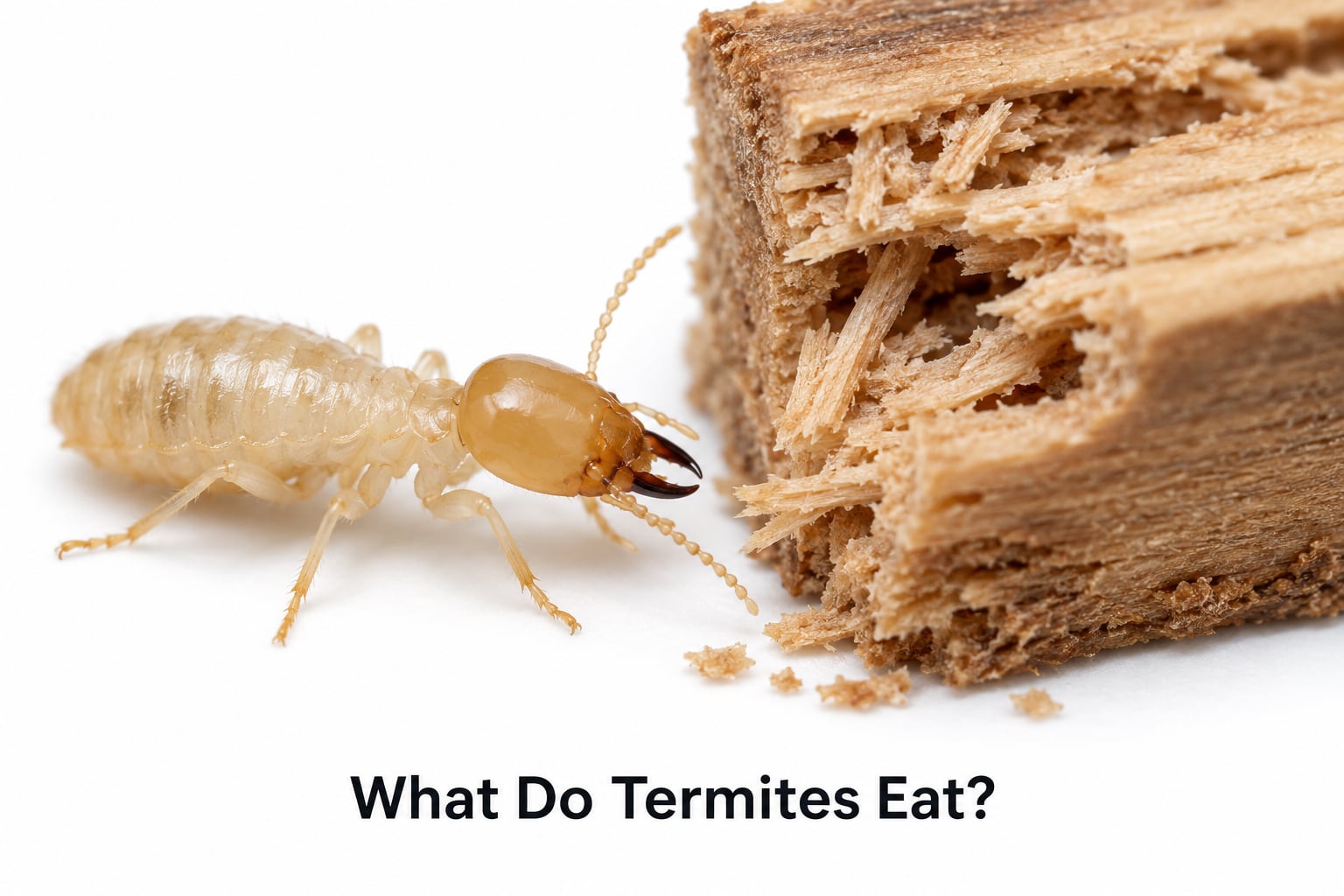
Termites eat cellulose, and they eat anything made of it. That means wood, but also paper, cardboard, book bindings, some textiles and the plant tissue in mulch and decaying stumps.
They will also consume soil, partly for the mineral content and partly for the cellulose-rich particles it contains. What they are not interested in is a material whose cellulose has been locked away behind a barrier.
Wood treatments, sealers and paints change how much of the underlying cellulose a termite can actually reach. That is the practical distinction behind most treatment advice: a heavily protected surface raises the cost of the meal, which is not the same as making the meal disappear.
Here is what a termite diet looks like in practice.
- Cellulose: the target nutrient, and the reason a colony can live on lumber alone.
- Hemicellulose: a softer, easier-to-break-down plant fiber that goes down first.
- Soil and mulch: mineral sources plus a share of fine plant debris.
- Paper, cardboard and cotton or linen fabrics: the same cellulose, stored indoors.
One note on framing. Saying termites eat cellulose rather than wood is not pedantry. It is the difference between understanding why a termite problem started and guessing at it.
Why Do Termites Eat Wood?
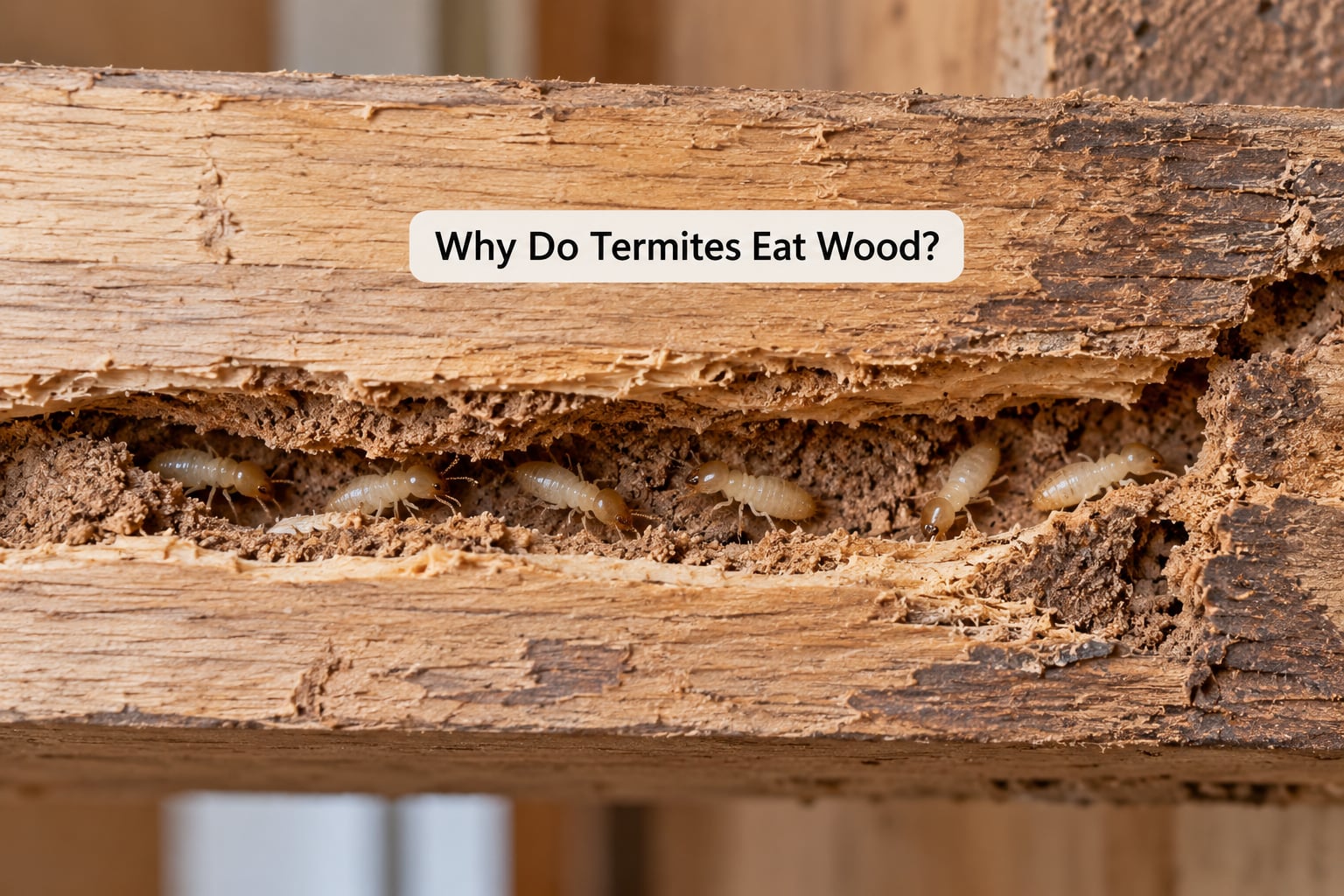
Termites eat wood because cellulose is one of the most abundant carbohydrates on the planet, and almost no insect can use it. Very few animals produce cellulase, the enzyme that breaks cellulose apart, so a food source this plentiful would be a wasted opportunity if it sat there uneaten.
A few reasons, in short:
- Cellulose is a rich source of sugar and energy, once microbes unlock it.
- Other insects cannot digest wood, so the competition is thin.
- Wood is everywhere near ground level, where termites live and travel.
- Protozoa and bacteria live in their stomachs and do the digesting for them.
The third point deserves more attention than it usually gets. A termite is not hunting for lumber in the sense a person hunts for a specific target. It is following moisture gradients through soil, following shelter, and following the chemical trail of plant material back to a connected piece of it.
Subterranean termites build galleries through soil and into whatever wood they meet first. If that wood never touches damp ground and never sits in a sheltered, humid pocket, the colony has to work harder and may never commit to it. Damage concentrates where wood, moisture and shelter overlap: around plumbing penetrations, near downspouts, beneath decks, along porch edges and in crawl space framing.
Wood is also a poor diet in a way that shapes everything else. It is nearly all carbon and very little protein, so termites have to eat a great volume of it and rely on nitrogen-fixing bacteria in their guts for nitrogen at the protein level. Take away the gut bacteria and the termites starve, which is the whole principle behind slow-acting baits.
What Do Termites Digest?
Termites digest cellulose and hemicellulose. They do not meaningfully digest lignin, and they pass a range of other wood components through the gut largely intact.
| Wood component | What happens to it | Result |
|---|---|---|
| Cellulose | Fermented by gut microbes into acetate and hydrogen | Absorbed as the termite’s main fuel |
| Hemicellulose, including xylan | Broken down to hexose sugars by fermenting microbes | Absorbed as additional carbon |
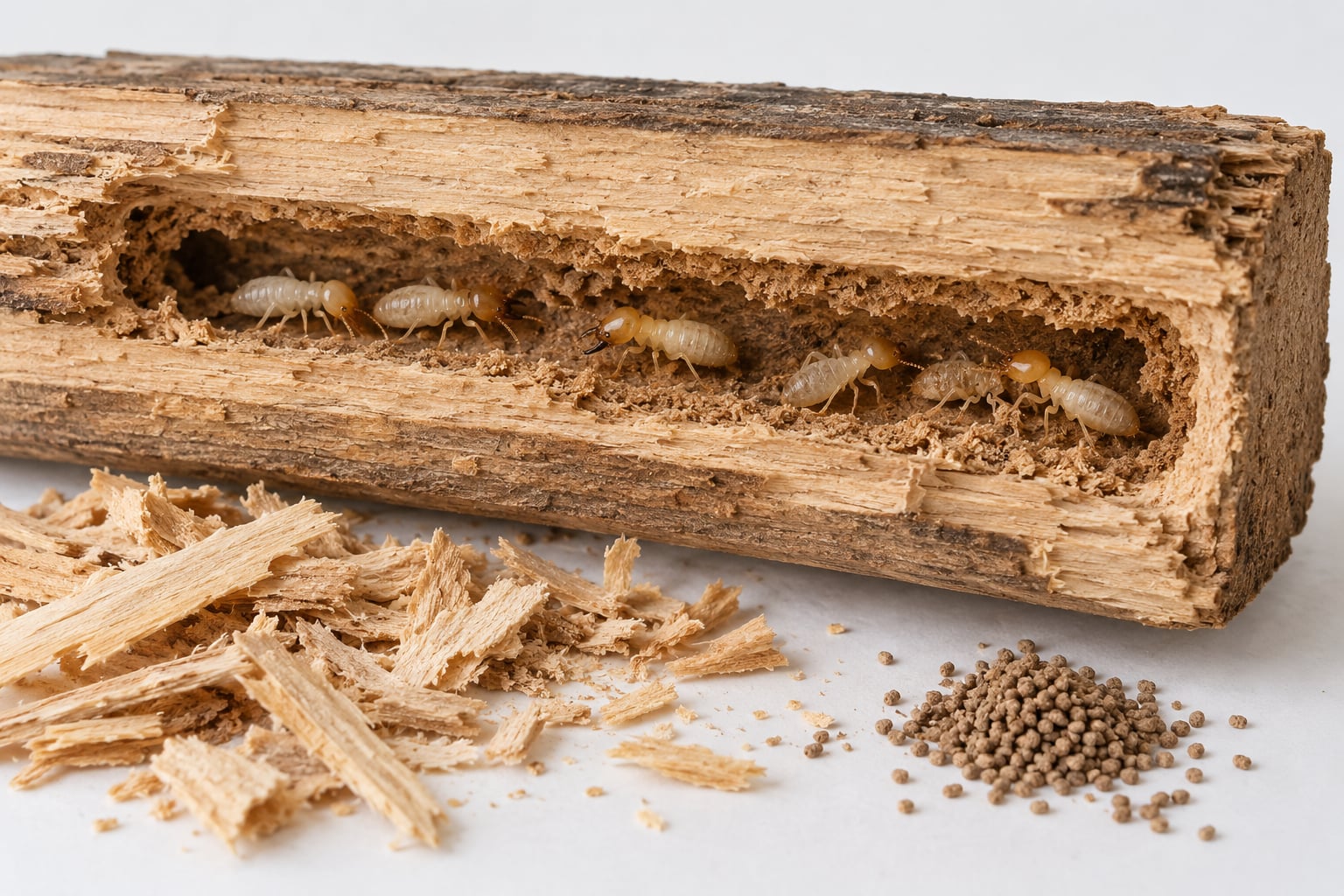
| Lignin | Largely untouched, broken down physically by chewing | Leaves the body as frass, the dry wood droppings |
| Nitrogen-bearing compounds | Almost absent; supplied partly by nitrogen-fixing symbionts | Protein comes from microbes, not from the wood |
| Waxes, resins, some oils | Not digested; some are repellent or toxic | Reduced acceptance of the material |
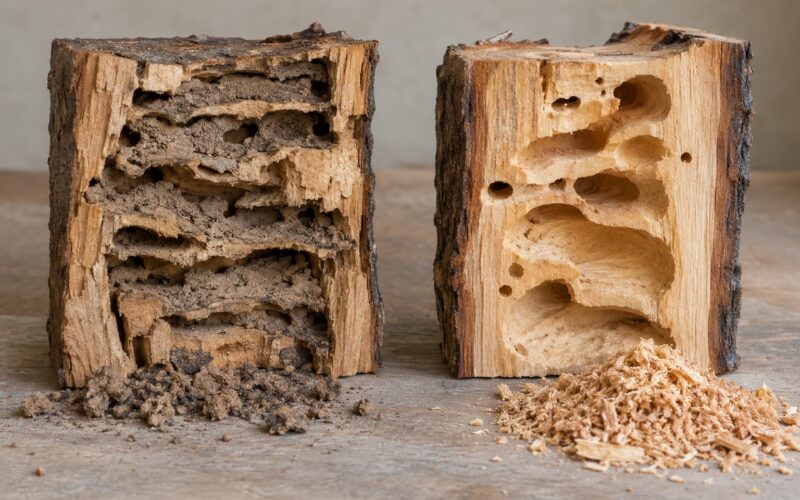
The lignin row is the one most homeowners find useful. Termites chew their way along the softer, nutrient-bearing parts of wood and leave the tougher lignin-rich skeleton behind, which is why damaged lumber often looks thin, blistered or hollow with the outer skin still intact.
That interior-first feeding habit is also why damage is so easy to miss. The outside looks fine right up until it doesn’t.
How Do Termites Digest Wood?
Why termites eat wood and what they digest at each step
The process runs from the mandibles to the paunch to the air tube, and it takes weeks rather than hours. A typical sequence looks like this.
- Cutting. A worker chews wood with hard, chisel-like mandibles, adding saliva that softens the fibers and cutting pieces small enough to swallow.
- Transport. The particles travel through a tube-shaped foregut and midgut. The termite adds nitrogen-rich material along the way, often by feeding on its own castes.
- Fermentation. Wood reaches an enlarged hindgut chamber, sometimes called the hindgut paunch. In some species that chamber is around a single cubic millimeter, and it holds one of the densest communities of microbes anywhere on Earth.
- Conversion. Flagellated protozoa and fermenting bacteria hydrolyze cellulose and hemicellulose into acetate, hydrogen, carbon dioxide and small amounts of sugars.
- Absorption. The gut wall takes up acetate, which circulates in the hemolymph and is oxidized for energy, generating carbon dioxide as the animal breathes it out.
- Waste. Hydrogen and carbon dioxide that are not used by the acetate and methane producers pass out of the anus, and undigested lignin exits as frass.
The oxygen situation inside the paunch is the quiet key to all of this. The gut is essentially oxygen-depleted, and a whole food web has evolved to live there: protozoa that eat the fermenting bacteria, spirochetes that fix nitrogen, acetogenic bacteria that compete with methanogens for hydrogen, and methanogenic archaea at the end of the chain. Change the balance among them and cellulose processing slows.
Newly hatched termites do not come with this community ready-made. They acquire it from older nestmates through trophallaxis, mouth-to-mouth exchange of food and gut contents. In termite lineages this behavior has been passing the same microbial partners down for over a hundred million years, which is a neat answer to the question of how termites got their digestion in the first place: inheritance, colony-wide and generational.
Why termites eat wood and what they digest can be put in a single comparison. You and a cow face the same wall and handle it with different equipment.
| Animal | Produces its own cellulase | Needs gut microbes | Ends up with |
|---|---|---|---|
| Human | No | Minimal; gut bacteria ferment a small fraction | Almost nothing usable from fiber |
| Cow | No | Yes, rumen protozoa and bacteria | Volatile fatty acids, mostly acetate |
| Termite | No | Yes, hindgut protozoa, bacteria and archaea | Absorbed acetate plus a little sugar |
The cow and the termite arrive at nearly the same product, acetate, from nearly the same raw material. That is not a coincidence. It is the same biochemistry solving the same problem in two very different bodies.
Why Termites Eat Wood and What They Digest
Termites eat wood because cellulose is abundant, energy-rich once processed, and available to almost no other insect. What they actually digest is narrower than the question usually implies: cellulose and hemicellulose are fermented by gut microbes into acetate and simple sugars, while lignin and other components pass through and leave as frass.
So the popular image of termites chewing through a beam is half right. The chewing is real, the wood is real, and the damage is real, but the termite is running a fermentation plant, not a wood grinder.
A side effect of that biology is worth noting. Because termites are major consumers of dead plant material, they are also significant recyclers, moving carbon out of fallen wood and back into soil. Researchers have estimated that termites produce a meaningful share of global methane, something on the order of a few percent each year, because methane is what the last organisms in the gut chain make from the leftover hydrogen.
For the same reason, some species are drawn to wood already weakened by fungi. Fungi break down lignin first, which exposes more of the cellulose underneath and softens the material. Termites and fungi often cooperate on the same log, and fungal decay alone is a separate structural problem worth understanding rather than confusing with termite activity.
Where else does the search turn up cellulose? Stumps and buried roots, mulch beds, dead branches, cardboard storage boxes, paper files, library books and cotton or linen clothing folded in a closet. Any cellulose item resting against damp soil or a damp crawl space wall is a candidate.
Do Termites Eat Wood in Homes?
Yes, and the way they get to it depends on the group involved.
| Group | Moisture and setting | Usual entry route |
|---|---|---|
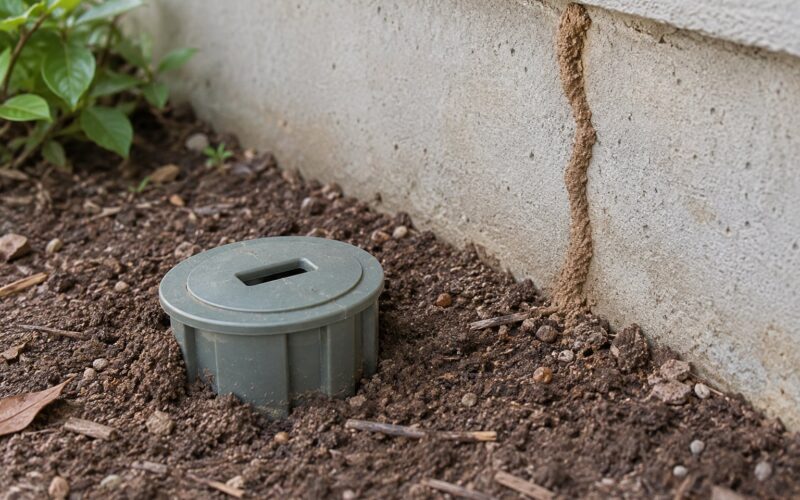
| Subterranean | Needs a damp source; soil contact most common | Soil mud tubes, cracks, plumbing gaps, foundation openings |
| Dampwood | Moist but not soaked wood, often leaks or poor ventilation | The damp wood itself, from windows, roofs and plumbing |
| Drywood | Wood with little external moisture; can reach sound timber | Small gaps around windows, doors, vents and roof edges |
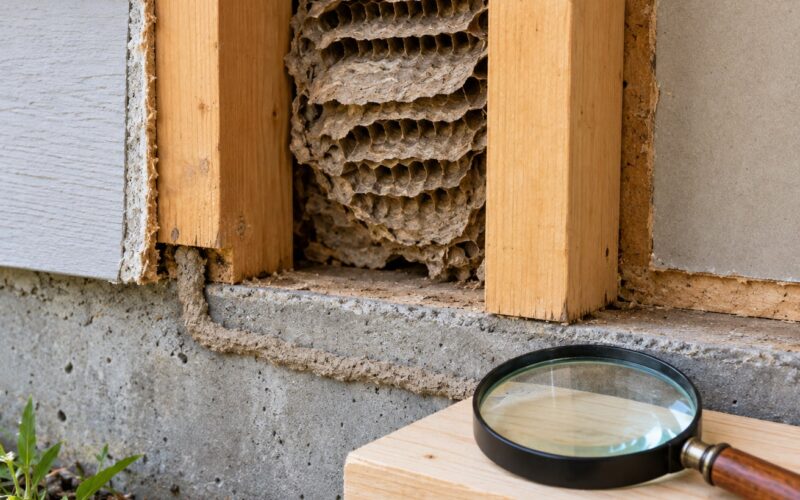
Subterranean colonies are the ones behind most structural damage. They travel from the soil and attack framing, trim and flooring from the inside out, which is why the exterior can look healthy while the interior of a stud has been hollowed.
Two claims come up often enough to correct. First, the idea that termites never touch treated wood is not accurate; they can bore through treated members, they simply find it more expensive as a food source, and results depend on which treatment was used and how thoroughly it was applied. Second, the viral figure that a colony eats a pound of wood a day is not a general rule. Homeowner forums argue about it constantly, and it fits at most to a large, mature colony under ideal conditions.
What is accurate is that termites do not need to consume the house to do meaningful damage. They eat where nutrition is concentrated, and structural members lose integrity as inner layers disappear. A board can be substantially hollow while still supporting weight, which is the dangerous part.
The widely repeated claim that termites bite people is also wrong. Termites do not bite humans and are not a health hazard in the way stinging insects are. Their presence in a house is a building problem and a moisture problem, not a medical one.
What Does This Mean for Wood-Damaged Homes?
Most termite prevention is really moisture management dressed up as wood management. If the wood is dry and the routes in are sealed, an established colony has far less to work with.
Watch for these warning signs:
- Sheltered piles of small brown pellets, called frass, near skirting, baseboards or window sills
- Thin, blistered or hollow-sounding floorboards when you tap them
- Bubbling or peeling paint on trim, a common sign of galleries underneath
- Alates, the winged reproductive termites, found indoors or around windows
- Damp or soil-covered mud tubes bridging from soil to wood
Then work outward from water. Repair plumbing leaks, add downspout extensions, keep mulch and soil off the foundation, move stored firewood and cardboard away from walls, and ventilate crawl spaces so they dry out. Seal gaps around pipes, wires, vents and the foundation line with appropriate materials.
Two misconceptions are worth naming. Spraying visible termites rarely helps, because the workers you see are a fraction of a colony and the food source is still there. And termite bait works by interrupting the colony’s microbial partner relationship rather than by poisoning the insect directly, which is why it is slow and why it needs an active, healthy colony to work on.
If you find mud tubes, widespread frass, alates inside, or galleries in structural lumber, call a licensed pest professional for an inspection. If the damage is already in a load-bearing member, a structural engineer is the right call, not a DIY fix.
Frequently Asked Questions
Do termites digest wood completely?
No. Termites digest cellulose and hemicellulose with help from gut microbes, converting them into acetate and simple sugars they can absorb. Lignin, along with resins and waxes, is largely passed through undigested and leaves the body as frass, the dry droppings you may find near baseboards and window sills. That partly digested material still makes good soil, which is why termite colonies leave useful residue behind them.
What part of wood do termites eat?
They eat the softer, nutrient-bearing portion of the wood: the cellulose and hemicellulose in the cell walls. The harder lignin-rich skeleton is mostly chewed past or left behind, which is why damaged lumber often looks hollow and blistered while the outer skin still appears sound. Some species are also strongly drawn to wood already softened by fungi, because fungal decay exposes more of the cellulose underneath.
How do termites digest cellulose?
They do it with help. Termites lack their own cellulase enzyme, so they depend on a community of flagellated protozoa, fermenting bacteria and archaea in an enlarged hindgut chamber called the paunch. These microbes hydrolyze cellulose into acetate, hydrogen and carbon dioxide, and the termite absorbs the acetate through the gut wall as its main energy source. Newly hatched termites pick up this microbe community from nestmates through trophallaxis.
Can termites eat treated or painted wood?
They can, but they prefer not to. Treatments and sealers do not remove the cellulose, they make it harder and slower to reach, so a well-protected surface raises the cost of feeding rather than making the material inedible. Termites will bore through some treated members when the alternative is no food at all. That is why prevention still depends on keeping wood dry and sealing entry points rather than treating surfaces alone.
Why do termites prefer damp wood?
Two reasons stack up. Termites need moisture to stay hydrated and the cellulose they ferment is easier to chew when the wood is softened by water rather than hard and dry. Damp conditions also let them travel through soil and stay connected to a colony. This is why leaks, poor ventilation, wet crawl spaces and soil touching the foundation matter so much more than the species of lumber used.
How can I tell if termites are eating my home?
Look for sheltered frass piles, thin or hollow-sounding floorboards, bubbling paint on trim, mud tubes bridging from soil to wood, and winged alates found indoors. Tap suspect boards; a hollow sound means the interior has been eaten away. If you find any of these, especially in a crawl space or near a plumbing penetration, have a licensed pest professional inspect it rather than spraying on your own.
Conclusion
Termites eat wood for the cellulose inside it, and they digest cellulose and hemicellulose with the help of gut microbes that convert the fiber into acetate. Lignin and other material pass through and leave as frass. Everything else follows from that arrangement.
If you start anywhere, start with moisture and wood. Look for frass, hollow-sounding boards, bubbling paint, mud tubes or alates indoors. Keep wood dry and away from soil, seal the gaps that lead inside, and if the signs suggest an active infestation rather than old damage, get a licensed pest professional to inspect it before more of the structure goes quiet from the inside.