Formosan termite identification and risk come down to four things you can check yourself: an orange teardrop-shaped soldier head, hairy wings on the swarmers, an unusually high share of soldiers in the colony, and a swarm that comes out at dusk instead of mid-morning. The Formosan subterranean termite, Coptotermes formosanus, is the most destructive termite species in the United States, and it is already established along the Gulf Coast, across Florida, the Carolinas and Georgia, in Hawaii, and in irrigated parts of Southern California.
Most of the alarm you read online is attached to the wrong moment. The flying insects are new reproductives leaving to start a colony somewhere else; they do no damage, and they do not eat. The colony that produced them is the one hollowing your woodwork, and it has almost certainly been doing that quietly for years.
What follows is the identification half of the question first, then the risk half, in the order a homeowner actually needs them. I have kept the numbers attributed to the sources that publish them, because the honest answer on colony size, soldier share and first US detection is a range, not a single clean figure. I will also flag the places where this species is not what people expect it to be, including one statistic that gets repeated far more confidently than it deserves.
Table of Contents
- How to Identify Formosan Termites
- What Do Formosan Termites Look Like?
- Formosan Termite Identification and Risk: Signs Around the Home
- How Serious Is a Formosan Termite Infestation?
- Where Formosan Termites Are Most Likely to Be Found
- What Should You Do If You Suspect Formosan Termites?
- How to Reduce the Risk of Formosan Termite Damage
- Frequently Asked Questions
- What to Do First
How to Identify Formosan Termites
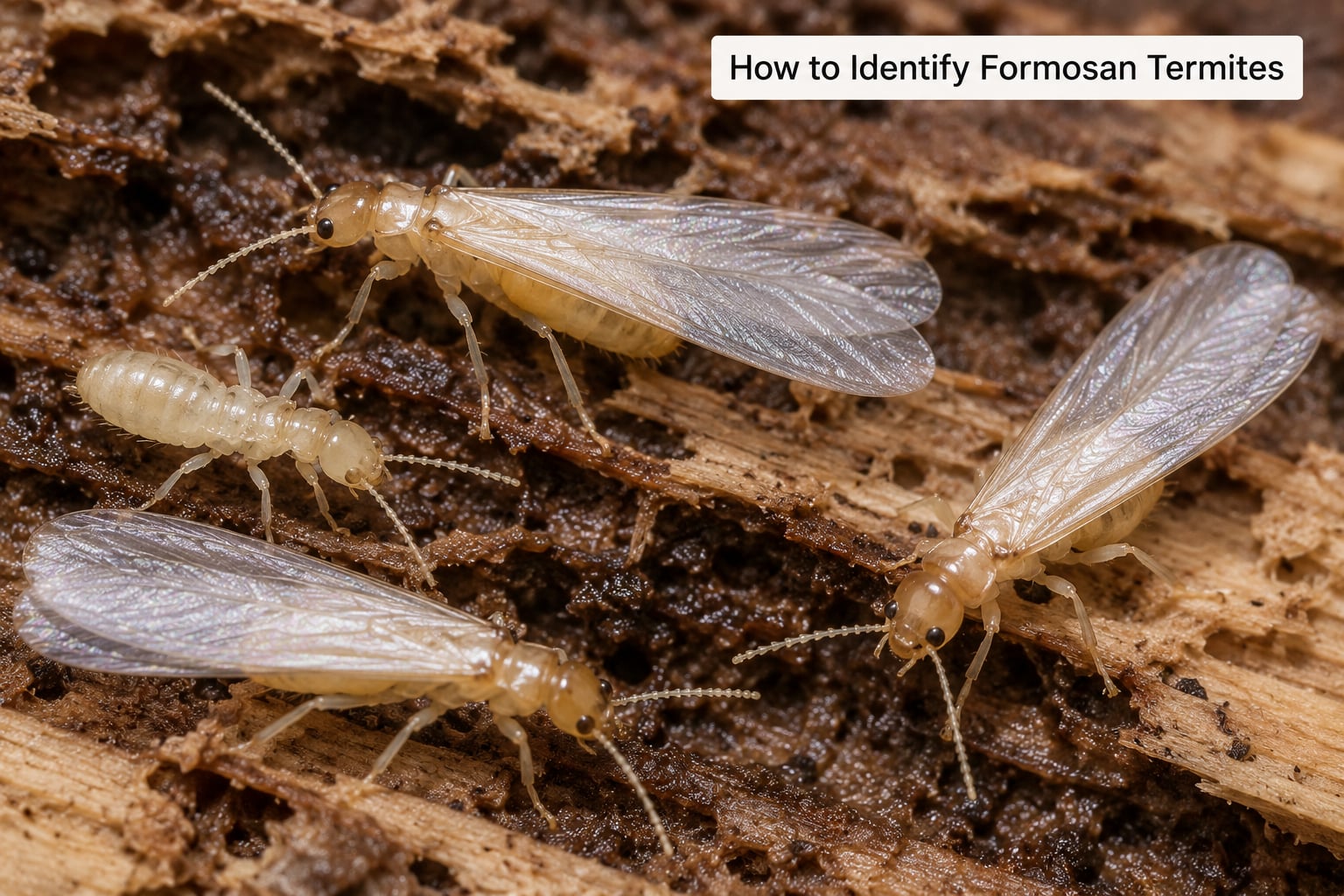
Start by ruling out the insects that are not termites, then work down to the specifics that separate this species from the native ones. That order matters because the most common identification mistake is an ant, and no amount of fine detail fixes a photo of the wrong insect.
First, rule out ants and other look-alikes
Ants and termites look similar at a glance and behave nothing alike. Ants have elbowed, bent antennae, a pinched waist where the thorax narrows to a thin stalk, and a head that is noticeably wider than the body. Termites have straight, beaded antennae, a thick waist with no pinch, and a head about the same width as the rest of the body.
Ant antennae bend. Termite antennae look like a string of tiny beads held straight out from the head, and they stay that way even when the insect is dead. If you can snap that one detail, you are already past most of the confusion people bring to a pest desk.
Winged look-alikes matter as much. Drywood termite alates are dark brown to black, far larger than Formosan swarmers, and have wings roughly three times as long as they are wide. Winged aphids are much smaller, hold their wings upright over their backs, and are usually clustered on new growth. Mayflies have two or three tails and a distinctly upright resting posture. Formosan swarmers are golden to caramel brown, roughly a third to a half inch long, and their wings are covered in fine hairs including across the membrane.
The four diagnostic tells of a Formosan termite
Once the insect is confirmed as a termite, four features carry the identification. You rarely get all four in the same sample, which is exactly why professionals use a microscope rather than a photo.
1. The soldier head. Formosan soldiers have a large, rounded, orange to amber head shaped like a teardrop with the point facing forward, and a noticeably narrow bridge behind the eyes. Eastern subterranean soldiers have a more rectangular, darker head with no such waist behind the eyes. This is the single most reliable field tell and the one most often missing from a photo, because the head is exactly the part people crop out.
2. Hairy wings on the alate. Formosan swarmers have a dense coat of fine hairs over the entire wing, including the membrane between the veins, and a hairy body. Under magnification the wing looks slightly frosted. Other common subterranean species have smooth wings, so this is a clean binary answer rather than a judgment call.
3. A soldier-heavy colony. Extension sources put the soldier share somewhere between 10 and 25 percent of the colony, though you will see 10 to 15 percent cited in some places and around a quarter in others. Either figure is far above what native subterranean species typically show. If you crack open a piece of infested wood and see a heavy minority of orange-headed soldiers, that is meaningful on its own.
4. A dusk or night swarm. Formosan alates leave in the late afternoon and evening, often within a narrow window around sunset. Eastern subterranean swarmers fly during the day. Ants fly in daylight, sometimes in large numbers, so a night swarm near a window is a strong signal and a daytime swarm is a weaker one.
Formosan vs Eastern subterranean termites, side by side
This is the question homeowners are actually asking when they ask how to tell what kind of termites they have, and extension sources usually answer it in prose or photographs rather than side by side. The table below pulls LSU AgCenter, UF/IFAS and Texas A&M AgriLife Extension into one view.
| Feature | Formosan subterranean termite | Eastern subterranean termite |
|---|---|---|
| Soldier head shape | Large, orange, teardrop-shaped with a narrowed bridge behind the eyes | Darker and more rectangular, without the narrow bridge |
| Alate wing surface | Covered in fine hairs, including the wing membrane | Smooth wings |
| Alate colour | Pale golden brown to caramel, with a hairy body | Darker brown to black, less hairy |
| Share of soldiers in colony | Roughly 10 to 25 percent | Much lower, commonly a small single digit share |
| Swarm timing | Late afternoon and evening, often around dusk | Daytime, typically late morning |
| Typical colony size | Millions; sources range from about a million to several million | Hundreds of thousands |
| Foraging range | Reported to cover more than an acre | More limited, usually tens of feet from the nest |
| Above-ground carton nest | Can build one in a wall void or tree and survive without soil contact | Not typical |
| Diet beyond wood | Feeds on cellulose in a wide range of materials and on living plant tissue | Primarily wood and cellulose from structures |
There is real disagreement in the sources on some of these numbers, and it is worth saying so rather than picking a figure and moving on. Colony size is the least settled: some sources describe colonies of a million or more, others several million, and the practical difference matters more than the exact figure because it changes how quickly a structure can be consumed. The soldier share varies for the same reason. The first US detection is also reported two ways, as 1957 in Charleston, South Carolina, and as 1966 around Houston, and the two accounts are not necessarily in conflict since they describe separate introductions.
What Do Formosan Termites Look Like?
Formosan termites develop in a caste system, which is just a word for the fact that different members of the colony look completely different and do completely different jobs. The scientific name sits in the family Rhinotermitidae, though UF/IFAS has proposed moving this species into Heterotermitidae and the reclassification is still being worked through. Knowing the caste in front of you tells you most of what you need to know.
| Caste | Approximate size | Colour | Distinguishing feature | How likely you are to see it |
|---|---|---|---|---|
| Worker | 3 to 4 mm | Pale yellow to brownish-yellow | Soft-bodied, straight beaded antennae, thick waist, no wings | Common, but stays inside galleries and rarely surfaces |
| Soldier | 4 to 5 mm | Pale body with an orange to amber head | Teardrop-shaped head, heavy mandibles, defensive secretion | Often the first caste seen when wood is opened |
| Alate (swarmer) | 9 to 15 mm, roughly a third to a half inch | Golden brown to caramel | Hairy wings including the membrane; sheds wings after landing | Very visible, usually indoors at dusk in small numbers |
| Queen | Larger, with a distended abdomen | Pale, soft-bodied | Physogastric, producing large numbers of eggs | Rarely seen outside a colony’s sealed core |
Workers: the caste that does the eating
Workers are the pale, soft-bodied termites at 3 to 4 mm, and they are the caste that actually consumes your structure. They also feed every other caste, including the queen. You will rarely see one on its own, because they avoid light and dry air and stay inside their galleries, which is why most people meet them for the first time when they pry up a board or move a planter.
Soldiers: the caste that makes the identification
Soldiers are slightly larger at 4 to 5 mm and carry the feature people search for: a large orange or amber head shaped like a teardrop, with heavy jaws and a narrowed bridge directly behind the eyes. When disturbed, a Formosan soldier releases a white, glue-like defensive fluid from its head, which is why the species is sometimes called the milk termite. Seeing a pale body with a bright orange head come out of damaged wood is usually enough to raise a hand, though magnification confirms it.
They also tend to cluster where you disturb them, and because they make up a substantial share of the colony, opening an infested piece of wood may produce several. That is the observation that separates Formosan from other subterranean species more reliably than anything you will find on a window sill.
Alates: the flying caste, and the one people find
Alates are the reproductive swarmers, 9 to 15 mm long, golden to caramel brown, with the hairy wings and hairy body described earlier. They emerge around dusk, mate in flight or after landing, and the newly mated pairs shed their wings and dig into suitable ground or a moist crevice to found a colony. Extension sources cite queens producing on the order of a thousand eggs a day once established.
The swarmers are the only caste most homeowners will see, and the only one that is visible only for a short window. That is the central trap of this species: the one moment attention peaks is the moment the colony is least relevant to your structure.
Formosan Termite Identification and Risk: Signs Around the Home
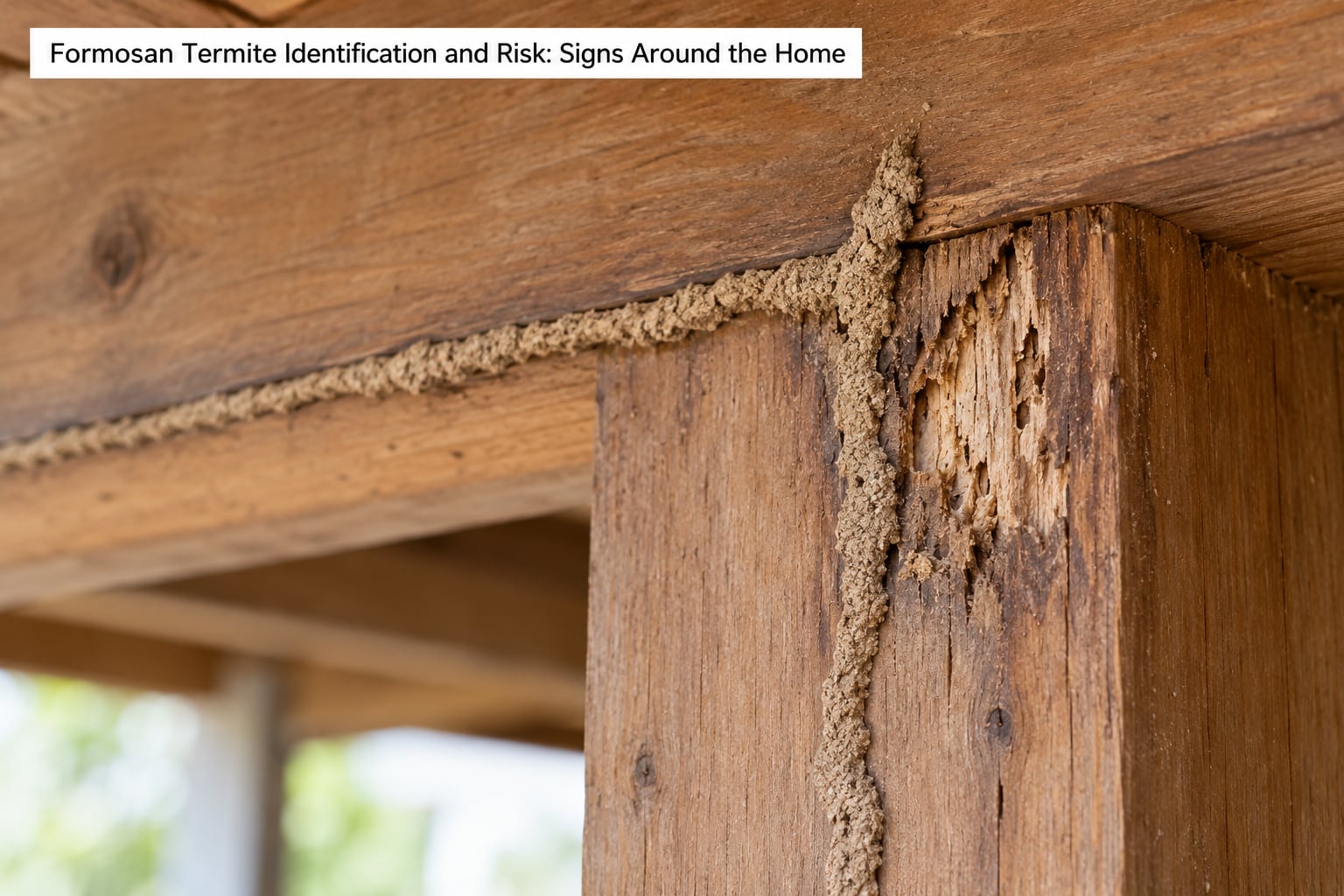
Signs run from obvious to nearly invisible, and a home can have a serious infestation with no visible evidence at all. The table below is the version worth keeping. Reading it as a pair of columns, you can sort what you found into something worth acting on now and something that still needs a trained eye.
| Sign | Where to look | What it means |
|---|---|---|
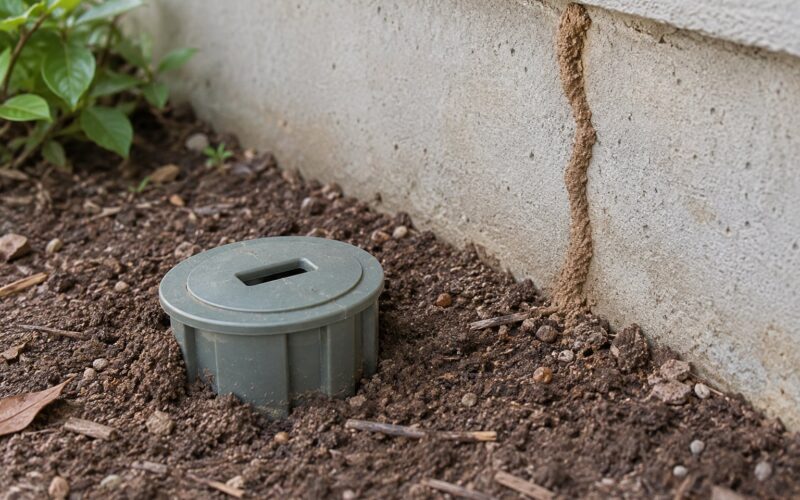
| Mud tubes or shelter tubes | Along foundations, up exterior walls, across beams and soffits in crawl spaces | A covered foraging route. Formosan build these over wet surfaces and are less fussy about the surface than other subterranean species, so they may run across masonry, not just soil |
| Wings near a window or light | Sills, glass, porch lights, and the floor just inside a room at dusk | A swarm has occurred near or inside the structure. A handful is common; hundreds to thousands is not |
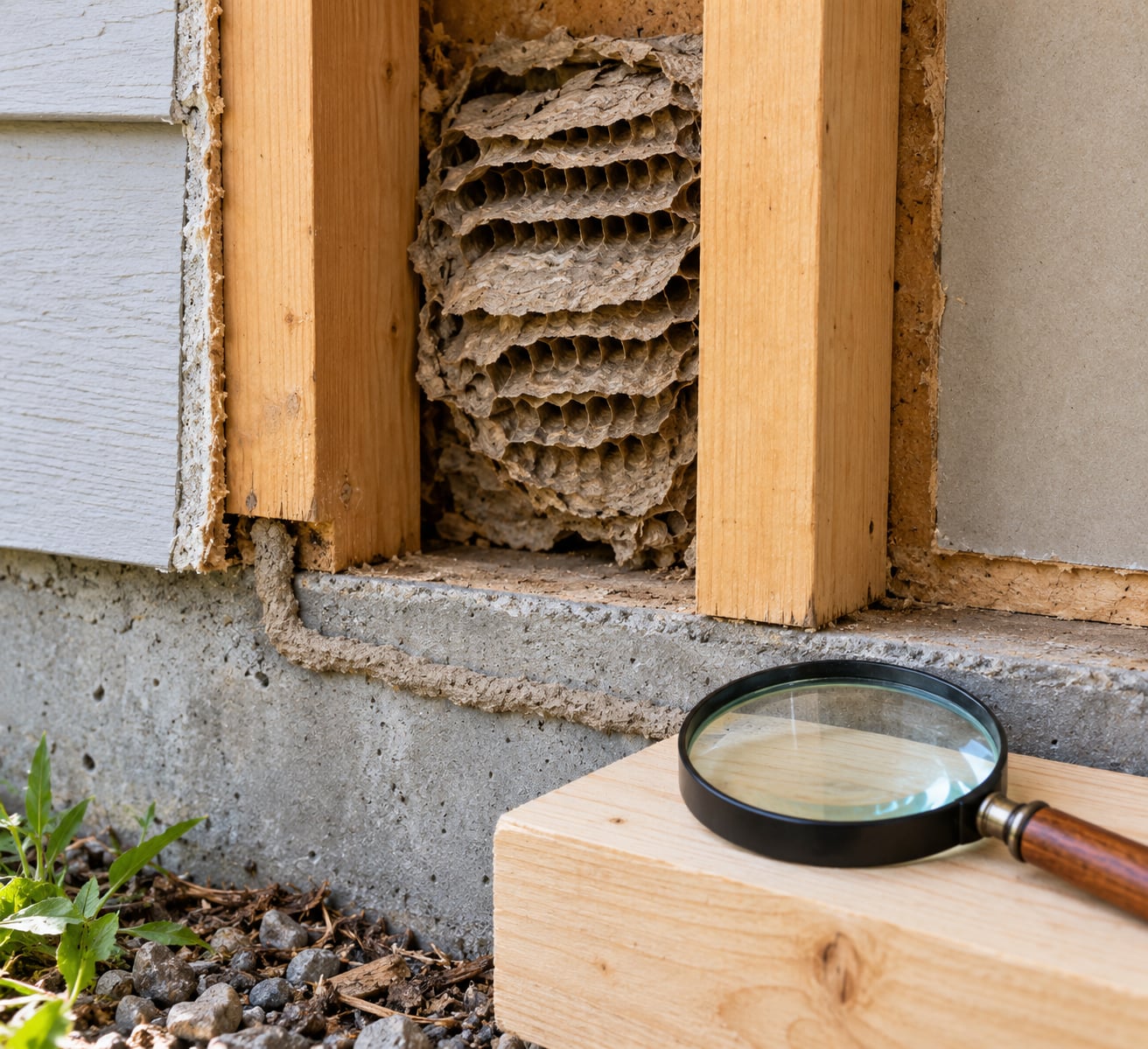
| Carton nest in a wall void | Attic eaves, roof overhangs, hollowed-out trees, wall cavities under drywall | An above-ground colony not connected to soil. Possible on this species but far less common than the internet suggests |
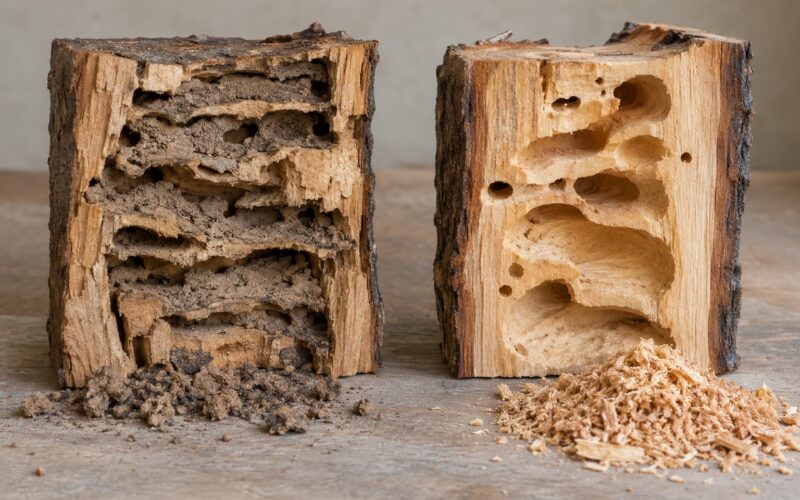
| Hollow-sounding wood or a blistered surface | Skirting boards, baseboards, window sills, door frames, deck boards | Interior wood removed and coated with a thin layer of remaining skin, sometimes described as blistered or peeled |
| Damp, softened wood | Anywhere water collects, including under a slow roof or plumbing leak | Moisture plus wood contact is the condition this species needs most |
| Frass, and galleries | Under damaged boards, inside hollowed members | Pellet-like droppings and smooth-lined tunnels. Useful evidence, but not proof of species on its own |
| A hollow-sounding living tree | Trees near a structure, especially with dead limbs or a hollow trunk | Living trees can be hollowed from the inside, which also creates a falling-branch hazard during storms |
Two of these deserve a caution. First, mud tubes indicate a covered route from a moisture source to wood, but they are not species-specific, so a tube alone cannot tell you that you have Formosan termites. Second, what looks like termite damage is often something else entirely. On forums like r/Termites, homeowners repeatedly open a repaired beam expecting to find termite residue and find mildew instead, and the argument over who is responsible for the repair turns out to be the expensive part of the mistake. Gaps lined with a fine concentric pattern are more consistent with termites; uniformly damp, stained, or soft material is more consistent with water.
On carton nests, the popular image of a Formosan colony as a permanent above-ground nest is misleading. One survey reported in a regional study found the large majority of infestations in its area were ground-based, with aerial colonies a small fraction. The wall-void case still matters to you, because that is the scenario where a colony keeps working even after the obvious soil route is sealed, but it is not the default.
How Serious Is a Formosan Termite Infestation?
Formosan termites are a serious structural and financial risk, and close to a non-issue for personal health. That three-part answer is the honest version, and it is worth taking apart, because the health half is what generates most of the panic and the structural half is what actually costs money.
Structural risk is the highest of the three. Extension sources describe this species as capable of severely damaging a structure in a period as short as a few months, and some commercial sources quote a consumption figure of roughly 13 ounces of wood per day for a mature colony, though that number is a vendor figure rather than an extension one and should be read as an order of magnitude. Larger colonies and a foraging range reported at more than an acre are what make this species different in practice. The additional problem is diet: this is not only a wood insect. It feeds on cellulose across a wide range of materials, will work on plaster and drywall paper, and will chew plastics, asphalt, and thin sheet metals such as lead and copper. It also feeds on living plant tissue, which is why trees near a house matter and why a live, apparently healthy tree can hollow out from the inside.
Financial risk is the part that surprises people. Standard homeowners policies treat termites as a maintenance issue and exclude the damage. Florida’s Department of Agriculture and Consumer Services is explicit about this, and the same exclusion generally applies across policies elsewhere, so an owner who assumed coverage was folded in after a termite claim is usually wrong. Repair, plus a retreatment guarantee, plus finishing work on damaged drywall and trim all land on the homeowner. In practice, the quote you receive will be driven by the extent of the infestation, the colony’s location, whether it is above or below grade, and the method chosen. A localized soil treatment and a full fumigation of the structure are very different jobs, and a colony sealed inside wall voids is a different problem again from one in the soil line. Anyone comparing quotes online will find wildly different numbers attached to wildly different situations, which is another reason to treat cost talk in forum threads as a rough regional signal and not a price for your house.
Health risk is essentially nil, and that is a sourced answer, not a reassurance. No university, state, or federal source attributes a bite, a sting, or a disease to Formosan termites. There is no reliable sound sign and no distinctive smell to look for either. These insects are a property and structural problem, not a human health one, and the one genuine physical risk is indirect: weakened structure and falling limbs.
A note on the number you have probably read. The claim that termites cause about a billion dollars a year in damage in the United States gets repeated everywhere, including by companies with a financial interest in the sentence. It traces back to a late-1990s study of repair costs in the New Orleans area, which then got extrapolated well beyond its evidence base. Treat it as a regional figure that became a national one, not as a measured national total.
The best news in the risk section is that Formosan termites are manageable and, when treated properly by a licensed company, controllable. The worst is that a swarm inside your house is not a small problem, because an indoor dusk swarm points to a colony already established in the structure rather than one that might wander in.
Where Formosan Termites Are Most Likely to Be Found
The conditions that produce Formosan termite activity are moisture, warmth, and a continuous connection between water and wood. Look for that combination rather than for the species itself, because a termite does not care what species you would prefer to be dealing with.
Structurally, the vulnerable points are wood in contact with soil, wood close to damp masonry or a slab edge, and any place where water collects. Sliding glass doors, downspouts that dump at the foundation, poorly graded soil against a crawl space, a washing machine hose that drips, an air-conditioning line that sweats onto a window frame, and a plumbing leak in a wall are all entry conditions rather than curiosities. In attics and eaves, ventilation is what separates a dry void from a productive one.
Geographic range has expanded through introductions, and the pattern in the United States is coastal and southern rather than continental. UC Cooperative Extension reports genetic work confirming at least three separate introduction events into Southern California, which is a useful reminder that presence in a given city is not a matter of a slowly advancing line on a map.
| Region | Typical swarm window | Notes |
|---|---|---|
| Florida | April through July, commonly reported around 8 to 10 pm | A long window with frequent indoor evening swarms; heavy moisture load supports large colonies |
| Louisiana | Late April through June, peaking around May | Dusk flights; the New Orleans area has the deepest published research history on this species |
| Texas | Generally May into June | Isolated infestations are reported across many parts of the state rather than only along the coast |
| South Carolina and Georgia | Early spring into early summer | Charleston is where the earliest US detection is dated in 1957 |
| Hawaii | Warm-season, extended activity | Conditions rarely get cold enough to stop foraging |
| Southern California | During warm, humid periods | Concentrated in irrigated, moisture-rich pockets; UC Cooperative Extension treats this as an active response situation |
These windows shift with local weather, and a warm humid spell can pull a swarm forward by weeks. Treat them as the period when you would most likely notice something, not as a schedule.
What Should You Do If You Suspect Formosan Termites?
Move quickly, and move carefully. The instinct to spray something, break open a wall, or pour boiling water into a gallery is understandable and consistently makes the situation worse. Here is the sequence that keeps you out of trouble.
Document before you disturb anything. Photograph every location where you saw insects, wings, mud tubes, or damage, and note the date and time. Wide shots that establish location, then close shots of the specimen itself.
Collect a specimen and hand it over. This is the step most people skip and the one that most improves the accuracy of what you are told. Put a swarmer, a shed wing, or a soldier in a small container with a folded paper towel and a drop of water so it cannot dry out, or freeze it, and give it to the inspector. Professionals on r/pestcontrol and r/Termites describe confirming Formosan under magnification, and a photo rarely shows the head or wing hairs well enough for a species call. A physical specimen takes minutes to preserve and removes most of the guesswork.
Count the swarmers. This is the volume triage that most consumer pages skip and that experienced technicians use constantly. A few swarmers indoors is a common seasonal event, and it does not by itself prove a colony is living inside the structure. Hundreds to thousands, clustered and emerging at dusk, is the version that warrants an urgent inspection. The middle ground is a judgment call that a professional should make.
Reduce obvious moisture where it is practical. Disconnect a hose that is dripping, move planters away from the foundation, and stop a downspout that empties against the wall. This changes conditions; it does not treat an infestation.
Do not spray, fog, or drench the interior yourself. Aerosol sprays kill termites you can see and can repel the ones you cannot, pushing them into adjacent areas. Partial treatments are one of the most common sources of the recurring, half-treated infestations described in homeowner discussions. This is not a DIY pest.
Get a professional identification before any repair or remodel. Opening a wall or replacing trim before treatment is complete can seal a colony into an untreated void, and in this species that pattern is a genuine risk because it can establish satellite colonies in wall cavities cut off from soil. Treatment first, repair second.
The first 24 hours after an indoor dusk swarm
Turn off nearby outdoor lights, which draws swarmers to the window and creates a much larger and more frightening-looking event than actually occurred. Vacuum up the ones on the sill and let the rest settle and fly off. Do not seal the openings, do not cut into anything, and do not call a company that responds by selling a treatment before it has identified the insect. That is the whole emergency.
What formosan termite identification and risk triage cannot settle
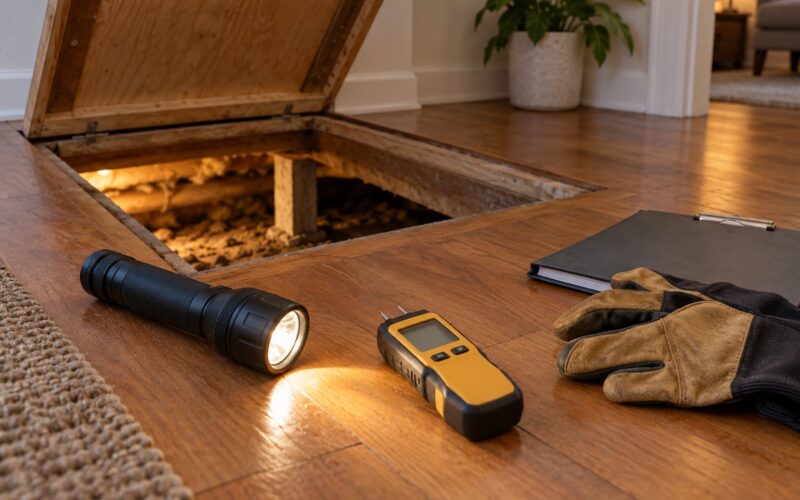
You can reliably establish that a termite is present. You can often establish whether it is Formosan rather than another subterranean species, especially if you have a soldier with an orange head or a hairy-winged alate. What you cannot do alone is confirm the colony’s extent, find the source, distinguish active feeding from old damage, or separate termite work from water damage that has been going on for years. That is a scope question, not a skill question, and it is exactly where a licensed pest management professional earns the inspection fee.
How to Reduce the Risk of Formosan Termite Damage
Prevention here is mostly water management, and for this species it is worth splitting into two categories that standard termite advice tends to blur together.
Soil-level and contact moisture. Keep soil, mulch, and stored material away from the structure, ideally several inches below the siding line. Do not let downspouts discharge at the foundation, and make sure the ground slopes away from the house. Keep wood, lumber stacks, and firewood off the ground and away from walls. Trim plants that touch the siding, and seal gaps around plumbing, conduit, and utility penetrations with appropriate materials. Fix the washing machine supply line.
Above-ground moisture. This is the category that matters most for Formosan termites in particular, because a colony in a wall void or an eave does not need soil at all. Repair roof and flashing leaks promptly. Watch for condensation on window frames, a persistent damp band on a ceiling, or a wall that stays cool and soft after rain. Keep attic and eave vents clear and unobstructed so wet sheathing can dry. Check that air-conditioning lines are insulated and are not dripping condensate onto wood or the frame. Do not stack firewood or store cardboard against an exterior wall in a warm, humid climate.
On monitoring, arrange a professional inspection if you live in an established range and have a history of activity, are buying a house where the seller has no recent records, or have already had a treated infestation. Ask for a contract with a monitoring period and a retreatment guarantee, and read what activity is covered. Recurrence after treatment is usually a monitoring gap or an untreated satellite colony rather than a failure of the method.
One last piece of advice, and it costs nothing: find a licensed pest management company before you need one and know what a written inspection report and a treatment contract look like. Homeowners on forums are far less anxious at the moment of a swarm when they already have a number to call.
Frequently Asked Questions
Are Formosan termites visible?
Yes, though you only meet them by accident. The pale workers stay hidden inside galleries, and the queen almost never leaves the colony core. Soldiers may emerge from disturbed wood with their orange heads showing, and the winged swarmers fly, which is how most people first notice them. Count what you see rather than judging by sight: a handful of swarmers indoors is routine, while hundreds to thousands at dusk points to a colony inside the structure.
Can Formosan termites fly?
Only the reproductive caste flies. Swarmers, or alates, are golden to caramel brown, roughly a third to a half inch long, and covered in fine hairs on the wings including the wing membrane. They shed their wings after mating and never fly again. The workers and soldiers that do the eating are wingless, so what you see on a window sill is a reproductive, not a worker.
What damage do Formosan termites cause?
The damage is structural and can be fast. Extension sources describe a severe infestation capable of seriously damaging a structure in a matter of months, and the damage is usually hidden behind intact-looking surfaces. This species also feeds on cellulose in plastics, plaster and asphalt, on thin metals, and on living plant tissue, so it can hollow out a healthy tree and damage materials other termites ignore. It does not bite people and carries no known disease risk.
Are mud tubes always a sign of Formosan termites?
No. Mud tubes and shelter tubes show that a termite is traveling between a moisture source and wood, but they are not species-specific, and other subterranean termites build them too. Formosan tubes do have a habit of running across wet surfaces such as masonry rather than only over soil, which is a clue but not a diagnosis. A tube plus a soldier with an orange head, or a hairy-winged alate, is a much stronger case for this species.
How quickly should I inspect a home after seeing a termite swarm?
Quickly, but not in a panic. A small number of swarmers indoors is a common seasonal event and does not prove an indoor colony. A large dusk swarm, especially one emerging from a window frame, a light fixture, or a wall, points to a colony already inside the structure and deserves an inspection within days rather than months. Collect a specimen in a sealed container, photograph where they appeared, and call a licensed pest management company for identification before treating anything.
Can I get rid of Formosan termites myself?
Not reliably, and the attempt usually makes things worse. Visible sprays kill what you can see and can repel the rest into adjacent areas, and partial DIY treatments are a common reason infestations recur. The species is treatable, and licensed companies control it routinely, but effective work depends on locating the colony, choosing between soil treatment, baiting, and fumigation, and sealing off the wall-void colonies that this species can establish. Use your own effort for moisture control and monitoring, and leave treatment to a professional.
What to Do First
Photograph what you found, in place, with a close shot of the insect itself if you still have one. Keep the area as dry as you reasonably can, and collect a specimen in a small sealed container so an inspector can identify it under magnification rather than from a description. Then arrange a professional inspection before you treat anything, and before you remodel or repair anything.
Formosan termite identification and risk are far easier to handle at the swarm stage than at the collapse stage, because at the swarm stage nothing has been lost yet. This guide was checked against extension and state agency sources in October 2026, including LSU AgCenter, UF/IFAS, Texas A&M AgriLife Extension, Clemson HGIC, the Florida Department of Agriculture and Consumer Services, the USDA Forest Service and UC Cooperative Extension. Where those sources disagree, such as on colony size and the soldier share of the colony, the ranges above reflect the disagreement rather than hiding it.