To get rid of crickets in a basement, do four things in this order: run a dehumidifier until a cheap hygrometer reads below 50% relative humidity, lay glue boards along the dark edges of the floor, seal cracks and pipe gaps, then clear debris and mulch away from the foundation. Most infestations thin out within two to three weeks of starting.
The reason a basement works so well for them is simple. Crickets need moisture to survive, they hide from light, and they can squeeze through openings a pencil fits into. A damp, dim, cluttered lower level gives them all three at once, which is why the same house can have zero crickets one month and four or five a night the next.
The order of operations matters more than anything else. Moisture control comes first, because crickets cannot persist in dry air. Entry points come second, because a sealed basement with one unsealed pipe gap is still an open door. Products are a distant third, and foggers are worse than useless indoors.
Before you buy anything, work through the identification step. A singing house cricket and a silent camel cricket need slightly different approaches, and mistaking one for the other sends you down the wrong path for a week.
Table of Contents
- What You Need
- Step-by-Step
- 1. Confirm that you have crickets, not another basement insect
- 2. Inspect the basement for entry points and moisture
- 3. Remove food, clutter, and shelter
- 4. Seal cracks and block entry routes
- 5. Reduce dampness and make the basement less inviting
- 6. Use targeted control only after you know where the crickets are active
- 7. Monitor for two weeks and repeat the necessary steps
- Common Mistakes
- Frequently Asked Questions
What You Need

Gather these before you start, so the work does not stall halfway through when you realize the caulk gun is upstairs.
- A hygrometer. A cheap digital model with a humidity readout is enough. Guessing at moisture levels is the single biggest reason people fail at this.
- A dehumidifier with a continuous drain hose. A unit you have to empty twice a day stops working on day three, usually in the middle of the hottest week of the year.
- Glue boards or sticky traps. Flat floor traps, not hanging fly traps. Wide ones catch more than small ones.
- A flashlight and a work light. You need both hands free. Clamping a work light to a joist changes the job.
- A vacuum with a hose attachment. A shop vac handles cardboard dust and grit better than an upright.
- Caulk or sealant. Polyurethane caulk for gaps that move, hydraulic cement for foundation cracks, silicone for around pipes and window frames.
- Stainless steel wool or brass mesh. Packed into the gap first, caulk over the top. Sealant alone bridges a small hole but not a large one.
- Gloves and a dust mask. Non-negotiable if you plan to handle old insulation or mouse droppings while inspecting.
- Cleaning supplies. A broom, a damp rag, and sealed containers for anything you find stored down there.
- One labeled control product. Food-grade diatomaceous earth, boric acid bait, or an indoor-labeled residual spray. Only after you know where they are active.
Skip the foggers and total-release aerosol bombs entirely. In a finished basement they push crickets deeper into wall voids, kill almost nothing, and leave a residue you then have to clean up. This is a complaint that comes up over and over on pest forums, and it is well founded.
Step-by-Step
Work top to bottom through these seven steps. Skipping ahead to step six because you want to spray something tonight is how the cycle restarts every fall.
1. Confirm that you have crickets, not another basement insect
Start by describing what you saw or heard. The sound settles it fast. If the basement is silent and you are finding long-legged jumpers, you have camel crickets, also called cave crickets or spider crickets. If you hear chirping at night, you are hearing a singing cricket, almost always a house cricket.
| Cricket | Size | Wings | Sound | Damage risk |
|---|---|---|---|---|
| House cricket | About 3/4 inch | Flat, tan with dark markings | Loud chirping at night | Wool, silk, fabric, paper |
| Field cricket | About 1 inch | Full wings, sturdy build | Chirps, outdoors mostly | Minor indoors |
| Camel, cave or spider cricket | 1 to 1.5 inches | Wingless, arched back, long legs | Silent | Cardboard and paper goods |
| Mole cricket | About 1.25 inches | Shovel-like front legs | Silent, lives in soil | Turf, not a basement insect |
Camel crickets have no wings and no sound-producing mechanism at all. They hop erratically in the dark and can fly several feet when startled, which unsettles people far more than the number of crickets actually justifies. Most homeowners find three or four a night indoors, and that is a normal population rather than a heavy infestation.
2. Inspect the basement for entry points and moisture
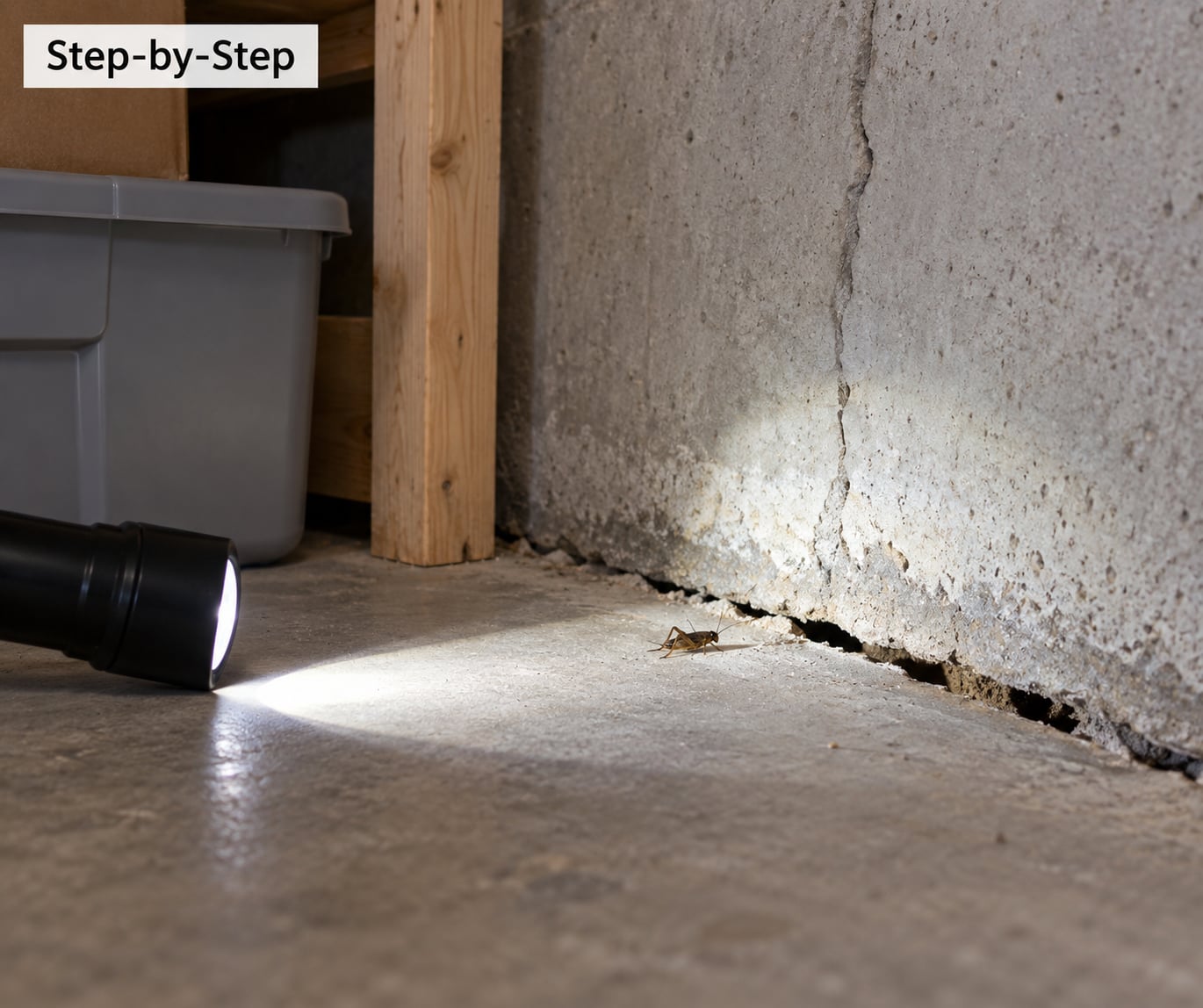
Walk the perimeter slowly with the flashlight off first, letting your eyes adjust, then switching it on. You are looking for gaps smaller than about 6 mm, which is roughly a pencil width, since anything wider is already on your radar and anything narrower is where the crickets come through.
Check along the foundation walls where the sill plate meets concrete, around every pipe and wire penetration, at the top and bottom of utility penetrations, under exterior doors and thresholds, around window wells and egress windows, at floor drains, and around the sump pit lid. Then check the ceiling for water stains and the floor for damp patches, because moisture and crickets travel together.
Record what you find. Mark the wall with pencil or masking tape and note whether a cricket appeared near it. Over two or three nights that list tells you more than a week of guessing.
3. Remove food, clutter, and shelter
Crickets eat almost anything organic, and they eat it in the dark without competing much with anything. Cardboard, paper, fabric, wool, silk, stored pet food, and damp organic debris in the basement are all on the menu.
- Vacuum the floor edges, under shelving, behind the water heater, and along every baseboard before anything else.
- Move stored boxes off the floor and onto shelving, leaving a clear gap so you can see the wall behind them.
- Cardboard is a nesting material. Break down or remove the boxes, or at least pull them away from the perimeter.
- Move clothing and textiles into sealed plastic bins rather than cardboard cartons.
- Keep pet food, birdseed, and any open food in airtight containers.
- Clear floor-level clutter from the corners, since those are where traps go and where you need to be able to see.
Move stored items 12 inches or more away from the foundation wall. You cannot seal a crack you cannot see, and cricket traps are useless if a storage pile covers them.
4. Seal cracks and block entry routes
Pick the material for the job. Use hydraulic cement or polyurethane caulk for cracks in the foundation or poured wall, since both expand slightly and grip damp concrete. Use packed steel wool under sealant around pipes, wires, and conduits. Use silicone around window and door frames, and add weatherstripping at any exterior door. Close and seal the sump pit lid properly, because an open pit is a highway straight to damp soil.
Do not seal a gap that is moving water or air on purpose. Leave weep holes, foundation vents, and drainage openings alone. Blocking a vent or a drain to win a fight with a cricket can push moisture into the wall, and damp walls create a bigger problem than the one you started with.
Keep electrical panels, junction boxes, and gas or furnace penetrations clear. If a gap is near anything electrical, seal it with a rated sealant or leave it for a professional. Structural or drainage work belongs to a licensed contractor, not a caulk gun.
5. Reduce dampness and make the basement less inviting
Measure first. Put the hygrometer on the basement floor or a low shelf, not near the dehumidifier intake, and read it after a day of normal household humidity. Above 60% relative humidity is a comfortable basement for crickets and probably for mold as well. Below 50% starts to squeeze them out; below 45% is better and costs little extra.
Then work down the list of moisture sources in order of how much they usually contribute. A leaking plumbing joint or a failed check valve on the sump pump puts water in the pit all day. Downspouts that dump against the foundation, window wells that hold water, and grading that slopes toward the wall all move surface water in. Condensation on cold pipes in summer is a smaller but real contributor in unfinished basements.
Run the dehumidifier continuously with a hose to a drain or a floor drain, and set it to the target reading rather than guessing. Ventilating helps, but only with outside air that is genuinely drier than inside, which on a humid summer afternoon it is not. Dehumidification is the lever that works regardless of the weather.
6. Use targeted control only after you know where the crickets are active
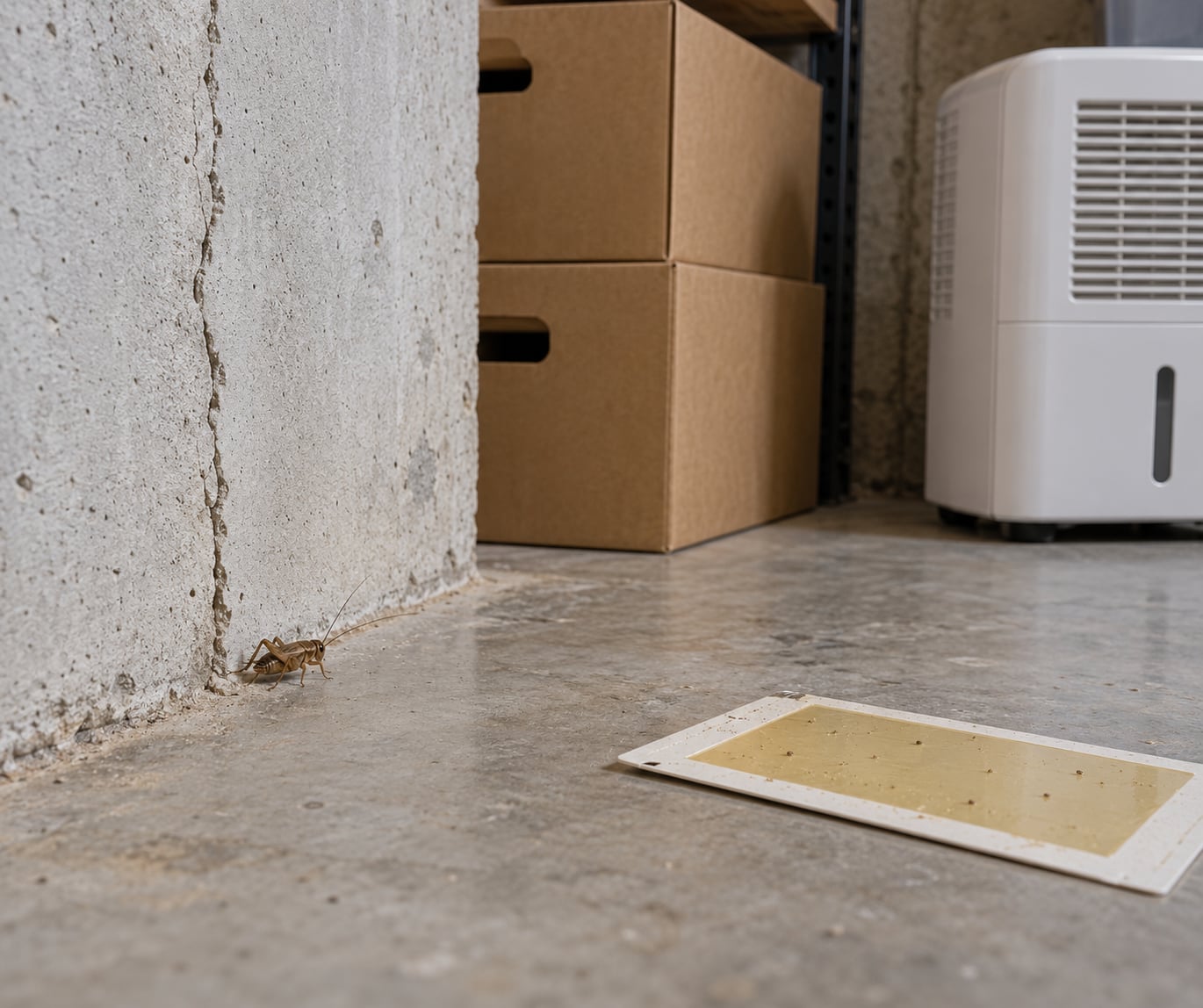
Place glue boards along the floor where you saw activity, not in the middle of the room. Good spots are corners, behind the water heater, along baseboards where they meet the wall, beside the sump pump, under the stair risers, and behind shelving. Lay them flat with the sticky side up, flush to the wall so anything walking along the edge contacts them.
For a cricket you actually see in a finished room, a glass and a piece of cardboard or a fly swatter with a long handle ends it immediately. For the ones you never see, use products that kill slowly and by contact rather than ones you spray into the air.
- Food-grade diatomaceous earth. It abrades the exoskeleton and dries the insect out rather than poisoning it. It works only in dry, still air, so applying it to a damp basement floor wastes the material.
- Boric acid bait. A slow option that carries crickets back to a nesting spot. Keep it sealed from children and pets.
- Residual spray labeled for indoor use. Apply as a thin band along baseboards and around penetrations, following the label exactly rather than misting the room.
Store every chemical product away from food, out of reach of children and pets, and never apply diatomaceous earth near a pet that grooms its coat or near open food. If you use a pet that spends time in the basement, remove bait and dust while the animal is elsewhere.
7. Monitor for two weeks and repeat the necessary steps
Crickets are nocturnal, so your best monitoring tool is a quiet room above the basement. Check the glue boards every two or three days and note the counts. Falling numbers mean the plan is working even if you still hear a stray chirp.
| Method | What it does | When you notice a change |
|---|---|---|
| Dehumidifier below 50% RH | Removes the moisture they require | New arrivals stop within 1 to 3 weeks |
| Glue boards | Catches active crickets along the edges | Counts drop within a few nights |
| Diatomaceous earth | Dehydrates them through contact | 2 to 10 days, only in dry conditions |
| Boric acid bait | Carries a slow kill back to the nest | Several days to a couple of weeks |
| Sealing entry points | Stops re-infestation | Full benefit after the next seasonal push |
If the counts are not falling after two weeks, the problem is almost never the method you are using. It is moisture you have not found or an entry point you have not sealed.
| Symptom | Likely cause | Fix |
|---|---|---|
| Dehumidifier runs constantly, crickets stay | Sealed drum with no working drain | Add a continuous drain hose to a floor drain |
| Crickets appear near the sump pit | Open pit lid or dry soil in the pit | Fit a sealed lid and dampen the pit soil |
| Activity behind shelving | Wall void with an open utility penetration | Seal the penetration, then seal over the access point |
| They reappear every September | Outdoor woodpile, leaf litter, or mulch at the wall | Move debris 2 feet away and re-caulk in the spring |
| Nothing visible, chirping only | House cricket harborage behind stored items | Clear stored items off the wall and set glue boards there |
| They reappear after a fogger | Driven into wall voids | Stop fogging; use glue boards and exclusion instead |
Call a pest professional if you are dealing with wall voids you cannot reach, a large population in a rental unit where you cannot seal anything, or damage to stored textiles that matters to you. Call a plumber for a wet pit or a suspected leak, and a basement or drainage contractor for standing water you cannot trace yourself.
Common Mistakes
Almost every repeat infestation traces back to one of these six errors.
Sealing only the crack you can see. One visible crack is rarely the only opening. Crickets move through door thresholds, floor drains, window wells, vent openings, and gaps around pipe penetrations. Walk the perimeter with a flashlight and treat every opening you find, not just the obvious one.
Spraying the whole room instead of the edges. A broadcast spray kills a few crickets and scatters the rest. Apply a thin residual band along baseboards and around penetrations, following the label, and let the crickets come to it.
Using a fogger in a finished basement. Aerosol bombs push crickets into wall voids where nothing reaches them, deposit a film on everything you own, and leave the core problem untouched. This is the fastest way to make a small problem a persistent one.
Leaving dampness alone. Sealing entry points in a basement that stays at 65% relative humidity just locks the crickets in with you. Fix the moisture first, or at the same time. Product alone will not hold.
Storing pesticides near food, or applying diatomaceous earth with pets present. Read the label, keep products sealed and out of reach, and never apply DE where a pet can walk through it or lick its paws afterward.
Assuming silence means it is over. Cricket activity is hard to hear for a few nights after a treatment, then returns if the conditions never changed. Judge success by trap counts and by a hygrometer reading, not by quiet.
A short prevention checklist covers most of it: keep relative humidity below 50%, keep 12 inches of clear space between stored items and the foundation, store paper, cardboard, and fabric in sealed bins, reseal gaps each spring after the ground thaws, keep mulch, leaf litter, and firewood at least 2 feet away from the wall, and check the sump lid and weatherstripping twice a year.
Frequently Asked Questions
Do crickets in a basement damage the house?
Most indoor crickets do not damage the structure itself. Large populations can chew fabrics, wool, silk, paper, cardboard, and stored food, so damage shows up in what you keep down there rather than in the framing. Their presence usually points to an open entry route and damp conditions, so treat it as a maintenance problem rather than a structural one.
Are crickets in the basement dangerous to people or pets?
Crickets do not sting, and common household species are not aggressive toward people. Some can bite if handled roughly, which is rarely more than a small pinch. The realistic concerns are contamination of stored food and accidental exposure to the pesticides you use, so follow the label and keep products away from pets and children.
Where do crickets hide in a basement?
Look along floor-level cracks, around utility penetrations, behind storage boxes, in cardboard and fabric piles, under stair risers, behind shelving, near drains, and in dark corners. Crickets are most active at night and avoid light, so check with a flashlight switched on after your eyes have adjusted. Behind stored items is where most people miss them.
Why do I still have crickets after sealing one basement crack?
One crack is rarely the only entry point. Crickets also come through window gaps, door thresholds, floor drains, utility openings, and vents. A dehumidifier alone can keep the space dry while new arrivals walk in weekly, so walk the whole perimeter, seal every opening you can see, and clear stored items away from the wall so you can see behind them.
What do crickets eat in basements?
Crickets eat almost anything organic. In a basement that means cardboard, paper, fabric, wool, silk, stored pet food, birdseed, and damp debris. They are most troublesome where food and moisture are both present, which is why sealing paper and textiles into plastic bins and vacuuming the floor edges removes more of the problem than spraying does.
Does diatomaceous earth kill crickets instantly?
No, and anyone promising an instant kill is overselling it. Food-grade diatomaceous earth works by abrading the exoskeleton so the insect loses moisture, which takes roughly two to ten days. It only works in dry, still conditions, so applying it to a damp basement wastes the material. Reapply after rain or when the area gets wet again.
That is the whole method: get rid of crickets in a basement by fixing moisture first, sealing every opening you can reach, cutting off their food and shelter, and only then adding traps or bait where you have actually seen activity. Start tonight with a hygrometer and a dehumidifier set below 50% relative humidity on a continuous drain, then lay glue boards along the dark edges of the floor. That gives you a number to work from and a way to count progress. Once the traps show fewer crickets at each check, walk the perimeter with a flashlight and seal every gap you find, and the population will not come back next fall.