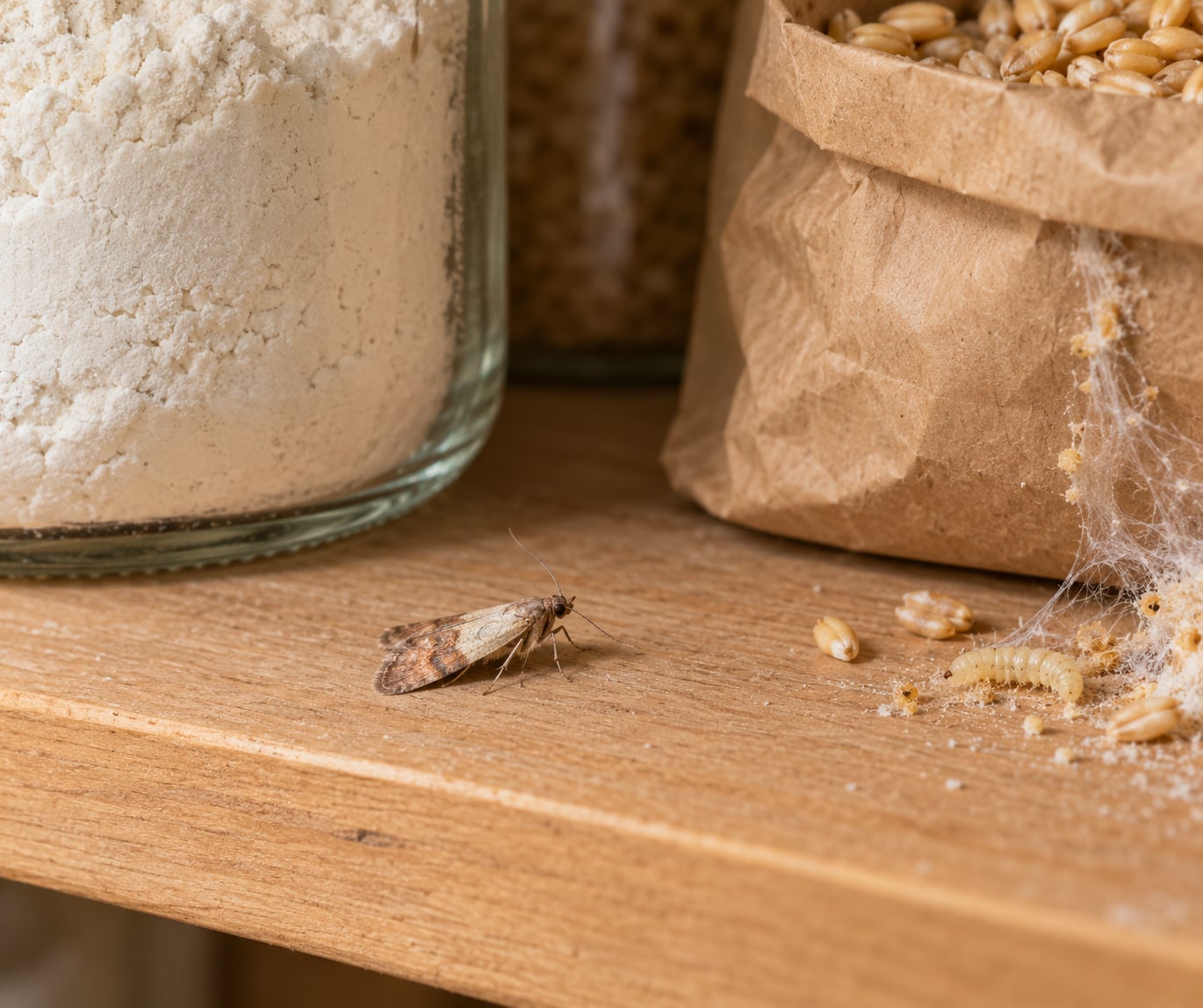
If you have spotted small moths near your cupboards, they are almost certainly Indian meal moths (Plodia interpunctella), and they arrived riding in on food rather than flying through an open window. A female lays 100 to 400 eggs on or beside a bag of grain, flour, cereal, pet food or birdseed, and the larvae that hatch are the only stage that feeds.
That last part explains why the moth you swatted was never the problem. By the time an adult is fluttering near the light, the damage is weeks old and the larvae are already silked into the food itself, or cocooned in a crack somewhere above your head. Pantry moth identification is really a two-part job: confirm the species, then trace the package it came in on.
Pantry Moth Identification and How They Get In
Two moth species dominate stored food in North American homes. The Indian meal moth is the one you will meet in almost every kitchen, and a handful of others — the Mediterranean flour moth (Ephestia kuehniella) and the Angoumois grain moth (Sitotroga cerealella) — turn up mainly in commercial grain, flour and pet food operations, and occasionally in bulk bins.
None of them are structural pests. They do not burrow into drywall, they are not coming in from a tree outside, and in the vast majority of cases the window was never the route. UC IPM’s pantry pests guidance puts the entry point squarely on infested food packages and stored products, and extension services from Kentucky, Colorado State and Clemson describe the same pattern.
The life cycle runs egg, larva, wandering larva, pupa, adult. A female moth finds a suitable food source and lays her eggs on or near it; the larvae feed under silken webbing, then leave the food to pupate in a distant spot like the wall-ceiling junction, and the adults emerge later. That wandering-to-pupate step is the reason people find larvae crawling on ceilings with no visible webbing in the food at all.
How to Identify Pantry Moths
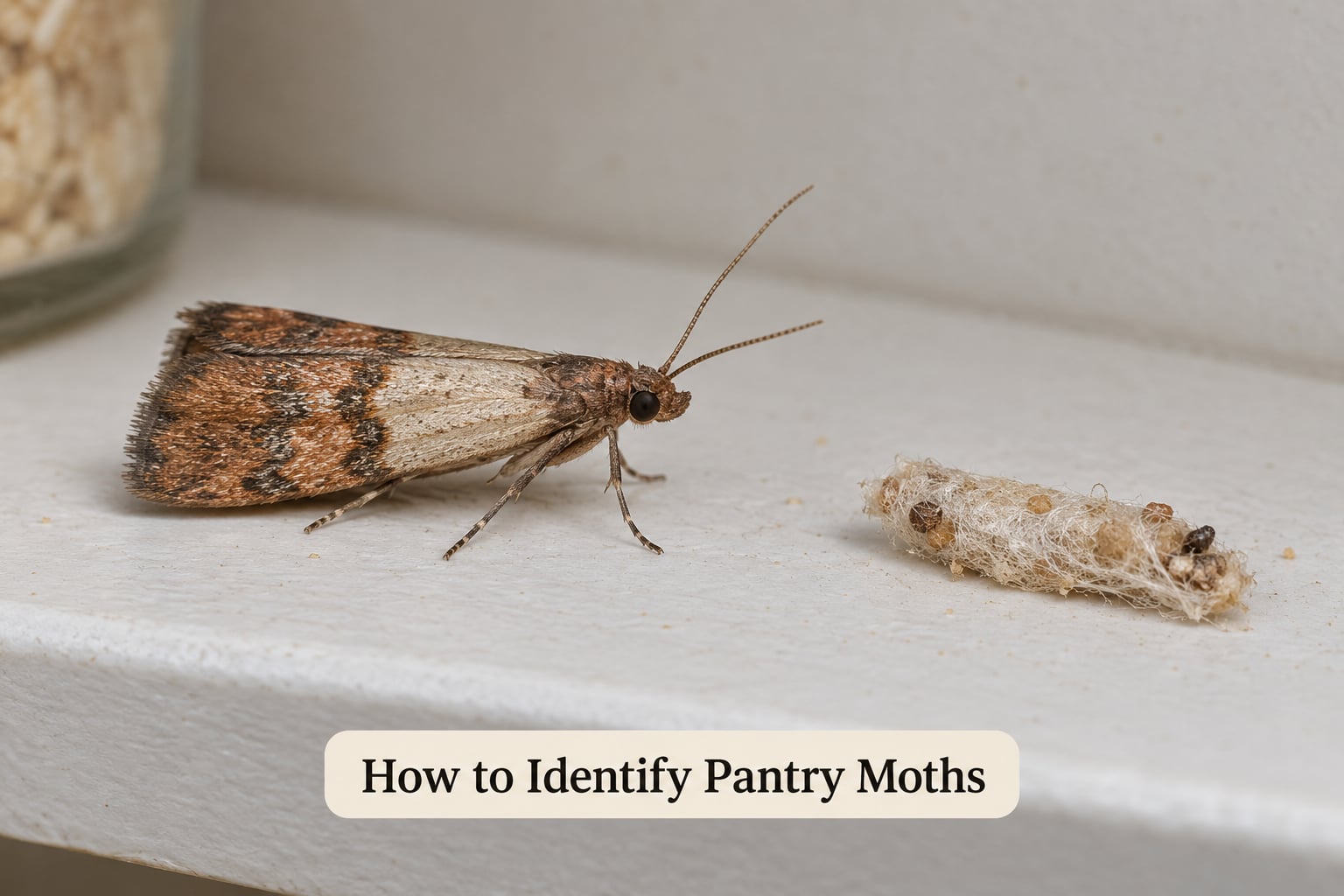
The adult Indian meal moth has a wingspan of roughly 12 mm, or about half an inch, so it is smaller than the moth you remember swatting in the porch light. Give the wings a hard look under a lamp or a 10x hand lens: the inner half is pale grey, straw or tan, and the outer half is a metallic coppery-brown that catches light as the moth moves.
Two-tone is the whole identification. That pale-to-copper split, plus a fringe of long hairs along the wing edge, separates it from nearly everything else that flies indoors. Resting, the moth holds its wings roof-like over its body in a narrow triangle rather than flat and spread.
The flight pattern is short and jerky. If you watch a small moth near a cupboard and it darts in a zigzag rather than drifting, that is consistent with a pantry moth. Adults do not feed at all, so the moth on your wall tells you nothing about whether the infestation is finished.
The larvae are the confirming evidence. They are cream-coloured with a dark brown head and about 5/8 to 3/4 inch long, and they spin fine silk as they feed, gluing food particles together into loose clumps. Look for silken tubes, webbing along the seam of a bag, and small pinholes in packaging.
Check the upper corners of the cabinet too. Larvae leave the food to pupate, and they spin a rough white cocoon in the upper corners, along the wall-ceiling junction, or on the underside of a shelf lip. Larvae on a ceiling with no moth in sight is a common and confusing sight, and it is entirely normal behaviour.
How Pantry Moths Get Into Your Home
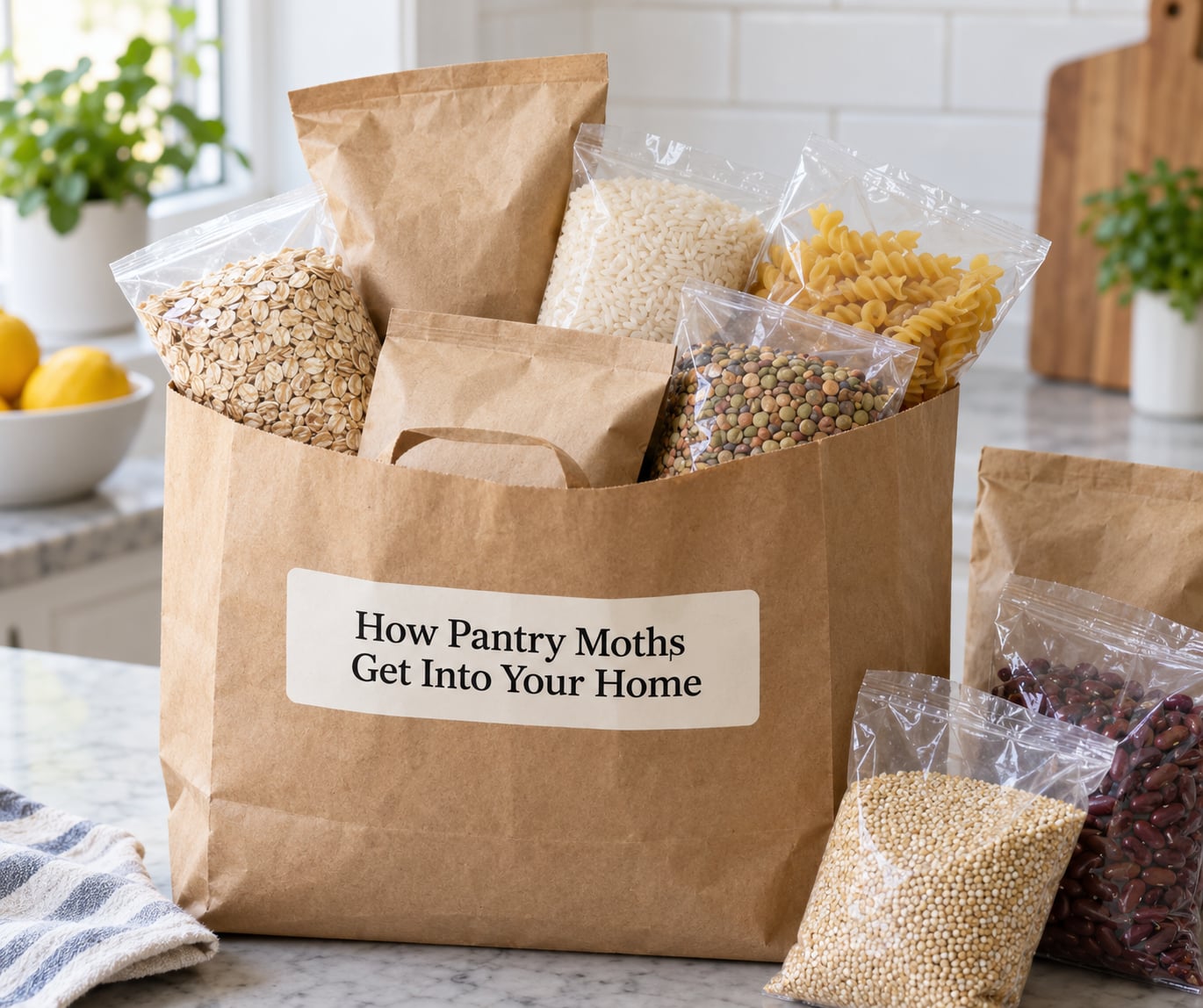
Route one, by a wide margin the most common, is eggs or larvae already inside a package when you buy it. Eggs are laid directly on the food surface in the factory, mill, warehouse or retail bin, and they are invisible to the naked eye. Sealed cardboard boxes do not stop them because the larvae simply eat through the material.
Route two is a product moved from somewhere already infested. A jar carried in from the garage, a cereal box brought down from a storage bin, or a bag of birdseed filled at a farm store can all seed a clean pantry. Pet owners report this constantly, and the introduction is usually dry food or birdseed bought in bulk and left in an open bag.
Route three is movement between rooms rather than entry from outside. Pantry moths travel from a garage or utility room pet food bin into the kitchen, or from a bird feeder stored indoors. Anyone describing moths arriving with a wreath or dried floral arrangement is describing a fourth, less common version of the same idea — natural plant material is a food source too.
Open doors and windows do play a role, but a minor one. Adults will wander in, and porch lights do draw them in, but a moth that flies in from outside still has to find food to lay eggs on. If nothing in the house is infested, an outdoor arrival usually dies without establishing anything.
Indianmeal Moth vs. Clothes Moth
| Feature | Pantry moth (Indian meal moth) | Clothes moth |
|---|---|---|
| Wing colour | Pale grey or straw inner half, metallic coppery outer half | Plain buff-gold to silvery grey, no two-tone split |
| Preferred food | Grain, flour, cereal, dried fruit, spices, pet food, birdseed | Wool, felt, fur, feathers and other animal fibres |
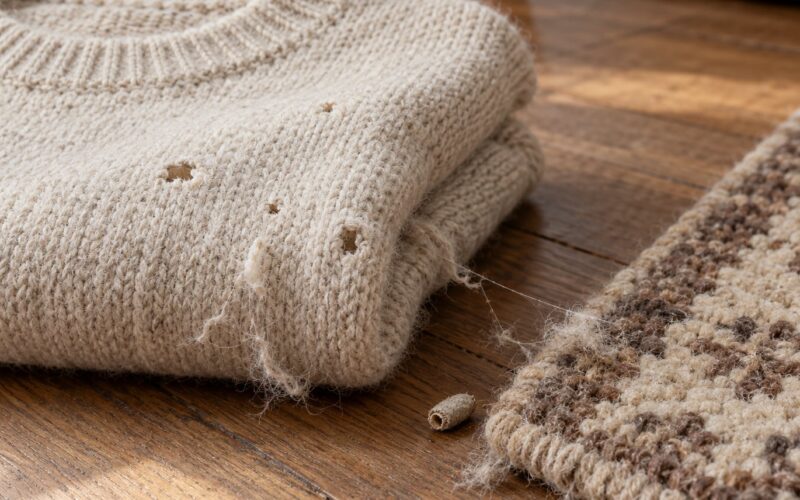
| Where damage shows | In the food, as webbing, clumping and frass | Small round or ragged holes in knitwear, coats and blankets |
| Larval case | Spins loose silk webbing through the food; cocoons in corners when pupating | Webbing clothes moth spins a silken feeding case it carries with it; casemaking clothes moth builds a case from fabric fibres |
| Larva appearance | Cream body, dark brown head, about 5/8 to 3/4 inch | Cream body with a brown head, similar length |
| First control priority | Find and remove the infested food package | Clean and store textiles, then treat the closet |
If your damage is in the food and you have never found a hole in a sweater, pantry moth is the correct assumption. The reverse is also true. Penn State Extension and Cornell IPM both note that clothes moth larvae will not feed on food, so the two problems never fix each other and treating one does nothing for the other.
What Signs Prove You Have Pantry Moths
Five signs, in rough order of how much they mean:
- Two-toned adults near a light or cupboard door. Pale at the body, coppery at the tips, about half an inch across.
- Silken webbing inside a food package. Fine silk strands webbing the contents together, especially at seams and corners.
- Food clumped into hard lumps. Grains or flakes stuck together with silk and moist, usually grain, cereal or dried fruit.
- Small holes in packaging. Pinholes in paper, cardboard or thin plastic bags, often with larvae inside the bag but not on the outside.
- White silken cocoons in the upper corners of the cabinet. Often the only sign people find after the food already looks fine.
Frass, the fine grainy droppings left by feeding larvae, is another clue. It looks like scattered flour or powder on the shelf surface, right next to the webbing. Where there is frass and webbing together, you have an active feeding population, not a stray that wandered in.
What Gets Mistaken for Pantry Moths
A fair number of people post the wrong insect entirely. Household threads and r/whatisthisbug and r/Monstera posts repeat the same handful of misidentifications.
| What you see | What it actually is | Quick tell |
|---|---|---|
| One small moth in a quiet room | Outdoors moth drawn to a porch light | Single moth, no webbing, no food damage |
| Dozens of tiny flies around a bin or plant | Fungus gnats | Slender body, flies rather than flutters, follow dampness |
| Quick darting flies near fruit | Fruit flies | Clear wings, hovering, always near overripe produce |
| Moving specks in dry cereal | Grain mites or booklice | Moving specks, not silk, no frass |
| Brown crawling beetles in flour | Confused flour beetle or grain beetle | Hard body, six legs, no silk |
| Quick grey shapes at dusk | Bats hunting insects | Larger, erratic, audible or visible at the door |
| A moving spot in a high corner | House spider | Eight legs, webs in the corner, no flight |
None of these eat your flour. If you have webbing, frass or holes in a food package, you have a moth problem, and the search starts in the pantry.
Where to Look First in Your Pantry
Open packages come first, always. An opened bag has had weeks of exposure, so it is far more likely to hold larvae than a sealed one. Work alphabetically and dump each item into a clear bin, so you can see the whole pantry at once instead of moving things twice.
Then work on packaging, not just contents. Hold the bag up to the light and look along the seams and folded corners for silk strands, and check for pinholes. Paper and cardboard are not a barrier to a larva with chewing mouthparts, and a bag that looks untouched can be hosting a dozen of them.
Check the foods these moths actually use: flour, cornmeal, other grain products, rice, cereal, oats, dried beans, nuts, seeds, dried fruit, prunes, spices, cake and bread mixes, granola, and anything containing those ingredients, including some pet treats.
Then look in the less obvious places. Under the lowest shelf, where crumbs collect, and behind the bin that sits at the back of the cabinet. Run a flashlight along the upper corners and the wall-ceiling junction for cocoons. Those are usually the only surviving larvae, and finding them tells you the population was bigger than anything still in the food.
Finally, widen the search beyond the kitchen. Garage pet food bins, the utility room, a basement shelf, birdseed stored for winter, and any cardboard box of dry goods that has been in a warm space all outrank the pantry itself. Forum users who cleaned the kitchen twice and still saw moths almost always found the source there.
One caution on method: judging by adult sightings alone is misleading. Swatting adults changes nothing, because the damaging stage is inside the food and the adults have already laid their eggs.
How to Stop Pantry Moths from Coming Back
Bag and remove the suspect food. Put anything with webbing, frass or larvae into a sealed bag and take it out of the house. Do not carry it down the hall to the garage, where it can start the problem in your car or your tools.
Freeze or discard what is suspect. Freezing kills larvae and eggs, but the recommended time varies by source. NPIC suggests about a week at 0°F, University of Kentucky Extension points to four days at 0°F, and Colorado State notes that a shorter window can work. If you want one safe answer rather than a table, use the longest window: about a week at 0°F, then let the food come to room temperature sealed before opening it.
Clean the storage area properly. Vacuum the shelf grooves, the corners, the underside of shelves and behind the bin line, then wipe with hot soapy water. Pay attention to the crumbs and the frass, since those are the working surface for reinfestation. Vacuum again two to three weeks later.
Store dry food in airtight containers. Glass or hard plastic with a tight seal is what breaks the cycle; thin plastic bags do not. Move paper and cardboard packages out and into containers before they come home from the shop, not after you find larvae in them.
Inspect new groceries. Check birdseed, bulk-bin nuts and grains, dried fruit and new pet food before it goes into a cupboard. Birdseed stored in the sun in a bag all summer is a classic source, and pet owners name it repeatedly in community threads.
Rotate what you buy. Use older stock first and keep pantry items off the floor and off exterior walls, where a neighbouring infestation can reach them.
Use traps as a clock, not as a fix. Pheromone traps attract males and reduce mating, but they do not kill larvae and they do not clear an infestation. Their real value is timing: once the source is gone and the pantry is clean, six to eight weeks of empty traps is your confirmation, because that covers the full egg-to-adult window.
Two warnings worth repeating. Do not use insecticides or foggers in a food storage area, and do not place mothballs near food or in reachable spaces; NPIC and extension services both advise against both, and mothballs are toxic if ingested.
Adult pantry moths do not bite, sting, chew building materials or transmit pathogens. If you have allergies, heavy frass buildup in a poorly ventilated space can irritate sinuses, which is a cleaning matter rather than a disease one.
Frequently Asked Questions
How long can pantry moths live?
An adult Indian meal moth lives only about a week, because adults do not feed and exist mainly to mate and lay eggs. What lasts far longer is the population: larvae can feed for several weeks or months inside a dry good, and in warm conditions egg to adult takes around 25 days, stretching to six to eight weeks in a cooler kitchen. A single female lays 100 to 400 eggs, so the visible moth is rarely the whole problem.
Does finding one pantry moth mean I have an infestation?
One moth alone means very little. Adults are easily attracted to lights, so an outdoor moth blown through an open door is a real possibility. Infestation is confirmed by larvae, silken webbing, clumped food, frass or a cocoon in an upper cabinet corner. Judge by the evidence inside your dry goods rather than by the number of adults flying around the kitchen.
Do pantry moths bite people or pets?
No. Adult Indian meal moths have non-functional mouthparts and do not feed at all, so they cannot bite people, sting, or chew drywall or clothing. The larvae do have chewing mouthparts, but they feed on stored grain products and dry pet food, not on skin, hair or blood. Pantry moths are not known to transmit pathogens or infest humans or pets.
Can pantry moths get into sealed food packages?
They can arrive in sealed packages rather than entering after you open them. A female lays eggs on the food surface in the mill, warehouse or bulk bin, and the sealed package then protects the developing moths, not you. Cardboard and paper are not a barrier to a chewing larva either. Freezing sealed suspect packages for about a week at 0°F is the standard response; moving dry food into hard airtight containers is the fix.
When should I call a pest control professional for pantry moths?
Call a professional when the source cannot be found after a thorough pantry and garage inspection, when moths reappear repeatedly after two or three cleanouts, or when you live in an apartment or multi-unit building where moths can move between units. Insecticides and foggers are not an option in food storage areas, so the source has to be found and removed rather than sprayed. Large-scale infestations in commercial food storage need a licensed operator.
What to Do First
Start by containing: seal up every open bag of flour, grain, cereal, nuts, dried fruit and pet food, and remove anything with webbing or frass from the house rather than to another room.
Then confirm the identification. Two-tone coppery and pale wings on a half-inch moth, cream larvae with dark heads, silk webbing in the food, or a cocoon in an upper corner.
Empty the pantry onto a clear surface, inspect packages and seams in good light, and check the garage and any birdseed at the same time. Vacuum every groove and corner, move dry goods into hard airtight containers, and set a pheromone trap to run for six to eight weeks. Empty traps across that window are what confirm the entry route is closed, not the day you finished cleaning.
Reference material for this guide includes UC IPM’s pantry pests pages, University of Kentucky Extension ENTFACT-612 on stored product pests, Colorado State University Extension, Cornell Integrated Pest Management, Clemson Extension, Penn State Extension, the National Pesticide Information Center and the Government of British Columbia home and garden pest management guide. Last reviewed 2026.