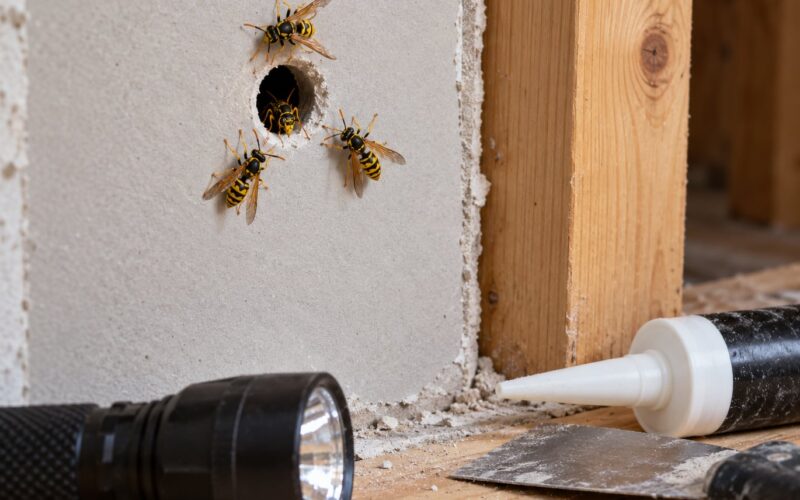
Wasps come inside in the fall because their colonies are breaking down. Food runs short as cold weather arrives, dying workers look for warmth, and newly mated queens deliberately seek a dry sheltered void to overwinter. Entry through one gap does not mean you have a nest in the living room. It usually means you have an opening a wasp can fit through.
Here are the three causes, roughly in the order most homeowners meet them.
- The colony is collapsing and its wasps are looking for heat and shelter. Workers that cannot survive the cold push into buildings, sheds and garages.
- Mated queens are deliberately overwintering indoors. A queen that finds a wall void or attic in October can stay there until spring and then found a brand new nest.
- Food draws them to your house from the outside. Uncovered garbage, sweet drinks and pet food put a year round buffet right next to your door.
Those three causes need three different responses, so it is worth figuring out which one you are actually dealing with before you seal anything up.
Table of Contents
- Why Wasps Come Inside in the Fall
- Wasps Seeking Warmth and Shelter
- What Happens When a Wasp Nest Is Nearby
- How Wasps Get Into Houses
- Which Wasp Is Coming Indoors?
- One Wasp or Many? What the Activity Means
- What to Do When Wasps Enter the Home
- Do Fall Wasps Disappear on Their Own?
- When to Call a Pest Professional
- Frequently Asked Questions
- Conclusion: Start with the Entry Point
Why Wasps Come Inside in the Fall
Fall entry is a season change, not a second colony. As plant growth slows and insect prey disappears, worker wasps are forced to forage closer to homes for sugar and protein. At the same time, overnight temperatures drop, and the sheltered parts of a building suddenly look better than a dying nest. Three things drive most of it: colony breakdown, food attraction, and queen overwintering.
The part people miss is that the wasps coming in are usually not nest bound. They are individuals looking for a place to survive the night or a warm wall to press against. A dozen wasps walking weakly across a workbench in early fall are almost always dying workers from a nest somewhere out of sight, not a new invasion.
Wasps Seeking Warmth and Shelter
Wasps are cold blooded, and that single fact drives most fall behavior. When daytime temperatures drop into the low forties, a wall cavity holding mild residual heat outperforms an outdoor nest in every way.
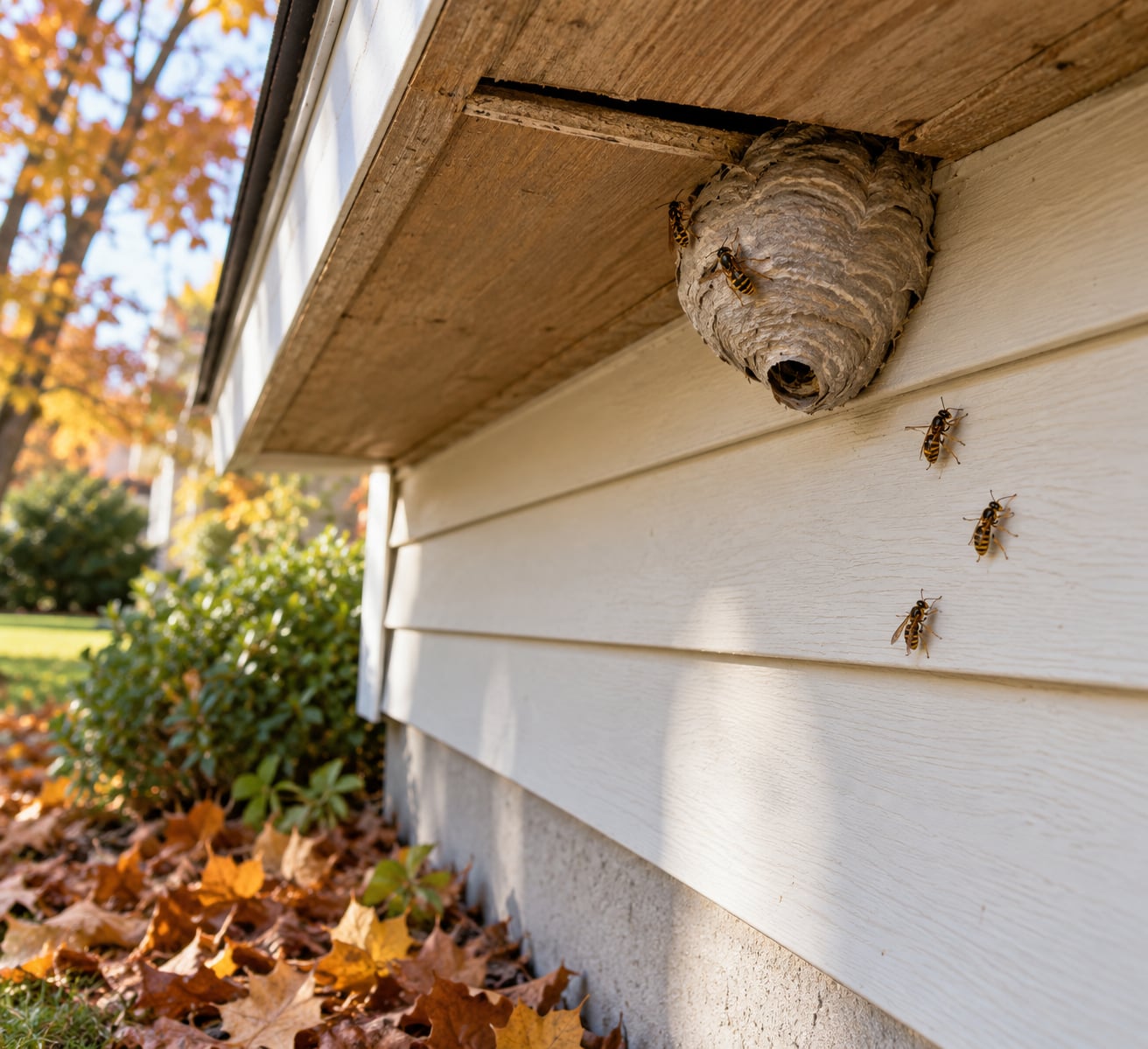
Species differ here in ways worth knowing. Yellowjackets nest underground or in wall voids and are the most likely to be found indoors, because those cavities are already the warmest place on the property. Paper wasps build that open umbrella shaped nest under eaves, soffits and porch ceilings, and when weather turns they tuck into gaps in the same overhangs. Bald-faced hornets nest in cavities too, but higher up, in tree hollows, wall voids and the space above a deck or porch roof.
Solitary wasps behave differently enough to be worth separating out. They never make a colony, they sting only what they are hunting, and the one female in the group spends winter alone in a hollow stem or a beetle burrow. If that is what you are seeing indoors, the risk is much lower and the correct response is usually just to release it.
What Happens When a Wasp Nest Is Nearby
By the time you notice wasps inside, the nest itself is often already finished. A social colony builds through summer, peaks in size, and then declines. Workers stop being produced, the remaining adults die off, and the nest goes quiet.
One thing that surprises people: an old nest is never re-used. The next season’s queens always start fresh, and usually in a completely different location. That matters for timing, because once activity at a nest has stopped, removal is flexible and carries almost no sting risk. You do not have to race the weather or pay for an emergency call in the middle of the night.
The exception is the overwintering queen. She leaves the dying nest in autumn and looks for a protected cavity, and an attic, soffit, wall void or shed near the house fits the bill. Homeowners in New England report finding live wasps indoors in January, which confirms queens will enter and settle in. The sting risk in spring is the real concern here: a queen that overwintered in your wall can start an indoor nest in the first warm week of spring, in a place you will not be able to reach without opening the wall.
Food and Water That Attract Wasps
Fruit, pet food, garbage cans, sweet drinks, nectar from late blooming plants and standing water all pull wasps toward a house in fall. Wasps find food by scent and follow it back to the source, and once a trail is established the same opening gets used again and again by dozens of insects. It is also why wasps seem to know exactly where the soda is the moment you open the door.
Clean up the attractants and a surprising share of the activity stops. Put pet food down, take garbage out in a sealed bin, rinse cans before recycling, and wipe down sticky surfaces with soapy water. Wasps hunt by odor as much as by sight, and soapy water cuts the trail.
How Wasps Get Into Houses
Any gap roughly a quarter inch or wider is enough, and most entry points on a house are not obvious from the ground. A single wasp on the windowsill tells you almost nothing about how it got in, which is why people chase the wrong hole for weeks.
| Entry point | Why wasps use it | How to close it |
|---|---|---|
| Gable and soffit vents | Open attic ventilation, often larger than a wasp and sometimes unlined | Fine mesh screen and exterior caulk, not a solid plug |
| Attic hatch or attic door | A large gap at the frame with a warped seal | Weatherstripping plus foam insulation on the lid |
| Bathroom and kitchen exhaust fans | The duct or exterior hood has a gap, and warm moist air is attractive | Exterior foil tape over duct joints, caulk at the housing |
| Dryer and kitchen exhaust vents | Sided or roof flanges lift away from the wall over time | Replace the flange, caulk, and add a screened exterior hood |
| Plumbing and electrical penetrations | Utility penetrations around pipes, wires and the service mast | Exterior grade sealant or polyurethane caulk, not latex |
| Siding seams, eaves and soffit gaps | Expansion gaps that open where trim meets wall | Caulk and backer rod, painted to match |
| Door thresholds and window edges | Worn weatherstripping, an unlatched door, a torn screen | Replace weatherstripping and repair screens |
Check inside too, because gaps behind baseboards, around plumbing cleanouts and through cabinet penetrations are the indoor side of the same openings. One homeowner on Reddit r/pestcontrol stopped wasps entering in winter by sealing a bathroom fan duct, and nothing else.
Which Wasp Is Coming Indoors?
Identification tells you how worried to be. Solitary species are a nuisance rather than a hazard, and social species are the ones that can rebuild in a wall.
| Type | Markings and size | Where it nests | Indoor risk |
|---|---|---|---|
| Yellowjacket | Black and yellow bands, compact, about half an inch | Underground, in wall voids, under decks | High. Defends an active nest aggressively |
| Paper wasp | Slender, long legs, reddish brown or black and yellow | Open umbrella nest under eaves and soffits | Medium. Nests indoors in porches and attics |
| Bald-faced hornet | Black with an ivory white face, larger than a yellowjacket | Cavities in trees, wall voids, above porches | Medium. Usually a single season indoors |
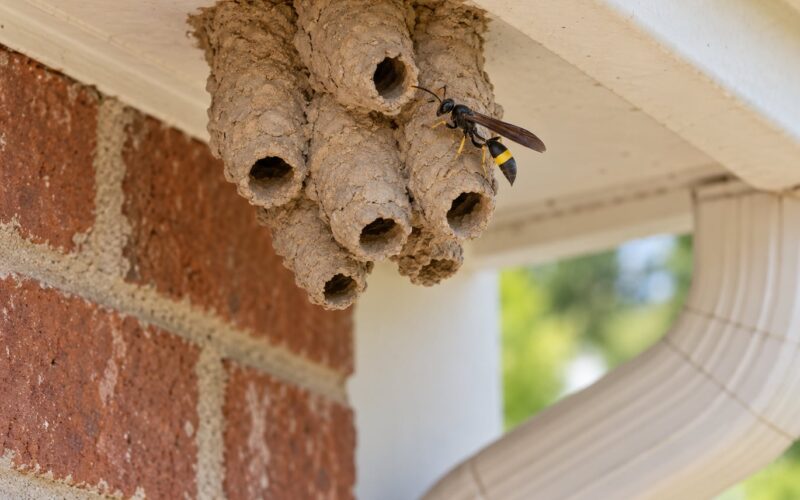
| Mud dauber | Very slender, dark with yellow or blue markings | Mud tubes on walls and protected surfaces | Low. Solitary, does not sting near people |
| Solitary wasps | Small, various colors, many look like tiny bees | Ground cavities, hollow stems, old burrows | Very low. Releases and flies away indoors |
If the wasp has a narrow waist and long dangling legs, it is likely a paper wasp. If it is black and white with no yellow, think bald-faced hornet. Mud daubers and solitary wasps rarely sting unless you grab them.
One Wasp or Many? What the Activity Means
Read the pattern rather than the number. One wasp that flies in, wanders, and finds its way back out is a forager or a lost queen doing exactly what it should. Repeat traffic through a single gap over several days points to a nest behind or above that gap.
Wasps clustered on a wall or ceiling overnight, or emerging from inside your own siding, mean a colony is living in the structure. Wasps that appear on a workbench, walk slowly and die are the opposite case, and that is the single most repeated question on pest forums: dozens of wasps indoors and no nest anywhere. The answer is usually that the nest is outdoors and above you, in a soffit, a wall void or a tree, and the workers are simply drawn indoors by the same warmth and food that is drawing them to your garbage.
Do not go looking for a nest on your own with a flashlight and a stick. That is the fastest way to a sting in September, when colonies are still fully populated and still guarding brood.
What to Do When Wasps Enter the Home
Start by getting out of the travel path. Wasps follow a straight line between their nest and a food source, and a door or a hallway in that line is where you will meet them.
- Close the room. Move people, pets and food out, then close the door behind you.
- Clear the attractants. Bag the trash, put away pet food, take fruit off the counter.
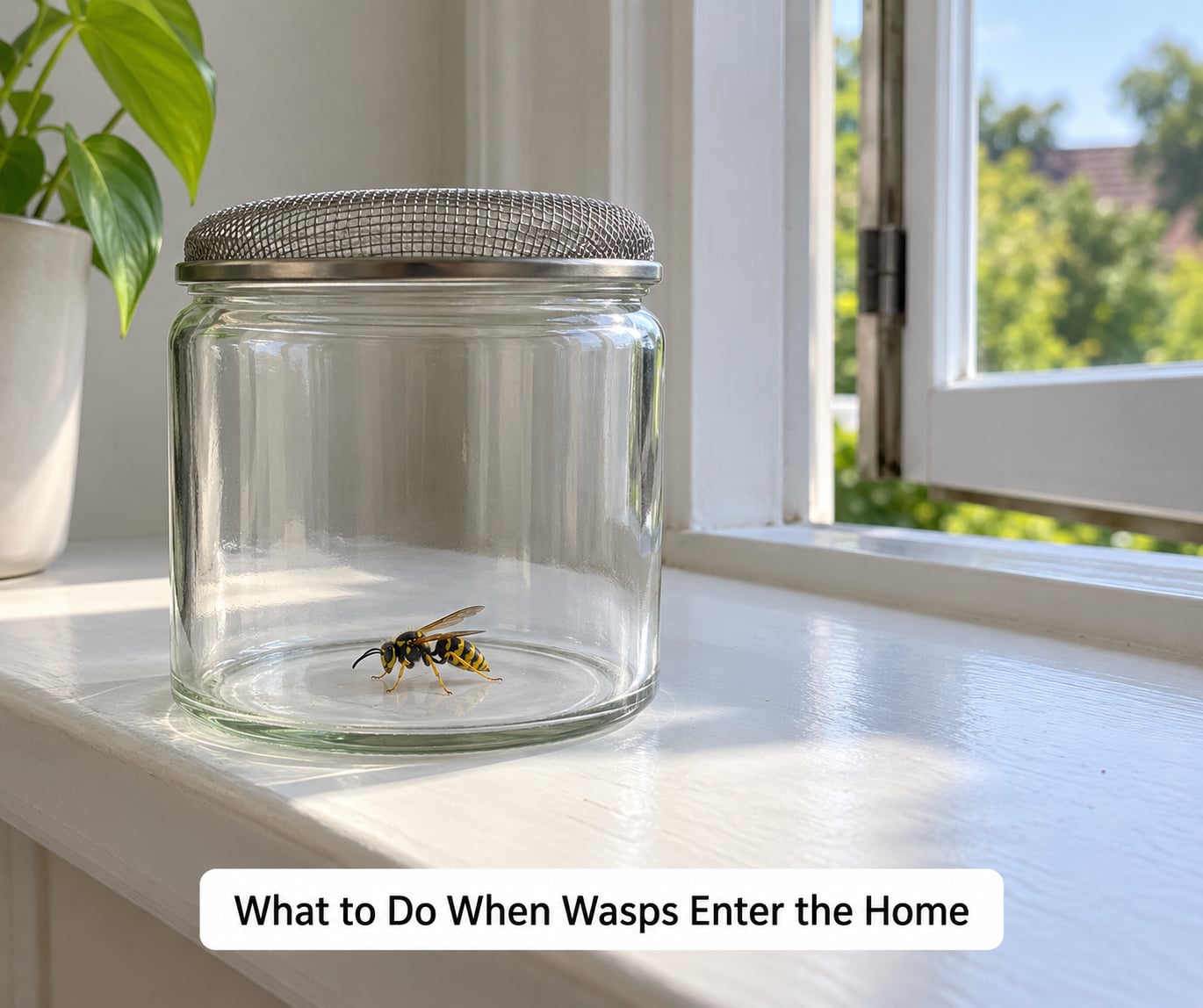
- Release a solitary visitor. Slide a glass jar over it, put a lid or a folded paper card on top, and carry it outside to release it a few steps from the house.
- Patch the obvious gap. A damaged screen, a cracked pane seal, a door that does not latch, a dryer vent that has pulled loose. Exterior grade caulk or foam, not interior spackle.
- Wait before sealing anything large. Do not close a gable vent, soffit gap or attic hatch while wasps are still moving through it, because a nest inside a sealed void is a much larger problem than one outside it.
- Note the time of day traffic stops. If wasps are still using a gap in the evening, the colony behind it is active, and removal is not a weekend project.
If a nest is inside a wall and the colony has already died, remove it in winter with no urgency at all. If wasps are still coming and going, treat it at dusk when they are slower and less aggressive, or call someone who does this regularly.
Do Fall Wasps Disappear on Their Own?
Most of them do. Once the colony has declined, workers die or leave, and the visible activity tapers off. In most of the country the noticeable indoor traffic is over within a few weeks, and in warmer climates it stretches out instead of switching off entirely, since the queens keep looking for a site longer where winters are mild.
Waiting is sensible when you see a handful of wasps, when nothing is coming through a wall, and when anyone in the house has a sting allergy. Waiting is not sensible when wasps are emerging from inside your own wall, when the traffic has not dropped after a few weeks of cleaning and sealing, or when you are not sure whether a queen is already inside. A trapped queen that survives the winter is the one outcome of fall entry that can turn into a real problem in spring.
When to Call a Pest Professional
Some situations are not DIY, and recognizing them early saves a lot of money. Persistent traffic through one gap that sealing has not stopped, sounds inside a wall or ceiling, wasps coming out of the interior of your siding, or damage inside a void you cannot reach are all reasons to bring someone in. So is any household with a member who reacts strongly to stings, and any nest located inside living space rather than in an attic or a void.
Get the species identified first, either in person or from photos. A yellowjacket nest in a wall is a job for someone with the right protective equipment, while a single mud dauber on the porch is a job for the jar in the cupboard.
Frequently Asked Questions
Why are wasps coming into my house suddenly?
Why wasps come inside in the fall usually comes down to three things: a collapsing colony, food left accessible outside, and queens looking for an overwintering site. Insects that once foraged far from your house start working close to it, so a gap you never noticed becomes visible traffic. Wasps entering the same spot again and again are nesting nearby; wasps that wander and leave are just passing through.
Are wasps in the house in fall more dangerous?
Not usually. Most of what shows up indoors in fall is dying workers from a declining colony, and they sting only when grabbed or crushed. The real concern is the overwintering queen, since one mated queen surviving in a wall can build a colony indoors next spring. Anyone with a known sting allergy should call a professional rather than handle it alone.
Should I seal a wasp hole I can see?
Only if no wasps are still moving through it. Sealing an opening while workers come and go traps the colony inside your wall, attic or soffit, which is harder and pricier to fix than the original nest. If traffic has stopped and the colony is finished, sealing the hole is exactly the right move. If wasps are still using it, wait.
How do I find a wasp nest inside my wall or attic?
Look for the path, not the nest. Wasps moving in and out of a single crack, a scrape on the drywall, or a stain near a vent usually point to the entry. Cover the suspected opening with tape and check in the morning for a trapped insect. Never probe or open a wall, because a colony disturbed in early fall is defensive.
Will wasps come back after I release them outside?
A single released wasp usually does not come back, because it has no nest to return to. Several may return if an active nest sits nearby, and a queen released outdoors may find another sheltered void. An old nest is never re-used, so if the colony is dead, the wasps you release will not be back next year.
Conclusion: Start with the Entry Point
Why wasps come inside in the fall comes down to warmth, shelter, food or a dying nest next door, and all four enter through a gap you can close. Take the trash out, put the pet food away, and seal the obvious holes while you are still ahead of spring. If a single wasp is wandering, jar it and take it outside. If traffic is still moving through a gap at dusk, leave that gap open and get help, because sealing it early is what turns a nuisance into an indoor colony in 2026.