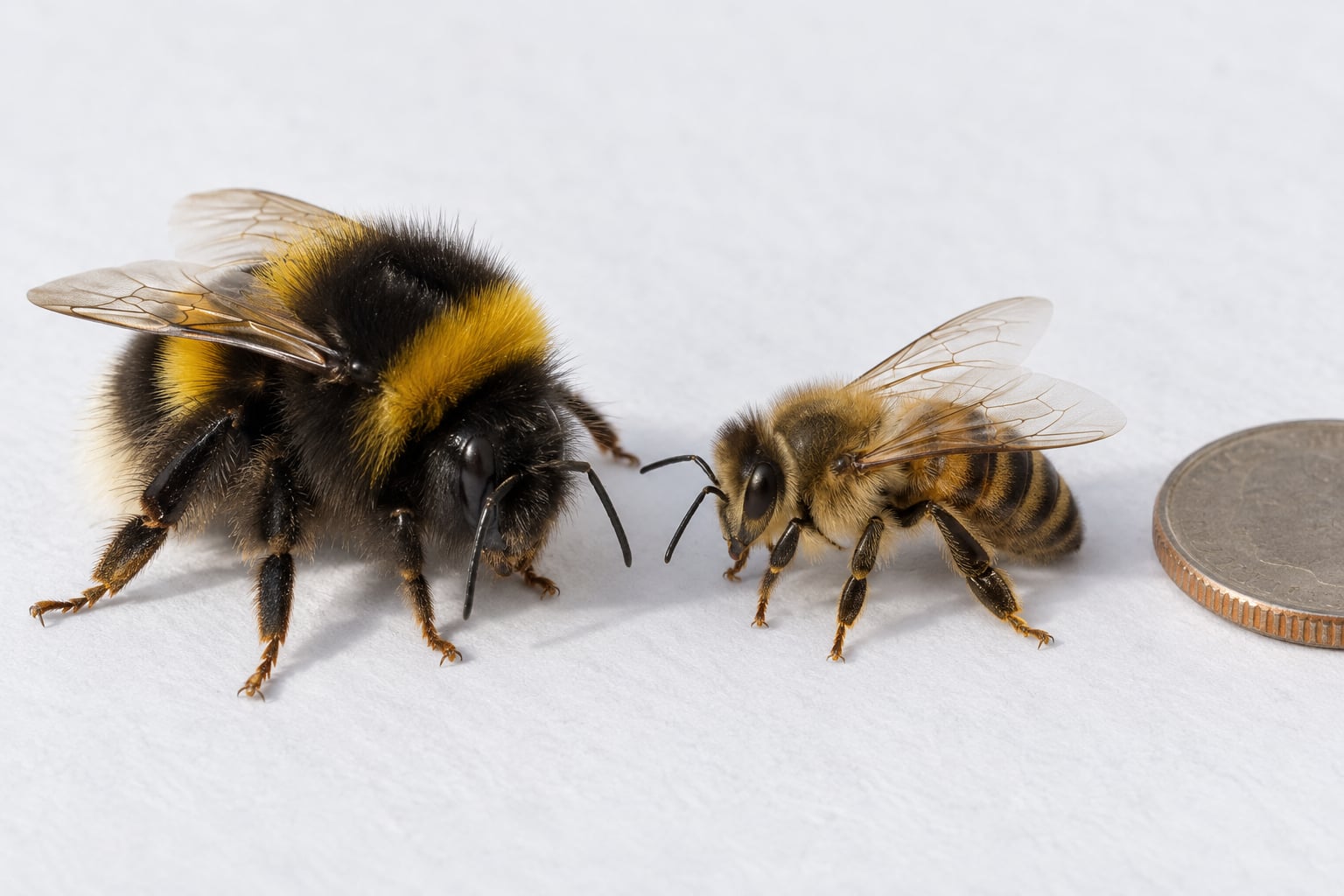
If you had to name one trait that settles it, it is body shape. Bumble bees are large, round, and fuzzy with a blunt, furry rear end; honey bees are smaller, slender, and smoother with a wasp-like waist and fine even stripes. Add where the bee is going and you can usually call it in about thirty seconds.
That is the whole game, and honestly it is easier than most identification articles make it sound. The two get confused because both are yellow, black, and furry-ish, and because a bumble bee caught mid-hover at an odd angle can look surprisingly slim.
What follows is the check I use, the look-alikes that cause most of the wrong calls, and what to do with the answer. No swatting, no spraying, no panicked exterminator call for a bee that was passing through.
How to Tell a Honey Bee From a Bumble Bee at a Glance
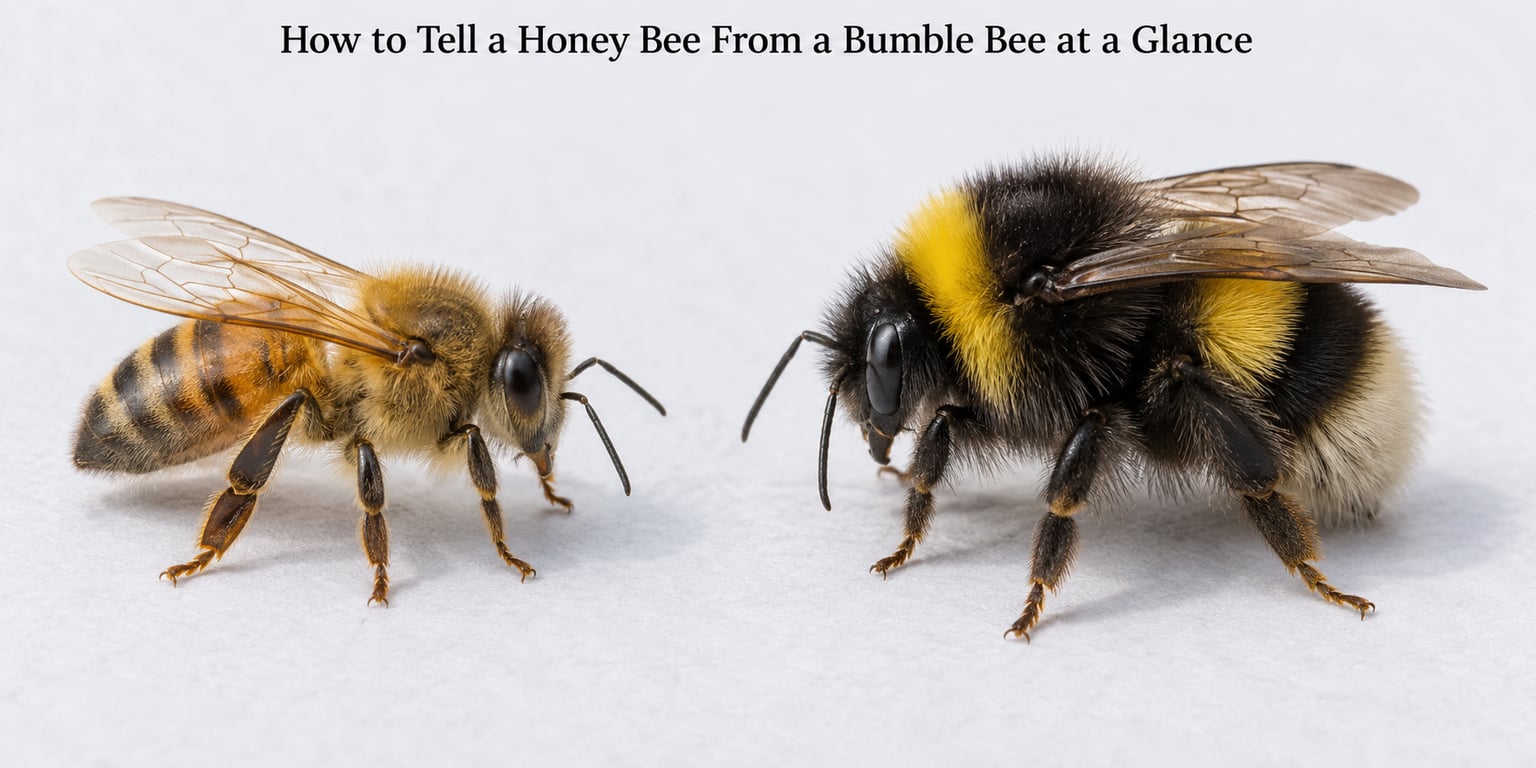
| Feature | Bumble bee (Bombus) | Honey bee (Apis mellifera) |
|---|---|---|
| Size | Large and stocky, roughly an inch long for a queen and a bit over half an inch for a worker | Smaller and slimmer, about a third to half an inch for a worker |
| Body hair | Dense, thick fuzz that softens the outline and blurs the bands | Thorax is fuzzy but the abdomen is smoother and shinier |
| Color from above | Bold, broad blocks of yellow, orange, red or white against black | Even, narrow bands of amber, brown, tan and black |
| Rear end | Blunt and rounded, furry right to the tip, often a noticeable tail | Tapered to a point on females, rounded on males |
| Waist | Short, thick, often hidden by hair | Clearly pinched, a narrow waist between thorax and abdomen |
| Head | Looks partly fused into the fuzzy thorax at a quick glance | Head and thorax read as two separate pieces |
| Pollen carrying | Loose pollen dusted on the hind legs and belly, no basket | Flat, shiny pollen baskets, or corbicula, on the hind legs |
| Flight | Slower, lumbering, often drifting side to side | Quicker, more direct, with frequent hovering |
| Nest | Underground or in a cavity, often a mouse-sized hole, sometimes in thick vegetation | A managed or feral hive box or wall cavity with steady traffic |
| Sting | Smooth stinger, so it can sting repeatedly | Barbed stinger, so it usually stings once and the stinger stays behind |
| Colony size | A few dozen to a few hundred, and it dies off each winter | Tens of thousands and it persists year-round |
Read the table from the top down. If two or three rows disagree with each other, the bee is probably not a honey bee or a bumble bee at all, which is where the look-alike section below earns its keep.
Body shape and size
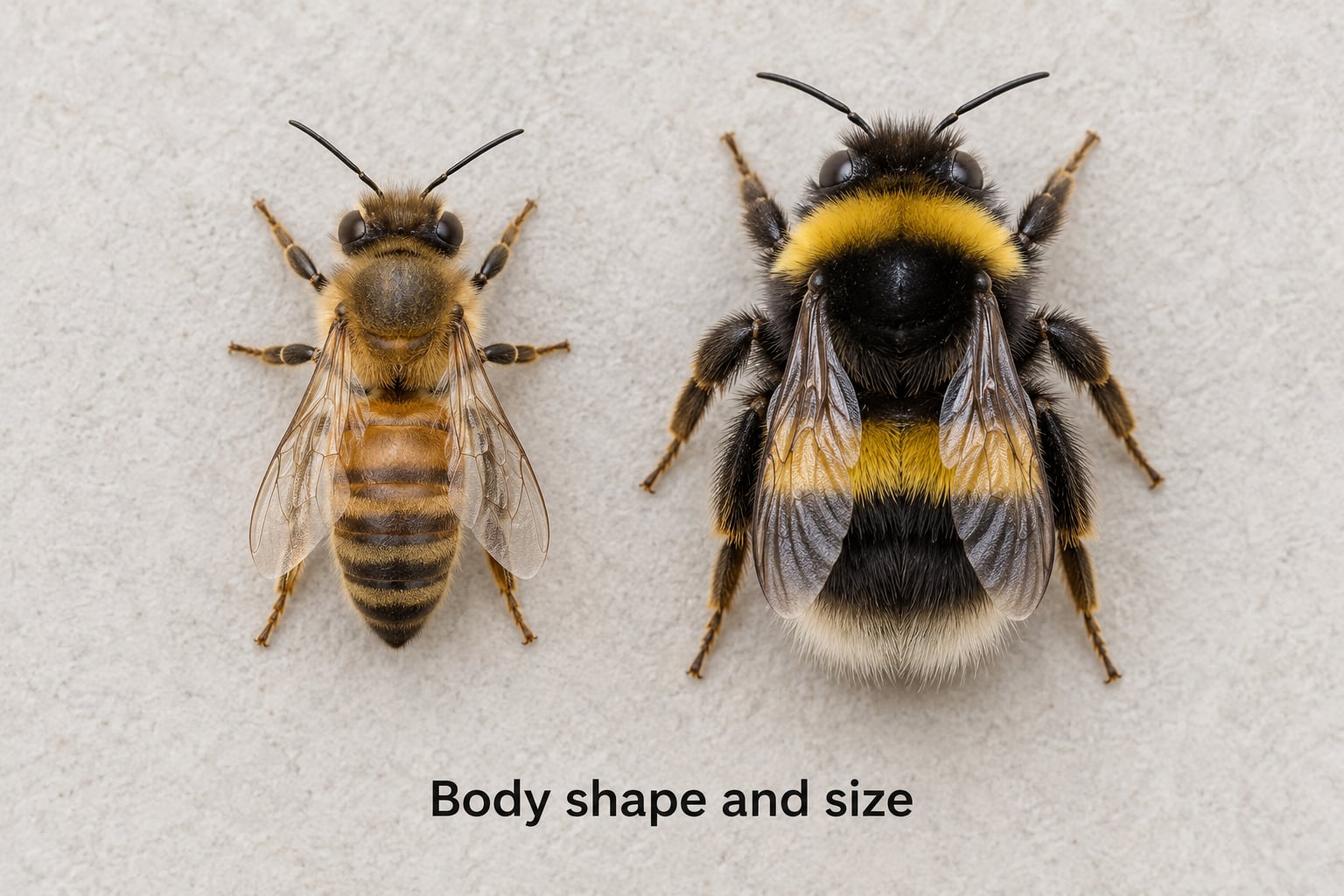
Body shape beats color every time. A bumble bee reads as a single plump mass with the head almost buried in the shoulders, while a honey bee reads as three parts stuck together: head, thorax, pinched waist, abdomen.
Size is the supporting clue, not the primary one. A large bumble bee queen can outweigh a honey bee worker by a noticeable margin, but a honey bee seen against a bare wall can look bigger than it is, and a lone forager with nothing to compare it to is where most misidentifications start.
Give yourself a ruler next time. A penny is about 19 mm across and a US quarter about 24 mm, so a quarter is a decent stand-in for a large bumble bee body. Put one on the deck board or the patio table, walk away, and check the bee against it later in the photo. That single habit fixes most of the scale confusion people complain about in identification threads.
Perspective lies in both directions. A bee two feet from your face with a wide lens looks enormous; the same bee at the far end of the garden looks tiny.
Color, stripes, and body hair
Color alone will get you wrong at least once. Honey bees can be near-black, striped in broad amber, or almost red-brown depending on subspecies. Bumble bees cover a wider palette still, and North America alone has well over fifty Bombus species, from the black-and-white-banded black-and-white bumble bee to orange-tailed and red-belted forms. Some honey bees also carry a bold yellow band that would fool anyone judging on color alone.
The useful cue is how the color is arranged, not which colors appear. Viewed from above, a bumble bee shows a few broad, solid blocks with softened, hairy edges. A honey bee shows a run of narrow, tidy, evenly spaced stripes on a smoother surface. If you can count three or four distinct stripes across the abdomen, you are probably looking at a honey bee.
Fuzz is the fastest visual test and works at a distance. A bumble bee’s outline looks soft and slightly blurred, like the insect was photographed through fabric. A honey bee has a crisp outline, a fuzzy golden thorax, and a noticeably sleeker abdomen.
One extra rule that catches people out: pointed rear end means female, rounded rear end means male. Males of both species have no stinger at all, and a male honey bee has a wide, blunt, fuzzy-looking abdomen that mimics a bumble bee quite well. Watch the bee land and look again if you can.
Flight pattern and behavior
Flight is the cue you get for free when the bee will not sit still. Honey bees move quickly and fairly straight between flowers, with quick bursts of hovering in front of a bloom before they commit. Bumble bees fly slower and look heavier, with a drifting, side-to-side wobble that makes them look like they are being blown about.
Neither pattern is diagnostic on its own. A honey bee carrying a heavy load of pollen crawls rather than flies, and a tired bumble bee can look brisk. Treat flight as a tiebreaker, not a verdict.
Hovering around you usually is not an attack. Forum threads on this question come back to the same explanation again and again: a bee hovering near your head or your clothes is almost always smelling you, working out whether you are a predator, a rival for the nest, or something worth investigating. Strong scents make it worse, which is why bug spray applied near a foraging bee draws a closer inspection rather than driving it off.
Bumble bees are generally more tolerant of handling than people expect. They are often described as docile, and a foraging worker will usually keep working while a careful observer watches from close range. Honey bees are fussier, and a hive with a strong scent, a nearby disturbance, or an aggressive colony will push guards out well beyond the entrance. If a group of bees stays persistently in the air near one spot, that spot matters more than the individual bee’s temper.
Nesting and pollination behavior
Nest location settles most cases faster than any body trait. Bumble bees are mostly underground or in cavities, so you find them near a mouse-sized hole at the base of a wall, under a deck, in an old mouse or vole burrow, or inside dense vegetation. Some species build a mossy dome right on the ground surface.
Honey bees are the opposite. What you are looking at is a colony: a hive box, a wall cavity, an abandoned structure with a steady stream of traffic in and out of a single opening. Count the bees at the entrance and the number climbs fast.
The colony structure differs too, and it explains the seasonal pattern people notice.
| Season | Bumble bee colony | Honey bee colony |
|---|---|---|
| Spring | An overwintering queen founds a small nest and the colony grows all season | An established colony forages steadily |
| Summer | Grows to a few hundred, often found by a new queen and worker | Grows toward its full population of tens of thousands |
| Late season | Males appear; old colony declines | Unchanged in size and activity |
| Winter | Colony ends; only new queens survive | Clustered inside the hive through the cold |
Pollination value runs the other way from what people assume. Honey bees are numerous and work many flowers, but bumble bees are often more efficient on individual plants. Their longer tongues reach deep tubular flowers honey bees cannot reach, and they vibrate flight muscles to shake pollen loose from certain crops, which is called buzz pollination. If your tomatoes, blueberries, or squash look underset, the bumble bees may be doing more of the work than the hive.
One regional note worth knowing in the US: bumble bees are native here, honey bees are not. Apis mellifera came over with European settlers and is now managed almost everywhere. Native bumble bee populations have declined over recent decades, which is a good reason not to treat a fuzzy bee as a nuisance.
How to identify each bee safely
Here is the sequence I use. It runs from the clue you get at the greatest distance to the clue you need up close, so a bee that will not sit still can still be identified.
- Size against a reference. Use a coin, a pencil, or a deck board so scale is not a guess. Noticing that a bee is noticeably bigger than the other insects in the same patch is usually enough to send you to the next steps.
- Outline and fuzz. Blurry, soft-edged, almost spherical: bumble bee. Crisp, segmented, slightly shiny abdomen: honey bee.
- Banding from above. A few broad blocks of color with hairy edges mean bumble bee. Four or five narrow even stripes mean honey bee.
- Rear end and waist. Blunt and furry with no visible pinch means bumble bee. Pointed, with a clear narrow waist between thorax and abdomen, means a female honey bee.
- Destination. Into a ground hole or a cavity: bumble bee. Into a hive with constant traffic: honey bee.
If the bee disagrees with the first four steps, check it against the look-alikes before you act on anything.
| Look-alike | Distinguishing feature | Where you see it |
|---|---|---|
| Carpenter bee | Shiny, bald, metallic-looking abdomen; drills round holes in wood | Untreated beams, deck posts, fascia |
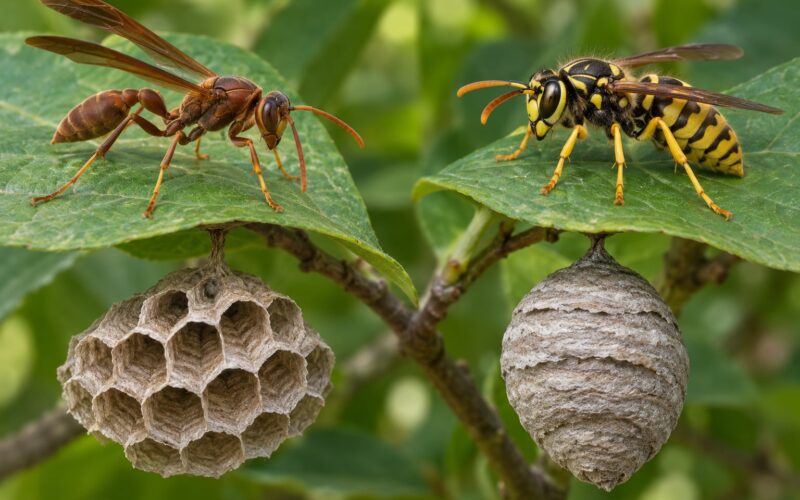
| Yellowjacket or wasp | Narrow waist, smooth body, no fuzz, folds wings lengthwise | Under eaves, wall gaps, near sugary food |
| Hoverfly | One pair of wings, huge fly-like eyes, no pollen carried | Floating over flowers, mimics a bee in flight |
| Sawfly | No pollen baskets, larva looks like a caterpillar on leaves | Adults on flowers, larvae on foliage |
The one that causes real damage is the carpenter bee, so it is worth separating clearly. It is a bee, it can sting, and it is not a household hazard the way termites are, but it will bore into bare or weathered wood and it does not eat it. Bored holes that are neat and round and about half an inch across, with sawdust below them, mean carpenter bee. Fuzzy bee coming out of the ground means bumble bee.
For photographs, shoot from a low angle in good light with a plain background and get something for scale in the frame. A side view shows body shape best, and a top-down view shows the banding that separates the two species.
Identifications worth double-checking: males of both species, very dark or very orange regional forms, carpenter bees, and hoverflies in a still photo. If you want a second opinion on a real sighting, iNaturalist takes observations with photos and location, and BumbleBeeWatch is the dedicated route for bumble bee records.
What to do if you see one
Neither bee is a household pest. A honey bee hive can be a genuine safety issue only if it is inside a wall you cannot reach, or if the colony shows persistent defensive behavior, and a bumble bee nest is usually a season’s activity in a hole you can leave alone. Most of what people are about to do to a harmless bee would cause more harm than the bee would.
Start with a few simple moves. Stay back and let the bee work. Do not swat at it and do not spray near it. Keep uncovered food and sugary drinks out of reach while you are outside, since that is what draws bees to an area in the first place. If you use repellent, apply it before you go out rather than chasing a bee with it, because a panicked spray cloud is exactly what a hovering bee is investigating.
Call a local beekeeper when you have a honey bee colony in an accessible hive or a visible swarm. Swarms are the one situation where a beekeeper genuinely wants the call. A wall cavity that is actively used, a colony showing persistent guarding, or repeated stinging near a doorway are the situations where a pest professional is the right call, and telling them you have identified it as a honey bee colony saves everyone a misdiagnosis.
If anyone is stung, the usual first aid applies: clean the area, apply a cold pack, and watch for swelling that spreads or breathing difficulty, which is a medical emergency rather than an insect identification question.
Which should you choose?
You are not choosing between them, and that is the part most comparisons get wrong. The question is which one you are looking at, and how confident you are.
In a backyard or garden, the fastest route is body shape and fuzz from about three feet away, then banding, then where it goes. Hive traffic or dozens of bees at one entrance means honey bee and probably a keeper nearby. A single fuzzy visitor working a flower, or a slow bee entering a mouse hole at the base of a fence, means bumble bee and nothing to do.
Near a structure is the case where it pays to be slower. Watch for a full minute and count. Steady two-way traffic through a single opening in wood or siding points to a colony inside; a handful of individual bees coming and going from a ground hole points to a bumble bee nest. If it is honey bees in a wall, a beekeeper first. If it is honey bees in a hive box, it may not need anyone at all.
If the bee is unusually large and shiny rather than fuzzy, you probably have a carpenter bee and a separate decision about the wood. If it has a hard pinched waist and no fuzz at all, it is a wasp, and the leave-it-alone reasoning changes completely because wasps nest in walls and do sting repeatedly.
Frequently Asked Questions
How do you tell the difference between a honey bee and a bumble bee?
Bumble bees are large, round, and densely fuzzy with a blunt rear end and a ground nest. Honey bees are smaller, slimmer, and smoother, with a narrow wasp-like waist, fine even abdominal stripes, and hive traffic. Fuzz and body shape decide it most of the time, since color varies widely in both.
Are honey bees and bumble bees dangerous?
Neither is dangerous under normal circumstances. Both sting only when threatened, crushed, or when their nest is disturbed, and both are valuable pollinators. Concern is justified mainly if there is a large colony inside a wall, persistent guarding behavior, or a person in the household with a known severe sting allergy.
Is a large fuzzy bee always a bumble bee?
Usually, but not always. Male honey bees have wide, blunt, fuzzy-looking abdomens, and carpenter bees are large and dark with shiny, bald abdomens. Confirm with two traits at once: fuzzy plus a blunt rear end plus a ground-level destination. Shiny and metallic means carpenter bee, not bumble bee.
Which sting hurts more, a honey bee or a bumble bee?
A honey bee sting tends to hurt more sharply at the moment of the sting because its stinger is barbed and keeps working briefly, and the stinger is often left in the skin. A bumble bee has a smooth stinger, so it tends to cause a more drawn-out ache and it can sting more than once.
Can a bumble bee sting more than once?
Yes. Bumble bees have smooth stingers with no barbs, so unlike a honey bee they can sting repeatedly while they are agitated. A honey bee’s barbed stinger tends to lodge in the skin, which is why honey bees usually sting only once per encounter.
What should I do about a bee that got into my house?
Stay calm and let it find the exit, which open windows and a dark, quiet room with a single light source will encourage. Bees indoors are usually disoriented and heading for daylight. If it is a nest inside the wall rather than a single bee, that needs a beekeeper or a pest professional, not a DIY removal.
Conclusion
Start with shape and hairiness from about three feet away, then confirm with the abdominal banding and where the bee is going. If you learn nothing else from this guide, remember that a blunt furry rear end plus a ground-level nest means bumble bee, and a narrow waist plus hive traffic means honey bee.
Neither one needs to be handled or removed to solve a problem. Leave them to work, keep scented sprays and swatting out of the situation, and bring in a beekeeper or a pest professional only when a colony is inside a structure or a genuine safety problem is developing.