Pharaoh ant identification comes down to four details: workers about 1/16 inch long, a pale yellow to reddish-brown body, a two-node waist, and a noticeably darker abdomen. They are hard to control because colonies run on multiple queens, split into satellite nests when disturbed, nest inside wall voids and appliances, and forage up to 148 feet from home.
Table of Contents
- Pharaoh Ant Identification and Why They Are Hard to Control
- How to identify a pharaoh ant
- What do pharaoh ants look like?
- Where do pharaoh ants live and forage?
- Why are pharaoh ants hard to control?
- How to control a pharaoh ant infestation
- When should you call a pest professional?
- Frequently Asked Questions
- Conclusion
Pharaoh Ant Identification and Why They Are Hard to Control
The scientific name is Monomorium pharaonis, and the name has a story attached to it. The ants were once assumed to be one of the plagues described in the Bible, so they picked up a royal label that has nothing to do with ancient Egypt.
These are warm-climate ants that live indoors year round in heated buildings, and that indoor life is the root of most of the frustration. Nothing about them behaves like the single-nest ant most people picture. A colony can run hundreds of queens, spread across a dozen hidden nests, and rebuild after treatment faster than you can find it.
So there are two questions on this page, and both need an honest answer. First, is what you are seeing actually a pharaoh ant? Second, if it is, why did the spray you bought last month make things worse instead of better?
How to identify a pharaoh ant
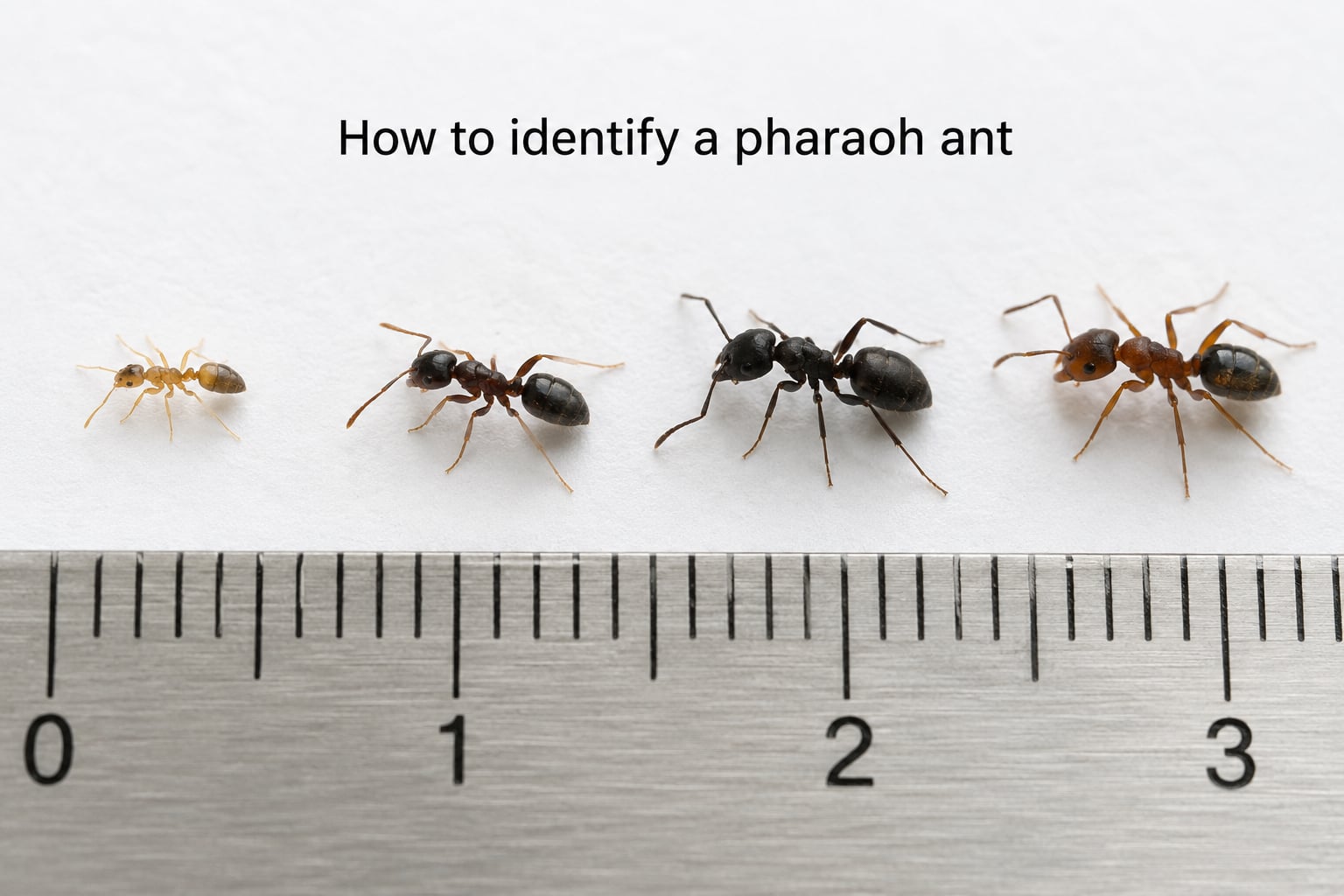
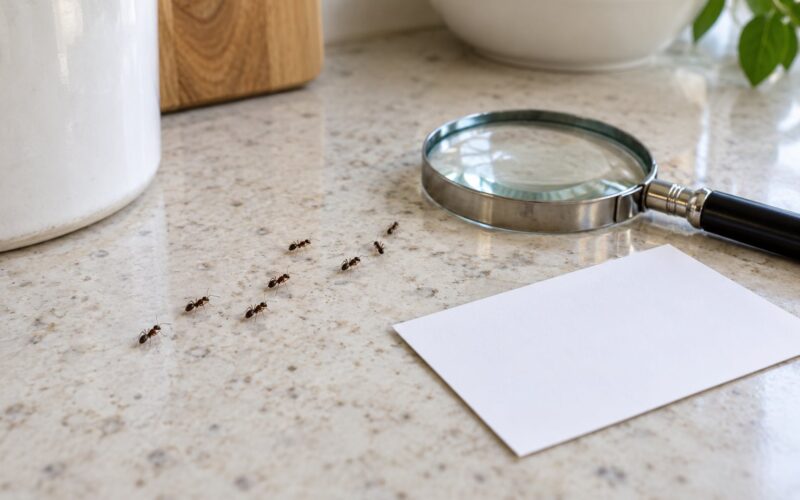
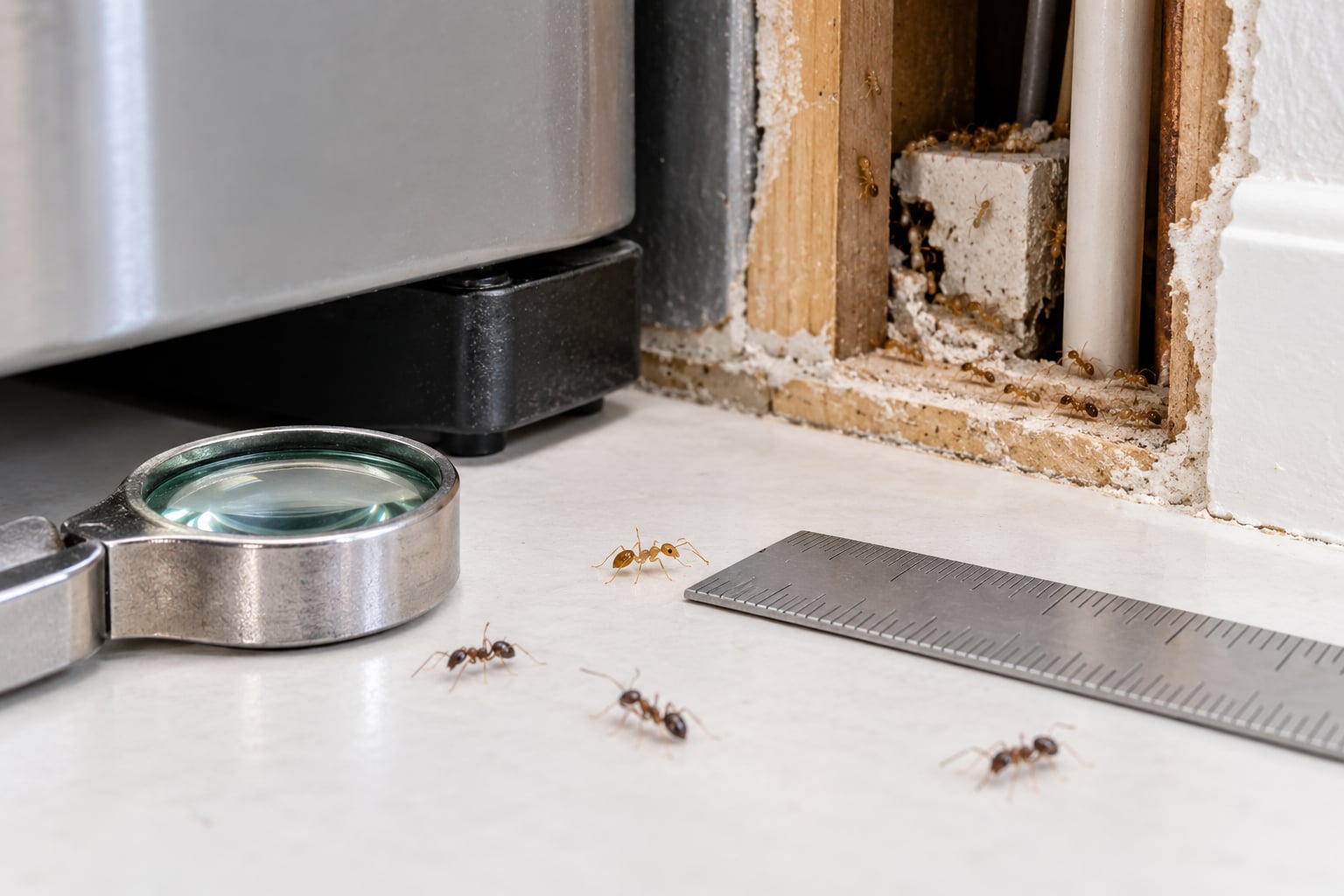
Get a magnifying glass or a hand lens and work through this five-point check on a single ant you have already killed. Everything below is visible under 10x magnification, which is the difference between guessing and knowing.
- Size. Workers run 1.5 to 2 mm, about 1/16 inch. If the ant in your hand lens is noticeably bigger than that, keep looking.
- Color pattern. Pale yellow to reddish-brown overall, with the abdomen (gaster) darker than the head and thorax.
- Waist. Two distinct pinched segments between thorax and abdomen, called petiole nodes.
- Antennae. Twelve segments, elbowed, ending in a three-segmented club.
- Movement. Slow and meandering rather than the quick scurry of a little black ant.
None of that is easy to judge by eye alone on a moving ant, which is why step one is the hand lens. Body details that decide the identification are genuinely below the resolution of unaided vision at that scale.
There is one more field test worth knowing, and it only applies to one look-alike. Crush a ghost ant between your fingers and you get a strong rotten-coconut odor, carried in glands on the thorax. A pharaoh ant crushed the same way gives you nothing much. It sounds odd to judge an ant by smell, but it settles arguments that a photo cannot.
Pharaoh ant versus common look-alikes
| Feature | Pharaoh ant | Ghost ant | Odorous house ant | Little black ant | Pavement ant |
|---|---|---|---|---|---|
| Worker size | 1.5 to 2 mm, about 1/16 inch | About 3 mm, clearly larger | About 3 mm | About 2 mm | About 3 mm |
| Head and thorax | Pale yellow to reddish-brown | Dark brown to black | Brownish-yellow to dark brown | Black | Dark brown to black |
| Abdomen | Noticeably darker, often translucent-looking | Dark and translucent, pale at the waist | Dark with pale bands | Uniform black | Dark with a two-tone look |
| Waist | Two nodes, tightly pinched | Two nodes, sharply pinched | Two nodes | Two nodes | Two nodes |
| Crushed smell | Faint or nothing | Strong rotten-coconut odor | Strong curry-like odor | Faint | Faint |
| Where you see it | Kitchens, baths, wall voids, appliances, sockets | Same areas, plus outdoor soil and mulch | Kitchens, pantries, near pet food | Counters, floors, near water | Sidewalks, driveways, entry thresholds |
Big-headed ants and thief ants are worth ruling out too. Big-headed workers have a disproportionately large head and are usually found around seed and protein sources. Thief ants are scavengers that steal from other ant species’ trails, which is a behavior pharaoh ants do not really do.
What do pharaoh ants look like?
Here is the visual checklist, in the order your eye should move down the body. Head and thorax first, then the waist, then the abdomen.
- Color. Pale yellowish to reddish-brown, and colonies often look like two different ants because workers vary from light to dark.
- Abdomen. Darker than the rest of the body and partly translucent, so you can sometimes see shadow of the gut through it.
- Thorax. Smooth, with no spines or ridges on the rear edge.
- Waist. Two distinct nodes, which separates it from carpenter ant look-alikes and their single pinched node.
- Antennae. Elbowed with a three-segmented club.
- Size. Small enough that many people describe them as pinhead-sized specks of dust moving.
Part of the confusion is that no single trait proves anything. A tiny pale ant with two waist nodes could still be one of several species, and the combination of size plus color pattern plus behavior is what makes the call.
How can you tell which ant is the queen?
Queens are noticeably larger than workers, roughly 1/8 inch or 3.6 mm, and darker with a more defined waist. Males, called drones, are winged and lighter in color. Finding a queen tells you the nest is nearby, because queens do not travel far from the colony.
What do pharaoh ants eat?
They are generalists. Syrups, fruit juice, honeydew, grease, seeds, and dead insects all work, as does blood in a hospital setting, where they have been found feeding on intravenous fluids. That broad menu is one reason indoor baiting is hard to aim, since the colony is usually eating several things at once.
Where do pharaoh ants live and forage?
Pharaoh ants nest wherever it is warm, damp, dark, and undisturbed, and indoors that means the parts of a building you cannot reach. Common nest sites include inside wall voids between studs, beneath baseboards and trim, in insulation, behind electrical outlets and switch plates, inside appliance housings, under the refrigerator and dishwasher, and in plumbing or wood fixtures near leaks.
They do not build outdoor mounds the way fire ants or field ants do, which is exactly why the trail is the only clue most people get. There is no visible pile to walk up to and flood with a hose.
Foraging is the other half of the picture. Workers travel as far as 148 feet from the nest and move slowly along pheromone trails, which is why you see them in defined lines rather than scattered randomly. Kitchens, bathrooms, laundry rooms, and any spot with a water source draw the heaviest traffic.
Signs worth taking seriously: trails that persist for weeks rather than days, activity in more than one room, ants in an outlet or light switch, or a trail that reappears in the same place after you cleaned it away. That last one is the strongest signal that something is nesting nearby.
Why are pharaoh ants hard to control?
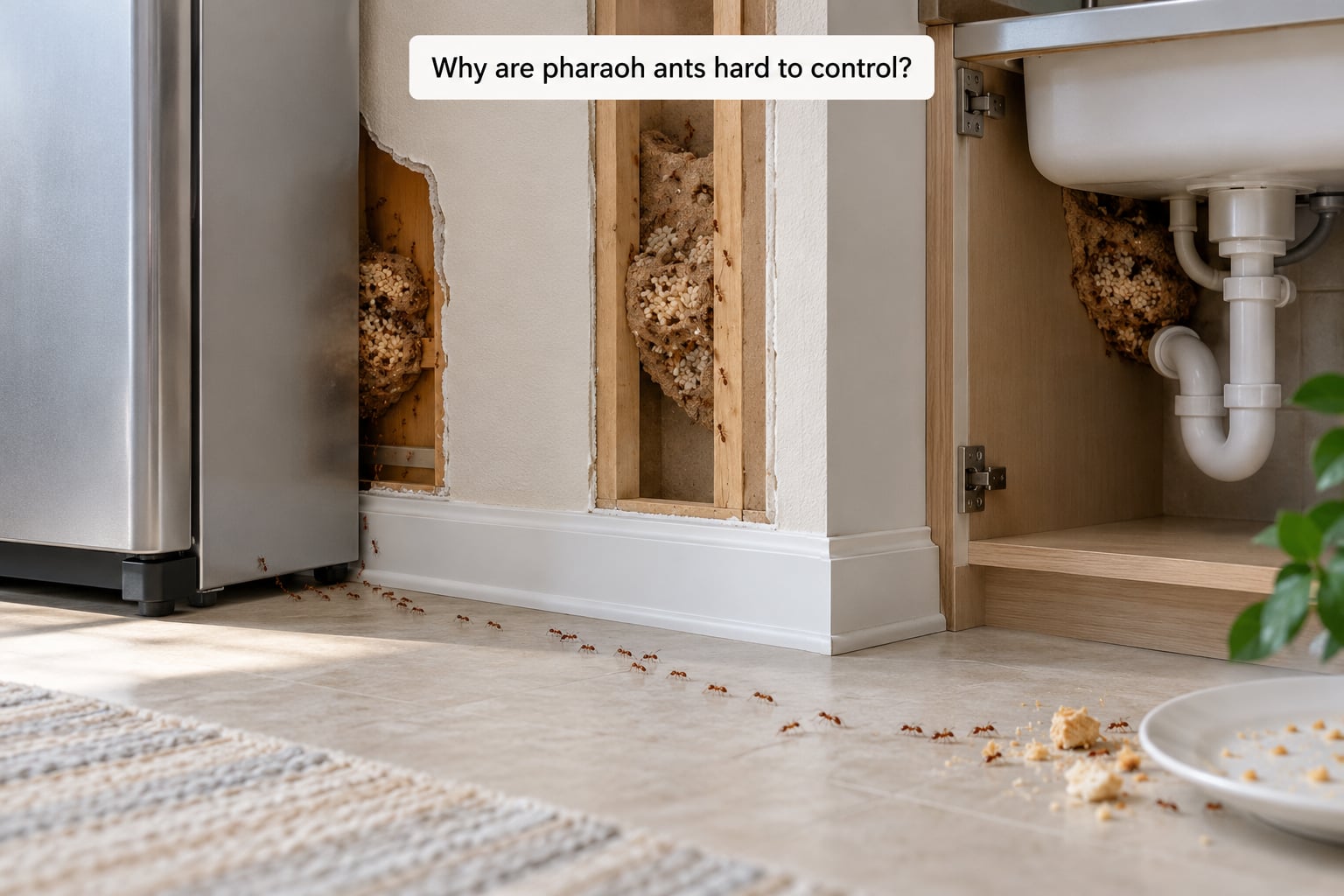
Of the household ants you are likely to meet, pharaoh ants rank among the hardest to eliminate. Five biological traits account for nearly all of it.
- Colonies run on multiple queens. Pharaoh ant colonies are polygynous, meaning many queens lay eggs in the same nest. Killing one queen changes nothing when there are dozens of others producing replacements.
- They bud and split. Disturb a colony and a worker group leaves with developing larvae and pupae, plus existing queens, and sets up a satellite nest nearby. One colony can become several within days.
- The nests are hidden and scattered. Nesting across wall voids, outlets, and appliance housings means one treatment almost never reaches every nest in the structure.
- They forage a long way and eat almost anything. A 148-foot foraging range means ants can reach your kitchen from a nest well outside the room, and a wide diet means blocking one food source does not block the colony.
- They are small enough to hide in. At 1/16 inch, workers fit into cracks and gaps that stop larger ants, which lets the colony spread through a building faster than you can seal it.
Budding: the single most important thing to understand
Budding, also called colony fission, is the mechanism behind most failed treatments. It runs in three steps.
Step one, threat. A chemical is applied, a nest area is disturbed, or a competing colony moves in. Workers register the threat and become agitated.
Step two, fracture. Instead of fleeing as an organized column, worker groups peel off carrying brood and a queen or two. They do not swarm and they do not mate in the open. Mating happens in the nest, which is why you never see a pharaoh ant nuptial flight the way you would with a fire ant.
Step three, new nests. Each departing group settles somewhere protected and warm and starts producing its own satellite colony. Repeat treatments mean repeat fractures.
Commonly cited research puts the minimum viable fragment at only a few hundred workers. If you kill the visible trail, you may have removed a small sample rather than the colony. One long-running figure in the popular literature claims fewer than 500 workers can found a new colony, though check it against your state extension office before you repeat it as fact, because the number circulates without consistent sourcing.
The life cycle runs fast
| Stage | Duration | What it means for control |
|---|---|---|
| Egg | About 3 to 5 days | A queen can lay up to 400 eggs; the pipeline never empties |
| Larva | About 7 to 12 days | Brood carried off during budding is already in progress |
| Pupa | About 6 to 12 days | No feeding, and no insecticide acts on this stage |
| Adult worker | Weeks to months | What you see on the counter is only the forager fraction |
| Adult queen | Years | Survives long after any spray you applied |
Add it up and the odds stack against contact spraying. Most of the colony is hidden, most of what you see is a forager sample, and the queens outlast whatever you sprayed. Broadly, foragers are cited as a small fraction of the colony, often put in the 5 to 10 percent range, so seeing only twenty ants does not mean the infestation is small.
The health angle matters too, and one detail is often stated wrong. Pharaoh ants do not bite or sting, and they are not usually dangerous to people or pets. The real concern is contamination: they move between drains, trash, pet food, and counters, carrying bacteria on their bodies and in their crop. Salmonella, Staphylococcus, Streptococcus, and Pseudomonas have all been recovered from them, which is why they show up in hospital and food-handling infection control protocols. The transfer is mechanical, on body surfaces and in stored food, not biological infection of the ant.
How to control a pharaoh ant infestation
Work in this order. Each step makes the next one work better, and skipping ahead to the spray is what turns one nest into six.
1. Confirm the identification first. One ant under a hand lens. Treating a colony of ghost ants or odorous house ants with the same routine wastes weeks, and odorous house ants in particular respond to different baits.
2. Remove the food and water attractants. Store food in sealed containers, wipe counters and stovetops, take out trash daily, sweep crumbs, and fix the dripping faucet or the wet baseboard. Water matters as much as food for this species.
3. Place slow-acting bait near active trails. Use a gel bait or a granular bait station placed where you actually see traffic, not sprayed into a void on the off chance. Follow the label, keep it away from children and pets, and do not place it next to a competing attractant such as a spray residue or an oil-based cleaner.
4. Do not spray the trails. A contact spray kills the foragers you can see and does little for the nest, while its repellency agitates the colony and invites budding.
5. Consider a growth regulator for stubborn cases. Insect growth regulators such as S-methoprene do not kill on contact. They are ingested, pass through the colony, and stop eggs and larvae from developing, which suits a species with many hidden nests.
6. Seal entry points and fix the structure. Caulk around baseboards, pipes, and utility penetrations, fit outlet covers where ants come out of a switch, and look for the moisture source behind the appliance.
Spray does have a place. A targeted application to a wall void where you have confirmed a nest, or a limited exterior barrier, can suppress an edge. It is a support step, not the strategy, and it should never be sprayed over bait.
| Repellent spray | Slow-acting bait | |
|---|---|---|
| What happens in the first hour | Visible foragers die on contact; the trail looks solved | Almost nothing visible; workers keep moving |
| What happens to the colony | Agitated, and likely to bud into satellite nests | Foragers carry it back to the nest as feed |
| Effect on queens | None, they are hidden and protected | Reduced feeding over days to weeks |
| Long-term result | More nests, more rooms, same problem larger | Colony shrinks and stops recruiting |
How long does it take, and what does normal look like?
Budget two to six weeks of consistent baiting for a household infestation. Activity often rises in the first few days because bait attracts more foragers to a trail that suddenly smells like food, and a temporary increase is a good sign rather than a failure.
Growth regulator treatments work on a much slower clock, since they act on developing stages. Four to six months is a realistic expectation, which is another reason most people abandon the plan too early.
Give up only when bait sits untouched for two weeks with no traffic at all, or when activity keeps returning to a specific spot after the trail has been gone for days. That pattern means a nest is still producing foragers.
DIY remedies worth skipping
Vinegar, oil, and homemade boric acid mixes all share one problem: they are repellent or contact-only, so they produce the same agitation and budding as a can of spray. Diatomaceous earth is nearly useless against a colony that spends most of its time inside a wall void, and it does nothing to a queen. None of them address the colony, only the ants you can see.
When should you call a pest professional?
Some situations are genuinely outside a household can of bait, and calling early costs less than a season of failed attempts.
- You see ants in more than two or three rooms. That pattern usually means several nests or a spread from an adjacent apartment, and one person can bait only the rooms they can reach.
- They appear in electrical outlets or switch plates. Ants in energized fixtures are a safety question as much as a pest one.
- You live in a multi-unit building. Pharaoh ants move between apartments, so the problem needs a building-wide approach rather than a unit-by-unit one.
- You work in food handling, healthcare, or a childcare setting. Infection control protocols make this a professional job with documentation.
- You have allergies or asthma. Bait is safer than spray for you and everyone else in the home, which is a good reason to have someone else do the application.
- Nothing changes after four to six weeks of proper baiting. At that point you are likely dealing with nests you cannot reach, and the next step is inspection, not more bait.
- You are seeing structural damage around damp wood or suspect it. That is a different problem from ants and deserves a look before any treatment.
A licensed operator can also do things a resident cannot, such as open a wall void, inspect an appliance housing, and treat multiple nests in one visit. If you take one thing from the professional page, take the expectation setting: a pharaoh ant job is measured in weeks, not days.
Frequently Asked Questions
Are pharaoh ants dangerous?
Pharaoh ants do not bite or sting, and they pose no direct threat to people or pets. The real concern is contamination. They travel between drains, trash, pet food, and counters, carrying bacteria such as Salmonella, Staphylococcus, Streptococcus, and Pseudomonas on their bodies. Hospitals and food-handling facilities treat them seriously for that reason. Anyone with allergies or asthma should favor baits over sprays.
How small are pharaoh ants compared with other ants?
Pharaoh ant workers measure 1.5 to 2 mm, roughly 1/16 inch, which is why they read as moving specks of dust. Queens reach about 1/8 inch, or 3.6 mm. Compare that with ghost ants and odorous house ants at roughly 3 mm and pavement ants at about 3 mm, all noticeably larger. Under a 10x lens the difference is obvious. Without magnification, size alone is not a reliable ID.
Can pharaoh ants live inside walls?
Yes, and that is the core problem with them. They nest inside wall voids between studs, under baseboards, in insulation, behind outlet and switch plates, and inside appliance housings. Because they build no outdoor mound, there is no visible nest to attack. One trail on a counter is often the only clue that a colony is living inside the structure, several feet from where you are standing.
Does killing pharaoh ants with bleach get rid of them?
No. Bleach kills the ants it touches, which may be the handful of foragers you can see, and it does almost nothing to a nest inside a wall void or behind an appliance. Worse, the smell and disturbance can scatter the colony into satellite nests, the same budding response a repellent spray triggers. Bleach has a legitimate use for disinfecting counters after the infestation is gone, but it is not a control method.
How long does it take to control a pharaoh ant infestation?
Plan on two to six weeks of consistent baiting in a typical home. Activity often increases during the first few days because bait draws more foragers to a trail that suddenly smells like food, so a temporary spike is normal and expected. Growth regulator treatments work on developing stages and take four to six months. Abandoning bait because the ants briefly got worse is the most common reason a control attempt fails.
Why do pharaoh ants keep coming back after spraying?
Three reasons stack up. Sprays are repellent, so they kill visible foragers while pushing the colony into budding. Multiple queens mean killing part of the colony leaves dozens of egg layers producing replacements. And nests hidden in wall voids, outlets, and appliances keep working while you spray the surfaces you can see. That is why the same trail reappears a few days after every cleaning session.
Conclusion
Start with a hand lens and confirm the identification, because the whole plan depends on knowing you are dealing with Monomorium pharaonis. Then remove food and water, place slow-acting bait on the active trails, and leave it alone. Do not spray the trails, and do not abandon the bait when activity rises in the first few days.
The ants you can see were never the problem. The colony is somewhere you cannot reach, running on many queens, and it will keep going until something reaches it through the trail.