Ants show up in a kitchen suddenly because a scout ant from a nearby colony found something worth walking toward — moisture, a sugar film you cannot see, or a gap small enough for workers to squeeze through — then laid a pheromone trail home that brought out the rest of the foragers.
A sudden appearance almost always points to one new attractant rather than a colony taking over the property. That is genuinely good news, because the fix depends on which attractant it is, and a damp patch under the sink needs a very different response than a crumb under the fridge.
Table of Contents
- Why Ants Appear in the Kitchen Suddenly
- 7 Common Reasons Ants Are Appearing
- How to Tell What Kind of Ants You Have
- Where Are the Ants Coming From?
- How to Stop Ants from Coming Indoors
- How to Prevent a Repeat Kitchen Infestation
- When Do You Need Professional Ant Control?
- Frequently Asked Questions
- What to Do First
Why Ants Appear in the Kitchen Suddenly
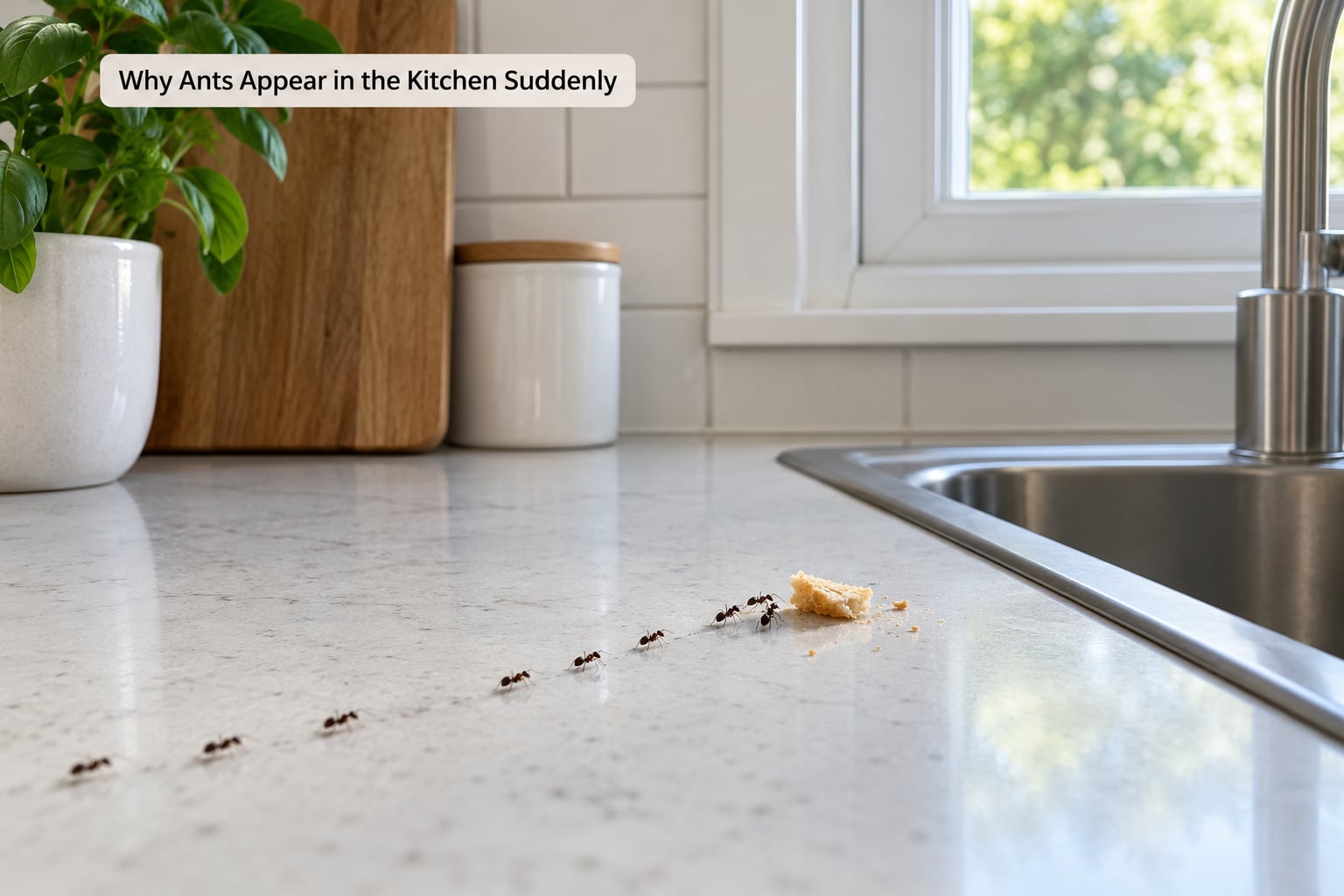
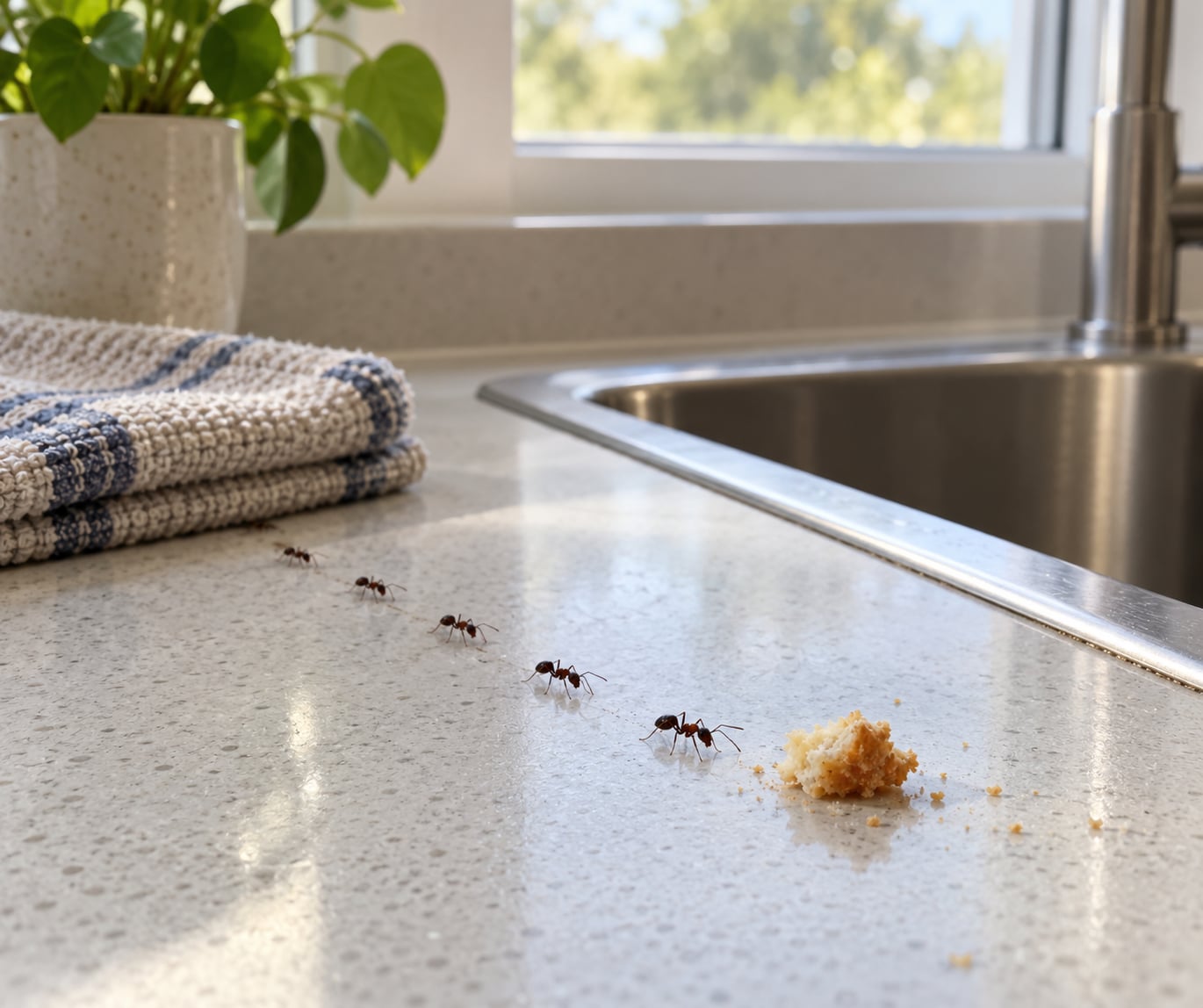
Ants appear suddenly because a scout ant found a reliable source of food, water or warmth, walked home laying a scent trail as it went, and the colony sent workers to follow it. Nothing about your kitchen changed as a problem. What changed is that the colony discovered it.
That distinction matters for the fix. Wiping the counter removes the last hour of evidence, but the chemical trail that rerouted the workers is still on the surface, and the nest that feeds them has not moved.
The visible ants are the symptom. The colony is the source.
How an ant trail forms in five stages
- A scout leaves the nest. A few workers wander out with no fixed route, which is why the first ants you notice seem aimless.
- The scout detects something. Moisture, a sugar or grease film, warmth from an appliance, or the faint chemical trace of an earlier ant. Human smell and eyesight miss most of it.
- The scout lays pheromone on the way back. It deposits a chemical marker at intervals while walking home, and nestmates can follow that line back to the exact spot.
- Recruitment. Foragers follow the scent, confirm the food or water, and reinforce the trail with their own deposits. This is the stage people mistake for an infestation.
- A visible line forms. Within hours, sometimes a day or two, you have a defined trail. It keeps working even after the original attractant is gone, because the pheromone marker is a separate signal from whatever first caught the scout’s attention.
That fifth point is the reason so many people clean the same counter twice in a day and see the same trail back by evening. The food is gone. The route is not.
7 Common Reasons Ants Are Appearing
1. Food residue you cannot see
The clue is a trail that converges on one spot: the bin, the recycling container, a pet bowl, a low cupboard, or the gap behind the fridge. Grease and sugar leave a film that looks clean in daylight and reads as a buffet to a scout with chemoreceptors.
Where to look: pull the fridge and dishwasher forward, check under the bin and the cooker, look at cupboard toe kicks and any low-level shelving. Check syrups, canned drinks, and the pet bowl that gets topped up rather than washed.
2. Water and moisture
This is the cause people miss, and it is the one that turns a two-ants-on-the-worktop problem into a colony. Ants need water far more often than most people assume, so a clean kitchen with a drip or a damp corner still attracts foragers.
Where to look: the base of the tap, the drainboard, the sink overflow, a dishwasher or washing machine connection under the sink, plant saucers, and any pipe running through a cold cupboard where condensation forms. Ants in a bathroom or a bedroom with no food anywhere usually point straight back to moisture.
3. A gap or entry point you did not know about
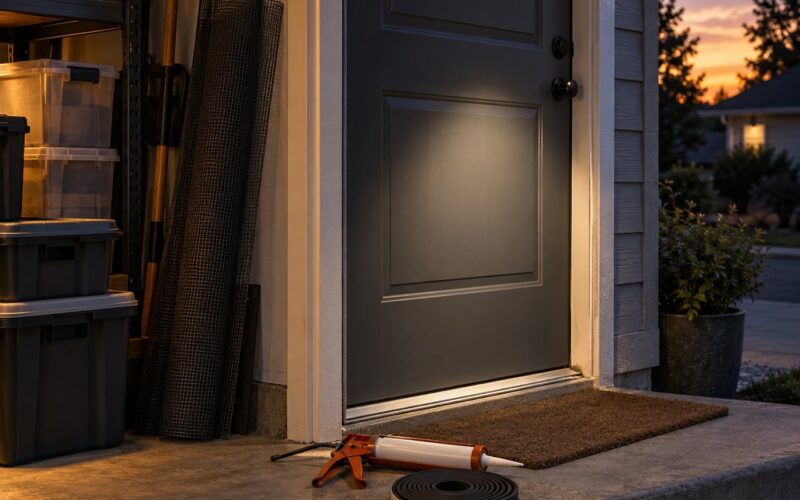
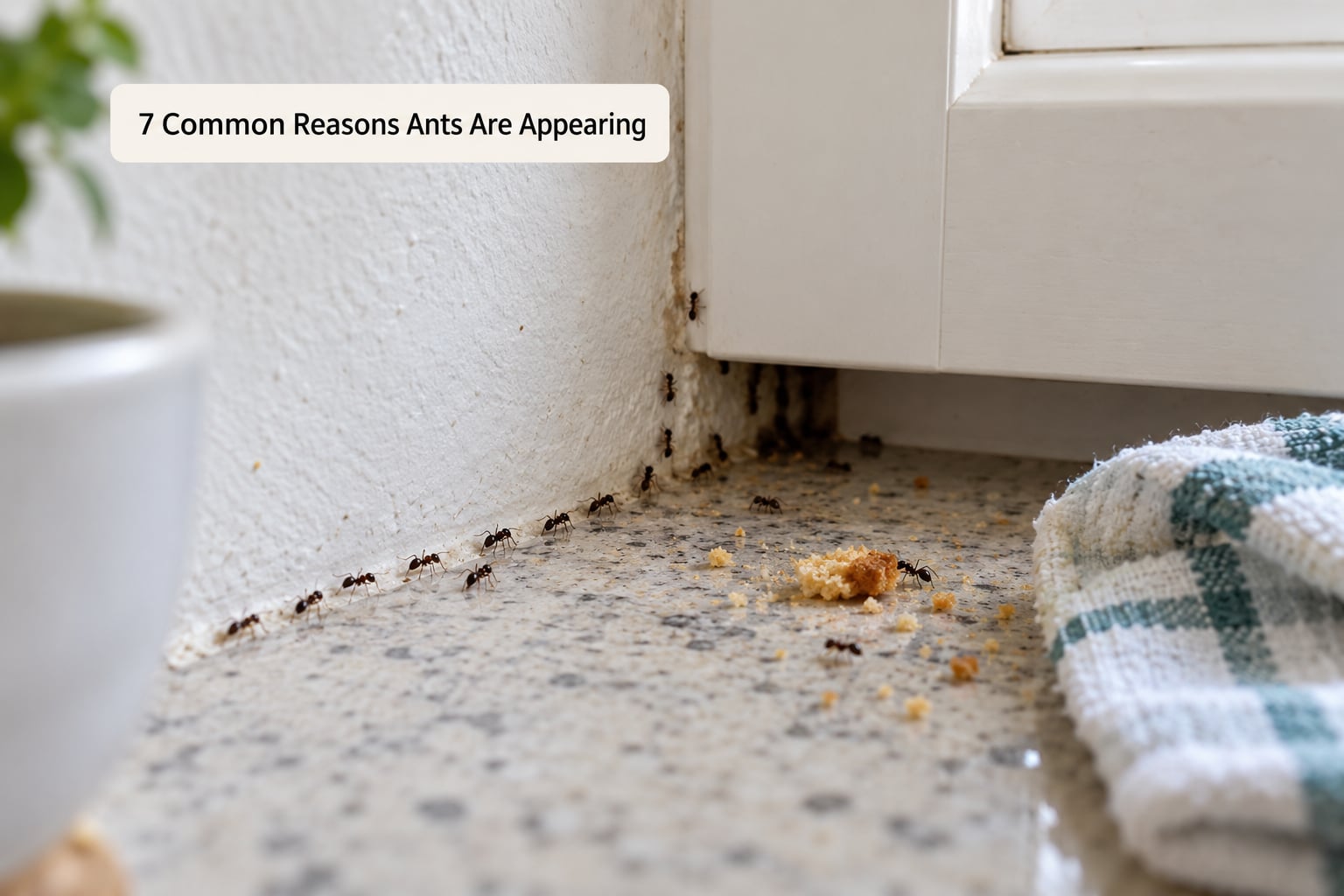
The clue is a trail that runs to a wall, a door frame or a window sill and disappears. Ants do not come through closed doors. They come through a 6 mm gap at a threshold, under a skirting board, around a pipe penetration or through an air brick, and they use the same route every time.
Where to look: door thresholds, window frames, the gap behind the fridge, where pipes pass through walls under sinks and in bathrooms, and the point where the kitchen meets outside. See the next sections for how to trace it.
4. Warm or rainy weather
Ants are ectothermic, so heat speeds up colony activity and sends workers further from the nest. A heat wave that bakes outdoor soil also drives ants inward looking for water, which is why kitchens get hit hardest during dry spells rather than damp ones. After heavy rain the opposite happens: nests flood or are disturbed and colonies move.
Where to look: your own pattern. If the trail appears on a hot dry afternoon, or the day after a downpour, weather is the trigger rather than something you left on the counter.
5. A nest close by, indoors or outside
Something has to be nesting to supply the workers. Outdoors that is usually under paving slabs, in a lawn edge, in a garden bed against a wall, or in a void behind cladding. Indoors it may be in a wall cavity, under floorboards or, with carpenter ants, inside damp structural timber.
Where to look: outdoors along the line the ants are walking, and indoors in hollow-sounding wall sections, damp timber near a leak, or a hollow door threshold. Sound matters here — a wall or floor that knocks hollow is a stronger clue than any ant you can catch.
6. Seasonal movement and mating flights
In spring and early summer, winged reproductives leave the nest on a nuptial flight. Males usually go first, then new queens. They pair up, land, and the males die off, so a room full of winged ants in one afternoon can look terrifying and resolve itself within days as the queens walk off to found new colonies.
Where to look: windows and light sources, because winged ants gather near light and try to get out. Queens that survive often find a warm crevice indoors, including wall voids and around windows, which can start a colony in the property.
7. Conditions at home that changed
Ants react to novelty. New pet, new rubbish routine, a delivery left in the hall, firewood stacked inside, a moved fridge revealing a previously dry gap, boxes brought in from a garage, a renovation, or a dishwasher installed slightly differently all create new opportunities without you noticing a change.
Where to look: your recent weeks. A move, a new appliance or a new pet usually lines up with the first sighting. It also means the fix may be simple: restore whatever was moved and the trail dries up on its own.
How to Tell What Kind of Ants You Have
Colour alone is a poor identifier. Worker size, where the trail comes from, and how the colony behaves tell you more than what the ant looks like in a photo, and most kitchen ants are harmless to the building.
| Ant | Typical worker size | Colour | Where it nests | Kitchen clue |
|---|---|---|---|---|
| Black garden ant | roughly 3 to 5 mm | dark brown, not pure black | outdoors, under paving and in soil | trail enters from outside, often on paving or at a door |
| Odorous house ant / pavement ant | roughly 2.5 to 4 mm | dark brown to black, sometimes a pale band on the abdomen | under floorboards, wall voids, outdoor paving | strong musty or rotten smell when crushed |
| Pharaoh ant | roughly 1.5 to 2 mm | pale yellow or light brown | inside walls, under floors, behind appliances | very small and very fast, prefers warm damp areas near boilers and pipes |
| Carpenter ant | roughly 6 to 12 mm | dark brown or black, sometimes reddish thorax | in damp, damaged timber | larger than a house ant, wings shed and left near windows; wood damage to check |
| Argentine ant | roughly 2 to 3 mm | light to dark brown | outdoors, in large colonies, often under paving | fast, long single-file trails, often near water outdoors |
Treat this table as a starting point rather than a verdict. Identification from a description is genuinely uncertain, and getting it wrong in either direction is costly — treating carpenter ants as a nuisance species wastes a season, while treating a nuisance species as structural is an expensive alarm.
Two things are worth checking if the ants are large, dark and came with wings or have been chewing timber. Look for frass, which is a fine sawdust-like material, and for soft, hollow or damp wood around windows and bathrooms. And do not poke at a suspected carpenter ant nest. A professional can open the structure safely; a chisel can spread damage across the whole beam.
Ants can bite and sting. Wash bites with soap and water, and get medical advice for swelling that spreads, signs of infection, or any breathing difficulty.
Where Are the Ants Coming From?
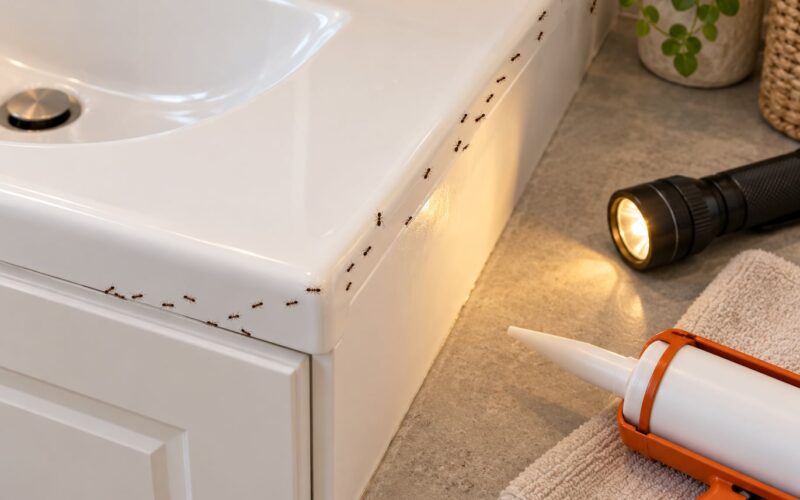
Trace the trail back instead of guessing. You are looking for the point where a continuous line of ants crosses a surface, because that point is an entry point, not a food source.
- Watch without disturbing. Stand still near the trail for a minute. Ants move fastest when they know where they are going, so early morning and evening give the cleanest read.
- Follow the line backwards to wherever it meets a wall, a door frame, a window sill or an appliance. That junction is the answer in most kitchens.
- Mark it. A pencil mark on the baseboard saves you hunting for it again later.
- Work outward. Check the immediate outside of that wall: paving slabs, air bricks, the gap around a hose bib, soil disturbed against the foundation.
- Test the seal. Stuff a rolled-up damp cloth into the gap temporarily. If the trail disappears, you have found the route.
- Look for the direction of travel. Ants carrying something back towards the wall are leaving the nest through that point. A trail that goes only outwards is usually a scout route rather than a live nest entrance.
Entry points worth checking every time: door thresholds and exterior doors, window frames and sills, skirting boards, air bricks, pipe penetrations under sinks and in bathrooms, the gap behind the fridge and cooker, extractor hood vents, and any cable or pipe that has been rerouted since the last building work.
In apartments, the source is often not your own unit. Shared plumbing risers, service ducts and party walls all carry trails, and one neighbour treating their kitchen does nothing for you. If your trail comes from a shared wall, from a bathroom on a neighbouring stack, or from the meter cupboard, tell your landlord or building manager, because treatment needs to cover the whole building.
You can usually tell whether an outside nest is involved. The trail enters from outdoors, the numbers spike after rain or a heat wave, the work concentrates along one wall, and there are no winged ants or hollow-sounding boards. A nest inside the structure is more likely when the trail persists through cold weather, when ants are active at unusual hours, or when you hear movement inside a wall.
How to Stop Ants from Coming Indoors
Work in this order. Each step only makes sense if the one before it worked, because you are removing the reason for the trail before you close the route.
- Remove the food.Bin food, take the bins out, wipe down every surface with hot soapy water, and clean behind and under appliances by moving them. Repeat daily for a week rather than once, because a film builds faster than you can see it.
- Remove the water.Fix dripping taps, wipe the sink and drainboard after every use, clear the sink overflow of debris, and empty anything holding standing water. Check under the sink and behind the washing machine.
- Wipe the trails.This is the step people skip, and it is the one that stops the column rather than the individuals. A damp cloth with vinegar solution removes the pheromone marker that workers are following.
- Store food properly.Airtight containers, not open bags. Push pet food off the floor, keep it in a sealed tub, and do not leave bowls out overnight.
- Seal the entry point.Silicone sealant or mesh appropriate to the gap, on clean dry surfaces. If the gap is larger than a few millimetres, back it with mesh first.
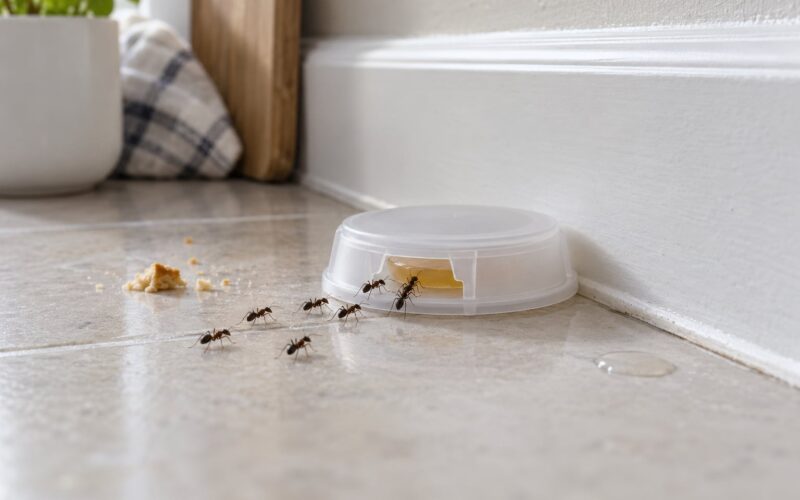
- Use bait only once the trail is clean.Bait works by letting a worker carry it back to the nest, so it needs a place where foraging ants already feed, and it needs patience. It will look worse for several days before the colony declines.
Why wiping the counter alone never works
Because you are cleaning the visible ants and leaving the two things that matter. The pheromone deposit that defines the route survives a normal wipe, and the attractant that put a nest in the area is untouched. This is the single most repeated complaint on pest forums: a clean kitchen, cleaned twice, same trail back by evening.
There is a second effect worth knowing. When you crush a worker or hit it with a spray, it can release alarm pheromones that startle the colony and cause it to branch and bud rather than withdraw. Repellent sprays on a trail can push the whole column to a neighbouring route while the underlying colony carries on growing, which is why aerosol treatment often seems to relocate the problem for a few days.
What DIY methods are worth your time
- Vinegar on a cloth, along the trail and at entry points.Repeatedly reported as the most consistent deterrent in DIY discussions, and it works on pheromone deposits because it both cuts the grease film and disrupts the chemical marker.
- Liquid dish soap diluted in water. Kills ants on contact by breaking down their protective coating. Useful for the immediate ants, useless for the nest.
- Borax or boric acid. A slow-acting stomach poison that a worker carries back. Keep it well away from food preparation surfaces, dishes, children and pets, and never sprinkle it where you cannot control who touches it.
- Commercial ant bait. Mixed results, and worth being honest about. It works where foraging ants feed steadily and where the colony is indoors. Reports of no effect after weeks are just as common, usually because it was placed where ants were seen rather than where they feed, or beside a competing sugar source.
- Worth skipping. Flooding areas with aerosol spray, pouring unknown liquids into wall voids, and mixing any two cleaning products. Bleach mixed with ammonia or acids releases dangerous gas.
How to Prevent a Repeat Kitchen Infestation
Most repeat problems are a food or moisture habit that came back two weeks after a clean-up. This checklist catches the usual culprits.
- Storage. Airtight containers for flour, sugar, rice and cereal. Nothing open on the counter overnight. Open packets resealed and pushed to the back of a cupboard.
- Cleaning routine. A weekly move-and-clean behind and under the fridge, cooker and dishwasher. Grease film behind an oven is invisible and heavily travelled.
- Pet food. Bowls washed after every meal and never left down overnight. Pet food is a bigger attractant than most people expect.
- Rubbish and recycling. Bins with lids, taken out regularly, and the bin cupboard floor wiped down. Rinse food containers before recycling.
- Moisture. Dripping taps fixed, sink wiped after use, overflows kept clear, plant saucers emptied, under-sink and behind-appliance areas left dry.
- Entry points. Seal the gaps you found once they stop being used. Check thresholds and sills at the start of each season.
- Monitoring. A few ants once a week means scouts are testing. A defined trail means something is established.
The distinction between a recurring problem and a one-off outdoor event is mostly about time and place. A one-off tracks the weather: a hot dry afternoon, the day after rain, or a spell when the kitchen door has been open. It starts at an external wall and fades within days of cooler or wetter conditions.
A recurring problem is anchored. It returns at roughly the same place on the same schedule, survives a thorough clean, and often spreads from the sink or a bin cupboard into a second room. If your trail is back within a week of a proper clean-out, treat it as a nest problem rather than a cleaning problem.
When Do You Need Professional Ant Control?
A licensed pest technician earns their fee in a few specific situations. If none of these apply, patience and exclusion usually work.
- Large, persistent trails that continue for more than a couple of weeks after you have cleaned, dried and sealed.
- Ants inside the structure — inside wall voids, ceilings, under floorboards, or around a window frame you cannot open.
- Carpenter ants, especially with frass, damp timber or hollow-sounding boards. That is a structural question, not an insect question.
- Repeated entry through the same fixed gap that sealing has not solved, which usually means the nest is inside the fabric of the building.
- A colony near electrical equipment. Do not spray ants around distribution boards, sockets or light fittings. Ants in an electrical enclosure can bridge contacts and cause failures, and that is a job for someone insured for it.
- A shared building problem in flats or apartments where the trail comes from common parts.
Before the visit, have a few things ready: roughly how big the ants are and what colour, where the trail starts and ends, when it appeared, whether it links to weather, photographs of the trail and any damage, and everything you have already tried. It makes the difference between a targeted treatment and a guess.
What a good technician does differently is identify the species, locate the nest rather than the trail, treat the nest and the route, and come back to check. A quote for repeated spray applications along the skirting boards without any attempt to find the nest is not the treatment you want.
Frequently Asked Questions
Why do ants come out at night when there is no food out?
Nocturnal behaviour usually means the colony is indoors. Outdoor nests shut down in colder or wetter conditions, so workers keep foraging through the evening instead. Night activity also follows light: ants gather around a porch light, a screen or a bright hallway before working their way inside. A kitchen trail at 9pm that did not exist at breakfast is one of the strongest signals that the nest is in the structure rather than in the garden.
Do ants in the kitchen mean my house is dirty?
No, and this is the most common worry people bring to the problem. Ants respond to a specific, reliable attractant, not to general untidiness. A spotless kitchen with a dripping tap, a bin that was emptied two days ago, or a gap at the threshold will attract ants every day. What they tell you is that something specific is available and reachable, not that your home is unclean.
Should I squash the ants I see in my kitchen?
It kills the ant but not the problem, and it can make things worse. A crushed worker releases alarm pheromones that startle the colony and encourage it to split into new trails, so you may see more paths afterwards rather than fewer. The visible workers are replaceable; the nest and the route are the parts that matter. Wipe the trail instead and take away what they are carrying.
Why do ants keep coming back after I clean the counter?
Because two signals survive a normal wipe. The pheromone trail still marks the route, and whatever first attracted the scout — grease behind the cooker, condensation on a pipe, bin residue, a sugar film under an appliance — is still there. Clean with hot soapy water, wipe the trail with vinegar, remove the attractant and reseal the entry point, then repeat the surface clean daily for a week.
How long does it take to get rid of ants in the kitchen?
For a trail from an outdoor nest, expect noticeable reduction within three to five days of removing the attractant and sealing the gap, and a fortnight of steady cleaning to be confident. Indoor colonies take longer because bait has to reach the nest before the workers decline, which is usually a few weeks. Ants appearing for only a day or two after rain or a heat wave can stop just as quickly once the weather changes.
What to Do First
Take the attractant away, then take the route away. Bin the food and empty the bins, wipe down every surface with hot soapy water, and wipe the trail itself with vinegar so the pheromone marker is gone. Repeat the wipe daily for a week.
While you are watching, follow one ant backwards to the wall or door frame and mark the spot with a pencil. Seal that gap with silicone or mesh, and check the six most common offenders: the door threshold, the window sill, the gap behind the fridge, pipes under the sink, the bin store, and the pet bowl.
Then monitor for a week rather than two days. Scout ants appearing once in a while mean the route is closed. A defined trail returning to the same point means the nest is still supplying workers, and that is the moment to move to bait or to a licensed technician. If the ants are large and dark, there is frass on a windowsill, or the trail comes through a shared wall in a flat, get it inspected sooner rather than later.
Sudden ants in the kitchen are a routing problem, not a housekeeping verdict on your home. Find the attractant, break the trail, close the door it came through, and the column disappears.