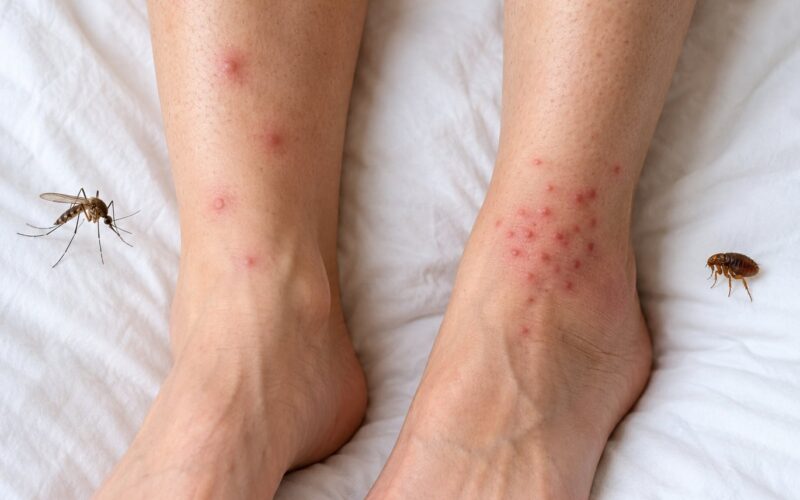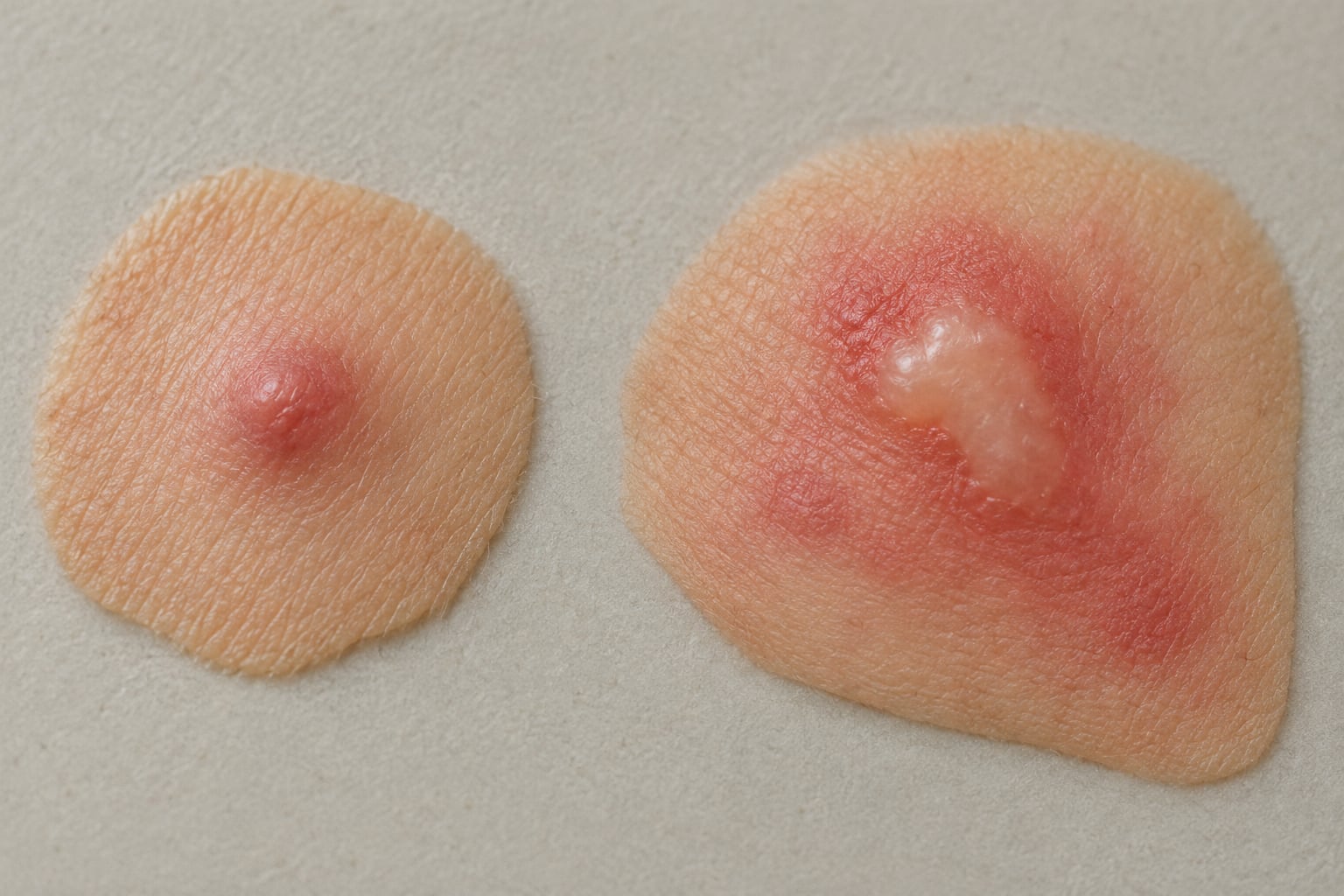
Most bites land on exposed skin at night, show up as a small red bump, and clear on their own. To tell a spider bite from a mosquito bite, look at three things: whether it itches or hurts, whether it sits alone or in a cluster, and whether there are two tiny fang marks in the center.
That rule of thumb gets you most of the way. It does not settle it. Most people who wake up with a mark they are sure is a spider bite are wrong about that, and the real cause is usually something more ordinary. This guide covers how to tell a spider bite from a mosquito bite, plus what a worsening bite actually needs.
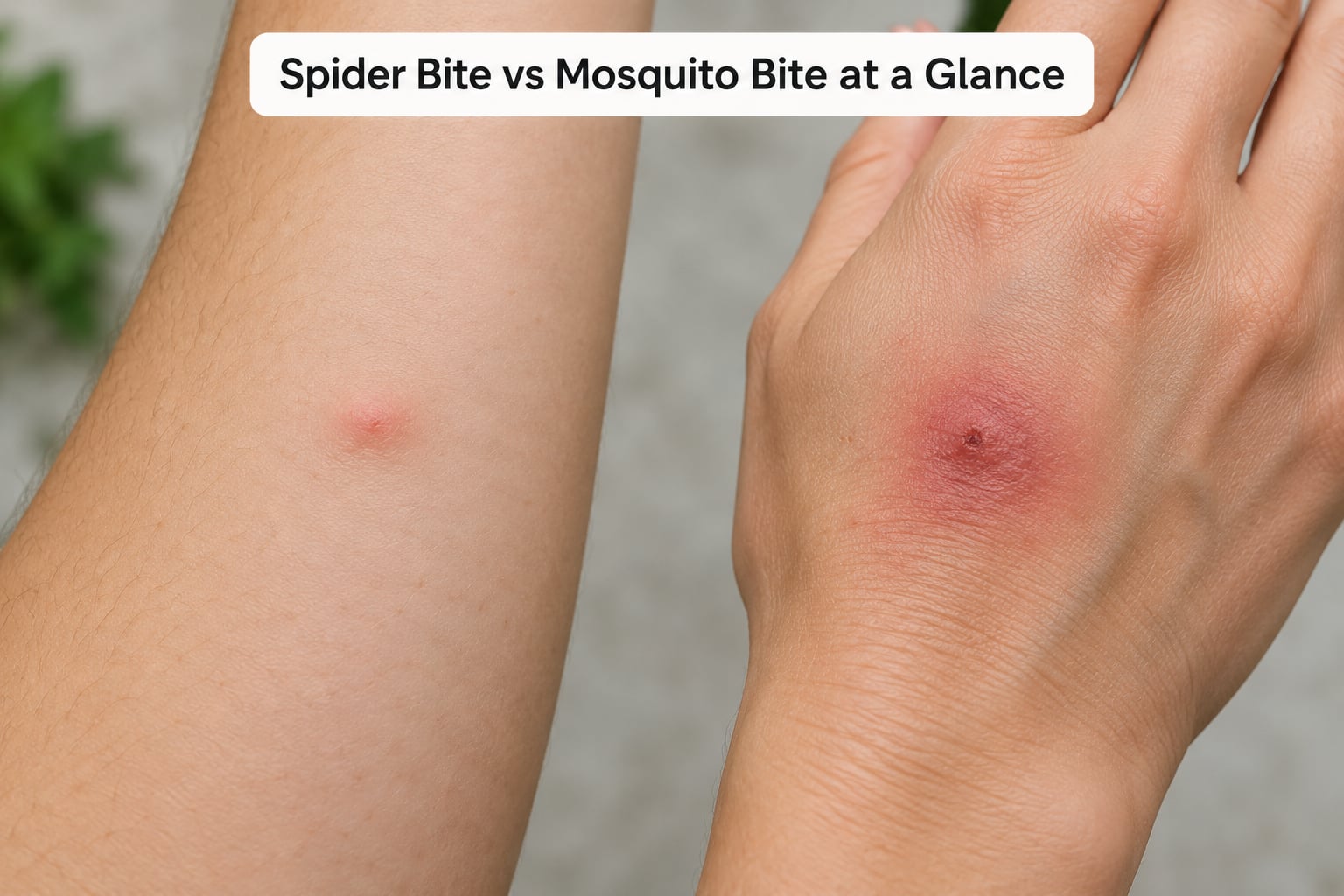
Spider Bite vs Mosquito Bite at a Glance
| Feature | Spider Bite | Mosquito Bite |
|---|---|---|
| Typical appearance | Red bump, often with two fang marks or a blister | Puffy raised welt, often with a pale center |
| Size | Usually under 1 cm early on, sometimes growing | About 2 to 5 mm across |
| Main sensation | Pain, sting, burning | Intense itching |
| Number of marks | One, isolated | Several, clustered or in a line |
| Puncture marks | Two small marks close together | One, usually not visible |
| Where it shows up | Anywhere, including under clothing | Exposed or clothing-accessible skin |
| When you notice it | Often delayed, hours later | Quick, within minutes of the bite |
| How it changes | Can blister, bruise, or darken over days | Peaks in itch within 24 to 48 hours |
| Real risk | Venom from black widow or brown recluse | West Nile, Zika, dengue, malaria |
| How long it lasts | A few days, longer if tissue is affected | A few days to two weeks |
| Urgent signs | Spreading pain, blistering, fever, cramps | Facial swelling, breathing trouble, high fever |
One column cannot confirm anything on its own. Any single row can mislead, and several of these features are shared by other bites entirely. Use the table as a starting point and check the details below.
How to Tell a Spider Bite from a Mosquito Bite
Four questions sort out most cases faster than staring at the mark. Ask them in this order.
Is it itchy or painful?
Itching points toward a mosquito. People describe mosquito bites as maddeningly itchy, sometimes for days. Spider bites are more often reported as a sharp sting, ache, or burning that settles into a dull pain. Plenty of people itch at a spider bite too, so this is a clue, not a verdict.
Is it alone or in a group?
One bump on one person points away from mosquitoes. Mosquitoes probe for a blood meal and often bite several times in the same sitting, which is why their marks show up in clusters, rows, or scattered patches of three or four.
A spider bites once, in self-defense, when it gets trapped against skin. That is why spider bites are solitary. If new marks keep appearing over several days, a spider is not the explanation.
Are there one puncture mark or two?
Spiders have two fangs, so a bite can leave two tiny punctures a few millimeters apart in the center of the redness. Mosquitoes have a single needle-like proboscis, and the mark is usually just the welt. The fang marks are easy to miss early because swelling fills in around them.
Did it show up right away or hours later?
Mosquito saliva triggers itching quickly, so you usually know fairly quickly that something bit you. Spider venom works more slowly, and the spot can take hours to show up, which is part of why so many people report bites that appeared overnight.
That combination is the practical answer to spider bite vs mosquito bite how to tell questions: painful, solitary, delayed points one way, and itchy, clustered, quick points the other. Neither pattern rules the other out completely.
How Each Bite Usually Feels
A mosquito bite raises a firm welt that swells within minutes of the bite, and the itch builds to a peak somewhere in the first day or two. Scratching makes it worse because the skin is already inflamed, and the mark can stay visible for a week or more after the itch fades.
A spider bite tends to sting sharply at first, then ache. Swelling can spread beyond the bite itself over a day or two, and some people develop a blister or a bruise-like patch in the middle.
Individual reactions vary more than any guide can describe. A person who barely reacts to one mosquito bite can swell up dramatically from the next one, and family members often respond completely differently to the same bites in the same yard. That reaction is sometimes called Skeeter syndrome, an exaggerated local response to mosquito saliva rather than a sign that something more serious is happening.
Where Mosquito and Spider Bites Appear
Mosquito bites land where skin is available. Ankles, lower legs, arms, hands, the neck, and any gap between clothing and shoes are common spots, because those areas are both exposed and easy to reach while you are outside at dusk or dawn.
Spiders bite anywhere. They live in shoes, in bedding, in folded laundry, in woodpiles, in gloveboxes, and in the gaps around window frames. A bite under tight clothing or on a spot you would not think to check is more consistent with a spider than with a mosquito.
Location alone is weak evidence, though. A mosquito will happily bite through a thin shirt, and a spider will bite a hand reaching into a dark corner. Use location as supporting detail rather than the main call.
What to Look for After the Bite
Most of what you can learn in the first day is lost if you do not record it. A few minutes of note-taking gives a clinician something concrete to work with.
Photograph it with something for scale
Take a photo with a coin or a ruler in frame. Size change is one of the most useful signals for judging whether a bite is progressing, and a bare photo of a red bump tells a doctor very little about how big it actually is.
Circle the edge and date it
Draw a pen line around the outer edge of the redness, note the date and time, and repeat every 12 hours. Redness that creeps past that line each day is a different problem from a spot that stays put and fades.
Note what you were doing
Write down where you were, what time it was, what you were wearing, and whether you had been near standing water, tall grass, firewood, or a shed. Also check for a retained insect. An embedded tick or a stuck insect fragment changes the whole interpretation.
Watch the timeline
Over the first six hours, a mosquito welt shows up fast and stays localized, while a spider bite may be barely visible. At 24 hours, mosquito itch is usually at its worst while a spider bite is growing, blistering, or darkening. By 48 hours, a mosquito welt is settling and a concerning spider bite is spreading. Past 72 hours, a mosquito bite is fading normally, and anything still expanding or breaking down needs a doctor.
Consider what it might really be
Several common conditions get labeled as spider bites. MRSA skin infections produce a red, warm, swollen area that spreads, sometimes with pus or a fever. Impetigo shows up as honey-colored crusting around the nose or mouth. Shingles follows a band of blisters on one side of the body. Contact dermatitis covers the area that touched an irritant rather than a single spot. Bed bug and flea bites arrive in rows or clusters of tiny marks, usually on exposed skin. A bull’s-eye rash spreading out from the bite point is the tick pattern people mean when they say Lyme disease.
Spider Bite Warning Signs
Get medical help the same day if you develop rapidly spreading pain or redness, swelling that keeps growing, blistering or skin breakdown, a dark or necrotic center, muscle cramps or spasms, chest tightness, fever, nausea, or sweating after a bite. A bite that looks like a bull’s-eye needs evaluation, and so does any mark that turns dusky, gray, or black.
Two species drive nearly all the serious spider bites in the United States.
A black widow bite can cause muscle cramping, abdominal pain, sweating, restlessness, and a rising blood pressure, sometimes with a dull or pinching pain at the bite site. Black widows are glossy black with a red hourglass marking on the underside, and they tend to hide in dark, sheltered spots such as sheds, mailboxes, and outdoor furniture.
A brown recluse bite often hurts less than you expect at first, then turns into a burning, deepening pain over the next day or two. The center can blister, darken, and break down as tissue dies. Brown recluses are plain brown with a violin- or fiddleback-shaped marking, and they hide in warm, dry, dark indoor spaces. Brown recluse range is mostly in the south and south-central United States, so bites with this progression outside those states deserve a closer look.
Call emergency services for trouble breathing, swelling of the lips, tongue, or throat, widespread hives, or faintness after any bite. Those are signs of anaphylaxis, not an insect bite.
For anything else, a doctor or pharmacist can advise you. Do not rely on a photo alone to rule a serious cause in or out.
Which Should You Choose?
You do not choose between these two bites. What you can do is match the pattern you are seeing to the explanation it fits, and decide how much attention it deserves.
If the pattern is itchy, clustered, fast-appearing, and on exposed skin at dusk, treat it as a mosquito bite: cool compress, over-the-counter antihistamine, and insect repellent going forward. If it is solitary, painful, delayed, blistering, or darkening, treat it as a possible spider bite and get it looked at before it progresses.
And if it is spreading, blistering, feverish, or not settling after two or three days, stop trying to name the insect. Bacterial infection is a more common cause of a worsening bite than venom, and it responds to different treatment.
Frequently Asked Questions
Can a mosquito bite look like a spider bite?
Yes. A mosquito welt that swells and reddens can look like a small spider bite, especially once it darkens or bruises. Appearance alone is rarely enough to tell them apart. Look at the pattern and timing instead: several itchy welts that appeared quickly point to mosquitoes, while one painful, delayed spot with two center marks points more toward a spider.
Do spider bites leave one mark or two?
Two. Spiders have two fangs, so a bite can leave two tiny punctures a few millimeters apart in the center of the redness. The marks are easy to miss in the first hours because swelling fills in around them. Mosquitoes use a single needle-like proboscis, so their marks show one point at most, usually not visible at all.
What are the five most common signs of a spider bite?
The five most common signs are a single isolated spot rather than a cluster, pain or burning rather than itching, two small fang marks in the center, appearance that is delayed by several hours, and progression that includes blistering, bruising, or a darkening center over one to three days. Any spreading redness or fever alongside those signs warrants medical care.
What is commonly mistaken for a spider bite?
MRSA and other bacterial skin infections are the most common culprits, along with impetigo, shingles, contact dermatitis, bed bug bites, flea bites, and tick bites. Distinguishing clue: infection typically spreads and stays warm and tender, while an ordinary bite stops expanding within a day or two. Worsening redness, pus, or fever should be assessed by a clinician.
Should I squeeze a spider bite to get the venom out?
No. Squeezing or cutting a bite pushes fluid and bacteria deeper into the skin, damages tissue, and increases the risk of a secondary infection. It does not remove venom, because venom is delivered in seconds at the moment of the bite. Clean the area gently, apply a cool compress, and let a clinician handle it if the site worsens.
Why do my mosquito bites swell up so much?
Your immune system is reacting strongly to mosquito saliva, which contains anticoagulants that keep your blood flowing while the insect feeds. People who react hard to one bite often react hard to all of them, and this exaggerated local response is sometimes called Skeeter syndrome. A cool compress and an oral antihistamine usually bring it down.
What to Do First
Photograph the bite with a coin or ruler for scale, write down when it appeared and what you were doing, and circle the edge with a pen so you can see whether redness spreads past it.
Wash it gently, hold a cool compress on it, and leave it alone. Most mosquito welts fade within a few days.
If it is solitary, painful, blistering, or darkening, or if redness is spreading after two or three days, contact a healthcare professional. Call emergency services for trouble breathing, facial or throat swelling, or widespread hives. And if you have any doubt at all, get it checked rather than arguing with yourself over a photo at 2am.
This guide is general information, not a diagnosis. For an individual bite or symptoms that worry you, talk to a doctor, pharmacist, or other healthcare professional.