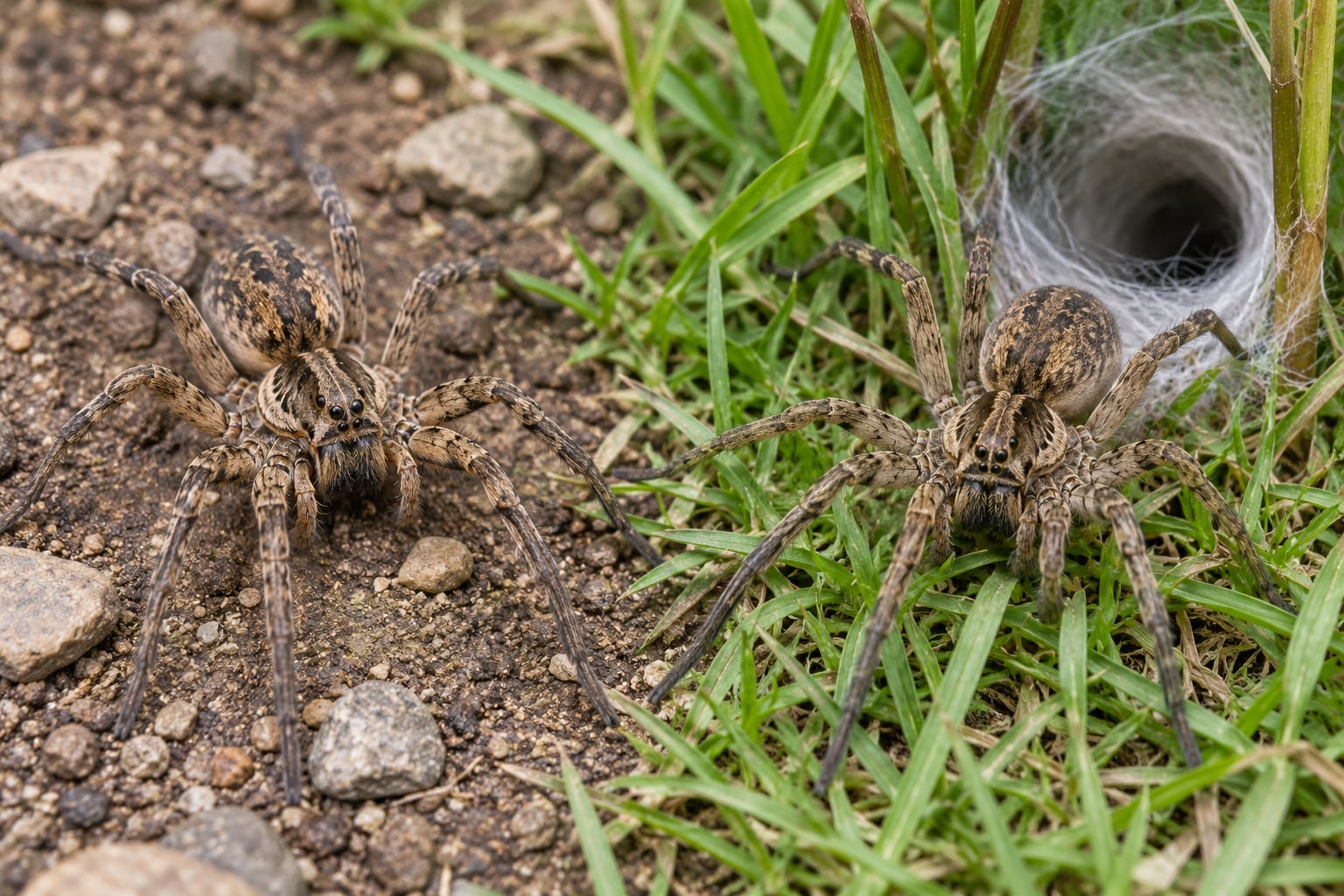
If there is a web, it is almost certainly a grass spider. If there is no web and the spider is sprinting across open ground, it is a wolf spider. That single check solves most wolf spider vs grass spider identification cases before you look at anything else.
Both are large, fast, brown hunters that live around homes, and both are useful predators in a yard. Neither is medically dangerous to people, and bites from either are not medically significant. The rest of this guide walks through the traits that actually separate them, plus the two look-alikes that cause the most confusion.
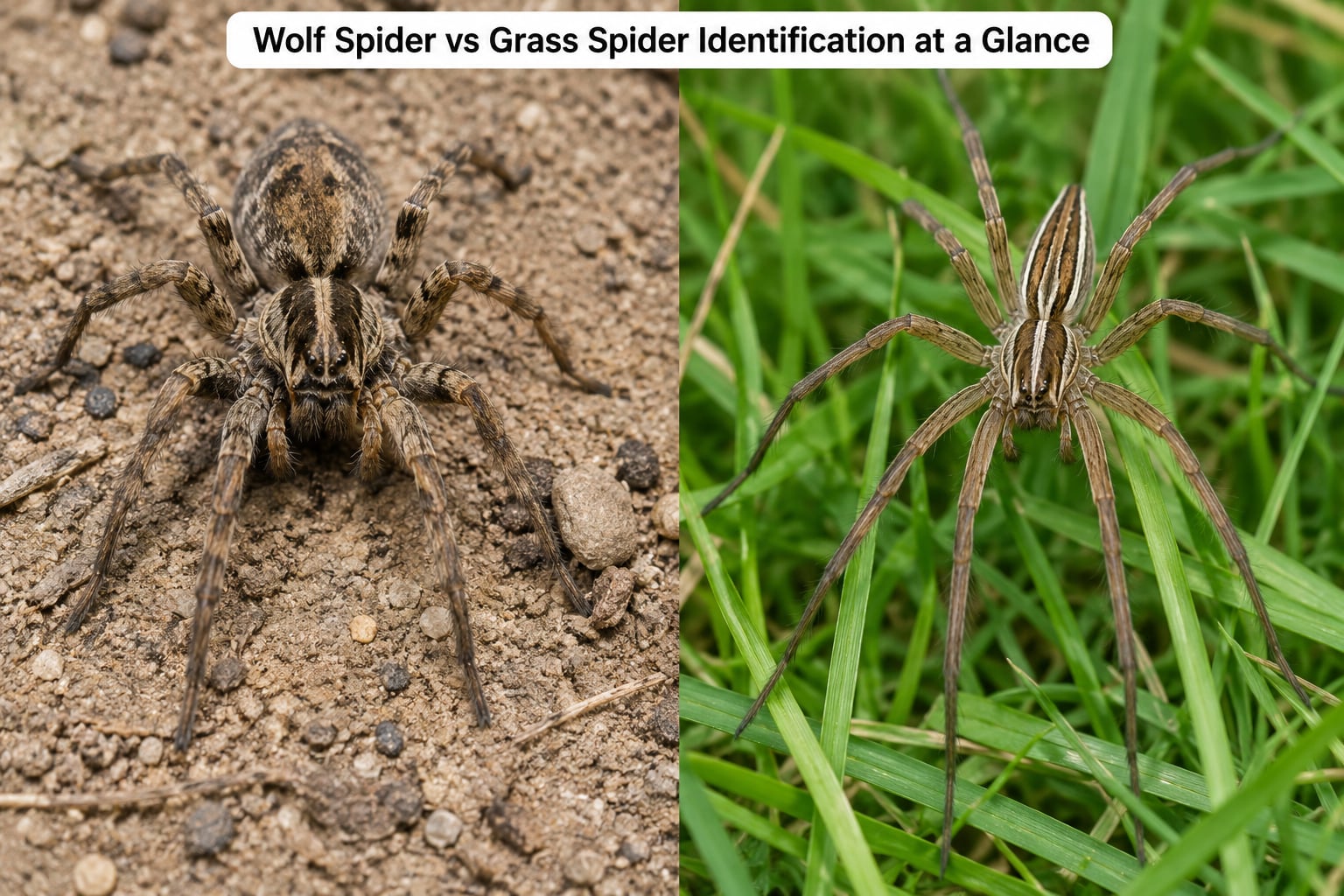
Wolf Spider vs Grass Spider Identification at a Glance
| Trait | Grass Spider | Wolf Spider |
|---|---|---|
| Family | Agelenidae (funnel weavers) | Lycosidae |
| Body length | About 10-20 mm (0.4-0.8 in) | About 10-35 mm (0.4-1.4 in) |
| Build | Slimmer cephalothorax, longer and thinner legs | Stockier cephalothorax, heavy coat of body hair |
| Color | Mottled tan to pale gray, pale chevron marks on the abdomen | Darker gray or brown, often a Union Jack dorsal pattern |
| Spinnerets | Long, prominent, extending past the abdomen tip | Short and easy to miss |
| Eyes | All roughly similar in size | Two large forward-facing eyes plus smaller ones |
| Web | Non-sticky sheet web with a funnel retreat | No capture web; a silk-lined burrow or a silken fence line |
| Hunting style | Sits in the funnel and waits | Actively chases prey over ground |
| Egg care | Egg sac left in the funnel | Egg sac carried on the spinnerets; spiderlings ride on her back |
| Where you find it | Lawns, shrubs, tall grass, porch corners, basements, garages | Stone piles, leaf litter, garden beds, woodpiles, ground-level floors indoors |
| Bite risk | Rare, brief, mild local reaction | Uncommon, sharp pain that fades within a day or so |
Read the table top to bottom and the split becomes obvious fast. The three rows that decide most cases are spinnerets, eyes and web.
How to Tell a Wolf Spider and Grass Spider Apart
Color is the least reliable feature here. Both species run from pale tan to nearly black depending on species, sex, lighting and how recently the spider molted, so anyone who tells them apart by color alone will get it wrong sometimes.
How to Tell a Grass Spider From a Wolf Spider: Body Shape and Size
A wolf spider has a heavier, more compact front end. The cephalothorax (the fused head and chest that carries the legs and eyes) is tall and muscular, and the legs are comparatively shorter and sturdier. Grass spiders are built the opposite way: a narrow cephalothorax and noticeably longer, thinner legs that give them a spidery look.
Size points the same direction. Wolf spiders reach about 35 mm in body length, while most grass spiders top out around 20 mm. Some of the larger grass spider species blur that gap, though, so treat size as a supporting clue rather than the deciding one.
Eye Arrangement and Head Shape
This is the trait experienced identifiers start with, because it stays reliable even in a mediocre photo. Wolf spiders have two noticeably larger forward-facing eyes in the second row, with a row of smaller eyes above and below. Grass spiders have eight eyes that are much closer in size to one another.
Two oversize eyes pointing straight at you, like headlights, points to a wolf spider. A face where the eyes all look roughly the same size points to a grass spider. Lighting and viewing angle can hide the large eyes, so crouch to eye level and use natural light rather than a phone flash.
Color, Markings and Body Hair
Wolf spiders tend to be darker overall and carry a distinctive pattern on the abdomen: darker radiating lines over a lighter background that resembles a Union Jack. Grass spiders are paler with a series of chevron or V-shaped marks running down the front of the abdomen.
Both groups have chevrons, so markings alone settle nothing. Body hair is a better separator. Wolf spiders are visibly fuzzy, with dense hairs over the cephalothorax and legs, while a grass spider looks smoother and shinier.
Webs: The Clearest Clue
Start here and you will usually finish. Grass spiders build a flat, non-sticky sheet web with a silken funnel-shaped retreat running off one corner. The sheet part is a trip-wire surface the spider does not need to stick to, because the silk is deliberately glue-free. Many also add a stiff barrier of silk uprights along the outer edge of the sheet.
Wolf spiders build no capture web at all. They line a burrow or a gap with silk, and some pile a visible fence or parapet of silk around the entrance. If you find a spider on open ground with no web and no funnel anywhere nearby, that is strong evidence for a wolf spider.
The one thing that muddies this is the hobo spider, which builds a messy tangled sheet rather than a clean funnel. That species gets its own section below because it causes more misidentifications than either spider on this page.
Where You Are Likely to Find Each Spider
Grass spiders want structure. Look for them in tall grass, dense shrubs, the corners of porches, along foundation edges, in window wells, under sheds and inside basements where the air stays humid. Their web is almost always attached to something flat and sheltered: a fence post, a wall, a railing, the underside of a deck.
Wolf spiders want ground cover. Stone piles, mulch beds, leaf litter, woodpiles, garden edging and ground-level indoor floors are their territory. Indoors they turn up mostly in garages, basements, laundry rooms and along baseboards.
A spider dragged indoors on a coat or a box of holiday lights changes its context entirely, so location helps less once it is inside. Confidence goes up outdoors, where you can check the ground and the web.
Behavior and Activity
Watch from a distance for a minute and the spider often identifies itself. A grass spider stays anchored at the mouth of its funnel, darting out and back. A wolf spider walks or runs across open surfaces in bursts and often freezes when you look at it, using its excellent eyesight to monitor you.
Mature male wolf spiders also roam, which is the reason so many people first meet one in late summer or fall. Males stop feeding as they search for a mate and wander into buildings through door gaps, window seals and utility penetrations. That seasonal influx is why indoor sightings spike when the temperature drops.
Wolf Spider or Grass Spider? Use Location and Behavior Together
Work through these five checks in order. The first two decide the majority of cases, and each step gives you a verdict rather than another feature to argue about.
1. Is there a web? A flat sheet web running into a silken tunnel means grass spider. No web, no funnel, no silk sheet anywhere nearby means wolf spider.
2. Are the spinnerets long and obvious? Spinnerets are the silk-spinning organs at the tip of the abdomen. On a grass spider they stick out well past the body and usually point outward or upward. On a wolf spider they are small and easy to miss entirely. Experienced identifiers treat the absence of visible spinnerets as the decisive negative cue.
3. Look at the eyes. Two large forward-facing eyes mean wolf spider. Eight similar-sized eyes mean grass spider.
4. Check the abdomen and the ground beneath it. Dark radiating lines over a paler abdomen, heavy hair, and a silk-lined burrow or silk fence all point to wolf spider. Pale chevron marks on a smoother body, sitting in a funnel, points to grass spider.
5. Watch how it moves. Anchored at a funnel mouth waiting to ambush means grass spider. Running over open ground, then freezing, means wolf spider.
Habitat is the tiebreaker when the body traits are ambiguous. Funnel weavers stay on vertical or sheltered surfaces near ground level, so one sitting on a foundation wall is almost always a grass spider. A wolf spider on bare soil, gravel or leaf litter is exactly where you would expect it. That pairing of location and behavior finishes most wolf spider vs grass spider identification puzzles in under a minute.
If you want a second opinion, photograph three things: a straight-down view of the whole spider, a close shot of the spinnerets from behind, and the surroundings where you found it. Put a coin next to the spider for scale. Identification apps disagree with each other on the same image, so a clear set of photos is far more useful than another app guess.
Also rule out the two common look-alikes. A hobo spider (Eriophora ravilla) is less hairy, has no funnel, builds a loose tangled web, and shows a herringbone pattern on the abdomen with a dark stripe down the center of the head. A brown recluse (Loxosceles reclusa) has a violin-shaped marking, is uniformly tan, builds a messy irregular web, and stays hidden in dark undisturbed corners. Outside its native range in the south-central United States, a recluse sighting is almost always a misidentification of something more common.
Do You Need to Remove Either Spider?
Usually you do not. Both species eat mosquitoes, flies, ants, beetles and other insects around the house, and both are far more likely to be living in your yard than in your living room.
Removal is worth doing when a spider is inside a room you use constantly, when a large grass spider has set up a funnel in a doorway or a walkway, or when a wolf spider keeps wandering through the same part of the house. Relocate rather than kill. Put a clear container over the spider, slide a flat card beneath it, carry it outside and release it several yards from the door.
Then close the route rather than the spider. Vacuum cracks along baseboards, seal gaps around doors and garage entries, fit mesh over vent openings, and trim ground cover back from foundation walls. Stacked firewood and dense mulch against the house give wolf spiders a covered highway straight indoors.
If someone is bitten, clean the area with soap and water, apply a cool compress, and watch it. Expect a small red bump and some itching that clears within a day or two. Seek medical care for a spreading rash, fever, a wound that turns black or fails to heal, muscle pain, or difficulty breathing. Bite symptoms from these two species usually fade quickly; the reasons to get help are infection signs and allergic reactions, not the venom itself.
Call a pest professional when you are dealing with repeated hobo spider sightings in a commercial or multi-unit building, or when you suspect a recluse in a region where those are known to occur. Neither of the spiders in this guide requires professional treatment on its own.
Frequently Asked Questions
Are wolf spiders and grass spiders the same type of spider?
No. They belong to separate families and are not even close relatives within Araneae. Grass spiders are Agelenidae, funnel weavers that sit in a sheet web with a tunnel retreat. Wolf spiders are Lycosidae, ground-dwelling hunters that spin no capture web. Both are brown, fast and common around North American homes, which is exactly why they get confused.
Is a wolf spider bigger than a grass spider?
Usually. Wolf spiders reach roughly 35 mm in body length, while most grass spiders measure about 10-20 mm. That said, the largest grass spider species overlap with small wolf spiders, so size is supporting evidence rather than proof. Build, spinnerets and the presence or absence of a funnel web settle far more cases than length does.
What kind of spider makes a funnel web?
Grass spiders in the family Agelenidae are the classic funnel-web builders among home spiders, which is why they are also called funnel weavers. Hobo spiders and false wolf spiders also spin sheet webs, but theirs are loose and tangled rather than a clean sheet running into a defined tunnel. True dangerous funnel-web spiders are not native to North America.
Are wolf spiders aggressive toward people?
No. Wolf spiders are active hunters, but they hunt insects rather than people. They avoid humans and rarely bite, and bites happen when a spider is pinned against skin or handled. They also give a clear warning before striking, running away and posturing when disturbed. A wolf spider on the patio is a harmless neighbor, not a threat.
How can I identify a spider without picking it up?
Watch it where it sits and photograph it in place. A funnel web means grass spider; no web and open-ground movement means wolf spider. Get a straight-down shot, a close view of the spinnerets, a clear photo of the eyes and a coin for scale. Long protruding spinnerets and eight similar-sized eyes point to a grass spider, two large forward eyes point to a wolf spider.
Should I be worried if I see a wolf spider in my house?
Worry is usually misplaced, since wolf spiders do not build webs in living spaces and rarely establish a colony indoors. A single one has almost always wandered in, often a mature male searching for a mate in late summer or fall. Cover it with a container and a card, release it outside, then seal door gaps and entry points to limit repeat visits.
Start with the web. If there is a funnel, you are looking at a grass spider; if there is nothing but a fast spider on open ground, it is a wolf spider. Check the spinnerets and eyes if you want to be certain, photograph it if you want it identified properly, and leave it where it is unless it is genuinely in your way. That sequence is all wolf spider vs grass spider identification really takes.