Fleas in a bed announce themselves in three ways: tiny black or dark brown specks of digested blood on the sheets, small red bumps that itch hard and cluster on your lower legs and ankles, and pinhead-sized reddish-brown insects that jump when you disturb them. If you can confirm even one of those three, you have your answer. The rest is process.
The whole check takes about ten minutes and costs nothing. You need a flashlight, a white paper towel or tissue, a pair of white socks and a way to strip the bed. In my experience the moment people stop guessing and actually run the damp paper towel test is the moment the argument ends, because either the specks smear reddish-brown or they do not, and there is no room left for paranoia.
This guide walks through that inspection room by room and bed by bed, then covers what to do if the evidence turns out to be real. It also covers the case most guides skip: how fleas get into a bedroom with no pets at all, which is where a lot of readers land and start wondering if they are imagining things.
What You Need
Gather these before you start, because the inspection goes faster when nothing has to be improvised halfway through.
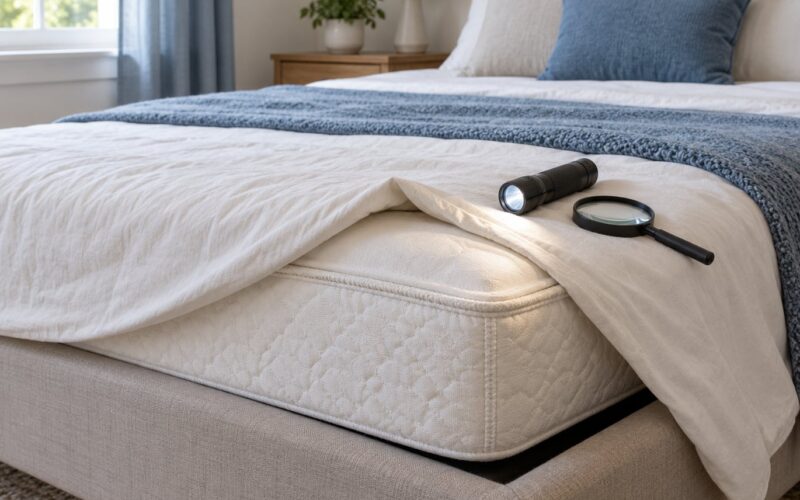
- A flashlight. A phone light works, but a narrow beam lets you sweep a seam slowly.
- White paper towels or tissues. Plain, uncoated, with no pattern. You are checking for a colour change on a white background.
- Clean white socks. The white sock test depends on contrast. Black or patterned socks defeat the purpose.
- A magnifying glass or hand lens. Helpful for seam piping and for flea dirt on a dark comforter.
- A flea comb if a dog or cat sleeps in the room. A fine-toothed metal comb is the tool; your fingers alone will miss a good share of them.
- Clear tape or a sticky sheet. For lifting eggs and larvae off fabric without disturbing them.
- Dish soap and a shallow plate. Optional, but useful for catching live fleas on carpet or flooring later.
- Gloves. Fleas bite humans readily, and handling bedding in bare hands means handling them in bare hands.
Before you strip anything, take two minutes to look at the bed the way an arriving guest would. That is how a second person would see the evidence, and it keeps you from over-reading a spot you have been staring at for an hour.
Step-by-Step: How to Tell If Fleas Are in Your Bed
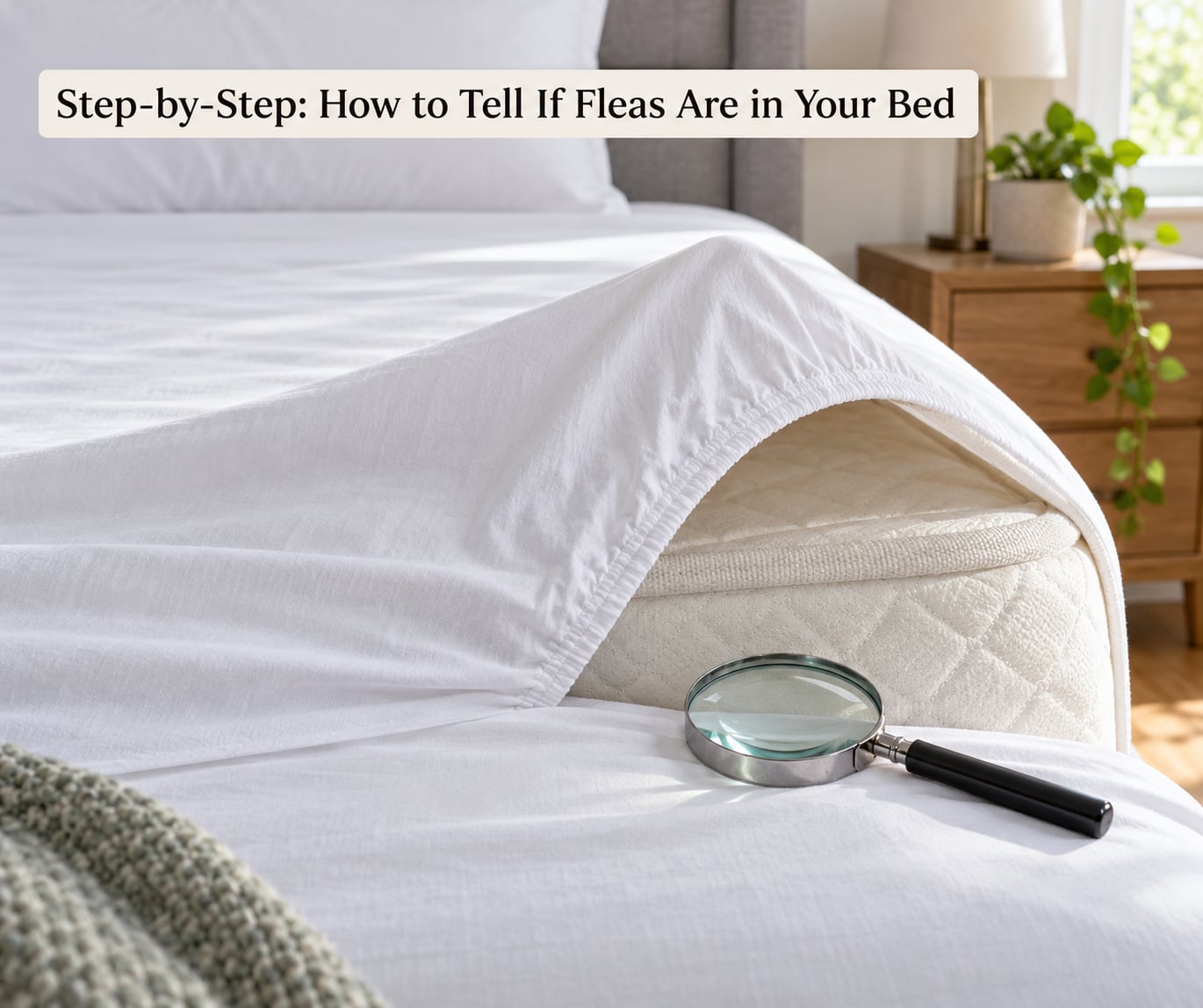
Work in this order, easiest evidence first. If step one already turns up live fleas or confirmed flea dirt, the remaining steps become confirmation and mapping rather than suspicion.
Check Your Bites and Skin
Flea bites cluster on the lower legs, ankles and feet because a flea jumps from the floor or the top of the mattress and lands low, then bites at whatever skin is nearest. You will usually find three or four bumps close together, sometimes in a short line, with a red centre and a paler halo around it.
Itching usually starts within a few hours and can run for a week or two. Flea saliva triggers a histamine reaction, which is why the bumps are so uniformly inflamed across people who barely react to mosquito bites.
Now the honest part: bites alone prove very little. Bed bug bites land on exposed skin while you sleep, so they show up on arms, shoulders and neck. Mosquito bites arrive in scattered single spots anywhere on the body, usually in summer and usually outdoors first. When you learn to read the pattern, the location alone often settles the question before you turn a single sheet over.
Seek medical care if the reaction includes swelling that spreads beyond the bite, difficulty breathing, or hives across the body. Flea bites are usually an annoyance, but the saliva causes an allergic reaction in a small number of people, and a severe one is an emergency rather than a nuisance.
Look for Fleas and Flea Dirt
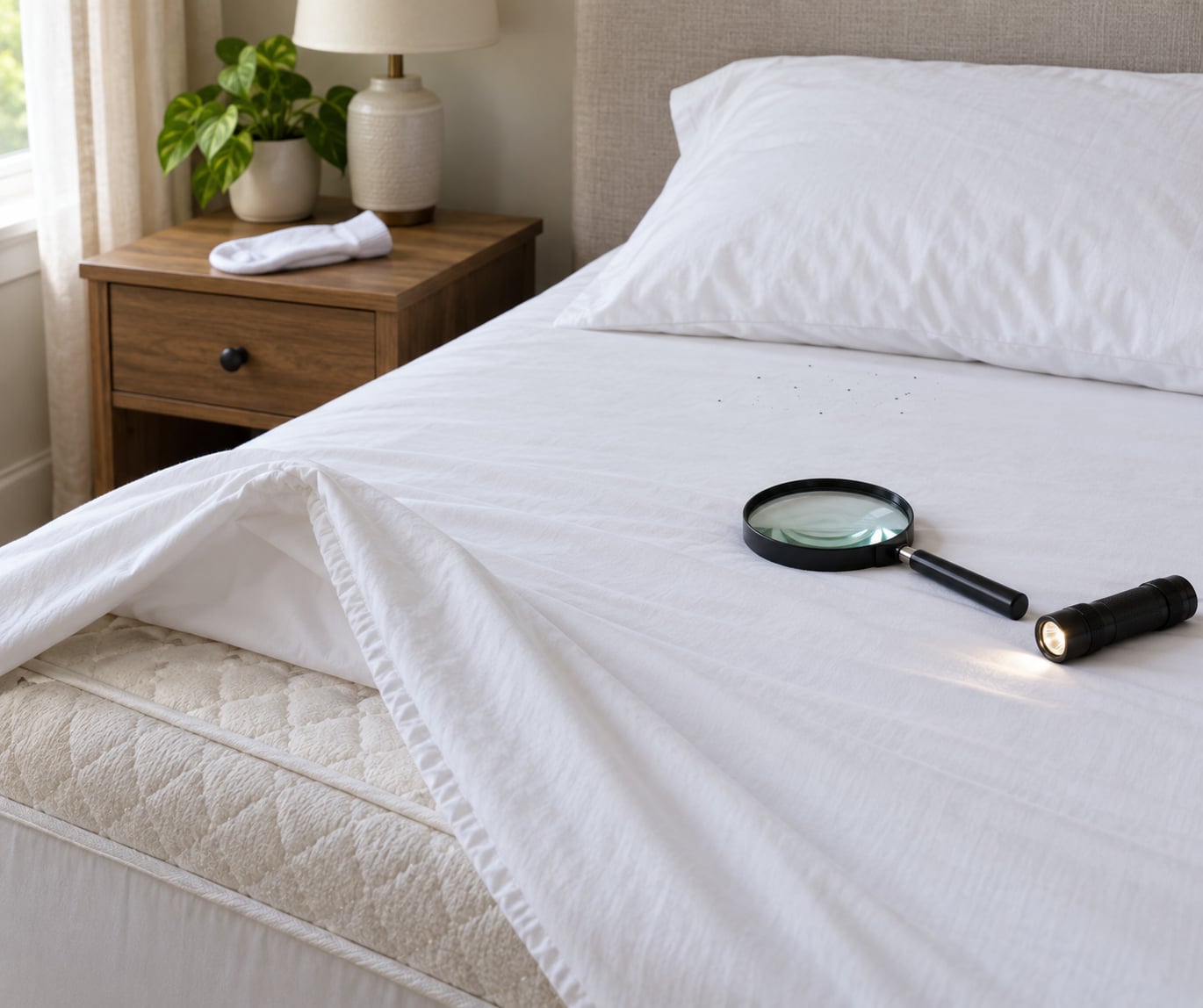
Flea dirt is the most reliable thing you will find in a bed. It is digested blood passed by adult fleas, and it looks like coarse black pepper grains scattered across a white sheet, a sheet seam or the crevice where the mattress meets the base.
Run this test to confirm it:
- Pick up the specks. Scrape a few onto a folded white paper towel, or press the damp towel straight onto the damp skin side of the sheet where specks are densest.
- Add water and wait about a minute. You want the towel damp, not dripping.
- Watch the colour. Flea feces smears into a rusty reddish-brown or orange-brown halo around each speck.
That colour is the tell. Flea dirt is iron-rich digested blood, so it bleeds red-brown when you wet it. Ordinary lint, dust, and dried detergent stay grey or stay put. Bed bug excrement is the closest look-alike and behaves differently: it stays dry and flaky, and it smears dark rather than red.
For live fleas, use the white sock test. Walk across the bed, the carpet and the rug in white socks, moving slowly, because fleas jump at movement and heat. Fleas that are present will hop onto the fabric and show up as small dark moving dots, most easily visible against white cotton. Reddit pest threads describe this as the first test people trust, and it is easy to understand why.
Add motion. Fleas are wingless, smaller than an eighth of an inch, reddish-brown to black, and built with six long legs and a hard, armoured body that is difficult to crush between your fingers. That armour is why the advice to squash them with your thumbnail backfires: the shell survives, and you smear blood into your sheet.
Instead, flick them into a bowl of soapy water or a dish of water with a drop of dish detergent. Surface tension gives out, the flea sinks, and you get a clean read without handling anything. A plate of soapy water set on the floor at night catches more, since activity peaks when the room is warm and still.
How to Check a Mattress for Fleas
This is the part most guides skip, and it is where an infestation actually lives. Fleas avoid light and prefer tight, warm seams near where a host rests. Go through the bed in physical order, top to bottom.
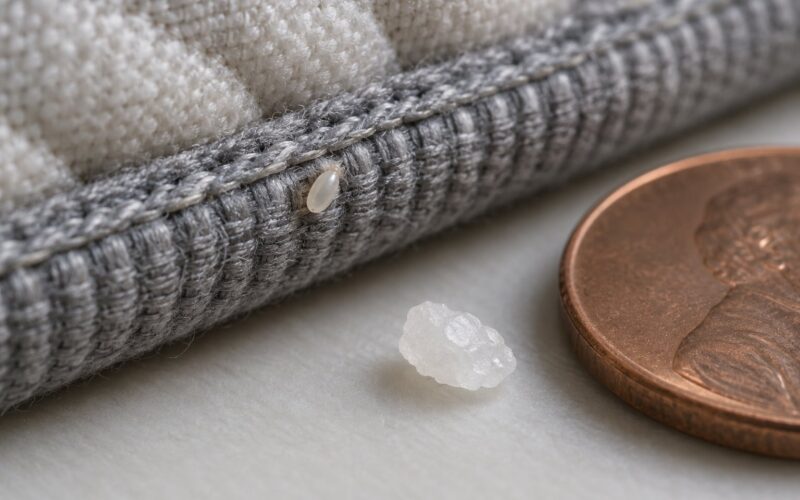
Mattress piping and seams. Run your fingers along the raised welt around all three exposed sides of the mattress. Piping is the single highest-yield spot. Look for dark specks, tiny pale oval eggs about the size of a grain of salt, and thin worm-like larvae that squirm away from light.
The underside and corner folds. Lift a corner and check where the mattress meets the base and where the ticking is stapled. That crevice stays warm and dark all year.
Box spring. If your bed has one, treat it as a second mattress. Fleas hide on its fabric panels, in the handles, and in the gap between the box spring and the frame. Nobody looks here, which is exactly why it works.
Bed skirt and the space under the bed. A bed skirt touching the carpet is a bridge between the floor and the mattress. Look at where the fabric meets the floor and along the baseboard on all four sides.
Headboard and frame. Upholstered heads and footboards harbour fleas in the seam where fabric meets wood, and in button tufts where debris collects. Check the frame joints too.
Sheet folds and bedding. Bunch the fitted sheet and look inside the folds rather than at the flat surface. Flea dirt concentrates in creases because that is where the material settles. Check pillowcases, duvet covers and any blanket that touches the mattress.
The floor under and around the bed. Vacuum lines along the baseboards, rug edges and under the bed tell you whether the bed is the whole problem or just one room of it.
Check Pets and Nearby Areas
If a dog or cat sleeps in the bedroom, check the animal before the furniture. Fleas are easiest to find on fur because the hair holds them still.
Use a flea comb with fine teeth, run it from the skin outward along the back, neck and rump, and do it over a white towel or sheet so anything that drops is visible immediately. Part the fur at the base of the tail and around the shoulders, where it is shortest and the skin is thinnest. Wiping the comb on a damp white tissue adds the same reddish-brown check you would use on bedding.
Other tells on pets include constant scratching or biting at the coat, hair loss or bald patches, scabs along the back and tail base, and red or irritated skin. Fleas move fast, so that restless, twitchy, constantly-shifting behaviour in a dog that cannot settle is often the first thing an owner notices.
Now, the awkward part. If nobody in the house has a pet, fleas did not appear from nowhere, and working out the entry point is what stops the problem coming back. Common routes in pet-free homes include:
- A previous tenant, housemate or visitor who brought an infested pet or a flea-infested blanket or rug.
- Pets belonging to neighbours, which reach a shared wall, shared crawlspace or shared exterior stairwell.
- Secondhand or inherited furniture and mattresses, picked up at a garage sale, an estate sale or from family.
- Wildlife such as rodents, raccoons or bats moving through a crawlspace, attic or chimney, carrying fleas with them.
- An adjacent apartment in a multi-unit building, reached through pipes, cable runs or shared utility areas.
Flea larvae feed on organic debris in carpets and bedding, and adults use people and animals as their food source, which is why a bedroom with no pets can still hold a full infestation. Adults jump; they do not need to travel far to reach you.
What the Evidence Means
Here is how to grade what you found. Live fleas or a positive damp paper towel result means confirmed. Dark specks that do not smear red-brown are unconfirmed and could equally be lint or shadow. Bites without either of those are a symptom worth chasing, not a diagnosis.
The most common expensive mistake is treating for the wrong pest, so this table settles the bed bug question in one pass:
| What you see | Fleas | Bed bugs |
|---|---|---|
| Body shape | Long, narrow, side-flattened | Flat, oval, broad |
| Size | Under 1/8 inch | About 1/5 inch |
| Colour | Reddish-brown to black | Reddish-brown |
| Movement | Jumps, then vanishes | Crawls slowly, rarely seen moving |
| Bite location | Lower legs, ankles, feet | Exposed arms, shoulders, neck |
| Bite pattern | Clusters of three to five | Lines or scattered singles, often on two people differently |
| Where they hide | Pet bedding, carpets, mattress seams, box springs | Mattress seams, headboard, bed frame joints, baseboards |
| Waste | Black specks that smear reddish-brown when wet | Dark specks that stay dry and flaky |
| Live on you | No, they jump off and live in the environment | No, they stay hidden and feed at night |
Two further details help. Adults can leap a distance many times their body length, which is why a flea that was there a second ago can be nowhere to be found. Bed bugs move at a walk and tend to stay put, so a bug you watch move across a sheet is almost certainly not a bed bug.
Call a veterinarian if a pet is scratching heavily, has bald patches, scabs or pale gums, since untreated fleas can cause anemia in young animals. Call a pest professional if you are dealing with a rental where the source may be a neighbouring unit or common area, if the infestation is in a room you cannot fully access, if you have a child under two who may have been exposed to a chemical product, or if you have treated twice with no change. That last pattern almost always points at an untreated source, not a failed product.
Common Mistakes
Relying on bites alone. Bites are the least reliable evidence you have. Many people react to fleas with no reaction at all, so the absence of bites is not proof of absence, and the presence of bites proves nothing on its own.
Checking only the top sheet. Fleas are in the seams, the piping and the box spring. A flat sheet stretched across the mattress shows you the least.
Assuming black specks are flea dirt. Most specks on bedding are lint, dust, or detergent residue. Run the damp paper towel test before you buy anything.
Treating the room but not the pet. The people describing repeated failed treatments on forums almost always skipped this step. An untreated animal walks back into the bedroom and restarts the cycle within days. Treat the pet first, or on the same day.
Spraying products you have not read the label on, or mixing them. Follow the label exactly. Never combine products, never apply a pet product to furniture, and never use a product on a pet that is labelled for the home. Keep children and animals out of a treated room until the label’s re-entry time has passed.
Discarding the vacuum contents in the house. Fleas survive in a vacuum bag just fine. Seal the bag, take it outside, and wash hot soapy water through the canister or bag immediately after.
What to Do After Finding Fleas
Work in this order and do not skip the middle two steps.
- Treat the pet first. Use a veterinarian-recommended product and check the label, which usually means treating every pet in the home for the full cycle rather than a single dose. A flea comb run daily helps you see the count fall.
- Wash all bedding hot. Bedding, sheets, pillowcases, duvet covers and removable mattress protectors go through a hot wash and a high dry cycle. Anything that cannot be washed gets a careful vacuum and a steam treatment where the fabric tolerates it.
- Vacuum aggressively and often. Every day, for a couple of weeks at least. Use the crevice tool along baseboards, the bed frame, the box spring, rug edges and under furniture. Seal the bag and take it out the same day.
- Treat the home according to the label. Apply the product where the label says, at the interval the label says, and not more often. Cut off treated pets’ access to the room while the product dries and for the re-entry period on the label.
- Look at where they came from. A neighbouring pet, an inherited bed, a crawlspace, rodents in the attic. If the source keeps feeding the room, you will be back in it in a month.
- Re-check after about two weeks. Repeat the sock test and the damp paper towel test. New bites should stop appearing, and you should see no live fleas or fresh flea dirt. If either continues, the source is still active.
On timing: a female flea can lay up to roughly 50 eggs a day, and about 95% of the eggs, larvae and pupae live in the environment rather than on you or your pet. That is why a room can look clean on day one and still produce fresh adults later, and why the two-week re-check matters.
Indoor conditions matter too. Fleas thrive in warm, humid air, and centrally heated homes in winter are just as hospitable as a summer yard. That is why indoor infestations keep showing up in months when people assume the season is over.
Frequently Asked Questions
Can you see fleas in a bed?
Usually no, not reliably. Adult fleas are under an eighth of an inch, move fast, and jump the moment you disturb fabric, so most people see flea dirt rather than fleas. Stand up slowly and scan mattress seams and the sheet before you shake anything. If you see a tiny reddish-brown insect that moves when you approach, that is a flea.
What do flea bites on humans look like?
Small red bumps that itch intensely, usually found in clusters of three to five on your lower legs, ankles and feet. Many have a red centre with a paler halo around them. Itching often starts within a few hours of the bite. Flea bites can look identical to bed bug or mosquito bites, so location and pattern matter more than appearance.
How can I check a mattress for fleas?
Strip the bedding, then run your fingers along the mattress piping on all three exposed sides, checking for black specks, pale oval eggs and worm-like larvae. Look under the mattress, in the box spring fabric, inside sheet folds and where the mattress meets the base. Then stand up slowly and watch for anything jumping. A white sock test across the surface confirms what you found.
Do I need to treat my pet if fleas are in the bed?
Yes, and it needs to happen on the same day as any home treatment. Fleas spend most of their life in the environment, not on the animal, but your pet is what they feed on and what carries them back into the bedroom. Untreated pets are the most common reason repeat treatments fail. Use a product your veterinarian recommends and treat every pet in the home.
How quickly can fleas spread from one room to the rest of a home?
In days rather than weeks, once they are established. Adults jump, they ride on shoes and clothing, and they spread through shared carpets and vacuumed debris. A single pregnant female can lay up to roughly 50 eggs a day, and those eggs develop into new adults within a couple of weeks under typical indoor conditions. Treat the whole home and not just the bedroom.
Are bedbug bites different from flea bites?
Yes. Flea bites concentrate on your lower legs, ankles and feet in tight clusters because a flea jumps low and bites whatever skin is nearest. Bed bug bites land on exposed skin while you sleep, so they cluster on arms, shoulders and neck and often hit different people differently on the same night. Checking for fleas in the bedding settles it far faster than the bites do.
Conclusion
Start with the two tests that take five minutes. Pick the dark specks off a white sheet, wet them on a white paper towel, and see whether they smear reddish-brown. Then walk the bed and carpet in white socks and check whether anything dark jumps onto the fabric.
If either test comes back positive, work through the mattress piping, the box spring and the sheet folds to see how far it reaches, then check every pet in the home with a flea comb. Treat the pet on the same day as the home, wash bedding hot, vacuum daily with the bag sealed and taken out, and follow the treatment label exactly. If you have no pets at all, chase the entry point, because a neighbour’s cat or an inherited mattress is what will bring them back.
Re-check in about two weeks. No fresh bites, no live fleas and no new flea dirt means the room is clear.