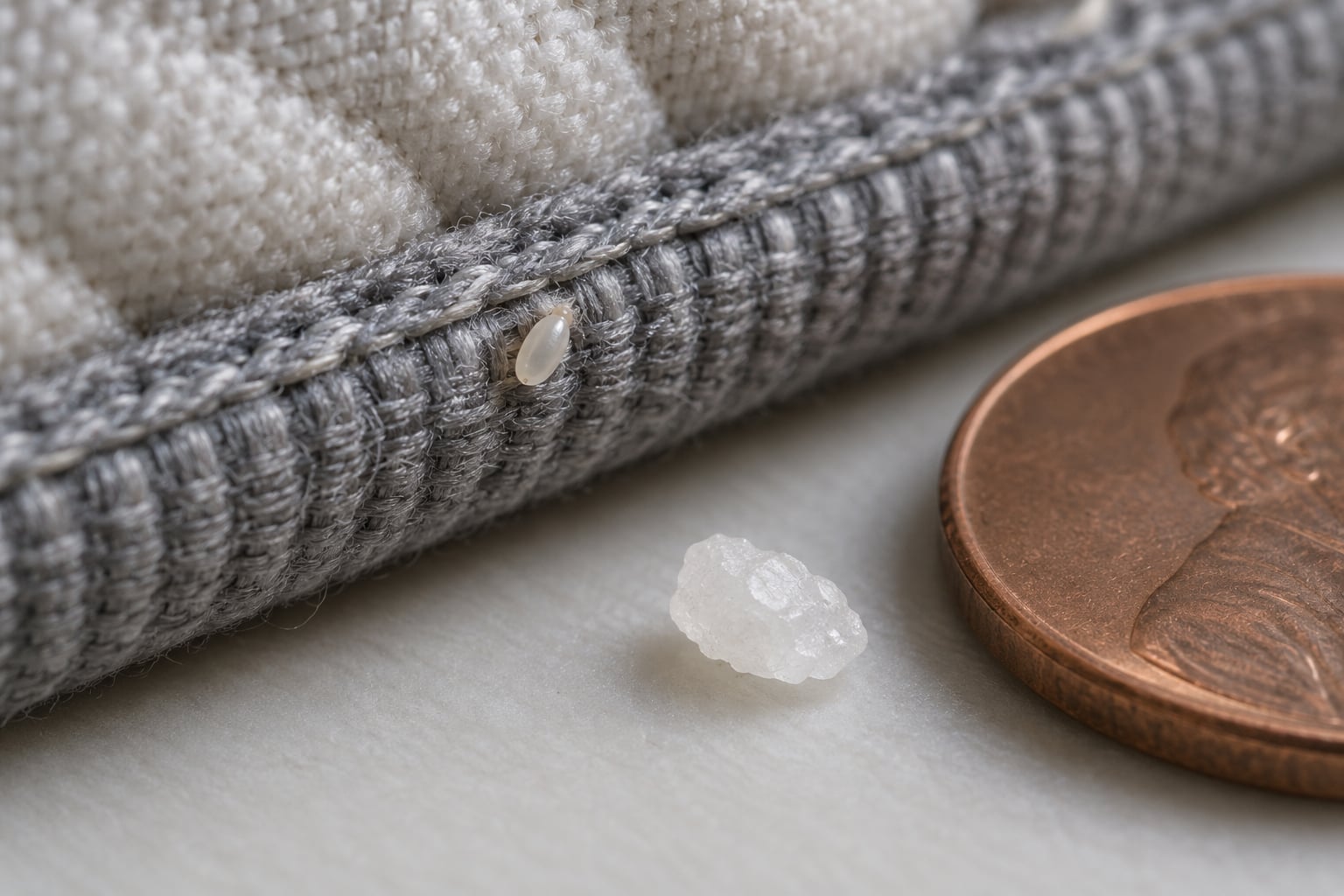
Bed bug eggs are tiny, oval, pearly white specks about 1 mm long, roughly the size of a grain of salt or a pinhead, and they are cemented to surfaces in tight clusters instead of lying loose. You will almost never find them on an open, exposed surface. They hide in mattress seams, box spring edges, bed frame joints, baseboard cracks, and upholstery folds, which is why a careful look at the sleeping area comes before anything else.
That combination is what makes identification hard. A single white speck on a sheet proves almost nothing on its own, because lint, paint flecks, booklice nymphs, and shed insect skins all look similar to an untrained eye. What makes a case convincing is the pairing of appearance and location: the right shape, in a protected seam, near other evidence like cast skins or dark spotting.
This guide walks through what viable eggs actually look like, where to look for them, how to inspect without accidentally seeding a new room, and what to do when you find something suspicious.
What Do Bed Bug Eggs Look Like?
Bed bug eggs, laid by the common bed bug (Cimex lectularius), are about 1 mm long, oval and slightly barrel-shaped, with a smooth, hard, faintly glossy shell. Fresh eggs are pearly white or translucent and are glued to the surface with a sticky secretion, so they stay put instead of rolling or brushing off. A cluster of them looks like a scatter of coarse grains, which is the source of the common salt comparison.
- Size: About 1 mm long and 0.5 mm wide. That is roughly a pinhead or a grain of salt, or a bit smaller than a grain of rice. Unmated eggs are noticeably smaller.
- Color: Milky white to pearly white when fresh, translucent enough that light passes partway through the shell.
- Shape: Oval, barrel-shaped, and slightly domed at one end. Not perfectly symmetrical, and not spherical.
- Texture: Smooth and hard-shelled. A fresh egg has a faint sheen under a flashlight beam held at a low angle.
- Attachment: Cemented individually to the surface with a glue-like secretion. Eggs do not shift when you tap the fabric, and they are not scattered loosely like crumbs.
- Clustering: Laid in tight groups of two to five, often in a seam, a screw hole, or a fold where the surface curves away.
If you sweep a flashlight across a seam and see round specks that glow pearly white, you are looking in the right place. The closer the light angle, the more the shell reflects, and a magnifier or jeweler’s loupe makes the oval outline obvious.
How the Appearance Changes as an Egg Matures
Fresh eggs are uniformly pale. After several days, a darker patch develops inside the shell. That patch is the eyes and head of the developing nymph showing through, and it is the single most useful clue that a speck is a real, living egg rather than a lint ball or paint flake.
So the sequence runs from uniformly pearly white, to pearly white with a visible dark eye-spot, to a fully dark nymph visible through a thinner shell. Hatched eggs are a different thing entirely: an empty, translucent shell with the end cap missing, lighter and thinner than a live egg and often collapsed or torn open on one side.
How Long Do Bed Bug Eggs Take to Hatch?
Eggs hatch in roughly 6 to 10 days under warm conditions, and a female lays one to five eggs a day, up to about 500 in a lifetime. Hatch speed depends on temperature and humidity, with a favorable range around 70 to 85 percent relative humidity and temperatures in the upper 60s to mid 70s Fahrenheit. Development slows markedly in a cool room and effectively stops in the low 50s.
Two details matter for anyone trying to read an infestation timeline. Eggs do not need their parents to hatch, and a nymph can survive for months on stored blood. So an egg cluster left alone in a mattress seam can produce a new generation without anyone noticing the original adults at all.
The practical reason to know the hatch window is timing. A treatment that kills mobile nymphs and adults but leaves eggs viable can look like a success on day one and a failure two weeks later, when the survivors hatch. That pattern is one of the most common complaints in homeowner discussions about bed bugs, and it is why egg mortality matters more than almost any other number in the treatment conversation.
Bed Bug Eggs vs. Other Small Specks
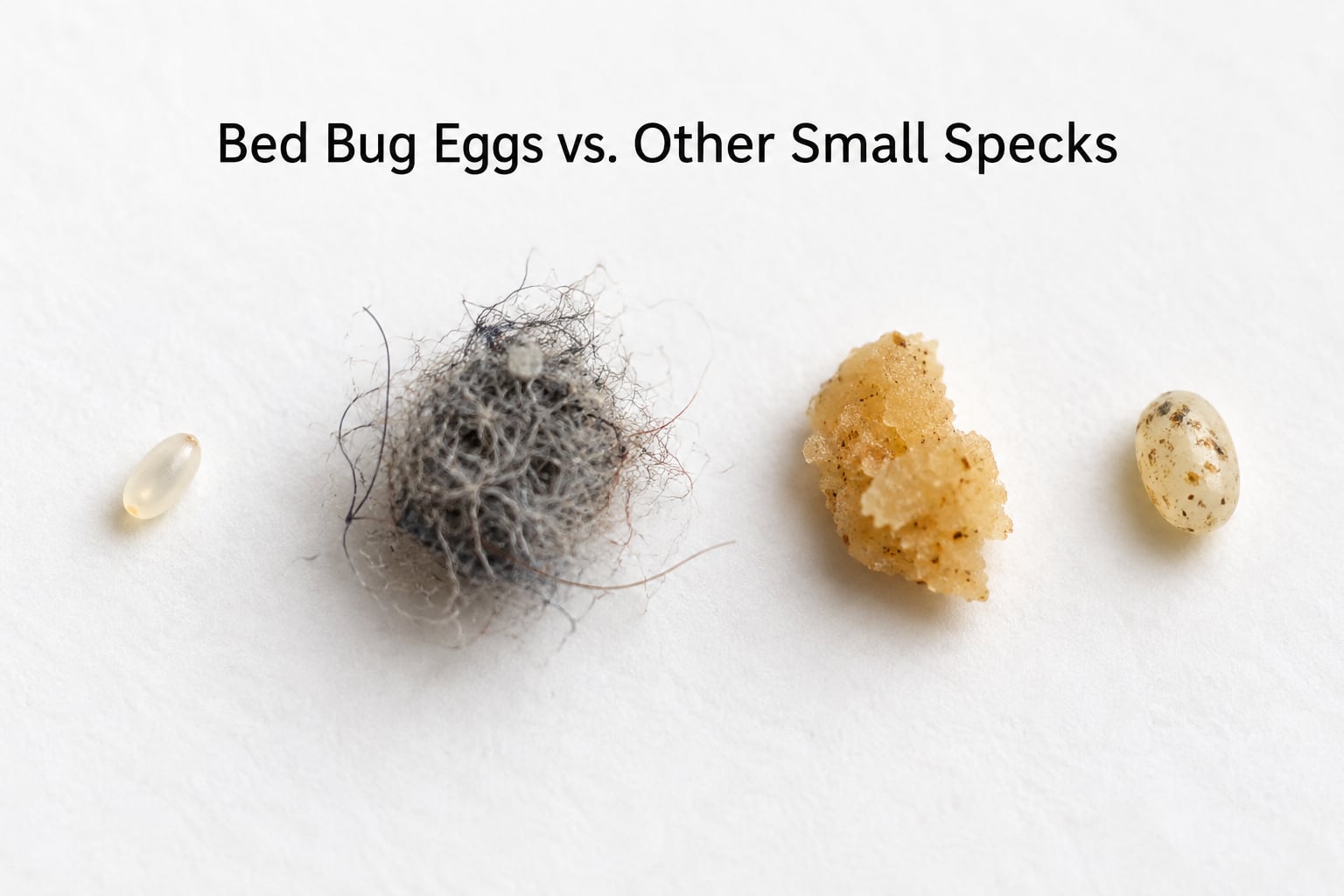
Appearance alone is not a diagnosis. Nearly every photo-based identification attempt online ends with somebody pointing out that the image is not conclusive, and they are right. What settles most cases is a combination: the right size, the right shape, a glued-down attachment, a protected location, and companion evidence nearby.
This table sets the common look-alikes against a viable bed bug egg. Note the last column, because that is where the practical difference sits.
| Look-alike or sign | Size | Color | Shape | How it behaves | How to tell it apart |
|---|---|---|---|---|---|
| Bed bug egg (viable) | About 1 mm | Pearly white, translucent | Oval, barrel-shaped, domed | Cemented in place, does not move or brush off | Glued to a seam or crevice, often in a cluster, with a dark eye-spot after several days |
| Booklouse (psocid) nymph | 1 to 2 mm | Clear to white, grey, or brown | Round body, visible legs and antennae | Runs quickly when disturbed, flies to light | It walks, it has legs, and it moves away from the dark crevice where eggs stay put |
| Carpet beetle egg | About 1.5 mm | White to cream | Elongated and cylindrical | Loose, often dropped in open areas of the room | Laid loose in carpet or on floors, not cemented into a mattress seam |
| Dust mite or debris | Under 0.5 mm | White or grey | Rounded, shapeless | Shifts or blows away easily | Far too small to see without magnification, and not attached to a surface |
| Lint or fabric fiber | Variable | White, grey, or colored | Irregular, curly, or twisted | Loose, picks up and floats | No oval outline, no hard shell, no fixed attachment point |
| Paint fleck or drywall dust | Under 1 mm | White, cream, or grey | Flat, angular chip | Crumbles or flakes when touched | Sharp-edged, leaves a dusty smear, found near walls, windows, or fresh paint |
| Adhesive or glue residue | Variable | Translucent to amber | Film-like, glossy | Smears and picks up dust | Sticky, spreads when you press it, never forms a clean oval shell |
| Empty eggshell (hatched) | About 1 mm | Translucent, whitish | Oval, thin and collapsed | Lies loose where the nymph crawled out | Missing end cap, paper-thin, no dark eye-spot, often torn open on one end |
| Cast skin (exuviae) | 1 to 5 mm | Tan to amber, brown | Nymph-shaped, hollow, segmented | Lies where the nymph molted | You can see legs and body shape in the imprint, and it crumbles when pressed |
| Fecal spot | 0.5 to 1 mm | Dark brown to black, sometimes rusty red | Round dot or smear, sometimes ringed | Wicks into fabric and stays | Dark, not white, and it stains the material rather than sitting on top of it |
| Grain of salt, sugar, or a crumb | Under 1 mm | White or tan | Irregular or cubic | Loose, dissolves or smears if damp | No attachment, no symmetry, and it moves when tapped |
| Flea egg | About 0.5 mm | White, pearly | Oval, smooth, rounded | Loose, shaken onto bedding from a pet or carpet | Smaller, rounder, and not glued down; associated with pets and carpet |
Booklice cause more panic than anything else on this list, and the distinction is easy once you look closely. A bed bug egg is a static oval glued to a dark crevice. A booklouse nymph is a moving insect with visible legs and antennae that scatters when light hits it. The two rarely sit in the same situation, so where the speck is matters as much as what it looks like.
Where Do Bed Bugs Hide and Lay Their Eggs?
Bed bug eggs are almost never on an exposed open surface. A female searches for a protected harborage, a spot where two surfaces meet and light does not reach, and she deposits her eggs there. That single behavior predicts most of the locations worth checking, and it also explains why a quick glance rarely turns anything up.
On and Around the Bed
- Mattress seams, piping, and tufts. Run your fingers along every seam from one end to the other. Piping and the recessed channel beside it are prime sites.
- Mattress tags and the underside cover. The seam where the ticking is stitched to the bottom panel creates a protected edge, and tags give bugs a flat, undisturbed place to glue eggs.
- Tufts, buttons, and quilted indentations. Each depression holds a pocket where a fingernail can lift the fabric and check underneath.
- Box spring fabric edges, welting, and staples. Staples leave tiny gaps. Eggs get laid on the fabric side of the staple line where they are hard to dislodge.
- Bed frame joints, slat gaps, and screw holes. Check the underside of every slat and the end rails, and look inside any screw or bolt hole with a flashlight.
- Headboard slats, cracks, and the wall gap behind it. Wooden slats offer dozens of narrow hiding spots, and the gap behind the headboard is often completely overlooked.
- Baseboards and the gap between the baseboard and flooring. Especially behind nightstands, where nobody looks.
- Bed skirts, dust ruffles, and the floor beneath the frame. The fabric edge traps humidity, and the carpet underneath catches cast skins and spotting.
Elsewhere in the Room
- Behind picture frames and hanging artwork. The wall gap and the backing board form a sheltered cavity.
- Electrical outlet and light switch plates. A flashlight angled across the wall shows shadows where eggs and shells sit on the plaster behind the plate.
- Behind wallpaper that is lifting or peeling. The paper itself is a protected harborage and the glue line holds moisture.
- Upholstered chair and couch seams, cushions, and undersides. Skirt fabric, welt cord, and the dust cover underneath are all worth checking.
- Carpet edges, rug tacks, and under mats. Look at the binding and at the floor along the wall.
- Curtains and window treatments. Especially the folds where fabric bunches at the rod.
- Clothing piles, laundry baskets, and backpacks. Folded fabric provides seams, and a warm bag provides a host.
Away From the Bedroom
Plenty of people assume bed bugs live in beds, and that assumption leads to missed infestations. If someone naps on a couch or an armchair during the day, that is the sleeping surface, and it can hold a full infestation with no bed in the room at all. Office chairs and shared workstations are the same situation, which is why workplace outbreaks usually trace back to a chair or a couch rather than to a bed.
Other places that matter: secondhand furniture before it enters the home, especially upholstered pieces with seams and a box frame; hotel and short-term rental mattresses, where eggs can ride home in luggage; dorm rooms and multi-unit housing, where a shared wall or a shared piece of furniture connects units; and vehicles, including ride-share seats and rides you take regularly. Anyone who travels should inspect the mattress seam of a hotel room before unpacking.
On walls and ceilings, sightings do occur. Nymphs and adults can climb, and vertical surfaces near the head of the bed, curtains, and hanging fabric collect shells and spotting. Eggs themselves still sit in seams and gaps rather than on flat wall paint.
How to Inspect for Bed Bug Eggs Without Spreading Them
The goal of an inspection is to learn what is in the room without changing what is in the room. Every item you move is an opportunity to carry eggs or nymphs into a clean space, and the most common self-inflicted mistake is tidying before investigating.
What to have ready: a bright flashlight, a magnifying glass or jeweler’s loupe, clear packing tape, a small sealed container or zip bag, gloves, and your phone for photos.
The order to work in:
- Start with the sleeping surface. Check both sides of the mattress, then flip it if the frame allows and check the underside, seams, and tags.
- Move to the box spring, then to the frame, slats, screw holes, headboard, and baseboards.
- Work outward to wall fixtures: outlet plates, switch plates, picture frames, and lifting wallpaper.
- Then furniture near the bed, including seams, cushion undersides, and dust covers.
- Finish with carpet edges, rug tacks, curtains, and anything stored near the bed.
At each site, hold the flashlight low and nearly parallel to the surface so the light rakes across it. Shallow depressions throw small shadows, and a pearly white egg shows up as a highlight with a shadow beside it. Work methodically in one direction and backtrack, rather than jumping around, so you can be confident you covered the whole seam.
If you find a candidate, photograph it in place first, with a coin or a ruler next to it for scale. Then lift it with clear tape or drop it into a sealed container and label the room and the date. Photographs with scale and a physical specimen are what let a pest management professional or a university extension entomologist confirm an identification, and forum readers consistently say the same thing: an unscaled macro photo alone usually cannot settle the question.
Do not spread them. That means:
- Do not move luggage, bedding, or furniture to another room, and do not put items into plastic bags and seal them away in a hallway.
- Do not start sleeping on a couch in the living room. Moving your body can carry a bug with you and start a second infestation.
- Do not run a fogger or total-release spray. Aerosol foggers do not reach eggs sitting in seams, and repeated exposure can make the surviving population harder to control.
- Do not move discarded furniture outdoors before it has been treated or wrapped, since that puts eggs in a new area and exposes neighbors.
- Do not use a high-suction vacuum on a heavily infested mattress without a plan, because it can spread eggs along the hose and into the motor housing. Bag the canister, seal it, and treat it.
Bed bugs follow a host. That single fact explains nearly every re-infestation story in homeowner discussions, and it is why keeping everything in place beats the instinct to clean up.
What Else Looks Like Evidence of Bed Bugs?
No single sign proves an infestation. Experts generally look for a combination, and the most useful way to think about it is in three signals: a viable egg or eggshell, shed skins, and fecal spotting. Finding all three in one area is a strong case. Finding one white speck in a lit room is not.
- Live nymphs. Newly hatched nymphs are pale yellow-white and translucent, roughly 1 to 2 mm, and turn brown as they feed. They are easier to catch than adults and move more slowly.
- Cast skins. After each of its five nymphal stages, a bed bug leaves behind an empty tan shell with the shape of the insect imprinted in it. These exuviae collect in clusters near harborage sites.
- Fecal spotting. Dark brown to black dots, sometimes ringed, and rusty red-brown stains on sheets or mattress ticking. The spotting sits on or soaks into fabric rather than resting on top of it.
- Musty odor. A heavy, sweet, musty smell in a small enclosed space is often described as a secondary sign. It is weak evidence on its own and hard to judge in a room that is simply closed up.
- Bites. Itchy welts often appear in a line or a small cluster on exposed skin. Reactions vary widely, and some people react to nothing at all, so bites confirm nothing by themselves.
The distinction people ask about most is egg versus dead skin. A cast skin is tan or brown, hollow, and holds the outline of legs and body segments, and it crumbles when you press it. An empty eggshell is white, translucent, paper-thin, and missing the end cap. A dead egg is still egg-shaped but shriveled, dry, hard, and often yellow-brown. Residents often describe what they found as “dry and hard,” which fits a dried egg or a cast skin rather than a fresh pearly-white one.
And if you can, check a wall or ceiling speck carefully rather than dismissing it. Nymphs and adults do climb, and the area above a headboard, near curtains, and around hanging fabric is a genuine finding site. Eggs, though, remain attached to seams and gaps.
What to Do After You Find Suspected Bed Bug Eggs
Start with capture and containment, not with spraying. The instinct to treat a problem you have not confirmed usually leads to a treatment that fails and a harder problem afterward.
Confirm what you have. Photograph with scale, lift a specimen with tape or seal it in a container, and get it looked at by a pest management professional or a county extension office. If a specimen is viable, meaning it has a dark eye-spot or hatches, you have your answer without any guesswork.
Keep the room as it is. Do not move belongings between rooms, do not start sleeping elsewhere, and do not discard bedding or furniture. If you need to stop using a bed, a spare room with no upholstered furniture and no connection to the rest of the home is a far better option than a couch in the same room.
Know why sprays disappoint. Published efficacy figures are sobering. Work reported in the Journal of Economic Entomology and summarized by the Entomological Society of America found pyrethroid products to be roughly 15 percent effective against bed bug eggs, with about 84 percent of eggs still able to hatch, while a combination product tested at about 87 percent effectiveness. A material that leaves most eggs viable is a material that will look like it worked and then rebound. Residual treatments aimed at mobile stages remain useful, but eggs are the reason a second visit 10 to 14 days later is standard practice.
Understand what heat does. The thermal death point for bed bug eggs is about 113 degrees Fahrenheit, or 45 degrees Celsius, sustained for roughly 1.5 hours; temperatures near 48 degrees Celsius kill them in about 20 to 30 minutes. Professional heat treatment is the most reliable egg-killer precisely because it reaches those numbers uniformly and penetrates seams, which is why whole-room heat is the treatment many professionals recommend when eggs are confirmed.
Know when a professional inspection is worth it. In apartments, condos, dorms, or any multi-unit housing, ask for a documented inspection and get the building involved, because the source is frequently an adjacent unit rather than yours. After travel, after buying secondhand furniture, or when bites appear with no other explanation, a professional inspection is more reliable than a weekend of looking. If you are not sure what you found, that inspection becomes a confirmation step rather than a sales call.
For the months after treatment: monitor with interceptor traps under the bed legs, keep inspecting mattress seams on a schedule, and reduce clutter near the sleeping area so future inspections are meaningful. Expect to check for 30 to 60 days, because a follow-up treatment during that window catches anything that hatched after the first visit.
Frequently Asked Questions
Can you visibly see bed bug eggs?
You can, but it takes real effort. Bed bug eggs are about 1 mm long and pearly white, so on a dark seam under a flashlight held at a low angle the shell catches the light and stands out. On a white sheet in daylight they are close to invisible. Most people only find them after pulling apart a mattress seam by hand, which is why searching protected gaps works and a visual scan of the bed does not.
Do bed bug eggs look like salt?
They genuinely look like coarse salt or sugar grains, which is the source of the comparison. The differences are that bed bug eggs are uniform ovals with one domed end, a hard glossy shell, and they are individually cemented to the surface. Loose salt grains shift, smear, or dissolve if you touch them with a damp finger, and they are not arranged in tight groups of two to five along a seam.
What do dried bed bug eggs look like?
Dried or dead eggs lose their pearly translucence. They look shriveled, hard, matte, and often yellow-brown or cream, and they may collapse or dimple on one side. This is different from an empty eggshell, which stays translucent, paper-thin, and is missing its end cap. If a speck is dry and hard, that points to an old or dead egg rather than a viable one, though it does not rule out fresh eggs nearby.
How can I tell if I found bed bug eggs or dead skin?
Check three things. A bed bug egg is white, oval, hard-shelled, and glued down. A cast skin is tan or brown, hollow, and shaped like a whole insect, with legs and body segments visible in the imprint. Debris from a dead insect is irregular and crumbles when pressed. Skin also clusters near harborage sites, often in groups, and leaves dark spotting nearby. A magnifier settles the question quickly.
What instantly kills bed bug eggs?
Sustained heat is what kills bed bug eggs reliably. The thermal death point is about 113 degrees Fahrenheit, or 45 degrees Celsius, held for roughly 1.5 hours; near 120 degrees Fahrenheit the time drops to about 20 to 30 minutes. No spray kills eggs instantly, and over-the-counter foggers essentially miss them because the aerosol never penetrates a mattress seam.
Will rubbing alcohol kill bedbug eggs?
Rubbing alcohol applied directly can kill an egg on contact, but it is not a practical control method. Eggs sit in dozens of tiny seams where a wet wipe cannot reach, alcohol evaporates before it soaks through a hard shell, and the residue does nothing for the rest of the infestation. It is fine for disinfecting a hard surface or a piece of equipment. It does nothing for eggs inside upholstery, and it will not treat a room.
Start With a Careful Bed Frame and Mattress Inspection
If you do one thing, take 20 minutes and work the bed systematically: every mattress seam and tag, both sides and the underside, then the box spring fabric, staples, slats, screw holes, headboard, and baseboards. Pull seams apart by hand and rake a flashlight across them. Photograph anything you find with a coin for scale.
Identification works when appearance and location agree. A pearly white oval about 1 mm long, cemented in place, tucked into a protected seam, near cast skins or dark spotting, is a strong case. The same speck in the middle of a lit floor is nothing.
Then leave everything where it is. Do not move the bedding, do not switch to the couch, do not fire up a fogger. Get a specimen confirmed, and let a professional treatment plan handle the part that individual effort cannot, which is reaching every egg in every seam.
And one last thing: bed bugs have nothing to do with how clean a home is. They arrive on a suitcase or a secondhand couch. Tidiness is not protection, and shame is not a useful part of the response.
Article reviewed and updated for 2026.