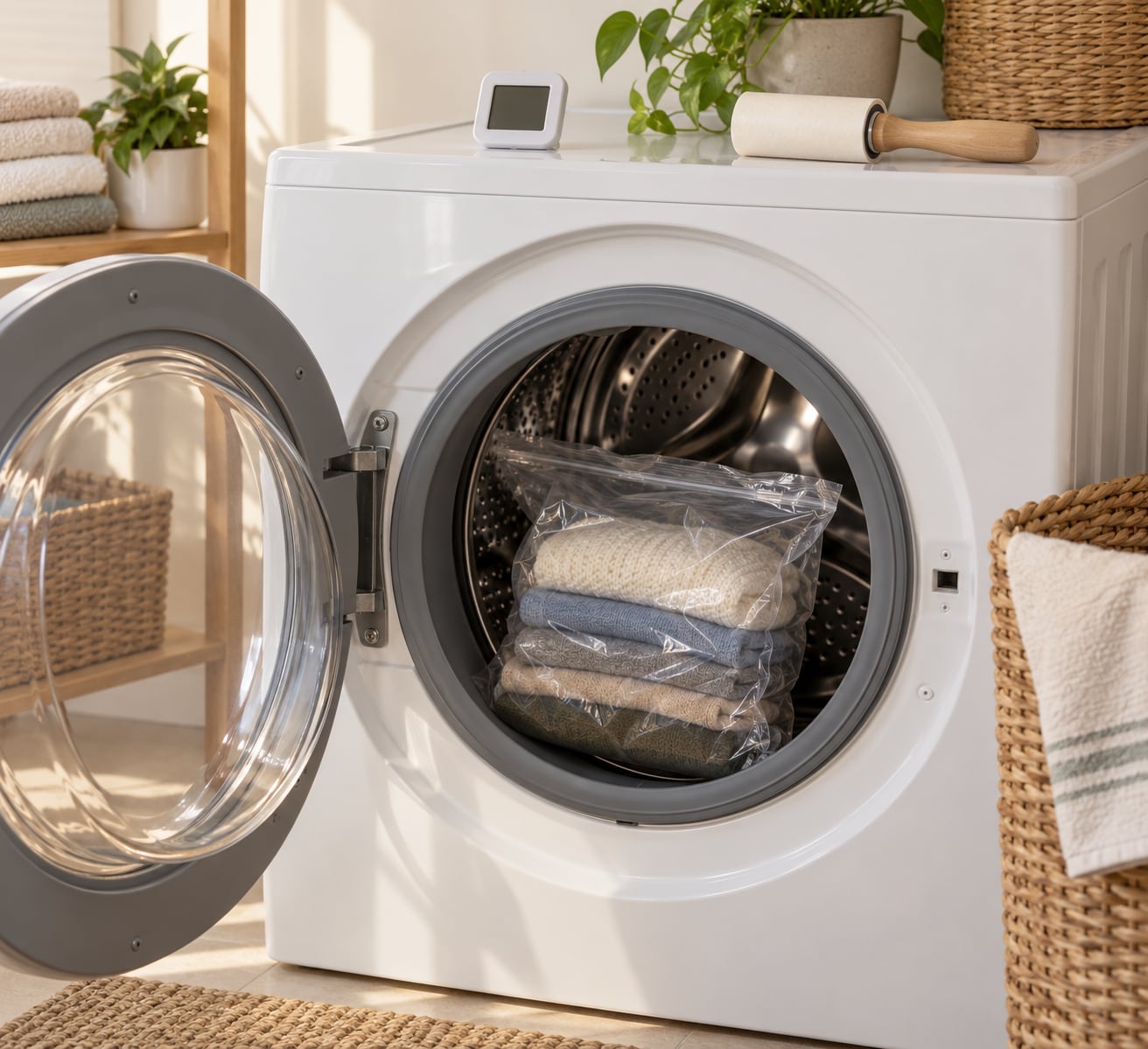
Bed bugs die from sustained heat, not from soap or a long soak. To wash clothes to kill bed bugs, seal the load in plastic bags, wash it at 130-140°F (54-60°C) on your hottest cycle, then tumble dry on high for at least 30 minutes. The whole job takes a couple of hours and it only works if the dryer heat actually reaches every fold.
That last part is where most people go wrong. A load gets washed, tossed in a dryer on a timer for 15 minutes, folded and worn, and a month later the same mattress is still producing nymphs. The clothing was never really treated.
Before you load anything, confirm you have bed bugs. Adults are flat, reddish-brown and about the size of an apple seed; nymphs are smaller and paler; sheets and mattress ticking show rust-coloured spotting where bugs have fed. Carpet beetles and bat bugs get mistaken for bed bugs constantly, and laundering a clean closet achieves nothing but a shrunken sweater.
Guidance below follows what public health and pest management sources agree on, including CDC material and state health department resources. If you are dealing with a confirmed infestation in a bedroom, cleaning clothes is one part of the job, not the whole job.
Table of Contents
- What You Need
- Step-by-Step: How to Wash Clothes to Kill Bed Bugs
- 1. Collect exposed clothing without spreading bed bugs
- 2. Separate items that can and cannot be washed
- 3. How to wash clothes to kill bed bugs safely
- 4. Dry every washable item on the highest garment-safe heat
- 5. Inspect, seal, and store the treated items
- 6. Treat non-washable belongings separately
- 7. Clean the laundry area and confirm the result
- Common Mistakes
- Frequently Asked Questions
- What to Do First
What You Need
Gather everything before you touch the first pile. Sorting exposed clothing is exactly when live bugs get carried into the rest of the house.
- Heavy-duty trash bags or a bed bug proof laundry bag with zip-style seals, plus a roll of tape
- A washer with a sanitize, extra-hot or 60°C setting — many machines top out well below that, so check your control panel first
- A dryer, ideally gas, since an electric dryer often struggles to hold high heat on a full load
- Regular laundry detergent — more of it does nothing extra
- A lint roller and clear packing tape for catching stragglers off surfaces and seams
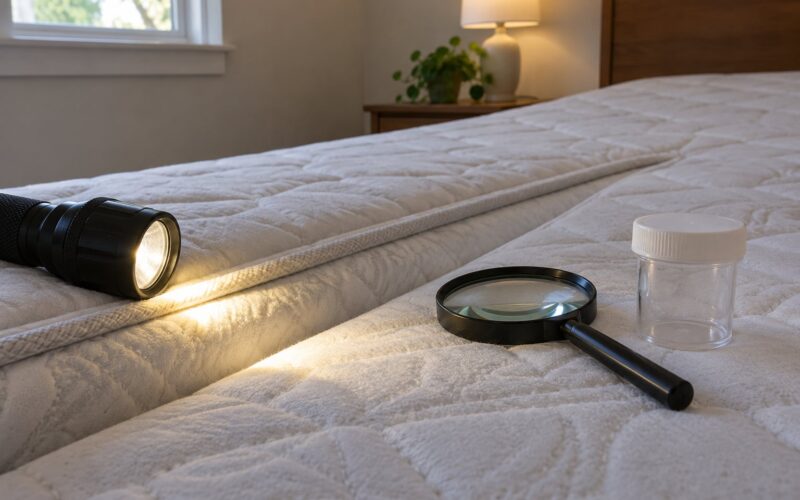
- Gloves and a flashlight for checking cuffs, waistbands and mattress-adjacent folds
- An infrared thermometer if you want to confirm your dryer really reaches the temperature on the label
- A labeled treatment plan for non-washable items — dry cleaning, a professional heat treatment, or disposal
Read the care label on every item before it goes in the machine. A cotton T-shirt can take 140°F without a second thought; a wool sweater, silk blouse or rayon layer cannot. Sort the load into three groups: heavily exposed washable items, worn-or-slept-on but lower-risk items, and objects that never go near a washer.
Clear a path to the laundry room first. If you have to walk that route through the bedroom, you are carrying bugs into the rest of the home.
Step-by-Step: How to Wash Clothes to Kill Bed Bugs
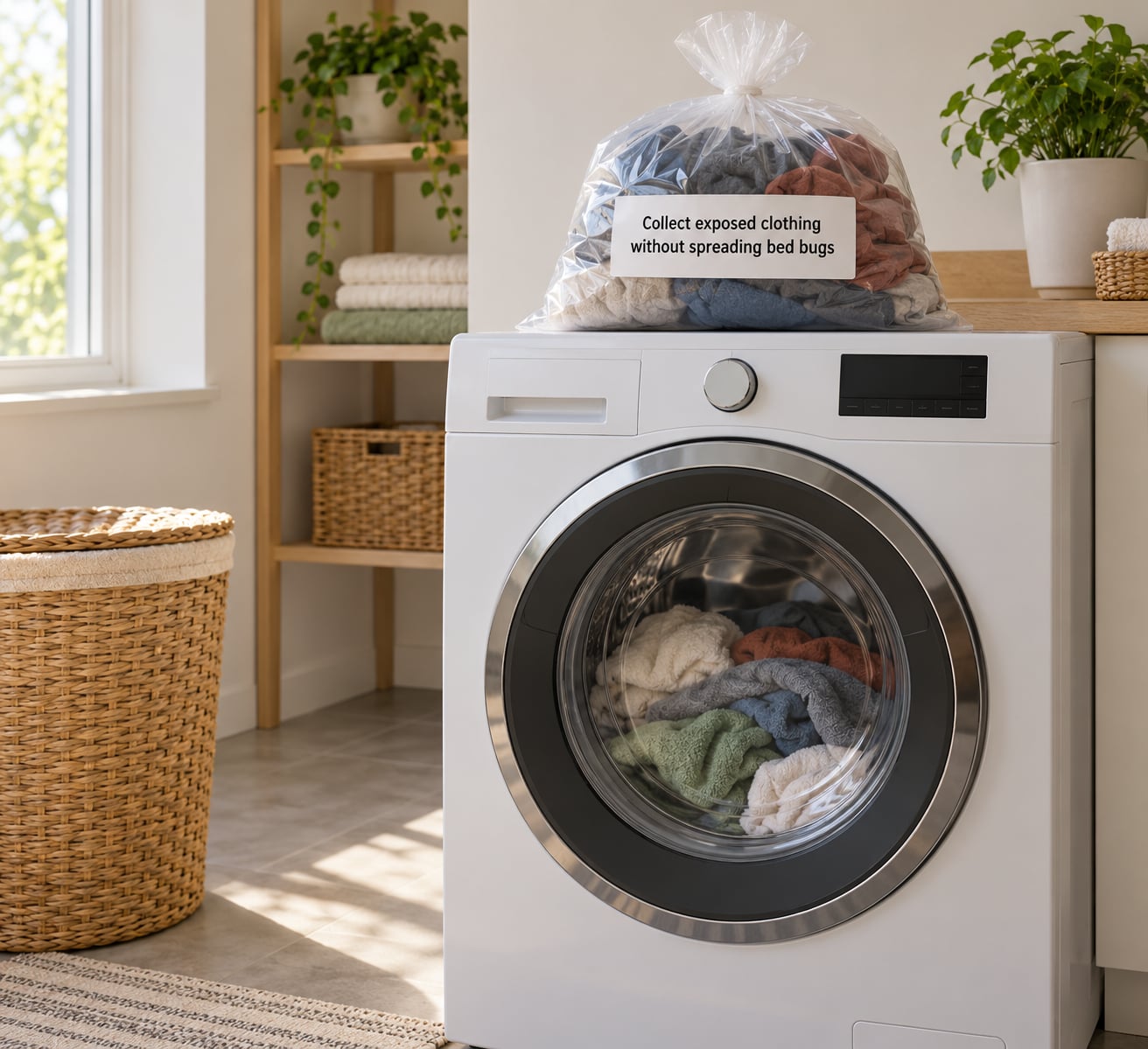
1. Collect exposed clothing without spreading bed bugs
Bag clothing where it lies. Do not carry a heap of exposed items to the hamper, and do not sort them on the floor.
Put clothing, linens, towels, and anything else washable straight into a sealed bag as you pick it up. Avoid shaking, beating, or flipping items, because that sends adults and nymphs onto the floor and up the wall. Seal each bag with tape, write the room and date on it, and keep bags closed until the moment they go into the machine.
Bug nymphs are fast enough to walk across a wall and along baseboards in a few minutes. Sorting in place is the single cheapest containment step available.
2. Separate items that can and cannot be washed
Three piles, three different fates. Confusing them is how wool sweaters end up in a 140°F cycle.
- Heavily exposed washables — bedding, sleepwear, towels, anything that slept on the mattress or sat on an infested chair. These go first, in their own load.
- Worn but lower-risk items — coats, work clothes, everyday pants that were in the room but not in contact with the bed. These get a separate load later.
- Non-washables — shoes, backpacks, jewelry, belts, electronics, and dry-clean-only garments. These get sealed and dealt with on their own terms.
For the third pile, household detergent is not a treatment method. Dry clean according to the garment’s label, take items to a professional heat treatment, or accept that some things get discarded.
3. How to wash clothes to kill bed bugs safely
Set the washer to its highest garment-safe temperature. If your machine has a sanitize or extra-hot setting, that is the one — it is how most modern washers reach 60°C (140°F).
Front loaders with a hot-water inlet tend to hit the higher temperatures, while many top loaders with a cold-only fill run cooler than the dial suggests. Run a long or extended cycle rather than a quick one, use the amount of detergent the box directs, and dry the load with no extra rinsing. Water temperature and time do the work; detergent is just a vehicle.
Keep the load small enough that the drum can move freely. A packed drum is the most common reason heat exposure falls short.
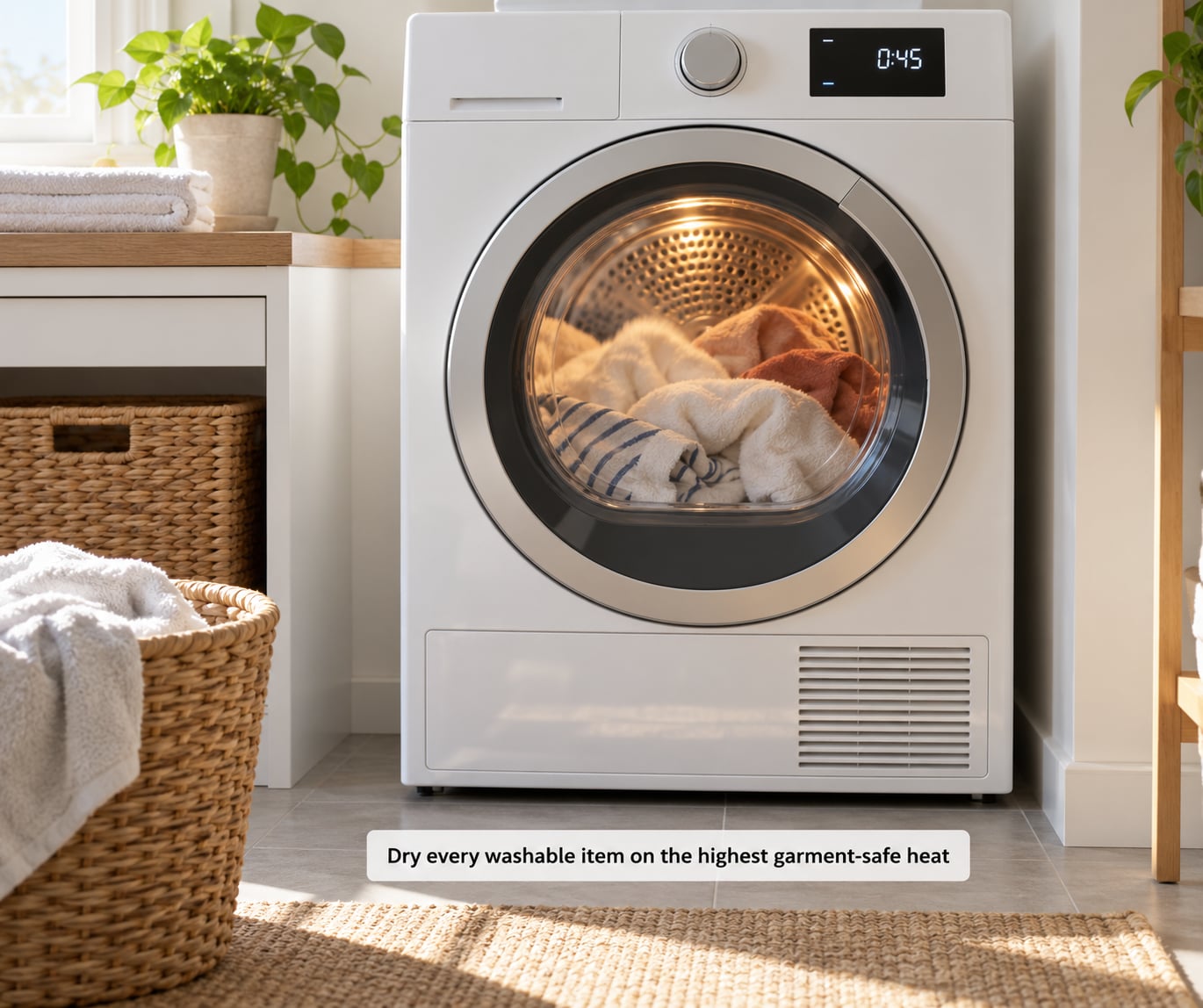
4. Dry every washable item on the highest garment-safe heat
The dryer is the part that actually finishes the job. Washing drowns some bugs and loosens others; sustained dry heat kills what remains, including eggs lodged in seams and waistbands.
Move the load straight from washer to dryer. Set it to high, or to the highest setting the care labels allow, and run it for at least 30 minutes on a timed cycle. Give thick items — jeans, layered sweaters, towels, a winter coat — 60 minutes, since trapped moisture in a fold is what defeats a short cycle.
If your dryer finishes on a sensor or moisture setting, the machine can end the cycle early. Override it with a timed or air-only continuation. On a shared or laundromat machine, an infrared thermometer is the cheapest way to settle the question of whether your dryer reaches the temperature on the dial.
Users on r/Bedbugs frequently ask whether a 34-minute cycle is long enough. For a normal load of cotton clothing it is. For anything thick or layered, treat it as a floor rather than a target.
Here is the reference for choosing settings by fabric. Wash water cools the moment it meets fabric, which is why the dryer figure is the one that decides whether eggs survive.
- Cotton sheets, towels, T-shirts and jeans — wash on the sanitize or extra-hot cycle at 140°F (60°C), dry on high for 30 to 60 minutes. Heat tolerance is rarely the problem with this group.
- Synthetic blends, sportswear and fleece — wash as warm to hot as the label allows, dry on high for 30 to 45 minutes. If it will not take the heat, dry clean it or seal and heat treat it.
- Wool sweaters and knits — cold or wool cycle per the label, then low heat for about 20 minutes. Otherwise, dry cleaning or a purpose-built heat treatment bag.
- Silk, rayon, linen and anything marked dry-clean-only — do not machine wash and do not tumble dry. Dry clean, professional heat treatment, or discard.
- Winter coats and down outerwear — hot per the label, one item at a time, then high for 60 minutes. Anything that will not take it goes to a professional heat treatment.
5. Inspect, seal, and store the treated items
Do not assume a clean-looking load is a finished load. Check seams, cuffs, waistbands, hoods, and elastic where bugs and eggs hide.
Look for live nymphs, cast skins left behind after molting, rust-coloured stains, and pinpoint blood spots. A flashlight and a lint roller help; a black flashlight is even better at making cast skins stand out. If you find anything, put that garment back through a full hot wash and a 60-minute dryer cycle rather than returning it to a sealed bin.
Then put the treated items in fresh sealed bins or bags, label them with the wash date, and keep them out of the affected room. Clothes washed today, folded into a bedroom that still has an active infestation will be re-exposed within days.
6. Treat non-washable belongings separately
Shoes, backpacks, hard cases, stuffed animals, and coats need their own protocol, and it is not a spray bottle of bleach.
Seal each item in a bag, then follow the manufacturer’s instructions for that material: dry cleaning, a labeled professional treatment, or a purpose-built heat treatment bag used according to its own instructions. Vacuuming and steam on a low setting reduce the numbers; neither reliably kills eggs across a whole item, and neither belongs in a dryer. Anything you cannot treat by a method that suits the material is better off discarded than returned to circulation.
7. Clean the laundry area and confirm the result
After the last load, the machines themselves need attention. Nobody asks this question, and it matters.
- Run the washer empty on its hottest sanitize cycle, with the drum about half full of water and a cup of bleach or a washer-cleaning product
- Wipe the door seal, gasket, detergent drawer, and the rim and underside of the lid where lint collects
- Run the dryer empty on high for 30 minutes, then clear the lint filter trap by hand
- Vacuum the hamper, baskets, floor, and baseboards around both appliances
Forum posters have reported seeing bed bugs inside laundromat washer machinery, and shared apartment laundry rooms are exactly the same problem. A hot wash cleans clothes, not the room they came from — so clean clothes are not proof that the bedroom is free of bed bugs.
Common Mistakes
Most failures are small and repeatable. Each one has a fix.
- Washing on warm or cold. Bed bugs need sustained heat. Fix: sanitize or extra-hot cycle at 130-140°F (54-60°C), or do not claim the load was treated.
- Short or sensor-controlled dryer cycles. A load can finish at 20 minutes and still hold viable eggs. Fix: 30 minutes minimum, 60 for thick items, timed cycle, repeated if the load was bulky.
- Mixing exposed items with the rest of the laundry. Fix: wash the heavily exposed load alone and first.
- Shaking clothing indoors before bagging. Fix: bag where the item lies, then seal and label.
- Expecting detergent, dryer sheets, or bleach spray to do the killing. Fix: heat does the work; no laundry additive replaces a hot dryer cycle.
- Using dry cleaning without checking the method. Not every cleaner runs a process hot enough or long enough to be a real treatment. Fix: ask how the garments are handled and whether items are sealed and treated individually.
- Believing clean clothes end the infestation. Laundering treats the item. The mattress, frame, baseboards, and neighbouring rooms need their own plan — encasements, targeted treatment, and often a professional.
- Stopping too early. If a single load is all you can manage, bag what is left, keep it sealed, and keep laundering in small batches. Half a job beats nothing.
Two scenarios deserve their own routine. If you buy second-hand or thrift clothing and have no infested room, bag the items on arrival and run them through the full hot wash and 60-minute dry cycle before they enter your wardrobe. If you have just come back from a hotel, hostel, or cruise, dry everything straight out of the suitcase on high before it goes near a bed — that is the routine travelers on r/solotravel report using, and it is much easier than an infestation.
Frequently Asked Questions
Can bed bugs survive washing and drying?
They rarely survive a full hot wash followed by 30 minutes of high-heat drying, but a wash alone does not reliably kill eggs. Bugs that survive a cool cycle can also climb out of an open machine door. That is why the load gets bagged, washed at 130-140°F, and dried on a timed high cycle of 30 minutes or more, then inspected before it is stored.
What should I do with clothes that cannot be machine washed?
Seal them and treat them by material, not by habit. Dry clean garments, wool, silk, rayon, and anything labeled dry-clean-only go to a cleaner you have asked about specifically, or to a professional heat treatment. Shoes, backpacks, and hard cases get bagged and inspected. Items you cannot treat by any approved method are usually better discarded than worn.
Is steam cleaning enough to control bed bugs on clothing?
No. Steam kills on contact, so bugs hidden in a seam, a fold, or a padded panel are missed entirely, and the treatment has to be repeated as the equipment cools. Use steam as a supplement for mattresses and furniture, not as a replacement for a hot wash and a 30-minute high-heat dryer cycle on clothing.
Do bed bug bites mean my clothes should be thrown away?
Bites alone do not mean that. People get bitten in hotels, on new furniture, and from guests, and bites do not confirm an infestation in the home. Look for the bugs themselves, cast skins, and rust-colored staining on sheets before discarding anything. Treating an unconfirmed problem usually means throwing away perfectly good clothing for nothing.
How soon should I check for bed bugs again after cleaning clothes?
Inspect the load the same day it comes out of the dryer, then re-inspect the bedroom weekly for two to three weeks. Bed bug bites can take up to about two weeks to show, so a lack of new bites right away proves little. If live bugs, cast skins, or fresh rust-colored spotting appear after treatment, the source is the bed or the room, not the laundry.
What to Do First
Bag the exposed items where they lie, seal and label them, and clear a path to the machine before you move anything.
Wash the most heavily affected garments first, on the sanitize or extra-hot cycle at 130-140°F (54-60°C), then dry on high for 30 minutes, longer for anything thick. Inspect the load, seal the clean items away from the affected room, and run your washer and dryer empty on hot when the last load is done.
Then keep laundering exposed items in small batches and keep inspecting the sleeping area. How to wash clothes to kill bed bugs is a solved problem on fabric. Clearing the room they came from is the harder half, and it is the half most people skip.