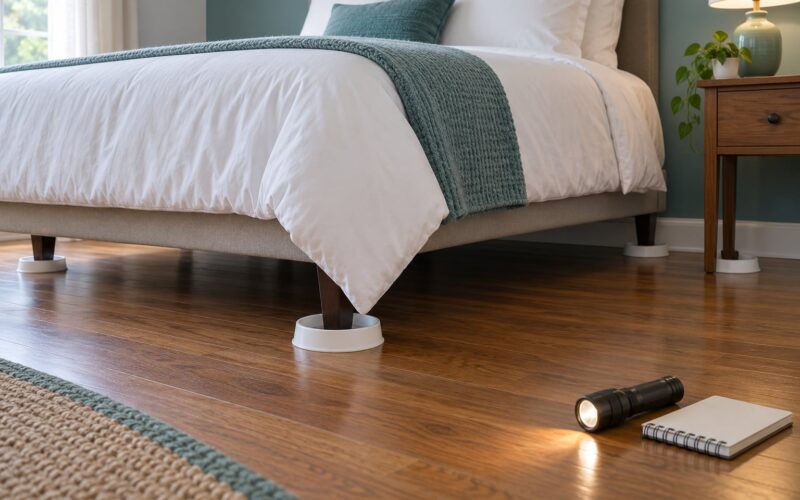
To keep bed bugs out of a dorm room, inspect the bed frame and mattress before you unpack anything, seal the mattress and box spring in zippered encasements, dry heat-exposed clothing and bedding on the highest dryer setting, keep your belongings off the floor, and file a housing work order the moment you find a live bug, a shed skin or a dark stain on a sheet.
None of that takes more than an afternoon at move-in, and most of it is free. It also matters that bed bugs have nothing to do with how clean a room is. They arrive on luggage, clothing, and second-hand furniture, and they can land in a spotless room just as easily as a messy one.
Residence halls are higher risk than most rooms because people cycle through them constantly. Every new resident brings a suitcase, a pile of clothes and often a thrift store find, and a single unnoticed introduction can spread along a row before anyone notices.
In the National Pest Management Association’s “Bugs Without Borders” survey, college dormitories ranked as the seventh most common location where pest management professionals encounter bed bugs, and 45 percent of those professionals reported treating dorms. The same survey notes that about 85 percent of bed bugs are found within five feet of the bed, which is why the bed area deserves nearly all of your attention.
What You Need Before You Inspect a Dorm Room
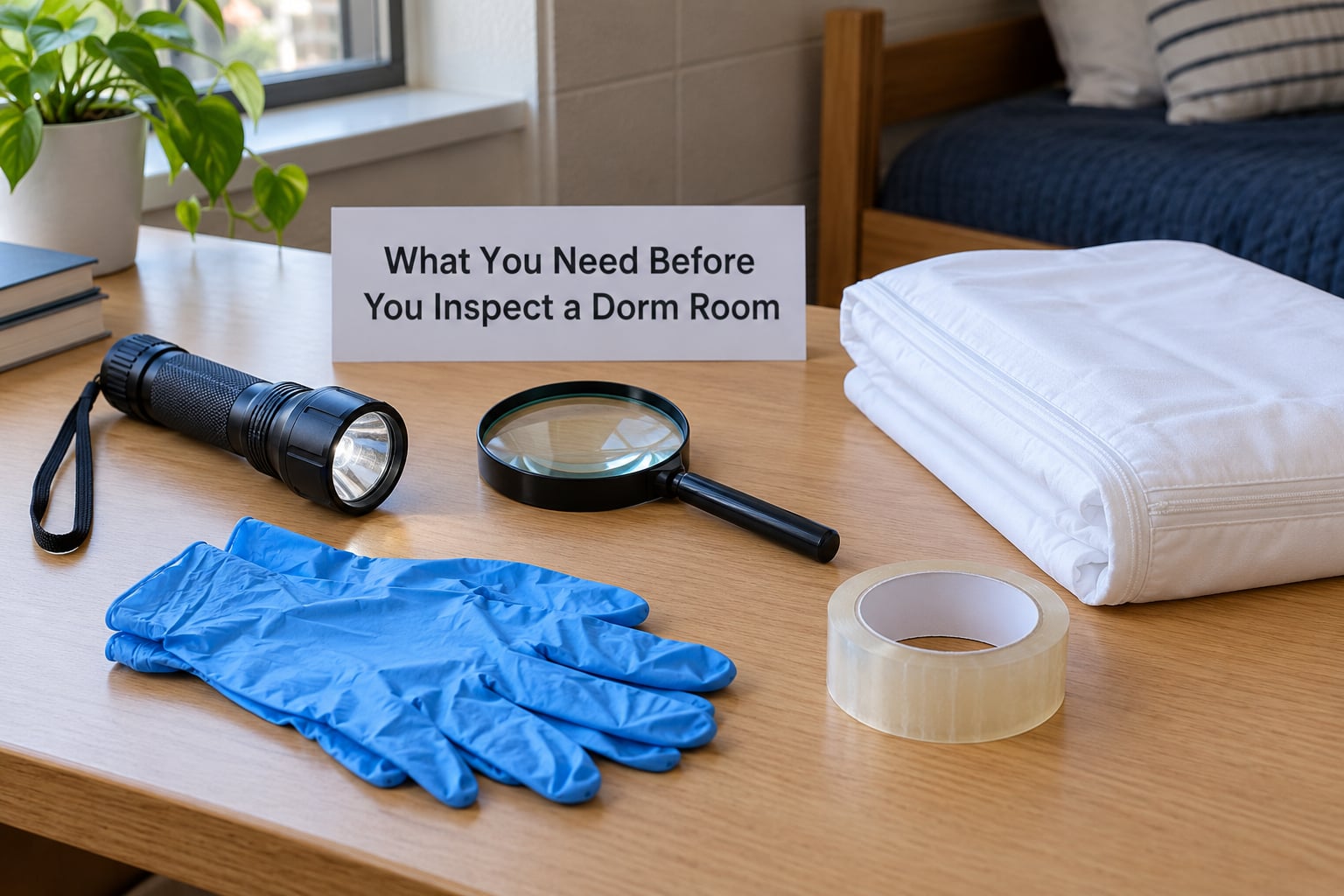
Most of this list costs very little, and several items are already in a dorm room. A flashlight, a phone camera, and a roll of clear packing tape cover most of what you need to do a careful ten-minute inspection.
- Flashlight — a narrow beam gets into seams and screw holes that a ceiling light never reaches.
- Magnifying glass or phone camera — nymphs are tiny and nearly translucent, so zoom in before you decide something is nothing.
- Clear packing tape — for capturing a suspected bug or cast skin so housing staff can identify it.
- Disposable gloves — you may be handling bedding that has not been washed in months.
- Zippered mattress and pillow encasements — sized for a twin dorm mattress, plus one for the box spring if the bed has one.
- Laundry bags — heavy-duty bags for bedding and clothing that cannot go straight into the dryer.
- Laundry detergent — any detergent works; the heat matters more than the soap.
- Ruler or measuring tape — so you can confirm the encasement actually fits the mattress before you zip it.
- Sealed storage bins or a luggage rack — to keep suitcases and bins off the floor.
If you want a bed bug interceptor or a mattress encasement, buy it before move-in day rather than after a roommate has already reported something. Search urgency is a bad reason to shop.
Step-by-Step: How to Keep Bed Bugs Out of a Dorm Room
1. Inspect the Mattress, Bed Frame, and Furniture
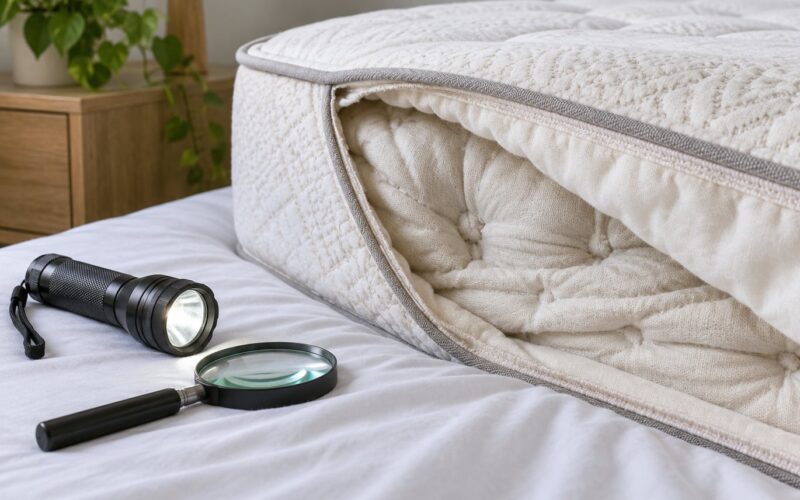
Bed bugs feed at night and hide by day, close to where people sleep. Start with the mattress itself: run your hands along every seam, the piping edge, the tufted indentations, and the handle, then check the underside where the mattress meets the platform.
Then work outward. Look at the box spring, the bed frame springs, the headboard brackets, screw holes, dowel pins and any gap where the mattress meets the frame. Dorm bed frames are popular harborages because they come apart into a dozen crevices that are never cleaned.
Move through the rest of the room in a fixed order so you do not skip anything: desk drawers, the space under the desk, the headboard wall, baseboards, electrical outlets, window blinds and any valance, and the space behind posters and wall art. A consistent sweep takes about ten minutes and is far more reliable than a casual glance.
You are looking for four things: live bugs that are flat, reddish-brown and roughly apple-seed sized; pale cast skins left behind as nymphs grow; tiny pale eggs; and dark reddish or rusty spots, which are droppings or dried blood on fabric. Rust-colored streaks on a fitted sheet near where you sleep are a strong clue even when you never see a bug.
You know the sweep worked if you can say what you checked. If you get interrupted halfway, start again rather than assuming the second half is clean.
It also helps to know what you are ruling out. Carpet beetle larvae leave brown, bristly husks and a matted spot in carpet rather than a seam, and bat bugs concentrate near windows and eaves where the building has wildlife access. Kissing bugs are larger, cone-headed, and hide in cracks and switch plates. Spider bites usually show up on arms and legs in ones and twos rather than in a straight line of three. If your only evidence is a bite and no sign near the bed, you do not have enough to call it.
Capture anything you find rather than crushing it or flushing it. Stick it to a sheet of clear tape, bag that tape in a sealed zip bag, and label it with the date and the room number. Housing staff and pest professionals can identify a taped specimen in seconds, and a photo helps them decide whether an inspection is warranted.
2. Wash and Dry Bedding and Clothing Thoroughly
Heat is what kills bed bugs, not detergent. Washing alone removes very little, because adults and nymphs can hold on to fabric in seam lines and elastics.
For anything that is dryer-safe, dry it on the highest heat setting for at least 15 minutes once the load is fully dry, not just damp. Bedding that has been near a possible exposure, clothing worn on a trip, and anything you pulled out of a shared dryer or a laundromat machine deserves this treatment.
For items that cannot go in a dryer, seal them in laundry bags or heavy plastic bags and have them heat-treated by housing staff or a pest professional, or treat them with the labeled product they specify. Do not improvise with a hair dryer, a heat gun, or a clothes iron pressed against a mattress seam; you will damage the fabric and probably not reach the temperature evenly.
Work out how you know it worked: when the load comes out bone dry after a full high-heat cycle, or when the bagged items have been professionally heat-treated and returned sealed. Anything less is not done.
3. Seal Mattresses, Pillows, and Box Springs
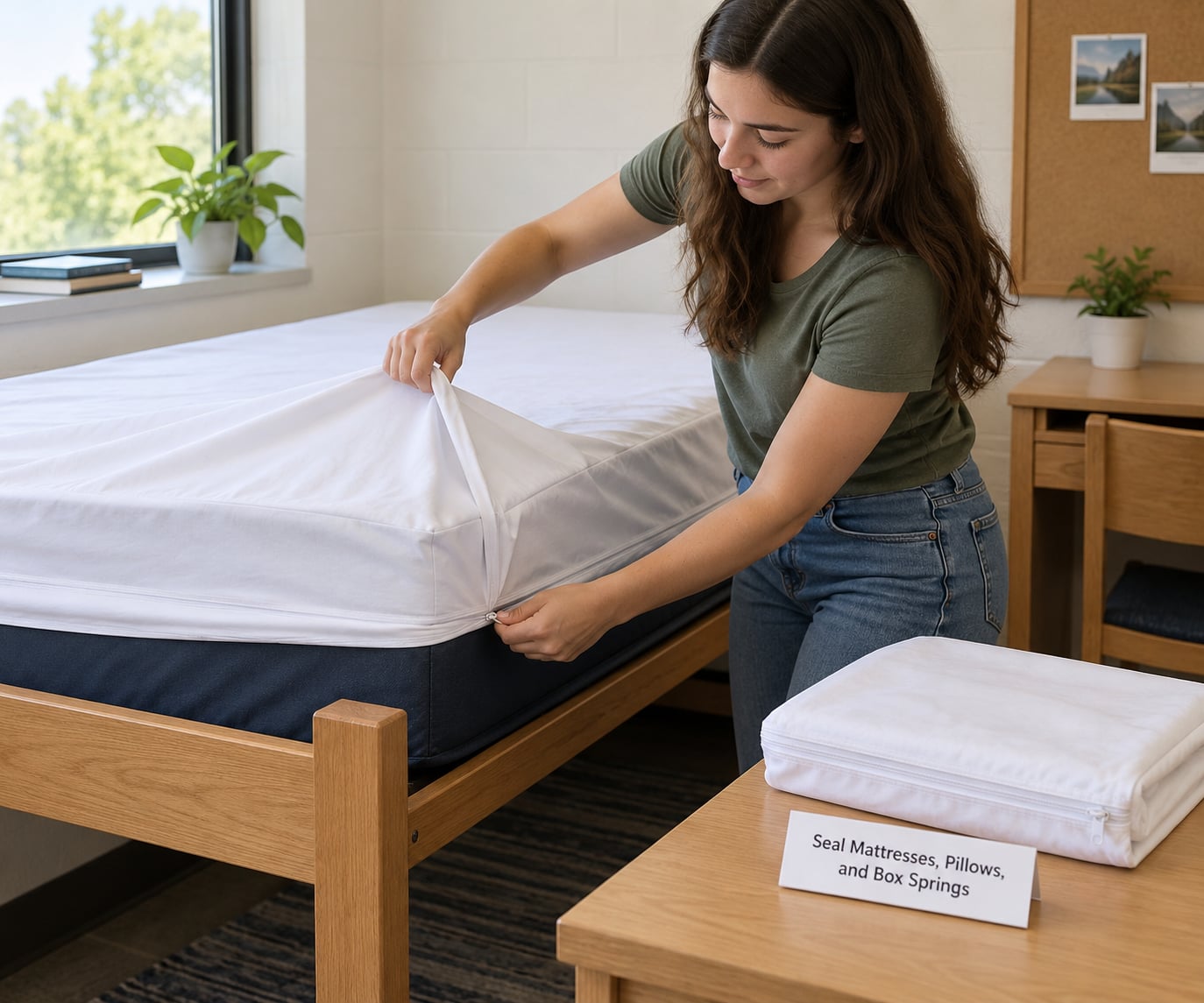
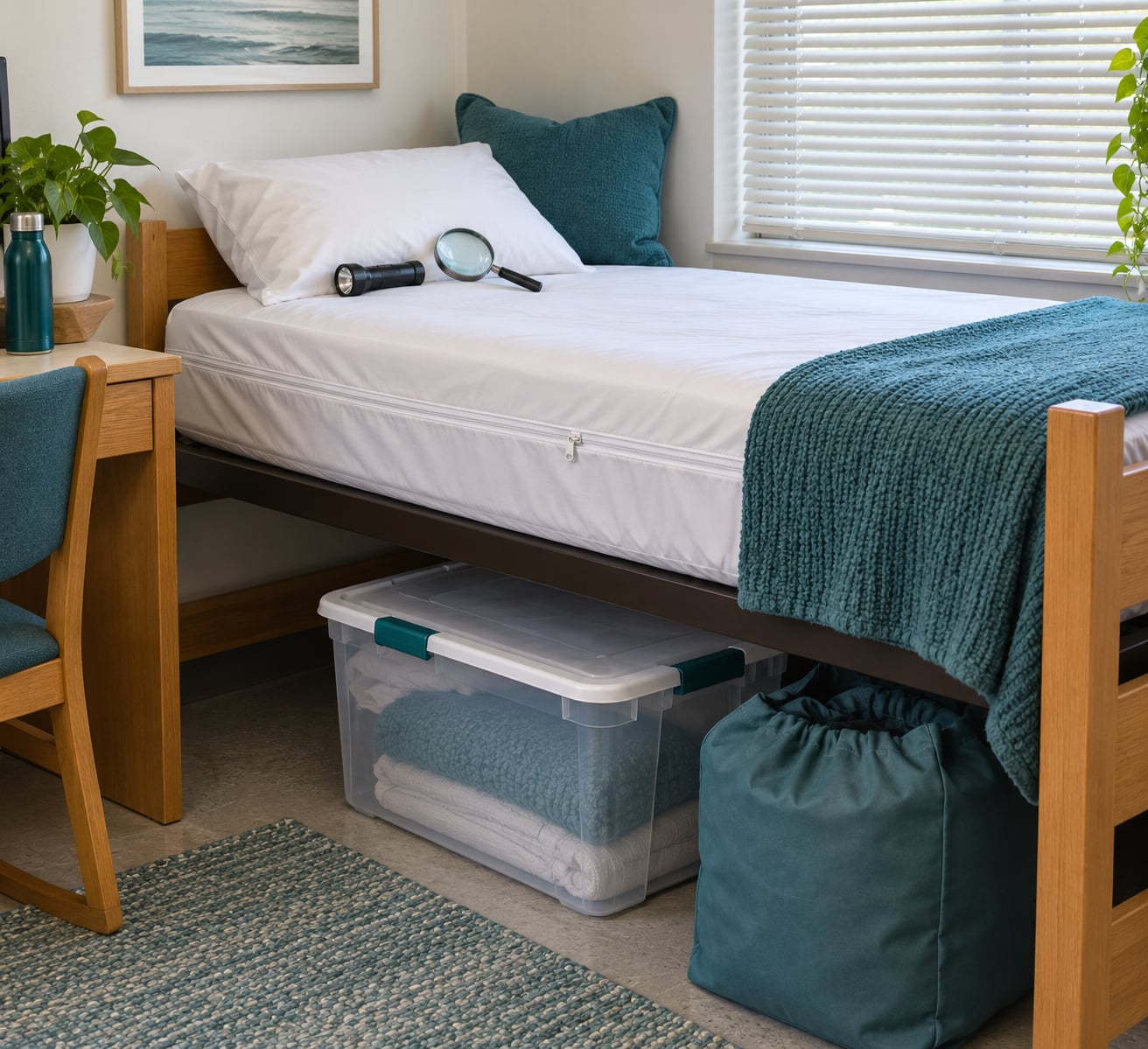
A zippered mattress encasement does one specific job: it gives bed bugs nowhere to hide on the mattress surface, and it traps any that are already inside so they eventually die without a meal. It is not a treatment on its own, and it does nothing for the frame, the box spring, or the rest of the room.
Measure the mattress before you buy. Dorm mattresses are almost always twin, but the encasement has to fit snugly enough that the zipper stays closed all night. While the encasement is on, seal every seam with tape if the zipper pull looks like it can slip, and write the install date on the encasement itself with a marker so you know when the six-month inspection is due.
Wrap the box spring separately if the bed has one, and put pillows inside encasements too, because seams and pillowcases are exactly where bed bugs settle.
Check the encasement monthly while you are checking the frame anyway. Look for tears, gaps at the zipper, and dark spotting on the outside surface. Leave it in place year-round unless housing staff tells you a problem has been ruled out or treated; taking it off early is one of the most common preventable mistakes, because it exposes a bed surface that has never been inspected.
4. Reduce Hiding Places and Prevent Transfers
Bed bugs travel on warmth and carbon dioxide, so the space around your bed matters as much as the bed itself. Keep suitcases, laundry baskets, backpacks, and storage boxes off the floor, ideally on a luggage rack or in sealed bins, and keep a clear path around all four sides of the bed.
Do not store bedding under the bed. It is a warm, dark, undisturbed spot within a few feet of where you sleep, which is the exact profile pest professionals describe for the places they find bed bugs. Same for piles of clothes on the floor and any gap where the mattress sags away from the frame.
The biggest transfer risk is second-hand furniture. Curbside finds, yard sale pieces, upholstered chairs, and borrowed mattresses are the classic entry route into a room, and no amount of laundering fixes an upholstered frame. If you want a secondhand piece in a dorm, the realistic options are to inspect it thoroughly first, or to leave it behind.
You know this step worked if you can look at the floor and see clear floor. That single test catches most of what matters.
5. Check Incoming Items and Reinspect on a Schedule
New belongings are how bed bugs get in, so make checking them a routine rather than a reaction. Before a trip, before you bring something home, and for about a week after you return, run the same five-part check that pest professionals teach to travelers.
- Survey — before you even sit down or lie down, look at the mattress seams, the headboard, and the area near the bed.
- Lift — lift the bedding one layer at a time, starting with the comforter, until you can see the mattress itself.
- Elevate — pick up luggage and bags off the floor before you look under them.
- Examine — check seams, hardware, screw holes, and the base of the headboard and footboard.
- Place — keep your belongings on hard surfaces or a rack, not soft furniture or the floor.
Run the same sweep on the way out of your own dorm before you leave for winter or spring break. Bag and launder worn clothing at home, keep luggage closed on the trip, and inspect your own bed frame the day you get back, before you start putting things away.
The shared laundry room deserves its own rule set. Dry on high heat and fold immediately rather than piling damp clothes into a cart that sits for an hour. Leave the dryer empty, clean the lint trap if your building asks you to, and take clean clothes straight to your room in a sealed bag rather than sorting them on a common table. If a shared dryer is running and a machine next to it has been sitting with a full load for a long time, choose another one.
Staying somewhere else matters too. Sleeping on a couch or an air mattress at a friend’s place is fine once you check it; sleeping in the same hotel or hostel bed repeatedly is higher risk because the same harborages get used night after night. Hostels and long-stay rental rooms are worth an extra five minutes of inspection for that reason.
Certain signs mean you call the housing office the same day: a live bug you captured, cast skins in a seam, dark spotting, or unexplained bites that keep appearing on exposed skin night after night. Bites alone are weak evidence on their own, since carpet beetles, bat bugs, spiders and mosquitoes all bite students in shared buildings. A captured specimen plus fecal spotting is a much stronger case.
Common Mistakes That Make Bed Bugs Worse
Selling only on sprays and foggers. Foggers and bug bombs are banned in most residence halls, and the reason is practical: they cannot reach bed bugs hiding in a mattress seam or a bed frame spring, they leave chemical residue in a space you sleep in for eight hours, and universities treat unauthorized pesticide use as a housing violation. The same goes for homemade sprays, essential oils, citronella and diatomaceous earth.
Moving your belongings to “get them safe.” The instinct is understandable and it is the fastest way to spread an infestation to another room, a friend’s dorm or a hallway. Keep everything where it is, then report it.
Storing bedding under the bed. This is a common placement error in dorms, and it puts your linen in a harborage zone.
Accepting curbside furniture without inspection. Upholstered and wooden-frame pieces are a well-known entry route. The cost of a used futon is never worth the risk in a room you may have to leave.
Removing the encasement early. If a treatment is planned or a sighting was cleared, leave the encasement on until housing staff says it is safe.
Waiting to report. Every day after a sighting is another night of feeding and a wider spread along the wall and to neighboring rooms. Reporting is not a disciplinary act, and residence halls generally handle pest treatment through housing rather than billing individual students, though policies vary, so ask your housing office what your school does.
Waiting for proof of an infestation before telling your roommate. If you have a captured bug, a cast skin, or a stained sheet, say so the same day. A shared room means shared decisions about laundry, encasements, and reporting.
Overreacting to a single bite. Skin reactions get blamed on bed bugs constantly. Bites usually appear in a line or cluster of three, on exposed skin, and show up on other people in the room too, but a lone itchy welt is much more likely to be a mosquito or a carpet beetle larva.
Frequently Asked Questions
Are bedbugs common in dorms?
Yes. In the National Pest Management Association’s Bugs Without Borders survey, college dormitories ranked as the seventh most common location for pest management professionals to encounter bed bugs, and 45 percent of professionals reported treating dorms. Three out of four also ranked bed bugs as the hardest pest to control. Dorms are high risk because of constant turnover, shared furniture, and heavy travel, not because of how clean the rooms are.
What smell do bed bugs hate most?
There is no proven smell that repells bed bugs. Peppermint oil, citronella, tea tree, lavender and rubbing alcohol all circulate online as deterrents, and none of them reliably repels or eliminates bed bugs in a room. Most residence halls also prohibit essential oils and unregistered pesticides in student rooms. What actually works is physical exclusion: encasements, high-heat laundering, sealed storage, and professional treatment.
What to do if you have bed bugs in a college dorm?
Do not move your belongings to another room. Photograph what you found, capture a bug or cast skin with clear tape, and submit a housing work order or tell your RA and community coordinator the same day. Launder bedding and clothing on the highest dryer heat for at least 15 minutes, and bag anything you cannot dry. Do not buy foggers, sprays, or bug bombs; housing supplies treatment and it is usually covered by the university.
What repels bed bugs instantly?
Nothing repels bed bugs instantly. No spray, oil, or scent reaches an established infestation, and any product sold as an instant fix is either ineffective or both. The only immediate actions are containment: stop moving items, bag loose belongings, keep clean laundry off the floor, and report. Professional treatment itself typically unfolds over days to weeks rather than a single visit.
How do I check my dorm room for bed bugs?
Ten minutes is enough if you go in order. Strip the bedding, check mattress seams, piping, tufting and the underside, then examine the box spring, bed frame springs, headboard hardware and screw holes, and gaps where the mattress meets the frame. Finish with desk drawers, baseboards, electrical outlets, window blinds and valances, and behind posters. Look for live apple-seed-sized bugs, pale cast skins, tiny eggs and rusty or dark spots on fabric.
Do mattress encasements stop bed bugs?
An encasement stops bed bugs from getting into a mattress seam and traps any that are already inside, where they eventually die without feeding. It does not treat the frame, the box spring or the rest of the room, and it does not work if it is the wrong size or if the zipper is left open. Buy it before move-in, seal the seams, inspect it monthly, and leave it on year-round unless housing staff approves removal.
Conclusion
If you do five things, you cover most of the risk: inspect the bed frame and mattress before you unpack, dry heat-exposed items on the highest setting, seal the mattress and box spring in zippered encasements, keep belongings and bedding off the floor, and report any sign the same day you find it.
Save your housing office and RA on-duty contacts in your phone before move-in day, not after you find a bug. A ten-minute inspection and a work order take less time than the fallout from a delayed report.