Using bed bug interceptors under bed legs takes about twenty minutes: pull the bed away from the wall, tuck up every hanging sheet, then slide one trap under each leg so the leg sits in the center well. After that, spend two minutes a week lifting each trap, shining a flashlight into the wells, and writing down what you find. That is the whole method, and it works because the traps catch bed bugs that a careful look around the mattress misses.
Interceptors also give you something no spray can. An empty trap in week two means something different from an empty trap in week eight, and a falling catch count is the clearest sign most people ever get that a treatment is working.
What they cannot do is end an infestation by themselves. Think of a bed bug interceptor as a monitoring tool that happens to drown the occasional bug on its way past, and the rest of this guide follows from that.
Table of Contents
- What You Need
- Step-by-Step
- Frequently Asked Questions
- How many bed bug interceptors should I put under my bed?
- Should the bed leg sit in the center of a bed bug interceptor?
- How often should I check bed bug interceptors under bed legs?
- Can an empty interceptor mean that my bed does not have bed bugs?
- Do bed bug interceptors get rid of an infestation on their own?
- Conclusion
What You Need
You need six things, and only one of them costs money beyond the traps themselves. Gather everything before you lift the mattress side of the bed, so you are not crawling around on your hands and knees twice.
- Interceptor traps — one per furniture leg, matched to the leg diameter. Buy a set with several sizes or a wide leg range, because bed legs, nightstand legs, and sofa feet are rarely the same width.
- Measuring tool — a tape measure for leg diameter and the wall gap, plus a ruler for the width of the baseboard gap you need to see into.
- Pen and masking tape or small labels — every trap gets a label naming the furniture and the leg, such as “queen bed, back right.”
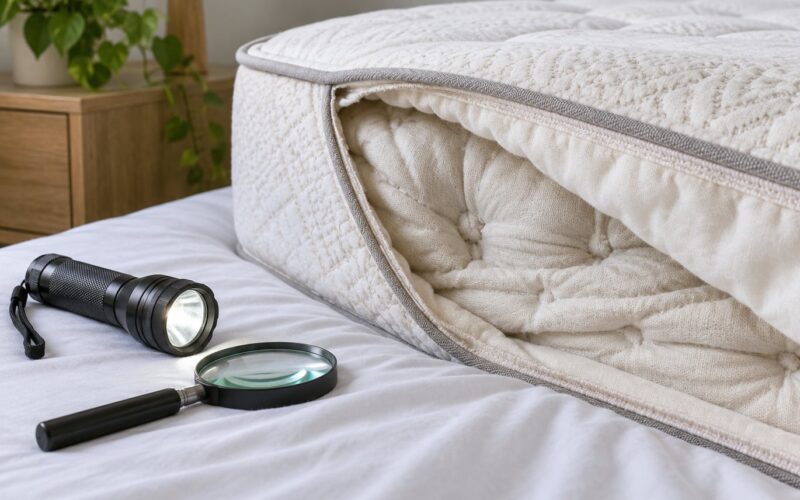
- Flashlight plus a hand lens or magnifying glass — a first-stage nymph is roughly the size of a pinhead and pale, and you will not find it without direct light and magnification.
- A dated log — a notebook or a note on your phone. One line per trap per check: date, what you found, which trap.
- A sealable container — a small vial, a specimen jar, or a zip-top bag for anything suspect you want to preserve.
- A reliable identification reference — comparison photographs from your state extension office or a land-grant university are better than product listings, which tend to show the insect people hoped to sell you.
One warning about the cheap traps. A very low-cost passive interceptor may come with no labeling, no leg-size range, and no instructions telling you whether the powder inside is part of the design or a packing residue. If you cannot tell what the trap is meant to do, it is not worth placing under a bed. Active monitors are a different category entirely: carbon dioxide or heat monitors need power and setup per their label, and they are built to attract rather than to passively wait.
Step-by-Step
How to Use Bed Bug Interceptors Under Bed Legs
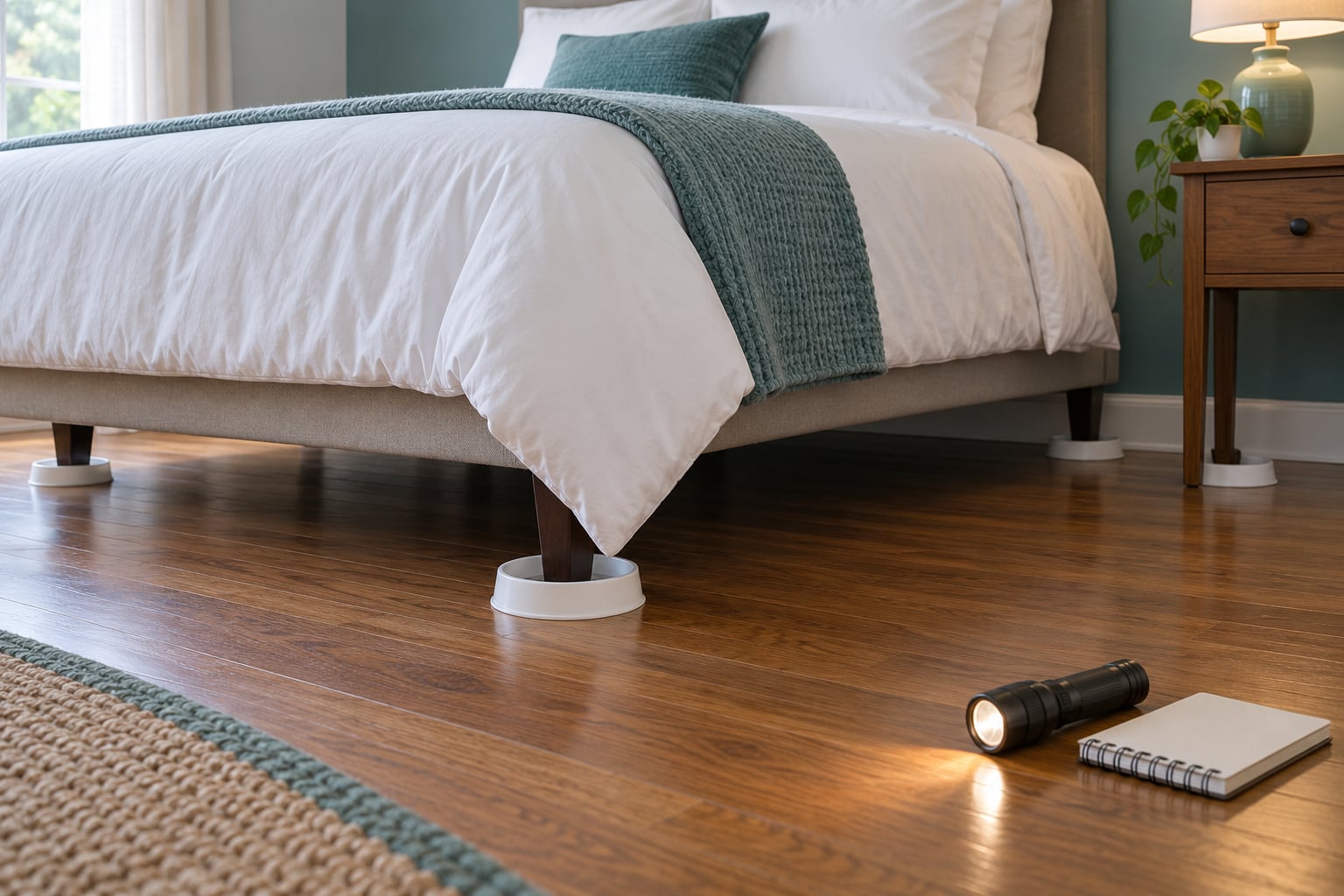
Here is the placement sequence in its shortest form. Pull the bed two to four inches off the wall, take the sheets and blankets off so nothing drapes to the floor, and check that no lamp cord, phone charger, or baseboard gap gives a bug a path. Then slide one trap under each leg so the leg drops into the raised center well and all four legs stay on solid floor. The leg should sit in the well, not be forced down into the opening.
That is the point of the two-well design. The outer moat has a rough wall a bed bug can climb, and the inner well has a slick wall it cannot scale once it falls in, so a bug walking up to the bed falls into the outer moat while a bug heading back down to the floor falls into the inner well. Both directions get trapped, which is why the counts in your two wells are worth recording separately.
Prepare the Bed and Check the Trap Design
Prep work decides whether the traps catch anything at all. The most common reason for a permanently empty trap is a bridge, and people in bed bug forums repeat one instruction more than any other: make sure your bed does not touch anything.
- Move the bed or sofa two to four inches away from the wall, baseboard, and headboard.
- Take off the bedding entirely for the first few checks, or tuck it up so no sheet, duvet, or bed skirt reaches the floor.
- Unplug and reroute lamp cords, phone chargers, and anything else that runs from the furniture to a wall or another piece of furniture.
- Check that the bed frame itself does not rest against the headboard wall, and that caster wheels or a platform base are not bridging down to the carpet.
Next, read the trap before you place it. Confirm the leg diameter range matches your furniture, and check whether the unit is a passive pitfall interceptor, which works with no chemicals and no power, or an active monitor, which needs its label instructions followed exactly.
Some passive traps arrive with a strip of adhesive holding the two halves together in the box. Peel that off. If it stays on, the halves cannot flex and the moat walls will not sit at the angle the design needs, and a trap that cannot flex will not catch. You should also confirm the trap can stay out for weeks with nothing added to it. If the design expects no powder and no liquid, adding your own diatomaceous earth is a separate decision with real drawbacks, mostly dust that travels into the room and settles on everything you own.
| Trap type | How it works | What it needs from you |
|---|---|---|
| Passive pitfall interceptor | Outer moat and inner well trap bugs by surface texture alone | Leg of the right size, level floor, weekly flashlight check |
| Powder-coated interceptor | Same pitfall design with a talc or similar coating that fouls the bug’s feet | The same, plus occasional re-coating per the label |
| Active monitor | Carbon dioxide, heat, or a light attract bugs to the trap | Power, exact setup per label, and a clear line of sight |
| Homemade dish or jar trap | A soapy water or talc surface in a shallow container | Making it, keeping it clean, replacing it often |
Place Every Trap Under a Bed Leg
One trap goes under every leg, not one trap under the bed. A single trap tells you almost nothing, because you have no idea which side the bug came from.
Cover the full sleeping surface: the four legs of the bed, and the legs of the box spring or platform if it is a separate piece. Then move outward to the nightstands, the dresser, any chair, and the sofa in the same room. A bug climbing the wall and dropping onto a nightstand never comes near your bed traps, and that is a common way a real infestation stays hidden for weeks.
Label each trap as you place it, and photograph the finished setup from a low angle. The photographs are for you three months from now, when you need to remember which leg was under the window and whether that one trap was the one that kept catching. If a leg is a caster, a square post, or an upholstered foot with no matching trap, choose a wider trap that the foot will seat into, or place the trap directly under the base of the post rather than leaving that leg bare.
You will know the placement worked when each leg sits in the center of a well, the trap sits flat with no rocking, and nothing in the room touches the floor anywhere near that furniture. Check the bed does not wobble, because a rocking leg lifts its trap just enough to break the seal.
Inspect the Interceptors on a Schedule
Check every trap at least once a week, and twice a week when you have a suspected infestation, an active treatment, or a recent trip where you stayed somewhere unfamiliar. Pick a fixed day. A schedule you keep is worth more than a thorough inspection you skip.
Lift the trap straight up and set it on a folded towel or a sheet of paper so you do not drop something on the floor. Look above the floor line, not just at the bottom, then check the grooves, the underside of the rim, and the floor right next to the trap for a bug that fell beside it rather than into it. Use the flashlight from a low angle so a pale nymph on a white floor still throws a shadow.
Count what you find in the outer moat and the inner well separately, and note whether it is a live bug, an exuviae, or droppings. Then put the trap back in exactly the same spot, without shaking bedding or rearranging the room to look around. Most empty traps get blamed on the product when the real problem is that a sheet was re-draped over the side of the bed the night before.
Collect Suspect Bugs Safely
If you find something, keep it intact. Tip the trap gently into a zip-top bag or a small vial, close it, and write the location and date on the outside with a marker. Do not spray insecticide into the trap, do not crush the insect, and do not brush it out with a cotton swab.
A crushed bug cannot be identified, and a bug that has been soaked in spray cannot be identified either. Household insecticide also destroys the evidence in a way that matters if you are dealing with a landlord, a security deposit, or a pest management company that needs to justify a treatment plan.
Identification is a matter of matching shape rather than color, because a first-stage nymph is pale and translucent while a fed adult is reddish brown. Look for a flat, oval body, no wings, and a three-segment antenna. Compare your specimen to identification photographs from your state extension service before you treat the room as infested, and take a photo of the trap in place with the label visible as your dated record.
Know When Interceptor Findings Need Follow-Up
A live bed bug in a trap is a confirmed presence in that room, and any one of these findings is enough to act: a live bug, shed skin left behind by a nymph, eggs in the seam of a trap, or dark reddish-brown spotting that smears like wet ink. Do not put the trap back and go to bed that night.
Leave the trap where it is and photograph it. Reduce your movement around that furniture, keep the room as it is so a professional can read the pattern, and inspect the mattress seams, box spring, headboard, baseboards, and nearby furniture yourself with a flashlight.
Then call a qualified pest management professional rather than starting a treatment plan from a forum thread. Interceptors monitor and trap; they do not reach a bug hiding in a seam, in a baseboard, or inside a wall outlet. A single catch plus signs on multiple pieces of furniture is a different situation from a single catch with nothing else found anywhere, and a professional can tell you which one you have.
Common Mistakes
Almost every empty trap traces back to one of these. Each has a fix you can make in under five minutes.
- Leg pushed into the center instead of seated in the well. A leg forced down closes the trap around itself and it catches nothing. Lift the trap, align the well under the leg, and let the trap rise around the leg on its own.
- Bed against the wall. Fix: move it two to four inches out, then re-check that the gap did not close when you made the bed.
- Sheet or duvet touching the floor. Fix: take the bedding off for the first several checks, or tuck it up high enough that you cannot see floor contact from above.
- Cords running from the bed to a wall outlet or lamp. Fix: unplug them and move the item to a different outlet on the same wall, with the cord looped up and off the floor.
- Traps only on the bed. Fix: add traps under nightstands, dressers, chairs, and the sofa in the same room.
- Checking once a month. Fix: set a recurring weekly reminder. A weekly trap with no catch is meaningful; a monthly one is not.
- Spraying insecticide into an empty trap. Fix: take it out of the room, discard it, and set a new one. The spray contaminates the well and ends your clean count.
- Expecting the traps to clear the room. Fix: keep them out as a monitoring layer inside a larger plan that includes isolation, encasements, targeted treatment, and professional service when evidence confirms an infestation.
Tips for Better Bed Bug Monitoring
A few habits make the data much more useful. Keep the traps level, because a tilted well gives a bug a grip it would not otherwise have, and check the traps that sit on thick-pile carpet more often, since carpet compresses the moat and can rock the trap.
Do not treat one insect as a verdict on the whole house. One nymph in a center well is common in a room that had activity weeks earlier and may be a leftover, and a single catch tells you where to look, not how much you are dealing with. On the other hand, catches in more than one trap in the same week is a stronger signal than one catch alone, and that pattern is exactly what your log is for.
When one bed is producing catches, extend the traps to the adjacent rooms rather than assuming the wall stopped them. Bed bugs move along baseboards, pipes, and shared electrical lines, and a second empty set of traps in the next room is useful information in both directions.
Keep every specimen and every photograph. A dated photo of a nymph in a labeled trap is the single most persuasive thing you can hand a landlord, a tenant, or a pest management company, and it takes ten seconds to take while you are already holding the flashlight.
Frequently Asked Questions
How many bed bug interceptors should I put under my bed?
Put one under every leg, which is four for a standard bed frame. Add traps for the box spring or platform if it is separate, then cover the nightstands, dresser, chair, and any sofa in the same room. A single trap under the bed tells you almost nothing, because you cannot tell which side a bug approached from. Label each trap by furniture and leg so your weekly counts stay meaningful.
Should the bed leg sit in the center of a bed bug interceptor?
Yes. The leg should drop into the raised center well and rest there while the trap walls sit flat against the floor. Do not push the leg down into the opening or force the trap upward; that closes the moat around the leg and it will catch nothing. If the leg will not stay in the well, the trap is the wrong size for that leg.
How often should I check bed bug interceptors under bed legs?
At least once a week, on a fixed day, and twice a week when you have a suspected infestation, an active treatment, or recent travel. Lift each trap, check above the floor line and in the grooves with a flashlight and a hand lens, then return it to the same spot. Record the date and the count each time so you can see the trend over several weeks.
Can an empty interceptor mean that my bed does not have bed bugs?
It means the trap caught nothing during that period, which is not the same as a clean room. Bed bugs hide in mattress seams, box springs, baseboards, and behind outlets, and they may simply not have crossed that floor. Confirm the setup first: bedding off the floor, bed pulled away from the wall, no cords bridging to a wall. An empty trap on a well-prepared bed is neutral, not a clearance.
Do bed bug interceptors get rid of an infestation on their own?
No. Interceptors are a monitoring tool. They trap and drown the occasional bug that crosses that floor, but they cannot reach a bug inside a seam, a baseboard, or a wall outlet, and the catch rate is usually low even in a confirmed infestation. Use them alongside isolation, mattress encasements, targeted treatment, and professional pest management when evidence confirms an infestation.
Conclusion
The first thing to do is place interceptors correctly: pull the bed two to four inches off the wall, get all bedding off the floor, and seat one trap under every leg with the leg resting in the center well. Do the same for the nightstands, dresser, and sofa, label each trap, and take one low photo of the finished setup.
From there it is a weekly habit. Two minutes with a flashlight, a hand lens, and a dated log will tell you more about your situation than any amount of guessing. And when the log shows a catch, keep the specimen, photograph it in place, and bring in a pest management professional, because monitoring works best beside isolation, encasements, treatment, and expert eyes, not instead of them.