Most brown recluse identifications can be made from about three feet away, without touching the spider and without killing it. A brown recluse, Loxosceles reclusa, is a small, smooth-bodied, uniformly tan-to-dark-brown spider, roughly the size of a quarter to a half-dollar, and it is the only common US house spider with six eyes, a fiddleback-shaped mark on its back, and a messy web that does not catch prey. This guide walks through the checks in the order that works, including the features that rule a spider out.
Here is the short version for anyone who just found something in a bedroom or storage room. Freeze where you are, keep children and pets out of the room, do not swat it, and take a photo with your phone. Everything below can be done standing up.
What You Need
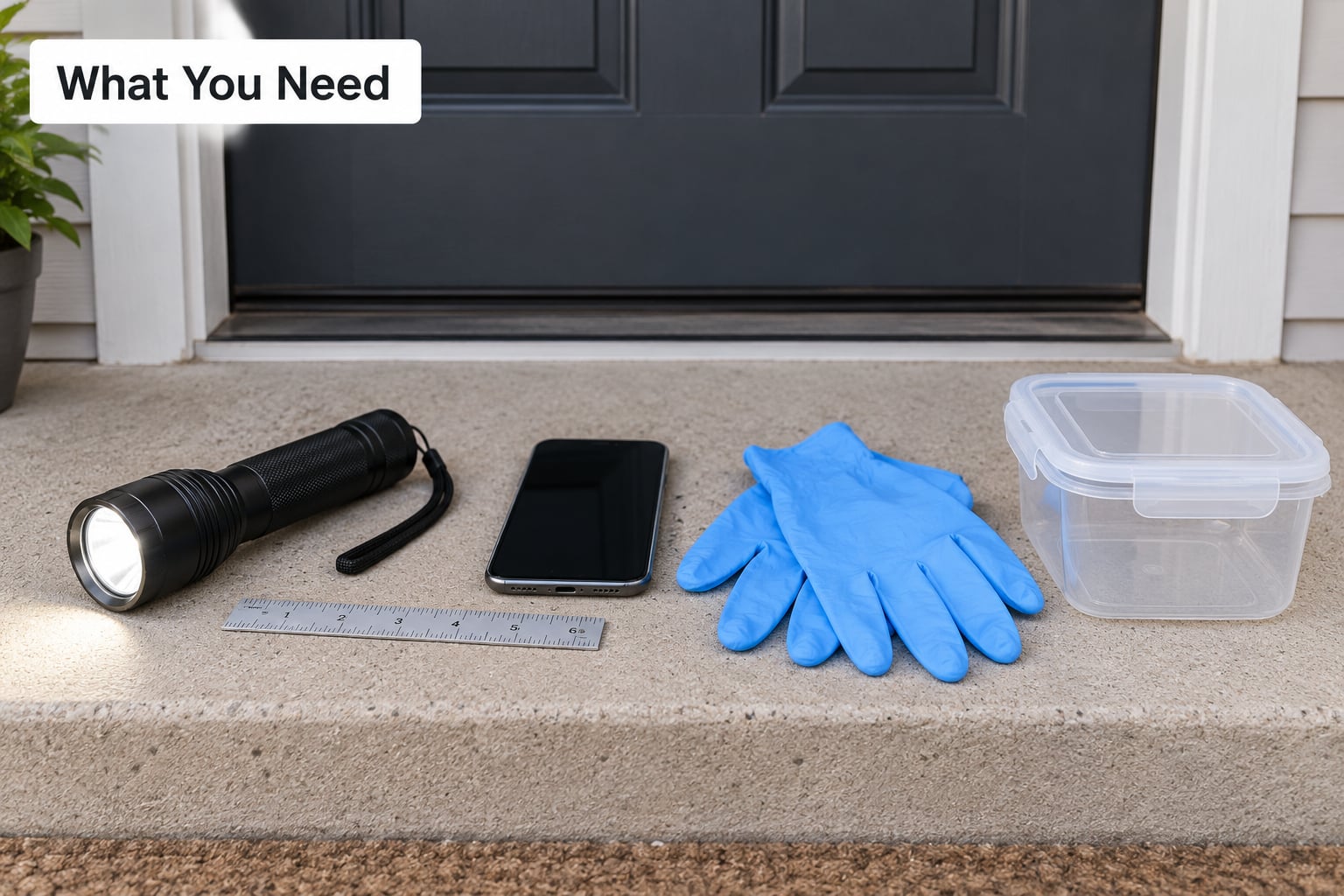
You need very little. A bright flashlight, a ruler or measuring tape, your phone camera, a pair of disposable gloves, and a clear container with a lid or a paper cup are enough for a careful look at almost any suspect spider.
Gloves are not a license to pick the spider up. They protect your hands if you brush against a surface it is sitting on, and they are useful for handling clothing or bedding that a spider may be hiding in, but the identification itself should happen at a distance.
The clear container matters for a specific reason. A brown recluse caught in a glue trap can still be alive and still able to bite, so a trap is a collection method, not a disposal method. A lidded cup or jar gives you a way to contain a specimen without crushing it, and it lets you carry it to someone who can identify it properly.
Add one more thing to the list: the phone number of a local cooperative extension office or pest professional. If the identification actually matters, because someone in the house is anxious, or a bite is suspected, or you need the specimen confirmed, that is the person to call.
Step-by-Step: How to Identify a Brown Recluse Spider Safely
Work through these six checks in order. The first two keep you safe, the next three describe the spider, and the last one decides whether you need outside help.
1. Keep a safe distance and secure the area
Move children, pets, and other people out of the room first, not after you have started looking closely. A startled spider running across a bed is the scenario that turns into a bite, and a frightened adult waving a shoe is what most bites actually involve.
Then give the spider room. Do not reach toward it, do not swat it, do not slide a magazine or a broom handle at it, and do not lean your face in to see the eyes. If it is in a closet, bedroom, garage, storage area, or a stack of boxes you just moved, your job right now is to keep the area undisturbed so it stays where it is.
Two rooms are worth doing immediately. If the spider was in a bedroom, check the other sleeping rooms, and if it was in a crib or on a child’s bed, move the child to another room for the night rather than picking the spider off the bedding.
2. Observe the spider from several angles
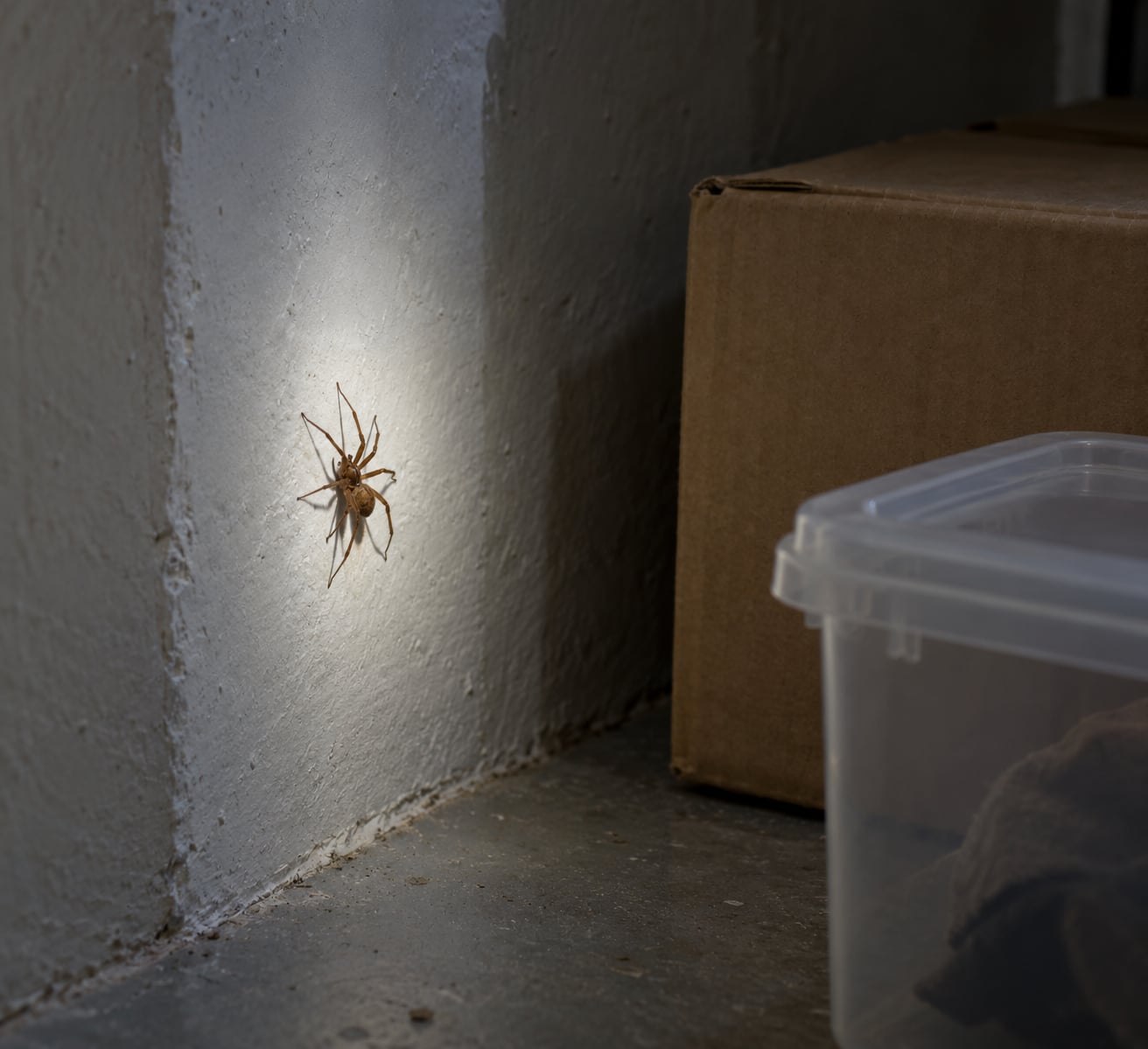
Use the flashlight from a low angle and photograph it from above and from the side. Zoom is more useful than closeness, which is why a phone beats leaning in. A clear photo also lets you send it to someone qualified later, which is the most common way a real identification happens.
Expect the spider to move. Brown recluses are nocturnal and reclusive, and they are most often noticed at night in a low-traffic room, near a floor or wall corner, or in a box that was just disturbed. A disturbed recluse usually retreats, and a disturbed specimen showing a different body posture than the one you saw on the wall is not a reason to rule anything in or out.
Behavior alone identifies almost nothing. Hiding, moving quickly, or holding still is common across dozens of harmless species, so treat the behavior as a reason to watch quietly rather than as evidence.
3. Check the body shape and leg arrangement
Look for a small spider with a smooth, non-hairy body, uniform tan-to-brown color with no stripes or bands on the legs, and slender legs held in that same uniform brown. Adults are usually about a quarter to a half-inch long for the body, with a total leg span around an inch to an inch and a half.
There is often a violin or fiddleback-shaped marking on the top of the cephalothorax, the front body section, with the narrow neck of the shape pointing toward the rear of the spider. Here is the detail that causes most of the wrong answers: on a live specimen that marking is often faint, partially hidden, or not visible at all, especially in young spiders. Many confirmed brown recluses have no visible violin, so its absence means nothing and its presence confirms very little on its own.
If the spider is dead, a recluse characteristically folds its legs tightly under its body rather than spreading them out. That is a useful supporting clue, not a rule, since many species curl when they die.
4. Look for the identifying eye pattern
Brown recluses have six eyes rather than the eight of most other spiders, arranged in three pairs, with the middle pair noticeably smaller than the other two. That single feature separates the species from almost every common house spider in the United States.
Do not check it by leaning in. Use your camera zoom plus the flashlight, and if you cannot resolve the eye count in a clear photo, accept that the eyes are unconfirmed and move on. Several features together make a case; one feature never does.
5. Compare common look-alikes
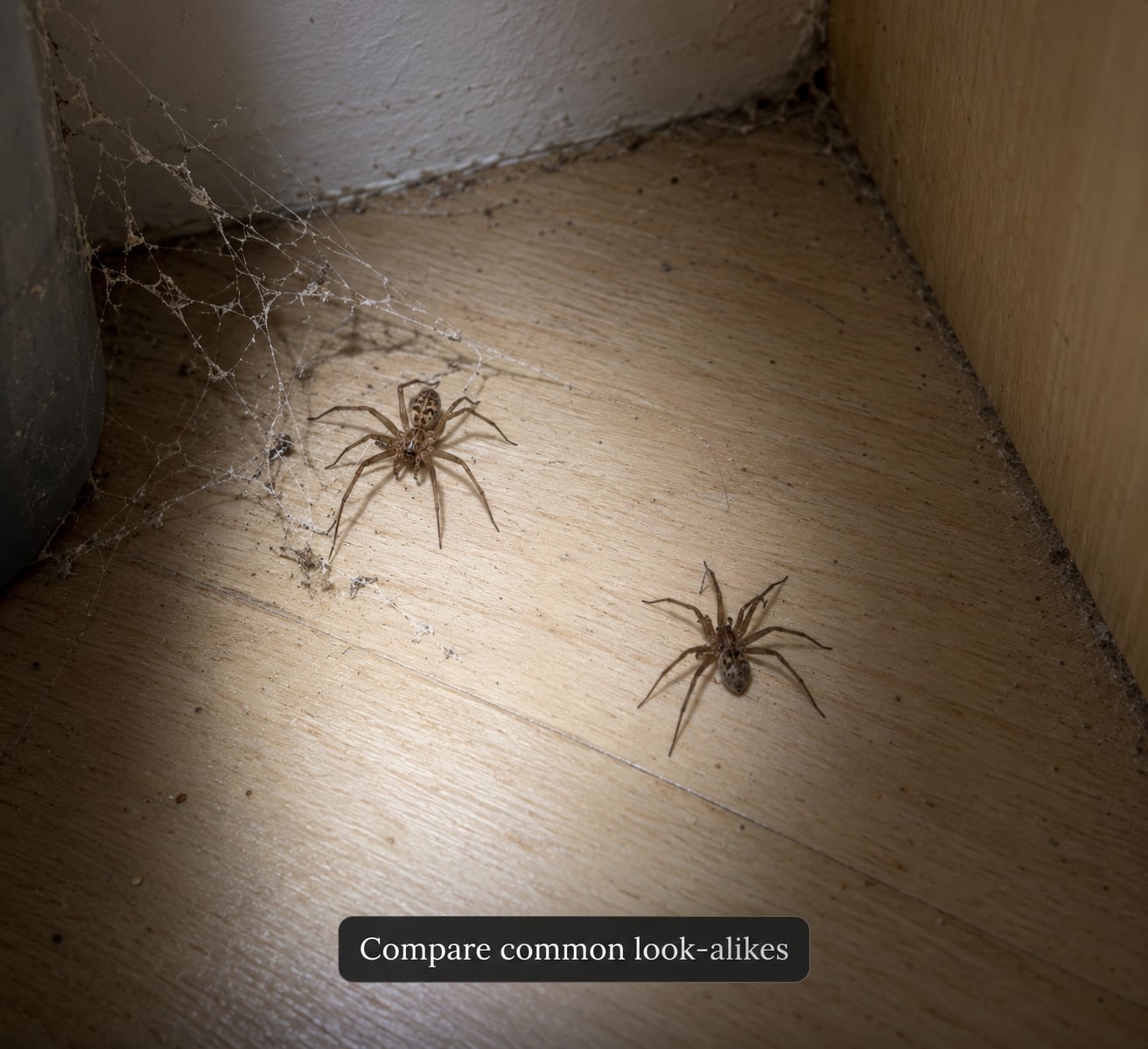
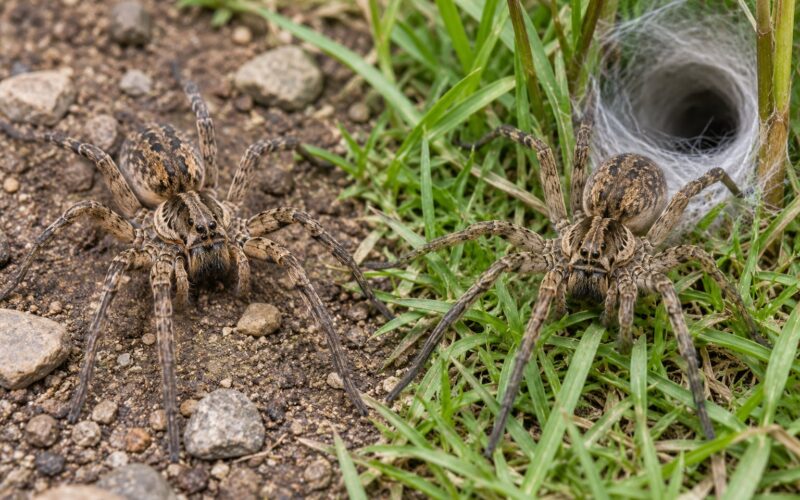
Most spiders people photograph and post as recluses are something else. Use the table to rule candidates out rather than trying to force a match onto the recluse row.
| Feature | Brown recluse | Wolf spider | Cellar spider | Common house spider |
|---|---|---|---|---|
| Body covering | Smooth, not hairy | Noticeably hairy and robust | Very small, delicate body | Hairy, patterned abdomen |
| Legs | Slender, uniform tan to brown, no bands | Thick, hairy, often banded | Extremely long and thin relative to body | Thick, hairy, banded or striped |
| Markings | Faint or absent violin on the back | Striped, spotted, or banded abdomen | No violin marking | Chevron or mottled pattern on abdomen |
| Eyes | Six eyes, middle pair smaller | Eight eyes, two large forward-facing | Eight eyes | Eight eyes |
| Web | Loose, irregular, off-white threads in a sheltered corner, not a capture web | No web, hunts on the ground | Tangled, messy, often in ceilings and corners | Messy cobweb in corners and windowsills |
| Where you find it | Dark, sheltered, low-traffic spots: closets, basements, storage boxes, woodpiles | Outdoors, in leaf litter, or wandering indoors at night | Basements, ceilings, corners, window frames | Corners, window frames, behind objects indoors |
Two quick rules do most of the work. If the spider has striped or banded legs, or a hairy body, or a patterned abdomen, or a large obvious pair of forward-facing eyes, it is not a brown recluse. And if you find a neat, symmetrical orb web, the spider that made it is almost certainly not one.
Geography works as a first filter too. Brown recluses are native to the south-central and Midwestern United States, roughly the area running from the southern Plains through the lower Midwest. Outside that range, a genuine brown recluse is unlikely, and a photo ID request is often better spent on the more common look-alikes in your area.
6. Confirm the identification or get help
Some cases cannot be settled from a photo, and that is normal. Web presence is one example: in some buildings and some regions, recluse webs are never obvious, so the absence of a messy web does not clear a spider.
When you want confirmation, send a sharp photo plus the location, date, and approximate size to your state cooperative extension office, and many will identify from images. Alternatively, place the specimen in a sealed container or a clear vial and take it to a pest professional, a local nature center, or a university entomology department.
On bites: brown recluse venom is dermonecrotic, meaning it can damage skin tissue where it is injected, and the effects of a confirmed bite can progress over days. Bites are uncommon, and many reported recluse bites turn out to be other insects or other spiders once the wound is examined. If you are bitten, wash the area, keep it clean, and photograph it. Get prompt medical care for a bite with severe pain, spreading redness, fever, or tissue breakdown, and urgent care for any reaction that is affecting breathing or swelling the face. A clinician decides those questions, not a web page, and this article does not attempt to diagnose a wound.
Common Mistakes
Treating every brown spider as a brown recluse. This is the most common error and it causes a lot of unnecessary fear and unnecessary treatment spending. Most small brown spiders indoors in the United States are common house spiders, cellar spiders, or wolf spiders. Rule a spider out with the table above before you start worrying about it.
Requiring the violin marking. Plenty of confirmed recluses show no visible violin, especially juveniles. If your whole identification rests on that mark, you will get the wrong answer in both directions: you will miss real recluses and you will believe a harmless spider that happens to have a faint smudge on its back.
Getting close enough to touch. Bites happen when a spider is trapped against skin, in clothing, in a shoe, or in bedding. Moving it from a wall is a different task from killing it, and the safe method is a container, not your hands.
Swatting, stomping, or vacuuming first. Crushing a specimen removes your chance to photograph it or have it confirmed, and it turns a harmless sighting into a panic. Capture and release is cleaner in every direction.
Leaving a glue trap as the solution. A spider in a sticky trap can survive and can still bite, and you will be handling a trapped animal to dispose of it. Check traps, and cover the container or the trap with a sealed bag before you throw it away.
Searching room by room and disturbing everything. Looking for a second spider by moving boxes and furniture wakes the first one. Sticky traps along walls and in low-traffic spots, checked every few days, give you a much better picture of whether one spider is a coincidence or a population.
After a confirmed sighting, prevention is mostly mechanical: cut clutter in closets, basements, and storage areas, move stored materials off the floor and away from walls, seal gaps where pipes and cables enter the building, and keep woodpiles and stacked boxes away from the structure. Reducing the insects a recluse eats also helps, and that is where a general pest control plan earns its keep.
Frequently Asked Questions
How can you tell if a spider is a brown recluse?
Check several features together rather than one. A brown recluse is small, smooth and non-hairy, uniformly tan to dark brown with no bands on the legs, has six eyes with the middle pair smaller, and produces a loose, irregular, off-white web that is not a prey-catching orb. The violin-shaped back marking is often too faint to see on a live spider, so its absence does not rule the species out.
Is it safe to sleep in a room where I have seen a brown recluse?
Yes, generally. Brown recluses are reclusive, nocturnal, and non-aggressive, and bites almost always happen when a spider is trapped against a person rather than from an attack. Shake out bedding and clothing, check the mattress edges and the space behind the headboard, and move the child to another room if a crib was involved. Bites are uncommon and many reported ones turn out to be other insects.
How do you know if you were bitten by a brown recluse?
You usually cannot tell from the wound alone. Brown recluse bites often go unnoticed at first, then develop pain, redness, and blistering that can progress to tissue breakdown over several days, and many other insect bites look the same. Wash the area, keep it clean, photograph it as it changes, and have a clinician assess it, especially if pain is severe, redness spreads, or you develop fever.
What do brown recluse spiders eat?
Small insects and other arthropods, including crickets, roaches, and other spiders. That hunting is one reason recluses can be useful in a home: a few of them keep insect numbers down without doing any structural damage. It also means that reducing general insect problems, plus cutting clutter and sealing entry points, goes a long way toward making the house less interesting to them.
Do brown recluse spiders bite people often?
No. Encounters are common in parts of the south-central and Midwestern United States, but bites are rare because the spider avoids people and only bites when it is pressed against skin, such as when it is trapped in clothing, a shoe, or bedding. Outside their native range, a spider reported as a recluse is far more likely to be a common house spider, wolf spider, or cellar spider.
How do I get rid of brown recluse spiders in my house?
Start by removing what they need: clear out closets, basements, and storage areas, lift stored boxes off the floor, move woodpiles and stacked materials away from the walls, and seal gaps around pipes, cables, and vents. Sticky traps along walls and in low-traffic corners, checked regularly, show you whether sightings were isolated. If you are seeing one regularly or several at a time, a pest professional who works with this species is worth the call.
What to Do First If You Find One
Move the people and pets out, leave the spider where it is, and take a clear photo from a few feet away. Then rule it out: striped legs, a hairy body, a patterned abdomen, eight obvious eyes, or a tidy orb web all mean it is something else. If several features still point toward a brown recluse, container it rather than crush it, and send the photo to a local extension service for a call you can trust. Knowing how to identify a brown recluse spider safely takes about three minutes of careful looking, and one accurate identification is worth more than a month of worrying.