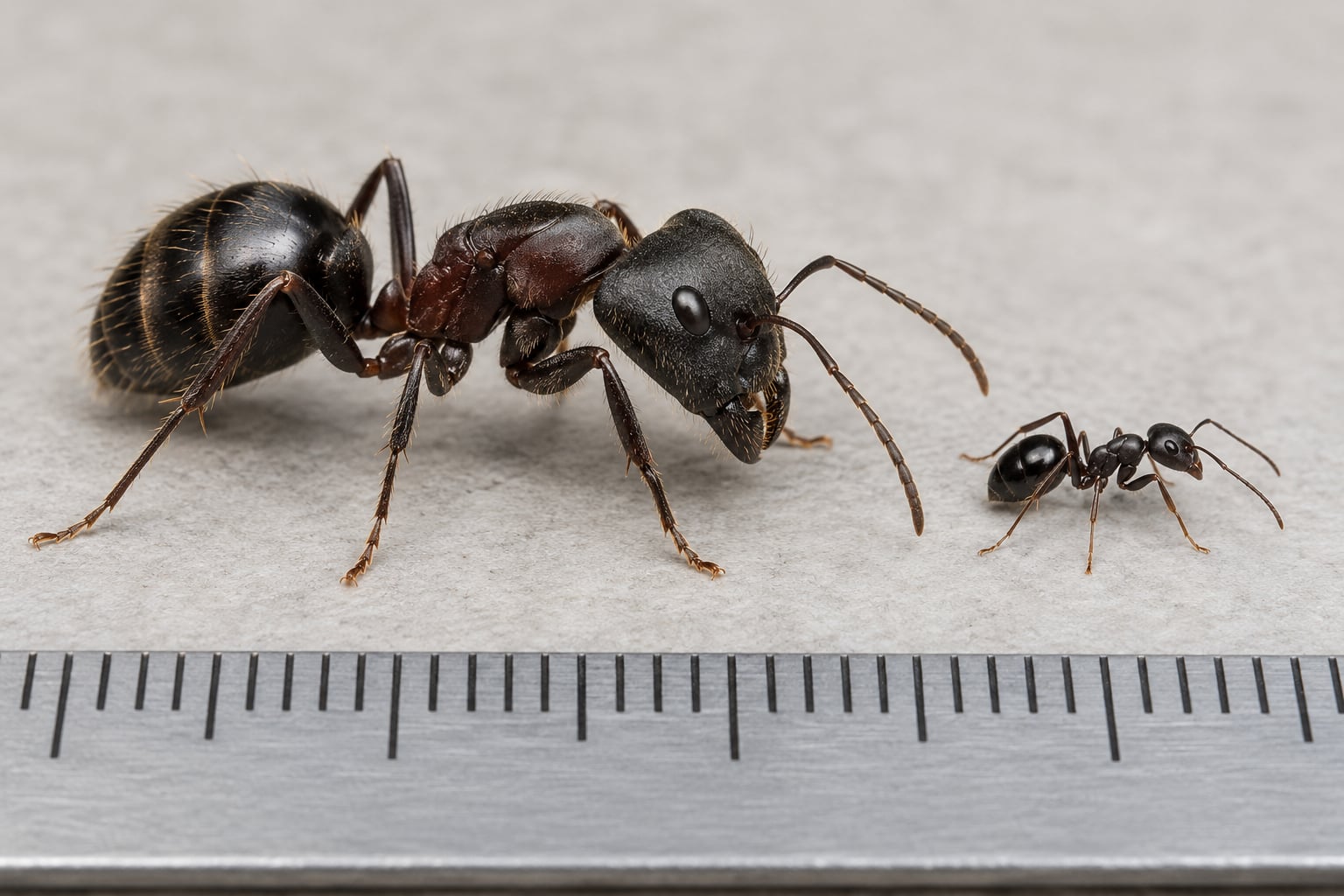
Color is the least reliable way to tell these two apart. For carpenter ant vs black ant identification, check three things instead: how long it is, where you found it, and what is underneath it. Carpenter ants run a quarter inch to a half inch, nest inside damp wood, and leave coarse sawdust piles containing insect body parts. Black ants stay at an eighth of an inch or under, nest in soil and wall voids, and leave no debris at all.
If you only have a minute, look at these in order:
- Measure it. Over a quarter inch with a broad head points toward a carpenter ant.
- Trace it back. Coming out of a window sill, door frame or deck board means carpenter ant. Wandering in from under a baseboard means a black ant.
- Look for dust. Coarse sawdust piled under the opening is the strongest single piece of evidence you can gather at home.
Most of the panic in this topic is really termite fear. Carpenter ants do not eat wood the way termites do, they hollow it out and discard the debris, so the wood damage is very different from a termite infestation. That distinction is worth knowing before you pay anyone to look at your house.
Table of Contents
- Carpenter Ant vs Black Ant Identification at a Glance
- What Do Carpenter Ants and Black Ants Look Like?
- How Big Are Carpenter Ants Compared With Black Ants?
- Carpenter Ant vs Black Ant Behavior
- Where Do Carpenter Ants and Black Ants Nest?
- What Damage Can Each Ant Cause?
- Carpenter Ants vs Black Ants With Wings
- Which Should You Choose?
- Frequently Asked Questions
- Conclusion
Carpenter Ant vs Black Ant Identification at a Glance
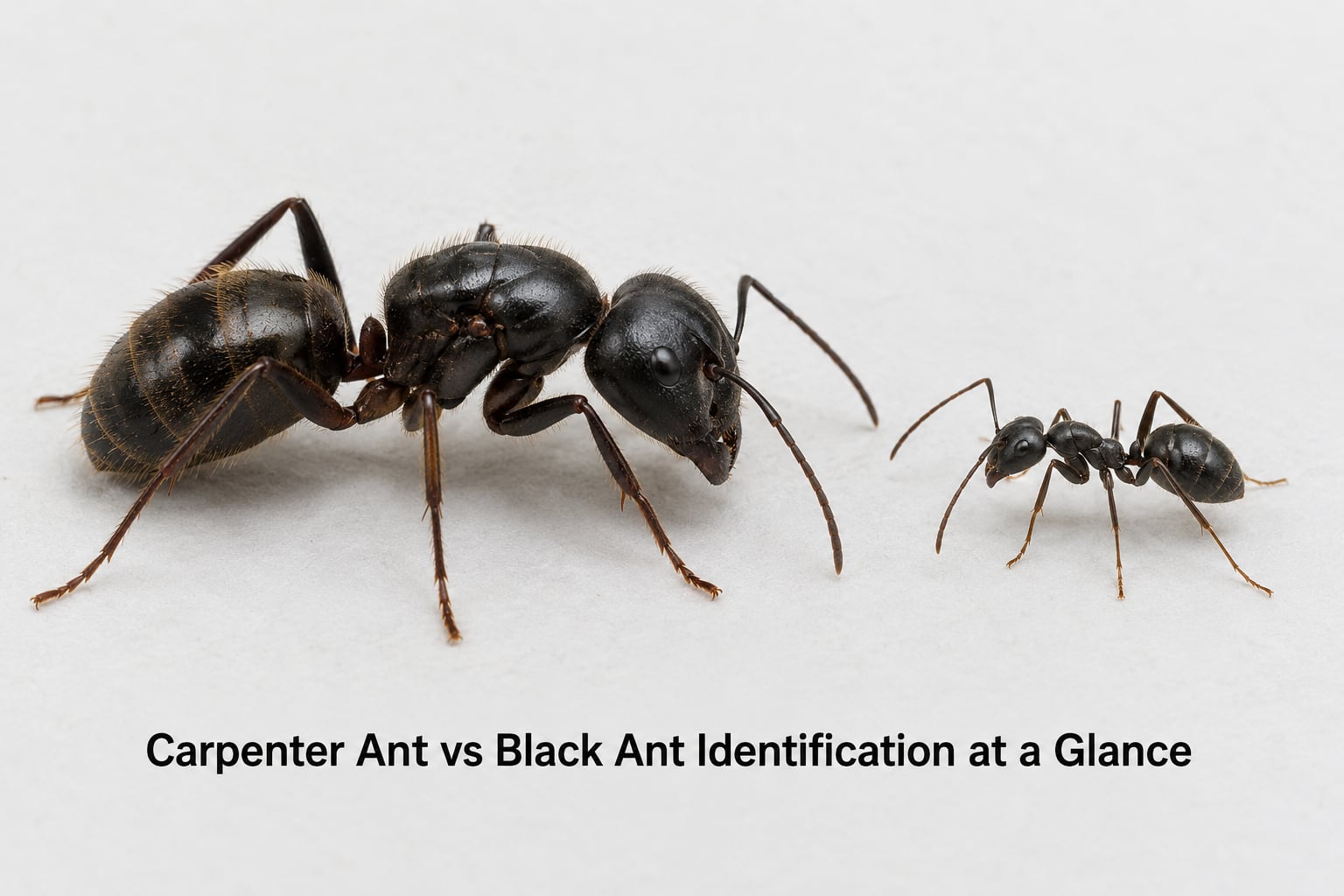
This is the short version. Every row below is a trait you can observe without equipment, a hand lens or a lab.
| Feature | Carpenter Ant | Black Ant |
|---|---|---|
| Body length | 1/4 to 1/2 inch (6 to 12 mm) | 1/8 inch (3 mm) or smaller |
| Head shape | Broad, distinctly heart-shaped when viewed from above | Rounded to oval, less angular |
| Color | Black, or red and black bicolored | Uniform black, dark brown or grey-brown |
| Thorax | Smooth and evenly rounded in profile | Rougher, less sculpted outline |
| Antennae | Clearly elbowed, 12 segments | Elbowed, less prominent against the body |
| Waist | One narrow waist bump (petiole with a single node) | Waist present, shape varies by species |
| Worker size variation | Very wide, workers come in several sizes | Mostly one size within a colony |
| Stinger | None | None |
| Bite | Can bite defensively, rarely stings | Can bite, generally minor |
| Nesting site | Damp, damaged or decaying wood, galleries inside framing | Soil, lawns, mulch, cracks, wall voids, under appliances |
| Debris left behind | Coarse sawdust-like frass with insect parts | No frass |
| Trail pattern | Comes out of wood trim, sills, doors and firewood | Runs along baseboards, counters, floors and window tracks |
| When active | Mostly late in the day and at night | Commonly active during the day |
| Main concern | Wood excavation plus the moisture problem behind it | Nuisance and food contamination |
What Do Carpenter Ants and Black Ants Look Like?
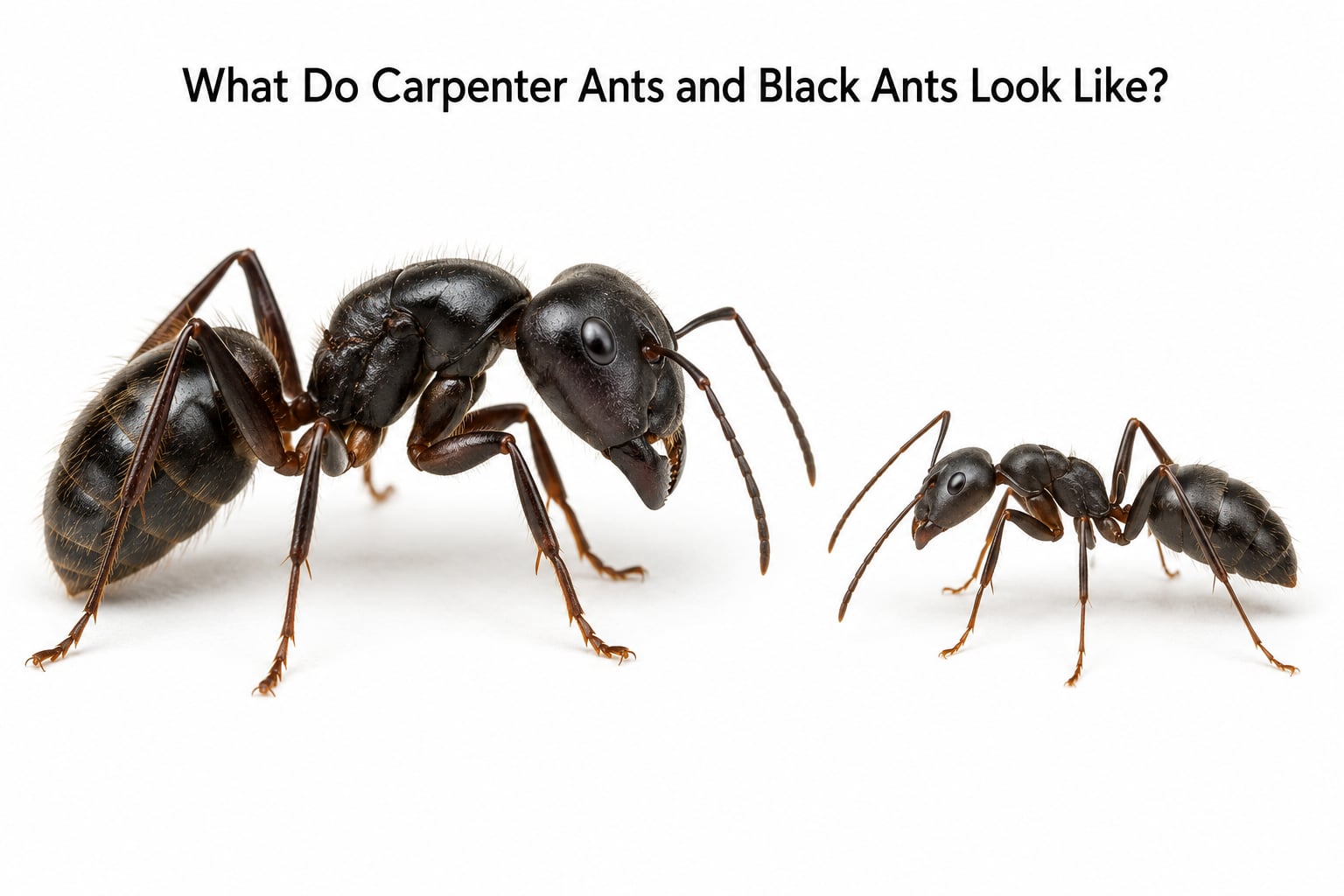
Why color is the worst way to tell them apart
Almost every ant you will find indoors in a homeowner’s description is called a black ant, which makes the word useless as an identifier. Some carpenter ants are jet black, others are red and black bicolored, and plenty of black ants are actually brown or grey once you look closely. Not all black ants are carpenter ants, and not all carpenter ants are black.
Species adds another layer. Carpenter ants in the genus Camponotus include the black carpenter ant common in northern and boreal regions and the red carpenter ant found further south, which is one reason the same photograph gets labeled both ways in forums.
The body markers that actually decide it
Look at the head first. A carpenter ant’s head is broad and heart-shaped when you look straight down at it, with powerful mandibles at the front. Look at the waist next, the narrow stem between thorax and abdomen. Carpenter ants have a single bump there, a petiole with one node, which is a useful detail because it separates them from many other ant families.
Then check the thorax in profile. A carpenter ant’s thorax is smooth and evenly rounded rather than sharply sculpted, and the antennae break the elbow clearly away from the head. Put those together with size and you have a solid case.
Black ant look-alikes worth ruling out
Several other species get mistaken for carpenter ants, and each has its own tell. The odorous house ant is small, dark and common in kitchens, and it gives off a strong rotten-coconut smell when crushed. The pavement ant nests under concrete, pavers and sidewalk cracks and often shows a faint ridged line along the body. The Argentine ant is uniformly dark, moves in long connected trails and displaces native ants rapidly, and it does not nest in wood.
None of those excavate galleries or drop sawdust. If you see debris, you are not looking at an odorous house ant.
How Big Are Carpenter Ants Compared With Black Ants?
Carpenter ants run 1/4 to 1/2 inch long. Most black ants in the house run 1/8 inch or smaller. That means a carpenter ant can look roughly twice the length of the ant you are used to seeing on the counter, which is why people describe them as huge.
Size alone is not a reliable cutoff, though, and this is the most common reason a confident ID goes wrong. Carpenter ant workers are polymorphic, meaning one colony contains workers of noticeably different sizes. Add that to the fact that the largest workers are typically the outdoor foragers, and a single ant wandering into your kitchen can genuinely be smaller than the carpenter ant in the photo you are comparing it to.
Use scale rather than memory. Put a coin next to the ant before you photograph it. If you can measure the specimen or note the coin size, an identification becomes far more reliable.
Carpenter Ant vs Black Ant Behavior
When you see them
Carpenter ants forage mostly late in the day and at night, so a big dark ant appearing in a dark hallway is more likely a carpenter ant scout. Daytime sightings are less expected and can indicate a large, well-established colony nearby.
Black ants are commonly active during daylight, which is a rough but real distinction between the two.
Where they forage
Watch the direction the trail comes from. Carpenter ants tend to emerge from wood: window sills, door frames, porch pillars, subfloors, deck boards, tree stumps and stacked firewood. Black ants come in along baseboards, under doors, through wall voids and across kitchen surfaces toward food and water.
Trails themselves are looser and less disciplined for carpenter ants. Black ants often follow established, well-worn routes.
Smell test
Carpenter ants release a strong, musky odor when they are disturbed or crushed. It is not a pleasant test, so do it outdoors and wash your hands afterwards. An odorous house ant gives off the rotten-coconut smell instead, which is a very different note and points to a nuisance species rather than a wood-nesting one.
Where Do Carpenter Ants and Black Ants Nest?
This is where the two split completely. Carpenter ants nest in wood that is already damp, damaged or decaying, and they excavate smooth-walled galleries inside it. They do not eat the wood, they hollow it out and push the debris out as frass, meaning insect excrement and excavation debris. Look for galleries in hollow doors, subfloors, porch pillars, window sills and roof areas, and check any firewood or tree stumps stored near the house.
Trace the nest back to its cause. In most cases the wood was wet first, from a leaking pipe, failed flashing, a dripping sill or poor ventilation, and the ants moved into it because it suited them. Fixing the moisture without dealing with the colony usually buys you a season at most.
One colony can also spread out. A main outdoor nest can support numerous satellite nests, sometimes up to twenty, in wall voids, attics and other sheltered cavities. That is why killing the one trail you can see often changes nothing, because six other trails still exist.
Black ants nest in soil, under lawns, in mulch, in cracks in concrete or brick, inside wall voids, under appliances and beneath carpets. Their entry points are ground-level and masonry cracks, not wood trim.
The frass triage
| What you find | What it points to |
|---|---|
| Coarse sawdust with insect body parts, often with a faint arc of droppings around the pile | Carpenter ant |
| Fine, uniform, powdery debris with no body parts | Drywood termite, confirm with a professional |
| No debris at all, just a trail | Black ant or another nuisance species |
| Dark pellets that crumble, stacked along a run | Rodent activity, not ants |
Visual evidence has limits. No debris does not prove there is no carpenter ant nest, and debris on its own does not prove how bad it is. If you are dealing with an active rodent population in the same wall, you will see damage that mimics ant galleries, and a professional is the only reliable way to separate those causes.
What Damage Can Each Ant Cause?
Carpenter ants hollow out galleries in wood, which weakens the material around them. The damage is real but slower and more limited than termite damage, because they are excavating already-damp material rather than eating sound structural wood. In many states carpenter ant activity is treated as wood-destroying-insect damage that has to be disclosed before a property sale, so if you are buying or selling, get it documented.
Black ants do not damage structure. Their cost is nuisance and contamination, food being carried into wall voids and cavities, and in some cases a stinging species reaction, though the common household black ants do not sting. They will not compromise a wall or a floor.
Do not start drilling, cutting or removing suspect wood yourself to look inside. You may spread disturbance through satellite nests, and structural work belongs to a licensed contractor.
Carpenter Ants vs Black Ants With Wings
Both species produce winged reproductives, called swarmers or alates. They emerge in spring, mate, and the queens then look for a place to start a colony, which is why people find a single large winged ant indoors in spring and panic.
The visible differences still apply. Winged carpenter ants keep the large body, broad heart-shaped head and elbowed antennae. Winged black ants stay small with a narrow head. If you find more than one, or a cluster, treat it as a sign of a mature nearby colony and follow up.
One caution: a lone winged ant indoors does not confirm anything. People frequently photograph it, mislabel it as a termite, and take the wrong next step. Termites have straight antennae, a waist that is not constricted and wings of even length. Ants have elbowed antennae, a pinched waist and front wings longer than the rear pair. If you cannot tell, do not treat for termites until someone has confirmed it.
Which Should You Choose?
That question has an odd answer here, since you are not choosing an ant, you are deciding how seriously to take one. The decision framework is short.
If it is a black ant
You have a nuisance problem. It is small, it is entering from ground level or a crack, and it is following food. Clean food sources, wipe trails with soapy water to disrupt the chemical path, seal entry points, and deal with the moisture that is attracting them. Bait works well here because the colony is reachable and the ants keep coming back to the same places.
If it is a carpenter ant
You have a building problem with a plumbing problem underneath it. Trace the trail back to the wood it came from, inspect that area for damp, and find the leak, the failed flashing or the blocked vent. Do not spray the visible trail. It removes the scouts and leaves the colony and its satellites untouched, which is exactly the situation homeowners on pest forums keep describing. Baiting plus correcting the moisture is the usual approach, and treating only the trail is why the ants come back.
When to bring in a professional
Call a pest professional if you find more than one nest or several separate trails in different parts of the house, if galleries are showing in a structural member rather than in trim, if wood is damp enough that you are unsure whether the material is salvageable, or if you are in the middle of a sale that needs a wood-destroying-insect inspection. A single scout ant in a kitchen, with no frass and no wood damage, does not need an inspection. People who only see one large dark ant are usually looking at exactly that.
Frequently Asked Questions
Are all large black ants carpenter ants?
No. Size alone confuses people most often. Carpenter ants have a distinctly broad, heart-shaped head, a single waist bump and a smooth rounded thorax, and the workers in one colony come in several sizes. A large black ant that lacks those markers is more likely a nuisance species such as an odorous house or pavement ant. Confirm with frass: coarse sawdust containing insect parts means carpenter ant.
Do carpenter ants eat wood?
No, and this is the fact that settles most of the fear. Carpenter ants excavate galleries in damp or decaying wood and push the debris out as coarse sawdust-like frass, but they do not eat sound structural wood the way a termite does. The damage comes from hollowing out already-weakened material, usually around a moisture problem. Fixing the water matters more than treating the ants.
What ants are mistaken for carpenter ants?
Most often the odorous house ant, the pavement ant and the Argentine ant. The odorous house ant gives off a rotten-coconut smell when crushed and stays under an eighth of an inch. The pavement ant nests under concrete and sidewalk cracks. The Argentine ant travels in long connected trails and displaces native ants. None of them excavate wood galleries or leave frass.
Are black ants active at night?
Black ants are usually active during the day, foraging along baseboards, counters and floors. Carpenter ants forage mostly late in the day and at night, so a large dark ant appearing in a dim hallway or a bathroom after dark is more consistent with a carpenter ant scout. Activity alone is not enough for identification, so pair it with size, head shape and evidence of nesting material.
How do I get rid of carpenter ants if I cannot find the nest?
Start at the trail, not the ant. Follow the line back to the wood it emerges from, then inspect that spot for damp and fix the leak or failed flashing. Avoid spraying the visible trail, because that kills scouts while the main nest and its satellite nests continue. If you cannot trace a trail, monitor several rooms at night for emergence points, and have a professional inspect if you find galleries in a structural member.
Does seeing one carpenter ant mean I have a colony in my wall?
Not necessarily. A single large ant indoors is very often just a scout that wandered in from outside, and most people who see one never find a colony. What changes the picture is repeated sightings, a consistent trail, coarse sawdust with insect parts, or wood that is already damp or excavated. One ant alone is worth noting; a pattern of activity is worth acting on.
Conclusion
Ignore the color and work through four things in order: where it came from, how big it is, what it is nesting in, and how it behaves. Location separates wood from soil, size separates a quarter inch from an eighth, frass separates a carpenter ant from a termite and from a black ant, and timing separates late-night scouts from daytime foragers.
Start at the point of entry. Follow the trail back to the wood, look underneath it for sawdust and insect parts, and check that area for damp. If you find one ant and no debris, note it and move on. If you find a trail, a gallery and more than one emergence point, fix the moisture and get it identified properly.