Wondering why spiders are good to have in a garden? They hunt the insects that damage your plants, and they do it for free. In most yards a handful of web-builders and sight hunters quietly take more mosquitoes, flies, moths, beetles and stinging insects than any spray bottle would, and they do it without the residue that kills pollinators and poisons the soil food web.
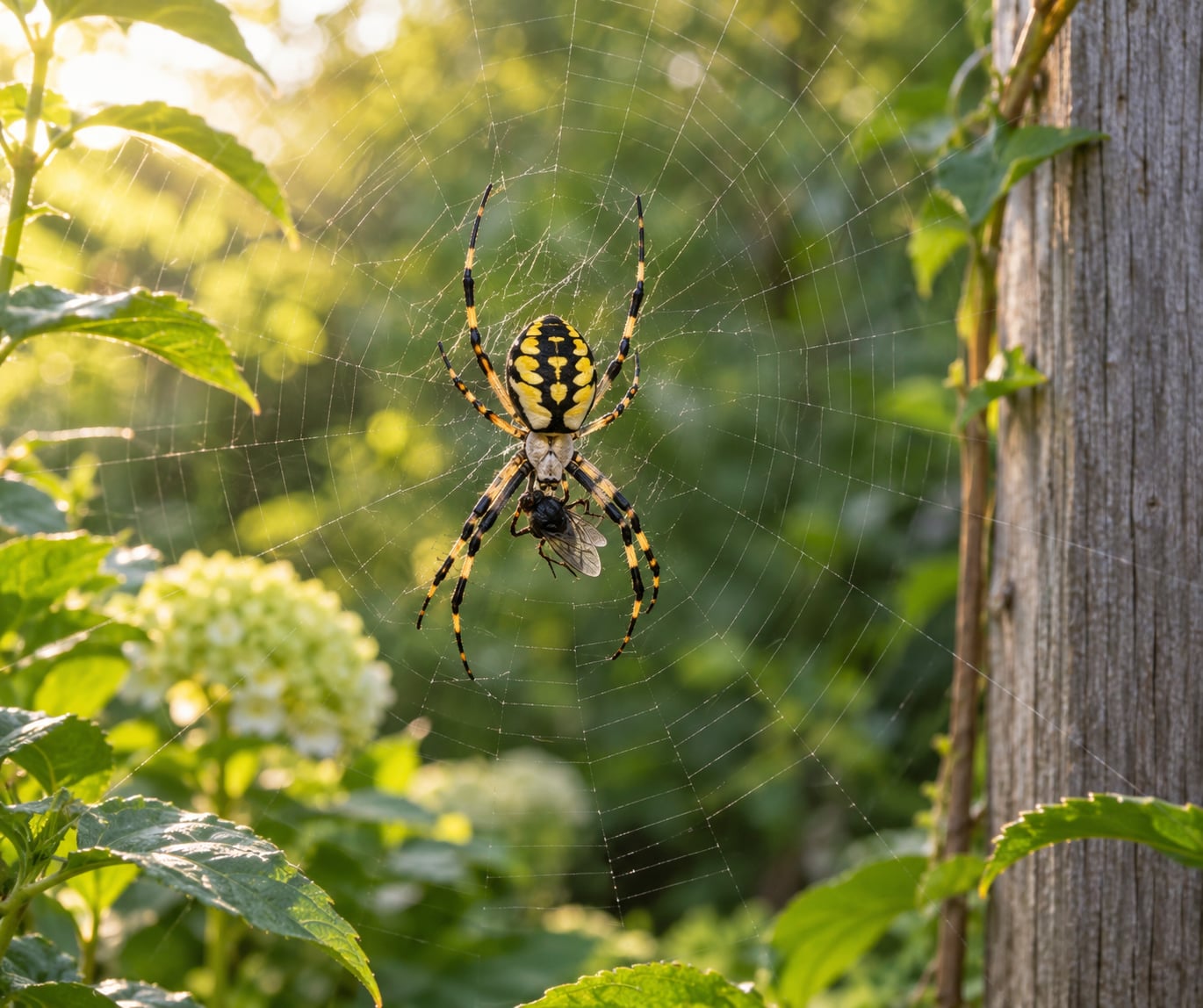
The awkward part is that the ones you notice most are the biggest ones. A yellow garden spider strung between tomato stakes reads as an invasion. Growers on r/gardening put it more bluntly in a thread about whether spiders are welcome: you can have spiders, or you can have a garden littered with pests. Both sides of that trade exist, and most gardens are better off keeping the spiders.
Here is what they actually do, what they eat, which ones are worth worrying about, and how to encourage them without turning your yard into a spider housing project.
Table of Contents
- Why Spiders Are Good to Have in a Garden
- What Do Common Garden Spiders Eat?
- How Do Spiders Support Garden Biodiversity?
- Are Spiders Bad for a Garden or Dangerous to People?
- How Can You Encourage Spiders Without Creating Problems?
- What About Large Webs, Nests, and Spiders Inside the Home?
- Frequently Asked Questions
- What Should Gardeners Do First?
Why Spiders Are Good to Have in a Garden
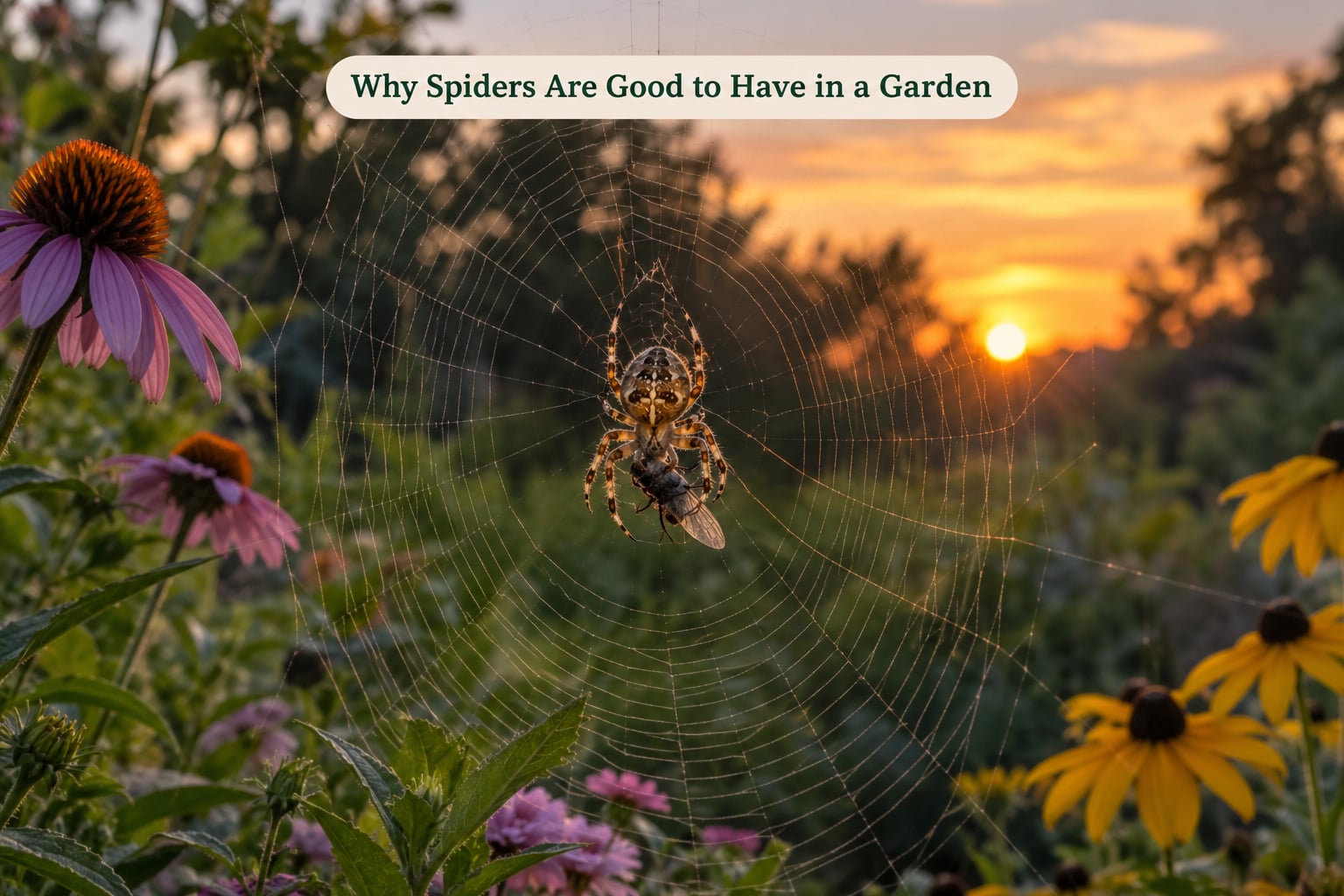
Every spider is a predator with a narrow menu of small arthropods, and in a garden that menu happens to be heavy with pests. They do not eat leaves, roots or stems, so they never damage the plant itself. The benefit is indirect and constant: fewer insects chewing, fewer insects laying eggs on your beans, fewer insects you feel like spraying.
| Benefit | What actually happens |
|---|---|
| Insect pest control | Web-builders trap flying adults, while hunters take caterpillars, beetles and other larvae before they reach your plants. |
| Mosquito reduction | Male mosquitoes do not feed on blood but do feed on spiders, so one web across a patio removes a lot of them. |
| Fewer biting flies | Stable flies, house flies and mosquitoes are all on the menu for larger hunting spiders. |
| Less pesticide use | Predation does the work a spray would, so you skip the insecticide that would also hit bees and beneficial insects. |
| Food for birds | Wrens, titmice, thrushes and small mammals feed spiderlings and egg sacs, so spiders are a link in the chain, not the top of it. |
| Nutrient cycling | Spiders eat a lot of insects and return the nitrogen as waste and as a carcass other decomposers work on. |
| Balance across the season | Spiders keep building when a single insect wave crashes, holding pest numbers down over weeks rather than days. |
| Pollinator-friendly | Fewer sprays means more bees, hoverflies and butterflies, which spiders never target. |
| Fewer plant diseases | Insects that vector some bacterial and fungal problems are removed before they reach foliage. |
University extension entomologists reach the same conclusion. Kansas State’s Raymond Cloyd, quoted in the extension service’s garden spider story, points out that spiders feed on the insects that damage ornamental and vegetable crops, which is the entire argument in one line.
One honest caveat: spiders are not picky. A jumping spider will take a hoverfly larva, and no orb weaver checks credentials before eating a beetle. In a healthy garden the balance works out because pest insects arrive in far greater numbers. Where pest pressure is genuinely low, spider numbers stay modest too.
What Do Common Garden Spiders Eat?
Spider diets split into two strategies, and knowing which one you are looking at tells you what it is doing for you. Web-builders wait, sight hunters chase.
Orb weavers spin the classic round, sticky wheel web you see between fence posts, tomato cages and door frames. Their menu is almost entirely flying insects: mosquitoes, house flies, moths, small beetles and midges. A single large web strung between two plants can be an entire mosquito filter, and you can watch it work by leaving a porch light off for one evening.
Wolf spiders do not use a web to hunt. They run across open ground and pounce, grabbing caterpillars, crickets, grasshoppers and beetles, sometimes carrying a meal bigger than themselves. They also carry egg sacs and then a brood of spiderlings on their backs for a week or two before the young disperse.
Crab spiders sit motionless on flowers and leaf surfaces with their front legs folded, waiting for whatever lands. A bumblebee looking for nectar is a good meal, and so is a small fly. Crab spiders can shift color to match the flower they are sitting on, which is why they are so often missed.
Jumping spiders are the ones that actually look at you. Most are small, hold a line of sight on their target, then jump or drop onto it. House flies, small moths and crawling insects are typical prey, and a jumping spider will rarely cross a room toward a person.
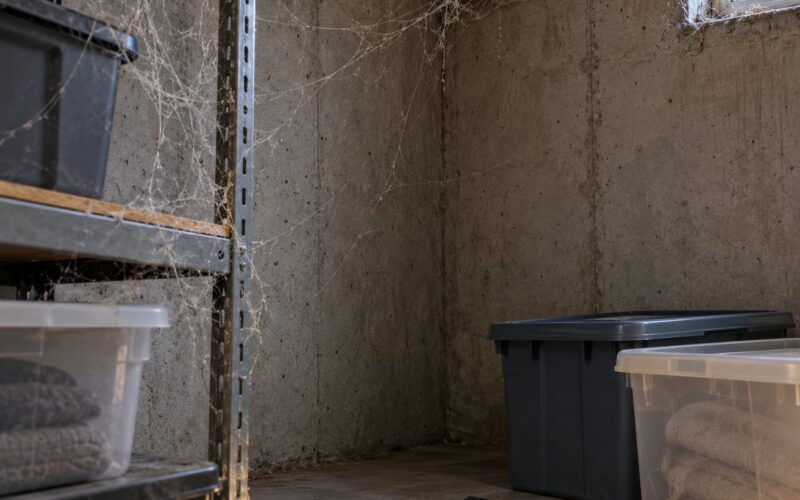
Lynx spiders are larger, long-legged hunters that pounce on hovering flies and bees that come into the garden. Cellar and tangle-web spiders live in corners, sheds and under eaves, where their messy cobweb nets catch flies and beetles that wander in from outside.
Add in the money spider, the ground spider that drops into seedheads, the woodlouse hunter under mulch, and a typical yard holds far more species than most gardeners ever see at once.
How Do Spiders Support Garden Biodiversity?
Spiders sit in the middle of the food web rather than at the top of it. Insects eat plants, spiders eat those insects, birds and small mammals eat spiders. Remove the middle link and you get two problems at once: the herbivores boom, and the birds that would have handled them lose a food source too.
The second job is keeping any one insect species from taking over. Aphids reproduce fast enough to overwhelm a plant in a matter of weeks, but predation puts a ceiling on the population. A spider that is holding down one corner of a bean patch also buys time for lady beetles and lacewings, whose larvae do heavy aphid work of their own.
Spiders are not doing all of this alone and they will not eliminate your pests. Nobody claims a garden stays bug-free because of arachnids alone. What they do is hold the line continuously and cheaply, and they do it without the boom-and-bust pattern you get from spraying.
Harvestmen are worth mentioning here because the confusion is constant. A daddy longlegs is not a spider, it is an arachnid in a different order, and it feeds mostly on scavenged material and small soft-bodied prey. Harmless to have around, and helpful in its own way, but not part of the spider count.
Why Spiders Are Good to Have in a Garden by Season
Spring is when hunting spiders get busy. Overwintered females carry egg sacs into the season, wolf spiders emerge carrying young on their backs, and the first flying insects draw web-builders into position as temperatures rise.
Through summer, orb weavers reach full size and rebuild their webs daily, sometimes every night. Hunting spiders work at dawn and dusk, which is one good reason to keep outdoor lighting off near beds and hedges.
Then late summer and autumn produce the jump that alarms people. Males of many species leave their webs and go looking, juvenile spiders move into leaf litter and mulch to overwinter, and hungry birds and small mammals thin the population so the survivors become more visible. A sudden appearance of tiny hunting spiders on walls in late autumn is a seasonal shift, not an infestation.
Garden Organic makes a related point about light: many spiders hunt around dawn and dusk, and research they cite suggests artificial light can reduce spider abundance and even affect spider brain development. A single downward-facing garden light is worth shielding.
Are Spiders Bad for a Garden or Dangerous to People?
Almost none of them. The overwhelming majority of garden spiders are not aggressive toward people, cannot bite through skin without real difficulty, or deliver medically insignificant venom. They bite only when handled or crushed, and even then it is usually nothing more than a small red itchy bump.
Two situations are worth knowing about by sight. Black widows are glossy black with a red hourglass marking on the underside, and they tend to build messy tangle webs in sheltered, undisturbed spots such as stored lumber, empty planters and porch corners. Brown widow spiders look similar, but the marking is more orange and geometric. Both bite defensively and their venom is medically significant, which is why they are worth identifying rather than guessing at.
Tarantulas are another common source of alarm in the southern and southwestern United States. They are large, hairy and intimidating, but their bite is comparable to a bee sting in severity. The one exception is the old-world tarantulas sometimes kept as pets, whose bite is more serious. Wild tarantulas you meet outdoors are not that animal.
Brown recluse bites get attention too, though the spider is largely an indoor, dry, dark-clutter species, not a garden resident, and its bite is more often a slow-healing wound than an acute crisis. If you suspect one, have it identified rather than treating every small brown spider as a recluse.
Seek urgent medical help for a bite that produces spreading pain, marked muscle cramps or rigidity, sweating, nausea, difficulty breathing, or a wound that becomes necrotic. Those are signs to act on quickly. In the United States, Poison Control is 1-800-222-1222.
Children and pets are the worry that comes up most on forums, and the practical answer is that a healthy adult bites back. A toddler who grabs a wolf spider gets a startled spider, not a dangerous dose. Cats and dogs are at more risk from chewing a large widow than from any bite, so keep genuinely dangerous habitat tidy rather than trying to make the whole garden childproof against arachnids.
A photo is a reasonable first step, but it is not identification. Anyone offering a definite species verdict from a picture alone is guessing, and local extension offices or arachnology groups can do it properly.
How Can You Encourage Spiders Without Creating Problems?
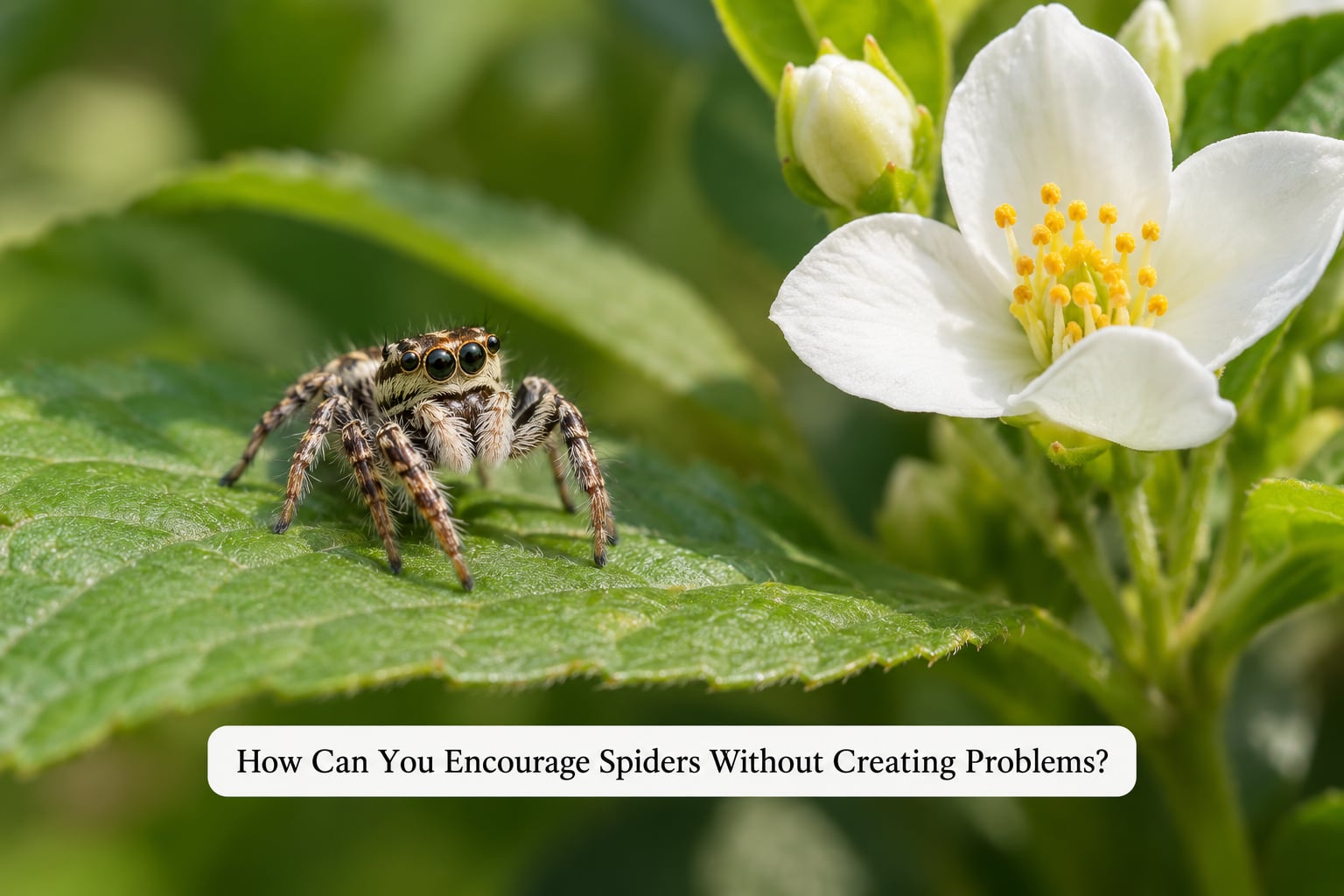
Habitat is what drives the list, and most of it is simply leaving something alone.
- Leave a corner undisturbed. A log pile, stacked boards, a dense hedge or a patch of leaf litter gives overwintering and ground hunters somewhere to survive until spring.
- Keep mulch and litter down. They are habitat, not mess, and they hold the moisture ground hunters need.
- Give web-builders structure. Shrubs, fences, trellises, tomato cages and railings give orb weavers something to anchor to. Remove every edge and there is nowhere to build.
- Skip routine broad-spectrum insecticides. Beyond killing spiders outright, sprays disrupt web repair and hunting behaviour, which Garden Organic notes can affect lifespan and prey relationships.
- Do not over-light the garden. Shield or motion-set fixtures near beds so the dawn and dusk hunting window stays usable.
- Plant a range of flowering plants. More insects means more prey, and a diverse planting keeps prey numbers from collapsing into a boom and bust.
Some ordinary garden work still needs ordinary care. Wear gloves and long sleeves when moving stacked lumber or digging in deep mulch, especially in the southern US where widows may be sheltering. Check inside cut flowers and produce before bringing them indoors, since crab spiders ride in on Queen Anne’s lace and zinnias.
Cutting a web down is not an attack on a colony. It removes an old capture surface, and the spider usually rebuilds within a day or two. The web is the useful part; the spider is the resident.
What About Large Webs, Nests, and Spiders Inside the Home?
A single large orb web spanning several feet between a fence post and a garden chair looks enormous. Judges disagree about the measurements, but the practical point is that a healthy adult orb weaver simply builds on a large scale, and a websbed porch in late summer means the insects you probably wanted gone are being caught instead.
One web is not a colony. Orb weavers are solitary and territorial, and each web usually holds a single female plus whatever else falls into it. Repeated dense sheet webs in a shaded corner are a different case, since sheet and tangle weavers build repeatedly in the same protected space.
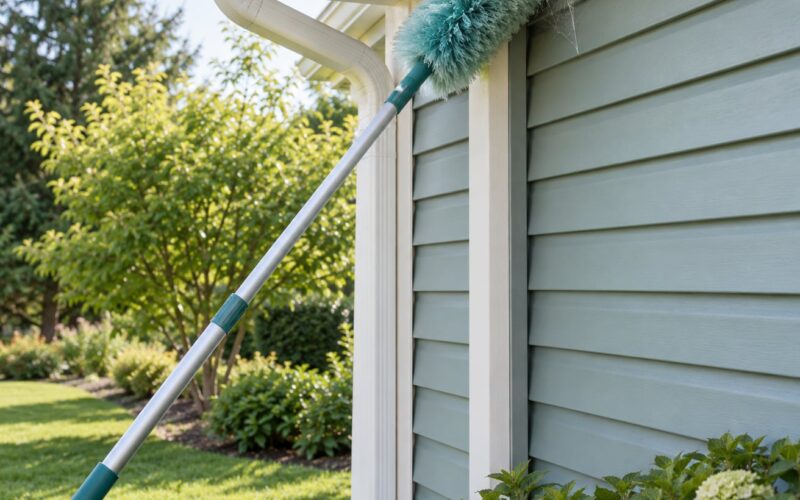
For a web you cannot live with, knock it down with a broom or hose, or cut the anchor lines with a long pole from a distance. Removal in spring, before egg sacs form, is the least disruptive window.
For a spider indoors, relocation is simple and it works. Put a cup over the spider, slide a card under it, carry it outside, and release it against a wall or into vegetation. Do it without crushing it, and do it yourself rather than using foggers, which kill the outdoor population you were trying to protect.
Sealing entry points matters more than removal. Door sweeps, intact window screens, gaps around utility penetrations and open basement vents are the routes that actually let spiders in.
One confusion deserves its own warning because it causes more false alarms than anything else: spider mites are not spiders, they are tiny plant-feeding arachnids, and they are a genuine pest. Fine webbing over a leaf with stippling, bronzing or tiny moving dots means mites. A garden spider sitting in a web is the opposite sign, which is a predator doing you a favour.
Frequently Asked Questions
Are large spider webs in a garden a sign of too many spiders?
Usually not. Orb weavers are solitary and territorial, so one big web between posts or over a patio means one spider working, not a colony. Dense repeated sheet or tangle webs in the same shaded corner are the case worth watching, since those species reuse sheltered spaces. A web is also a useful signal: heavy webs usually mean plenty of flying insects, which is exactly what you wanted reduced.
Do garden spiders kill bees and other beneficial insects?
They can. Spiders are generalist predators and do not check whether a hoverfly larva is a friend before eating it. In a healthy garden pest insects vastly outnumber beneficials, so the net effect is still strongly positive. The exception is a garden with almost no pest pressure, where a large spider population could tip the balance. That situation is rare in a mixed vegetable planting.
Can I use insecticide around a garden without harming spiders?
You can, but you lose more than you gain. Broad-spectrum sprays kill spiders outright, and they also damage the webs and interfere with web repair and hunting behaviour, which affects lifespan and how much prey gets caught. Target a specific pest with a specific product instead of spraying the whole bed, spot-treat rather than broadcast, and spray in the evening when pollinators are back in their nests.
What kind of spider bite needs medical attention?
Get urgent help for spreading or severe pain, marked muscle cramps or rigidity, sweating, nausea, trouble breathing, or a wound that turns dark, blistered or necrotic. Those signs point to a medically significant venom and should be treated promptly. In the United States, Poison Control is 1-800-222-1222. A routine garden spider bite is usually a small red itchy bump that clears within a day or two.
Should I remove every spider I find around my home?
No. Nearly all garden spiders are harmless to people, and removing them removes your cheapest form of pest control, so pesticide-free gardens usually see more pest damage once the spiders are gone. Act on the small number of situations that matter: black or brown widows in stored lumber and porch corners, a spider inside the house, or a web blocking a doorway. Outside those, leaving them alone is the better gardening decision.
What Should Gardeners Do First?
Drop the routine broad-spectrum sprays first. That single change protects the predators already working for you and costs nothing, and most gardeners notice fewer pests within a season rather than more.
Next, learn the handful of species in your own region. Five names covers most US gardens: orb weaver, wolf spider, jumping spider, crab spider and cellar spider. Once those stop registering as threats, the panic that drives people to kill every eight-legged shape loses most of its force.
Tolerate moderate numbers anywhere outside the walls of your house. Where you genuinely cannot live with a web or a nest, knock it down and relocate the spider rather than spraying, and seal the entry points instead of reaching for a fogger. That way you keep the population working in your favour.
And when a spider genuinely worries you, get it identified by a local extension service or arachnology group rather than trusting a photograph’s confident guess. Most of the time the answer is that it is an orb weaver, and the only thing it was ever going to eat was your mosquitoes.