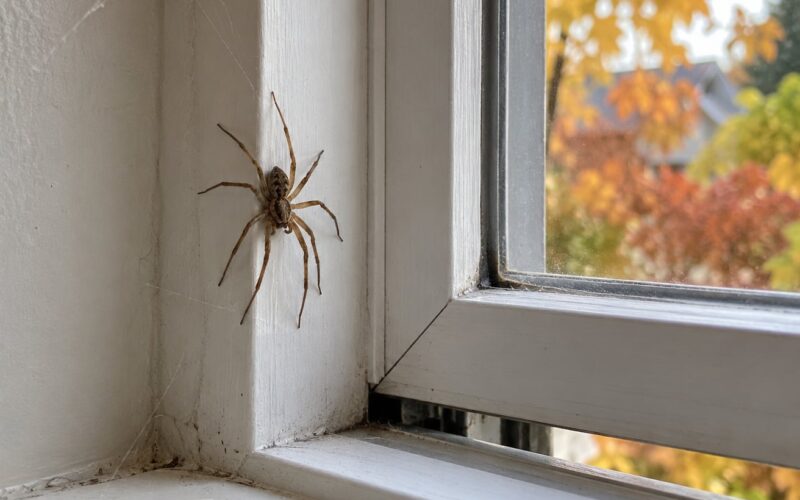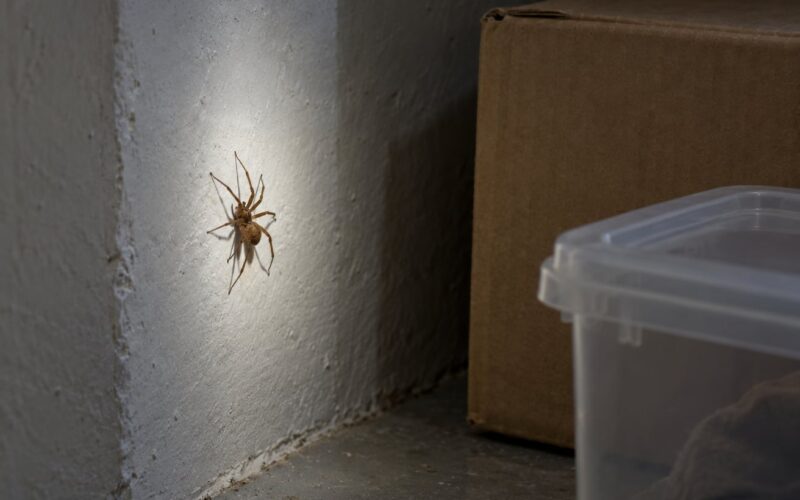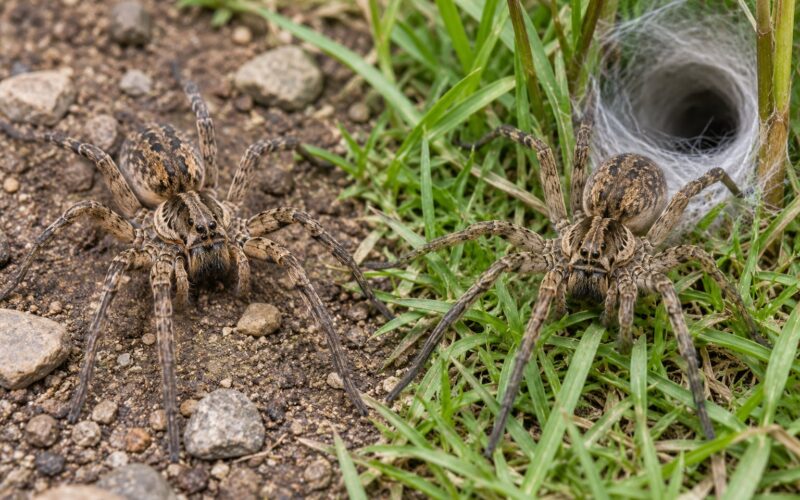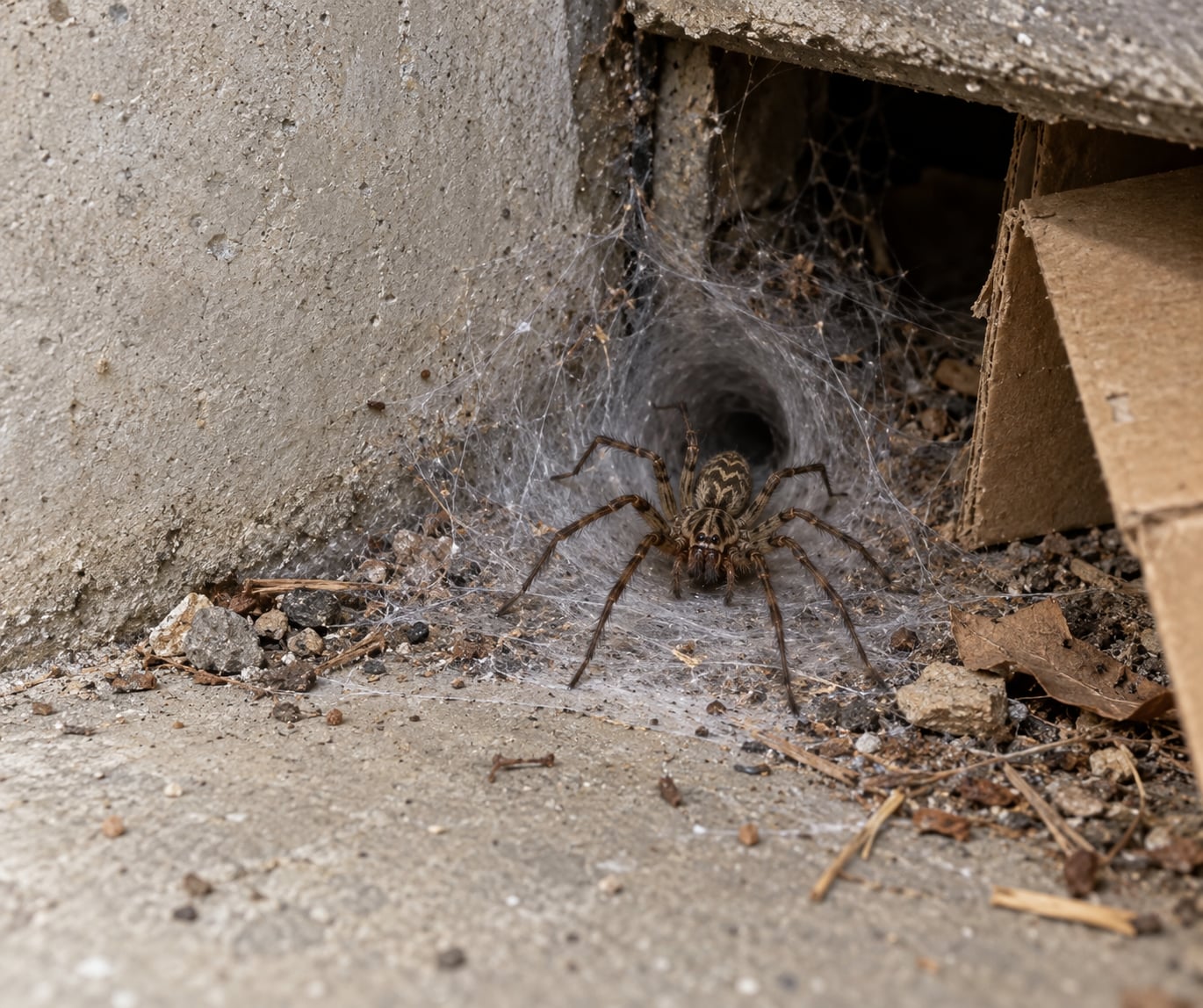
If you found a fast-running brown spider in a basement, garage, or ground-floor room, it is most likely a hobo spider, Eratigena agrestis, formerly called Tegenaria agrestis. This field guide covers hobo spider identification and habits in plain language: what the spider looks like, how its web works, where it lives, and why it wanders into houses in late summer. On the question that worries people most, the answer is reassuring. Hobo spiders bite only when trapped against skin, and the old claim that their venom eats flesh is not supported by the research.
One honest caveat before we start. Robert S. Vetter, the entomologist who led the research on this species, put it plainly in the Washington State University Extension guide How to Identify (or Misidentify) the Hobo Spider: most people try to use coloration as the main identifying feature, and it is one of the least reliable characteristics you have. Confirming a hobo spider means examining the specimen. What follows gets you close, which is as far as a guide like this honestly goes.
Table of Contents
- Hobo Spider Identification and Habits at a Glance
- What Does a Hobo Spider Look Like?
- Hobo Spider Identification Checklist
- Where Do Hobo Spiders Live?
- What Are Hobo Spider Habits?
- How Does a Hobo Spider Build Its Web?
- Are Hobo Spiders Dangerous?
- How Can You Manage Hobo Spiders Without Panic?
- Frequently Asked Questions
- Conclusion
Hobo Spider Identification and Habits at a Glance
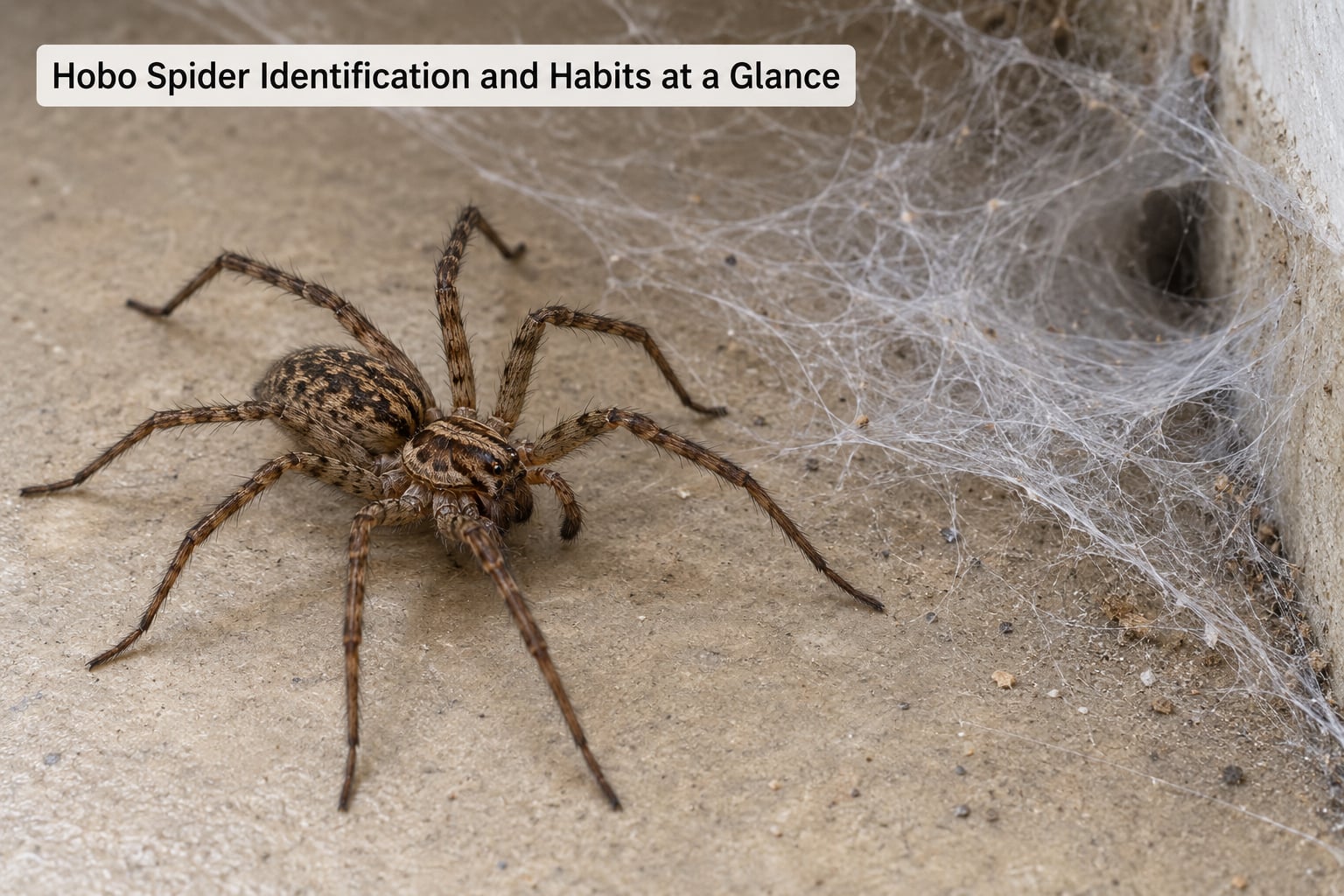
Here is the whole picture on one page. Read it as a set of clues rather than a checklist of certainties, because no single trait on this list confirms the identification by itself.
| Feature | What a hobo spider usually shows |
|---|---|
| Color | Brown to grayish-brown, sometimes faintly yellow-tan under warm light |
| Abdomen pattern | Pale chevron or V-shaped markings, often soft-edged and low contrast |
| Legs | Uniformly brown with no dark banding; lightly hairy |
| Body size | Males about 7 to 13.5 mm; females about 9.5 to 16.5 mm |
| Web | Loose, non-sticky sheet with a funnel-shaped retreat tube, usually at ground level |
| Where it sits | Inside the funnel, facing outward, waiting |
| Activity | Mostly nocturnal; the males wander in late summer and fall |
| Movement | Fast runner over open ground; poor climber on smooth walls |
| Posture when disturbed | Runs. It does not rear up or posture |
| Medical risk | Not considered medically important to humans |
The two rows that do the most work are the web and the behavior. A flat sheet web with a funnel tube at floor level, plus a spider that bolts when you approach instead of standing its ground, narrows things down faster than any marking on the body.
What Does a Hobo Spider Look Like?
Start with the body plan. A hobo spider has a plain brown cephalothorax, the front section behind the jaws, with darker smudged markings rather than crisp lines. The abdomen carries the pattern people photograph most: a series of pale chevrons, the V shapes stacked down the center, sometimes described as a herringbone. Those markings fade as the spider matures, and dull lighting flattens them further, which is one reason so many photos get misread.
Legs are the quieter tell. They are the same brown as the body from femur to toe, without the distinct dark rings or bands that show up on many other brown spiders. There is fine, nearly clear body hair called plumose setae that you can only make out under magnification, and the underside of the front section, the sternum, is usually marked with small pale spots.
Hobo spider size: how big is it, really?
| Measurement | Male | Female |
|---|---|---|
| Body length | 7 to 13.5 mm (roughly 0.28 to 0.53 inch) | 9.5 to 16.5 mm (roughly 0.37 to 0.65 inch) |
| Typical appearance | Slimmer, darker, long-legged | Stouter, fuller abdomen, shorter legs |
| Diagnostic feature | Swollen palpi that look like boxing gloves | Epigynum on the underside, visible only under magnification |
Mature males are a genuine puzzle for beginners. Their palpi, the paired feeler-like structures at the front, swell into rounded pads that a newcomer reads as a stinger or an injury. It is a mating structure, and its presence tells you the spider is an adult male that will not grow any larger.
How does this differ from a brown recluse?
A brown recluse (Loxosceles reclusa) is the spider this one gets confused with most often, and the two are easy to separate if you know two things. A recluse has six eyes arranged in pairs. A hobo spider has eight. The recluse also carries the famous violin or fiddle-shaped marking on its back, dark on a pale tan body, while the hobo’s markings are softer chevrons on a mottled abdomen.
Behavior separates them too. Recluses move slowly and hide in undisturbed clutter. A hobo spider sprints across open floor. Recluses also stay in the southern and central United States, well away from the Pacific Northwest, so geography alone often ends the question.
How does it differ from the giant house spider?
This is the misidentification people make most often, and the one that dominates spider identification forums in the Pacific Northwest. Eratigena duellica, the giant house spider, used to be lumped in with house spiders as Tegenaria domestica and is still sometimes called the aggressive house spider despite being largely harmless. It is a different, larger animal.
Giant house spiders have noticeably longer legs and a longer abdomen, so the legs often appear not to curl beneath the body the way a hobo spider’s do. Their markings also run darker and higher contrast. A practical rule: if the spider scatters with long, gangly legs, you are probably looking at the giant house spider.
Hobo Spider Identification Checklist
Work through this after a sighting, in order. The more items you can tick, the better your case, and no single line is proof.
- Measure the body, not the leg span. Females run about 9.5 to 16.5 mm and stay well under half an inch.
- Look at the abdomen for chevrons. Pale V shapes are a strong clue, but they fade with age and disappear in poor light.
- Check the legs for banding. Uniform brown with no dark rings fits a hobo spider. Clear bands point elsewhere.
- Count the eyes if you can. Eight eyes in two rows is normal for a hobo spider. Six means you are not looking at this species.
- Find the web. A flat, non-sticky sheet with a funnel tube at one end is the classic structure.
- Check the height. These webs sit at floor level and in corners. A web two stories up is a different spider.
- Watch how it moves. A fast, erratic sprint across the floor is characteristic. Slow, deliberate movement is not.
- Note the time of year. Repeated indoor finds from late summer through fall usually mean wandering males.
- Look for repeated sightings in the same spots. Basements, garages, crawl spaces, and under stairs are the pattern to check.
- Consider the underside. Sternum spots and, under magnification, the epigynum or swollen palpi are what actually confirm the species.
If steps one through nine line up but you still want certainty, the answer is not a better camera angle. It is a specimen in a vial, taken to a local extension office or an entomologist. BugGuide’s own guidance says the same thing: identification from photos is very difficult.
Where Do Hobo Spiders Live?
Hobo spiders are ground-level residents, and indoor finds almost always trace back to a ground-level reason. Common spots inside include basements, garages, crawl spaces, under staircases, storage areas, utility rooms, and window wells. Outdoors they favor woodpiles, rocks, debris, and the sheltered edges of foundations.
Native to Europe, the species arrived in North America and is now common across the Pacific Northwest, with records in Washington, Oregon, Idaho, and Utah. It is a ground-dwelling spider that prefers cool, dark, undisturbed shelter near the floor of a structure.
That last word, undisturbed, explains why one spider in a basement becomes twenty after you move a stack of boxes. You did not attract them. You removed the cover they were living under.
Why do I keep finding these in my house?
The most common reason is the male wandering season. From late summer into fall, males leave their webs and travel across the ground looking for females, and a house with a gap at the bottom of a door, an open crawl space vent, or a window well below grade becomes a highway. One spider a week in September, in the same corner of the same basement, is usually this behavior rather than an infestation.
What Are Hobo Spider Habits?
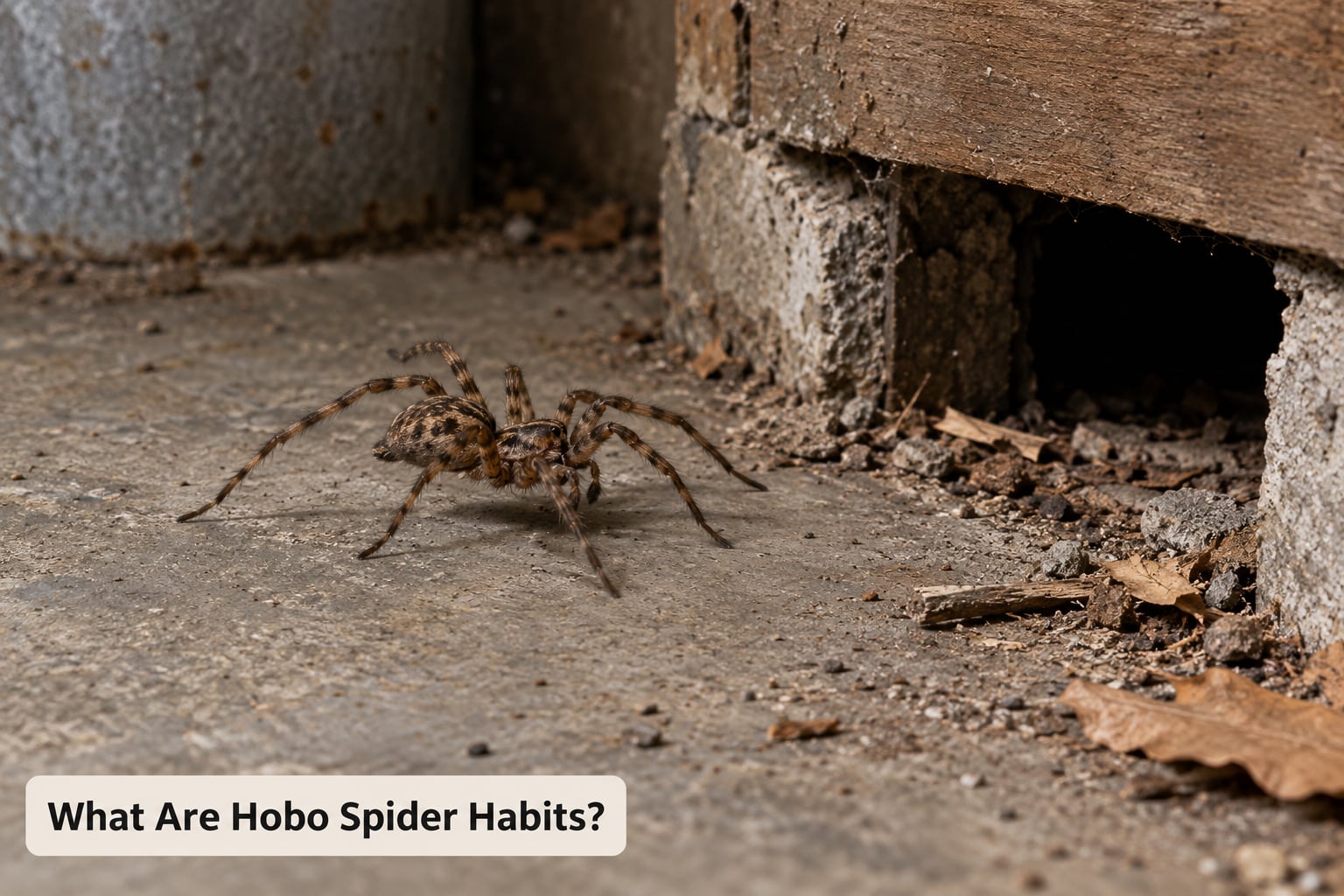
Hobo spiders hunt rather than trap. Most of the day they sit in the dark end of their retreat tube, body forward, waiting for something to walk across the sheet web. They are most active at night, which is also when most people notice them, usually a fast shape crossing a lit basement floor.
They eat whatever lives at ground level in and around a home: crickets, roaches, silverfish, flies, and other small insects. That is genuinely useful to you. A single hobo spider in a basement is consuming pests you would rather not have.
Movement is the signature. On open ground they are quick and darting, and they are poor climbers on smooth vertical surfaces, which is why they turn up on floors, steps, and low walls rather than running up the side of a wall. They do not jump, and they do not posture defensively. Bites happen when a spider is trapped between clothing and skin, or pinched in a hand, which is why the encounters cluster around laundry, shoes, and bedding rather than around people sitting still.
How Does a Hobo Spider Build Its Web?
The web explains a lot. A hobo spider spins a flat, slightly ragged sheet of non-sticky silk over a surface, usually horizontal and near the floor. At one end the sheet folds back into a funnel, and behind that funnel runs a silk-lined retreat tube the spider can retreat into.
The hunt works like this. An insect steps onto the sheet and the vibration reaches the spider. It rushes out, grabs the prey, and drags it back into the tube to eat. The sheet itself is deliberately not sticky, because sticky silk would foul up and the spider would lose its footing during the chase. It relies on speed instead.
That structure separates it cleanly from other spiders you will meet indoors. A common house spider builds a neat, circular orb web with radiating spokes and sticky spiral bands, usually in a corner or across a window. A long-bodied cellar spider throws out irregular, messy tangles of silk with no funnel and no retreat tube, and it climbs walls and ceilings with ease. If the web in your basement has a tube attached to a flat sheet, you are in the right neighborhood.
One note on the name. This is not related to the Australian funnel-web spider, despite the shared common name. Different family, different continent, different level of medical concern.
Are Hobo Spiders Dangerous?
No. Hobo spiders are not considered medically important to humans. They are nuisance hunters that bite only when provoked by being trapped or handled.
The species spent decades described as one of the most dangerous household spiders, blamed for wounds that spread, blistered, and left scars. Vetter and colleagues published a review in 2003 in the Journal of Medical Entomology (volume 40, pages 159 to 164) that examined the evidence and found it unsupported. Bites do occur, and they are typically described as a localized painful sting with redness, sometimes mild swelling and itching that resolves within a couple of weeks. Necrosis is not the expected outcome, and routine prophylactic antibiotics are not part of standard care for an uncomplicated bite.
Here is the practical part. You cannot identify a biting spider after the fact from the wound alone, because a dozen species leave similar marks. Treat an unknown bite the way you would any puncture wound: clean it, watch it, and consider a tetanus booster if you have not had one recently.
See a doctor if the site spreads, reddens, or swells over the following days rather than improving. A spreading rash, fever, wound that does not close, or a bite on a child or an immunocompromised person is also worth a call. You do not need to know the species to make that decision.
How Can You Manage Hobo Spiders Without Panic?
Start with what you have already learned. These are ground-level, prey-driven, shelter-loving spiders. Work on those three things and numbers drop on their own.
- Cut the food supply. Insect prey is the reason they are there. Sticky monitoring traps along basement and garage edges show you what is actually living in the space before you do anything else.
- Seal ground-level openings. Door sweeps, garage door thresholds, crawl space vents, and gaps around pipe penetrations are the routes they use. This is the single most effective change you can make.
- Reduce shelter. Clear stored items, cardboard, and clutter away from walls in basements and garages. The spider will not return to a spot with no cover.
- Capture and release rather than kill. A cup and a piece of card work well. Take it outside to a ground-level area several yards from the door.
- Use a flashlight, not your hands. You will see them far more often at night with a light than during the day, and looking removes most of the surprise that turns an encounter into a panic.
- Escalate to a professional only when the math demands it. Repeated daily sightings in a lived-in space, or sightings spreading to multiple rooms, justify a pest professional. A seasonal trickle in one basement corner does not.
There is no smell that reliably repels hobo spiders. Peppermint and vinegar circulate online as deterrents, but neither is supported by evidence for this species. Sealing entries and reducing insect prey is the approach that actually works, because it removes the reason the spider is there in the first place.
Frequently Asked Questions
Is a hobo spider worse than a brown recluse?
No. The brown recluse is the one that carries a documented risk of tissue damage, and it lives mainly in the southern and central United States. Hobo spiders are not considered medically important to humans and bite only when trapped against skin. Count the eyes to settle it: a recluse has six, a hobo spider has eight.
Are hobo spiders commonly found indoors?
Yes, and the indoor sightings are usually seasonal rather than a sign of infestation. Hobo spiders live at ground level and enter homes through open vents, door gaps, and window wells, usually during late-summer and fall male wandering. Basements, garages, crawl spaces, and storage areas are the spots worth checking first.
How fast do hobo spiders move?
They are quick sprinters over open ground and are most often noticed as a fast shape crossing a lit basement floor at night. They are poor climbers on smooth vertical surfaces, which is why you rarely see one on a wall or ceiling. Despite the speed, they are not aggressive and rarely bite unless trapped against skin.
Do hobo spiders jump?
No. Hobo spiders do not jump and they do not leap onto people or onto prey. If you see a spider suddenly leave a wall or ceiling in a jumping motion, that is a completely different kind of spider, most likely a jumping spider. A hobo spider’s fast movement happens entirely on flat ground or low surfaces.
What should I do if one is in my bedroom?
Do not pick it up bare-handed, because trapped spiders bite. Cup it with a drinking glass, slide a card over the top, and carry it outside to release it at ground level away from the door. Then check under the bed frame, along baseboards, and behind moving boxes for a route in, and seal any ground-level gap you find.
What smells do hobo spiders hate?
No smell is a proven repellent. Peppermint oil, vinegar, and citronella are widely repeated online as deterrents, but there is no reliable evidence any of them keep hobo spiders out. What does work is removing their reasons to enter: seal ground-level gaps, cut down household insects, and clear clutter that gives them shelter.
Conclusion
The most reliable clues are behavioral and structural, not cosmetic: a fast, ground-level runner with a loose non-sticky sheet web and a funnel retreat, low-contrast chevrons on a brown abdomen, and unbanded legs. A photo plus context gets you close. A specimen gets you certain.
So do this first. Photograph the spider and its web where you found it, avoid handling it, and if sightings keep repeating, walk the ground-level perimeter of your basement or garage looking for a vent, a gap, or a threshold that needs sealing. That one afternoon of checking is what actually reduces the number of spiders you meet this fall.