Funnel web spider identification in lawns usually comes down to three things: a flat, wispy sheet of silk with a tube tucked into one edge, a small fast-moving brown spider with a tapering abdomen, and a spot sheltered by grass, shrubs, rocks, a deck, or an opening in the ground. Get all three and you have your answer. Get only the web, and you can still narrow it down.
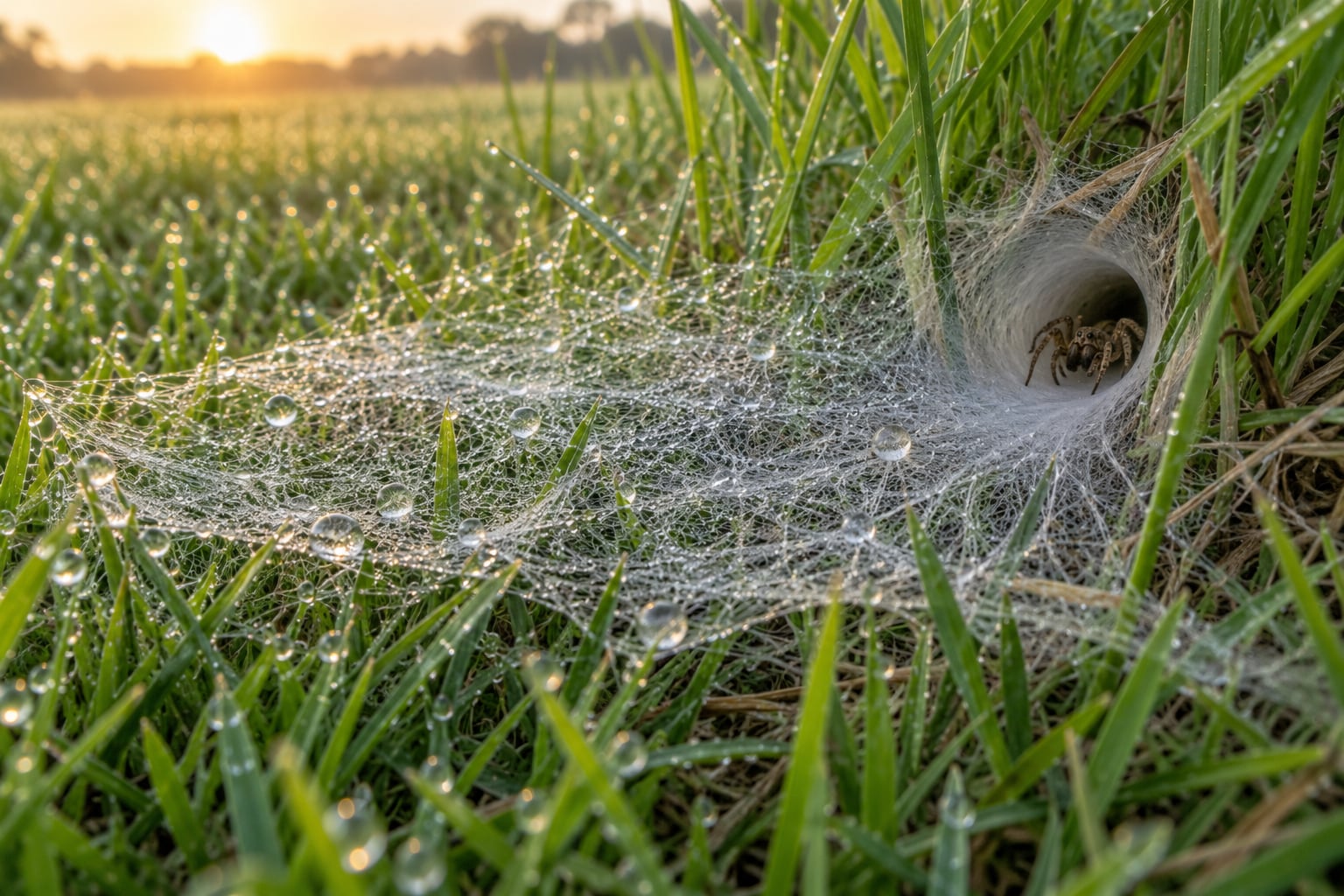
Most people find these spiders the same way: they walk out early on a dewy morning, grass blades glazed silver, and a lawn that looked fine yesterday now looks like someone draped gauze over it. That sudden appearance is the whole reason the topic fills search results with nervous questions. The good news is that the spider behind almost all of those webs in the US is a grass spider in the family Agelenidae, and it is not looking for you.
This guide is written for homeowners, gardeners, parents and dog owners who want a reliable way to tell a funnel weaver from a wolf spider, a hobo spider, or something they have read about online that genuinely is worth avoiding. No products, no affiliate anything, just how the identification works and what to do next.
Table of Contents
- Funnel Web Spider Identification in Lawns: What to Look For
- What Does a Funnel Web Spider Look Like?
- Where Do Funnel Web Spiders Build Lawn Webs?
- Is It Dangerous to Have Funnel Web Spiders in a Lawn?
- Funnel Web Spider vs. Other Common Lawn Spiders
- What to Do About Funnel Web Spiders in Lawns
- When to Contact a Pest Professional or Local Extension
- Frequently Asked Questions
- Conclusion
Funnel Web Spider Identification in Lawns: What to Look For
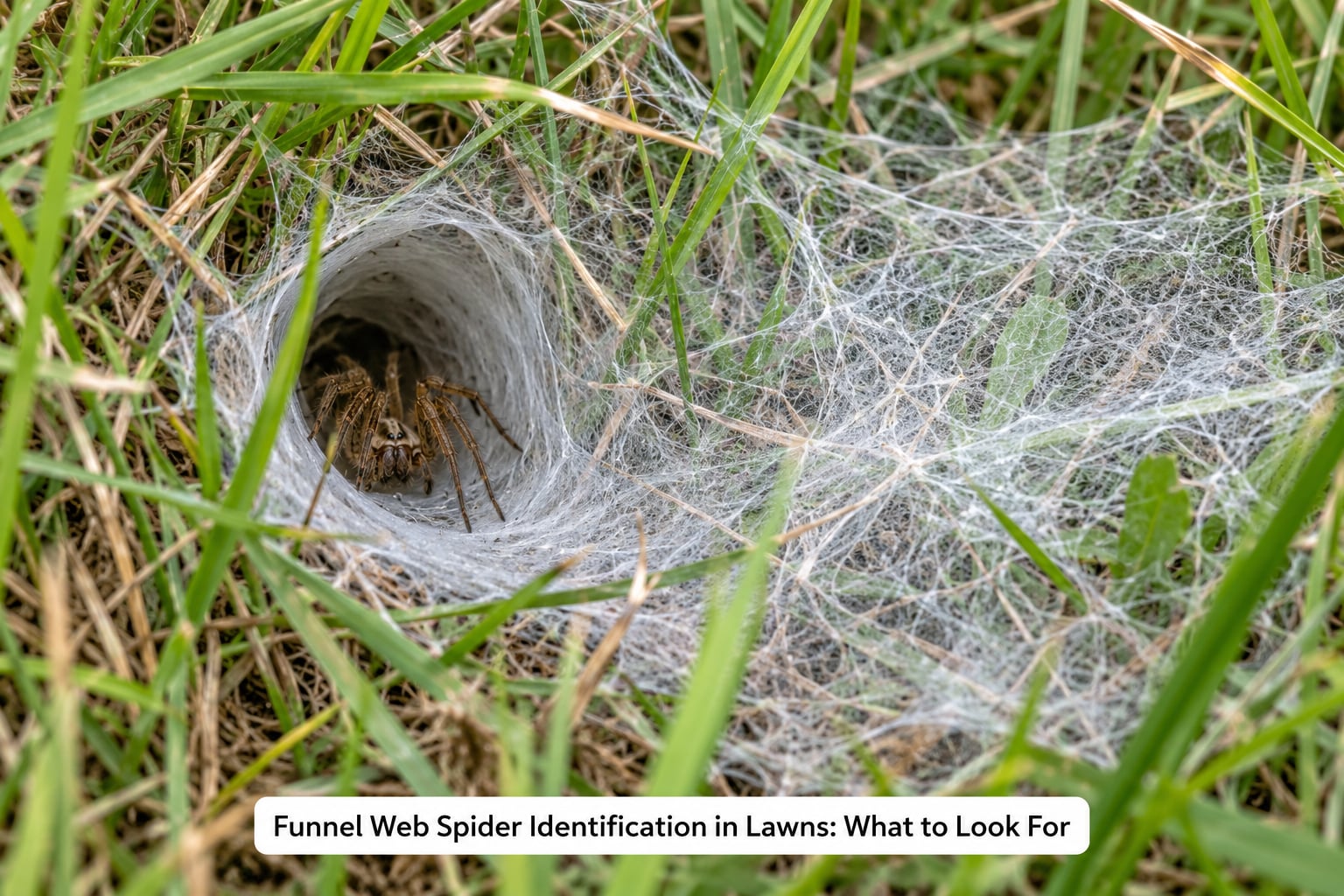
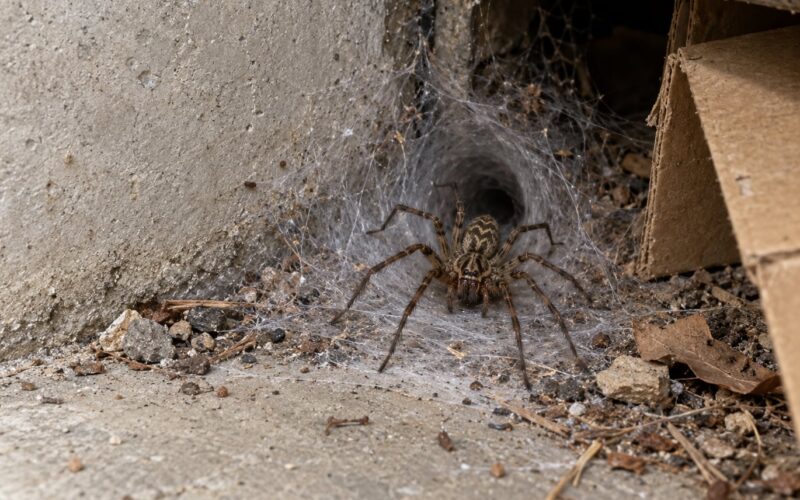
The single most reliable feature is the web itself, not the spider. Funnel weavers spin a sheet web that looks like a small, messy hammock of non-sticky silk, with the silk pulled back into a narrow tube at one end. Grass spiders of the genus Agelenopsis build them; many other species build nothing, and hunt on the ground instead. When the spider itself is hidden inside its retreat, the web still tells you what family you are dealing with.
Here is the five-point check, in the order I would run it, starting in the yard rather than with a photo app.
- Is there a sheet web? Look for a low, horizontal mat of silk stretched across grass, groundcover, a shrub base, or a deck corner. Orb weavers build tidy circles and wheel-shaped webs, so a flat sheet points somewhere else entirely.
- Does the silk run into a tube? At one end the sheet narrows and folds back into a funnel or a short tunnel. That retreat is where the spider sits facing outward, and it is the part that gives the group its name.
- Is the silk sticky? It should not be. Funnel weavers rely on speed and on the web being a vibration sensor, not on glue. A dense sheet that snags a fingertip is usually something else.
- Does a long, narrow abdomen show? When it does come out, expect a tan-to-brown spider roughly half to three-quarters of an inch in body length, longer in the legs, with a slim abdomen that narrows toward the rear and noticeably long spinnerets projecting past it.
- How does it move? A hard, quick dash back into the funnel, often vanishing before you have finished focusing, is characteristic. Slow, wandering spiders on open soil are almost never funnel weavers.
If you only get three of those five, the web structure and the movement are worth more than anything else. Color, honestly, tells you very little.
How to Confirm Funnel Web Spider Identification in Lawns
Start by watching rather than touching. Stand at the edge of the sheet web, a few feet back, and watch the retreat opening for a minute. Funnel weavers sit inside facing out, and many will show themselves in cool, still conditions.
Next, check the web up close with a twig, not your hand. Tap the edge of the sheet and watch what happens. A funnel weaver usually bolts out, grabs the twig or the vibration, and reverses instantly back into the tube. People who do this report the same result almost every time, and it is the most satisfying confirmation you can get without picking anything up.
Then look at the body proportions, and only at them. The abdomen shape matters more than color: long, slim, and pointed at the back with two long rear spinnerets, on a cephalothorax that is a little darker and unmarked. The eyes are all about the same size, which helps rule out jumping spiders with two large forward-facing ones, and helps rule out wolf spiders with a distinct eye arrangement and no web at all.
Finally, place it. Grass, groundcover, woodpiles, foundation corners, porch edges, and the lip of a deck are all classic. So is late summer into early fall, when adults are at their largest and webs show up best in morning dew. A large brown spider wandering across bare soil in spring, with no silk anywhere, is a ground hunter, not a funnel weaver.
What Does a Funnel Web Spider Look Like?
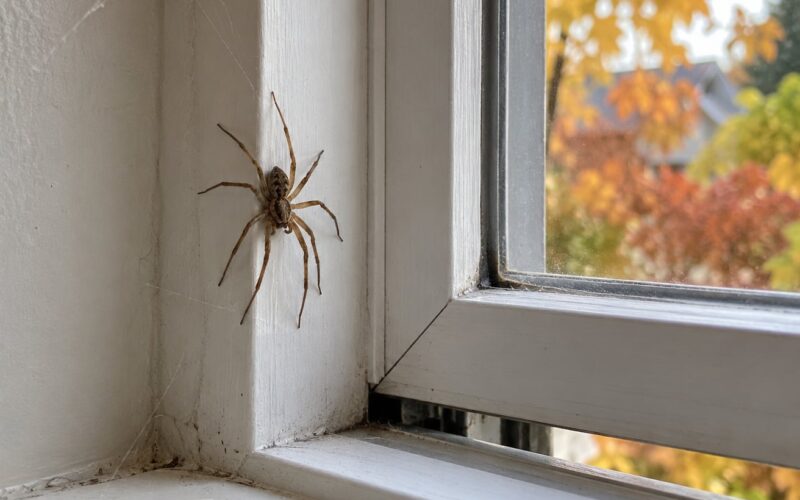
Body shape is the identifier here: a small brown spider with an unusually slim, tapering abdomen, long legs, and two spinnerets that stick out past the tip of the abdomen like a tiny pair of tails. Color alone cannot establish a species or a medical risk.
Adults run about half an inch to roughly three-quarters of an inch in body length, not counting legs, with legs adding a good deal more. Most of what people see is leg. When a funnel weaver is at the mouth of its retreat, it can look considerably larger than it is, which is part of why people are startled by it.
Color runs from pale tan through grey and beige to a very dark brown, and the pattern is usually two darker longitudinal stripes running the length of the top of the abdomen, though in some individuals those stripes are faint or missing entirely. That variability is exactly why identification sites keep telling readers the same thing: color alone is useless for separating a grass spider from a hobo spider, and color is not how you rule out a brown recluse either.
Two physical details do real work in identification. First, the spinnerets at the rear of the abdomen are long and clearly visible in a grass spider, projecting beyond the abdomen tip. In a wolf spider the rear of the abdomen is blunt and the spinnerets are short and hidden. Second, the eyes are all similar in size, unlike the oversized forward pair of a jumping spider.
Movement is the third. A disturbed funnel weaver does not freeze and posture. It runs, fast and in a straight line, and retreats into silk. It is not especially timid in the way a wolf spider is, and enthusiasts often note that these spiders will sit in the open on cool mornings, in the open mouth of the funnel, apparently unbothered.
In the US the species you are most likely to meet belong to the genus Agelenopsis, including A. pennsylvanica across much of the east and A. naevia in the Southeast, plus regional species such as A. heredabilis in parts of the west. Telling them apart needs a microscope, a good dorsal photograph, and usually an entomologist, which is why anything past genus level belongs with an expert.
Where Do Funnel Web Spiders Build Lawn Webs?
Funnel weavers build wherever there is low, sheltered cover close to the ground, with a surface to anchor silk to. The web is nearly always built between about ankle height and knee height, anchored to a solid edge rather than suspended in open air.
- Grass edges and lawn seams, especially where blades are thick enough to hold a web above the soil.
- Groundcover, ornamental grasses, and low shrubs, including ivy and pachysandra mats under foundation plantings.
- Foundation corners, porch edges, and steps, where a vertical wall supplies one side of the anchor and gives the spider a hard edge to run along.
- Rocks, mulch beds, stacked firewood, and stacked lumber, all of which create shaded, stable, insect-rich pockets.
- Under decks, porch ceilings, crawl space vents, and around utility openings, where the sheltered microclimate is damp and the temperature is steady.
Not every silk tube in a yard is a funnel weaver’s. True burrows, sometimes lined with a collar of silk and sometimes with a trapdoor of debris, belong to ground-dwelling families such as wolf spiders and trapdoor spiders, and they do not come with a sheet web above them. A funnel retreat is always attached to a sheet. If you find a tube with no silk mat around it, you are looking at something other than a grass spider.
Dew is what makes all of this suddenly visible. Sheet silk is fine and holds a film of water, so on a foggy or dewy morning every web in the lawn lights up at once. Nothing arrived overnight; the webs were there and became visible. Homeowners across the eastern US describe the same thing, webs that were not there on Sunday and covered the lawn by the following week, and the answer is usually seasonal growth plus mating activity in late summer rather than a new infestation.
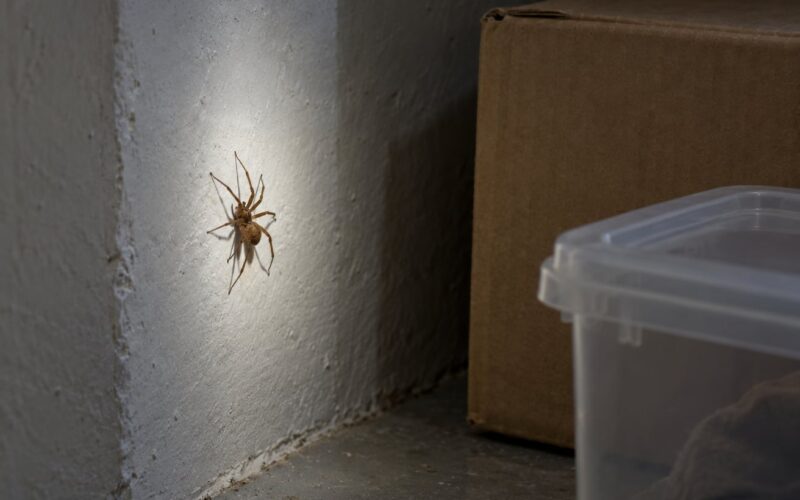
It is also why these spiders turn up indoors. A funnel weaver wandering along a foundation, under a door, or into a sunroom or basement in late summer is usually lost rather than nesting, and there is a real reason: a female that has mated and laid her eggs often overwinters in a protected space. Egg sacs and molts may show up in a garage or basement along with a wandering adult. If the room has no insects to eat, the spider usually leaves or dies within a few weeks; it does not set up housekeeping.
Is It Dangerous to Have Funnel Web Spiders in a Lawn?
Generally no. The funnel weavers in US lawns are not aggressive, they avoid people, and they do not seek out human contact. Treat the answer as a general safety overview rather than a diagnosis of whatever is in front of you, and do not handle an unidentified spider regardless of what you think it is.
Here is the naming trap that causes most of the panic. Outside Australia, the phrase funnel web spider is frequently used for harmless North American grass spiders in the genus Agelenopsis, and for house and giant house spiders in Europe. The frightening species the name evokes is Atrax, the Australian funnel-web, which is a different family entirely and does not occur in North America. A search that returns the Australian name next to a photo of your lawn spider is a terminology problem, not a diagnosis.
It is worth ruling out the two North American species that do matter, because both are easy to separate from a grass spider with clear physical features rather than a color guess.
| Feature | Grass spider (Agelenopsis) | Brown recluse | Black widow |
|---|---|---|---|
| Web | Sheet web with funnel retreat, outdoors on vegetation | No web; loose, messy silk in a sheltered indoor spot | Round, tangled, irregular tangle-web in corners, vents and sheds |
| Color | Tan to dark brown with two faint dorsal stripes | Plain tan to brown, no stripes | Glossy black with a red hourglass on the underside |
| Abdomen and legs | Slim tapering abdomen, long rear spinnerets, long legs | Flat, uniformly colored, violin-shaped marking on the back | Rounded, shiny abdomen, smooth legs |
| Where you see it | Lawn, groundcover, shrubs, foundation corners, decks | Indoors, deep in undisturbed storage, rarely in an open lawn | Indoors or in sheltered outdoor voids near doors and vents |
If a bite ever happens, do not diagnose it from the internet. Clean the area, watch for anything unusual, and contact a healthcare professional or poison control if symptoms develop. For households with a known allergy to spider venom, or anyone who is not comfortable making that judgment, the sensible move is simply to remove the spider rather than reason about it.
Pets are a fair question. Dogs and cats pick up spiders constantly in the yard, and a grass spider that gets mouthed or swatted is a completely different hazard than one that bites a person, mainly because of the mouth. Keep an eye on a pet that is chewing a spider, wipe its mouth, and watch for drooling, swelling, or unusual licking. Any of those and you call your vet the same day.
Funnel Web Spider vs. Other Common Lawn Spiders
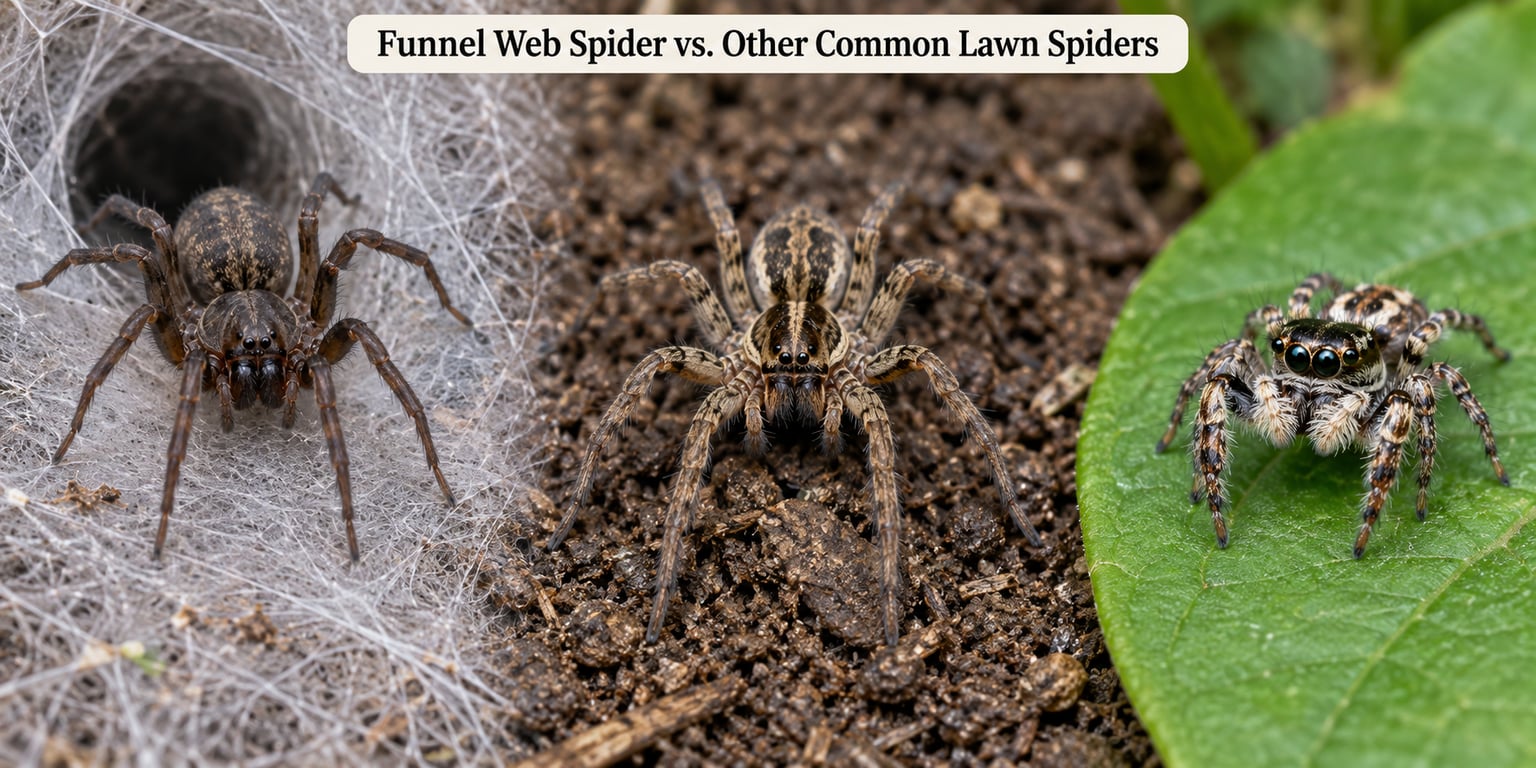
Almost every lawn spider question reduces to one comparison: grass spider or wolf spider. The table below separates the five lawn regulars by the things that actually differ, including the one feature people usually forget, spinnerets.
| Feature | Funnel weaver (grass spider) | Wolf spider | Jumping spider | Cellar spider | Orb-weaver |
|---|---|---|---|---|---|
| Web | Sheet web with a funnel retreat | None; hunts on the ground | None, or a silk pad and safety line | Loose, messy tangle web in corners and ceilings | Orb: a tidy circular wheel web |
| Silk | Non-sticky, a vibration sensor | Not applicable | Safety line and dragline only | Non-sticky silk | Sticky capture spiral |
| Spinnerets | Long, projecting past the abdomen | Short, not visible | Short | Not a field feature | Short |
| Abdomen | Slim, tapering to a point, faint dorsal stripes | Large, oval, bold patterning | Compact, often dark, sometimes iridescent | Very small, pale, long thin legs | Rounded, often patterned and hairy |
| Posture and eyes | All eyes similar in size | Distinct eye arrangement, front-facing and larger | Two large forward-facing eyes | Grouped in two clusters | Large front eyes with a bump above |
| How it hunts | Waits in the retreat, dashes out, drags prey back | Active pursuit, no silk | Stalks, then leaps onto prey | Vibrates and swings on the web | Waits in the orb, senses the wrap |
| Reaction to people | Retreats rapidly into the funnel | Quick to move off, rarely bites unless handled | Looks at you and sidesteps; may jump away | Shy, stays high in corners | Stays in the web or drops off it |
| Typical size | About 0.5 to 0.75 inch body | Larger, often 0.5 to 1 inch body | Small, usually under 0.5 inch body | Body under 0.5 inch, legs long | Body 0.25 to 1 inch |
Two more comparisons get asked constantly, and both come down to web structure. A hobo spider (Eratigena agrestis) also builds a funnel web, but its retreat is usually in a corner, a window well, a garage or a basement rather than out in lawn grass, and the web is a messy tube of silk rather than a horizontal sheet. An orb-weaver never hides in a tube; it sits in the middle of its wheel, which is the opposite arrangement.
For species-level confirmation, a good dorsal photograph plus a photo of the web and the retreat is usually enough for a confident answer. Upload it to BugGuide or iNaturalist, or take it to your county or university extension office. Extension entomology services exist for exactly this and they will tell you plainly when an identification is not possible from a photo. Forum commenters are also a useful second opinion, particularly for confirming spinnerets, but a single confident comment is not a diagnosis.
What to Do About Funnel Web Spiders in Lawns
Most sightings do not need any treatment at all. A lawn full of funnel webs is usually a sign that your yard is working: these spiders eat flies, ants, beetles, midges, and a good share of the other surface-dwelling insects that make a lawn pleasant. Removing them means removing your own pest control.
Still, there are times when you want the webs gone. Work through these in order, from least to most invasive, and stop as soon as the problem stops bothering you.
- Change the habitat instead of the spider. Break up sheltered anchor points, trim the thickest mat of groundcover away from the foundation, and clear debris, stacked lumber, and stored items out of the corner where the webs concentrate. Webs need a stable, sheltered edge; remove the edge and the spider relocates.
- Keep the vegetation managed. Cut ornamental grasses back before late summer, and thin dense groundcover along walkways and steps where people brush past the webs.
- Wash down or sweep off webs you can reach safely. A broom, a leaf blower, or a hose from a distance removes silk quickly. Do not climb a ladder to reach a web, and do not put a hand inside a retreat.
- Handle egg sacs and molts if they are accessible and outside. A low web beside a walkway can be disposed of with a stick and a sealed container, without touching the spider. Leave sacs that are out of reach alone.
- Close the entry points for indoor wanderers. Door sweeps, intact weatherstripping, and screened or fitted crawl space vents resolve most of the late-season indoor appearances.
- Avoid broad-spectrum pesticide. Spraying a lawn perimeter for a beneficial predator kills the insects the spider is eating, pushes surviving spiders outward into living space, and can produce a worse problem than the webs you started with. If anyone recommends it for grass spiders, that is a reason to get a second opinion.
Dense, repeated webbing does carry one useful signal. If the webs appear in heavy numbers year after year, the yard is supporting a large insect population, which usually means something else is attracting it: standing water, pet waste, fallen fruit, excessive exterior lighting, or a dense, un-irrigated, weedy edge. Address the food supply and the spiders thin out on their own.
When to Contact a Pest Professional or Local Extension
Reach out when the situation is a recurring documented problem rather than a bad morning, and when you are not comfortable identifying or handling the spider yourself. The distinction matters, because the most common bad advice in this topic comes from people selling treatment for a harmless predator.
- Webs clustered right at doors, vents, or entry points, repeatedly, season after season, and the household has stepped on one or a child has been near one. That is a hardware and habitat problem, and a pro can find the anchor points you are missing.
- Repeated sightings indoors, in a room you use daily, with no insect population to support them. Indoor placement plus persistent presence means something is getting in and staying.
- Uncertainty about what the spider is. This is the single best reason to call, and your local extension office is the right first call, not a pest control company. Extension entomology staff can identify from photographs and will tell you when no treatment is warranted.
- Households where a bite would be a serious problem, including a venom allergy in a family member. Removal without judgment calls is reasonable here.
- Cases where treatment or trapping would be unsafe, such as a young child, a pet that cannot be kept out of the area, or a homeowner with a reaction to pesticide. A professional can decide the method.
One thing not to do: do not collect a suspected dangerous spider by hand and relocate it, and do not ask a child to hold one. Use a container and a long-handled tool, and even then, only if you are certain of the identification. If you are not certain, leave it and call.
Frequently Asked Questions
Are funnel web spiders in lawns poisonous?
US lawn funnel weavers in the genus Agelenopsis are not considered medically significant to people and are not aggressive. The name causes confusion because the Australian funnel-web spider Atrax is a different, dangerous species that does not occur in North America. Do not handle an unidentified spider, and seek medical advice after any bite that produces unusual symptoms.
What does a funnel web spider bite feel like?
Bites from grass spiders are rare, because they retreat rather than bite, and most reported bites involve handling or crushing the spider. Reactions reported by victims are typically localized pain with redness and swelling that fades within a day or two, similar to any minor insect bite. Clean the area, watch for spreading redness or systemic symptoms, and contact a healthcare professional or poison control if anything unusual develops.
When are funnel web spiders most active in lawns?
Activity and visibility peak in late summer and early fall, when adults are largest, mating occurs, and webs hold morning dew so they glisten against the grass. Most of the year they are there but hidden inside their retreats, and cold winter months put them deep in protected overwintering spots. This is why lawns can look suddenly web-covered in September when nothing actually moved in overnight.
Do funnel web spiders require pesticide treatment?
No. The great majority of lawn sightings need no treatment at all, and spraying for them is counterproductive, because broad-spectrum pesticide kills the flies, beetles and midges the spiders eat. Change the habitat instead: trim thick groundcover, clear debris and stored lumber, cut back ornamental grasses, and close entry points with door sweeps and fitted vents. Only consider professional work if exposure is repeated and documented.
How can I identify a funnel web spider safely?
Watch the web before the spider. Look for a flat, non-sticky sheet of silk with a tube folded back at one end, anchored low to grass, shrubs, rocks, or a foundation corner. For a closer look, tap the edge of the sheet with a twig and watch for a fast dash and an instant retreat. Note the long rear spinnerets and the slim tapering abdomen, and confirm with BugGuide, iNaturalist, or a local extension office.
Conclusion
Start with the web, not the spider. Take a photo from several feet back showing the sheet and the funnel retreat, note where it is anchored and what is sheltering it, and tap the edge with a twig to watch the dash. Those three things will identify a lawn funnel weaver with more confidence than any picture search can.
Then leave it alone. US grass spiders are not aggressive, they eat a lot of what you would rather not have in your yard, and a lawn covered in sheet webs in late summer is a functioning predator community, not an infestation. Take action only if repeated exposure at your doors or indoors becomes a documented recurring problem, and take it to your extension office before it takes it to a spray can.