Most of the common house spiders that are harmless share three traits: venom built for insects rather than people, a strong preference for staying put, and an appetite for the flies and mosquitoes you would rather not have indoors. The spider on your wall is almost certainly one of them, and it is far more likely to flee from you than to bite you.
Updated for October 2026. If you are reading this mid-panic with a spider photo on your phone, scroll to the quick ID table first, then match your spider by web type and location. That combination identifies most house spiders faster than color alone.
Table of Contents
- Common House Spiders That Are Harmless at a Glance
- 1. Common House Spider (Parasteatoda tepidariorum)
- 2. American House Spider (Parasteatoda parietum)
- 3. Long-Bodied Cellar Spider (Metellina segmentata)
- 4. False Widow Spider (Steatoda species)
- 5. Yellow House Spider (Thomisus onustus)
- 6. Spiny House Spider (Micrathena gracilis)
- 7. Barn Spider (Araneus cavaticus)
- 8. Cross Orb Weaver (Araneus diadematus)
- 9. Northern House Spider (Achaearanea nordmarki)
- 10. Zebra Spider (Salticus scenicus)
- Frequently Asked Questions
- Are common house spiders poisonous?
- What is the most common harmless spider found indoors?
- How can I tell a harmless house spider from a brown recluse?
- Do house spiders bite people, and what should I do after a bite?
- Why do I suddenly have more spiders in my house?
- How can I prevent spiders without killing them?
- Conclusion
Common House Spiders That Are Harmless at a Glance
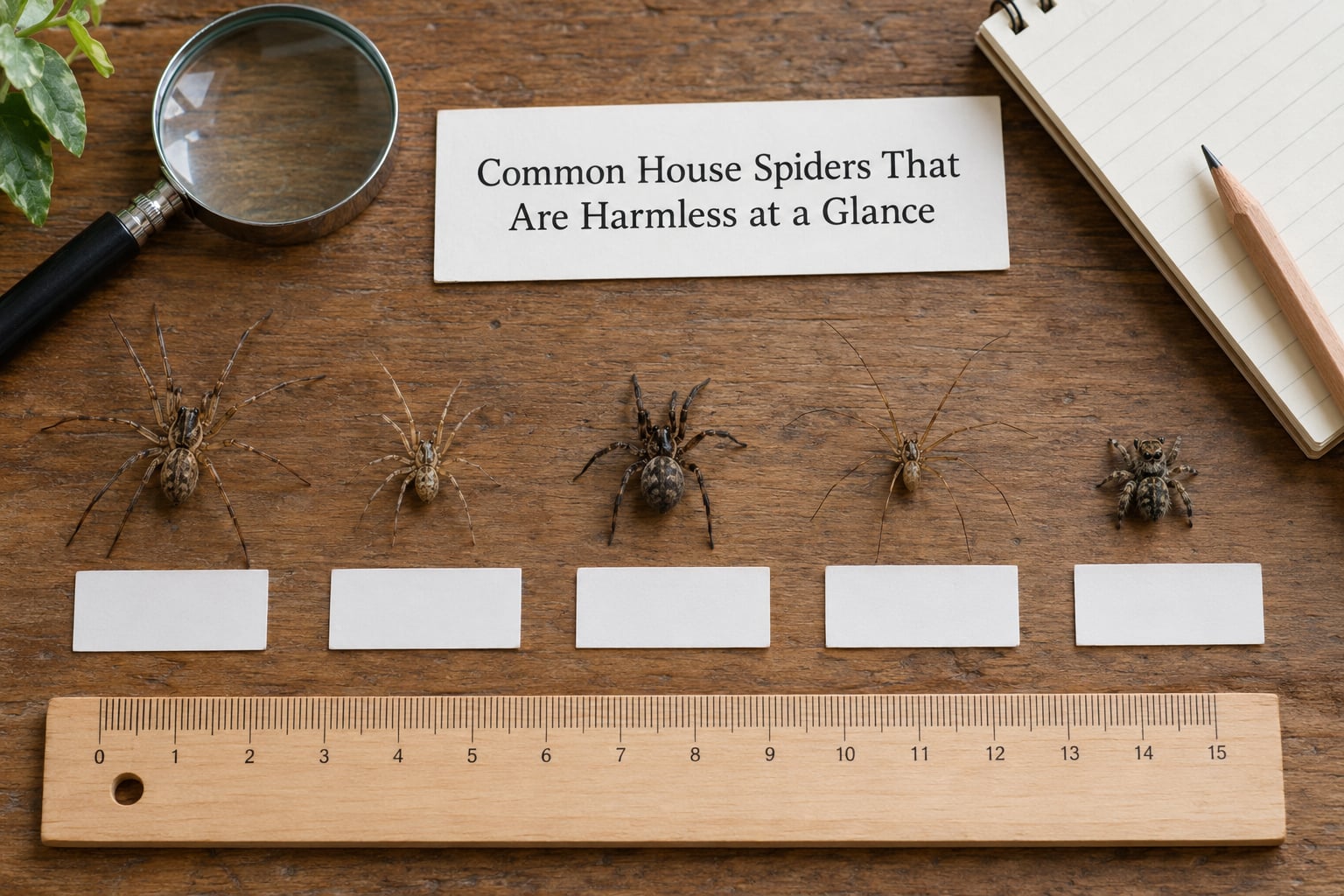
All ten species below are non-aggressive arachnids that live around homes in North America. The useful column is not color, because brown means almost nothing here. It is web type plus where you found it.
| Spider | Body length | Web type | Where you find it | Bite risk | Best ID clue |
|---|---|---|---|---|---|
| Common house spider (Parasteatoda tepidariorum) | about 0.2 inch | Messy tangle cobweb | Ceiling corners, window frames, porch lights | Harmless; bites only when crushed | Glowing bulb-shaped abdomen with dark zigzag |
| American house spider (Parasteatoda parietum) | up to 0.5 inch | Messy tangle cobweb | High corners, wall junctions, unused rooms | Harmless | Large round abdomen with pale patches |
| Long-bodied cellar spider (Metellina segmentata) | 0.2 to 0.3 inch | Open messy tangle | Basements, garages, crawl spaces | Harmless | Legs several times the length of the body |
| False widow (Steatoda species) | 0.2 to 0.4 inch | Tangle cobweb with sticky strands | Sheltered corners, sheds, mailboxes | Uncomfortable but not medically significant | Teardrop abdomen, mottled cream and brown |
| Yellow house spider (Thomisus onustus) | about 0.3 inch | No capture web | Flowers, porch railings, window plants | Harmless; ambush hunter | Holds its legs sideways like a crab |
| Spiny house spider (Micrathena gracilis) | 0.3 to 0.5 inch | Orb web | Porches, fences, near outdoor lights | Harmless | Spiny white or yellow abdomen with a dark center |
| Barn spider (Araneus cavaticus) | up to 0.8 inch | Large orb web | Vegetation around sheds and garages | Harmless | Striped, hairy abdomen; stays in the web |
| Cross orb weaver (Araneus diadematus) | up to 0.7 inch | Circular orb web | Windows, garden frames, railings | Harmless | Row of white dots forming a cross |
| Northern house spider (Achaearanea nordmarki) | about 0.15 inch | Tangle cobweb | Quiet indoor corners, window sills | Harmless | Dark chevron pattern on a pale abdomen |
| Zebra spider (Salticus scenicus) | about 0.2 inch | No capture web | Sunny walls, window frames, posts | Harmless; rarely bites at all | Black and white stripes, active in daylight |
Two more species get confused with these constantly, and both are worth ruling out before you relax: the black widow (Lactrodectus species), glossy black with a red hourglass underneath, and the brown recluse (Loxosceles reclusa), tan with a violin-shaped marking and six eyes. Neither is common indoors in most of the country, and neither belongs on the list above.
What “harmless” actually means here
Entomologists call a bite medically insignificant when the venom is delivered through a fang too small to puncture skin easily, and the dose is far below anything that affects a human. A pinprick, some redness, maybe itching for a day. Nothing more.
The two species to rule out before you relax
Black widows hang in a messy tangle web and prefer sheltered, undisturbed spots like a porch railing gap, an outdoor box, or a crawl space. Brown recluse are tan, uniformly hairy, and carry a violin mark on the head region, and they hide in dark, dry clutter such as cardboard boxes and woodpiles.
1. Common House Spider (Parasteatoda tepidariorum)
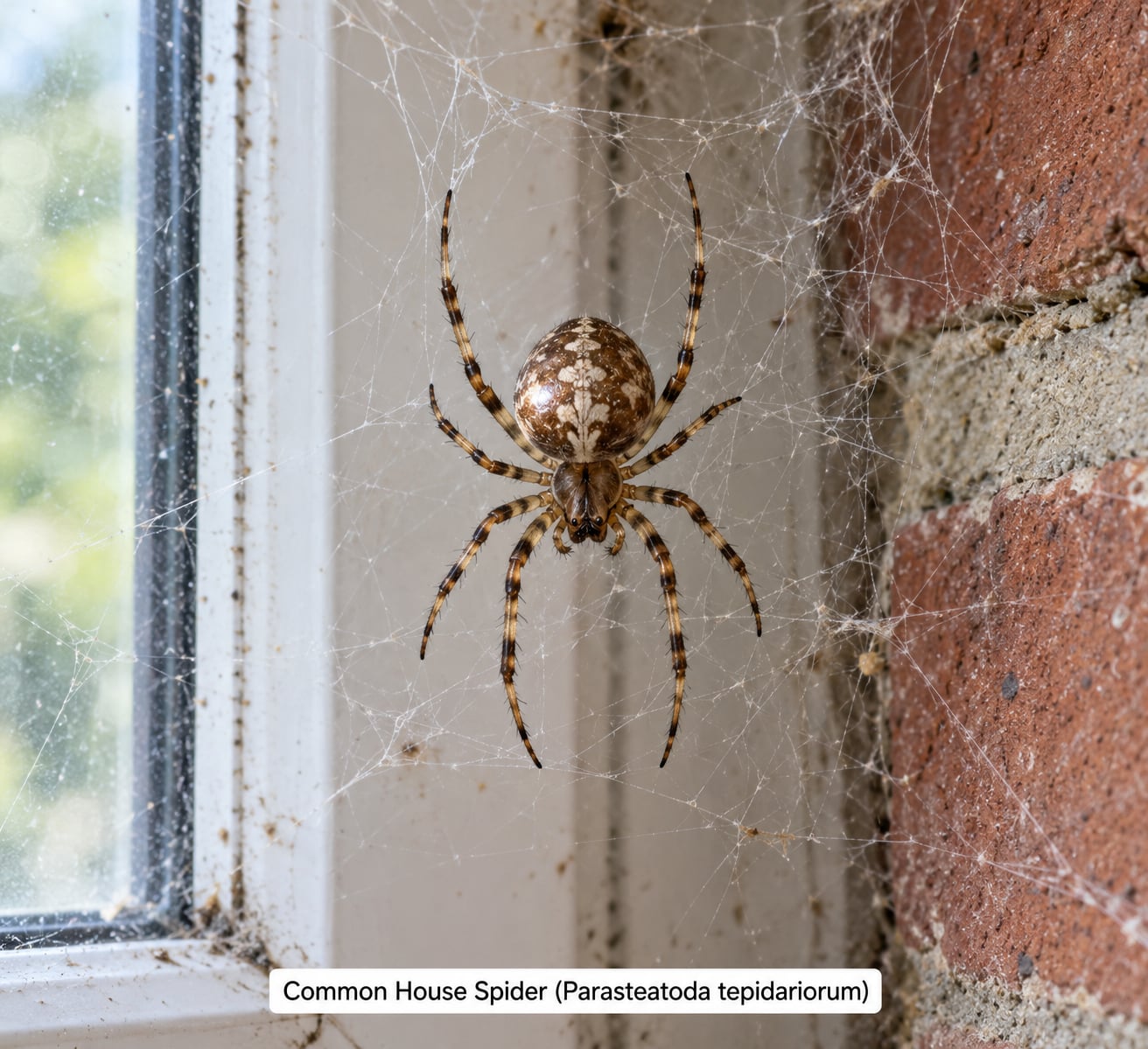
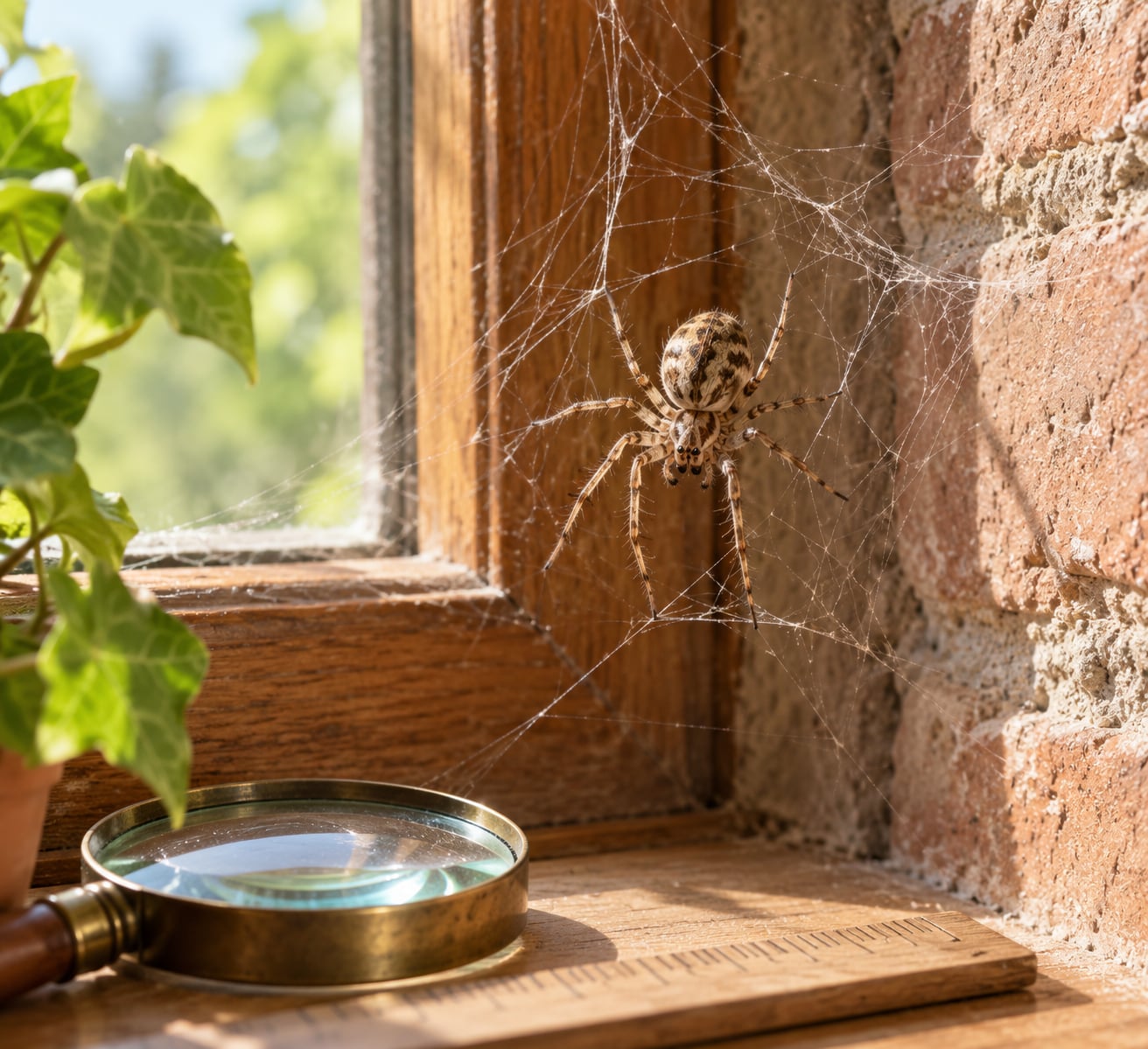
This is the spider most people mean when they say house spider, and it turns up in more US homes than any other. It spins the untidy tangle web you find in ceiling corners, behind outdoor lights, and along window frames, then sits in it for weeks.
Identification is easy once you know it: a bulbous abdomen that looks translucent and faintly glows when backlit, usually pale tan or gray with a dark wavy zigzag running across it, and legs banded in the same dull pattern. Body length runs around 0.2 inch, with a leg span closer to 0.5 inch.
It eats flies, gnats, small insects, and it has no interest in you. Venom exists to immobilize prey an order of magnitude smaller than a person, and bites essentially only happen when a spider gets trapped between clothing and skin.
2. American House Spider (Parasteatoda parietum)
The American house spider is the larger cousin of the previous species, reaching roughly half an inch in body length with a noticeably rounded, bulbous abdomen. It is the answer to that common question about a brown spider with a large round body living indoors.
Look for pale cream or yellowish patches arranged on the abdomen, sometimes forming a leaf or chevron-like pattern, against a darker brown background. It builds the same messy tangle web, usually in a high corner where a wall meets the ceiling or where two walls meet.
It is calm, slow, and completely uninterested in people, and it tends to pick spots in rooms that get little traffic, which is why it goes unnoticed for so long. Males are thinner and darker, and you may find one wandering across a wall in late summer looking for a mate. That roaming is seasonal behavior, not aggression.
3. Long-Bodied Cellar Spider (Metellina segmentata)
If the spider has absurdly long, thin legs and a small narrow body, you are almost certainly looking at a cellar spider. Metellina segmentata, the long-bodied cellar spider, is the species most often indoors in basements, garages, and crawl spaces.
Its web is an open, loose tangle hung in a corner or across a ceiling rather than a tight, flat sheet. That looseness matters, because true cellar spiders hang from their own web when disturbed, which produces the distinctive drifting, dangling motion people notice.
Body length is only about 0.2 to 0.3 inch, but the legs can span several inches, which is why photos make them look enormous. They cannot bite people in any meaningful way, and they are useful residents: a single one eats a steady stream of flies and small insects in a damp basement.
4. False Widow Spider (Steatoda species)
False widows get a bad reputation because they look like widows, and that is the whole problem. Their abdomen is teardrop shaped and glossy brown with mottled cream markings, similar to a brown widow, and they build a loose tangle web with sticky threads running through it.
A real black widow hangs lower in its web on stronger silk and shows a clear red or orange hourglass on the underside. A Steatoda false widow hangs higher, looks pale and mottled rather than clean black, and its markings are cream, not red.
Bites are rare and reported most often when someone handles the spider directly. When they happen, people describe localized pain and itching that resolves within a day or two, and the venom is not considered medically significant for healthy adults. Treat it with the same calm approach as any house spider: do not pick it up with bare fingers.
5. Yellow House Spider (Thomisus onustus)
This is the crab spider of the front porch. Thomisus onustus, the yellow house spider, is pale yellow, cream, or faintly greenish, and it holds its first two pairs of legs out to the sides in a crab-like stance that makes it instantly recognizable.
It builds no capture web. Instead it sits motionless on flowers, seed heads, porch railings, and window boxes, waiting for visiting insects with front legs ready. That hunting strategy keeps it in shaded, plant-heavy spots near doors and gardens rather than in dusty corners.
People rarely notice it until it is on a flower they are about to pick, and then it startles them. It does not pursue people, and its bite is not a concern for most adults, though anyone with known sensitivity should wash their hands after handling plants.
6. Spiny House Spider (Micrathena gracilis)
Micrathena gracilis looks like a small piece of stained glass with a thorn attached. Its abdomen is hard and spiny, with several sharp points projecting from the edges, and it is usually white, cream, or yellow with a pair of dark lengthwise markings.
It spins a small orb web, usually near a porch light, along a fence, or beside an outdoor window, where flying insects gather after dark. Those lights are the reason it shows up near houses at all.
Body length runs about 0.3 to 0.5 inch, and the spines are a defense against predators rather than a warning about people. It is a non-aggressive species, it stays in its web, and there is no documented medical concern from its bite.
7. Barn Spider (Araneus cavaticus)
The barn spider is one of the larger North American orb weavers, and the females can reach nearly an inch in body length. The abdomen is hairy and oval with bold dark and light stripes running front to back, which reads as a pattern of pointed triangles down the back.
It builds a large orb web across openings near sheds, porches, fences, and garden rows, and it works on it mostly in the evening when insects come out. When something disturbs the web, this spider drops straight down on a silk line to the lower frame of the web instead of moving across it.
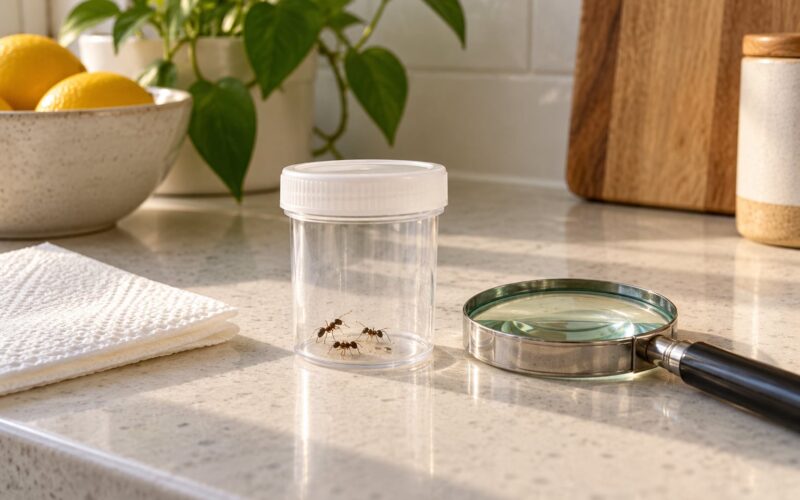
That drop-and-hide response is often mistaken for aggression and rarely is. It is a web-based ambush predator with poor eyesight, and its whole strategy depends on staying still in the center of its web. If one ends up inside, carry the cup-and-paper method rather than reaching for it.
8. Cross Orb Weaver (Araneus diadematus)
Araneus diadematus is the European and Canadian species that has settled widely across the northern United States as well. It builds a clean circular orb web on window frames, porch posts, garden fences, and playground equipment, and it rebuilds the whole web most days.
The signature marking is a cross: a row of white spots running vertically down the abdomen intersected by a shorter horizontal row, all on a mottled brown or tan background. Those white marks are actually thickened hairs, which is a nice detail if anyone asks why they look almost painted on.
It sits in the web or drops on a thread, both at night and during the day, and it is one of the least aggressive spiders you will meet. It does not chase and it does not bite defensively, though like most orb weavers it can jab if firmly handled.
9. Northern House Spider (Achaearanea nordmarki)
Achaearanea nordmarki, the northern house spider, is a small northern species that genuinely lives indoors across Canada and the colder United States. Body length is around 0.15 inch, small enough that many people never notice it at all.
The abdomen is pale with a dark curved or chevron pattern across the front half, and the legs are thin and slightly yellowish. It spins a fine tangle web in quiet corners, along baseboards, behind furniture, and on window sills in rooms that stay undisturbed.
Its behavior matches the web placement. It stays hidden in its silk most of the time and has no hunting stage, so it rarely crosses an open room or approaches a person. There is no meaningful bite risk attached to this species.
10. Zebra Spider (Salticus scenicus)
Salticus scenicus is a jumping spider, and its pattern gives it away from across a room: bold black and white stripes running along the abdomen, sometimes with a greenish or bronze sheen in sunlight. It is small, roughly 0.2 inch, with large forward-facing eyes.
Unlike the web-builders on this list, zebra spiders hunt actively and jump. They prefer sunny surfaces, which is why you find them on exterior walls, window frames, patio furniture, and posts on warm days.
They are curious rather than aggressive, and the occasional bite happens when one is trapped against a hand. When that occurs, the pain is brief and the reaction is minor and short-lived. They are considered beneficial hunters of small flying insects around entries and doors.
Frequently Asked Questions
Are common house spiders poisonous?
Nearly all of them are not a medical concern. Most common house spiders have venom strong enough to paralyze a small insect but far too weak and delivered in far too small a dose to affect a healthy adult human. A bite, when it happens at all, usually feels like a pinprick with mild redness and itching that clears within a day or two. Black widows and brown recluse are the exceptions worth knowing about by sight.
What is the most common harmless spider found indoors?
The common house spider, Parasteatoda tepidariorum, is the one people mean most of the time. It has a bulbous pale abdomen with a dark zigzag marking, banded legs, and a body length of about 0.2 inch. It spins the familiar untidy cobweb in ceiling corners, behind porch lights, and along window frames. The American house spider, Parasteatoda parietum, is the close second and is noticeably larger and rounder.
How can I tell a harmless house spider from a brown recluse?
Start with the eyes and the markings. A brown recluse has six eyes arranged in a row, while house spiders have eight. Recluse are uniformly hairy and tan, with a dark violin-shaped mark on the top of the head region, and they have very long, thin legs that stay folded flat against the body when disturbed. Wolf spiders are the usual mistake: they are stocky, hairy, and have large forward-facing eyes, but they have eight eyes and no violin mark.
Do house spiders bite people, and what should I do after a bite?
Rarely, and almost never on purpose. Bites generally happen when a spider is trapped between skin and clothing, squeezed in a sleeve, or handled. Clean the area with soap and water, apply a cool compress, and watch it. Seek medical care if you develop spreading redness, swelling, fever, or a wound that does not heal, and get urgent attention for any bite from a black widow or brown recluse, or if you have known venom sensitivity.
Why do I suddenly have more spiders in my house?
Spiders follow prey, so a rise in visible spiders usually means more small insects, not a spider invasion. Late summer and autumn are peak times, because outdoor insects decline and spiders move indoors to find food, and male house spiders roam looking for mates. Humidity and warmth raise activity too, as does moving into an older building with more entry gaps or a nearby woodpile serving as a refuge.
How can I prevent spiders without killing them?
Reduce what draws them in rather than targeting the spiders. Vacuum and dust webs and corners regularly, especially in basements, garages, and attics, since removing webs removes the structure they reoccupy. Seal gaps around pipes, door frames, and window openings, add door sweeps, and repair torn screens. Cut down on flies, gnats, and mosquitoes, since eliminating the food source reduces the spider numbers far more effectively than any pesticide.
Conclusion
Start with a photo rather than a spray bottle. Match what you saw against the quick ID table by web type and location, and remember that the species on that list are non-aggressive predators that eat flies, gnats, and mosquitoes for a living, which is a good deal more than they ask from you.
Then work on the conditions rather than the spider. Vacuum webs and corners, seal gaps, fix screens, and reduce the flying insects it came after. If you find a black widow or suspect a brown recluse, give the room a wide berth and contact a pest professional or your local extension office instead of handling it.