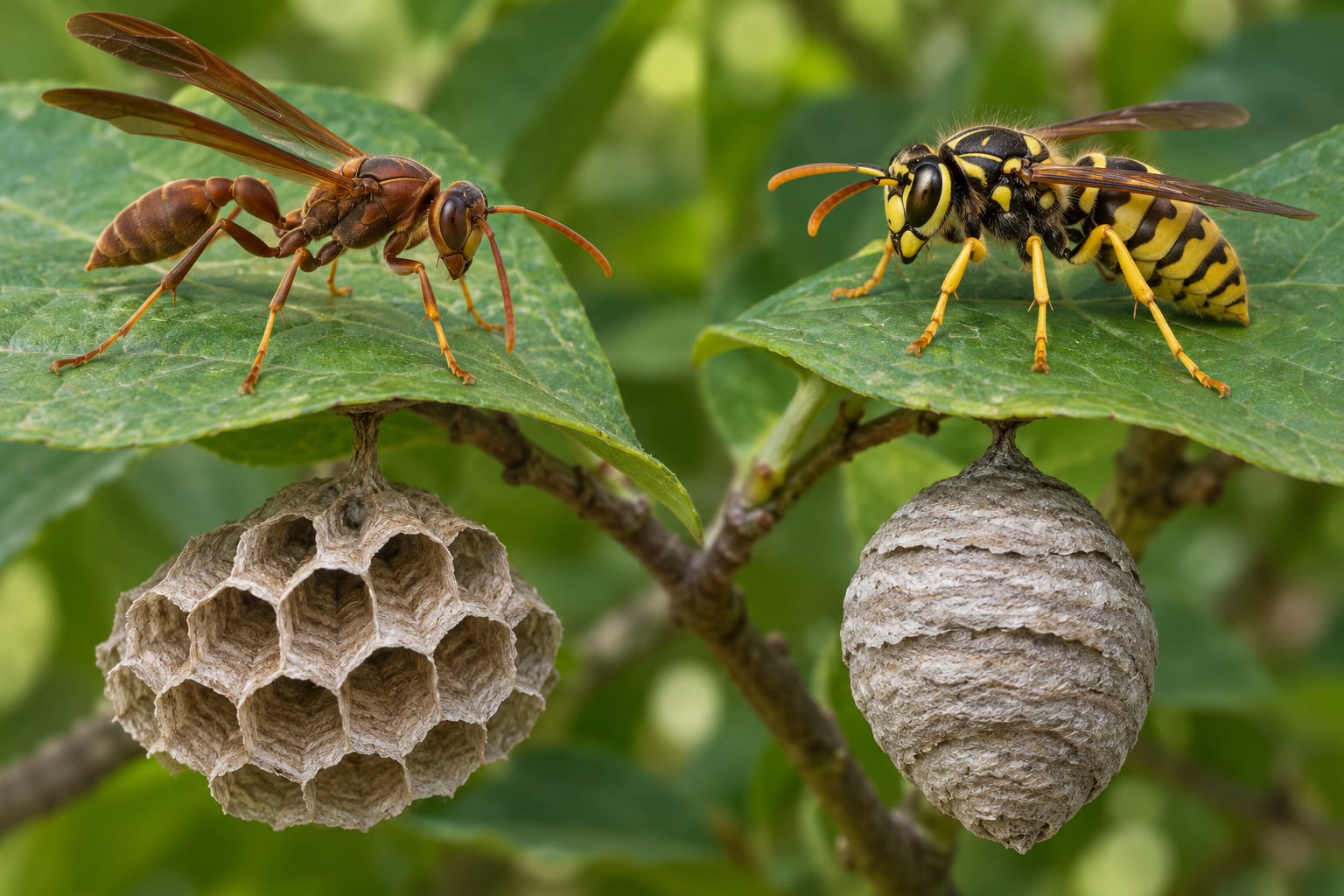
Paper wasps are slender, long-legged wasps with thin pinched waists, orange-tipped antennae, and open umbrella-shaped nests under eaves. Yellowjackets are shorter and thicker, with black antennae and enclosed paper nests, usually underground or inside wall voids. Color alone rarely settles it. Nest design does.
Getting the paper wasp vs yellow jacket differences right matters more than it sounds. One of these nests under your porch ceiling can usually be lived with all summer. The other one wrapped around a downspout or buried under a walkway can send a family to the emergency room. This guide covers the traits you can actually check from where you are standing, plus a short list of what to do with each nest.
Table of Contents
- Paper Wasp vs Yellow Jacket Differences at a Glance
- Body Shape and Size Differences
- Color and Marking Differences
- Nesting Habits and Where You May Find Them
- Behavior and Flight Differences
- Stings, Aggression, and Safety
- What to Do About Each Insect
- Which Should You Choose?
- Frequently Asked Questions
- Conclusion
Paper Wasp vs Yellow Jacket Differences at a Glance
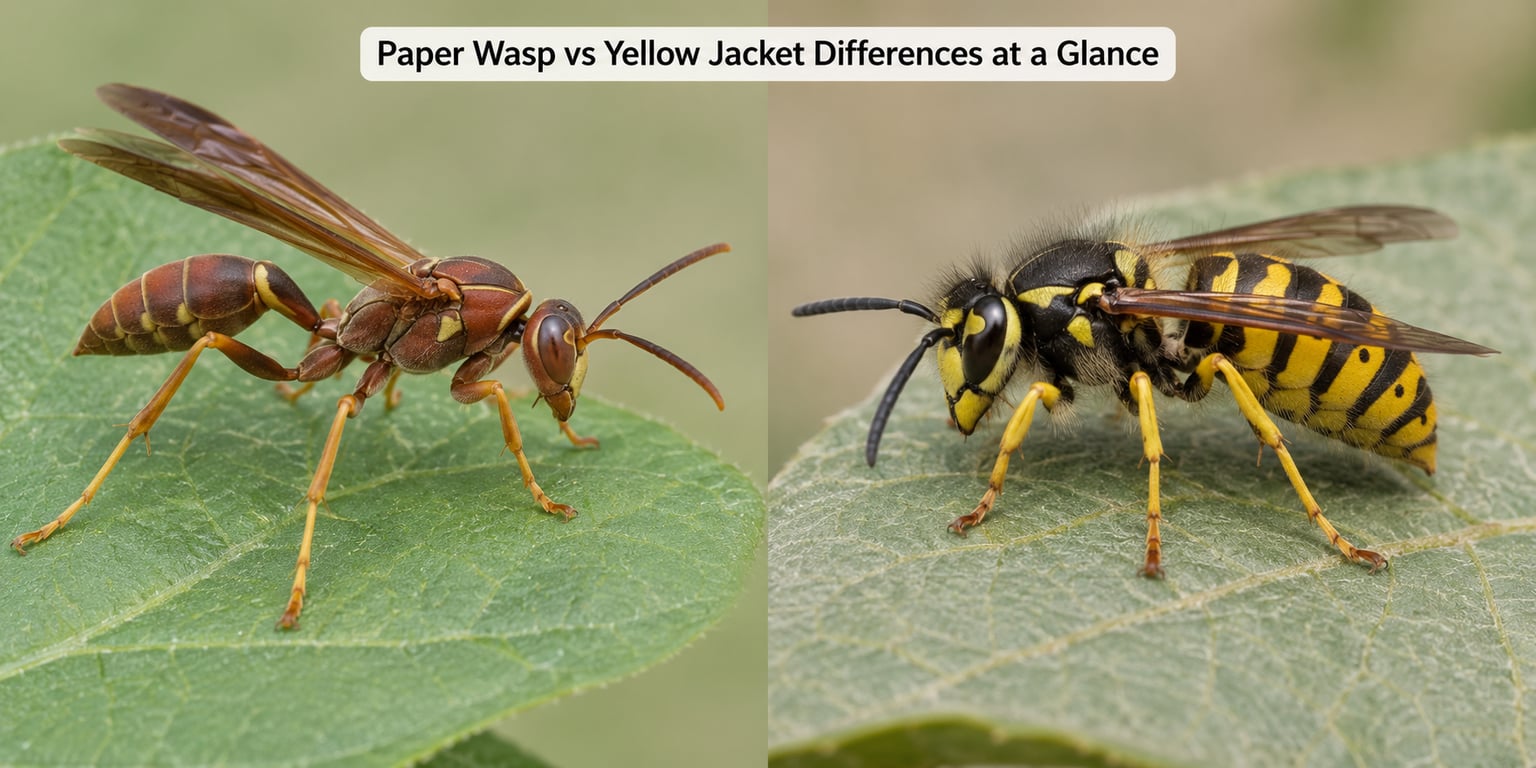
| Feature | Paper Wasp | Yellowjacket |
|---|---|---|
| Body shape | Slender, long, smoothly tapered | Short, thick, compact |
| Waist | Thin pinched waist, a visible petiole | Waist hidden by a broad abdomen |
| Length | Roughly 5/8 inch to nearly 1 inch | Roughly 3/8 inch to 5/8 inch |
| Antennae | Often orange or yellow toward the tips | Entirely black |
| Legs in flight | Long legs dangle below the body | Legs tucked in close to the body |
| Body hair | Smoother, sleeker look | Fuzzier appearance on the abdomen |
| Markings | Reddish-brown, brick-red, or amber bands | Bold black-and-yellow, or black-and-white |
| Nest shape | Open comb shaped like an upside-down umbrella | Enclosed paper envelope, often football-shaped |
| Nest location | Eaves, sheds, porch ceilings, window corners, shrubs | Underground voids, wall cavities, attics, rodent burrows |
| Diet | Nectar and insects, including caterpillars | Nectar plus protein, scavenges food and carrion |
| Temperament | Usually docile around people | Defends the nest aggressively |
| Colony size | Roughly 20 to 75 members | Thousands at peak season |
| Stinging | Can sting repeatedly, rarely unprovoked | Can sting repeatedly, attacks in groups |
One quick note on spelling. Entomologists write yellowjacket as one word, and the university extension services behind this guidance use that form. Both spellings mean the same insect.
If you take one habit from this table, make it checking where the nest is before you check anything else. An open comb bolted to a rafter and a hidden ground entrance two feet from your back door are never going to be confused, and that one clue usually settles the ID faster than anything you can see on the insect itself.
Body Shape and Size Differences
Body shape is the most reliable trait you have when the insect is right in front of you. Paper wasps are slim, elongated, and taper smoothly from thorax to abdomen. Yellowjackets are built closer to the body, chunky through the middle with a broad abdomen that hangs down.
The waist tells the same story. That narrow segment where the thorax meets the abdomen, called the petiole, is long and pinched on a paper wasp. On a yellowjacket the abdomen is so wide that the waist is mostly hidden, which is why people who expect a wasp silhouette often misread one.
On size, paper wasps run from about 5/8 inch to nearly a full inch, while yellowjackets are generally smaller, around 3/8 inch to 5/8 inch. Treat those numbers as ranges rather than rules, though. Perspective distorts a lot at twenty feet, and a big paper wasp at close range can pass for a very large yellowjacket until you see the waist.
Color and Marking Differences
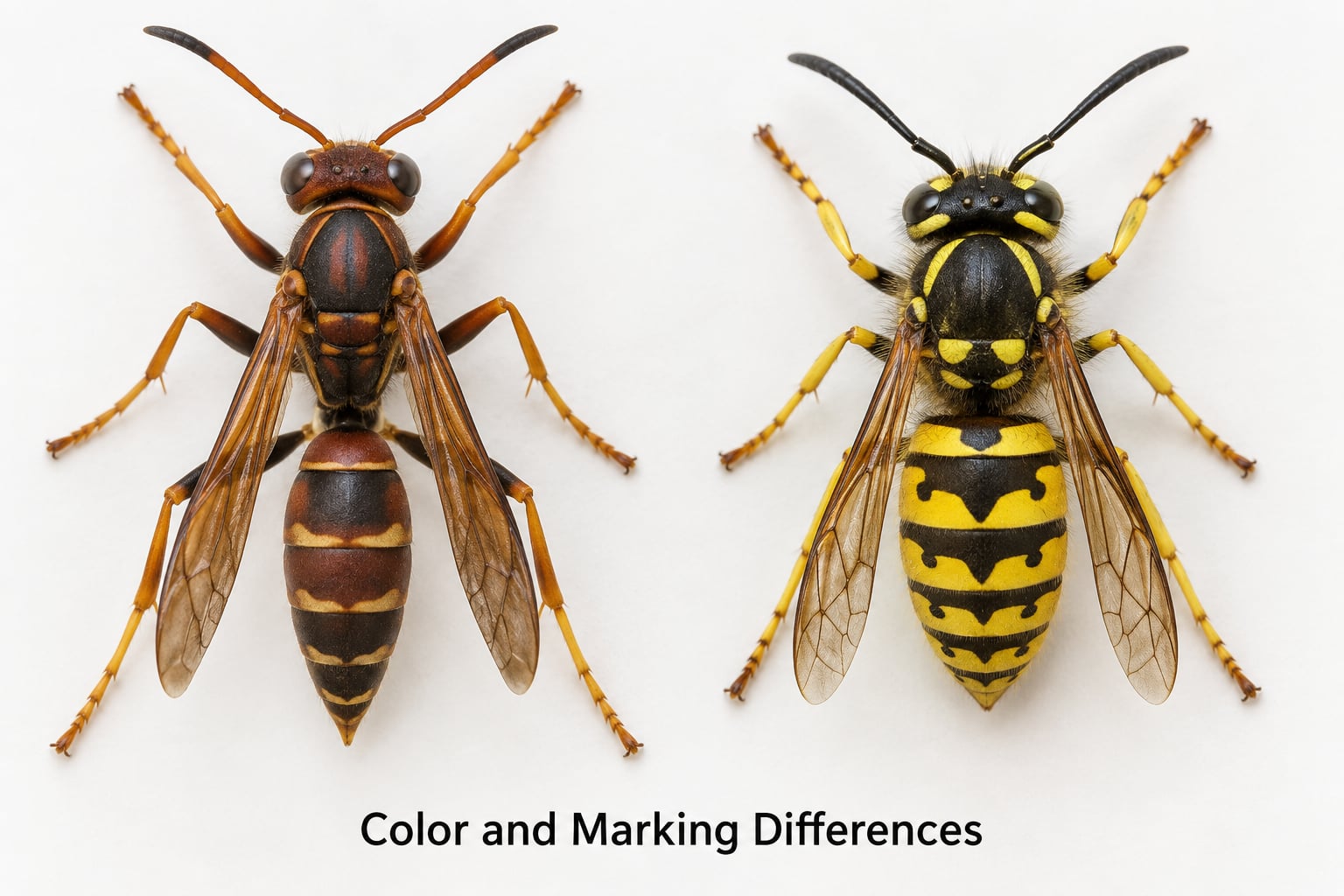
Common paper wasps carry reddish-brown, brick-red, or amber markings on a darker body, often in angular shapes. Yellowjackets run bolder: sharp black-and-yellow bands, or the black-and-white face pattern that makes the so-called baldfaced hornet famous. Neither pattern is a reliable rule on its own.
Here is where color confuses people. The European paper wasp is yellow and black with orange antennae, and it looks remarkably like a small yellowjacket at a glance. The red paper wasp causes the opposite confusion, since a bird-masked-looking insect with red-brown markings gets reported as a yellowjacket all summer.
Shape settles both cases. A yellow-and-black wasp with long dangling legs and an orange antenna is a European paper wasp in the genus Polistes. A black-and-white wasp with a stocky body and black antennae is the eastern yellowjacket, Vespula maculifrons.
Worth knowing: the baldfaced hornet everyone talks about is not a hornet at all. It is an aerial yellowjacket, a Dolichovespula species, so it nests in the open like a paper wasp but defends itself with yellowjacket intensity.
University of Maryland Extension also notes a detail most people never see: male paper wasps have longer antennae with distinctly curved tips and a paler, yellower face than females. If you are trying to settle an argument about species, the males are the easiest to identify.
How to Identify a Paper Wasp vs Yellow Jacket
Work through this order and you will usually have your answer in a minute. Watch from a distance and never reach into an opening to look.
- Check the nest location first. Open comb under an eave, shed beam, or porch ceiling means paper wasp. A single entrance hole in the ground, or a bulge in a wall or soffit, points to yellowjacket.
- Watch one insect fly. Long legs trailing below the body are paper wasp. Legs pulled tight against the body are yellowjacket. This works at a surprisingly long distance.
- Look at the antennae. Orange or yellow toward the tip suggests paper wasp. All black suggests yellowjacket.
- Compare body proportions. Long and slim with a visible pinched waist, or short and stocky with a broad abdomen.
- Look at the nest itself. You can see hexagonal cells and larvae on an open paper wasp comb. A yellowjacket nest is wrapped in a gray paper envelope with one hole.
- Watch the behavior, from far away. A steady stream of wasps calmly working one flower or one insect is normal. Repeated diving at anything passing near the entrance is yellowjacket defense.
If steps one through five still leave you unsure, a local extension office or a licensed pest professional can identify it for you from photos. That is worth doing before any removal, because the two require opposite decisions.
Nesting Habits and Where You May Find Them
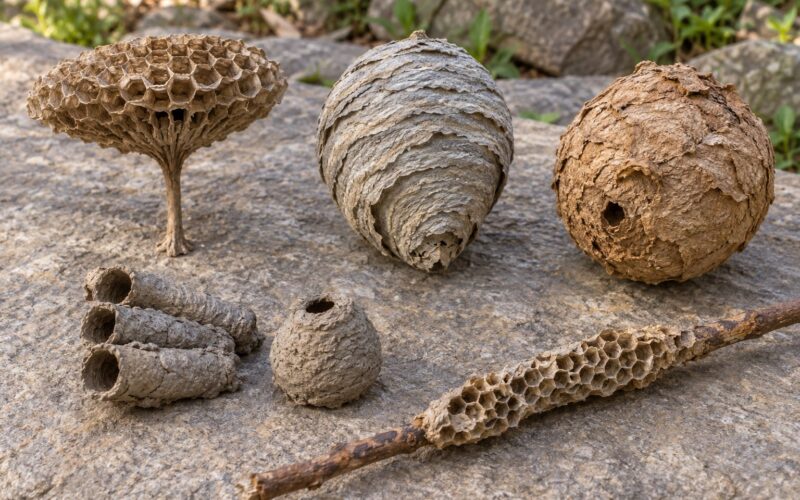
Both build paper nests from chewed wood pulp mixed with saliva, but the architecture could not be more different. The paper wasp vs yellow jacket differences show up most clearly right here. A paper wasp nest is a single open comb with the cells facing downward, attached by a short stalk, shaped like an upside-down umbrella. You can look straight at the brood. A yellowjacket nest is enclosed in a smooth gray or beige paper envelope, layered like a football, with a single entrance hole near the bottom.
That design explains location. Paper wasps pick sheltered, high, dry spots that stay warm in the sun: under eaves, in sheds and garages, on porch ceilings, in the corner where two beams meet, and in shrubs. Yellowjackets use enclosed voids, most often a rodent burrow or an abandoned ground cavity, plus wall cavities between studs, attic spaces, and under porches where a wall meets the soil.
Colony size follows the same split. A paper wasp nest rarely holds more than 20 to 75 members. A yellowjacket colony runs into the thousands by late summer, which is why the ground nest you barely noticed in June can be a problem by August.
Behavior and Flight Differences
Paper wasps fly slowly, almost gliding, with that signature trailing-leg posture. They forage on nectar and on insects, including caterpillars, and they rarely interrupt a person unless their nest is disturbed. Most homeowners who leave an eave nest alone report living comfortably with it for an entire summer.
Yellowjackets fly in fast, purposeful lines between a food source and the nest entrance, legs tucked. Adults shift to protein in late season, which is why they show up at hamburgers, pet food, and unattended picnic food. That scavenging habit puts them where people are, and people get stung.
Both insects get more defensive as summer ends. The colony cycle explains it: in autumn, new queens and males are produced, workers are dying off, and the remaining colony is at its most defensive phase. A nest that was calm in July can be genuinely aggressive in late September with no change in your behavior at all.
Stings, Aggression, and Safety
Both species can sting repeatedly, unlike honey bees, which sting once and leave the stinger behind. That is the single most important thing to know before you decide a nest is harmless.
The difference is in context. Paper wasps are generally docile and sting mainly when their nest is jarred or when you handle the wasp itself. Yellowjackets defend the nest vigorously, and a nest near a doorway, a walkway, or outdoor dining area can trigger a swarm response to something you barely noticed, like a lawn mower or a hedge trimmer buzzing under the flight path.
Do not swat, knock down, climb toward, plug, or spray an unknown nest. Do not mow directly beneath a nest, and do not reach into an unlit opening to check what is inside. If you have ever had a severe reaction to an insect sting, treat any wasp nest near your home as a professional job.
After a sting, move away calmly, wash the area, and apply a cold pack for swelling. Watch for trouble breathing, throat or tongue swelling, widespread hives, dizziness, or nausea. Any of those means call emergency services, and if you have a prescribed epinephrine auto-injector, use it as directed.
What to Do About Each Insect
Paper wasp nest: if it sits away from doors, play areas, and where you walk, leaving it alone is a reasonable choice. They control caterpillars and other crop pests, and most residents never have an incident. If it must come down, removal at night when the colony is inside and sluggish is far safer than daytime spraying, and an elevated nest on a ladder is work for a professional.
Yellowjacket nest: do not attempt this yourself, particularly underground or inside a wall. Removal generally happens at night by a trained technician, and sealing first traps agitated insects inside your wall or your yard rather than solving anything. Seal entry points only after the nest has been removed and the cavity is treated.
After the first hard frost, active colonies die off and next spring’s queens start fresh elsewhere. Indoor sightings in a basement or attic in winter are usually overwintering queens, not an active nest, and they go away on their own.
Which Should You Choose?
This is not a contest. The right answer is the identification that matches what you actually found. If you have an open umbrella comb under an eave, you have a paper wasp, and the practical response is usually tolerance or careful professional removal. If you have an enclosed nest in the ground or a wall, you have a yellowjacket, and the practical response is distance plus a professional.
Prevention is straightforward once you know which species keeps returning. Paper wasps are drawn to gaps around soffits, door frames, and window corners. Yellowjackets find entry points around vents, utility penetrations, and cracks where siding meets the foundation. Close those openings in spring, before colonies are established, and you remove the reason they keep coming back.
When identification stays uncertain and the nest sits anywhere near a walkway, an entry door, or an outdoor eating area, a pest professional is the sensible call. The cost of a wrong guess is much higher than a single visit.
Frequently Asked Questions
Are paper wasps the same as yellow jackets?
No. They are different genera of social wasp. Paper wasps belong to Polistes, yellowjackets to Vespula, and bald-faced hornets are actually aerial yellowjackets in the genus Dolichovespula. All three build paper nests from chewed wood and live in colonies, which is why they get confused. Slender body, orange-tipped antennae, and open umbrella nests mean paper wasp. Stocky body, black antennae, and an enclosed envelope mean yellowjacket.
Which is more aggressive, a paper wasp or a yellow jacket?
Yellowjackets are the more aggressive of the two, especially near their nest. Paper wasps are generally docile and forage on flowers without bothering people, which is why an undisturbed nest under an eave can be tolerated all summer. Yellowjackets defend a nest aggressively and may swarm anything that disturbs it. Both become noticeably more defensive in late summer and autumn as colonies produce new queens and males.
How can I tell a paper wasp from a yellow jacket by its nest?
Look at the nest before you look at the insect. A paper wasp nest is a single open comb shaped like an upside-down umbrella, with hexagonal cells visible, usually under an eave, shed beam, or porch ceiling. A yellowjacket nest is wrapped in a smooth gray paper envelope, football-shaped, with a single entrance hole, usually underground, in a wall void, or in an attic. Open comb means paper wasp, envelope means yellowjacket.
Do paper wasps and yellow jackets both sting repeatedly?
Yes. Unlike a honey bee, which stings once and leaves its stinger behind, both paper wasps and yellowjackets can sting again and again. That makes repeated stings from a single disturbed insect possible. The severity depends on the person’s reaction rather than the species, and anyone with a known sting allergy should carry a prescribed auto-injector and avoid nests entirely. Seek emergency help for trouble breathing or swelling of the face or throat.
Should I remove a paper wasp or yellow jacket nest myself?
Usually not. A paper wasp nest away from doors, walkways, and play areas is often safer to leave alone, and it will die out after the first hard frost. Yellowjacket nests, especially underground or inside a wall, should be removed by a trained professional, generally at night when the colony is less active. Do not plug the entry hole before removal, which traps agitated wasps, and seal openings only afterward.
Conclusion
The fastest identification rule combines three things: body shape, antennae color, and nest design. Slim body with a pinched waist and orange-tipped antennae means paper wasp. Stocky body with black antennae and an enclosed gray envelope means yellowjacket. Color on its own will send you wrong at least once a season.
From there, keep your distance. Leave a nest under the eave alone if nobody walks past it, and hire a professional for a ground nest or a wall void. Either way, sealing gaps around vents, doors, and utility openings in spring keeps next year’s colony from starting in the same place.
Once you can name what you are looking at, every other decision gets easier. The paper wasp vs yellow jacket differences that actually matter are the open comb versus the sealed envelope, and the slim waist versus the broad body. Check the nest first, keep clear of both insects, and let a professional handle anything you cannot identify with confidence.