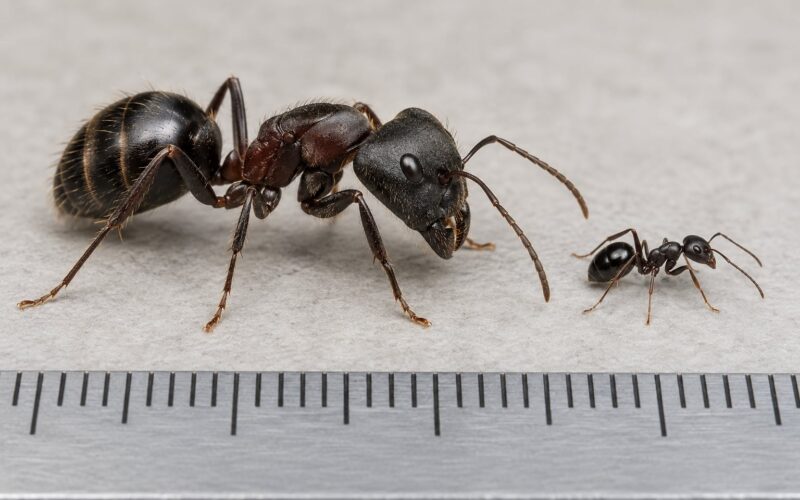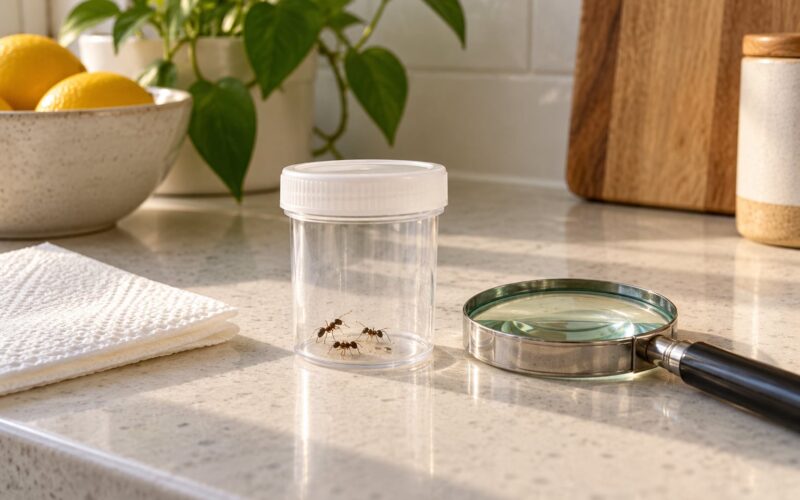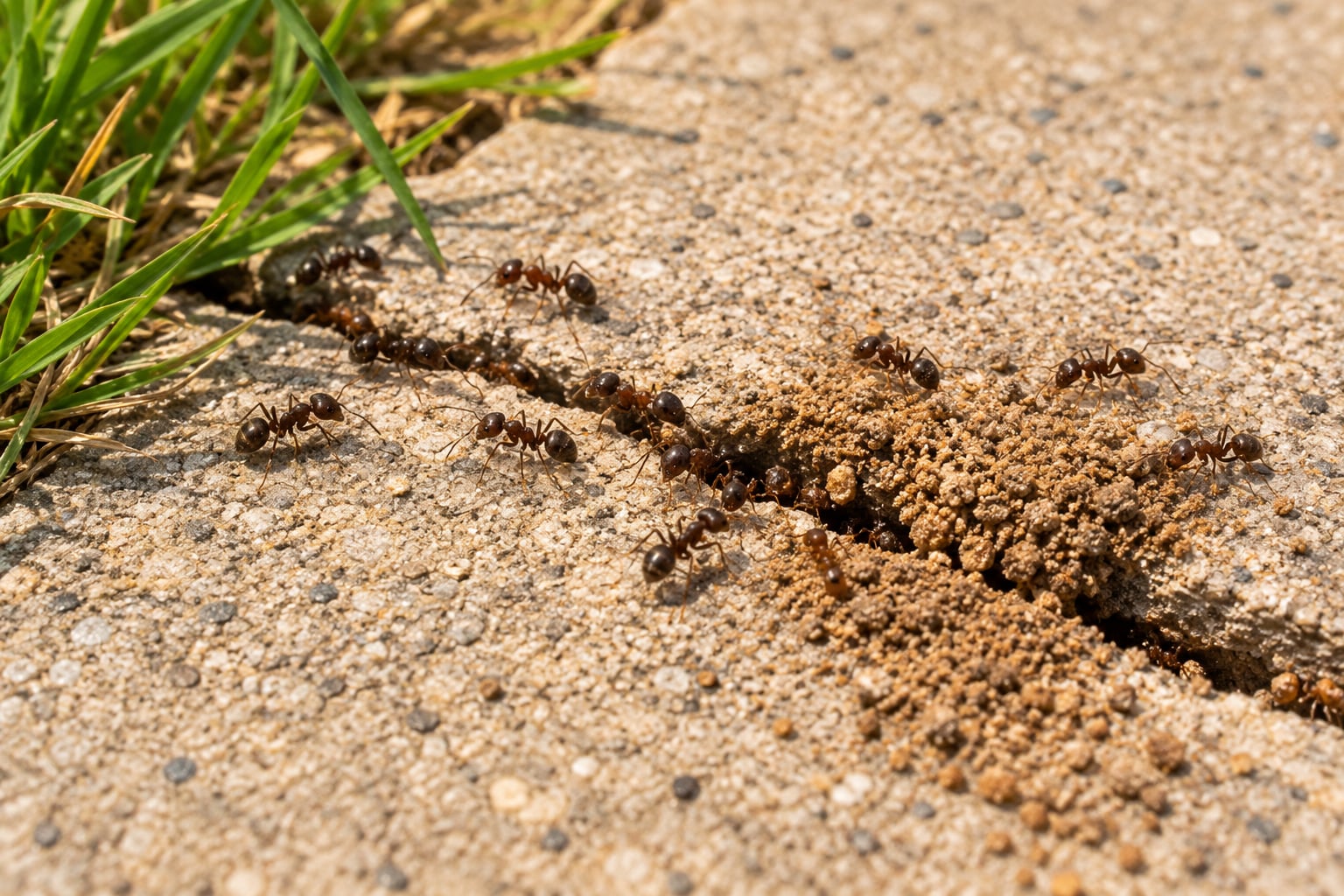
Pavement ant identification comes down to three things you can see with the naked eye: a small size of roughly 1/8 to 1/4 inch (2.5-4 mm), a dark brown to almost black body, and two tiny spines on the petiole, the narrow waist segment just behind the thorax. Those ants nest under sidewalks, driveways, patio pavers, and building foundations, pushing small piles of excavated soil up through pavement cracks. Understanding pavement ant habits explains most of what you see outdoors, and most of what follows when one wanders into your kitchen.
Pavement Ant Identification and Habits
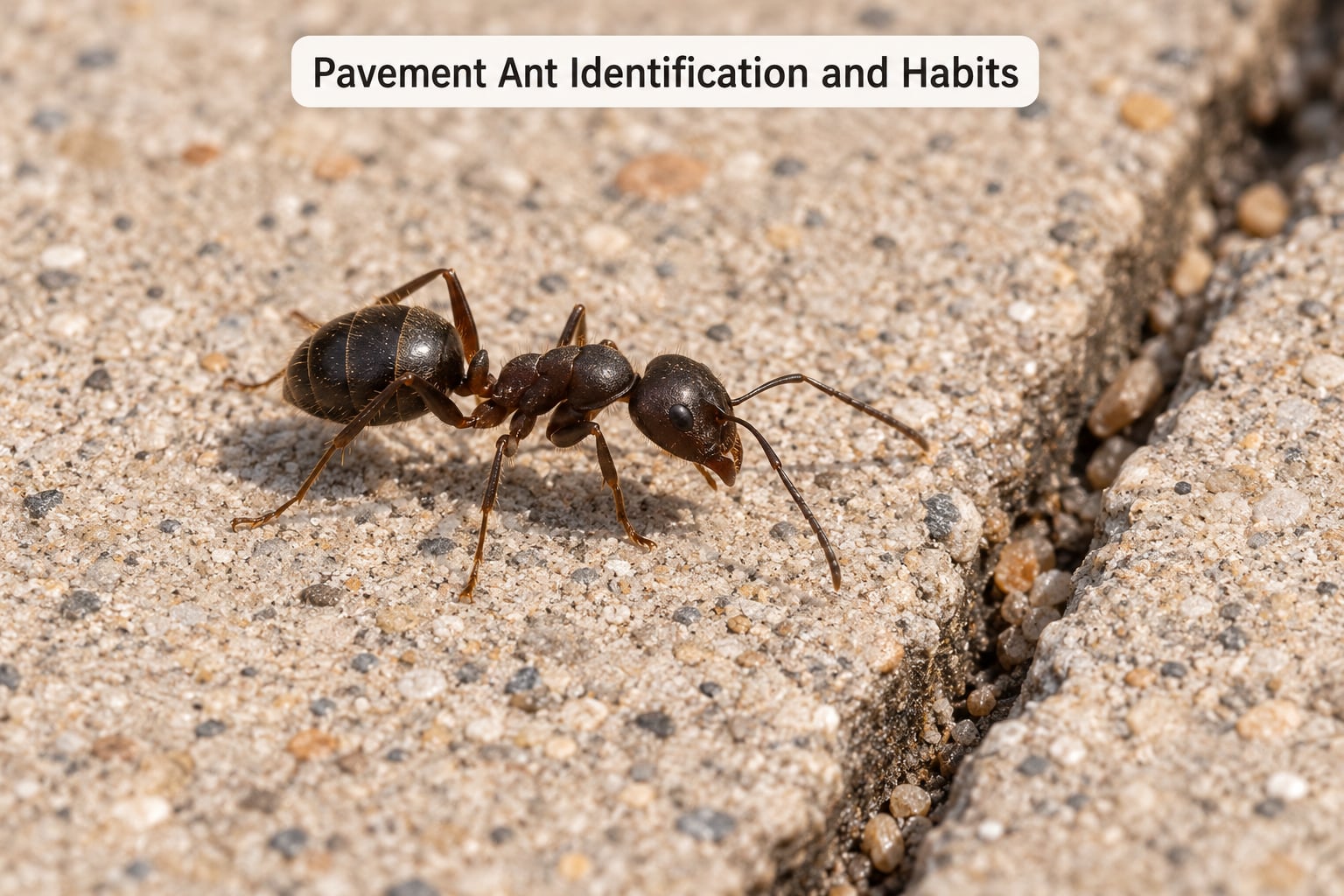
A pavement ant is a small, dark brown to black ant about 1/8 to 1/4 inch (2.5-4 mm) long that nests beneath sidewalks, driveways, patios, and building foundations. It pushes small piles of excavated soil up through pavement cracks, and forages in visible trails along hard surfaces. Most of the colony stays hidden under the slab, which is why you see a fraction of it at any moment.
Here is the quick snapshot most people need before they start guessing at species.
| Feature | What you see |
|---|---|
| Size | 1/8 to 1/4 inch (2.5-4 mm); workers are strikingly uniform in size |
| Color | Dark brown to almost black, with pale yellowish legs and antennae |
| Body structure | Fine parallel grooves on the head and thorax, plus two small spines on the petiole |
| Antennae | Elbowed, 12 segments, ending in a 3-segmented club |
| Eyes | Small compound eyes, visible but not large |
| Sting | Has a functional sting, rarely used against people |
| Where you find them | Sidewalk and driveway cracks, under slabs, hollow concrete block walls, foundation margins |
One naming note that clears up a lot of confusion. The ant common in the United States is Tetramorium immigrans. Many pest pages, including several that rank well, label it Tetramorium caespitum, which is the closely related European species. The two are easy to mix up in writing, but when you see the North American ant outdoors on your patio, you are almost certainly looking at Tetramorium immigrans.
Is it worth worrying about? In structural terms, no. Pavement ants do not chew wood, do not eat drywall, and do not undermine foundations the way termites do. They are considered a nuisance pest. Their only real impacts are contamination of food surfaces and the sheer irritation of a trail crossing your countertop every morning.
How to Identify a Pavement Ant
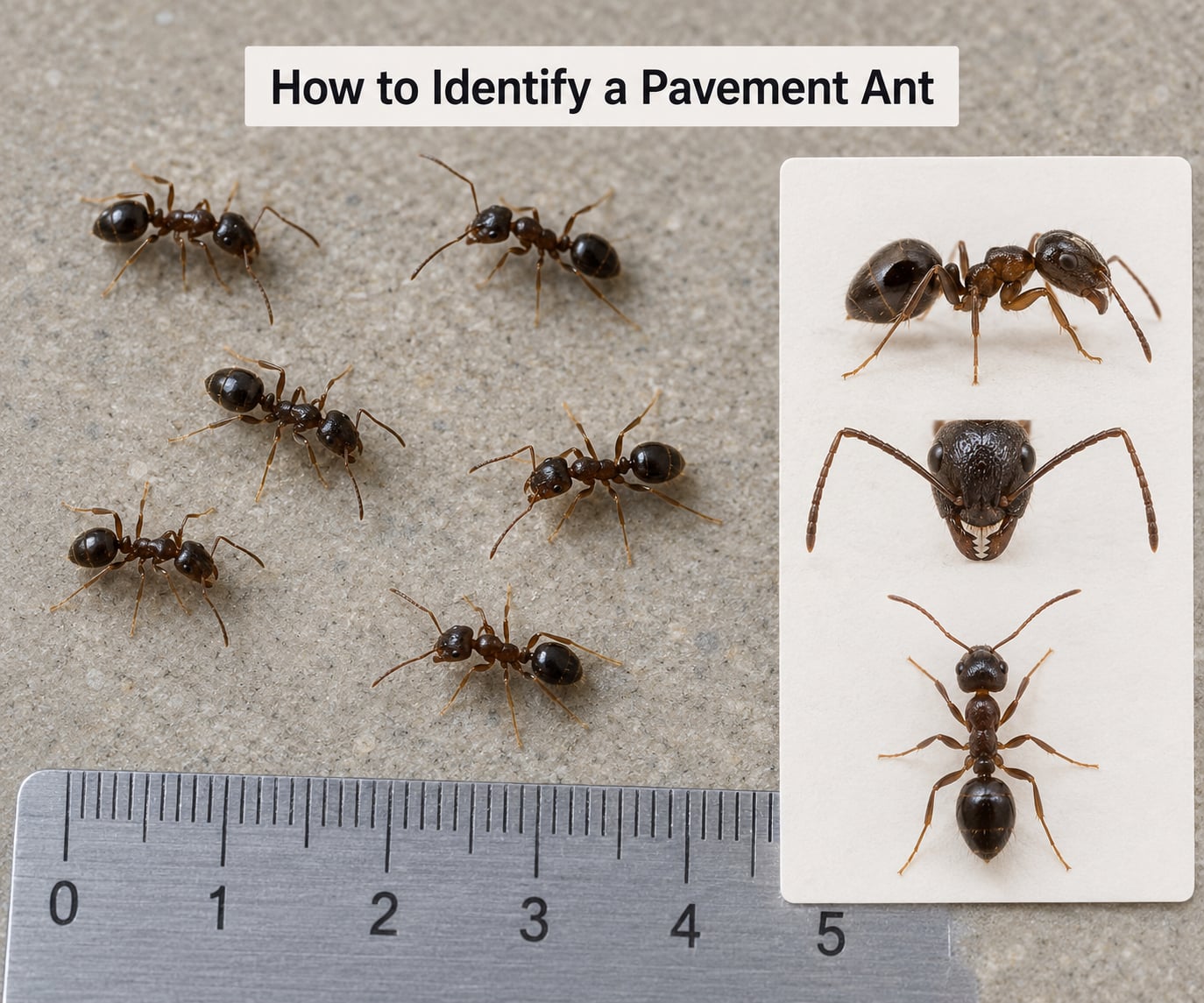
Confirm the species in five steps, working from the least to the most reliable trait. Most misidentifications happen because people stop at color, and half of all common household ants are some shade of dark brown.
- Check the scale. Put a dime next to the ant. A pavement ant is roughly the width of the dime and a bit longer. If the ant is a quarter inch or bigger, you are probably looking at a carpenter ant, which is a different problem with different consequences.
- Look at the waist. Find the petiole, the single narrow segment between thorax and abdomen. You are looking for two small spines on top of it, pointing backward. Magnification helps enormously, even a cheap 10x loupe or the zoom on a phone held close.
- Check for grooves. Fine, closely spaced parallel grooves cover the head and thorax. This is one of the most reliable field marks and the feature experienced identifiers lean on hardest.
- Note the appendages. Legs and antennae are noticeably paler than the body. The antennae bend sharply at an elbow and end in a three-part club.
- Watch the movement. Workers move slowly and steadily, in a loose line along edges and cracks. Fast darting and constant traffic usually points to a different species.
Scale references matter more than they sound. At 1/8 inch, features that are diagnostic in a diagram are genuinely hard to see without magnification, which is why so many identification photos get posted to forums like r/whatsthisbug and r/ants asking for help.
Pavement Ant vs Carpenter Ant vs Odorous House Ant
This is the single most common mix-up homeowners run into, and the three species are easy to separate once you know what to look at.
| Trait | Pavement ant | Carpenter ant | Odorous house ant |
|---|---|---|---|
| Typical size | 1/8 to 1/4 in (2.5-4 mm) | 1/2 to 5/8 in (13-16 mm) | 1/8 to 1/6 in (2.5-4 mm) |
| Color | Dark brown to black, pale legs | Black, reddish, or bicolored | Dark brown to black |
| Petiole spines | Two | One | One |
| Head texture | Fine parallel grooves | Smooth, often polished | Smooth and shiny |
| Odour when crushed | Pungent, formic acid | Musty, strong | Strong coconut or rancid |
| Where it nests | Under slabs, cracks, soil, hollow block | Inside damp wood, window trim, attics | In wall voids, under sinks, in clutter |
| Risk to the home | Nuisance only | Moist wood damage risk | Nuisance only |
The odorous house ant is the near-miss. It matches pavement ants on size and color almost perfectly, which is why identification guides keep stressing the spine count and the grooves. A pavement ant with a crushed worker smells sharp and acrid, formic acid off the acid gland, while the odorous house ant gives off a distinctly sweet, coconut-like note. That test settles most arguments.
Where Pavement Ants Nest
Pavement ants nest in protected, humid sites under hard surfaces, which is why they are named after pavement. Typical sites include cracks and expansion joints in sidewalks and driveways, the joints between patio pavers, underneath concrete slabs including patios and garage floors, and inside hollow concrete block foundation walls where the blocks are open on both ends. In lawns and garden beds they dig shallow chambers in soil, sometimes several feet from any hard surface, and they will also use mulch, leaf litter, and the warm soil alongside a foundation wall.
Look for the small crater-shaped soil mounds. These are excavated material pushed up through a crack or pushed against a surface at the nest entrance. They are often the only physical sign of a colony, and they show up in warm weather as workers expand and vent the nest. Homeowners sometimes mistake these mounds for termite activity, which is one of the more common alarm escalations on ant threads.
Satellite colonies are a real feature of this species. Pavement ants commonly maintain more than one queen in a single nest and will spin off additional nest sites in a nearby yard, in a crack a few feet from the original, or under an adjacent slab. That is why killing every visible worker changes nothing, and why control measures that ignore the underground portion fail.
The sidewalk battles you sometimes see are territorial, not a symptom of infestation. Neighboring colonies overlap on foraging routes, and workers from different nests square off in groups, grappling and tumbling in a ring on the pavement. Experienced users on r/pestcontrol describe this as a normal spring and summer sight. It looks alarming because so many ants are in one place, but a mass of fighting ants is often a mass of ants that are busy, not multiplying.
What Pavement Ants Eat and Do
Pavement ants are omnivores, and that generalist diet is exactly why they turn up in homes. They take grease and oily foods, sweets and anything sugary, seeds and grains, and protein sources including meat, pet food, and dead insects. Outdoors they also tend aphids and scale insects and feed on honeydew, the sugary excretion those insects produce, which makes them useful in a vegetable garden in small numbers and a nuisance in large numbers.
How they forage
Workers leave the nest on established paths and reinforce them with pheromone as they go, so what you see is a two-way conveyor of returning and departing foragers. They travel along edges, cracks, and other sheltered lines rather than across open ground. Reports commonly put the working foraging range at roughly 30 feet from the nest, and that number is genuinely useful: if you follow a trail backward in one direction and it dead-ends at a crack, a joint, or a slab edge, you have probably located the nest entrance.
Life cycle
Pavement ants go through complete metamorphosis, the same four stages as a butterfly, and the adult stage does all the damage and all the foraging.
- Egg. Laid in batches inside the nest, in the brood chambers kept moist and protected.
- Larva. Legless and curled, fed by workers, growing through several instars over roughly three to six weeks.
- Pupa. A pale, immobile stage that looks a bit like a seed. This is where the dark body color and adult shape form.
- Adult. Workers, or alates in the winged reproductive form. Egg to adult takes about 6 to 10 weeks depending on temperature.
Mature colonies commonly run several thousand workers and can exceed 10,000. Winged swarmers, the alates, appear mainly in spring, often after rain or on the first warm stretch of weather, and disperse to found new nests. A single larger ant wandering near your foundation in spring may well be a dealate queen looking for a new site. Multiple queens in one nest is normal for this species.
When they are active
| Season | Outdoors | Indoors |
|---|---|---|
| Spring | Nesting ramps up, mounds appear, swarming after warm rains | Mostly quiet; trail activity climbs late in the season |
| Summer | Peak foraging, territorial battles on warm pavement | Largest indoor pressure, trails to kitchens and garages |
| Fall | Final push for food before cold, heavy trail traffic | Often the worst month for indoor trails, as outdoor food disappears |
| Winter | Overwintering under slabs, in soil, inside hollow block; activity near frost lines | Rare, except in warm garages, basements, and utility rooms |
The fall spike confuses a lot of people. When outdoor food dries up in late autumn, the colony concentrates on whatever it can still find, and the trail you first noticed in August becomes a highway in October. That is a seasonal shift, not a colony that suddenly multiplied.
Why Pavement Ants Enter Homes
Pavement ants do not need your permission or an open door. The species is built to move through the same narrow cracks it uses outside, so anything that connects the slab to the interior is a highway.
The common entry points, in rough order of how often I see them:
- Expansion joints and cracks in the slab, particularly where a patio, driveway, or walkway meets the foundation.
- Utility penetrations, where service wires, water lines, and gas lines pass through the foundation, often with a gap around the pipe.
- Door thresholds with a gap under the door that is wider than an ant at its widest point.
- Window frames and sash, especially older wood windows and sliders that no longer close tight.
- Basement and garage cracks, including where the slab has settled and pulled away from the wall.
Any gap wider than about 1/16 inch is an open door for this species, which is one reason so much of the advice aimed at larger ants does not work here. Door sweeps rated for mice are overkill; a tube of silicone and a pencil are usually enough.
Getting inside is only half of it. Something has to be attracting them, and it is almost always food, moisture, or shelter.
Kitchen crumbs, spills, and sugar are the obvious attractants. So are pet food bowls, water bowls left outdoors, garbage and recycling bins, and compost. Grease and protein matter more than most people expect, and users report pavement ants going for spilled cooking oil and grease before anything sweet. If you see a trail, follow it backward from the source: it almost always ends at one of these, and the trail direction is the fastest diagnostic tool you have.
Once inside, ants also follow pheromone trails the same way they do outdoors, which is why wiping a surface with soapy water rather than a fragrance-heavy cleaner can reduce repeat traffic. The smell is not the point; removing the chemical message is.
Now separate the two situations people constantly merge. A handful of workers coming in and going out through one obvious crack is normal foraging behavior and often does not need treatment. Dozens of ants following a pheromone trail to your pantry, plus ants appearing from a second area of the house, means you have an established indoor presence worth acting on. Count and locate the entry points, because two entry points means two problems, and treatment aimed at one crack leaves the other one running.
How to Prevent and Control Pavement Ants
Start by deciding whether you actually need to act. If the ants are outside on the patio, on the driveway, or in the garden and not touching your food, they are doing very little harm and the colony is one of the most abundant outdoor ants in North America. Tolerating them is a legitimate choice, and treating every sighting leads people into a cycle of spraying that never ends. Act when ants reach food surfaces, when a trail appears inside on a repeated basis, when you see entry from more than one area, or when pets or small children are in contact with baited material.
Then work in this order.
1. Remove the attractants
Wipe counters and stovetops daily with soapy water, clean under the sink, take pet bowls in after meals, and move garbage to a bin with a tight lid. Clean the crumb tray in the toaster and the ring left by a can opener. Every piece of removed food weakens the pheromone trail, and the ants re-evaluate whether your kitchen is worth the trip.
2. Find and trace the entry point
Follow an indoor trail back to its source and mark it. Outside, follow the trail until it ends at a crack, joint, or slab edge. That end point is the nest entrance, and sealing it without dealing with what is underneath it tends to push the traffic somewhere less convenient rather than eliminating it.
3. Exclude
Fill cracks in the slab and expansion joints, backer rod and caulk utility penetrations, add a door sweep or draft stop on exterior doors, and repair window gaps. Silicone and polyurethane sealants flex with the slab through seasonal movement; rigid mortar cracks again in a year or two.
4. Cut the moisture
Grade soil away from the foundation and keep mulch a few inches off the siding. Fix dripping outdoor spigots and leaky supply lines in garages and basements. A damp structure edge gives the colony the sheltered ground it needs to survive winter right next to your house.
5. Bait the trail rather than spraying the ants
Spray kills the workers you can see and does nothing to the colony, the brood, or the multiple queens underneath the slab. That is the honest reason so many treatments appear to fail. An ant bait station or gel placed along an established trail gives the foragers something to carry back, and it works through the colony over days. Preferences vary between colonies, and homeowners on r/pestcontrol commonly report pavement ants ignoring protein baits and preferring sugar and grease sources, so switching formulations sometimes matters more than switching brands. Keep children and pets away from any bait you set, and read the label for placement and re-entry timing.
When to call a professional
Bring in a pest pro when the ants are inside a hollow concrete block wall, when they show up in a basement or utility room with no obvious trail to explain them, when you see more than one entry point and the traffic does not fall off after a couple of weeks of baiting, when the structure itself is compromised and needs repair regardless of the ants, or when you are dealing with more than one species at once and cannot tell which is which. Anyone working on the exterior block wall, foundation, or slab should be licensed where your state requires it, since that is structural work rather than pest work.
Frequently Asked Questions
How can I tell if the ants in my house are pavement ants?
Check three features: they measure roughly 1/8 to 1/4 inch (2.5-4 mm), they have two small spines on the petiole behind the thorax, and their head and thorax show fine parallel grooves. Odorous house ants share the size and color but have a single spine and a smooth, shiny head, and they smell sweet rather than acrid when crushed.
Do pavement ants bite people?
Not in practice. They have a functional sting and can deliver mild venom, but bites and stings are rare and usually only happen if you handle or crush a worker. Most encounters are nuisance contact, not injury. The ants are fast-moving rather than aggressive and have no interest in people beyond the food they carry.
Are pavement ants the same as termites?
No, and they behave nothing alike. Termites are pale, soft-bodied insects with straight, beaded antennae and wide waists, and they consume wood, which makes them a structural threat. Pavement ants are dark, hard-bodied, narrow-waisted insects with elbowed antennae and two petiole spines. They push soil up through cracks but never eat the structure.
Why do pavement ants keep coming back after I clean the house?
Usually because the attractant is not gone or the entry point is still open. Cleaning removes the pheromone trail and the food source, but ants re-enter through the same slab cracks, expansion joints, or utility penetrations and find a new reason to set up a trail. Surface spraying kills visible workers while the colony, including multiple queens, keeps producing more underground.
Where do pavement ants usually nest?
Under sidewalks, driveways, patio pavers, and concrete slabs, in cracks and expansion joints. They also nest in soil near foundations, in mulch and garden beds, and inside hollow concrete block walls. You will often see small crater-shaped mounds of excavated soil at the entrance during warm weather, and colonies can maintain satellite nests nearby.
When should I call a pest professional for pavement ants?
Call one when ants appear inside hollow block walls or in a basement with no visible trail, when you have more than one entry point, when baiting and cleaning have not reduced traffic after a couple of weeks, or when you cannot tell which species you are dealing with. Also call before anyone repairs the exterior block, slab, or foundation, since that is structural work.
What to Do First
Confirm the identification before you buy or borrow anything. Two spines on the petiole and fine grooves on the head and thorax mean you have a pavement ant, and that fact alone tells you the nest is under a slab rather than in your walls, which changes every decision that follows.
Then follow a trail until it ends. Indoors, the trail leads to the entry point and the food that pulled the ants in. Outdoors, the trail ends at a crack or joint marking the nest. Clean the attractants the trail pointed to, seal the gaps you found with flexible sealant, and set bait along the trail rather than spraying the workers you can see. Give it a couple of weeks and watch for renewed traffic.
If ants are still foraging outside on the patio and nowhere near your food, that is pavement ant habits working exactly as intended, not a problem you need to solve.