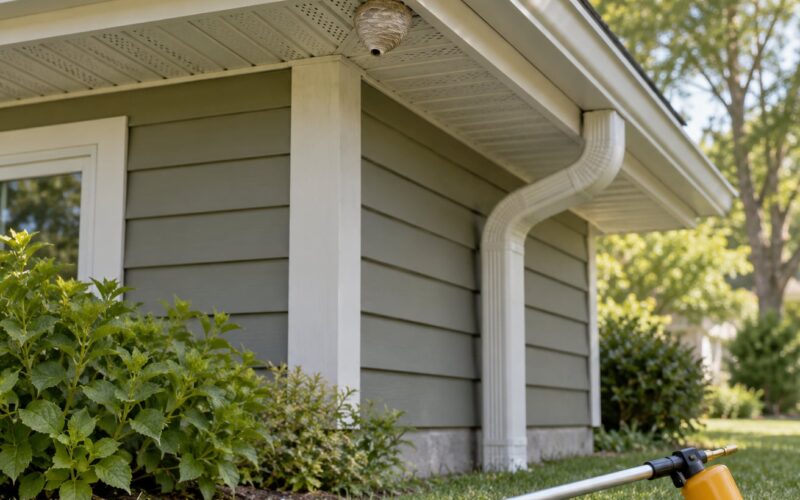
Mud dauber nests are usually fine to leave in place. These solitary wasps do not guard their nest the way paper wasps or yellowjackets do, so a nest tucked in a quiet corner of a porch or garage is an appearance problem rather than a safety one. Remove it when the location creates a real access or stinging problem, such as directly over a doorway, walkway, swing set, or workbench.
Most searches about mud dauber nests and whether to remove them come down to that one question: is this nest in my way? The answer is usually yes for looks, and almost never for danger.
I have pulled mud tubes off two garage rafters and a porch overhang in my own house, both times after confirming what they were, and neither job took more than ten minutes with a putty knife. Here is the same decision I made each time, laid out so you can make yours quickly.
Table of Contents
- Mud Dauber Nests and Whether to Remove Them: The Short Answer
- Mud Dauber Nests: What They Look Like and Where They Form
- What Do Mud Dauber Nests Do to a Home?
- Should You Remove a Mud Dauber Nest?
- How to Remove a Mud Dauber Nest Safely
- How to Prevent Mud Daubers From Rebuilding Nearby
- When Nest Removal Is Not the Best Choice
- Frequently Asked Questions
- Conclusion: Start with the Sting Risk
Mud Dauber Nests and Whether to Remove Them: The Short Answer
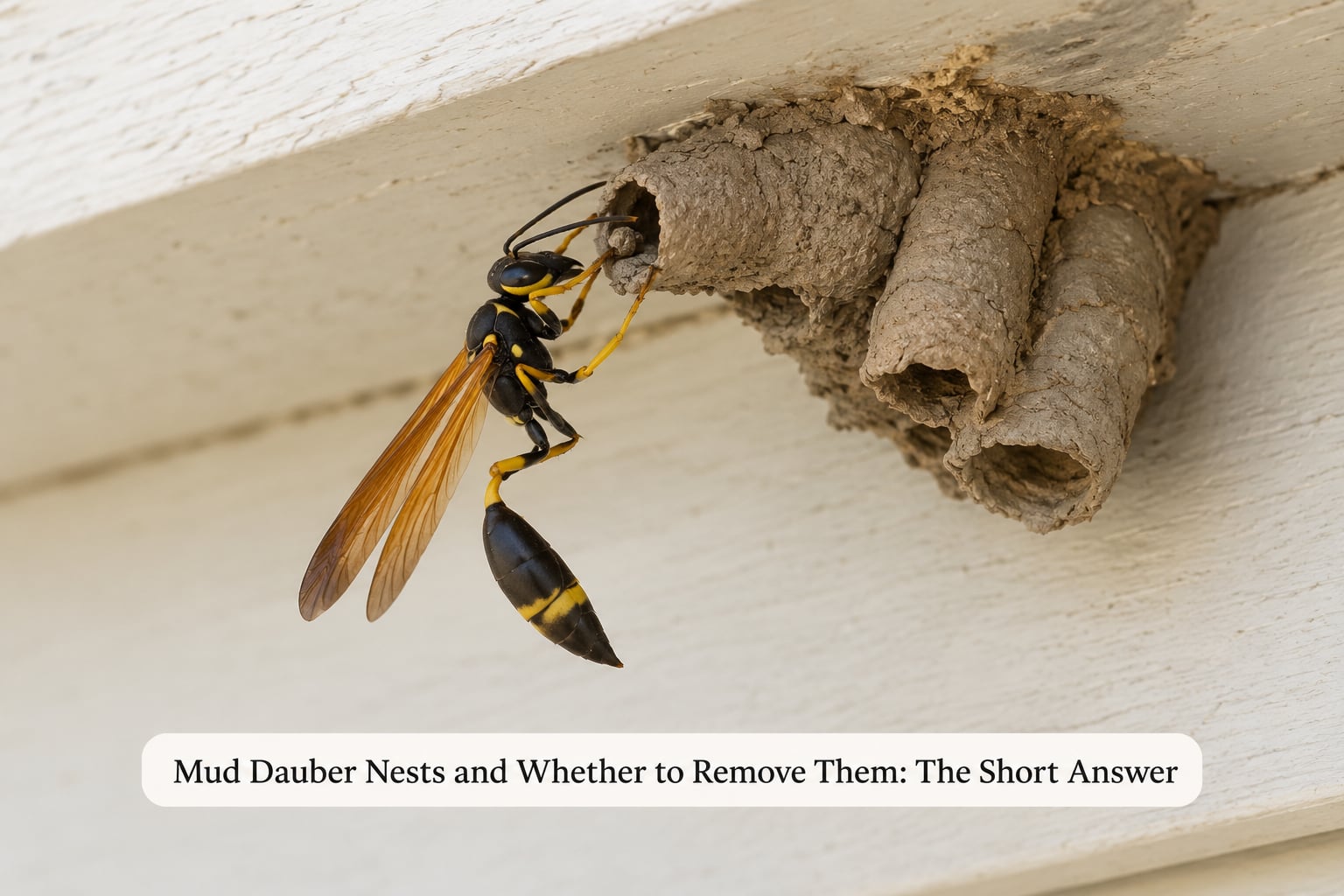
Three steps decide it. Identify the nest, judge where it sits, then choose. Get those right and the rest is a ten-minute job with a flat scraper.
Step one: confirm it is a mud dauber nest
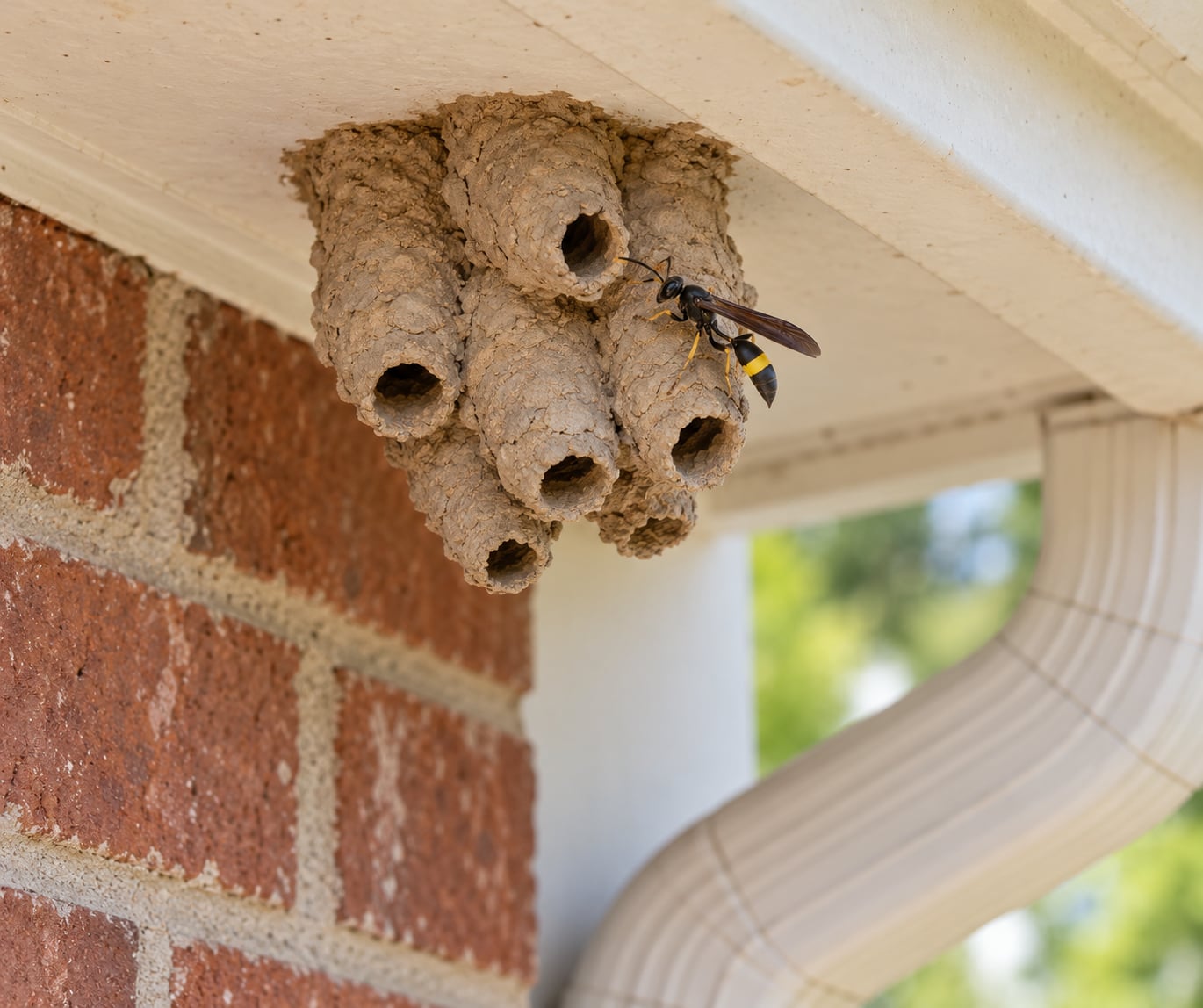
Mud cells are made of wet soil, shaped like short fat tubes or lumpy rounded beads stuck side by side on a flat or vertical surface. Paper wasp combs are layered gray paper, and yellowjacket nests are smooth enclosed paper envelopes tucked in a cavity. If you cannot tell, look for the wasps themselves: a slender dark wasp with a yellow or pale band, or a bluish-black one with a metallic sheen, hovering near the nest while carrying mud or a limp spider.
Step two: judge the location
Ask whether anyone passes under it, opens a door beneath it, parks a ladder near it, or plays underneath it. If the answer is no and you can live with looking at it, leave it. If the answer is yes, or the nest is in plain view from the street and bothers you daily, remove it after the wasps are done for the season.
Step three: decide, then act
Removal during the fall or very early spring, once the wasps are gone, is the cleanest option. During the summer you can still knock down a nest, but expect an adult female to be inside and plan for one wasp in the air rather than a swarm.
Mud Dauber Nests: What They Look Like and Where They Form
A mud dauber is a solitary wasp in the family Sphecidae, and the species you are most likely to meet are the black and yellow mud dauber, Sceliphron caumentarium, the organ pipe mud dauber, Trypoxylon politum, and the blue mud dauber, Chalybion californicum. Adults run about three-quarters of an inch to an inch long, with long legs and a narrow waist. Their nest is a row of mud cells attached to something sheltered and firm.
The nest itself is not one hollow chamber. Each cell is a separate clay compartment that the female seals shut, and inside a finished cell you will find a single egg plus a cache of paralyzed spiders, commonly six to twenty of them depending on cell size. The larva eats the cache, pupates, and spends the winter sealed in.
Nesting surfaces are predictable: under eaves and overhangs, porch and soffit ceilings, garage and shed rafters, the underside of window trim, exterior siding, stucco, and any rough-textured patch of wall within about head height of open ground. Protected from rain and wind, with room to fly in and out, is all a female asks for.
Mud dauber nests vs paper wasp and yellowjacket nests
| Feature | Mud dauber nest | Paper wasp nest | Yellowjacket nest |
|---|---|---|---|
| Material | Wet soil shaped into tubes or rounded cells | Layered gray paper comb with open cells | Smooth paper envelope, usually inside a cavity |
| Colony | Solitary, one female per nest | Colony with a queen and workers | Colony with a queen and workers |
| Defends the nest | No, generally stays away unless handled | Yes, guards the comb aggressively | Yes, defends the colony aggressively |
| Sting risk to people | Low when undisturbed, still capable of stinging | Moderate to high near the nest | High near the nest, repeated stinging |
| Best removal approach | Scrape or knock down, no pesticide needed | Spray at dusk or call a professional if high | Spray at dusk or call a professional if high |
That last row is the whole argument for identifying first. Scraping a paper wasp comb because you assumed it was a mud dauber nest is the single worst outcome in this whole subject.
What Do Mud Dauber Nests Do to a Home?
Structurally, almost nothing. Mud cells weigh very little, sit on the surface rather than boring into it, and will not compromise siding, stucco, or a rafter. Extension services from states including North Carolina, Minnesota, and Pennsylvania treat mud dauber nests as a nuisance issue rather than a building one.
What they do cause is cosmetic. Scraped mud leaves gray smears that need scrubbing, and some residue clings to textured stucco or rough paint. If the nest is directly above a window you open, expect wasps crossing the room.
The other effect is psychological, and it is a real one. A wasp over your head is unsettling even when the odds of a sting are tiny. That discomfort is a legitimate reason to remove the nest, and nobody needs to justify it with a safety argument.
Two things nests do not do: they do not damage the structure, and they do not mean your house has an insect problem. Mud daubers eat spiders rather than invading homes, and they are not a sign of a broader infestation.
Should You Remove a Mud Dauber Nest?
Remove it if any of these are true. The nest hangs over a door you use daily, a walkway, a porch swing, a sandbox, or a workbench where you stand with your head near it. Remove it if someone in the house has a known sting allergy, or if small children or pets treat the spot as theirs. Remove it if you cannot stop glancing at it from the kitchen window, which is the most honest reason most people give.
Leave it if the nest is high on a side wall nobody uses, in a shed corner, or above a window that stays shut. Leaving it costs you nothing but the sight of it, and the wasps keep working through spiders in the yard.
How to tell whether the nest is still active
Three checks tell you most of what you need, without touching anything.
- Exit holes. Look for small, clean, round holes in the end faces of the mud cells. A hole means an adult already emerged from that cell.
- Sealed cells. Cells with no hole at all may hold a pupa overwintering or a larva feeding, even when the surface looks dead. Late in the season, treat a fully sealed nest as occupied until spring.
- Traffic. Watch from about fifteen feet away for ten minutes in the middle of the day. A female carrying mud or a dangling spider in and out means the nest is active right now.
No traffic, no fresh mud, and a weathered surface almost always means you are looking at leftovers.
Timing matters for both the wasps and your ladder. The adult female builds and provisions from roughly May through August, then dies off in the fall. The immature stages stay sealed inside through winter and emerge the following spring, so a nest you never touch keeps a floor plan alive across seasons. Fall and early spring are the safest windows because there is no adult left to defend the work.
How to Remove a Mud Dauber Nest Safely
Confirm the ID twice, then treat this as a ten-minute job with a flat blade and a ladder you trust.
Before you start
- Put on long sleeves, closed shoes, and eye protection. Gloves are nice but not the point.
- Set a stable ladder on level ground. Ladders and wasps are the two ways this job goes wrong.
- Do the work in late evening or on an overcast afternoon, not in bright sun. Overhead work in full sun with wasps flying is how people fall.
- Pick a dry day. Wet mud sticks and smears worse.
The removal itself
- Scrape from the surface inward with a putty knife, plastic scraper, or paint scraper. Mud cells release from most siding and stucco without soaking.
- Let pieces drop into a bucket lined with a trash bag so nothing falls onto your head or the ground below.
- Work outward from the outermost cell rather than prying into the middle of the row.
- Bag the debris and check for sealed cells. If one cracks and a paralyzed spider tumbles out, that is normal, and it is harmless outside a sealed cell.
You do not need to kill anything. Extension guidance from NC State, the University of Minnesota, Colorado State, and Penn State all point the same direction: physical removal, no insecticide. If a wasp does fly out and you need it gone, soapy water or an aerosol wasp spray applied directly will handle a single insect. Spraying a cluster of mud tubes is unnecessary, wastes product, and can read as an attack to every other wasp in the area.
After scraping, wash the surface with a stiff brush and soapy water, then rinse. On textured stucco a light touch-up with matching paint covers the scuff marks. Do not pressure wash, which can etch the surface.
If you break into a live nest mid-season, step down, keep moving, and let the wasp go. A mud dauber that has been disturbed will fly off rather than mount a coordinated attack, because there is no colony to coordinate anything. Clean up when you are calm and come back later.
Call a licensed pest professional if the nest is above the second storey, if you cannot work safely at that height, if the species is genuinely unclear, or if a household member has a serious sting allergy. Identification is worth paying for when the wrong guess means a paper wasp comb on your porch.
How to Prevent Mud Daubers From Rebuilding Nearby
Expect some return. The original female dies in the fall, but new females find the same sheltered microhabitat every spring, so removing the nest does not close the door on next year. What changes the outcome is making the surface less attractive.
- Seal gaps under soffits, around pipe penetrations, and in siding joints with a paintable exterior sealant or mortar.
- Repair torn window and door screens so wasps are not wandering inside with them.
- Move or shield outdoor light fixtures. Lights and light-colored walls attract wasps that then look for a sheltered wall next to them.
- Repaint or patch the exact spot after a season of use. Nests on rough or weathered surfaces hold mud better than smooth sealed ones.
- Swap loose brick or rubble for something smooth in the few areas that keep getting nests.
- Clean up spider habitat near the structure only if you are already doing yard work.
Skip the scent repellents and citronella-type deterrents sold for wasps. Evidence for them against mud daubers is thin, they fade quickly, and a few of them are strong enough to bother you as much as the wasps. Broad-spectrum sprays are worse: they remove insects across the board without touching the nesting habit that brought the wasps to your siding in the first place.
When Nest Removal Is Not the Best Choice
Some situations argue for leaving the nest alone entirely. If it sits high on an exterior wall away from doors, play areas, pets, and open windows, removal buys you nothing but a clean-looking wall and an open summer of wasps passing over the same spot. If the wasps are on a part of the house nobody enters, you have made peace with the sight of mud on your siding, and no one in the house has a sting allergy, leaving it is the lower-risk choice.
There is a case beyond convenience too. Mud daubers are efficient spider predators and they stay local, working the hunting grounds around their own nest. Keeping them is a small, ongoing service in a yard. Just be clear-eyed about the popular claims: mud daubers do not selectively hunt dangerous or disease-carrying spiders, and there is no established evidence that they reduce ticks.
If you do leave a nest, monitoring is easy and requires nothing. Check it once a month from the ground. Note the traffic, note the new cells, and know that when the wasps stop coming in early fall, the season is finished.
Frequently Asked Questions
Are mud dauber nests dangerous to remove?
Removing a correctly identified mud dauber nest is low risk because the wasps are solitary and do not defend the nest. You still need long sleeves, eye protection, and a stable ladder, and the real hazard is falling rather than stinging. Scraping a paper wasp or yellowjacket comb by mistake is the genuinely dangerous outcome, so confirm the ID first.
Can I remove a mud dauber nest while the wasps are inside?
Yes, you can knock down a nest during the season, but expect one adult female in the air rather than a swarm. Step down calmly if she exits and let her fly off. Overhead work in bright sun with a wasp circling your head is how people get hurt, so choose an overcast afternoon or evening and work from a ladder you trust.
What happens if I leave a mud dauber nest alone?
Almost nothing bad. The female builds and provisions from about May through August, then dies off in fall, and the sealed cells hold immature stages that overwinter and emerge as adults next spring. A nest out of traffic areas is a visual issue only. It will not damage siding or stucco, and it will not grow into a colony of stinging wasps.
How can I tell if a mud dauber nest is abandoned?
Three checks help. Small clean round holes in the cell ends mean adults already emerged. All cells sealed with no holes suggests larvae or pupae inside, especially before spring. Watch from about fifteen feet for ten minutes and see whether a female is carrying mud or spiders. No traffic, no fresh mud, and a weathered surface usually means leftovers.
Do mud daubers nest inside walls?
They nest on the surface, not inside the wall cavity. You will find mud cells under eaves, on porch and soffit ceilings, in garage and shed rafters, on siding and stucco, and under window trim. A nest can appear indoors when one is carried in on stored items or during a move, but it is a transported nest rather than one built there.
How many mud dauber nests should I expect around my home?
Several is normal, often one per favorable sheltered spot. Because females return to the same microhabitats each spring, you may get the same corner year after year. Removing the visible tubes does not prevent that. Sealing gaps, smoothing weathered surfaces, and screening openings reduce the appeal of the spot more effectively than cleaning up alone.
Conclusion: Start with the Sting Risk
Remove a mud dauber nest when where it sits creates a real access problem or a stinging risk, and when the appearance bothers you enough to act on it. Everything else is a preference, not a necessity. The wasps do not guard the nest, they do not damage the house, and no pesticide is needed, so confirm what you are looking at, scrape it in the fall or early spring, and patch the surface so next spring’s female looks somewhere else.