A cicada killer wasp is a large solitary digger wasp in the genus Sphecius that hunts adult cicadas and provisions an underground burrow with them for its larva. The eastern cicada killer, Sphecius speciosus, is the common species in the eastern United States. They rarely sting people unless provoked, and they do not build paper nests or attack in groups.
That last point is where most of the panic comes from. These wasps are routinely mistaken for invasive Asian giant hornets, the so-called murder hornets, and homeowners kill a beneficial insect over a case of misidentification. Cicada killer wasp identification and behavior have to be read together, since the field marks only settle half of it. Here is what to actually check before you reach for a spray can.
Quick identification checklist:
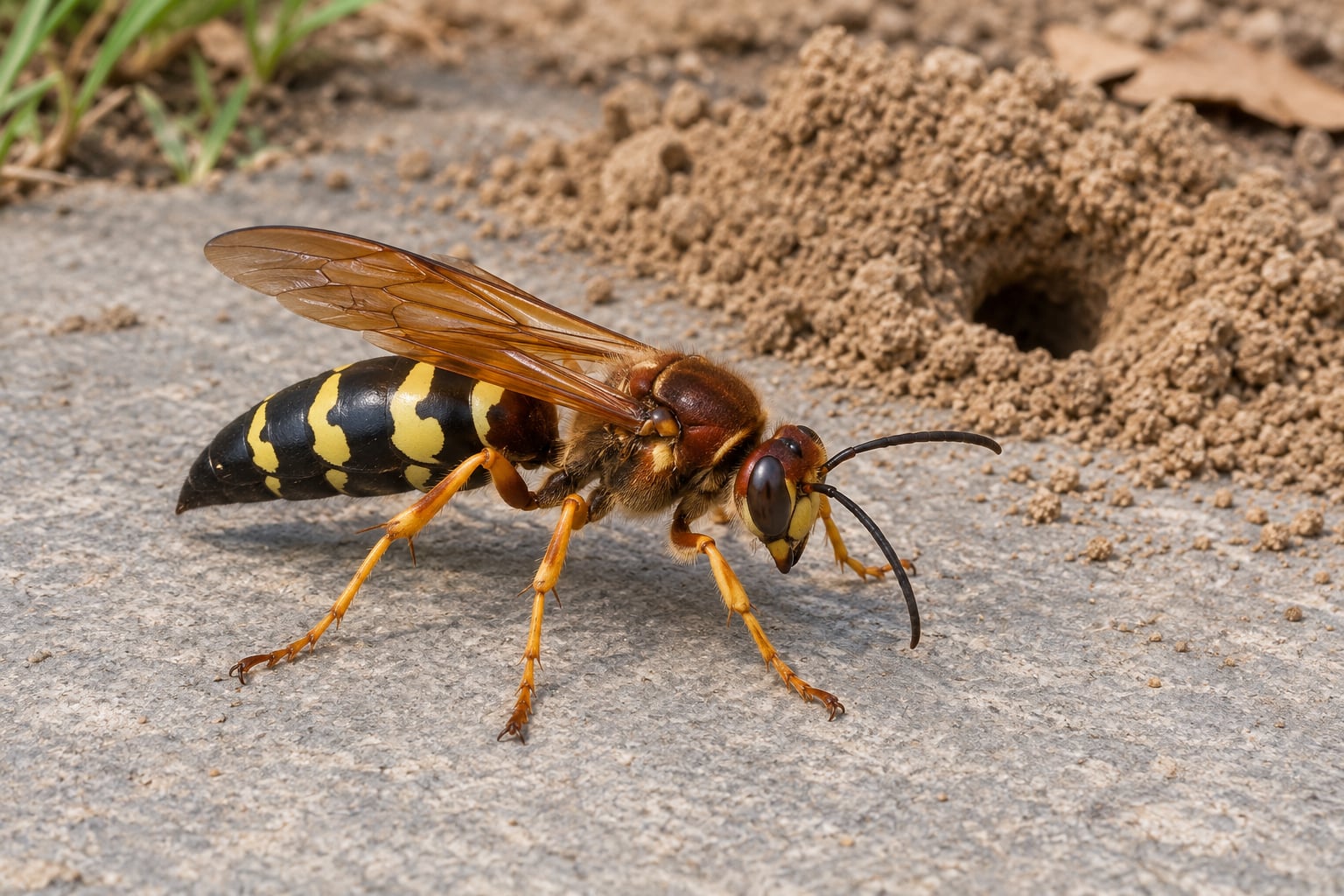
- Length of roughly 1.25 to 2 inches, with females at the large end.
- Black abdomen with yellow or orange markings that are broken bands, not smooth rings.
- Amber to rusty-brown wings held folded along the body.
- Reddish-brown thorax behind the head, distinctly warmer than the rest of the body.
- Long yellowish legs that dangle beneath the body while it hovers.
- A narrow waist, noticeably slimmer than the body behind it.
- Behavior at a bare patch of soil: hovering low, or dragging a cicada toward a hole.
Size alone settles a lot of arguments, because most wasps people worry about are half as long. Once you know that, the remaining field marks are quick.
Table of Contents
- Cicada Killer Wasp Identification: Features to Check
- Cicada Killer Wasp Behavior and Habitat
- Where Cicada Killer Wasps Nest
- When Cicada Killer Wasps Are Most Active
- Are Cicada Killer Wasps Dangerous?
- How to Prevent Problems Without Killing Beneficial Insects
- Frequently Asked Questions
- Conclusion: What to Do First
Cicada Killer Wasp Identification: Features to Check
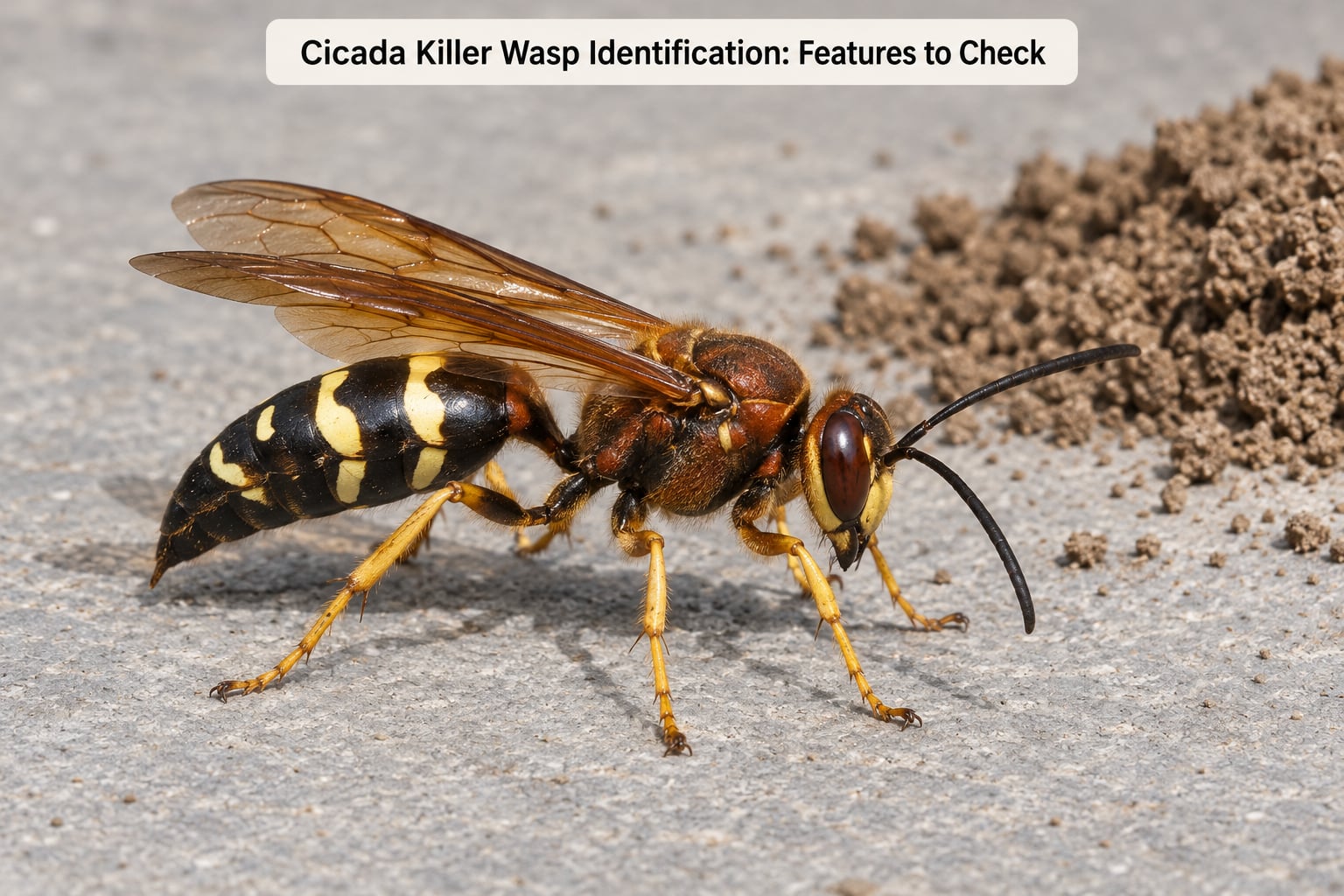
Start with the abdomen. Cicada killers wear yellow or orange markings that appear as separate patches on each segment, so the body looks banded and broken rather than neatly striped. European hornets and yellowjackets show more continuous, solid bands by comparison.
The wings are the next fastest check. They are amber or rusty brown rather than clear, and they look noticeably darker toward the tips. The thorax is a warm reddish brown, which stands out against the mostly black body when you see the wasp in profile.
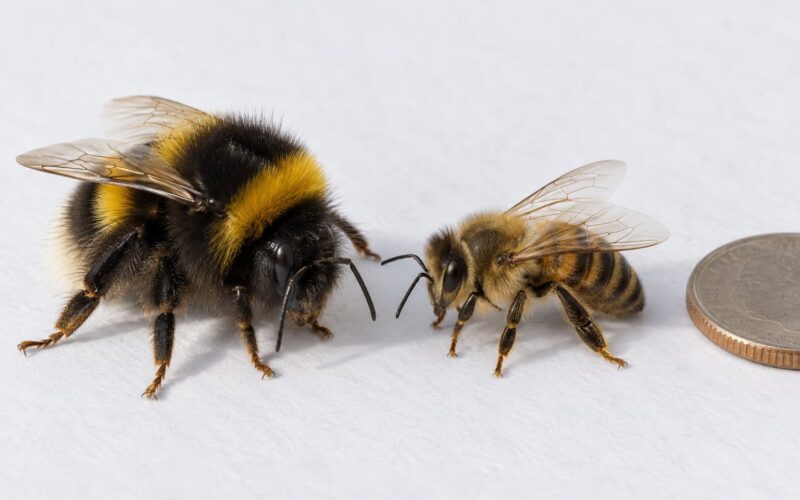
Body shape is the most reliable feature of all. The waist is narrow, almost pinched, and the abdomen is long and tapered. Hairy, barrel-bodied insects with the same yellow and black color scheme are carpenter bees or bumblebees, and a heavy, fuzzy body on a buzzing insect is a strong signal you are looking at a bee rather than a wasp.
Markings on their own are not diagnostic. Nearly every large wasp in North America wears some version of yellow and black, which is exactly why so many cicada killers end up reported as murder hornets. Size, waist shape, wing color, and behavior together narrow it down far more reliably than color alone.
| Feature | Cicada killer wasp | Bald-faced hornet | Yellowjacket | Paper wasp | Carpenter bee |
|---|---|---|---|---|---|
| Typical length | 1.25 to 2 inches | 0.5 to 0.75 inches | 0.4 to 0.6 inches | 0.5 to 0.75 inches | 0.5 to 1 inch |
| Waist | Narrow, sharply pinched | Moderate | Moderate | Long and slender | Broad, no visible waist |
| Body texture | Smooth and shiny | Smooth | Smooth | Smooth | Dense hair or fuzz |
| Abdominal markings | Broken yellow bands | White or ivory bands | Solid yellow and black | Solid yellow and black | Solid black, often no yellow |
| Flight pattern | Slow, low, steady patrol | Agile hovering | Quick darting | Sailing glides | Erratic hovering |
| Nesting | Solitary burrow in bare soil | Gray paper nest, often in a tree cavity | Underground colony or wall void | Open paper comb under eaves | Tunnel in bare wood |
How to Tell a Cicada Killer Wasp from Other Insects
Work through five checks in order. Each one narrows the field, and the answer only matters once the earlier checks line up.
- Measure the length. If it is over an inch long, you are looking at a cicada killer, a European hornet, or something similar in scale. Everything else on this list is smaller.
- Look at the waist and body texture. A pinched waist plus a smooth, shiny body rules out carpenter bees and bumblebees. Fuzz means bee; a narrow waist means wasp.
- Check the head color. Asian giant hornets have a broad orange-yellow head. Cicada killers have a dark head, close in color to the thorax and body.
- Read the abdominal pattern. Broken yellow patches favor a cicada killer. Neat continuous bands favor a yellowjacket or paper wasp. White or ivory bands favor a bald-faced hornet.
- Watch what it does at ground level. Hovering a few inches over bare soil, digging at a hole, or carrying a cicada is the behavior that confirms identification.
Behavior and location are supporting clues rather than proof, and no photo taken at a distance is ever fully conclusive. If it matters, take a few clear photos, ideally in daylight with the insect on a plain background, and note where and when you saw it. A local insect identifier, a county extension office, or a university entomology department can confirm from images alone.
Cicada Killer Wasp Behavior and Habitat
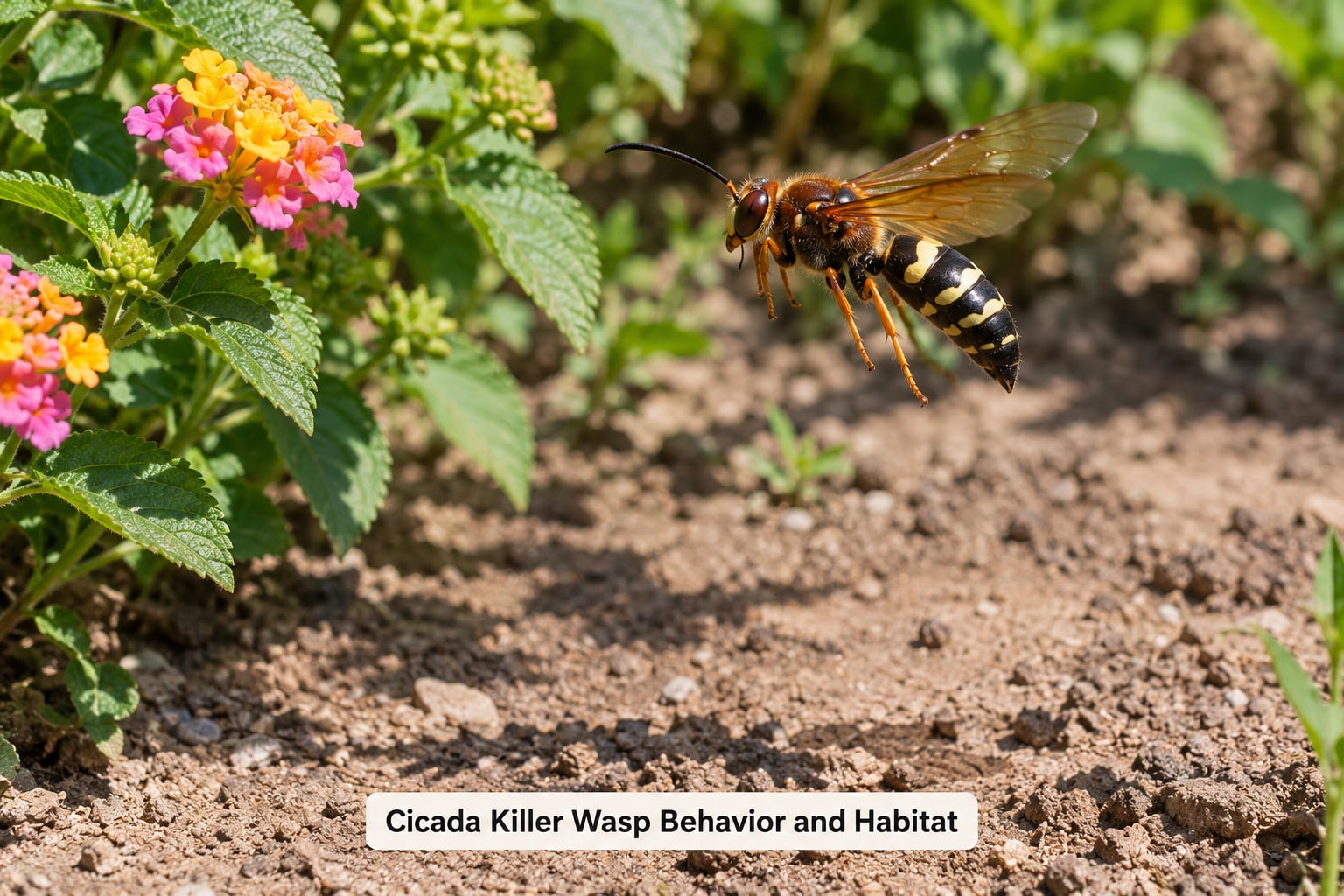
Cicada killers are solitary. A dozen active burrows in the same neighborhood is normal and does not mean there is a colony, because each female works alone and nests alone.
Adults eat nectar and plant sap, which is why they show up on flowering shrubs, milkweed, goldenrod, and anything else blooming in full sun. That foraging also makes them genuine pollinators during the same weeks they are active.
The female does the hunting. She captures an adult cicada, stings it to paralyze it, and then either drags it across the ground or carries it in flight to the burrow. Homeowners frequently report seeing her drop a cicada in a tree, then come back for it, or drag it to the base of a trunk before flying the load home. That staging behavior is confusing if you do not know what it means.
She digs with her front legs and the spines on her hind tibiae, which is why burrow entrances often have a fresh fan or ring of loose soil around them. Nests are stocked in sequence: a cicada, an egg laid on or beside it, then the cell is sealed off. Larvae eat the provisioned cicadas, spin a silken cocoon underground, and stay dormant through winter before pupating and emerging the following summer.
Cicada Killer Wasp Behavior Around People and Homes
Cicada killers do not chase people and they do not guard a shared nest. A female working a burrow a few feet from where you are sitting will usually ignore you completely. That is the single biggest source of relief for people who find one, and wildlife watchers regularly report sitting next to an active burrow untouched.
Males are the ones that look aggressive. Males have no stinger at all. They patrol low over grass and shrubbery, darting outward at anything that enters their territory, including people, dogs, and lawn mowers. This dive-bombing looks like an attack and is the main reason readers assume these wasps are dangerous.
A female stings only when handled, stepped on, trapped against skin, or disturbed at a burrow she is actively stocking. That said, a wasp pinned between your shirt and your arm is a stinging wasp, and repeated aggressive encounters in a walkway or a schoolyard are a legitimate reason to change something.
They do not enter houses to nest. Cicada killer nests are always in the ground, and the walls of a building do not attract them. If you find one indoors, it came in through an open window chasing a cicada and will leave on its own.
Where Cicada Killer Wasps Nest
Cicada killers nest in bare, sunny, well-drained soil. Common sites include lawn edges, sand piles, dry creek beds, gravel driveways, freshly disturbed garden soil, flower bed margins, and the sandy strips beside roads and sidewalks. Shade, heavy clay, and thick turf are all less attractive, because digging is harder and it is not warm enough at the surface.
Entrances are typically around half an inch to an inch and a half across, surrounded by a small mound of excavated soil with a scalloped or fan-shaped edge. Sources disagree on depth for a good reason: published figures run from about 10 to 20 inches, with nests occasionally reaching three feet or more where the soil is deep, soft, and sandy. Depth varies with soil conditions, not with the wasp.
What makes the nest diagnostic is not the hole itself but what gets dragged into it. Finding a partly eaten or paralyzed cicada at an entrance, or watching a female dragging one in, confirms the identification more than any photo of the wasp.
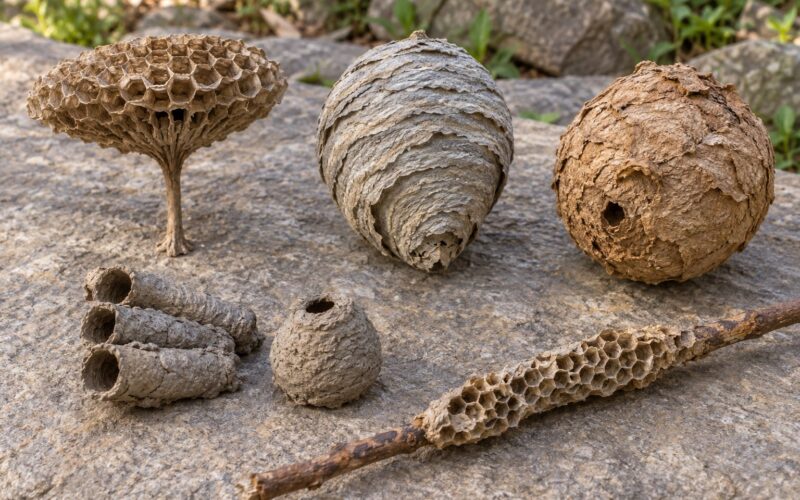
A cicada killer nest also looks nothing like a social nest. There is no paper envelope, no multi-level comb, no cluster of workers defending a shared entrance. One female, one burrow, one larva, and a few provisioned cicadas. That difference is the fastest way to tell whether you have a beneficial solitary wasp or a colony wasp that will defend a location all summer.
Repeated nesting in the same spot year after year is common and simply means the soil conditions suit them. Changing what is on the surface, not poisoning the soil, is what changes that.
When Cicada Killer Wasps Are Most Active
Cicada killers appear from about mid-June through mid-September across much of the eastern United States, tracking the emergence and calling activity of annual cicadas. In areas with a periodic cicada brood, the wasps can concentrate for a few weeks around the emergence rather than staying out all summer.
The window shifts with latitude and climate. Southern yards may see them from late May, northern ones not until July. Because timing follows the local cicada population rather than a calendar, your state or county extension service is a better reference than any national date range.
Adults live for only a few weeks. Everything about their presence, including a mound of dirt in the lawn and the wasps hunting near shrubs, resolves itself within a month or so.
Are Cicada Killer Wasps Dangerous?
A cicada killer sting is painful because the venom is designed to paralyze a cicada, which is a heavy insect. The pain is sharp and immediate, and the site can stay tender and swollen for a day or two. Treat it like any other large wasp sting: clean the area, apply a cold pack, and take an antihistamine if you itch or swell.
Two facts matter more than the pain. First, only females sting, and unlike honey bees they can sting repeatedly, so a female that feels cornered is not limited to one. Second, the venom is hymenoptera venom, and people with a known wasp or bee allergy can have a serious systemic reaction to a species they have never been stung by before.
Seek emergency help immediately for difficulty breathing, throat or facial swelling, dizziness, fainting, or rapidly spreading swelling. If you already know you carry an epinephrine auto-injector, use it and call for help without delay.
Beyond allergy, practical precautions are simple. Keep children and pets away from an active burrow or a cicada lying on the ground, since a food-laden female returning to a spot is the most defensive she will ever be. Do not swat, try to capture, or corner the insect, and do not reach into a burrow to feel for a nest.
How to Prevent Problems Without Killing Beneficial Insects
Start at the least aggressive step and only move up if the problem is real. Most yards never need more than the first two.
- Tolerate them where they are. If nests are in a bed away from foot traffic, leave them. They eat no garden pests, damage nothing, and disappear on their own in a few weeks. They also pollinate while they are active.
- Change the surface. Rake soil flat, reseed bare patches, spread mulch, or plant low groundcover over the area once the season passes. Wasps pick the same sunny bare ground again and again, so covering it removes the reason they came.
- Reduce food and water sources. Keep drinks covered and trash sealed, since adult wasps take in liquid and sugary food.
- Route foot traffic elsewhere. Where the nests are unavoidable, walk around them, mow before dawn or after dusk when the wasps are inside the burrow, and keep a clear buffer between the burrow and places where people sit or children play.
- Have burrows treated by a professional. Where nests sit under a slab, driveway, or walkway and cannot be left alone, a licensed pest control operator can apply an insecticidal dust into the entrance in the evening, when returning females are inside and less able to sting.
Broad-spectrum lawn spraying is counterproductive. It kills pollinators along with the target and rarely reaches a wasp inside a deep burrow, and it removes the cicada control these wasps provide. Do not excavate a nest yourself, seal an active entrance during the day, or pour anything into the hole while wasps are active nearby.
After burrows are treated, restore the mound and the area. Rake the loose soil flat, top-dress with a thin layer of compost or topsoil, water it in, and reseed. A few dozen small mounds rarely need more than that to disappear into a lawn.
Dogs are worth their own note. A dog digging at a burrow or grabbing a cicada off the ground can trigger a sting, so keep them off active nests during the season and pick up paralyzed cicadas before the wasp returns.
Frequently Asked Questions
Do cicada killer wasps nest in houses?
No. Cicada killer wasps nest exclusively in the ground, in burrows dug into sunny bare soil such as lawn edges, sand piles and garden beds. They do not build paper nests, and walls never attract them. An adult found indoors has almost certainly flown in through an open door or window while chasing a cicada and will find its way out on its own. Seal the entry after it leaves.
How large is a cicada killer wasp?
Adults run about 1.25 to 2 inches long, with females at the large end and males slightly smaller. Anything you see in the United States that looks much bigger than that is usually a cicada held near the wasp, a motion-blurred photo, or a different species entirely. Size is still the fastest first check, since yellowjackets, bald-faced hornets and paper wasps are all well under an inch.
What does a cicada killer wasp do when disturbed?
A male will dart at and dive-bomb whatever intrudes on his patrol route, which looks like an attack but cannot sting, because males have no stinger. A female usually flies or walks away, and stings only when handled, stepped on, or cornered at her burrow. Female cicada killers can sting repeatedly rather than once, so avoid swatting or trapping one against skin.
Are cicada killer wasps more aggressive than hornets?
No. Cicada killers are solitary and do not defend a shared nest, so they show none of the persistent, nest-guarding aggression of yellowjackets or social hornets. The dive-bombing people describe is almost always territorial male behavior, and males cannot sting. Real problems come from nests placed where people walk or sit, not from wasp temperament.
How long do cicada killer wasps stay active?
Adults are surface-active for roughly a few weeks, usually from mid-June to mid-September across much of the eastern United States, tracking local cicada emergence. The exact window shifts with climate and brood timing, and can be shorter in areas with a brief periodic cicada emergence. Nests that look abandoned are usually just empty for the day, so check again rather than treating them.
Should I remove a cicada killer wasp nest myself?
Usually not. Most nests can simply be left alone because the wasps leave by early fall and cause no structural damage. Do not excavate or flood a burrow yourself while wasps are active. If a nest sits under a slab, driveway or walkway and stings are a real risk, have a licensed pest control operator treat the entrance with an insecticidal dust in the evening, then reseed and repair the soil afterwards.
Conclusion: What to Do First
Keep a respectful distance, confirm the insect with clear daylight photos if you can, and check sunny bare soil for a burrow with a fresh mound or a cicada lying nearby rather than assuming an infestation. Individual wasps hunting and provisioning are normal seasonal activity and need no response at all.
Act only when behavior is a genuine threat: a nest under a walkway, a driveway or a patio, repeated stings, or a spot where children and pets cannot be kept clear. In that case, contact your county extension service for a free identification, and a licensed pest professional for treatment. Everything else is a beneficial insect passing through.