Scorpions glow under blacklight because fluorescent compounds in a thin outer layer of their exoskeleton, called the hyaline layer, absorb ultraviolet light and immediately re-emit part of it as visible blue-green light. The scorpion is not lighting up on its own. Turn the UV source off and the glow stops instantly.
That short answer settles the most common question about scorpions, but it leaves the interesting parts open: which chemicals do it, why an animal would bother, and what a homeowner in the Southwest should actually do with a flashlight at 11 p.m. on a patio. I have pulled the research and the field reports together below, and flagged clearly where the science is settled and where it is still argued over.
One correction worth making early, because it comes up constantly. Scorpions are not radioactive, they are not bioluminescent, and a bright glow does not mean a dangerous animal. The glow is a chemistry trick with an ultraviolet lamp, nothing more sinister.
Table of Contents
- What Makes Scorpions Glow Under Blacklight?
- What Chemical in a Scorpion’s Body Causes the Glow?
- Is Scorpion Fluorescence the Same as Bioluminescence?
- Why Do Scorpions Fluoresce at All?
- What Color Do Scorpions Glow, and Does Every Species React the Same?
- How to Use Blacklight to Find a Scorpion Safely
- Why Scorpions May Be More Visible at Night
- What Does a Glowing Scorpion Tell You?
- How to Reduce the Risk of Encountering Scorpions
- Frequently Asked Questions
- Conclusion: Treat the Glow as a Clue
What Makes Scorpions Glow Under Blacklight?
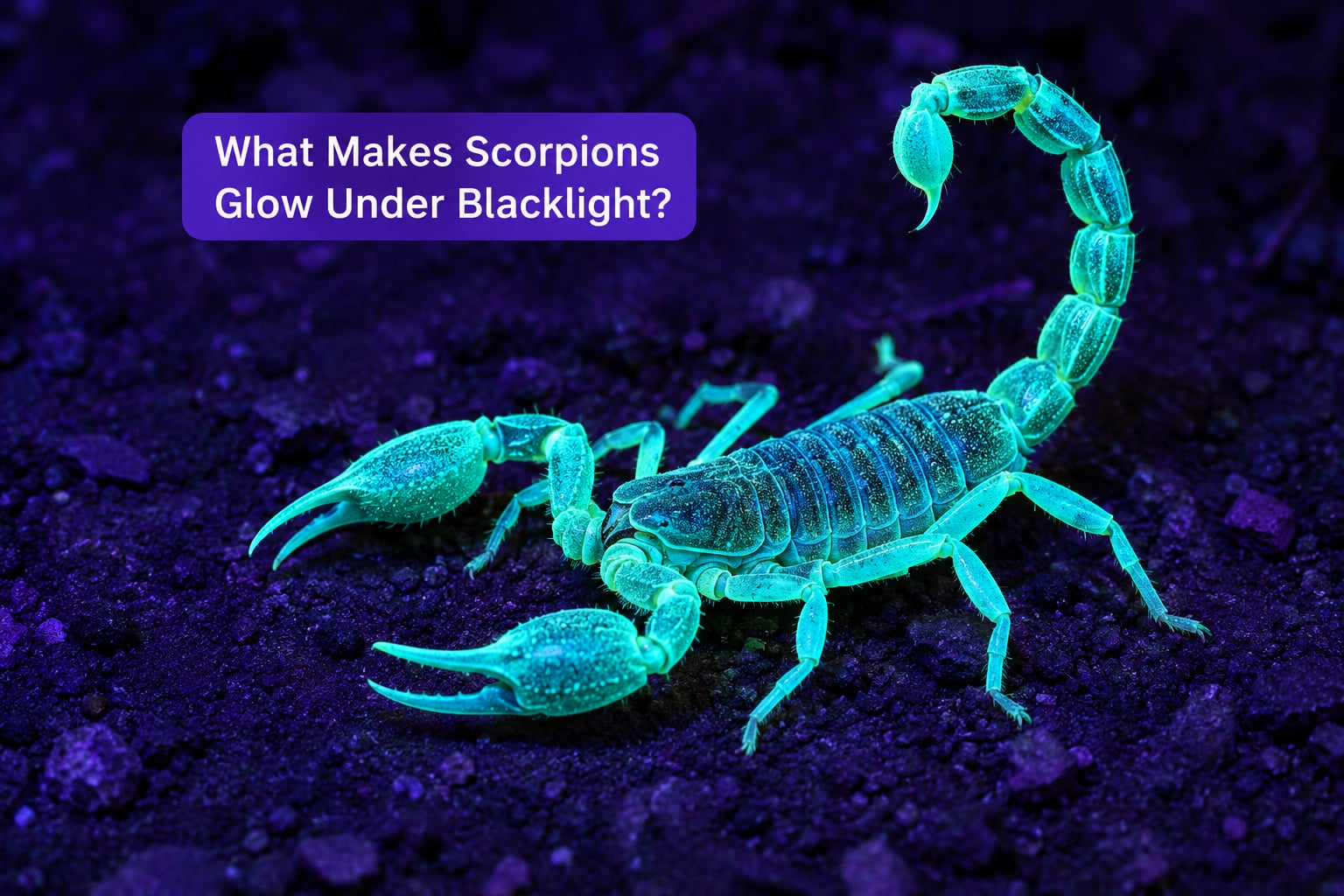
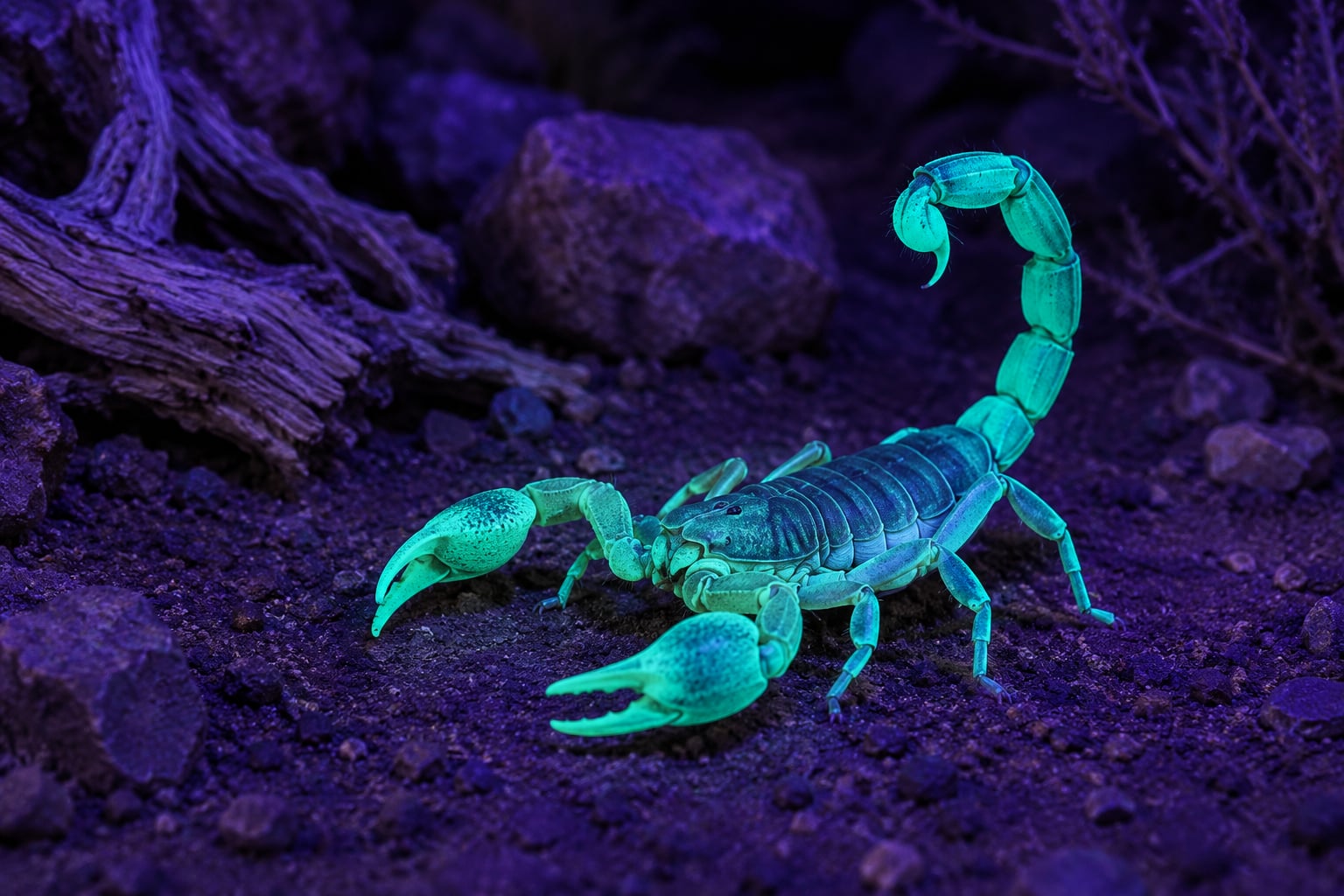
The direct answer: scorpions are fluorescent. Fluorescent molecules in the hyaline layer of their exoskeleton absorb long-wave ultraviolet light, convert it, and give off visible light at a longer wavelength. That re-emission is the aqua glow you see.
The wavelength shift matters. Ultraviolet light is invisible to your eye, and so is the glow on its own. The scorpion takes in energy at a short UV wavelength and releases it at a longer, visible one, a change scientists call the Stokes shift. Hold a 395 nanometre UV flashlight near one and the whole animal lights up like a strip of neon tubing.
The glow comes from the cuticle, not from inside the animal. That is why it covers the pincers, the legs, the segmented tail and the body plates evenly, with almost no shadow. Enchanted-looking does not mean internally lit.
Some light always leaks from a UV lamp into the visible range, which is why cheap flashlights show a violet wash around the beam. So the color you see is a blend: scorpion fluorescence plus whatever your lamp happens to leak.
What Chemical in a Scorpion’s Body Causes the Glow?
Two fluorescent compounds have been identified in scorpion cuticle: beta-carboline and 7-hydroxy-4-methylcoumarin, also written as 4-methyl-7-hydroxycoumarin. Both sit in the hyaline layer and both absorb UV and re-emit it in the visible range.
In 2020, a team at Kyushu University reported a third compound, a phthalate ester, in the shed skin, or exuviae, of the Asian forest scorpion Liocheles australasiae. Their finding, published in the Journal of Natural Products, also turned up antifungal and antiparasitic activity in the same material, which is why this discovery sits at the centre of the most interesting theory about the glow.
Older sources, including a lot of science-news coverage, say the substance is unidentified. That is out of date now, though the picture is still incomplete. Not every fluorescent molecule in every species has been isolated, and researchers argue about whether these compounds act alone or in some combination.
Two practical consequences of this chemistry fall out of the research:
- The glow outlives the animal. A dead scorpion keeps fluorescing because the molecules are still in the cuticle. This trips up people who assume any glow must be biological.
- A fresh molt does not glow right away. The new cuticle has not hardened or developed its fluorescent layer yet, so freshly molted individuals, including most newborn scorpions, stay dark until the exoskeleton ages.
The discarded skin left behind after a molt is often the brightest thing you will find. Scout reports describe empty exuviae glowing while the scorpion that produced them is nowhere in sight.
Is Scorpion Fluorescence the Same as Bioluminescence?
No. Bioluminescence is light a living organism makes on its own, like a firefly or a glowworm, and it needs a chemical reaction inside the animal. Scorpion fluorescence needs an outside ultraviolet source. No UV, no glow.
| Feature | Biofluorescence (scorpions) | Bioluminescence (fireflies) |
|---|---|---|
| Needs an external light source | Yes, UV light | No |
| How the light is made | Absorb UV, re-emit it at a longer visible wavelength | Chemical reaction inside the body |
| Stops when the source goes | Immediately | Only when the animal stops |
| Example | Scorpion, some spiders and millipedes | Firefly, glowworm |
This distinction settles a question people ask constantly: do scorpions glow in moonlight? Moonlight contains a small amount of UV, and scorpion fluorescence can be triggered by it, so some species do show a faint response under moonlight. What they cannot do is glow in a pitch-dark room. Anyone who has found a scorpion that appeared to shine in total darkness was looking at an afterimage, a reflection off a shiny surface, or a strong case of expectation.
Why Do Scorpions Fluoresce at All?
Nobody has settled this. Five explanations have real support of some kind, and the honest answer is that more than one could be partly true. Here is where each one stands.
- Moonlight detection. Scorpions are nocturnal and hide during bright nights, and fluorescence tracks lunar phases closely. A 2019 study in the journal Current Biology, by Kloock and colleagues, exposed fifteen female Paruroctonus becki to low-level UV for sixteen hours a day to fade their fluorescence, and the animals behaved as though the night sky were brighter than it was. The idea is that a scorpion can use its own glow as a rough readout of ambient light.
- UV protection, essentially a sunscreen. Scorpions live in deserts with intense solar radiation. A cuticle that absorbs UV and re-radiates it at a harmless visible wavelength is a tidy solution, and the layer doing it is thin and external, which suits a screening role.
- Parasite and fungus defence. The 2020 phthalate ester work is the strongest support here, since the compound turned up alongside antifungal and antiparasitic activity in exuviae.
- Mate finding and signalling. Fluorescence patterns vary between body parts and sometimes between sexes, which leaves room for a courtship signal. Critics answer that scorpions rely on scent and vibration far more than sight, and that nocturnal courtship happens when UV is scarce anyway.
- An accidental by-product. A chemical reaction with no purpose at all. An arachnid curator at the Queensland Museum told ABC News it could be a fluke, nature being accidental. This is the null hypothesis, and it is impossible to rule out.
| Theory | Best evidence | Status |
|---|---|---|
| Moonlight sensing | Controlled UV exposure study, moon-phase activity patterns | Plausible, supported by experiment |
| UV protection | External screening layer, desert habitat | Plausible, not directly proven |
| Parasite defence | Phthalate ester with antiparasitic activity in exuviae | Emerging evidence |
| Mate finding | Pattern and intensity differences between body parts and sexes | Speculative |
| Chemical accident | Cannot be tested directly | Cannot be ruled out |
Field hobbyists on forums tend to come down harder on the by-product side than the published literature does, largely because the fluorescence is so bright and so useless to the animal that people assume there must be a catch.
What Color Do Scorpions Glow, and Does Every Species React the Same?
Usually cyan, aqua or blue-green, with some species leaning greener and others bluer. Nearly the whole body fluoresces, and the brightest areas are typically the legs, the pincers and the tail segments.
Intensity varies a lot between species, between individuals and between the conditions you are looking under. Keep scorpion owners report that emperor scorpions light up almost solid aqua, and field observations in the American Southwest show the same effect in bark scorpions. Distance, angle, lamp strength and cuticle age all change how bright it looks, so brightness is a poor way to tell species apart.
Do spiders and other arachnids glow under UV light?
Some do. Scorpions are unusual in how completely and evenly they fluoresce, but other arthropods show UV response too, including several spider species, harvestmen and millipedes. Some scorpion species are described as weakly fluorescent, which is why one common keeper question asks what scorpions do not glow. In practice, the exceptions are rare and dim rather than absent.
How to Use Blacklight to Find a Scorpion Safely
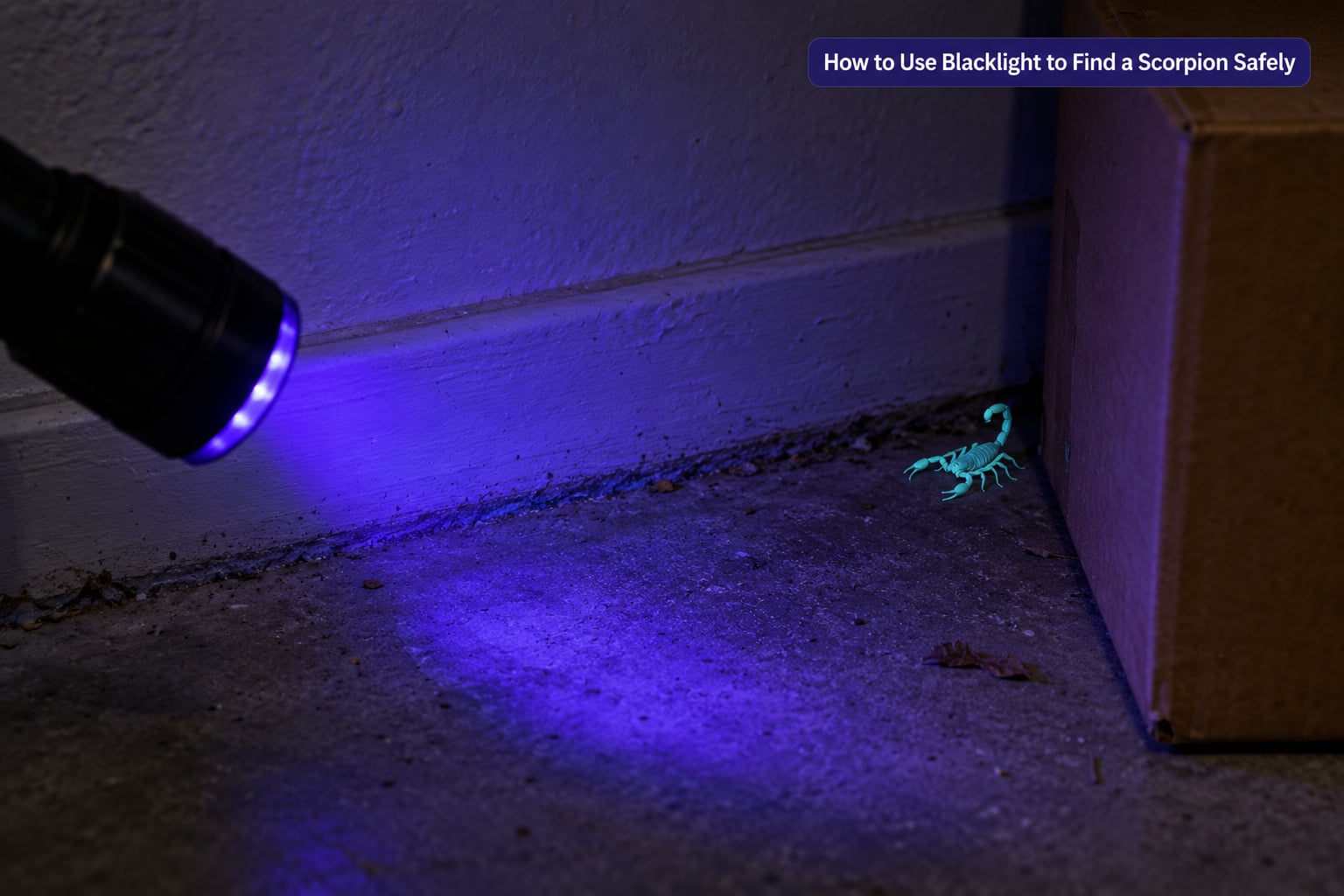
A UV flashlight is a detection tool, not a catching tool. It tells you where the scorpion is. It does nothing about getting it out of your hand safely, and a cornered scorpion stung in the wild will sting again.
If you sweep for them, work in this order:
- Wait until full dark. Scorpions are nocturnal, and daylight or dusk is wasted effort.
- Scan the edges, not the middle. Walls, baseboards, door thresholds, garage corners and the underside of shelves, where they hug cover.
- Check the structures. Sheds, crawl spaces, woodpiles, stacked lumber, mulch beds and rock piles, which are all shelter.
- Move slowly. A fast-moving beam washes out the fine aqua edge and you will step over it.
- Wear closed shoes and long trousers, and use a container to trap rather than fingers. Gloves help but they do not make bare handling safe.
- Keep the beam off faces. Hold the lamp low and away from other people.
On lamp choice, most people use 395 nanometre UV-A lamps, which are widely sold and inexpensive. Higher-powered lamps reach further but are harder to aim and easy to shine into an eye. On eye safety: UV-A is far less hazardous than UV-B or UV-C, but repeated close exposure is still worth avoiding, particularly for children. Do not use a UV lamp to look at your own skin for lesions and expect a useful result.
Why Scorpions May Be More Visible at Night
Two reasons stack up. Scorpions are active after dark, so at 9 p.m. or 10 p.m. they are moving instead of hiding, and darkness is what makes a faint aqua outline stand out against a floor.
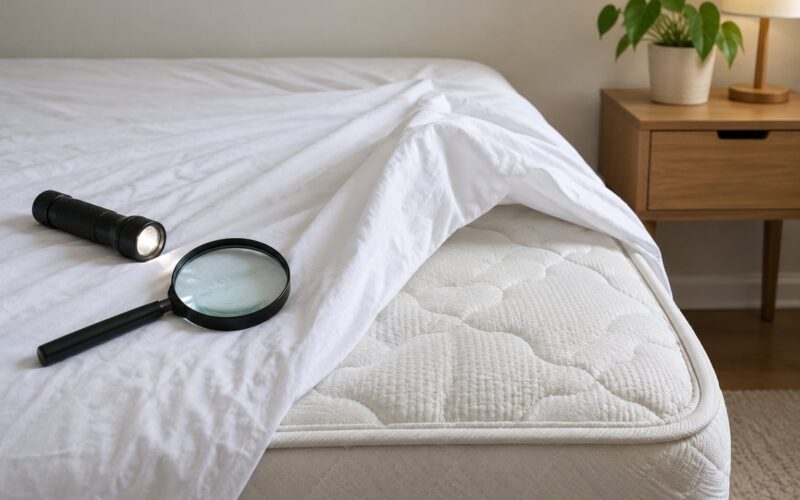
Check bedding and shoes before you get into them rather than after. Scorpions do not climb into beds to seek people, but shoes left on a garage floor, a coat dropped on a step, or towels shaken out on a patio are ordinary ways an indoor encounter starts.
The UV light does not lure scorpions toward it either. It is only useful when you point it at a surface the scorpion is already sitting on.
What Does a Glowing Scorpion Tell You?
It tells you the scorpion is there, it shows the body outline clearly enough to see the pincers and tail, and a dull or patchy glow can hint that the cuticle is newly molted. A shed skin that glows tells you one lived there recently.
It tells you nothing about venom strength, sting severity, how many are inside your walls, or whether you have already been stung. The dangerous species in the American Southwest, including the Arizona bark scorpion, and the milder species found elsewhere look similar under UV. Glow is not a danger meter.
And it is not radioactivity. That myth persists because scorpions look like something from a cave wall, but the glow comes from UV photons hitting the cuticle, not from any decay process. Nothing about a glowing scorpion is more radioactive than the doormat it is sitting on.
How to Reduce the Risk of Encountering Scorpions
Fluorescence tells you where they are. Prevention decides how often that matters.
- Seal entry points. Sweep doors, garage thresholds, utility penetrations, cracked foundation gaps and torn screens. A scorpion that cannot get in does not need handling.
- Clear clutter. Cardboard boxes, stacked lumber, firewood and dense mulch are shelter. Moving them removes cover.
- Lower moisture outdoors. Irrigation, standing water and damp ground litter attract the insects scorpions eat, and a full insect table means more scorpions.
- Shake out what you pick up. Shoes, boots, gloves, towels, camping gear and dog bedding before bringing them inside.
- Gloves and closed shoes for yard work. This is the single most useful habit, especially around rock piles and woodpiles.
- Glue traps in the right rooms. Garage, utility room, laundry and closets near exterior walls. Flat glue traps catch wandering scorpions before you meet one face to face.
Call a pest professional if scorpions keep turning up indoors, if you see repeated activity in a bedroom or a room with small children or pets, or if you live in an area where medically significant species are established. A stinger or a trained technician with a container is a far better answer than a flashlight and bare hands.
Frequently Asked Questions
Are scorpions actually bioluminescent?
No. Scorpions are biofluorescent, not bioluminescent. Fluorescence means molecules in the hyaline layer of the exoskeleton absorb ultraviolet light and re-emit it immediately as visible blue-green light. Bioluminescence means an animal makes light through its own chemistry, like a firefly. Scorpions produce no light on their own, so they cannot glow in a dark room with no UV source.
Do all scorpions glow under blacklight?
Nearly all of them. Every scorpion examined fluoresces under ultraviolet light, and species differences show up as brightness and shade rather than presence or absence. The main exception in practice is a freshly molted scorpion, including most newborns, because the new cuticle has not developed its fluorescent layer yet. Shed exuviae from a recent molt usually glow very brightly.
Can a scorpion’s glow make its sting less dangerous?
No. Fluorescence says nothing about venom potency or how serious a sting would be. Medically significant species and mild species glow under UV in similar ways, and brightness varies with cuticle age, viewing angle and lamp strength. If you need to judge the risk of a scorpion in your area, identify the species instead of reading its glow.
Does blacklight attract scorpions?
No. A UV flashlight is a detection tool, not an attractant. Scorpions are not drawn to ultraviolet light, so shining a lamp around does not lure one toward you. What it does is reveal a scorpion that is already present. Keep the beam low, move slowly, and scan edges and shelters rather than open floor.
What should I do if I find a glowing scorpion indoors?
Keep children and pets away from the area and do not pick it up bare-handed. Contain it by sliding a flat container and a stiff card underneath it, or trap it with a glue trap, then release it outside away from the house. Seal the entry point it came through, and check shoes, bedding and stored boxes before assuming you are done.
Why can I see a scorpion’s glow but not its eyes?
Because the glow comes from the cuticle, not from the eyes. Scorpion eyes are small and pigmented, and the tissue around them does not fluoresce the way the exoskeleton plates do. Under UV the body lights up as a solid aqua shape while the eyes read as two dark dots, which is why a scorpion looks like a glowing outline with dark spots on it.
Conclusion: Treat the Glow as a Clue
Scorpions glow under blacklight because fluorescent compounds in their cuticle absorb UV and re-emit it as blue-green light. That is the whole mechanism, and it is physics rather than biology.
So use it as a clue and nothing more. Sweep the dark spots where scorpions shelter, keep your hands in a container instead of your fingers, seal what they came through, and bring in a pest professional if they keep showing up inside.