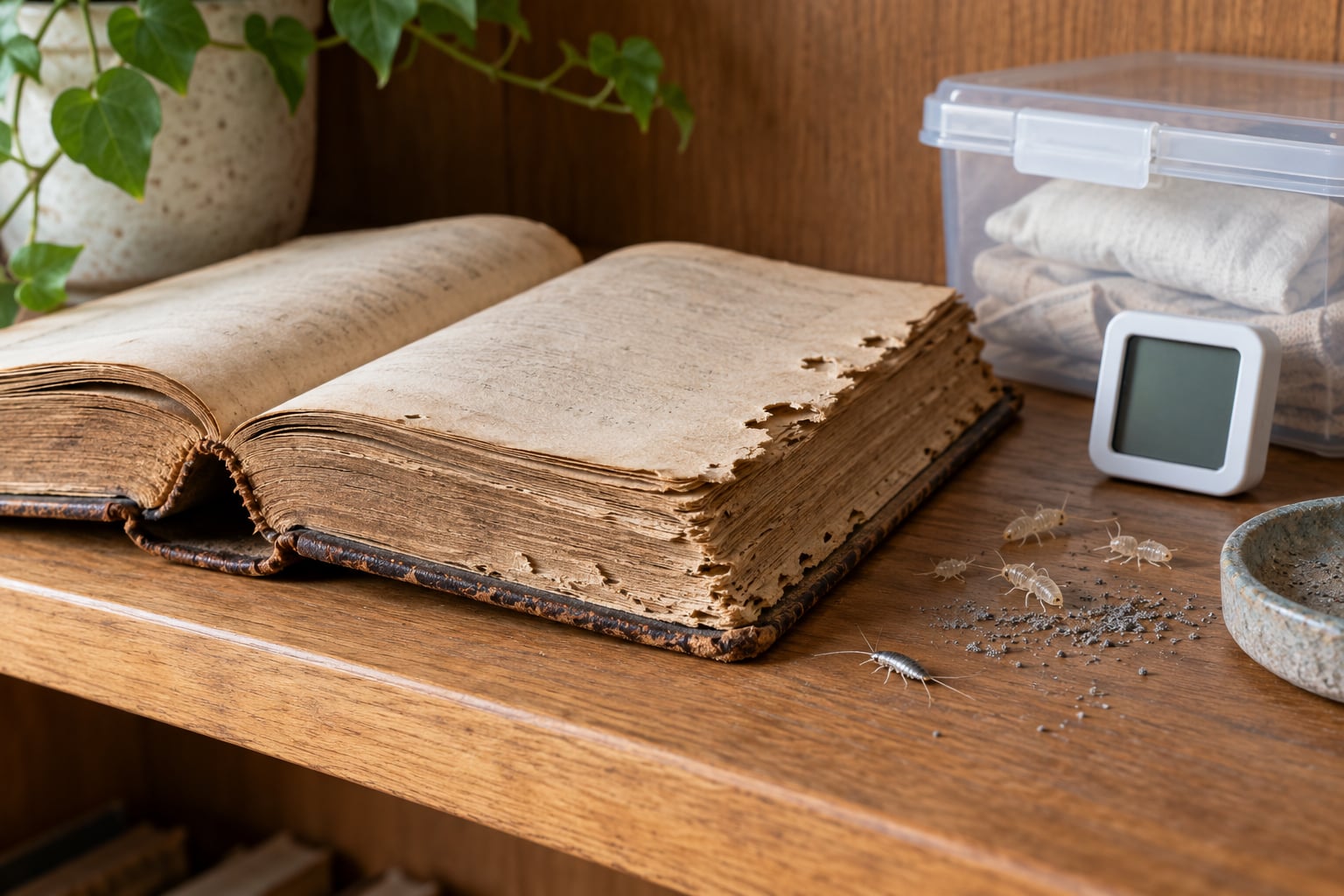
Silverfish damage to books and paper shows up as irregular holes, notched page edges, yellow-brown stains, loose binding glue and silvery shed skins around affected items. The culprit is a small, wingless insect called Lepisma saccharina that grazes on the starches, cellulose and animal glues in paper, book cloth and paste. The damage is permanent, so the useful part is spotting it early, telling it apart from other paper pests, and cutting off the moisture and shelter these insects depend on.
I have pulled apart enough water-damaged and insect-nibbled books to know how easy it is to misread this. A hole in a page edge is not proof of anything on its own. What convinces me is the pattern: several irregular, thumbnail-sized gaps scattered across one page or along a margin, a faint yellow halo around them, and a scatter of tiny grey skins and black pepper-like specks on the shelf below.
Below is what the damage actually looks like, why paper attracts them in the first place, which other pests leave confusingly similar marks, and a step-by-step plan for protecting and treating an affected collection. I have kept it to measures that are safe around kids, pets and books themselves.
Table of Contents
- What Does Silverfish Damage to Books and Paper Look Like?
- How Do You Know It Is Silverfish?
- Why Do Silverfish Damage Books and Paper?
- What Other Pests Cause Similar Paper Damage?
- How to Protect Books and Paper from Silverfish
- How to Prevent Silverfish Infestations in Your Home
- Frequently Asked Questions
- Conclusion
What Does Silverfish Damage to Books and Paper Look Like?
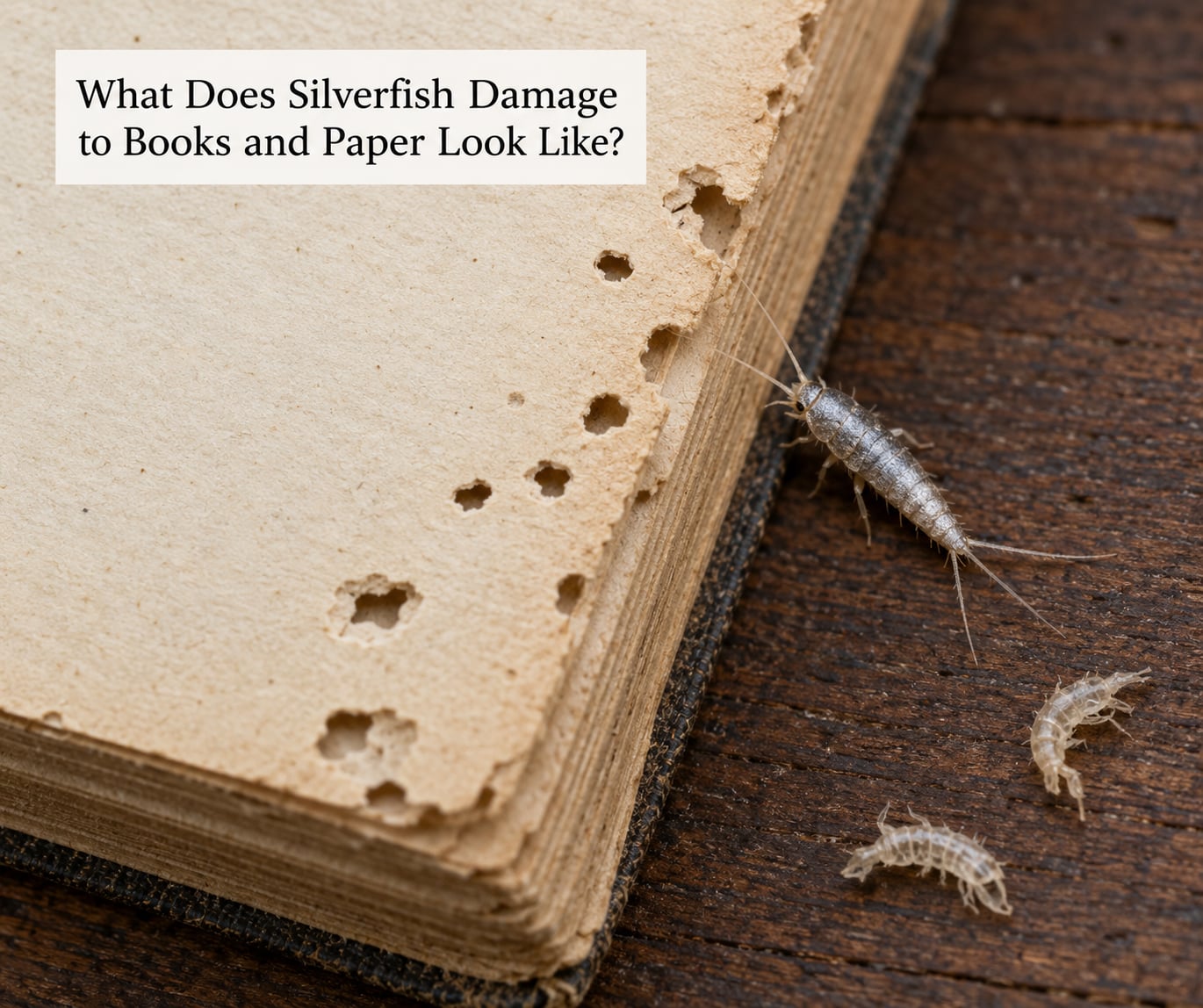
Silverfish damage to books and paper is surface grazing rather than deep boring. You get shallow, uneven holes and notches where the insect rasped the paper, yellow-brown stains from its digestive enzymes, loose or powdery binding adhesive, and grey cast skins and black specks of frass nearby. The holes have soft, ragged edges and no bore dust, which is how you rule out beetles.
The five signs worth checking for
- Irregular holes and notches. Small gaps in the paper, often wider at one end, with ragged rather than drilled edges. They tend to sit near margins, gutters and spine edges.
- Surface etching. A grazed, thinned or scuffed look on the face of a page, sometimes mistaken for foxing or a handling stain until you hold it to the light.
- Yellowish stains. Amber to rusty-brown discoloration around feeding marks, caused by digestive enzymes, sometimes present even where the paper itself is not eaten through.
- Shed skins and droppings. Translucent grey cast skins and tiny black or brown specks of frass on the shelf, the floor or the top of neighbouring volumes.
- Loose binding and glue damage. Pages wobbling in a tight spine, cloth or leather grazed pale in patches, or paste that feels powdery when you press the cover.
There is a sixth clue that people miss: the damage usually spreads outward from one shelf, one box or one corner. Silverfish are not territorial, but they stay near where they entered and where conditions suit them, so a run of affected books tells you where the population sits.
Where silverfish damage to books usually appears first
Start at the least disturbed spot in the room. For most households that means the bottom shelf of a bookcase in a basement, a bedroom closet, or a storage tote that has been sitting in a garage or unheated cupboard. Silverfish move at night and avoid light, so the outer edges of a stack and the gap between the books and the shelf wall go unchecked the longest.
Photo albums are worth checking on the same pass. Silverfish graze the gelatin or protein layer on the back of old prints, which makes photos stick face to face, curl, and go permanently cloudy. That damage is not recoverable at home.
How Do You Know It Is Silverfish?
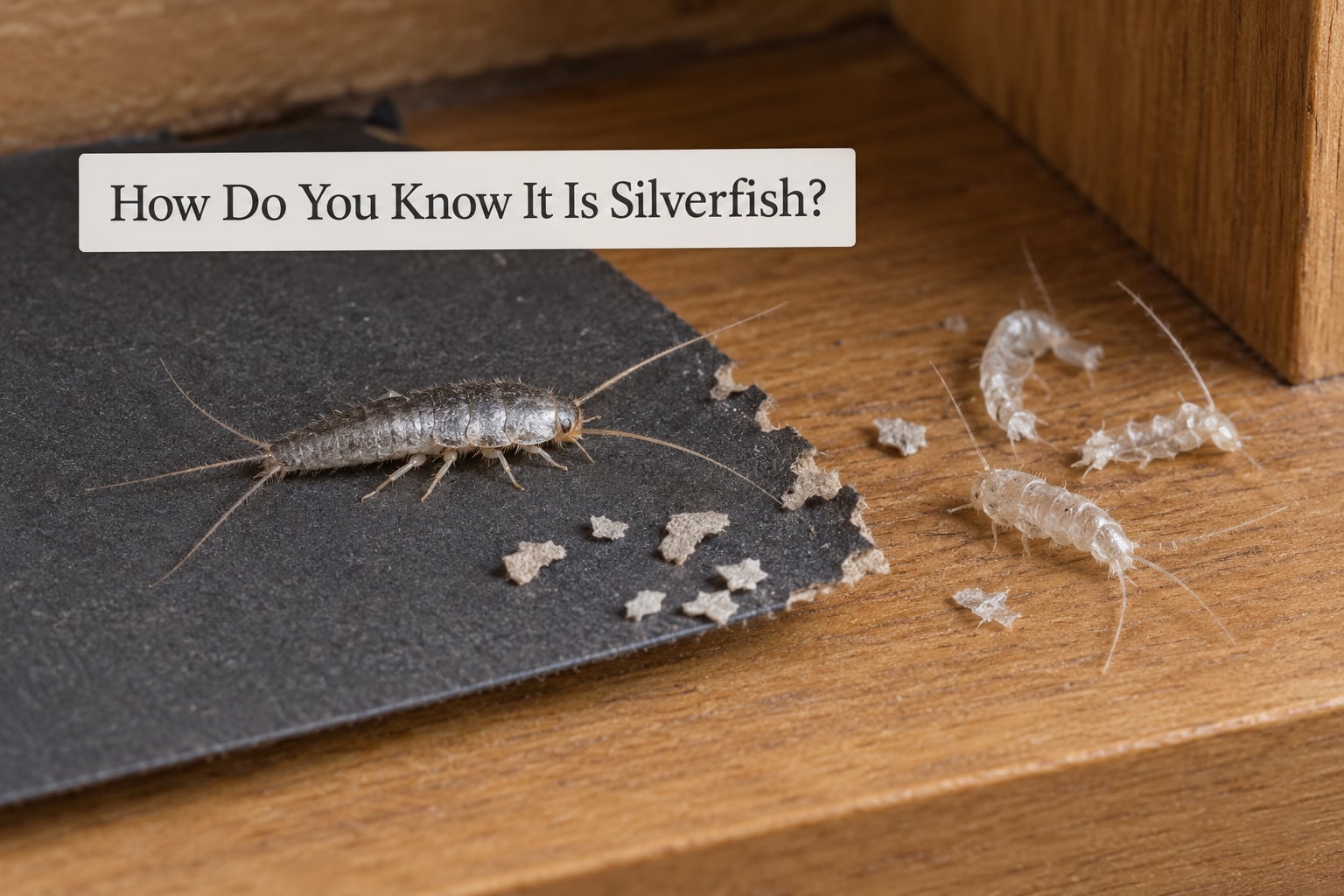
Silverfish are easy to identify once you have seen one. They are flat, teardrop-shaped insects roughly a quarter to half an inch long, covered in silvery grey scales that give them a fish-like glint, with long threadlike antennae and three bristly tail filaments at the rear. They have three pairs of legs, no wings, and they move fast when disturbed.
The firebrat is the close relative to know. It is mottled brown rather than silver, grows slightly larger, and prefers heat rather than damp, so it shows up near boilers, ovens and hot pipes. If you find silverfish in a warm dry spot, suspect firebrat and change your approach.
Where they hide
Look in damp, dark, undisturbed places: basements, bathrooms, kitchens, closets, utility rooms, storage boxes and piles of newspapers. Reddit users in r/pestcontrol describe finding ten to twenty of them on a single night hunt, which tells you how well hidden a modest infestation can be.
A jar trap with a piece of damp bread inside, set out under a bookshelf overnight, is the cheapest way to confirm they are present. Glue monitors and paper blunder traps sold for insect monitoring work the same way and let you check daily without disturbing anything.
Why Do Silverfish Damage Books and Paper?
Because paper and its adhesives are food. Paper itself is mostly cellulose, which silverfish can digest slowly, but the real draw is the starchy and sugary sizing inside the sheet, the dextrin-based wallpaper and paste, and the animal glue or starch paste in older bindings. Add leather, silk and wool textiles, and you have a collection that is essentially a pantry.
Why they live in books in the first place comes down to three conditions: water, shelter and calm. Silverfish need relative humidity above roughly 75% to develop properly, though they tolerate drier air as adults, and they survive long stretches without eating as long as there is water. A cool, damp, dark shelf with no disturbance is close to ideal.
Why a dry house still gets them
This is the most common frustration I see in homeowner forums, and the honest answer is that humidity is one lever, not the whole switch. People in apartments report catching silverfish at 35 to 50% relative humidity with no visible leaks, sometimes in poured concrete units where the building holds damp even when the meter reads dry.
There are three other entry routes people forget. New construction delivers building materials that are damp inside their wrapping. They migrate in from an adjacent unit or a neighbouring basement through shared walls, pipe gaps and skirting boards. And a woodpile, cardboard moving boxes or newspaper stack stored indoors gives them a bridge straight into the house.
Measuring with a cheap hygrometer tells you more than guessing. Put one on the suspect shelf for a week and read the real number rather than the number for the rest of the house.
What Other Pests Cause Similar Paper Damage?
Treating every hole as a silverfish problem wastes your time and can make things worse, because the treatments barely overlap. Paperbooklice, furniture beetles, rodents and plain damp deterioration all leave marks that get called silverfish damage by mistake.
| Pest or cause | Damage pattern | Where to look |
|---|---|---|
| Silverfish | Irregular ragged holes, surface etching, yellow stains, loose binding glue | Cool damp shelves, closets, storage boxes, bathroom and kitchen edges |
| Paperbooklice (psocids) | Very small shallow holes or nibbled surface, usually clustered, rarely staining | Fresh paper, cardboard, window sills, damp wall edges; moves in herds |
| Furniture beetle or woodworm | Round, clean-edged exit holes and tunnels in wooden boards, covers and shelving | Wood, not paper; round holes with fine bore dust below |
| Rodents | Large gnawed corners, ragged tearing, greasy grey or brown staining | Attics, garages, drop ceilings; teeth marks on edges |
| Damp and mould | Foxing spots, tide lines, wavy cockling, brittle or fused pages, musty smell | Exterior walls, cold surfaces, leaks, unheated basements |
The practical difference: silverfish holes have no bore dust and no clean round rim, and they come with shed skins and frass. Bookworm holes are circular and sit in wood. Rodent damage is far larger and comes with nesting material.
Booklice deserve their own warning because they frequently arrive alongside silverfish. Psocids prefer fresh, recently damp paper and mould, need high humidity to thrive, and cause far less damage. The trap is that treating the dampness clears booklice without touching the silverfish at all.
How to Protect Books and Paper from Silverfish
Work in this order and you stop the loss before you spend anything: identify, isolate, dry, seal, then treat only what is still active. Do not start with insecticide spray. Nothing you can safely buy for a bookshelf should ever be sprayed, dusted or fogged directly onto a collection, because that does far more to paper, inks and glue than to the insect.
Step 1: Isolate and inspect
Move affected books off the shelf entirely. Bag them separately in a sealed container or heavy-duty plastic sack so nothing else gets carried through the house, then inspect the rest of the shelf and its neighbours under a bright light. Check bindings, page edges, spine joints and any book with a loose cover.
Step 2: Freeze the affected books
Freezing is the most reliable household treatment for books and paper, and the one most often botched. Seal the books in polythene bags first, because condensation is what ruins paper, then freeze at minus 18C (0F) for two weeks or at minus 30C (-22F) for three days. Take the sealed bags out and let them return to room temperature while still sealed before you open anything.
Many readers describe a 24-hour freeze in a home freezer as their routine, and for a quick knock-down it does help. It is well below the sustained cold and long enough exposure that libraries and archives use, so treat it as a partial treatment and repeat it rather than trusting it once.
Step 3: Dry out the source
Find and fix what is feeding them. Run the dehumidifier or air conditioner until the room reads below 50% relative humidity on a hygrometer, and keep it under 45% in a basement or storage area. Aim for a 45 to 65% band in any room holding paper you care about, which protects the paper without shocking it.
Step 4: Seal and clean
Vacuum the shelf, the skirting board and the floor around it, then wipe surfaces with soapy water. Vacuum up shed skins and frass, because leaving them behind keeps signalling that the spot is worth returning to.
Swap cardboard boxes for sealed plastic or metal containers, and store paper in the clean, dry interior rather than against an outside wall or a bare concrete floor. Silica gel packets in a closed container slow moisture but do nothing to an active population on their own.
Step 5: Protect what you cannot freeze
Rare books, photographs and anything with value beyond sentiment belong with a paper conservator, not in a home freezer. Anoxic treatment, or heat treatment in a professional chamber, does the job without the temperature swings.
How to Prevent Silverfish Infestations in Your Home
Prevention here is dull and effective: reduce moisture, reduce shelter, increase disturbance, and monitor. Most of the fix is doing the same four things consistently rather than finding a new product.
Control moisture first
Hold general living areas between 30 and 50% relative humidity and storage areas closer to 35 to 45%. Use a dehumidifier, run the bathroom and kitchen exhaust fans after use, repair dripping plumbing, and keep books off damp basement floors on shelving or pallets. Dry outdoor walls and cold pipes are the two most common damp sources behind a bookcase in an exterior wall.
Remove the routes in
Seal cracks and gaps around pipes, skirting boards, baseboards and where walls meet floors with silicone or polyurethane caulk. Fit door sweeps and seal garage or utility room thresholds. Replace cardboard moving boxes with plastic, and give paper stores new paper before bringing them indoors.
Disturb the shelter
Move books off shelves once a year and vacuum behind them. Keep newspaper and magazines in sealed bins rather than loose stacks, and store rarely used volumes in a way that lets you lift them individually rather than as one heavy block.
Choose treatments that suit who lives with you
| Option | How it works | Pets and kids | Safe near books |
|---|---|---|---|
| Diatomaceous earth | Desiccates the insect on contact; needs reapplication | Breathable dust is a lung irritant; keep away from pets and children | Yes, if kept off paper surfaces |
| Boric acid | Toxic to insects through ingestion; slow acting | Off-limits where toddlers, infants or pets can reach it | Yes, in cracks and along shelf edges |
| Silica gel or desiccant dust | Dries the micro-environment inside containers | Generally low risk if kept out of reach | Yes, inside sealed storage |
| Neem oil or pyrethrin-based products | Plant-derived repellent or contact insecticide | Follow the label exactly; pyrethrins irritate skin and pets | Never spray onto a collection |
| Essential oils such as citrus or spearmint | Limonene-based repellent, works as a lure or deterrent | Toxic to cats, birds and fish; never near them | Use in a diffuser outside the room, never on paper |
| Mothballs | Naphthalene vapour repellant | Toxic if swallowed; not for homes with children or pets | Not recommended for collections |
That chart matters because the two most commonly recommended products are the two least suited to a family. A reader with a toddler and a dog asking about exactly this trade-off settled on diatomaceous earth along baseboards and under sinks, and other posters in the same community report similar long-term success. Others report that lavender satchels and bay leaves simply moved the problem from one room to the next.
Monitor instead of spraying
Integrated pest management, which museums adopted decades ago, is the model here: trap, identify, then target. Set out a few monitors near bookshelves and check them weekly. Catch counts that stay at zero for a month mean the shelf is clear; a few catches a week mean you have work to do; dozens mean you have a population and should escalate.
When to call a pest professional
Call a licensed pro when the infestation spreads between rooms or units, when you are seeing large numbers nightly, when books are stored in a shared or multi-unit building you do not control, or when the collection holds items a conservator would need to treat. Be upfront that silverfish are usually managed rather than eliminated, so you are asking for a plan and a follow-up schedule, not a guarantee of permanent removal.
Frequently Asked Questions
Can silverfish actually eat through paper?
Yes, but slowly and unevenly. Silverfish rasp the surface of paper rather than boring through it, leaving shallow irregular holes, notched edges and grazed patches that thin the sheet over time. They feed more readily on the starches, dextrins and glues inside the paper than on the cellulose itself, which is why old cloth-bound and paste-bound books suffer more than modern acid-free stock.
Will silverfish ruin my books?
A contained infestation is usually a few damaged volumes. Left alone, silverfish work through a shelf slowly because they eat starch and glue rather than bulk fibre, so a collection rarely disappears overnight. The real losses are photographs that stick and curl, brittle glue that lets pages fall out, and ink or paper surface that never recovers. Prompt isolation and drying limit the loss to the books already showing marks.
What is bookworm damage, and is it the same as silverfish damage?
No. Bookworm is a loose nickname covering several pests, but it usually means wood-boring beetles such as the furniture beetle, which leave clean round exit holes and fine bore dust in wooden boards and covers. Silverfish damage is irregular, ragged and ragged-edged, with no bore dust, and it is usually accompanied by shed skins and black specks of frass. Round holes in wood mean beetle; ragged holes in paper mean silverfish or booklice.
Are silverfish dangerous to humans?
No. Silverfish do not bite, sting or burrow into skin, and they do not carry disease the way rodents do. If one is swallowed it is harmless, since it is an insect that feeds on starch rather than anything toxic. Having silverfish also says nothing about how clean a home is, because they arrive in packaging, cardboard boxes and firewood. The only real concern is indirect: some treatments, such as boric acid and naphthalene mothballs, are toxic if swallowed.
Can you ever fully get rid of silverfish?
Complete, permanent eradication is rare because they enter from neighbouring units, deliveries and firewood, and they can survive a long time without food as long as water is available. Most households manage them instead, holding numbers low enough that damage stops, and that is a legitimate result rather than failure. Hold relative humidity under 50%, seal cracks, keep paper sealed and monitor with traps. If catches stay at zero for a month, the problem is solved in practice.
How do I get rid of booklice in my books?
Bag the affected books individually and tighten your case for dry storage, since psocids need high humidity to flourish. Vacuum and wipe the shelf, remove any mould source, and get the room below 50% relative humidity with a dehumidifier or air conditioning. Booklice respond far faster to drying out than silverfish do, so a moisture fix alone often clears them within weeks. If they return quickly, look for a slow leak or condensation behind the wall or window.
Conclusion
Start by confirming the pest rather than assuming it: ragged holes plus shed skins and black specks point to silverfish, round holes in wood point to beetles, and torn corners point to a rodent. Then isolate the affected books in sealed bags, freeze them properly at minus 18C for two weeks, and let the moisture source go, holding the room under 50% relative humidity on a hygrometer. Seal cracks, swap cardboard boxes for plastic, vacuum the shelf and set out a few monitors to confirm the numbers have dropped before you treat with anything at all. For 2026 and beyond, the goal is a quiet shelf you check monthly rather than an empty house you keep re-treating.