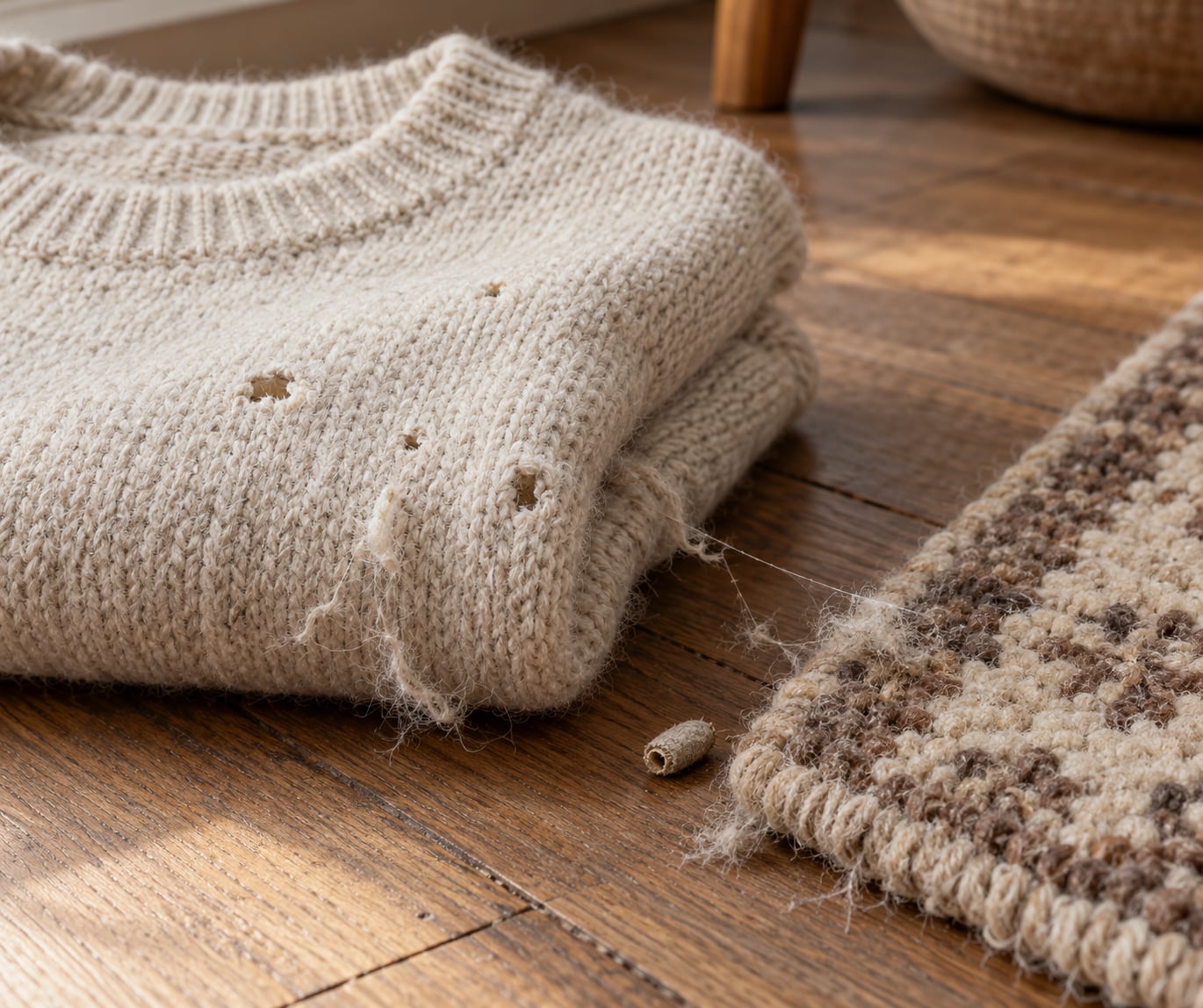
Webbing, silken cases or frass on the fabric means clothes moths. No webbing at all, with irregular shaved patches and shed larval skins, means carpet beetles. That single difference settles carpet beetle damage vs moth damage faster than any other clue, and it matters because the two pests respond to completely different treatments.
The bad news first: in both cases the larvae do the eating, not the adults. And the larvae of both species target keratin-based animal fibres, so wool, cashmere, silk, fur, feathers and felt are all on the menu.
Table of Contents
- Carpet Beetle Damage vs Moth Damage at a Glance
- What Does Carpet Beetle Damage Look Like?
- What Does Moth Damage Look Like?
- Where Do Carpet Beetles and Moths Cause Damage?
- What Signs Prove Which Pest Is Responsible?
- How Do You Treat Carpet Beetle Damage?
- How Do You Treat Moth Damage?
- Can You Prevent Future Infestations?
- Which Should You Choose?
- Frequently Asked Questions
- Are the holes in my carpet caused by carpet beetles or moths?
- Can the damage be repaired, or do I have to throw the item out?
- Does one hole mean I have an active infestation?
- Will vacuuming alone get rid of carpet beetles or moths?
- Do carpet beetles or carpet moths bite people?
- When should I call a pest control professional?
- Conclusion
Carpet Beetle Damage vs Moth Damage at a Glance
| Clue | Carpet beetle | Clothes moth |
|---|---|---|
| Hole shape | Irregular, ragged, frayed edges | Small, neat, round |
| Webbing | Never any | Silk sheets, tube tunnels or portable cases |
| Cast skins | Abundant, hairy shells near the damage | Rare |
| Damage pattern | Wide, diffuse spread across the surface | Concentrated in folds, seams and creases |
| Typical location | Carpet edges, under furniture, upholstery, pet bedding | Wardrobes, drawers, sealed storage boxes |
| Frass | Fine and sparse | Noticeable, sometimes piled at seams |
| Who eats | Hairy larva, up to about 6 mm | Larva inside silk or in a portable case |
| Adult | Small round beetle, about 2-3 mm | Weak-flying moth, 9-12 mm wingspan |
| First action | Vacuum thoroughly and find the source | Isolate items, then heat or freeze them |
One row deserves emphasis: webbing. If you find silk anywhere near the damage, stop reading the rest of the table and treat this as a moth problem.
What Does Carpet Beetle Damage Look Like?
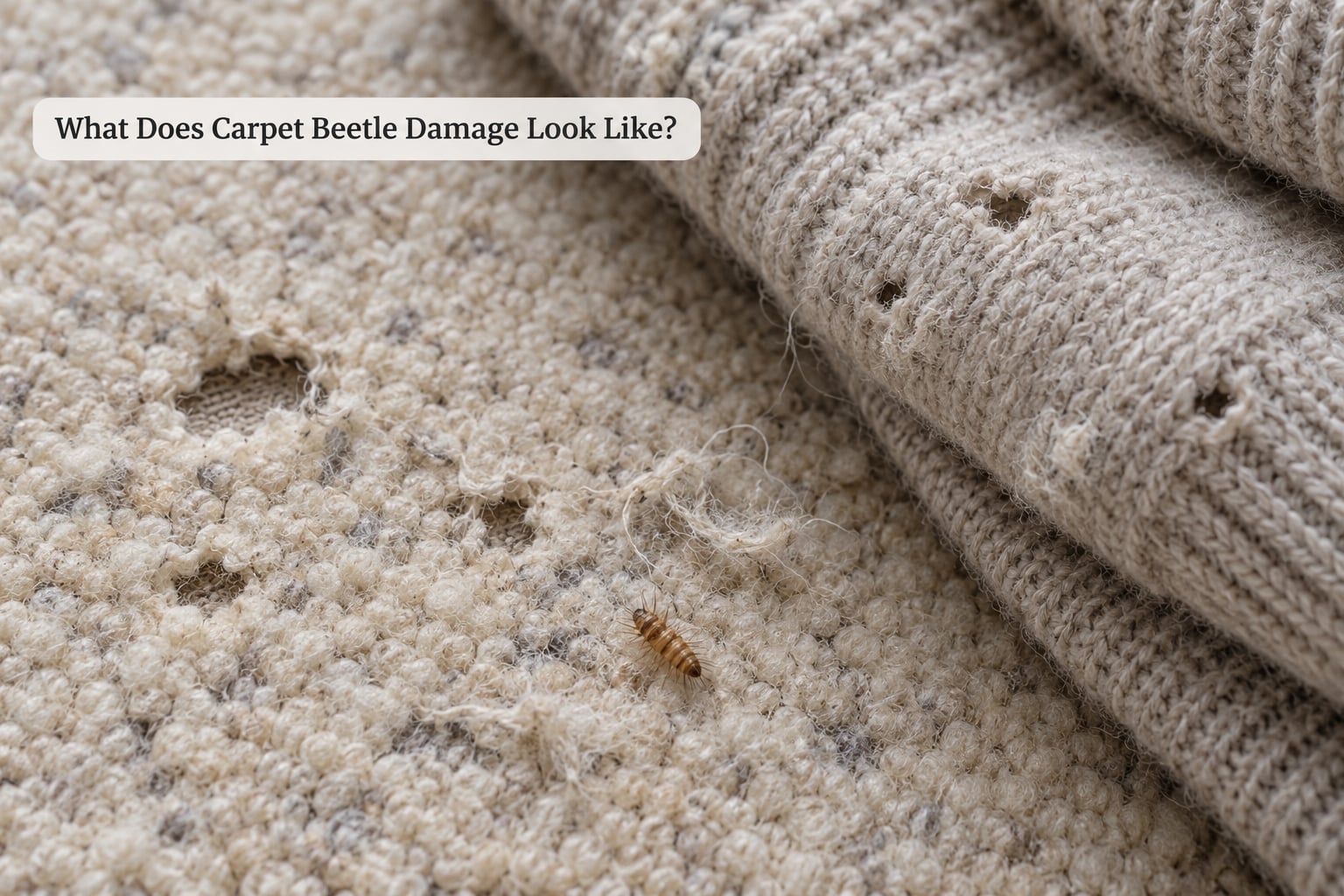
Carpet beetle damage rarely looks like a clean hole. The larva grazes the surface of the fibre rather than chewing through it, so the first sign is usually a shaved or thinned patch that catches the light differently from the surrounding pile.
As grazing deepens, holes open with ragged, frayed edges instead of neat circles. Upholstery and rugs develop threadbare areas, and wool coats get eaten through at the hem, cuffs, lapels and lining before anywhere else, because those edges collect fibre and stay undisturbed.
The giveaway evidence is the cast skin. Carpet beetle larvae moult repeatedly as they grow, and they leave behind empty hairy shells that scatter across the pile like coarse brown flakes. On a dark rug they can look like dirt. On a light sweater they are unmistakable.
Look for a living larva too. It is a slow-moving, bristly, brown or cream caterpillar, tapered at both ends, often with the nickname “woolly bear” attached to it. That is the insect you want to find, because adults are harmless to your clothes and larvae are not.
What Does Moth Damage Look Like?
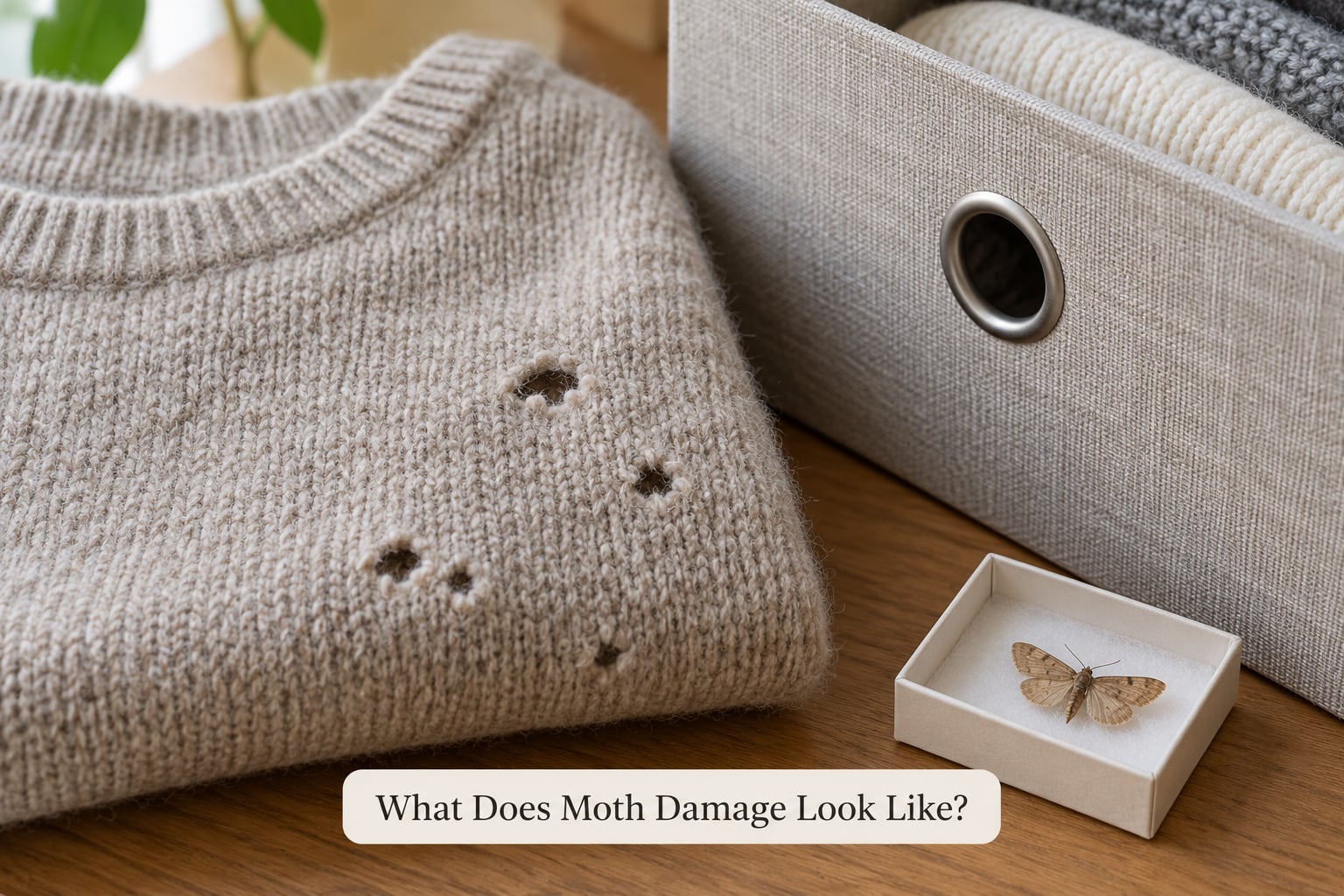
Moth damage is tidier-looking but no less destructive. Holes tend to be small and round, and they cluster where fabric folds against fabric: underarm seams, pleats, collars, hems and the lining of a coat.
Two species produce two different tells. The webbing clothes moth (Tineola bisselliella) spins silk directly onto the fabric, leaving gossamer sheets, mats and tube tunnels near the damage, and it produces a lot of frass. The casemaking clothes moth (Tinea pellionella) carries a portable silken case with it, so you may find small tubes travelling across the wool with grains of waste stuck to the outside.
Pantry moths are a separate issue. The Indianmeal moth (Plodia interpunctella) damages dry food, grains, nuts and pet food rather than textiles, and you will spot webbing in the cupboard rather than on a jumper.
Terminology trips people up constantly. “Carpet moth,” “clothes moth” and “wool moth” all refer to the same textile moths. Only the larvae cause damage in every case.
Where Do Carpet Beetles and Moths Cause Damage?
Location is often more telling than the holes themselves. Work through this list and find your match:
- Wall-to-wall carpet, along baseboards and tack strips – carpet beetle. Larvae travel the edges where dust and dead insect matter collect.
- Under furniture and under low shelving – carpet beetle. These spots are dark, still and rarely disturbed, which is exactly what larvae want.
- Area rug in a bedroom or living room – carpet beetle first, moth possible if wool clothing is stored nearby.
- Seam of a sofa or armchair nobody uses – carpet beetle, often with pet hair in the mix.
- Wardrobe, drawer or storage box of woollens – clothes moth.
- Attic or under-bed box of stored textiles – clothes moth, especially in unheated or damp spaces.
- Feather bedding, down pillows, costume and taxidermy – either pest, whichever has the food source nearby.
- Dry food cupboard, cereal or pet food packaging – pantry moth, not a textile pest at all.
One forum question comes up over and over: why do I have carpet beetles and no carpet? The answer is usually pet hair, felt, wool bedding or a bird nest in the eaves. Carpet beetles do not need carpet to live.
What Signs Prove Which Pest Is Responsible?
Run these five checks in order before you spend a dollar. Photograph whatever you find first, because the evidence is the only thing that matters until you know which pest you are dealing with.
1. Look for webbing or silken cases
Silk sheets, tube tunnels or portable cases anywhere near the damage confirm a clothes moth. Carpet beetles produce no silk of any kind. This is the fastest discriminator that exists.
2. Look for cast skins
Plenty of hairy empty shells scattered around the fabric point to carpet beetles. Clothes moth larvae keep their cast skins inside the case or in the webbing, so you see far less.
3. Find the larva
Hairy, bristly and fast-moving on the pile means carpet beetle. Cream or pale, smooth-bodied, and either wrapped in silk or dragging a case means moth. A white larva sitting openly on a bed is much more likely a carpet beetle than a moth.
4. Check the spread pattern
Carpet beetle larvae wander openly, so the damage sprawls thinly across a wide area. Moth larvae stay sheltered and eat hard in one place, so you get a dense cluster of holes rather than a diffuse field.
5. Check where the damage sits
Folds, seams and stored clothing favour moths. Broad grazing across carpet, upholstery and wool suggests beetles.
One myth worth clearing up while you are looking: frass pellets are hard, opaque and dark. Moth eggs are tiny, translucent and fragile, and they do not lie dormant in your textiles waiting months to hatch. If you see hard pellets, you are looking at waste, not an unopened future infestation.
How Do You Treat Carpet Beetle Damage?
Carpet beetles respond to thorough removal, not to fogging. The sequence that works:
- Remove the food source. Vacuum the affected rug, carpet and upholstery with a machine that has a beater bar or rotating brush, and do the edges, seams, tassels and the underside of loose rugs. A slow pass lifted into the pile beats three fast ones.
- Empty outdoors immediately. Eggs, larvae and cast skins in the canister die when the bag is left in the sun. Sealing the bag and storing it in a closet just relocates the problem.
- Work outwards from the damage. Vacuum the whole room, not a two-foot square around the bald patch.
- Clear the pet contribution. Wash or replace pet bedding, remove accumulated hair from upholstery seams, and keep a routine cleaning schedule in the room where the damage appeared.
- Check outside. Bird nests in eaves, attics and wall voids are a classic source. Removing nests once the birds have left usually ends new arrivals.
- Repeat weekly for several weeks. Larvae hide deep in the pile, so one pass rarely clears them. Larval activity tends to peak in late spring, which is when you most need to keep going.
A professional is worth calling when the infestation is spread through multiple rooms, when damage keeps appearing after a month of disciplined vacuuming, when you cannot reach wall voids or under fixed furniture, or when anyone in the house has a respiratory condition and you would rather not use any pesticide indoors.
How Do You Treat Moth Damage?
Moths need their textiles made unavailable, then hot enough or cold enough to die. Both directions work.
Isolate first. Bag everything suspect in sealed plastic before you move it, so nothing travels to a room it has not been in. Then treat item by item, following the care label. Washing at 60C or above, or a tumble dry on high heat, kills eggs, larvae and pupae in a garment that tolerates it. Items that cannot be washed, including wool coats, cashmere and anything dry-clean only, can go into the freezer for 72 hours or more. Six months is the safer figure if you want certainty.
Clean the storage area itself. Vacuum the wardrobe interior, the drawer bottoms and the shelf edges, and take the small amount of time to do it even though it is tedious. Webbing and cases hide in the gap between the back panel and the wall.
Storage is where most people lose the battle. Airtight bins, vacuum bags with oxygen scavengers, and cotton or wool wraps change the equation because they remove the access adults need to lay eggs. Cedar blocks, mothballs and pheromone traps do not. A pheromone trap catches males, it does not stop egg-laying, and treated products have to be used exactly as labelled with children and pets out of the room.
For dry food and pantry moths the treatment is separate: airtight containers with gasketed lids, a thorough clean of the cupboard, and checking new grocery bags before they go in.
Replace damaged fabric only after the pest problem is genuinely under control. A new rug installed into an active infestation gets eaten in a season.
Can You Prevent Future Infestations?
Prevention is mostly common sense applied consistently:
- Store wool, cashmere, fur and feather items in sealed bins or vacuum bags, not in open baskets or on open shelves.
- Wash or air woollens before storing them, so any existing eggs and larvae come with the garment.
- Keep dry food and pet food in airtight containers, and check bags before they go into the cupboard.
- Vacuum rugs, carpets and upholstery regularly, especially under furniture and along baseboards.
- Keep pet bedding and pet hair out of the equation with a consistent wash and vacuum routine.
- Watch humidity. Damp storage areas attract moths, so deal with condensation in attics and basements.
- Quarantine anything second-hand or coming out of storage for a season before it joins the wardrobe.
- Use sticky monitoring traps in wardrobes and cupboards to check whether adults are still flying.
Which Should You Choose?
Pick the path by evidence, not by fear, because moths get the reputation and carpet beetles do the damage. In practice carpet beetles are the bigger risk to wool.
- Irregular grazing, ragged holes, shed cast skins, no webbing – treat it as carpet beetles. Vacuum protocol, source removal, edge and void attention.
- Silken webbing, tube tunnels, portable cases, round clustered holes, adults flying toward light – treat it as clothes moths. Isolate, heat or freeze, then rebuild storage.
- Both signs in the same home – run both treatments at once. They rarely share the same room, so a room-by-room approach works: beetle protocol on the floor and upholstery, moth protocol on the wardrobes and boxes.
If you are renting rather than owning, take photos and keep the receipts. Household policies commonly cover sudden accidental damage such as a moth-damaged rug, while wear and tear and gradual damage usually sit with the tenant. It varies by policy, so read yours before you assume either way.
Frequently Asked Questions
Are the holes in my carpet caused by carpet beetles or moths?
Shape and location help, but evidence is more reliable. Carpet beetle holes are irregular with frayed edges and come with shed larval skins on the pile. Clothes moth holes are small and round and come with silken webbing, cases or frass in folds and seams. If you find silk, you have a moth. If you find cast skins and no silk, you have a beetle.
Can the damage be repaired, or do I have to throw the item out?
It depends how far it has gone. Thinned or grazed fibres in a rug can often be lifted and patched, and small holes in knitwear are darnable. Bald patches with deep wear in carpet, or a lining chewed away from a coat, usually mean replacement. Take a clear photo of the item before deciding, because most people overestimate the damage once they have looked closely.
Does one hole mean I have an active infestation?
Not on its own. A single hole can be an old scar from a previous season, ordinary wear at a stress point, or a snag. You have a live problem when new holes appear over weeks, when you find larvae, cast skins or webbing, or when adults are seen flying. Track the item with a pencil mark and check it monthly rather than reacting to a single mark.
Will vacuuming alone get rid of carpet beetles or moths?
For a light carpet beetle problem it can, because vacuuming removes pupae and larvae from the pile. Use a machine with a beater bar, work the edges and under furniture, empty the contents outdoors straight away, and repeat weekly for several weeks. It will not control a moth infestation in a wardrobe, and it will not reach wall voids or heavy furniture that you cannot move.
Do carpet beetles or carpet moths bite people?
Neither bites. Their mouthparts are built for keratin fibres, not skin, and both species spend their larval stage eating textiles. A bite-like mark in a bed is far more likely to be a bed bug, a biting midge or a flea than a carpet beetle. If you are being bitten and the marks appear overnight in a line or a cluster, get the insect identified before you treat the wrong pest.
When should I call a pest control professional?
Call when the damage is spreading across several rooms, when new damage keeps appearing after a month of careful vacuuming and heat or freeze treatment, when the source is inside a wall void, under fixed furniture or in an attic you cannot reach, or when anyone in the home is pregnant, has a baby, has pets, or has asthma. A professional can also confirm the identification, which saves weeks of treating the wrong pest.
Conclusion
Start with the fabric, not with a product. Bend the damaged item over a light, look for silk, then look for hairy cast skins, and pick the larva up in a jar if you can find one. That single inspection resolves carpet beetle damage vs moth damage in most homes within five minutes.
Photograph the evidence, check the location against the list above, then commit to the matching treatment: vacuuming and source removal for beetles, isolation plus heat or freezing and better storage for moths. And act before you replace anything, because new fabric in an untreated room gets eaten too.