If you want to know how to tell gnats apart in a home, you need three things: body color, wing shape, and where you actually see them. Location is the strongest clue, because fungus gnats, fruit flies, drain flies, and mosquitoes each breed in a different place, and almost nobody ever sees the larvae that gave them their name.
Below is the identification system I wish I had when a bathroom started buzzing with fuzzy flies in a house I was renting in Arizona. Five insects get called “gnats” indoors, and only two of them bite.
Table of Contents
- How to Tell Gnats Apart in a Home: 4 Types at a Glance
- What Do the Most Common Indoor Gnats Look Like?
- Where Are They Coming From?
- Fungus Gnats vs Drain Flies
- Fruit Flies, Fungus Gnats, and Drain Flies: Which One Is It?
- Do Midges, Mosquitoes, and Gnats Look the Same?
- How to Control the Type of Gnat You Found
- Which Type of Gnat Is Most Likely in Your Home?
- Frequently Asked Questions
- Conclusion
How to Tell Gnats Apart in a Home: 4 Types at a Glance
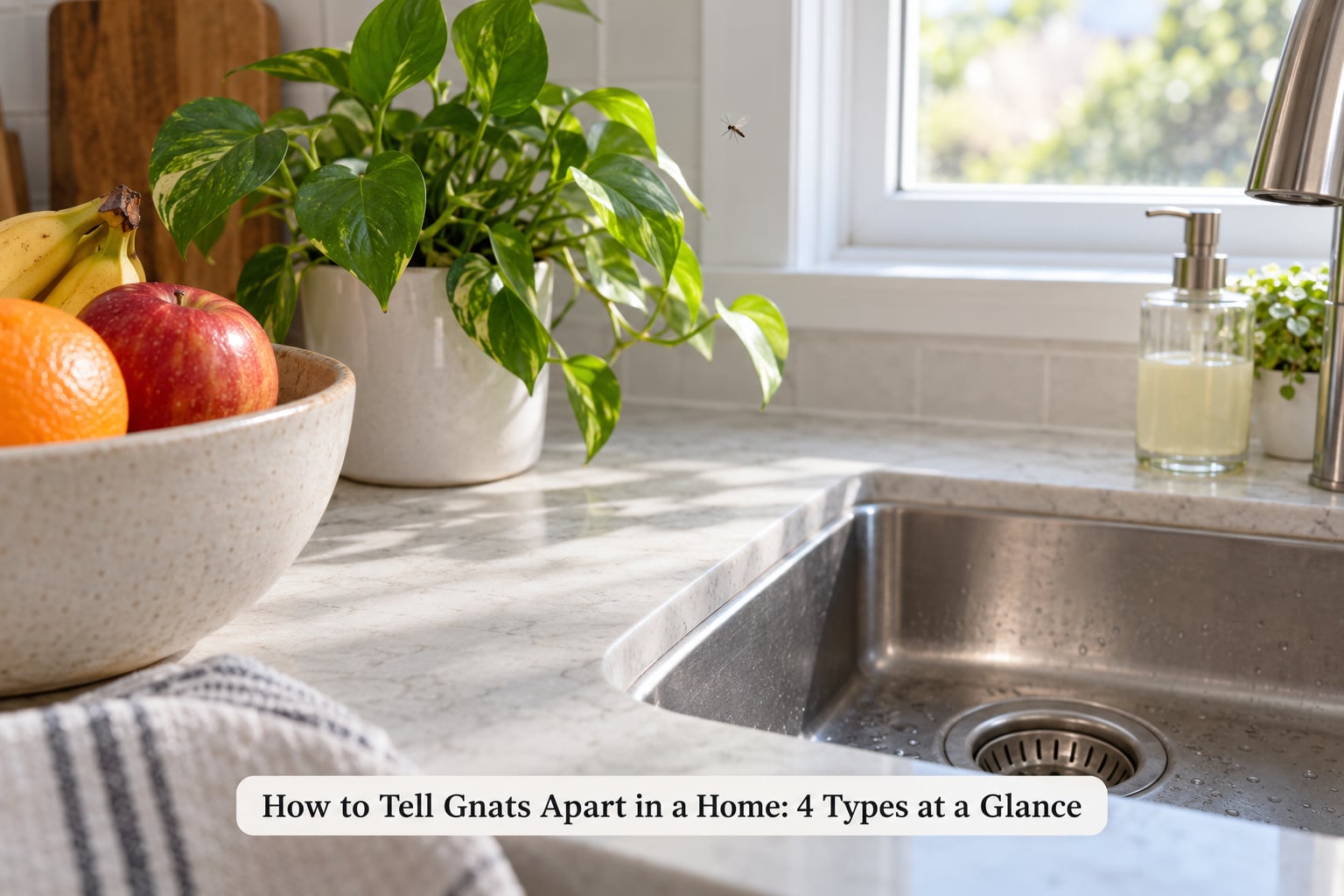
Most of the insects people call gnats are one of four indoor fliers, plus a fifth group that is not a gnat at all. Read across the row for your suspect and compare it against the others rather than the description in the photo.
| Type | Color | Body length | Wings | Eyes and antennae | Flight | Where you see it | Bites? |
|---|---|---|---|---|---|---|---|
| Fungus gnat (Bradysia spp.) | Dark grey to black, slender | About 1/8 inch (3 mm) | Clear, transparent, oval | Dark eyes, long thin threadlike antennae, long legs | Weak, hovering, zigzag or darting bursts | Houseplants, damp potting mix, propagate benches | No |
| Fruit fly (Drosophila melanogaster) | Tan, yellowish or amber, sometimes near-black | About 1/8 inch (3 mm) | Clear, broad, with visible veins | Distinct red eyes, short antennae | Fast, erratic darting that pauses suddenly | Fruit bowls, trash cans, garbage disposals, recycling | No |
| Drain fly or moth fly (Psychodidae) | Grey to black, covered in fine hairs | 1/8 to 1/4 inch (3 to 6 mm) | Fuzzy and moth-like, held flat or tented over the body | Long antennae, sometimes whip-like | Weak flutter, sudden jumps along surfaces | Sink, shower, floor and utility drains, humidifiers | No |
| Midge and mosquito | Variable, from grey to striped to black | Mosquito about 1/4 inch (6 mm) or more; biting midges smaller | Clear and narrow | Mosquitoes have a long proboscis under the head | Sustained hovering, then a fast direct dash to you | Near windows, doors, screens and outdoor wet areas | Mosquitoes and many midges do |
What Do the Most Common Indoor Gnats Look Like?
Fungus gnats are the trickiest because they read as “tiny mosquito.” The body is dark, narrow, and shiny, with legs held out well past the body so the insect looks leggy and slightly bent. Wings are clear and held out to the sides, not folded over the back.
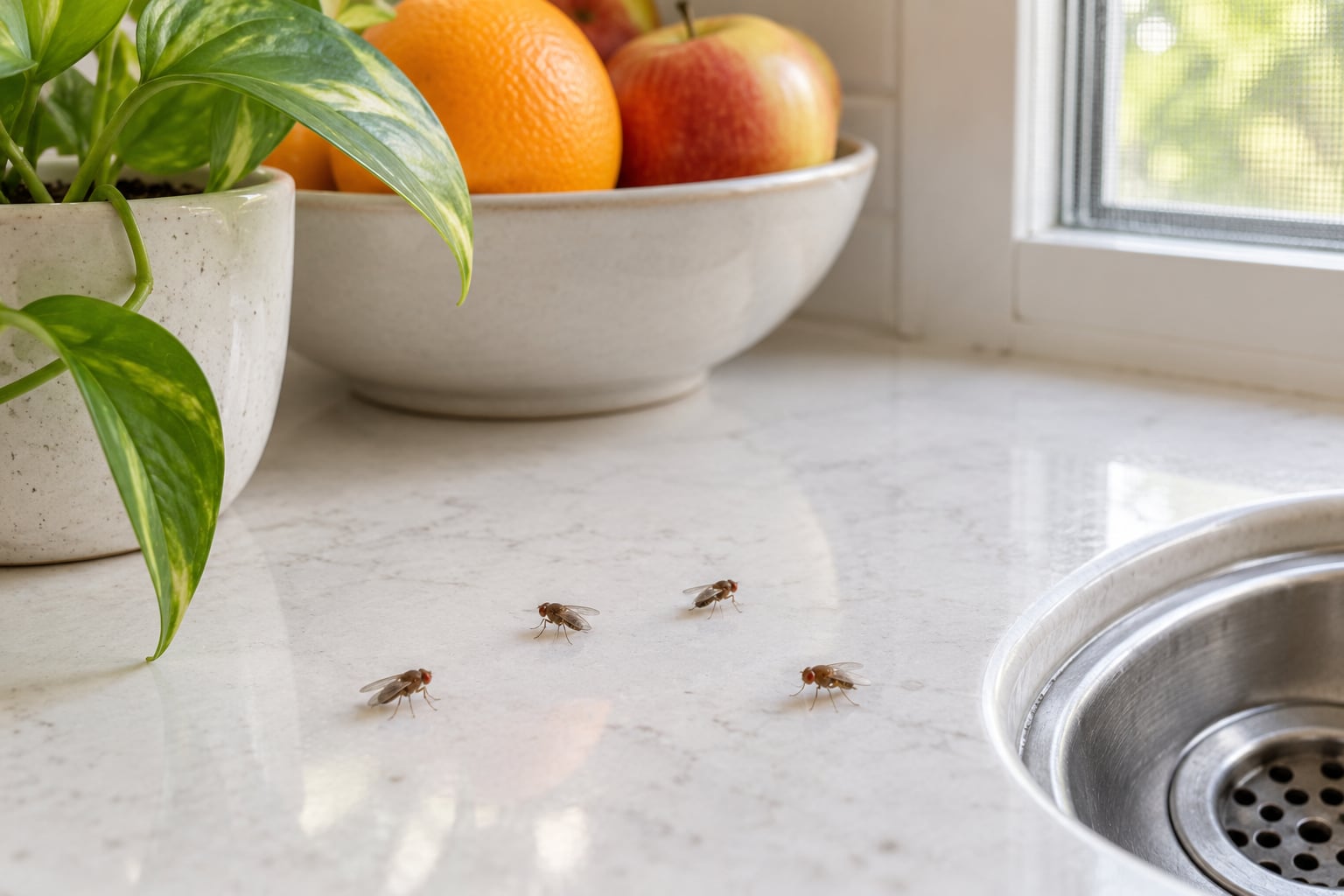
Fruit flies are shorter and rounder. The red eyes are the giveaway at almost any distance, and the body reads amber or tan rather than black. They hold their wings slightly back, and they move in bursts, hovering a moment in front of a peach before snapping away.
Drain flies look like a miniature moth that got in the water. Fine hairs on the body and wings make them look fuzzy, and they rest with those wings held flat or tented over the abdomen. They are weaker fliers than fruit flies and tend to shuffle along a wall or windowsill instead of flying straight.
The other marker most people miss is length relative to the room. A drain fly at 1/4 inch reads as big and obvious against a white sink. A fungus gnat at 1/8 inch against a dark countertop can look like a moving speck until the light catches its wings.
Where Are They Coming From?
Source is the most reliable signal you have, so trace backwards from where you see them. A fly that keeps reappearing in the same window is usually an outdoor breeder coming in, not something that lives in your walls.
Over the fruit bowl and along the counter
Fruit flies and vinegar flies breed in anything fermenting: overripe fruit, a compost-scummed compost bucket, a forgotten bottle of juice, a garbage disposal. Move the fruit out, take the trash out daily, and empty the compost before you empty the cabinet. Rinse the counter with hot water and a degreaser, since a thin film of sugar is enough to hold a population.
Around a houseplant or propagation tray
Fungus gnats lay eggs in damp potting mix. The tell is not the flying adult, which wanders, but the cloud that rises off the soil the moment you tap the pot or water it. Lift a finger’s worth of the topsoil and look for slender white legless larvae with a dark head, wriggling against the mix.
Over a sink, shower, or floor drain
Drain flies breed in the slimy biofilm that collects in pipes. Put a piece of clear tape over the drain, leave it for a day, and count the flies underneath. Or set a clear cup of water with a film on top directly over the drain; flies hatching in the biofilm below will rise to it.
At a window, sliding door, or patio door
Mosquitoes, biting midges, fungus gnats and harmless non-biting midges all drift indoors from outside. Screen repairs, a propped-open door, a gap under the slider, and standing water in a planter or birdbath nearby are the usual culprits. This is a year-round situation in warm climates and a spring-through-autumn one further north.
In a wet corner, crawlspace, or laundry room
Persistent drain flies in the same spot every day usually mean a plumbing issue rather than a dirty sink: a dry floor drain trap, a cracked cleanout, or a condensate or humidifier line that has biofilm in it.
Fungus Gnats vs Drain Flies
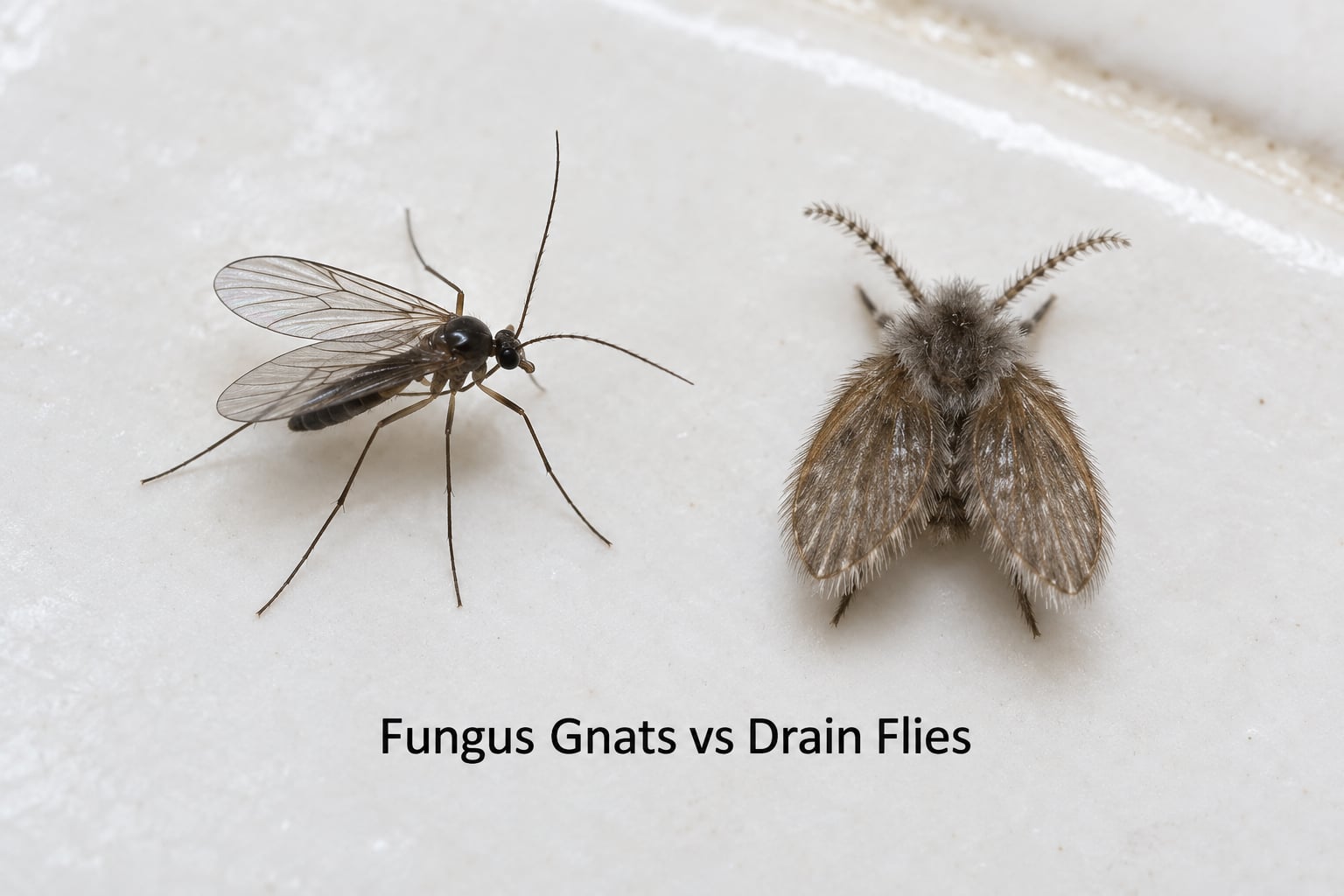
These two get mixed up constantly because both are small, dark, and weak fliers. The separation comes down to texture, antennae, and where they hang out.
| Marker | Fungus gnat | Drain fly |
|---|---|---|
| Body | Slender, shiny black, sharply mosquito-like | Stouter, grey to black, fuzzy with fine hairs |
| Wings | Clear, oval, held out from the body | Fuzzy, moth-like, held flat or tented over the back |
| Antennae | Long, thin, threadlike, drooping forward | Long and prominent, sometimes whips of a different color |
| Legs | Noticeably long for its size, held out | Shorter, closer to the body |
| Flight | Quick, jerky, mouse-like darting in a small area | Feeble fluttering, more of a hop and flutter |
| Where it sits | Clouds above soil, under leaves, on the pot rim | Flat on sink walls, tubs, tiles, window sills near water |
| Larvae | Translucent white, legless, black-headed, in soil | In the black film inside pipes and drain traps |
| Bites | None | None |
One useful field note from a pest control forum: drain flies have antennae you can see without a magnifier, and they rest with the wings covering the abdomen rather than standing proud of it. In practice, if the insect rests flat against a bathroom surface with its wings folded over its back, you are looking at a drain fly even if the light is poor.
A second test settles it. Block the suspected source. Cover the drain with tape or a dish, and if the cloud keeps coming from the drain rather than from the pot, it was a drain fly.
Fruit Flies, Fungus Gnats, and Drain Flies: Which One Is It?
Location beats color in almost every case, because a phone photo under a warm kitchen bulb makes every fly look amber. Start with the room and work outward.
If it is in the kitchen near food
You have fruit flies unless the insects are coming out of the drain itself, because fruit flies use sinks and disposals as breeding sites too. Red eyes and a fast darting hover confirm it.
If it is in the bathroom or laundry room
Fuzzy wings and a flat resting posture point to drain flies. If you never see them near a drain and only near a plant, you have fungus gnats instead.
If it is near a plant, a greenhouse, or a propagation bench
Fungus gnats. Adult fungus gnats rarely travel far from where they emerged, so a steady cloud around one pot is a strong signal. Tap the soil and watch for the upward scatter of tiny pale larvae.
If it is scattered through several rooms
Look for an entry point. Mosquitoes and midges drift in from outside, and fungus gnats travel in on infested potted soil or fresh plant material you brought home. Insects that only ever appear in one room are almost always local to a source in that room.
If the fly runs instead of flying
Phorid flies are the misidentification nobody expects. They are dark with prominent antennae, and instead of flying off when you approach, they run across the surface in short bursts, almost like a fast ant. They breed in decaying organic matter, wet pet bedding, and droppings, so they turn up in kitchens, garages and around houseplants that got their mix from composted material.
If nothing fits, it may be a sewer fly, a larger drain fly that shows up in large numbers when a floor drain trap has dried out or a sewer line is cracked. Counts in the dozens rather than ones and twos, coming from a floor or basement drain, are the reason to call a plumber instead of cleaning the sink.
Do Midges, Mosquitoes, and Gnats Look the Same?
They do not, and the difference that matters most is the mouthpart. Mosquitoes and many midges have a long proboscis projecting from the head, fungus gnats and fruit flies do not. A mosquito is also bigger, most often at least 1/4 inch, and it hums while it flies.
Non-biting midges are the ones people bring indoors after dark around lights and windows. They are smaller, mosquito-like, and harmless to people. Gall midges or aphid midges show up as swarming clouds around an outdoor tree or shrub, not inside, and they are not biting your plants; the distorted new growth is caused by the plant-feeding midge larvae inside the leaves, not by the adult swarm.
Adults of every one of these are fragile, but mosquitoes need a blood meal from a host to produce eggs, so only females bite. Midge bites show as small red raised welts that often cluster on exposed forearms, ankles and the back of the neck.
How to Identify a Gnat by Behavior and Location
Watch one insect for two minutes without moving toward it. Note where it holds still, where it is in the room, and what happens when you pass close.
- Run vs fly test. Sweep a hand toward it. A phorid fly runs. Fruit flies and drain flies take off, usually upward.
- Light response. Turn off the room lights for an hour and leave a single lamp or a flashlight beam on. Fungus gnats, drain flies, and midges accumulate in the beam; fruit flies mostly ignore it and stay near food.
- Sticky card position test. Place a yellow card near the pot, another near the fruit bowl, and one by the drain, then compare catches over 24 hours. Cards sit close to the breeding source, and the counts tell you where you are dealing with. Cards monitor; they do not treat.
- Soil inspection. Set a shallow dish of water on top of the potted soil for an hour, or press a piece of clear tape to the top inch of mix. Anything wriggling and legless in that soil is a fungus gnat larva.
- Drain test. Tape a clear cup of water over the drain for 24 hours, or seal the drain with tape and watch whether flies appear underneath. That confirms breeding rather than an attracted visitor.
Keep cards where children, pets, and open aquariums cannot reach them, and treat any description you write from memory as a starting point. A clear photo in daylight, shot close with one fly in frame, or a specimen in a sealed jar beats any written guess, including this one.
How to Control the Type of Gnat You Found
Fungus gnats: fix the moisture, then the larvae
Let the top inch or two of soil dry between waterings and stop standing water in saucers. Skim off and replace the top inch of mix with fresh potting media, discard the old mix rather than composting it indoors, and repot only roots that are already failing. Yellow cards tell you when the adults are gone; they will not touch anything in the soil.
For the larvae, two options get recommended by greenhouse and university extension programs: Bacillus thuringiensis subsp. israelensis (Bti) applied to the soil surface and watered in, or beneficial nematodes such as Steinernema feltiae. Both work on larvae and neither touches adult flies. Repeat on the label interval until a card set where it was placed earlier comes back empty.
Fruit flies: remove every fermenting surface
Take trash out every day rather than nightly. Empty the compost and the countertop compost keeper. Store fruit in the fridge, rinse containers before recycling, and scrub the garbage disposal with hot water and a degreaser while running it. Vacuum under the fridge and along the base of cabinets, where spilled juice dries unnoticed. Trap tests using a shallow dish of apple cider vinegar with a drop of dish soap over it are good for confirming activity.
Drain flies: clean the biofilm, not just the opening
Cover the drain, then give the pipe a long flush and scrub the grate. Enzyme or bacterial drain cleaners designed for biofilm work better on the film than bleach, and they need several nights to act. Running a disposal regularly keeps the trap wet and the line flushed, and a floor drain in a basement should be run or kept damp every month to hold its seal.
Midges and mosquitoes: block the entry
Repair screens, close the gap under sliding doors, and remove standing water from planters, birdbaths, buckets, and clogged gutters within a few days of a rain. If the flies are already inside, they usually leave on their own in a day or two once the entry point is closed. Any bite relief product belongs to the bite chapter, not this one.
When to bring in a professional
Call a plumber, not an exterminator, if flies keep coming from a floor drain, basement drain, or laundry drain despite cleaning, if you see a lot of them at once, or if a drain near a toilet keeps running dry. A plumber is treating the cause; a technician spraying adults over a broken trap will not solve it.
Two myths worth dropping, since both cost people money. First, pouring bleach down a drain kills the adults it touches and does nothing to the film that feeds the next generation, and mixing bleach with ammonia or acidic cleaners produces toxic gas. Second, a sticky trap is a diagnostic tool, not a treatment; the catch you count tells you where the source is, and that is all it does.
Finally, a description is not an identification. If the source is unclear after a few days of looking, take a sharp daylight photo of one resting fly and note which room, which surface, and whether the soil nearby was wet. That single picture resolves almost everything this guide describes.
Which Type of Gnat Is Most Likely in Your Home?
Match the situation you are actually in rather than the description online.
- You own houseplants and see them around the pots: fungus gnats. Check the soil for larvae and fix your watering rhythm.
- They hang near a sink, shower, or floor drain and fuzz up against the tile: drain flies. Find the pipe, then check whether the trap seal is intact.
- They gather around fruit, trash, or a recycling bin: fruit flies. Work backward to every fermenting surface in the kitchen.
- They appear at an open window or on a wet patio and are near your skin: mosquitoes or biting midges. Nothing you do to the drains or the pots will touch them.
- They run instead of flying and have long visible antennae: phorid flies. Look at damp compost, pet bedding, and pet waste.
- They arrive in numbers from a basement drain: sewer flies. That is a plumbing repair.
Two of these types are common indoors year-round, while mosquito and midge activity follows the outdoor season and the warmth in your neighborhood. In a warm climate you may see all five at once.
Frequently Asked Questions
What are the tiny flying insects in my house?
They are almost always one of four small fliers: fungus gnats near houseplant soil, fruit flies near fruit and trash, drain flies near sink and floor drains, or mosquitoes and midges at windows. Color and wing shape narrow it down, but where you keep seeing them decides it. Tap overwatered soil for a rising cloud of adults, or seal a drain with tape and check underneath the next day.
Are fungus gnats the same as drain flies?
No. Fungus gnats are slender, dark, and sharply mosquito-like, with clear wings held out from the body and long thin legs. Drain flies are stouter and fuzzy, with moth-like wings held flat or tented over the abdomen and visible antennae. The simplest check is location: one hovers above damp potting mix, the other rests flat on bathroom surfaces near water.
Do fungus gnats bite people?
No. Fungus gnats and their larvae feed on fungi and decaying organic matter in soil, not on blood, and they have no piercing mouthpart. The same goes for fruit flies and drain flies. If you are being bitten at night or outside, you are dealing with a mosquito or a biting midge instead, and those are the ones to treat for bite relief.
Why do I see gnats coming from my sink drain?
Because a film of organic sludge inside the pipe is feeding larvae, and fruit flies use drains as well as drain flies do. Seal the drain with tape or cover it with a clear cup of water for a day. Flies hatching underneath confirm breeding there. A long flush and a scrub of the grate help, but persistent flies from the same drain usually mean a plumbing issue worth a plumber’s call.
How do I get rid of gnats in houseplant soil?
Start by cutting moisture, since fungus gnat larvae live in damp mix. Let the top inch or two dry between waterings, empty saucers, and replace the top inch of soil with fresh potting media. Then treat the larvae with Bti or beneficial nematodes according to the label and repeat until a sticky card placed in the same spot catches nothing. Avoid flooding the pot to drown them out, which damages roots.
Can small flies in the house be mosquitoes or midges?
They can. Mosquitoes are larger, roughly a quarter inch or more, and have a long proboscis projecting from the head, plus a hum in flight. Biting midges are much smaller but leave small red raised welts, often clustered on forearms and ankles. Fungus gnats, fruit flies, and drain flies have no piercing mouthpart and never bite, so an itch nearby points to a different insect entirely.
Conclusion
Check one thing first: where the insects keep showing up. Match that room to a source, compare the body and wings against the table above, and then look for larvae where they live, in damp mix, in fermenting food, or in the biofilm inside a drain.
Treating the source is what works. Swatting adults buys you a quiet afternoon, and the adults come back because eggs and larvae never saw it. Get one clear photo of a resting fly in daylight before you buy anything, and if the source stays unclear after that, the plumbing or an extension service can take it from here.