Lawn grubs are the cream-white, C-shaped larvae of scarab beetles — Japanese beetles, masked chafers, June beetles — that feed on grass roots just below the soil surface. To learn how to identify grubs in a lawn, cut a 12-inch square of sod about 2 to 3 inches deep at the edge of a brown patch, lift it, and count the larvae underneath. One to three per square foot is normal. Ten or more is a problem.
That five-minute test is the whole diagnosis. Yellow grass on its own proves nothing, because drought, heat, compacted soil and fungal disease all look similar from above. A larva in your hand is proof.
Below is the inspection sequence, what a real grub looks like, which soil larvae get mistaken for grubs, and what your count actually means.
What You Need

You need a spade, shovel or garden trowel, a pair of work gloves, and a flat tray or a bucket to sift soil onto. A hand lens helps with the close look later. A ruler or tape measure keeps your sample honest, since every threshold on this page is stated per square foot.
Timing matters more than gear. Inspect when the soil is slightly moist, not soaked and not bone dry, because a dry sample crumbles and a saturated one turns to mud on the blade. Early morning or late evening in late summer and early fall is when the larvae are closest to the surface and easiest to find.
A watering can is worth having on hand if the lawn is dry. Give the spot a drink, wait 20 minutes, then dig. Nothing else is required, and no special equipment is usually necessary for a reliable count.
Step-by-Step: How to Identify Grubs in a Lawn
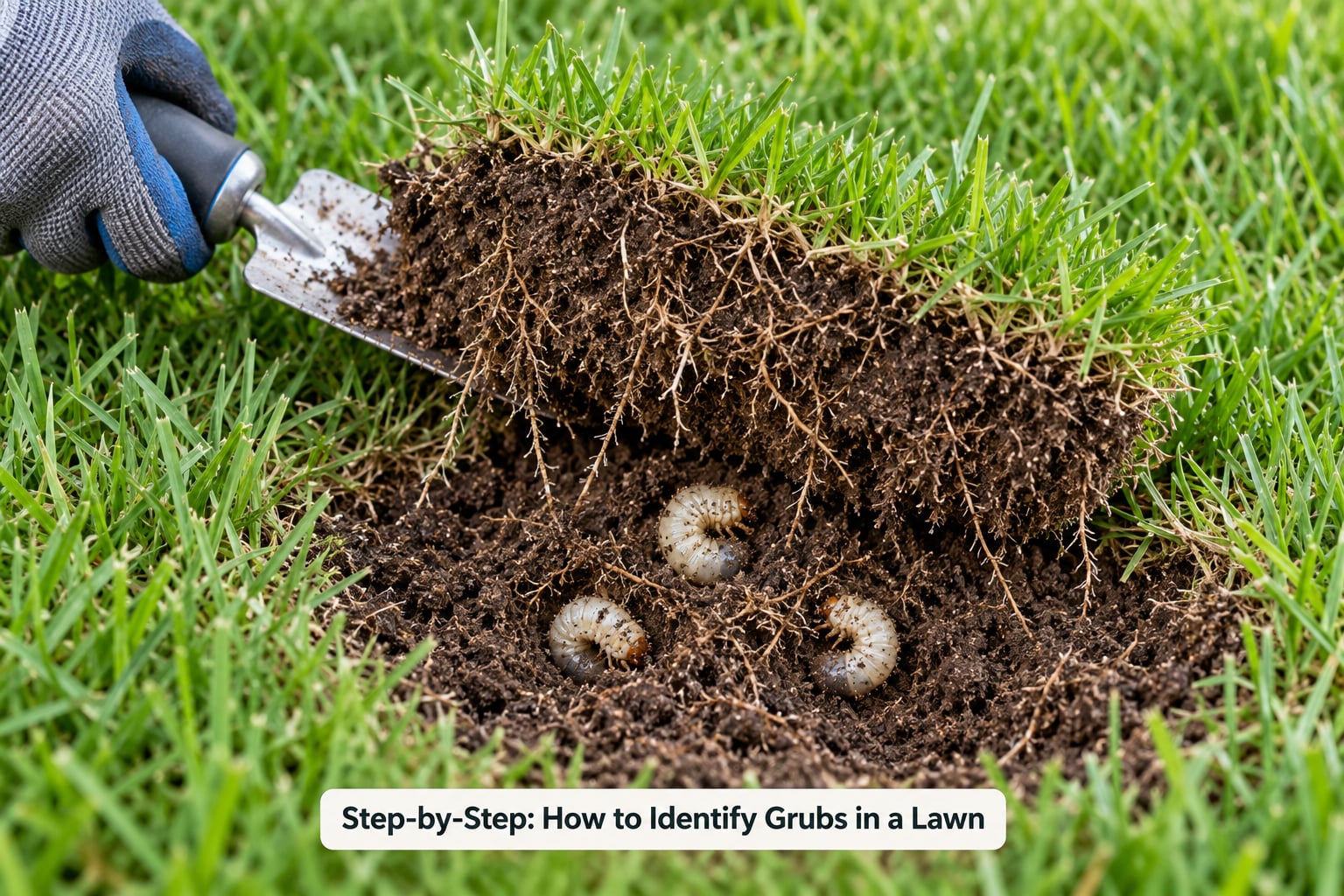
- Walk the lawn and mark the spots. Look for irregular brown or yellow patches, turf that feels spongy underfoot, and areas that wilt in the heat of the day but never recover. Pick two or three representative spots, including one mildly affected area, because the worst patch is rarely representative.
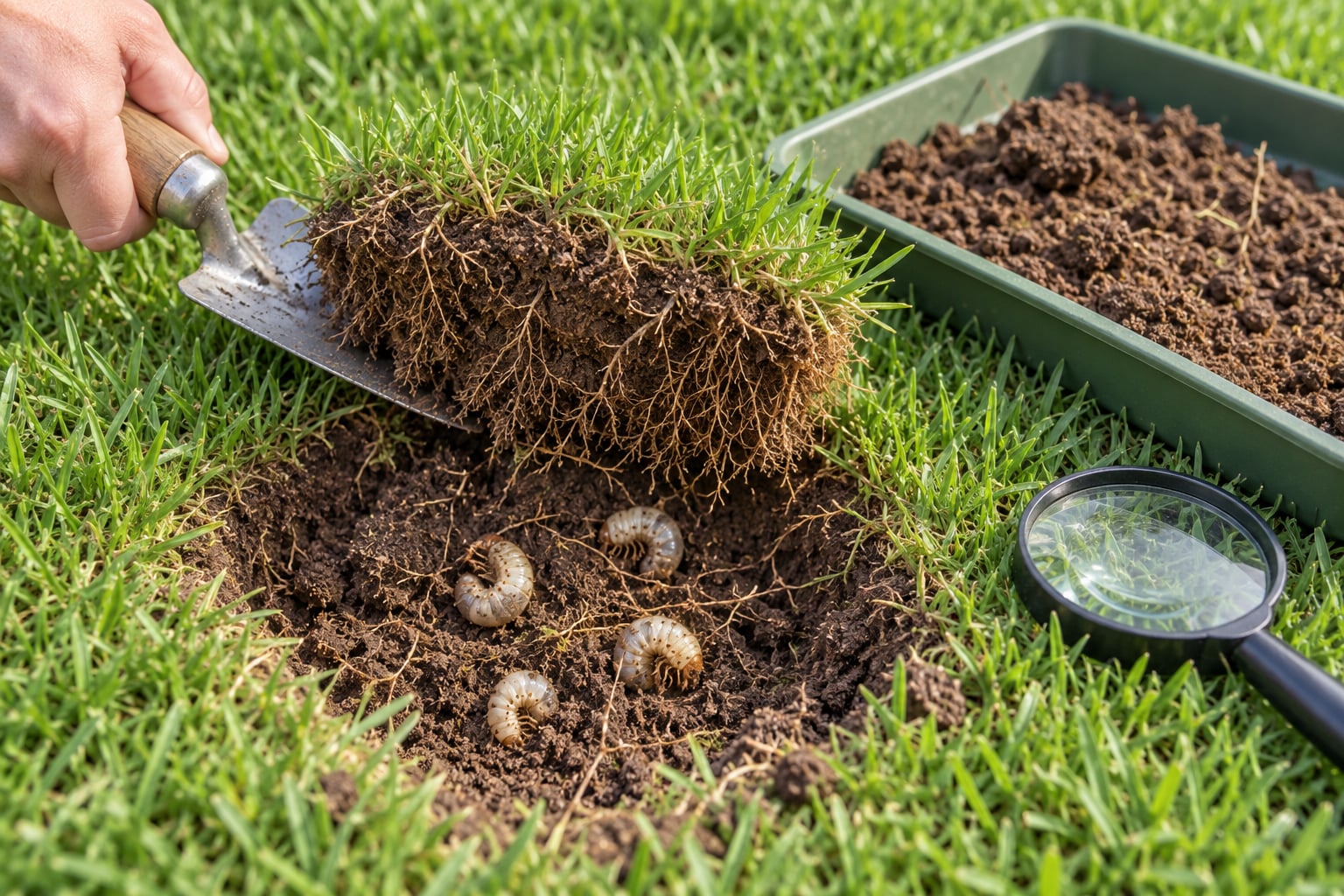
- Cut three sides of a 12-inch square. Use the spade to score the sod into a square foot on three sides, cutting roughly 2 to 3 inches deep. Leave the fourth side uncut so the sample stays attached and lifts as one piece.
- Lift the sod. Peel the square back like a flap of carpet. If the roots are intact and full of fine white fibers, that is a healthy piece of turf. If the roots are cut short, brown, or nearly absent, something has been eating them.
- Sift and break apart the soil. Break the soil clumps open against the tray and pick through the top 2 to 3 inches by hand. Grubs react to disturbance and often wriggle out of a broken clod on their own.
- Count every larva. Count the C-shaped larvae in that one square foot of soil, then check the roots on the underside of the sod piece. Multiply by your sample size later if you cut more than one square.
- Put the sod back. Lay the flap down, water it in, and close the seams. A stressed lawn with severed roots cannot tap soil moisture on its own, so keep it damp for about a month. Discarding the sod is optional; see the recovery section below.
How to identify grubs in a lawn by checking the roots
The root tell is the fastest field signal. Grub feeding shears the anchoring roots off near the crown, so a bad patch of turf lifts with almost no resistance. Experienced users describe the grass layer coming up like a bad toupee.
Turn the lifted sod over and look at the underside. Healthy grass roots are a dense white mat, fine and fibrous, running the full depth of the slice. Grub-damaged roots are short stubs, sometimes only an inch or two long, and the crown may lift out with almost nothing attached.
A ten-second pre-dig screen: tug a tuft in the suspect area. If it releases and the soil beneath is hollow-feeling and soft, dig. If the tuft resists and tears at the blade instead, the roots are still holding on and you are probably looking at a moisture problem.
How to identify grubs in a lawn by examining the damage
Four signs of grubs in lawn damage show up above ground. None of them proves anything on its own.
- Discolored patches: irregular brown or yellow areas with soft edges, usually appearing in late summer when the larvae are largest and the roots can no longer carry water.
- Loose turf: grass that peels up from the soil like a piece of carpet, or a spongy, bouncy feel underfoot when the soil has lost its root anchoring.
- Wilting that irrigation does not fix: the blades droop in heat and stay droopy after watering, because severed roots cannot reach deeper moisture.
- Animal digging: raccoons, skunks, moles and crows tearing at the turf at night. Treat this as a secondary signal, never a conclusion, because those animals eat grubs and earthworms alike.
The small round holes people often blame on grubs are made by the birds and mammals feeding on them, not by the larvae themselves.
Check soil moisture before you blame insects. Push a finger 4 inches down. If it comes up cool and damp, the brown patch has another explanation. Drought damage fades after irrigation or rainfall and sits in a pattern that follows your sprinkler pattern or the slope. Fungal brown patch shows a dark ring or a smoky halo at the edge of the lesion, and it spreads outward in days. Compaction and shade keep turf thin in the same spot year after year.
How to confirm a larva is a grub
Run through this checklist before you decide anything.
- Body shape: curled into a tight C, like a comma or a letter C.
- Color: cream or white body with a distinctly darker brown head capsule.
- Legs: three short pairs clustered near the head. No legs near the tail end.
- Size: about a quarter inch to an inch long when fully grown, roughly the size of a small shrimp.
- Texture: soft-bodied and slightly translucent, with the darker gut line often visible through the skin.
- Location: found in the top 2 to 3 inches of soil, attached to or feeding on grass roots.
Grubs are beetle larvae, not caterpillars and not adult insects. They feed on roots underground for most of their life, then pupate in a soil cell and emerge as a scarab beetle in summer. In fall they work deeper as the soil cools, and in cold regions they overwinter below the frost line and are effectively out of reach of a surface count.
If you want to go to species level, examine the hairs on the grub’s rear underside. A pattern of hairs arranged in a V shape points to certain species, and parallel rows or a different arrangement point to others. Head position and the way the legs are held help as well. Cornell University’s Grub ID key is the standard reference for this.
Is It Really a Grub? Look-Alike Soil Larvae
This is the single most common misdiagnosis, and it shows up in lawn forums constantly, usually as a photo of something dug up with the question “is this a grub?” In r/lawncare and r/LawnAnswers, the most frequent correction is that the thing in the photo is a maggot, not a beetle larva.
| Larva | Shape | Legs | Head | Where you find it |
|---|---|---|---|---|
| White grub | Tight C-curve | Three pairs near the head | Brown head capsule | Top 2-3 inches, on grass roots |
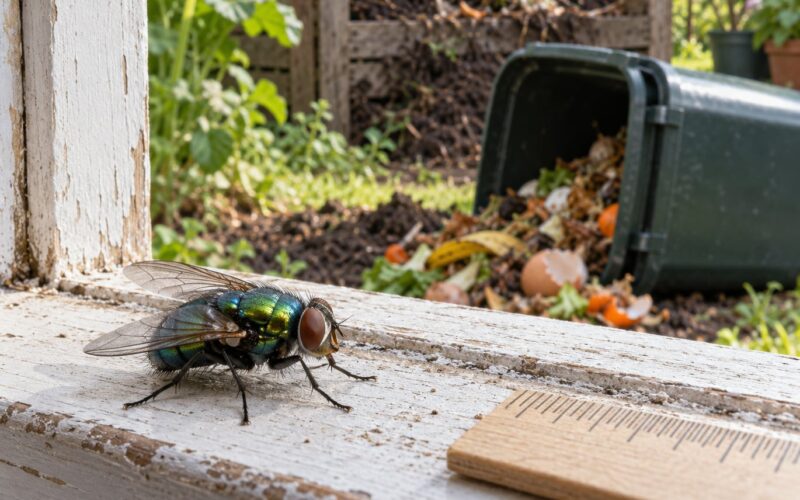
| Maggot | Tapered, legless, wedge-shaped | None | No distinct head capsule | Under manure, compost, decaying plant matter |
| Cutworm | C-curve, thicker and smoother | None or tiny prolegs | No distinct capsule | At the soil surface, cutting off seedlings at night |
| Wireworm | Straight, hard, segmented like a wire | None | No distinct capsule | Deep in the soil profile, often 3-6 inches |
| Billbug larva | C-curve, white with a tan to brown head | None | Head blends in, no browner capsule | Near corn, sorghum and other grasses |
| Root maggot | Slender, legless, translucent | None | No distinct capsule | On vegetable and ornamental roots |
Two rules settle most cases. If there are no legs and no brown head capsule, it is not a white grub. And billbug larvae, the closest look-alike, have no distinctly darker head capsule the way a white grub does, which is why they cause so much debate in lawn forums.
Crickets that jump when you walk across dead grass are a different thing entirely, and they get mislabeled constantly in post titles.
How Many Grubs Per Square Foot Is Too Many?
Extension thresholds vary by source, which is why online advice sounds contradictory. Put side by side, they are consistent.
| Grubs per square foot | What it means | What to do |
|---|---|---|
| Under 5 | Normal background population. Healthy turf tolerates this without visible damage. | No treatment. Mow and water normally. |
| 5 to 9 | Worth watching. Damage is likely next season if the count climbs. | Monitor, hold off on summer irrigation, and keep the turf vigorous. |
| 10 or more | Damage threshold for bluegrass and perennial ryegrass lawns. | Treatment is warranted. |
| 12 to 14 | Tall fescue tolerates a higher count than other species. | Treat if the count is confirmed across several samples. |
| 18 to 20 | Level commonly cited for Asiatic garden beetle grubs. | Treatment warranted at this level. |
Ohio State and Penn State Extension are among the sources behind these ranges, and they all agree on the shape of the answer: low counts need nothing, high counts need action, and the middle band is a decision point rather than a verdict.
One or two grubs in the whole lawn means nothing at all. People post about finding two and asking whether to reseed the yard. Take more samples before you spend a dollar or a weekend.
When Grubs Are Hardest to Find
Timing explains why people dig in the wrong place or dig too shallow and conclude their lawn is clean.
| Season | Where the larvae are | Scouting notes |
|---|---|---|
| Late spring to early summer | Newly hatched, tiny, close to the roots | Hard to see and often overlooked |
| Mid to late summer | Feeding actively in the top 2-3 inches | Best window for scouting; damage appears |
| Early fall | Largest larvae, still near the surface | Curative treatments target this window |
| Winter in cold regions | Below the frost line, deeper in the profile | A surface count returns near zero even when present |
This is also why treatment timing splits the year in two. Preventive products are applied in mid-June through mid-July and target the eggs and young larvae. Curative products work on larger, actively feeding larvae from about mid-August through September, and many stop working once the soil gets cold.
Is September too late? It is late, but it is usually still inside the curative window. Past that, you are relying on a preventive application the following season, and beneficial nematodes need soil temperatures that most regions do not reach until spring.
Does Dawn Dish Soap Kill Grubs?
No. Dish soap and soapy-water flushes come up constantly in lawn forums and they do not kill grubs. Grubs live in the root zone, several inches down, and a surface pour never reaches them. A soapy flush mostly kills earthworms and beneficial surface organisms instead.
The remedy that does work is the one in the next section: a confirmed count followed by a treatment timed to the life cycle. Beneficial nematodes applied in soil that is warm, moist, and after rainfall, are the biological option, though results vary with timing. Milky spore disease targets Japanese beetle grubs specifically, works on a multi-year timeline, and is not a quick fix for a lawn that already looks bad.
Common Mistakes
Diagnosing from yellow grass alone. Fix: do the moisture check first, then the pull test. Dig a square before you decide anything. Brown patch and drought stress produce identical color change and neither has C-shaped larvae at the roots.
Inspecting one dry patch. Fix: sample at least three locations, including a spot that looks healthy. One sample gives you a number, not a diagnosis, and grubs cluster unevenly across a lawn.
Digging too shallow. Fix: cut 2 to 3 inches. Most people stop at the surface layer, find nothing, and wrongly clear their lawn.
Assuming every soil larva is a grub. Fix: check for the C-curve, the three leg pairs, and the brown head capsule before counting anything. A maggot has no legs and no head capsule, and treating for grubs when you have maggots wastes the application.
Treating without confirming the cause. Fix: count first, then treat. A lawn-service professional will tell you the same thing, and people running a “try the shovel test before grub killer” check in forums are mostly frustrated by treatments applied to lawns that never had a problem.
Fleeing the pulled-up turf. Fix: lay it back down and water it. Peeled turf that is still moist will re-root in most cases; turf left out on the driveway will not.
A few habits make the whole process faster. Inspect the same lawn each year on roughly the same date so your counts are comparable. Mark your sample spots, because grubs move deeper in hot weather and shallower in fall. Water lightly and cut grass high, since deep roots and thicker turf make the lawn tolerate a low count without visible loss. Keep thatch under control and avoid over-irrigating in July and August, since deep moisture keeps young larvae near the surface where they do the most damage.
Frequently Asked Questions
What do grubs look like?
Lawn grubs are C-shaped larvae, cream or white with a darker brown head capsule and three short pairs of legs clustered near the head. Fully grown larvae reach about an inch long, roughly the size of a small shrimp, and feel soft-bodied. If what you dug up has no legs and no brown head, it is a maggot or another larva, not a grub.
Where do grubs live in a lawn?
White grubs feed in the top 2 to 3 inches of soil, right where grass roots are densest. In late summer and early fall they stay close to the surface and are easiest to count. In cold regions they move below the frost line to overwinter, which is why a late-season check can return zero even when the lawn still has a population.
Do a few grubs in my lawn actually cause damage?
Usually not. One to three grubs per square foot is a normal background population, and healthy turf tolerates that without thinning. Damage generally appears around ten or more per square foot in bluegrass and perennial ryegrass, with tall fescue tolerating closer to 12 to 14. Finding a single larva is not a reason to reseed.
How do I tell a grub from a maggot?
A white grub curls into a tight C and has three pairs of legs plus a distinctly brown head capsule. A maggot is legless, tapers to a pointed end, and has no head capsule at all. Cutworms curve too but lack legs and the brown head. Wireworms are straight, hard, and segmented. Check for legs and a brown head before treating.
Will my lawn recover from grub damage?
Often yes, if the roots were only partially eaten. Lay the peeled sod back down, water it daily for about a month so the severed roots can reach soil moisture, and keep the area seeded or sodded. Rotted, compacted soil is different: that needs topsoil, aeration, and re-seeding. Severed crowns that never re-root are the real losses.
Does Dawn dish soap really kill grubs?
No. Dish soap and soapy-water flushes stay on the soil surface, while grubs feed several inches down in the root zone. A flush does little to the larvae and can harm earthworms and other beneficial soil organisms. Count the grubs first, then choose a treatment timed to the life cycle, ideally a preventive application in June or July or a curative one in late August and September.
Conclusion
Start by sampling. Cut a 12-inch square 2 to 3 inches deep at the edge of a brown patch, lift it, count the C-shaped larvae on the underside of the sod and in the soil below, and repeat in two more spots.
Then confirm the identification. Legs near the head, a brown head capsule, and a tight C-curve mean a white grub. No legs and no brown head means you have something else entirely. Verify before you treat, keep the peeled turf watered so it re-roots, and use the count to decide whether you need to act at all.