June bug identification starts with one thing: knowing which stage of the insect you are looking at. The adult beetle bores into foliage but rarely harms a lawn in any visible way. The larva, a fat white C-shaped grub with a brown head, chews grass roots for one to three years underground and that is what turns turf brown and loose.
So the short answer to june bug identification and lawn damage is this: the beetle at your porch light in June is not eating your lawn, but its offspring probably are, right below the surface. This guide covers how to recognize the adult, the grub and the eggs, what the damage actually looks like, how to confirm it in five minutes with a spade, and when treatment is worth doing.
Table of Contents
- June Bug Identification and Lawn Damage: What to Look For
- How to Identify a June Bug
- June Bug Identification for Larvae and Eggs
- What Does June Bug Lawn Damage Look Like?
- How to Confirm June Bugs Are Causing the Damage
- How to Control June Bugs Without Damaging Your Lawn
- How to Repair Lawn Damage from June Bugs
- June Bug Identification and Lawn Damage: Frequently Asked Questions
- What to Do First
June Bug Identification and Lawn Damage: What to Look For
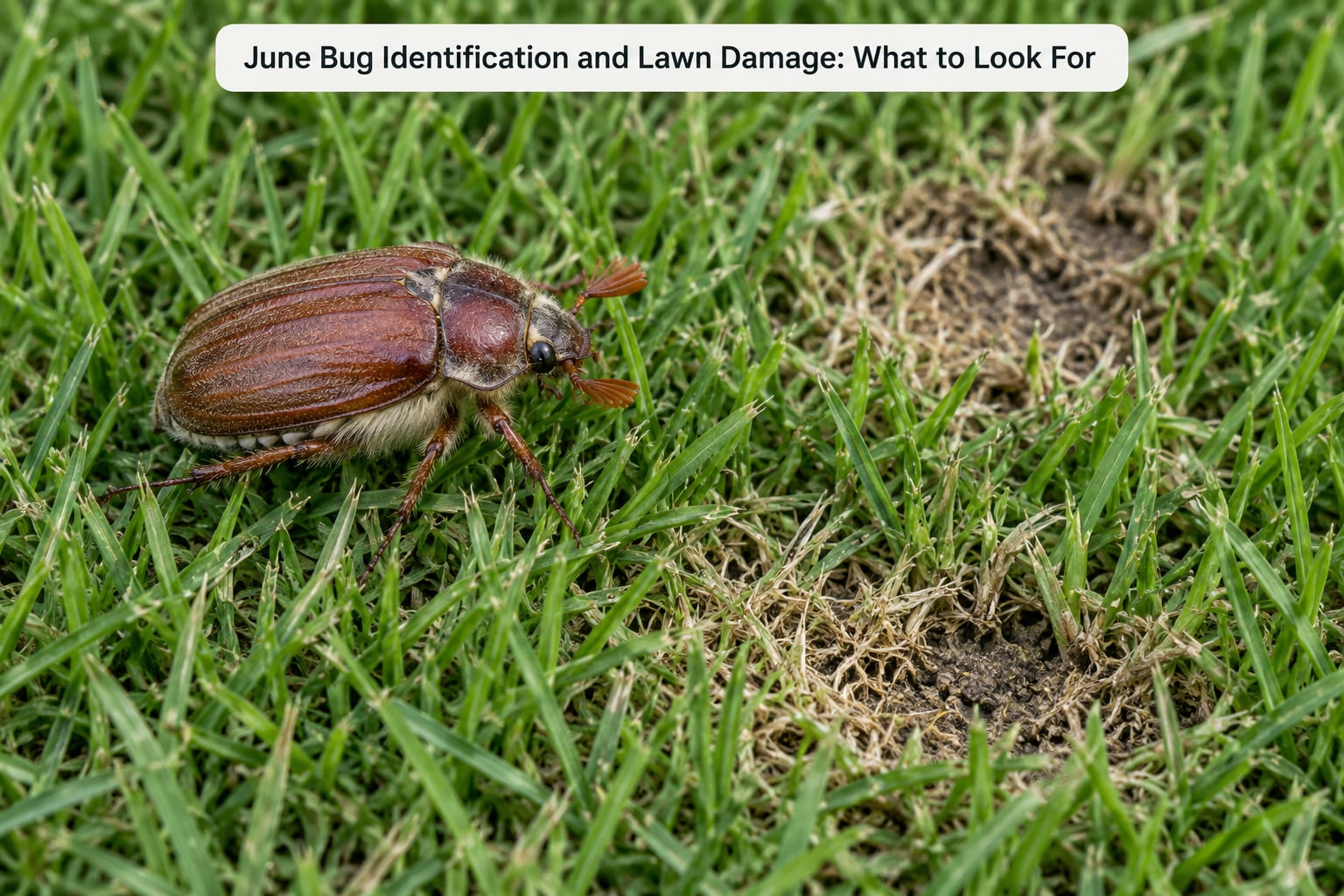
A June bug is a large scarab beetle in the genus Phyllophaga, family Scarabaeidae, and the name is a nickname rather than a species. Most people who say June bug also mean May beetles, because the same insects fly from late April through August depending on latitude.
There are four things worth learning separately, and mixing them up is the most common reason people treat a lawn that does not need it.
- The adult. A clumsy, slow-flying brown beetle roughly three-quarters of an inch long, drawn to porch lights on warm nights.
- The larva. A white, soft-bodied, C-shaped grub with a tan-to-brown head capsule and three pairs of legs near the front. This is the stage that eats roots.
- The egg. Oval, pearly white and about the size of a grain of rice, laid in clusters in soil that is moist and freshly worked.
- The damage pattern. Irregular brown patches that do not green up after watering, turf that feels spongy underfoot and lifts like a carpet when pulled at the edge.
One point that gets buried on a lot of lawn pages: the adult’s damage is real but cosmetic. Skeletonized leaves on roses, corn and small fruit trees can happen in a heavy flight year, and lawn grass is usually too coarse and too low for most homeowners to notice anything.
How to Identify a June Bug
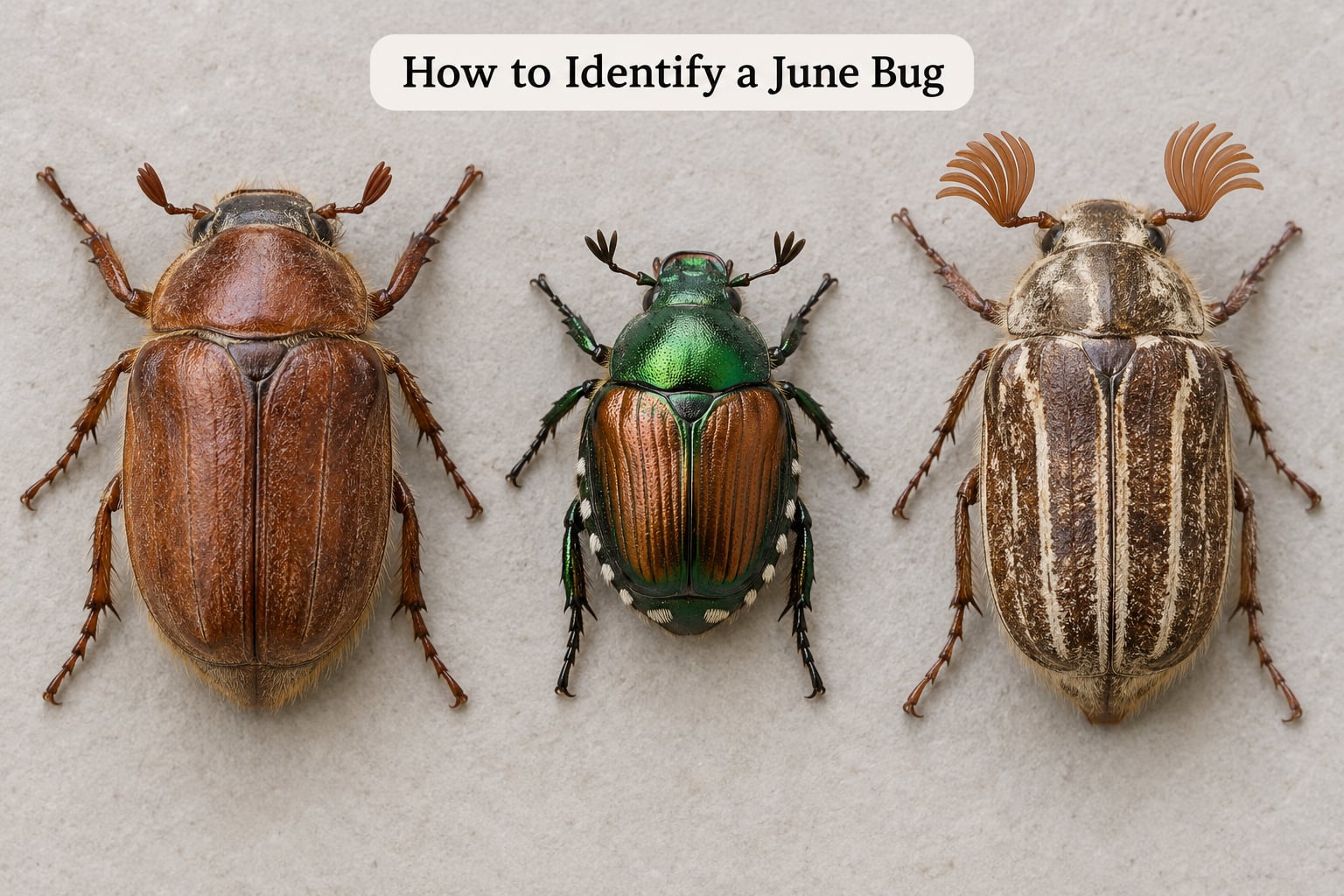
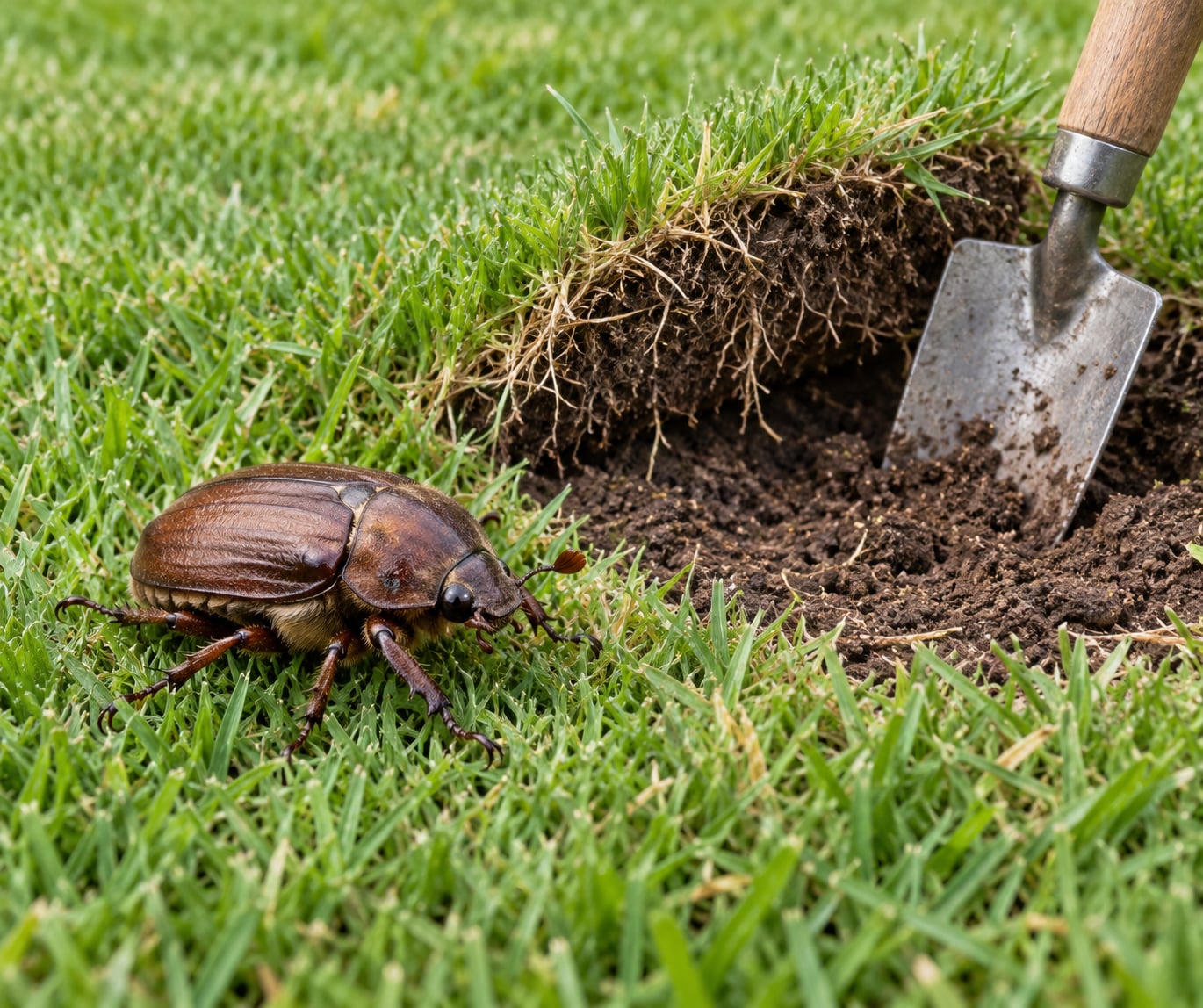
An adult June bug is easiest to recognize by its overall impression rather than any single marking: a bulky, oval, hard-shelled beetle in plain reddish-brown to dark brown, with clubbed antennae and a body that tapers slightly toward the rear.
Adults run about three-quarters of an inch to an inch long. They are nocturnal, they fly awkwardly with legs extended, and they bump into porch lights and window screens instead of steering around them. Some pages describe them as sticky, which is simply wrong. Nothing about them is slimy, and that myth has confused a lot of people into thinking they found something else.
The look-alikes table below covers the four beetles people mix up with June bugs most often.
| Beetle | Size | Distinguishing marks | Peak flight | Lawn damage from adult |
|---|---|---|---|---|
| June bug, Phyllophaga | 0.75 to 1 inch | Plain oval brown shell, no stripes or spots, clubbed antennae | Late April to August | Negligible |
| Green June beetle, Cotinis nitida | 0.75 to 1 inch | Shiny metallic green, smooth oval back, white markings on the sides | June to August | Negligible |
| Japanese beetle, Popillia japonica | about 0.5 inch | Metallic green head and thorax, copper wing covers, five white tufts along each side | Late May to August | Severe skeletonizing on roses, grapes and roses-family plants |
| European chafer, Amphimallon majale | about 0.5 inch | Paler tan with a dark head, faint darker markings, very hairy underside | Late June onward | Negligible |
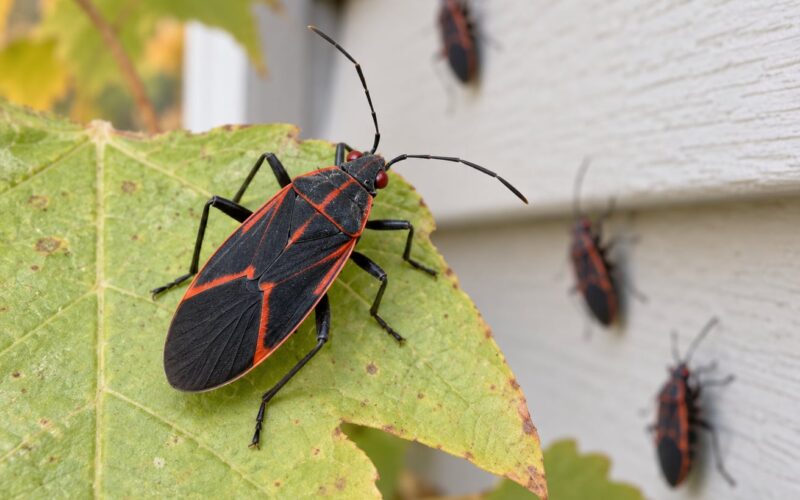
The easiest field shortcut: if it is big and plain brown, it is probably a June bug. If it is half the size with copper wing covers and white tufts down the sides, it is a Japanese beetle, and its adult feeding is a genuine problem for ornamentals.
Two more comparisons worth knowing. Click beetles are narrow, elongate and shiny black or brown, with a distinctive click when they flip onto their back. Cicada killers are large wasps, two or three times the length of a June bug, with smoky wings and a narrow waist. Neither one chews grass roots.
June Bug Identification for Larvae and Eggs
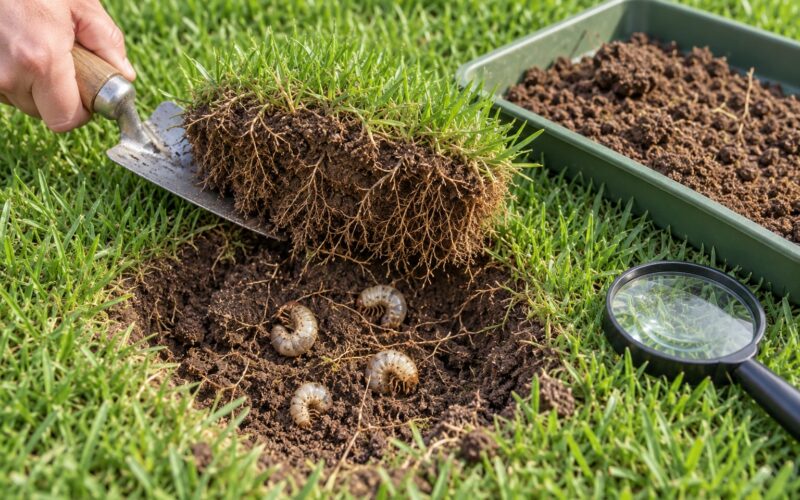
June bug grubs are white to cream, distinctly C-shaped, and reach roughly an inch and a half to two inches long when fully grown, larger than Japanese beetle or European chafer grubs. The head capsule is tan to reddish-brown, the body is soft and slightly translucent, and three pairs of legs sit right behind the head.
You will find them in the top few inches of soil, curled against a chunk of grass root or a clod of earth. In the middle of summer the small ones sit close to the surface, which is exactly when they are easiest to find and easiest to control. Later in the season they drop deeper, below the frost line, to overwinter.
Eggs are far harder to locate. Females bury them in groups in moist, recently cultivated soil, which is why new sod and freshly worked beds sometimes get hit harder than an established lawn.
Not every white worm in the lawn is a grub. Cutworms are gray-brown, thicker in the middle, and usually curled in a tight C as well, but they have no brown head capsule and they cut stems at the soil surface rather than eating roots. Armyworm larvae have clear stripes and a distinctive upside-down question mark on the head. Grubs are the ones you find wrapped around roots.
What Does June Bug Lawn Damage Look Like?
Grub damage is root damage, so the symptoms look like drought even when the soil is wet. Once the roots are severed, the grass cannot pull water up no matter how much you irrigate, and the patch keeps failing to recover.
The checklist, in rough order of how often you will see it:
- Irregular brown patches that stay brown through watering and through a cool week.
- Turf that feels spongy or hollow underfoot when you walk across it.
- Sod that peels back like a wet carpet at the edge of the damaged area.
- Ragged, chewed-off roots when you lift a square of turf.
- Thinning density and yellowing that spreads outward as the grubs feed wider.
- Oversized holes in low areas where animals have dug for grubs.
- Small plants, daylilies and shrubs in the same bed wilting without any wilt pattern.
On lawns, that last point is worth separating out because it is usually downplayed. Phyllophaga grubs chew more than grass. They will strip the roots from young shrubs, rose canes and vegetable transplants, and a newly planted tree that wilts in July may have had its entire root ball chewed through.
The single most misread symptom is raccoon and skunk digging. Raccoons tear up turf in ragged, meter-wide patches, and skunks do the same on a smaller scale. That damage is bigger than what the grubs did. It is a signal that grubs were present, though, which makes it useful evidence rather than a separate problem.
How to Confirm June Bugs Are Causing the Damage
Confirm grub damage with a spade test before you spend anything. It takes five minutes and settles the diagnosis faster than any other method.
- Walk to the outer edge of the brown patch, where damaged turf meets healthy turf.
- Cut out a one-square-foot section, about 30 cm by 30 cm, and lift it up like a flap.
- Break the clod apart with your hands and count the grubs against the underside of the sod and in the soil.
- Repeat in two or three more spots around the patch, including one in apparently healthy turf nearby.
Some people use a cut-off soda can as a 12 cm diameter cylinder for the same purpose. It works fine and is quicker in compacted soil, since you are pushing a sharp edge instead of levering with a spade.
Count results mean something specific. The threshold most lawn professionals use, and the number repeated across lawn forums, is about five to ten grubs per square foot. Sample at the edge of the damage, not in the middle, because the middle is often already empty and the grubs have moved outward to fresh grass.
| Grubs per square foot | What it means | What to do |
|---|---|---|
| 0 to 5 | Normal range, not a cause of visible damage | Nothing. This count will not explain a brown patch. |
| 6 to 9 | Borderline, worth watching | Improve the lawn and re-sample in two to three weeks. |
| 10 or more | Root loss severe enough to cause the symptoms you are seeing | Act within the treatment window. |
If the spade test comes back clean, you are looking at something else. This is where most misdiagnosis happens, and the differences are usually obvious once you know them.
| Problem | Where the damage shows | Texture and signs | Confirm with |
|---|---|---|---|
| Grubs | Irregular patches, often near turf edges, paths and beds | Spongy, sod lifts like carpet, roots chewed short | Spade test finds C-shaped white grubs |
| Chinch bugs | Sunny, dry, south-facing areas and along pavement | Yellowing that fades in the evening, red-black adults on hot days, grass that is thin rather than loose | Inspect base of blades for tiny black bugs in summer heat |
| Armyworms | Newly seeded lawns and lawn edges | Notched or ragged leaf tips, gray-green cast, larvae hide in the leaf layer during the day | Look under debris at dawn and dig at dusk |
| Cutworms | Young transplants, stems cut just below soil level | Stems severed, not roots eaten, no spongy turf | Find gray larvae in the soil beside a cut stem |
| Drought or heat | Whole lawn, or the driest and highest-traffic areas | Uniform, no loose turf, recovers after rain or deep irrigation | Spade test finds few or no grubs |
| Fungal patch | Circular patches that expand through the season | Ring of darker green growth, straw-colored center, no root loss | Roots are intact when lifted |
A word of caution about chinch bugs, because it causes the most wasted treatment. Chinch damage often follows drought, the grass yellows during the heat of the day and recovers by evening, and there is a faint sweet or fishy odor over severely affected turf in late summer.
How to Control June Bugs Without Damaging Your Lawn
Timing matters more than product choice. Curative products work on young grubs near the surface and largely stop working once grubs are large and deep, which is why people who react in July usually end up treating the lawn again the following year.
Beneficial nematodes. Heterorhabditis bacteriophora are microscopic organisms that parasitize grubs from the inside. Applied correctly they give good control, and they are a common choice when pets or small children use the lawn. They fail more often than any other option, and the reasons are consistent: grubs too large, soil too hot, soil too dry, sunlight killing the nematodes on contact, or product that sat in a hot warehouse. Apply in the early evening or on an overcast day, keep the lawn continuously moist for a week afterward, and check the label for the maximum soil temperature and application window.
Curative products. These target grubs that are already feeding. Best performance comes in late summer to early fall when grubs are newly hatched and still small. Check the label for the target species and the crop or site it is cleared for, because Japanese beetle and European chafer are not always on the same label.
Preventive products. These are most useful on lawns you own or manage, applied early in the season before eggs hatch. Their value drops sharply year to year on the same property, so treat the decision as a recurring part of lawn care rather than a one-time fix.
On safety, keep children and pets off treated turf until the product is dry, usually a few hours, and follow the label re-entry interval, which is what the law actually requires. If a lawn is heavily used by dogs or toddlers, the nematode route or a cultural approach is the sensible default.
Cultural work does more than people expect, and it costs nothing but attention.
- Mow high, about 7 cm, and never remove more than a third of the blade in one pass. Taller turf has deeper roots and tolerates root loss better.
- Water deeply and infrequently to build root depth, rather than sprinkling daily.
- Aerate compacted soil in spring or fall so roots can reach moisture.
- Overseed thin areas in early fall, when soil is warm and rainfall is reliable.
- Omit fertilizer in the hottest weeks of summer, and avoid a heavy late-summer nitrogen push, which produces soft growth that grubs and disease both favor.
On adults: light traps and bug zappers are not worth buying for June bugs. A trap attracts beetles from neighboring yards, concentrates them, and kills a small fraction of what lands, which can increase egg-laying in your soil. Outright swarms at porch lights in June are a light problem, not a population problem.
How to Repair Lawn Damage from June Bugs
Most lawns recover from grub damage on their own if the grubs are gone and the soil has moisture. The repair work is about giving the thin areas a chance, not about replacing the lawn.
- Remove the cause first. Confirm grubs are no longer above the treatment threshold before spending effort on seed and fertilizer.
- Rake out dead thatch and matted material, and break up compacted soil so seed can reach the surface.
- Loosen the existing sod edges and topdress bare patches with compost and topsoil rather than laying new sod into grubs-inhabited ground.
- Reseed in early fall on most of the country, or in spring where fall is too dry. Bare soil, not straw, holds moisture best against birds and drying wind.
- Water daily until the seedlings emerge, then taper to two or three deep waterings a week for the rest of the growing season.
- Hold fertilizer until the new grass has been up for about three weeks, then apply a modest, balanced feeding.
- Re-sample with a spade test in mid-summer to check the count.
Timing for the visible result is usually three to four weeks to emergence in warm soil, then four to six weeks of filling in. From a summer treatment to solid green cover, most homeowners are looking at a full season. Damage severe enough to strip the crown and roots of every blade in a patch may not recover at all, and that patch should be lifted and replaced once grubs are under control.
June Bug Identification and Lawn Damage: Frequently Asked Questions
Are grubs and June bugs the same thing?
Yes, they are different life stages of the same insect. A June bug, or Phyllophaga beetle, is the adult. Its larva, the white C-shaped grub with a brown head, is what feeds on grass roots. Grubs from Japanese beetles and European chafers look similar and are commonly called June bug grubs too, so identification comes down to size and season rather than the nickname.
How long do June bugs stay in the ground?
A June bug larva stays underground for one to three years, depending on species, before pupating and emerging as an adult. Most Phyllophaga take two to three years. The first summer is spent as a small grub near the surface, later summers are spent deeper in the soil, and they overwinter below the frost line. That multi-year cycle is why treating one season rarely ends the problem for good.
How do I know if I have grubs in my lawn?
Cut a one-square-foot flap of turf at the edge of the damaged area, break the soil apart with your hands, and count the C-shaped white grubs with brown heads. Sample in three or four spots, including healthy-looking turf nearby. Around five to ten grubs per square foot is the commonly cited threshold for damage, and anything below five is normal background population.
What insects cause lawn damage?
Grubs cause most underground damage, including June bug, Japanese beetle and European chafer grubs. Above ground, chinch bugs thin and yellow turf in hot dry weather, armyworms chew notches in new lawns, and cutworms sever young stems at soil level. Raccoons, skunks and birds do the most visible damage but are usually responding to grubs rather than eating the grass.
Will grass come back from grubs?
Usually yes. Once the grubs are gone and moisture is steady, thin patches fill in within four to six weeks, and reseeded areas fill in over the rest of the growing season. Three conditions have to hold: the crown and at least some roots must still be alive, soil moisture must be consistent, and the grubs must not return. Patches stripped down to bare soil need reseeding or new sod.
When should I treat my lawn for grubs?
Late summer to early fall is the reliable window, because young grubs are hatching and are still small and close to the surface. Curative products lose most of their effect by mid-summer, when grubs are large and deeper in the profile. Preventive products go on earlier in the season before eggs hatch. Treatment in June or July is often wasted money unless a spade test confirms high numbers.
How can I get rid of June bugs in my yard?
Target the grubs, not the adults. Mow at 7 cm, water deeply, aerate compacted soil, overseed thin areas in early fall, and treat grubs in the late-summer window with beneficial nematodes or an appropriate curative product. Adults will return regardless for two to three years because of their life cycle. Traps and bug zappers attract beetles from nearby yards and rarely reduce numbers.
What to Do First
Find one beetle and look at it closely, because june bug identification and lawn damage come down to which stage is responsible. Then lift a one-square-foot flap of turf at the edge of the worst patch and count the grubs.
If the count is high and the turf is loose, treat in the late-summer window while the grubs are young, then repair with fall reseeding and steady water. If the count is low, the problem is drought, chinch bugs, a fungus or compacted soil, and watering, adjusting your mowing height and feeding at the right time will fix more than any grub product would.