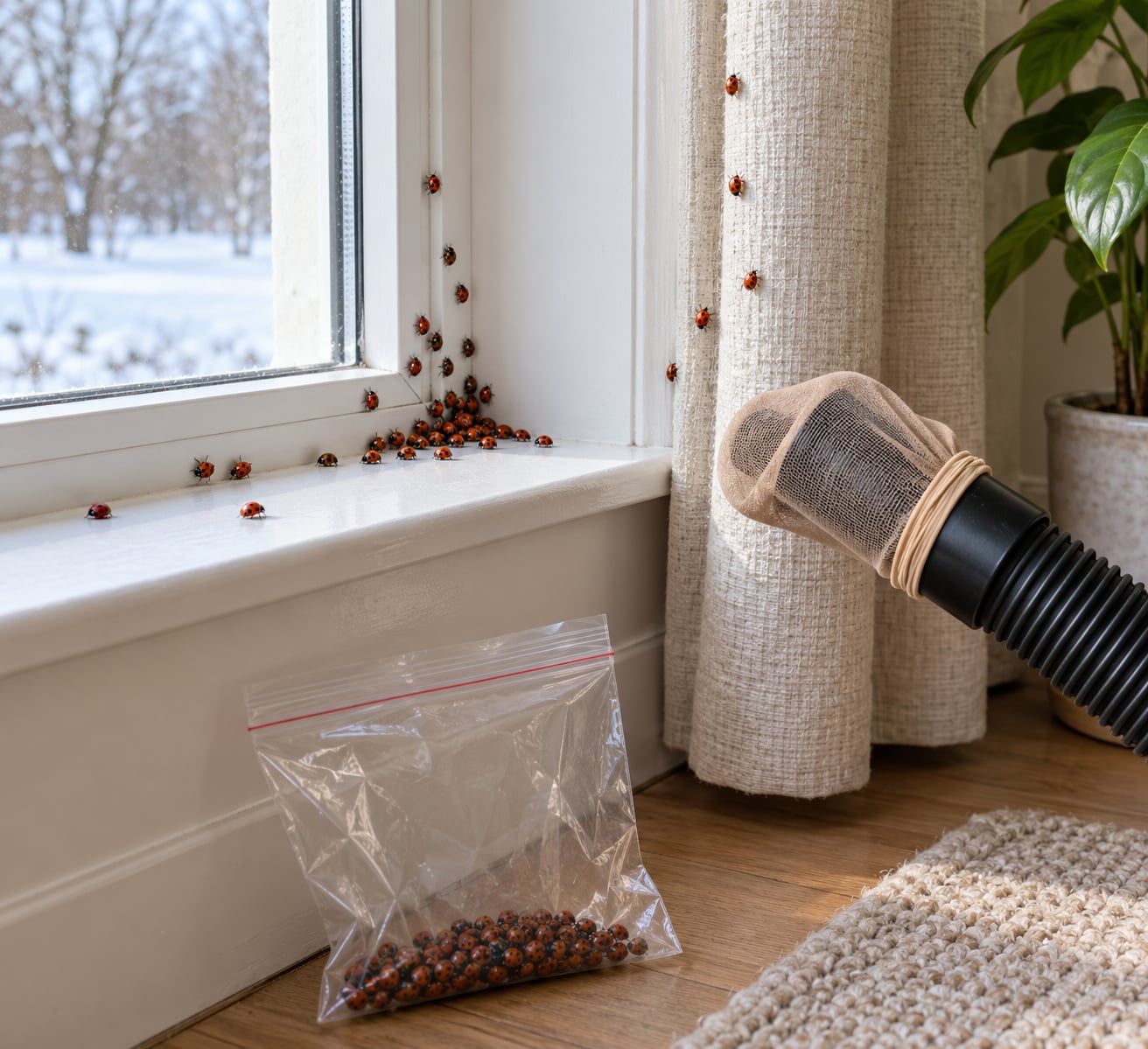
To get rid of Asian lady beetles indoors, vacuum them up whole rather than crushing them. Slip a knee-high nylon sock over the vacuum hose, hold it with a rubber band, vacuum every cluster, then empty the bag or canister straight into a sealed plastic bag and take it outside. Never crush them: a crushed beetle releases a foul-smelling yellow stain that marks walls, curtains and upholstery.
That single method handles most of what you are seeing. Asian lady beetles (Harmonia axyridis) do not eat drywall, wood, fabric or stored food, and they cannot reproduce indoors. What you have is a seasonal guest that wandered in during the fall flight and is now bivouacked in your walls, waiting for warmth.
The whole job is three parts: identify them, remove the ones inside without bursting them, and close the gaps they used. Do it in that order and you will not be back to the same problem in February. Most readers spend an hour on the removal and a weekend on the sealing, and the sealing is what actually reduces the numbers next year.
One thing worth saying up front. Plenty of people pay for an indoor pest control visit and get told to vacuum and spray soapy water, which is where a lot of them started. The fix for a beetle that lives outside your walls is almost always outside your walls.
Table of Contents
What You Need
You do not need much, and you probably do not need any product at all for the removal itself.
It helps to split the job in two, because the two halves need different gear. Removal is a ten-minute task with a jar, a sock and a vacuum. Sealing is a weekend task with caulk, weatherstripping and mesh. If you only have time for one, do the removal now and book the sealing for September.
- A flashlight. Needed for finding entry points, not beetles.
- A vacuum with a hose attachment, ideally with a crevice tool for trim and baseboards.
- A knee-high nylon sock and a rubber band to cover the hose end.
- A wide-mouth jar or container with a lid, for scooping beetles off a windowsill one at a time.
- A broom or dustpan, used to guide beetles out, never to sweep them indoors.
- Paper towels, a microfiber cloth and dish soap for wiping surfaces.
- Caulk or sealant, weatherstripping and fine mesh screening for the sealing work.
- Optional: insecticidal soap labeled for indoor use, if a stubborn cluster will not stay gone.
People often arrive ready to buy a spray. Most of the time that is money spent on the wrong end of the problem. A jar, a sock and a vacuum handle a heavy cluster in a living room in about ten minutes.
Step-by-Step
How to get rid of Asian lady beetles indoors: start with the entry points
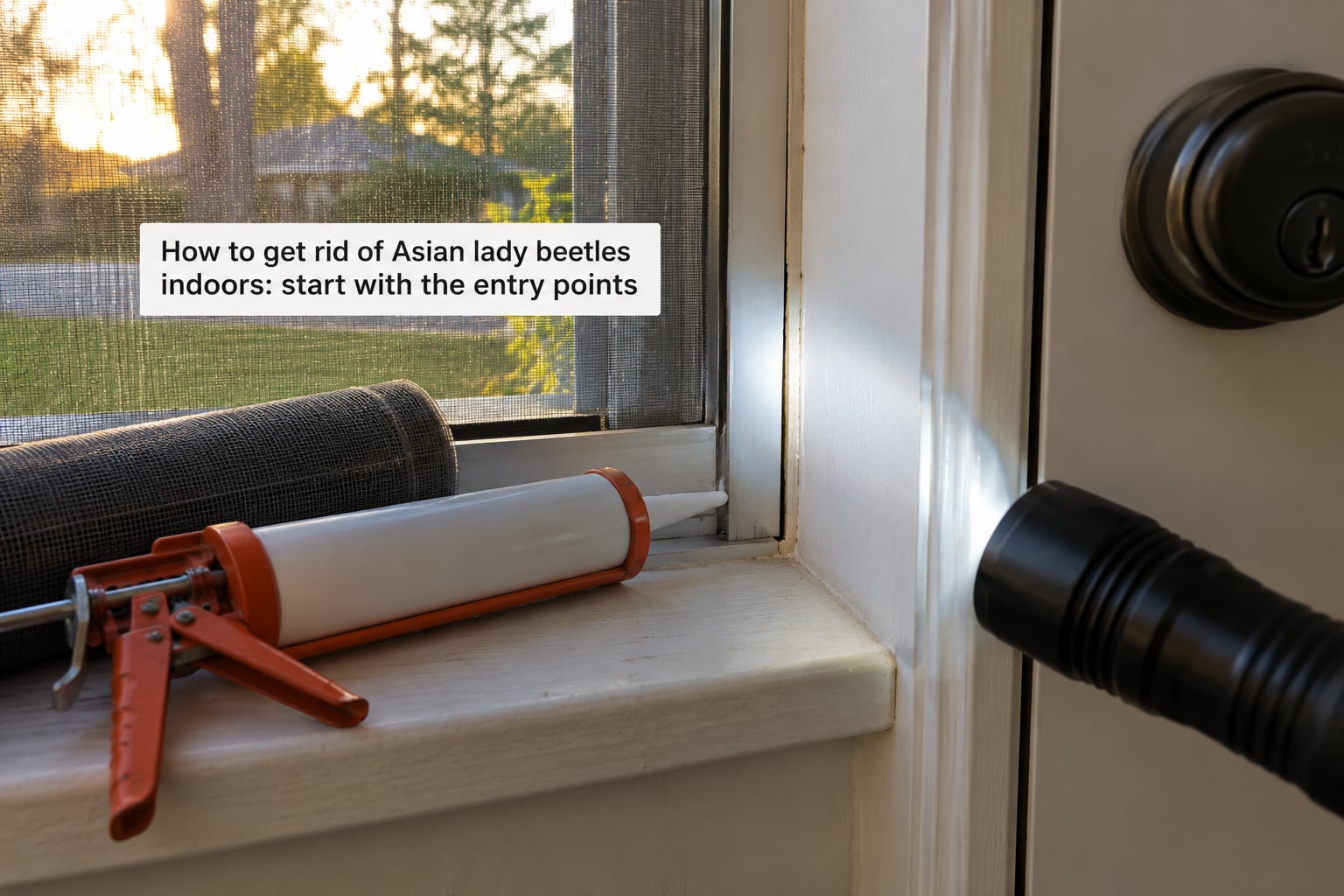
Before you remove anything, walk the house with a flashlight and find how they are getting in. Entry points are usually small, boring and easy to miss.
Check the joint where the soffit meets the fascia, the top course of vinyl siding, the laps between siding panels, and the frame around every window and exterior door. Then look up: gable vents, ridge vents, unscreened louver vents, and any gap where a cable, hose or pipe enters the wall.
Photograph or mark anything suspicious before you seal it. On older houses the gaps that matter are often a few millimeters wide, and once you start filling them you will want to know you covered the right spot.
Mark the areas, then come back to sealing after the removal work. Doing it in that order means you are not sealing beetles into a room you have already cleaned.
1. Confirm what you are looking at
Asian lady beetles are convex and dome shaped, about a quarter inch long. Color runs from yellow-orange through orange to deep red, and the number of spots ranges from zero to nineteen, sometimes with no marking at all.
The detail that settles it is on the pronotum, the shield behind the head. Look for a black M or a black W on a pale background. Native species such as the convergent lady beetle and the seven-spotted lady beetle have different markings, usually two separate pale patches or a straight pale margin rather than a single letter.
If you are not sure what you caught, post a photo to an identification forum. People on r/whatisthisbug sort this out from a single phone photo most days, and it beats guessing and treating the wrong insect.
Four groups of beetles turn up indoors the same way, so it pays to separate them before you treat anything:
- Asian lady beetle. Convex dome, about a quarter inch. Yellow-orange through deep red, zero to nineteen spots, a black M or W on the pronotum. Overwinters in voids and attics, and stains and smells if crushed.
- Native lady beetle such as the convergent and seven-spotted. Similar dome and similar size, red with black spots, but two pale patches or a straight pale edge behind the head and no letter marking. Does nothing indoors and usually leaves on its own.
- Boxelder bug. Flat and elongated, about half an inch, dark brown-black with red lines along the wings and red legs. Overwinters in the same places, and does not stain.
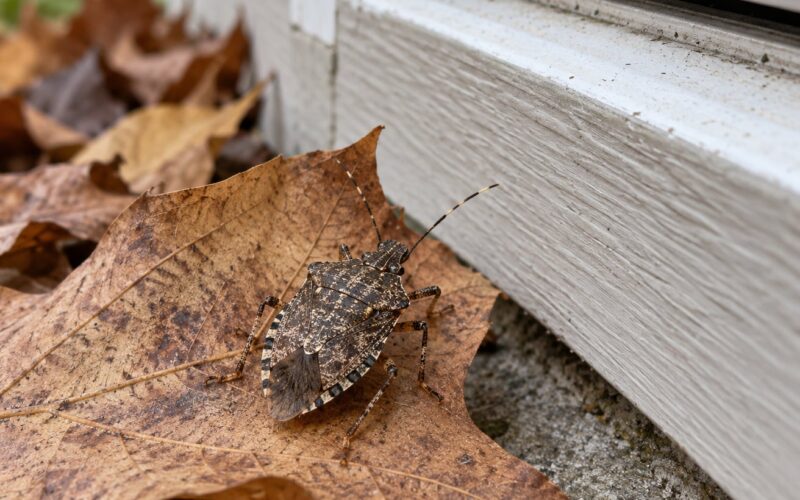
- Brown marmorated stink bug. Shield shaped, about five-eighths of an inch, mottled brown with pale bands on the antennae. Overwinters indoors and releases an odor when handled.
They all come inside for the same reason and respond to the same sealing work, so if you are closing gaps anyway, one job covers them. Cluster flies show up in attics on the same schedule and are handled by the same vent work.
Of these, the Asian lady beetle is the only one that punishes you for handling it. The others do not stain your wall, so a mistake with a boxelder bug costs you nothing and a mistake with a lady beetle costs you a paint touch-up.
2. Find where the beetles are gathering
Start in the rooms that get the most sun. Beetles follow warmth and light, so the south and west sides of a house are where they end up first, and the rooms above and inside those walls are where you will see them.
Look along window sills and curtains, on ceilings near exterior walls, around light fixtures, along baseboards and crown molding, and behind or above outlet and switch plates. Check the attic hatch, the garage, closets against exterior walls, and any window air conditioner or fan opening.
Light fixtures are the one people miss. A ceiling fixture or recessed light is a warm spot that beetles fall into and cannot get out of, so the same fixture can drop a fresh handful onto the floor every evening for weeks.
A practical test: turn off the lights in a room at midday, wait ten minutes in the dark, then switch one lamp back on. What falls out of the fixture is what is living behind that wall.
3. Remove them without crushing their shells
This is the part that matters most, and the part that is easy to ruin. When an Asian lady beetle is pinched, stepped on or squeezed, it releases hemolymph from its leg joints. That defensive bleeding is the yellow-orange, foul-smelling fluid that stains and the odor that lingers in the room for days.
Five methods work, in order of how well they protect your walls:
- The sock over the hose. Stretch a knee-high nylon sock over the vacuum hose end and twist it, securing it with a rubber band. The mesh lets air through while the elastic keeps whole beetles in the sock and out of the canister.
- Cup and release. Slide a jar or container over a beetle on a windowsill, slide a sheet of paper under the rim, carry it outside and release it. This is the gentlest option and the best one for a single straggler.
- Broom to the door. Use a broom or a folded paper to guide beetles across a hard floor and out an open door. Sweeping with a dry broom indoors crushes them, which is why this only works when you are herding them toward an exit on a surface you can wipe afterwards.
- Soapy water knock-down. A light mist of dish soap and water settles exposed beetles and makes them drop to the surface where you can collect them. Keep the solution off finished wood and painted surfaces, and test an inconspicuous spot first.
- Fixture removal. For a cluster inside a ceiling fixture, switch off the breaker for that fixture before you touch it, then remove the globe or diffuser the way the fixture’s instructions show. Vacuum the housing and the recess while the bulbs are cool, then refit the glass.
Whatever you use, dispose of the catch outside immediately. Tie the bag, carry it out and put it in a bin. A vacuum bag sitting in a closet overnight is how a cleaned room gets infested again the next morning.
You will probably find more after you clean up. That is normal. Beetles sheltered behind trim and inside voids migrate outward as the room warms and the light changes, so work the room twice, a few hours apart, before you decide the method failed.
4. Clean the room and the stains
Once the beetles are out, deal with what they left behind. Dried fragments and shed skins collect in corners, along baseboards and in window tracks, and high concentrations of that debris are a known aggravator for rhinitis and asthma, so it is worth removing properly rather than shaking it into the carpet.
Vacuum surfaces first with the crevice tool, then wipe hard surfaces with a microfiber cloth dampened with dish soap and water. Open a window or run the exhaust fan while you work so the odor leaves the room instead of settling into upholstery and clothing.
For stains that are already there, work from the outside edge inward. Blot fresh marks with a damp cloth, then treat what remains with a solution of dish soap and warm water and a clean cloth. On paint that is already dry, a barely damp cloth and patience work better than anything abrasive.
On upholstery, blot and repeat rather than scrubbing, then dry it fully with a fan. Over-wet upholstery takes days to dry and a musty cushion is a worse problem than the beetle was.
For the odor itself, once the room is clean, air it out for a day with the fan on high and the windows cracked a few inches where the outdoor air is cold enough to keep the room safe. Washing curtains and removable covers in warm water with detergent takes most of the smell out of fabric.
5. Seal the gaps and repair the screens
Sealing is what reduces next winter’s count, and it is the step people skip because it is not dramatic. It is also the step that makes the difference between dealing with a dozen beetles and dealing with three hundred.
Work from the biggest openings down:
- The soffit and fascia joint and the top course of siding. This is the main route on most houses, and it is usually a continuous gap rather than a few holes.
- Window and door frames. Replace worn weatherstripping, fit door sweeps along the bottom of exterior doors, and check that every window sash closes and latches against its frame.
- Vents. Cover gable vents, ridge vents and any unscreened louver with fine mesh screening, and fasten the screening with screws rather than tape so it survives a season of weather.
- Utility penetrations. Pack cable, hose and pipe entry points with sealant or expanding foam, including dryer vents, hose bibs and the electrical service entry.
- Trim gaps. Where siding, brick or stucco meets window and door trim, run a bead of caulk that follows the surface instead of bridging across it.
Use the sealant or foam the manufacturer specifies, and follow the label. Fill gaps you can see daylight through with expanding foam, and use caulk for joints that must stay flexible as the building moves. Do not block a vent that a furnace, dryer or attic needs for required ventilation.
Follow each product’s instructions on curing time before you close the opening up, because foam that has not set will not hold.
6. Stop them coming back next season
Do the sealing in late August through mid-September, before the first cold snap. The beetles fly to sunlit walls in October and look for shelter as temperatures drop, so anything you close off after they are already inside is closing the door behind them.
The calendar that matters runs like this:
- Late August to mid-September. Inspect and seal. This is the only window that materially changes next winter.
- October. Peak flights and visible clustering on sunlit exterior walls. Nothing indoors yet.
- November to January. Dormant and aggregated inside voids, attics and garages.
- The first mild winter day. A warm cavity pulls them toward light and they emerge through fixtures, trim and baseboards. This is when people think the problem started.
- March and April. Survivors move out to breed, which can mean one last indoor appearance on the way.
That sequence is why the job is seasonal rather than permanent. No treatment makes a house permanently beetle-proof, and pretending otherwise is how people end up disappointed. What sealing does is reduce the number that get in, and a house that let in a hundred last October might let in twenty this October, which is a difference you can live with.
Do not wait for the first sighting inside to begin. By the time one is walking across your ceiling, the group has already been in the wall for weeks.
The same reasoning explains the loop that frustrates everyone: you vacuum ten beetles out, walk back into the room, and there are twenty more. Those twenty were not avoiding the vacuum. They were behind a baseboard or a casing in a warmer part of the cavity, and removing the visible ones changed the temperature and light in the room enough to draw the rest out of hiding. The way to break the loop is to do the removal and the sealing in the same week rather than treating removal as a finished job.
If you want a residual treatment outside, apply a labeled exterior product to the south and west walls, the foundation line and entry points in early fall, before the flight, and reapply only on the interval the label allows. This is outdoor work done to the manufacturer’s directions, not an indoor broadcast spray. If you rent, the exterior is usually the landlord’s call, so ask rather than doing it yourself.
Light matters more than people expect. Beetles gather on walls and windows where sunlight makes the surface warmer, so closing blinds on bright fall afternoons and switching exterior lights to warm bulbs reduces how attractive that wall looks to them.
A shallow pan of soapy water set under a desk lamp works as a trap. Beetles are drawn to the light, fall in and cannot get out. It catches dozens at a time and it needs nothing but dish soap and daylight.
On child and pet safety: vacuuming, the jar method and the soapy water pan use nothing but water and soap, which makes them the right choice for a bedroom, a playroom or anywhere a pet sleeps.
If you do use insecticidal soap, it has to be labeled for indoor use, and you spray it directly onto exposed beetles rather than into the air. Keep children and pets out of the room until it has dried as the label says, and skip it entirely around food surfaces. Do not use outdoor concentrates indoors, and never apply any pesticide in a room without reading its label first.
Avoid spraying inside your wall voids. The beetles are often inside the wall where you cannot reach them, so the treatment does nothing for the ones that are actually causing the problem. It can also kill the predators that live in those voids, and a vacuum cleaner sitting quietly in a wall cavity can then draw in carpet beetles, which is a genuinely worse indoor problem than the one you were solving.
In an apartment or a multi-unit building, your control over entry points is limited to your own unit. Focus on interior measures: door sweeps, weatherstripping on your own doors and windows, sealing gaps where interior pipes and cables pass through walls, and screening any vent you are allowed to screen. Exterior wall work and shared utility penetrations usually belong to the building owner or the property manager, so put the request in writing.
Call a professional when the sealing job is bigger than a weekend: a home with failing window seals across two floors, a shared wall or roofline problem in a multi-unit building, or beetles showing up in quantities you cannot keep up with over several rooms. Ask for an exclusion inspection that names the entry points and an exterior residual timed before the fall flight, and be skeptical of any quote that is built around spraying inside your walls. Nobody can see inside a wall void, and treating a space you cannot inspect is where people spend money for nothing.
Common Mistakes
Crushing them indoors. One squashed beetle can mark a wall and a curtain, and the smell sets into upholstery and carpet. This is the single most common mistake, and it is entirely avoidable by vacuuming or cupping.
Sweeping with a dry broom. You are rolling beetles under the bristles and crushing them, then dragging the stain across the floor with it. Guide them to an exit with a broom if you like, but do not sweep a cluster into dust.
Bug bombs and foggers. Aerosol foggers saturate the air and land on open surfaces. Beetles are in voids, behind trim and inside a light fixture, where the fog never reaches. Extension services and university entomology departments are consistent about this, and the residue is left in a room your family lives in.
Indoor broadcast sprays. A general bug spray applied around the room leaves chemicals on upholstery, floors and food-prep surfaces and does nothing about the beetles in the wall. If you use anything, use insecticidal soap on exposed beetles and only as its label allows.
Waiting until the beetles are already inside to start sealing. By then you have sealed them in. The work belongs in late August and September.
Do Asian lady beetles bite? No. They are not venomous and do not bite. They can pinch or nip defensively when handled, and people regularly mistake that for a bite, but it does not raise a welt the way a spider or a biting insect does.
Treating one beetle as an infestation. A handful in a warm room in February is a normal overwintering population that came in as a much larger group in October. It is not a colony, it will not multiply, and the population shrinks over winter. What you are managing is a seasonal nuisance, and the fix is exclusion rather than extermination.
One last check that costs nothing: on the next warm, sunny afternoon, look at the south and west walls from across the street before you go inside. Beetles visible on the siding in daylight are the same beetles that will be in your light fixture tonight, and that is the moment to go seal the gap.
Frequently Asked Questions
Are Asian lady beetles dangerous to people?
Asian lady beetles are not venomous and generally do not bite, though they can pinch or nip when handled and people mistake that for a bite. When threatened they release a foul-smelling yellow-orange fluid from their leg joints. The main indoor concern is not a sting but that odor and stain, plus dried beetle debris, which is a documented trigger for rhinitis and asthma symptoms in sensitive people.
Why do Asian lady beetles come inside?
They enter in fall, when warm days and cold nights send them looking for shelter, and they settle into wall voids, attics and spaces behind trim. They cannot reproduce indoors, so nothing multiplies in your house. On the first mild winter day the cavity warms, they move toward light and appear in rooms through light fixtures, baseboards and outlet plates, which is why the count seems to rise in February.
Do Asian lady beetles damage walls or furniture?
They do not eat wood, drywall, fabric or structural materials, and they do not damage stored food. Their indoor impact is nuisance presence, plus the yellow-orange stain and odor left where a beetle was crushed. That stain is surface level and can usually be removed from paint and fabric with dish soap and water, but the odor in upholstery takes airing out and washing.
Can I use bug spray to get rid of Asian lady beetles indoors?
Broad bug sprays are usually unnecessary for an indoor group and they expose people, pets, food and surfaces to chemicals while missing the beetles hiding in voids and behind trim. Use containment instead: vacuum whole beetles with a nylon sock over the hose, empty outside right away, and clean the surfaces. Insecticidal soap labeled for indoor use is an option for exposed beetles only, applied per its label.
How do I keep Asian lady beetles from coming back next year?
Inspect and repair damaged screens, weatherstrip doors and windows, fit door sweeps, seal small exterior gaps, and screen gable and ridge vents before the fall flight. Treat the sunny south and west elevations with an exterior residual in late August or September if you choose to, following the label. Repeat the inspection in spring, because new gaps open as trim moves through a season.
Start with the room you are standing in. Put a nylon sock over the vacuum hose, take the clusters off the sill and out of the light fixture, empty the bag outside, then wipe the surfaces and open a window. When the vacuum is put away, walk the exterior with a flashlight and start closing the soffit joint, the window and door frames and the vents. That is how to get rid of Asian lady beetles indoors and keep next winter’s group small.
Last reviewed for 2026. Guidance here is general information for homeowners in the United States; follow the label on any product you use, and for structural, electrical or heating and ventilation work, use a licensed contractor.