Call a professional exterminator when the pest is dangerous, when the infestation is established rather than a single stray, when two DIY attempts have already failed, or when you are seeing structural damage and health symptoms. One bug in a kitchen is not an emergency. Droppings in a wall void, a wasp nest above the door, and a colony behind the fridge are.
Most homeowners wait far too long on that second category. Threads on r/homeowners show people spending a second year of sticky traps before they call anyone, then reporting the problem gone within weeks of a professional treatment. That delay is the expensive part, not the service itself.
The trick is telling a sighting from an infestation. This guide breaks the decision down pest by pest, gives you an urgency triage you can act on today, and explains what a licensed company actually does on arrival.
Table of Contents
- When to Call a Professional Exterminator at a Glance
- What Signs Mean You Need Professional Help?
- How to Tell a Minor Pest Problem From an Infestation
- When Should You Call Before a Pest Problem Is Severe?
- What Pests Usually Need Urgent Professional Treatment?
- What You Can Do Before the Exterminator Arrives
- What to Expect From a Professional Exterminator Visit
- How to Choose a Licensed Pest-Control Company
- DIY Treatment or Professional Exterminator?
- Frequently Asked Questions
- Conclusion
When to Call a Professional Exterminator at a Glance
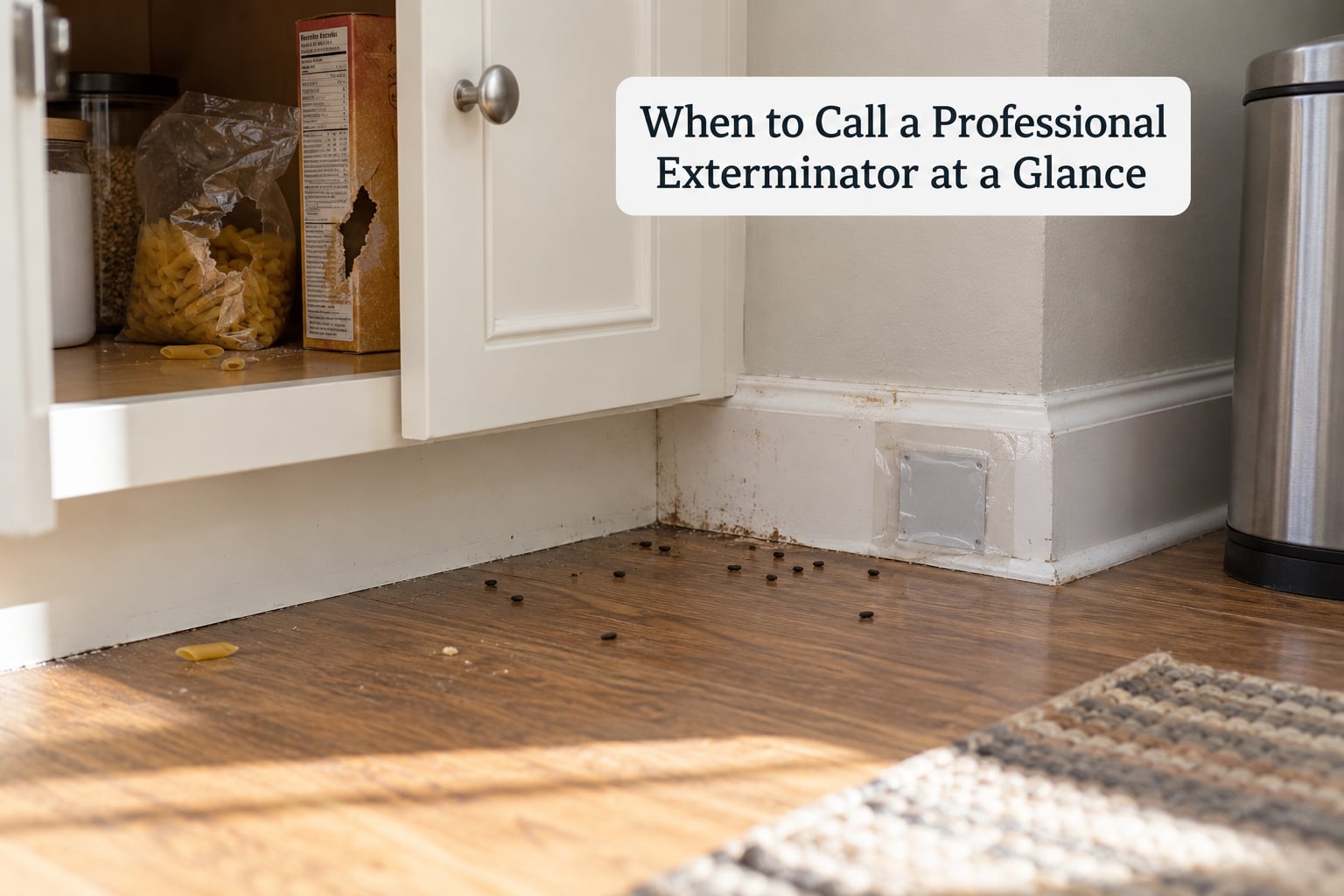
Short version: one insect outside, near a window, in spring, is normal. Anything reproducing indoors, anything nocturnal, anything you cannot identify, and anything that stings or bites is a call.
| Situation | Handle it yourself? | Urgency |
|---|---|---|
| A single stray insect indoors | Yes, usually | Monitor |
| Ants marching in a line to one food source | Often, if caught early | This week |
| Two or more rodents seen in the house | Call a pro | This week |
| Droppings in a cabinet or behind an appliance | Call a pro | This week |
| Discarded wings near a window in spring | Inspect, then decide | Monitor |
| Nest above a door, in an attic, or in a wall | No | Call today |
| Mud tubes on a foundation wall | No | Call today |
| Bites on skin in a pattern, no other cause | Call a pro | Call this week |
| Cockroach sighting in an apartment building | Call a pro | Call this week |
| Birds or bats inside the living space | No, and do not seal the entry yourself | Call today |
Two details in that table catch people out. Rodents multiply so quietly that a second sighting almost always means an established population, and a wasp nest over an entryway puts everyone who opens the door at risk of being stung repeatedly.
What Signs Mean You Need Professional Help?

Here are the warning signs, roughly in the order they show up in real homes.
- You see more than one. One cockroach is often a lone traveler. Two daytime sightings usually means they are living inside your walls.
- Droppings are fresh and grouped. Fresh droppings are soft and shiny. Old ones are dry and dusty, so cleaning the pile and finding it again in days tells you the population is still producing.
- You hear scratching in the wall at night. Nocturnal noise above a headboard, behind a bathtub, or in a shared wall points to rodents in harborage rather than one lost animal.
- The same pest keeps coming back after removal. Pheromone trails, egg cases, and hidden harborage mean the thing you killed was never the source.
- You see structural evidence. Gnaw marks on wiring, mud tubes on a foundation, hollow-sounding wood, buckled paint, or wings on a windowsill are not a cleaning problem.
- There is a nest or colony you can see. Visible harborage is already past the DIY stage for most species.
- Someone in the house is being stung or bitten. Insects that sting repeatedly, and rodents that chew skin, move this up the list fast.
- Two DIY attempts have failed. If a bottle of spray and a snap trap have not solved it in a month, the third attempt will not either.
- You cannot identify it. Treating the wrong species wastes money and can make some problems worse.
Technicians on r/pestcontrol say the same four categories warrant a call without hesitation: termites, bed bugs, rodents, and stinging insects. If your situation matches any of them, the rest of this article is mostly about who to call, not whether.
How to Tell a Minor Pest Problem From an Infestation
Use five tests. Location, freshness, frequency, identification, and your own track record.
Where are you finding it?
A bug on the patio, in a bathtub, or at the window screen is a visitor. The same species behind your fridge, inside a wall void, or in a food-storage area has moved in.
Are the signs fresh?
Check droppings for softness, gnaw marks for bright exposed wood, and frass for a wet look. Physical evidence stays readable for a few days. When you clean it and it comes back, you have a population, not an accident.
How often does it show up?
Once a week is different from once a night. Pests are nocturnal and hide during the day, so your sighting count is a floor on the real number, never a ceiling.
Can you name it?
Carpenter ant damage and termite damage look similar from the doorway and are handled in opposite ways. r/whatbugisthis exists because identification is genuinely hard, and treating the wrong pest is how people end up paying twice.
What has your DIY history been?
Be honest about scope. Two traps in two rooms is not two serious attempts. A month of work plus fresh droppings behind the stove is.
Quick triage: call today for stinging insects, bats, and structural pests. Call this week for rodents, bed bug evidence, and multi-unit cockroach sightings. Monitor for a week for a single unknown insect with no physical evidence.
When Should You Call Before a Pest Problem Is Severe?
Early advice is worth paying for in five situations.
- You do not recognize the pest. A five-minute phone call to a technician can prevent a whole wrong treatment.
- It has come back twice in a year. Recurring activity means an entry point is still open.
- Someone in the home is elderly, pregnant, immunocompromised, or has asthma. Rodent droppings and cockroach allergens carry real health weight in those households.
- The harborage is inaccessible. Inside walls, above ceilings, in ductwork, or in a shared wall between units, you physically cannot reach it.
- The damage is expensive if it continues. Termites and rodents can run up bills fast, and insurers often exclude gradual, unaddressed damage.
Two more worth mentioning. If you are buying, selling, or renting out a property, get an inspection before the closing date rather than after a buyer’s inspector finds something. And if you manage a restaurant, childcare space, or food-processing area, local rules usually require documented pest management rather than your own spray bottle.
What Pests Usually Need Urgent Professional Treatment?
These are the ones where removing the pest is also a safety task.
| Pest | Can you DIY it? | Call a pro when | Urgency |
|---|---|---|---|
| Termites | Rarely | Any mud tubes, wings, or soft wood | Call today |
| Bed bugs | Rarely | Bites in lines, rust-colored mattress spots, shed skins | Call this week |
| Mice | Single trap, maybe | Night sounds, fresh droppings, more than one seen | Call this week |
| Rats | No | Any sighting, indoors or out | Call today |
| Wasps, hornets, yellowjackets | No, indoors or overhead | Nest visible or near an entrance | Call today |
| Carpenter ants | Surface only | Damage inside wood, colony in a wall | Call this week |
| Fire ants | No | Mounds in a play area or walkway | Call today |
| Cockroaches in an apartment | Not alone | Any sighting in shared housing | Call this week |
| Sewage flies, drain flies | Mild cases only | Hundreds daily, or with odor | Call this week |
| Snakes, scorpions, centipedes indoors | No handling | Any indoor presence | Call today |
Do not knock down a wasp or hornet nest above head height, do not handle a venomous animal indoors, and do not seal a wildlife entry point on your own. Sealing a bat or raccoon opening without a proper one-way door traps animals inside, which is worse for everyone. Follow local public health guidance where it exists, and for anything that stings, treat a sting reaction or difficulty breathing as an emergency first.
What You Can Do Before the Exterminator Arrives
Ten minutes of prep makes the visit more useful and usually cheaper.
- Photograph the evidence. Droppings, gnaw marks, the insect itself, and where you found it. Photos often let a technician pre-plan.
- Identify the pest as best you can. A clear photo of the insect and the damage speeds up the service call.
- Log where and when you saw activity. A note of “behind the stove, 11pm” is worth a lot.
- Clear access. Pull the fridge and stove out, empty under-sink cabinets, move stored boxes off the floor.
- Secure food and pet food. Move them into sealed bins so nothing new gets carried in or out.
- Move pets, fish, and children out of the treatment area. Ask the technician about return timing and write it down.
- Do not spray anything in the last 48 hours. Repellents can drive pests deeper into the wall before the technician arrives.
- Clean droppings without sweeping. Dry sweeping aerosolizes it. Damp-wipe or use a HEPA vacuum.
- Note prior treatments. What you used, when, and whether it seemed to work at all.
If you rent, check the landlord first
Most leases put pest control on the landlord for existing conditions, and many buildings already have a contracted pest service. A r/AskNYC thread captures the mistake well: a roommate paid for an exterminator before checking whether the building already covered it. Send the landlord photos and the pest name, check your lease, and keep the receipts either way.
What to Expect From a Professional Exterminator Visit
Here is the sequence, so nothing surprises you.
- Inspection. Interior rooms, exterior perimeter, attic and crawlspace access, harborage sites. Expect 30 to 90 minutes depending on the home.
- Identification. The technician confirms the species and may pull samples. This is the step worth watching, since treatment follows identification.
- Recommendation. Chemical, bait, mechanical exclusion, or a combination, plus what fixes are yours to make.
- Safety briefing. Which products are used, where they are applied, whether anyone can re-enter tonight, and what to do about dishes, food, and pets.
- Treatment. Interior application, exterior perimeter work, and exclusion repairs if the company does that work.
- Follow-up. A scheduled re-treatment inside the guarantee window, or a return call if activity continues.
On guarantees, ask for the window in writing. Most are expressed as a re-treatment period of a few weeks to a few months, and often only for the species treated. A warranty on ants is not a warranty on rodents. Nobody can promise a result in advance, and any company that does is selling you something.
How to Choose a Licensed Pest-Control Company
Get three quotes and compare scope, not the headline number. Licensing is state-by-state; verify it directly rather than trusting a flyer.
Questions to ask on the phone before anyone visits:
- Are you licensed and insured in this state?
- Are the products EPA-registered, and can you name them?
- Who identifies the pest, and does the quote follow the inspection?
- Does the price include inspection, treatment, follow-up, and exclusion repair?
- What does the guarantee cover, for which pests, and for how long?
- Is a recurring plan required, and what are the cancellation terms?
- How long before we can re-enter, and what do you recommend for pets and children?
Walk away, or at least get a second opinion, if you are quoted before anyone has inspected, if the technician cannot name the species, if the guarantee is verbal only, or if an annual contract appears with cancellation fees you did not know about. Forum readers repeatedly describe being quoted an annual plan for a problem the salesperson had not yet seen. That is the single most common reason people distrust the industry.
DIY Treatment or Professional Exterminator?
| Situation | DIY makes sense | Call a pro |
|---|---|---|
| One stray insect | Yes | No |
| Ants to a single food source | Yes, if you cut the trail and wipe it | If it returns within two weeks |
| Silverfish in a basement | Often, with dehumidification and sealing | If it spreads upstairs |
| Fleas with no pets | Only if you find the source, often another household | Almost always |
| Squirrels in the attic | No | Yes, plus exclusion |
| Bed bugs, termites, rodents, stinging insects | No | Yes |
Why spraying ants can make things worse
An outdoor spray kills the visible trail but leaves the colony intact, and disrupted pheromone trails can cause it to bud into multiple smaller colonies. Bait and removing the food source address the queen. That is why the same kitchen can have three ant trails after one aerosol blast.
What treatment costs in the US
Typical figures vary by region, property size, pest, and access, and they change over time. A one-time interior rodent or general insect treatment usually runs from roughly the low hundreds of dollars for a standard home, while a recurring plan costs a monthly fee that adds up across a year and is often cheaper per visit. Termite treatment is priced by linear footage of affected structure. Bed bug work is usually priced per room or per square foot and almost always needs follow-up. Two quotes that look far apart are usually quoting different scope, so compare what is included before comparing the number.
One more thing that shows up in cost discussions: a monthly plan is usually only worth it if you already had an infestation or your home has a known history. Preventive service on a pest-free house is insurance, and reasonable people buy it or skip it.
Frequently Asked Questions
At what point should I call an exterminator?
Call a professional exterminator when the pest is dangerous to people, when you have physical evidence like fresh droppings or gnaw marks rather than a lone sighting, when the same pest keeps returning after you remove it, or when two DIY attempts have failed. Termites, bed bugs, rodents, and stinging insects warrant a call without hesitation, because the source is almost never visible and the population grows faster than you can remove it.
How many mice should I catch before calling an exterminator?
One trapped mouse proves a mouse can get in, not that you have an infestation. Call a professional once you see a second mouse, hear scratching or running in the walls at night, or find fresh droppings in more than one room or location. Two active devices that both catch within the same week is a good trigger. Trapped animals are also far less humane than an exclusion-first approach.
What is the 5 day mouse rule?
The five-day mouse rule is a rule of thumb homeowners use to estimate the population: clean up all droppings, then monitor for fresh ones over five days. The number of fresh droppings that reappear suggests a small group rather than a single animal. It is a guideline, not a scientific measure, and it works best when you can count droppings in one small defined area such as a garage corner or under a sink.
What is the hardest infestation to get rid of?
Bed bugs and termites are usually cited as the hardest, and rodents come close. Bed bugs hide in seams, headboards, and neighbouring rooms, and one treatment rarely finishes the job. Termites live inside the structure, where treatment has to reach the colony rather than the visible workers. Both spread between units, which is why professional treatment with follow-up is worth it for them.
Is DIY pest control legitimate?
DIY works well on a single stray insect, an ant trail you cut off at one food source, and mild silverfish problems you address with drying and sealing. It fails on pests that live inside walls or structures, on species that sting, and on anything you cannot identify. Two failed attempts is a reasonable point to stop, and continued spraying after that often spreads the problem rather than clearing it.
Is a monthly pest control plan worth it?
A recurring plan is worth it if you have an active problem, recurrent history, or a seasonal pattern in your area. It is optional insurance on a pest-free home, and the annual total often costs more than two one-time treatments. Ask whether the plan includes follow-up visits and exclusion work, since a monthly spray schedule without repairs to entry points will not stop rodents or termites.
Conclusion
When to call a professional exterminator comes down to three questions: can you name the pest, do you have physical evidence rather than a single sighting, and is anyone at risk. Answer yes to the safety question or no to the other two, and you are done deliberating.
Start with the pest ID and ten minutes of cleanup, then get three quotes and compare what is actually included. If it stings, chews structure, or lives inside a wall, make the call today.