Cockroach droppings vs mouse droppings identification comes down to two things you can check with a magnifying glass in under a minute. Cockroach frass measures under 2 mm and is either granular or a ridged barrel with blunt ends, while mouse droppings are 3 to 7 mm long, smooth, tubular and pointed at both ends. Size and end shape settle it; colour almost never does.
Most people find these specks somewhere they would rather not look closely, a cabinet corner, behind the washing machine, a pantry shelf. The good news is that droppings are one of the more reliable signs a pest has left behind, and unlike a glimpse of the animal itself, they stay put and can be compared side by side.
What catches people out is that both pests use the same hiding places, and both change colour as droppings age. Treat for the wrong one and the real infestation keeps growing while you are busy baiting a species that was never there. This guide walks through the checks in the order that resolves the question fastest, then the cleanup and control steps for whichever pest you have.
Table of Contents
- Cockroach Droppings vs Mouse Droppings Identification at a Glance
- Size and Shape: The Fastest Clues
- Where Each Kind of Dropping Usually Appears
- How to Check for a Cockroach or Mouse Infestation
- What to Do After You Identify the Droppings
- Which Identification Clue Should You Trust Most?
- Which Should You Choose?
- Frequently Asked Questions
- What to Do First
Cockroach Droppings vs Mouse Droppings Identification at a Glance
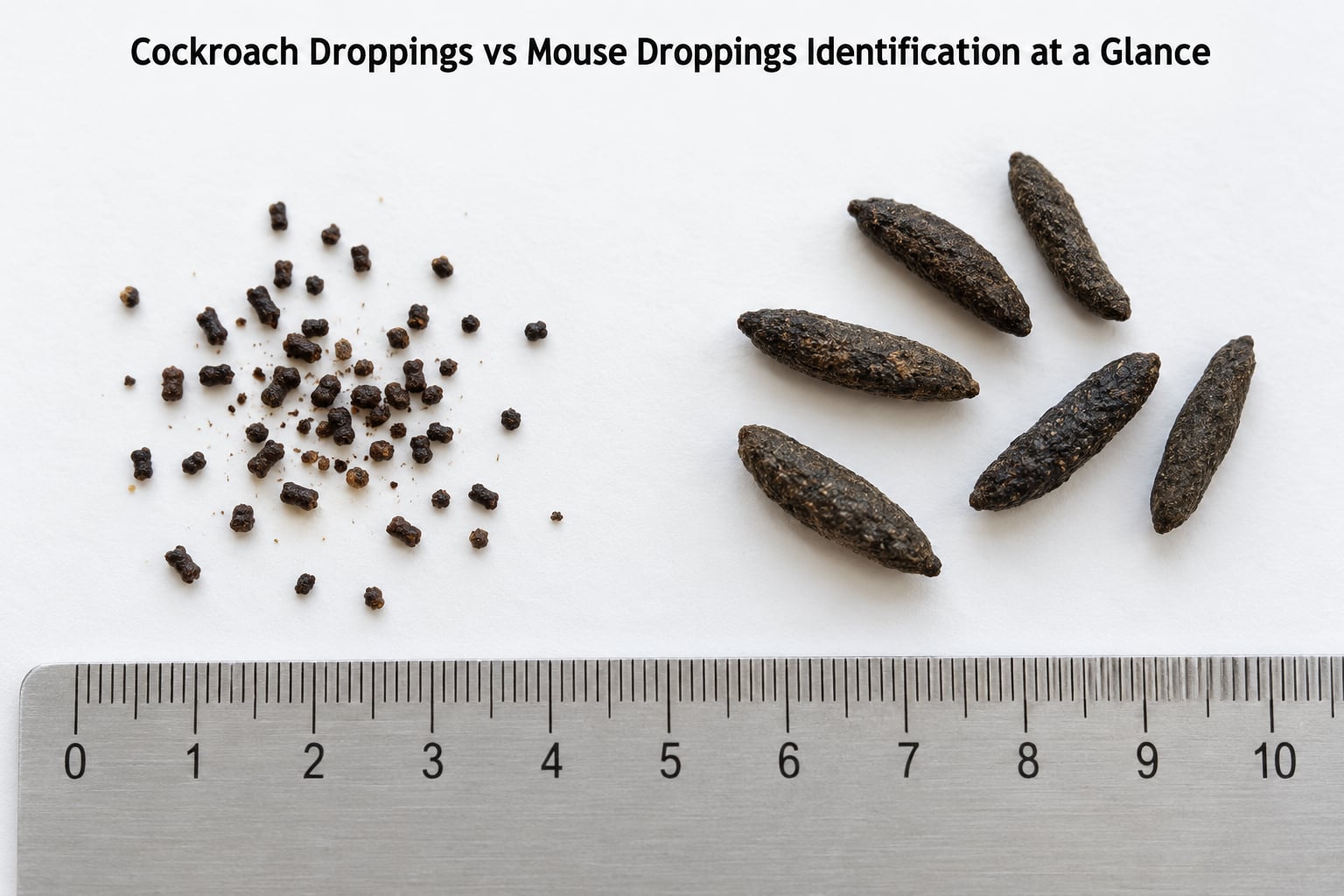
The table below is the fastest read. Measure against a coin, look at the ends, then use the location as supporting evidence rather than the deciding factor.
| Trait | German cockroach | American or Oriental cockroach | Mouse | Rat | Bed bug |
|---|---|---|---|---|---|
| Size | Under 2 mm, pepper-like | 2 to 3 mm | 3 to 7 mm (about 1/8 to 1/4 inch) | 12 to 19 mm (about 1/2 to 3/4 inch) | Under 1 mm |
| Shape and ends | Irregular grains, blunt or ragged | Barrel or cylinder, blunt ends | Rice-grain, tapered pointed ends | Thick, blunt-ended, curved | Ink-like round spots |
| Texture | Granular or powdery when old | Hard pellets with ridges | Smooth, shiny when fresh | Smooth, larger | Liquid stain, already smeared |
| Ridges on the surface | No | Yes, up to six lengthwise | No | No | No |
| Colour when fresh | Black | Dark brown to black | Black | Black | Dark red to black |
| Colour when old | Tan to grey, crumbling | Brown, dusty | Tan to grey | Grey | Deep brown stain |
| On a damp cloth | Smears into brown streaks | Smears or leaves a dark mark | Holds shape, leaves a faint mark | Holds shape | Spreads as a stain |
| Typical location | Kitchen cabinets, drawer slides, sink and fridge areas | Basements, utility rooms, under appliances | Along baseboards, wall edges, pantries, shelves | Basements, attics, garage, behind stored items | Mattress seams, bed frames, skirting |
Size and Shape: The Fastest Clues
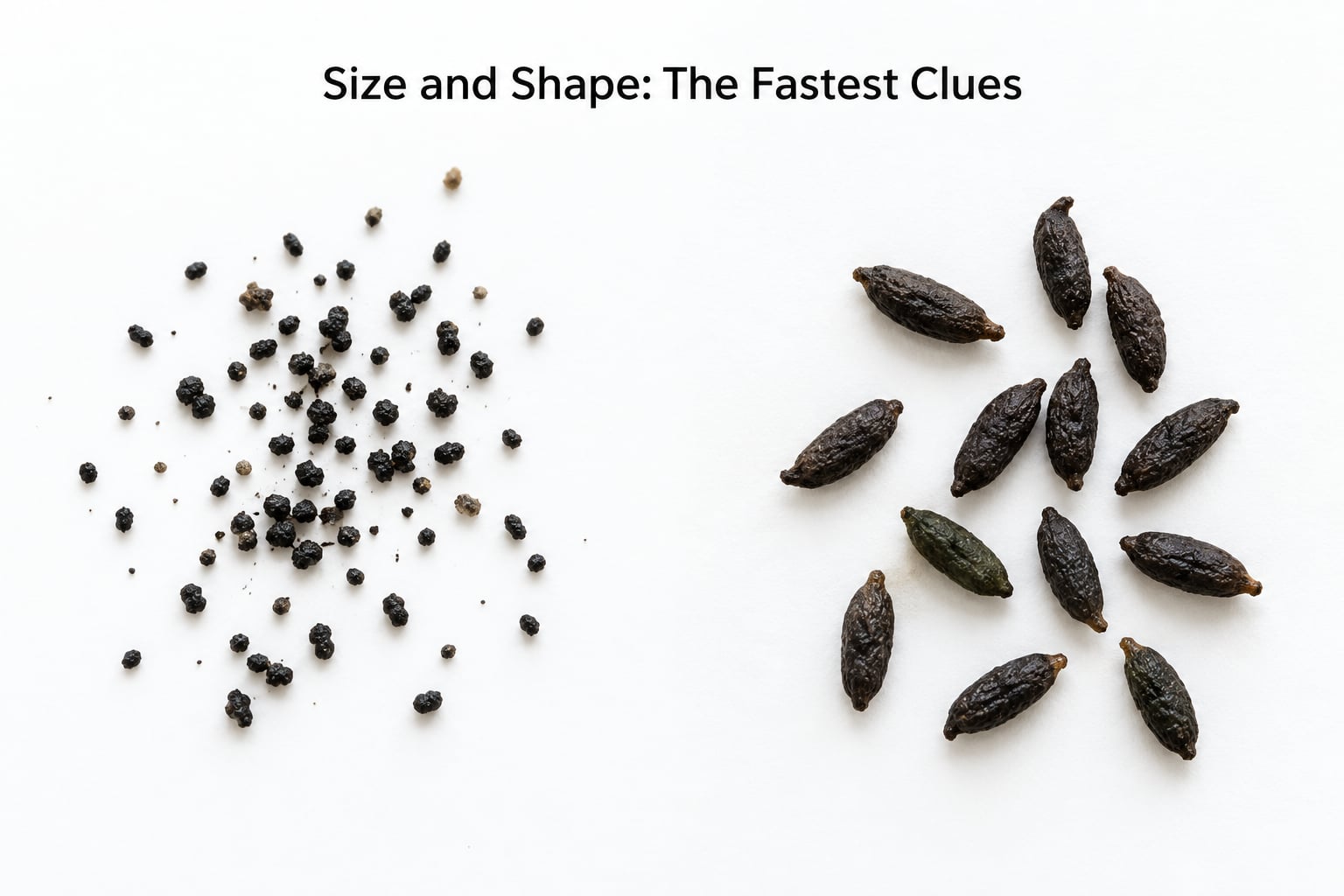
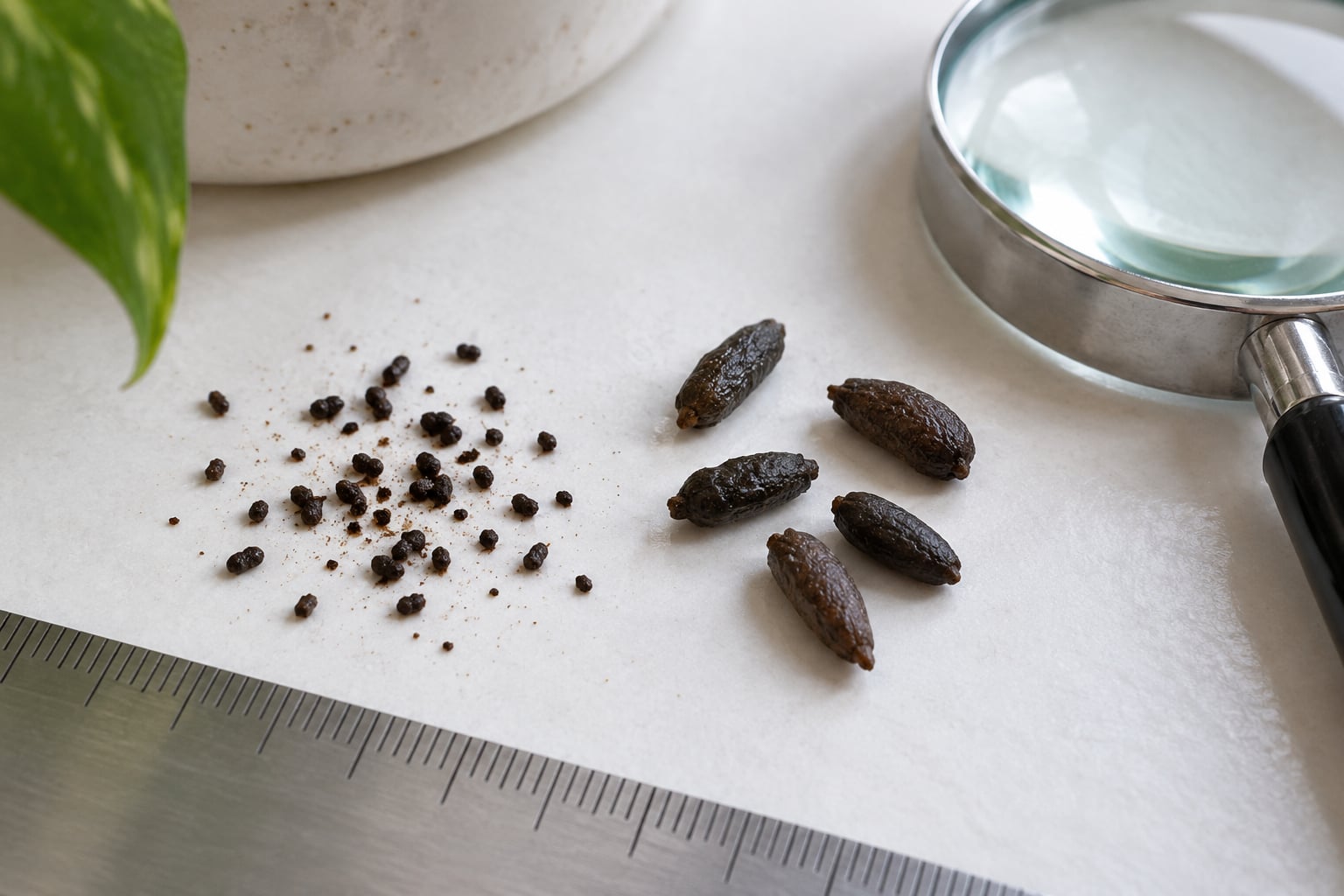
Cockroach droppings are small and irregular. German cockroaches, the ones most likely indoors in cooler climates, pass frass that looks like ground black pepper or coffee grounds: dark specks under 2 mm with no consistent shape, often scattered in a cluster rather than laid in a line. Where a surface stays damp, the same material smears into brown streaks instead of holding a pellet shape.
American and Oriental cockroaches produce something different. Their droppings are barrel-shaped or cylindrical, roughly 2 to 3 mm long, with blunt ends and a set of ridges running lengthwise down the outside. Those ridges are the single most definitive cockroach tell, and the reason for them is anatomical. Cockroach waste is pressed as it leaves the gut by six internal rectal pads, and each pad stamps one ridge into the surface of the pellet. Under a 10x loupe, count them.
Mouse droppings are bigger, smoother and more consistent. They run 3 to 7 mm, about the length of a grain of rice, and both ends taper to a point, because the material is shaped inside the lower intestine rather than pressed at the exit. Fresh ones are black and faintly shiny. Old ones turn tan to grey and look dusty.
If you have a coin, use it. A US quarter is about 24 mm across, so a mouse dropping fills roughly a quarter of its width, while cockroach frass is a small fraction of the same. Scale removes all doubt.
Cockroach Droppings vs Mouse Droppings: Texture, Color, and Smell
Texture separates them as well as size does. Older cockroach frass dries out and crumbles between your fingers into a powder, sometimes leaving a dusty film on the shelf. Fresh mouse droppings stay firm and smooth. The damp white cloth test settles the rest: press a dampened white paper towel or cloth onto the droppings. Cockroach waste smears into a brown streak because it is granular and partly pasty. Mouse droppings hold their shape and leave only a faint mark.
Colour is the clue people trust most and it is the least reliable. Fresh droppings of both pests are black, and both fade. Diet changes the shade too, and roaches feeding on one thing produce darker droppings than roaches feeding on another. Age is the bigger factor: give a sample a few months and even an expert cannot date it from colour alone. Smell helps a little more. Cockroach activity often comes with a musty, oily odour, and a heavy infestation has a smell people describe as stale or nutty. Rodent droppings smell mustier and more ammonia-like, particularly in a closed space, but odour travels and mixes, so treat it as a supporting clue only.
Look for other signs while you have the area open. Cockroach evidence includes shed skins, egg cases, and a nymph-to-adult ratio in glue monitors skewed heavily toward nymphs. Mouse evidence includes gnaw marks, greasy rub marks along baseboards, and droppings that appear in batches along a run.
Where Each Kind of Dropping Usually Appears
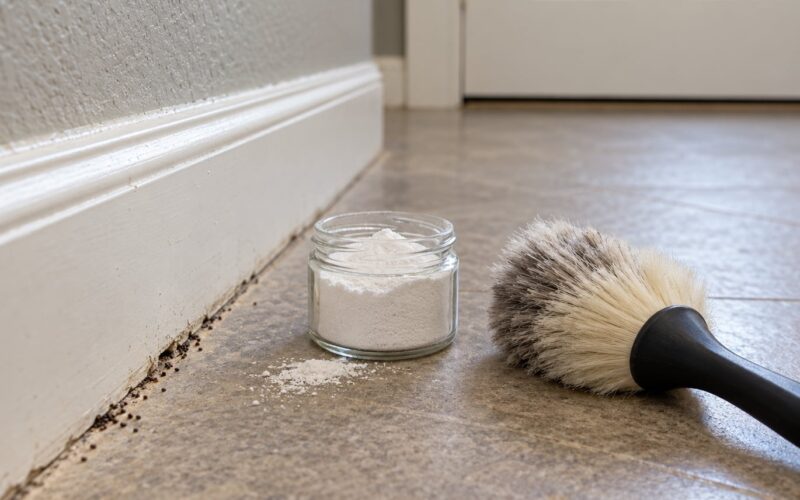
Location narrows things down but rarely decides alone, because the two pests overlap more than people expect. Cockroach droppings cluster where they feed and travel: cabinet corners, under hinges, along drawer slides, the underside of the refrigerator gasket, around sink and pipe penetrations, and on top of appliances in the laundry room where warmth and dust collect. Mouse droppings follow edges instead of hiding in corners, which is the habit behind their whole design. Look along baseboards, in the gap between the wall and the kitchen units, on pantry and garage shelves, in cupboards you rarely open, and in the attic, basement or garage where food and nesting material are stored.
Two more patterns help. Mouse droppings tend to appear in quantity in one spot, because an animal deposits repeatedly in the same run; a mouse can produce somewhere around 50 to 100 droppings a day. Cockroach frass is usually scattered more thinly and widely across a surface. Fresh cockroach droppings on a vertical wall high up point away from either pest and toward a flying insect or a wanderer from an adjacent flat.
How to Check for a Cockroach or Mouse Infestation
Five checks, in order, will settle most cases. First, do not handle droppings bare-handed and do not dry sweep them. Fine rodent waste carries pathogens and cockroach frass carries allergens that become airborne the moment you sweep it up.
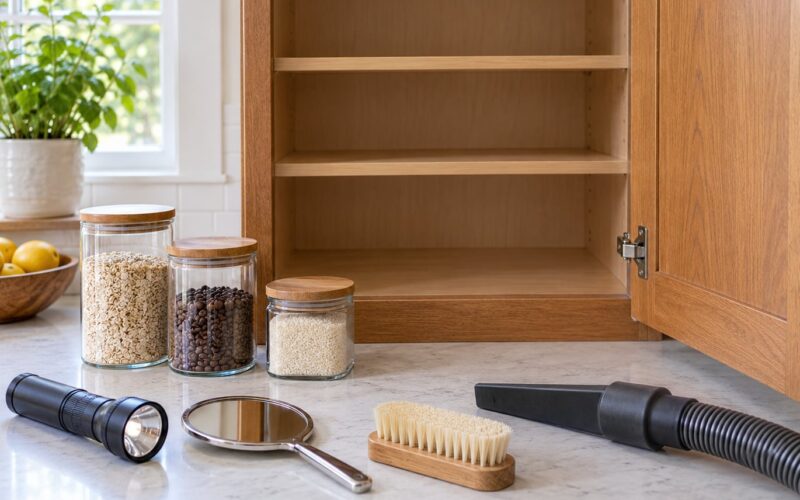
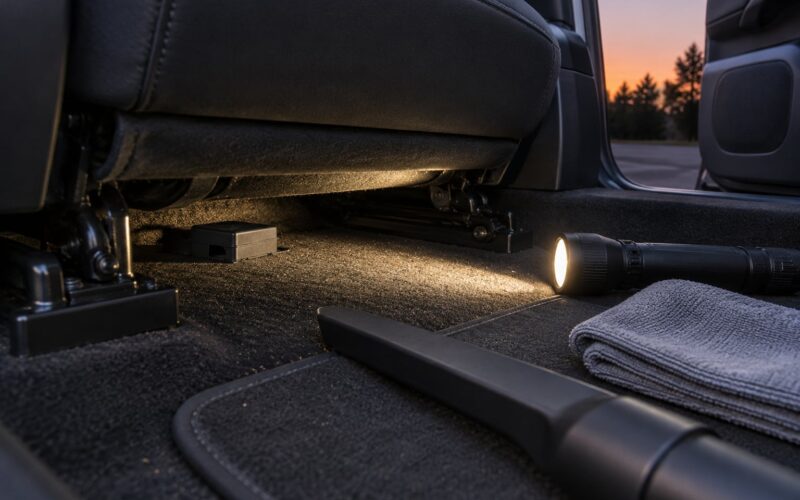
Next, light the area with a flashlight at a low angle. Side lighting makes ridges and tapered ends visible in a way overhead light never does.
Then pick up one specimen with gloves or a wet cotton swab, place it beside a coin, and put it under a 10x loupe. A phone macro lens works nearly as well. Ridges and blunt ends mean cockroach. Smooth sides and a point at each end mean mouse. If it breaks into grains in your hand, it is frass.
Run the damp cloth test next, and check freshness while you are there. A wet sheen means recent activity. Dry and dusty with no sheen means old. A fifth check is timing: cockroaches are nocturnal, and mice are most active after dark, so a flashlight sweep of the kitchen and pantry at night catches movement the daytime inspection misses.
On the 5-day mouse rule: finding droppings or gnaw marks in the middle of the week usually points to weekend activity, since mice forage mostly at night and away from human traffic. It is a scheduling hint for when to set traps, not a way to date the droppings.
Clean up, then wait five to seven days. New droppings mean the animal is still coming back, and now you know which control route to take.
What to Do After You Identify the Droppings
Start the same way for either pest. Gloves on, damp wipe or HEPA vacuum the surface rather than sweeping, disinfect, bag the waste, and wash your hands. Do not clean before you have treated, because removing the evidence before bait works roaches robs you of the only way to tell whether the problem is gone. Clean after treatment, then keep checking.
If it is cockroaches, treat the moisture and the food. Fix the drip under the sink, dry the sink overnight, take out the trash daily, seal dry food in airtight containers, and vacuum crumbs. Then place gel bait and glue monitors in the harborage areas you found droppings in: under the sink, in the cabinet corner, at the back of the stove. Foggers and bleach poured down the drain do very little against a German cockroach population, because they kill only what is exposed while the rest stay sheltered in harborage and breed. A licensed technician is worth it when droppings cover more than one room or you are seeing daytime activity in daylight.
If it is mice, start with exclusion, since trapping without sealing just moves the problem next door. Anything a mouse can squeeze through, roughly pencil width, gets closed: caulk around pipe penetrations and the sink drain, add door sweeps, and fit metal mesh over gaps larger than a dime. Then set snap traps along walls and inside cabinets in the droppings trap-line, check them daily, and store food in metal containers with tight lids. Droppings found away from walls and edges point to a larger animal than you think, which means rat-sized traps and a second look at the garage and attic.
Which Identification Clue Should You Trust Most?
Trust the end shape and the surface texture first. Blunt ends with lengthwise ridges are cockroach droppings; tapered points on smooth sides are mouse droppings. Those two features are structural, so they survive aging, cleaning, and being moved by a vacuum or a curious cat.
Rank size just behind them. It is reliable, but German cockroach frass and the smallest mouse droppings sit close enough together that a coin comparison matters. Colour ranks low. Fresh droppings of both pests are black and both fade, so age and diet erase the difference. Location is supporting evidence, useful mainly when the sample is ambiguous. The most common reason people get this wrong is that both animals use the same dark gaps under cabinets and behind appliances.
Corroborating signs are what turn a maybe into a decision. Shed skins and egg cases alongside pepper-like specks settle the cockroach question. Gnaw marks, a wall-edge run of rice-shaped droppings, and greasy rub marks settle the mouse question. If you find both kinds of evidence, you have both pests, which happens more often in older buildings and in summer heat when everything is indoors. Treat each separately.
Which Should You Choose?
Choose the cockroach route when the droppings are small, irregular or ridged, sit in kitchen, bathroom or laundry areas, and come with a musty smell, shed skins, or roaches seen at night. The work is moisture control, sanitation, bait in harborage, and monitoring.
Choose the mouse route when the droppings are larger, smooth, pointed at both ends, and sit along walls or inside cupboards with gnaw marks and rub marks nearby. The work is sealing every pencil-width gap, setting traps on the run, and removing accessible food.
If the evidence is genuinely split, deal with exclusion first. Sealing entry points costs nothing, helps against both pests, and closes the door on the rodent problem while you test the roach problem with bait and monitors.
Frequently Asked Questions
How can I tell the difference between cockroach feces and mouse feces?
Put a specimen under a 10x loupe and look at the ends and the surface. Cockroach droppings are under 2 mm, granular or barrel-shaped with blunt ends and up to six lengthwise ridges from internal rectal pads, and they smear into a brown streak on a damp white cloth. Mouse droppings are 3 to 7 mm, smooth, rice-shaped and pointed at both ends, and they hold their shape on the same cloth.
What can be mistaken for cockroach poop?
The usual culprits are ant frass, which is lighter, more fibrous and comes in a distinct pile near an ant trail; bed bug spotting, which is a flat ink-like stain under 1 mm; flea dirt, which is fine and nearly black but turns red-brown when wet; and tracked-in soil or old rat droppings. A white or grey powdery dust next to the specks is usually debris from building materials, not pest waste.
Where to check for mouse droppings?
Check along baseboards, in the gap between the wall and kitchen units, inside cupboards you rarely open, on pantry and garage shelves, and behind stored items in the basement, attic and garage. Look for a run rather than a single dropping, because mice deposit repeatedly along the same route. Greasy rub marks on the wall above the droppings are a strong sign that something is travelling there nightly.
What is the 5 day mouse rule?
The 5-day rule is a scheduling guideline: finding fresh droppings or gnaw marks in the middle of the week suggests the mice are most active on the weekend, when the house is quiet and food is left out. It tells you when to set traps, not how old the droppings are. For age, use a damp cloth instead. A wet sheen means recent, and a dry dusty surface means old.
Is it worse to have mice or roaches?
Both matter for health, in different ways. Cockroach droppings and shed skins carry allergens that are a well-known trigger for asthma, and roaches can carry bacteria on their bodies. Rodent droppings and urine can carry hantavirus and salmonella, which is why you should never dry sweep either. Mice move fast and gnaw wiring, while roaches multiply faster, so respond to whichever you have without delay.
Does pouring bleach down the drain get rid of roaches?
No. Bleach kills only what it directly touches, and cockroaches spend most of their time sheltered in harborage such as cabinet corners, drawer slides and under appliances. What reaches the drain rarely does. Effective control means fixing the moisture that feeds them, sealing food, then placing gel bait and monitors in the harborage areas where you found the droppings.
What to Do First
Grab a coin, a flashlight and a 10x loupe, and look at one dropping closely before you buy anything. Ridges and blunt ends, or points and a smooth surface, will tell you in a minute which pest you are dealing with, and that one minute decides whether you spend the next week sealing gaps or fixing a leak and laying down bait. Do not dry sweep either one. When in doubt, seal first, monitor second, and bring in a licensed technician if the evidence keeps growing after a week.